Uttrakhand Board Class 9 Syllabus 2020-21 (Deleted)
Finished viewing? Save it for later —
Download Uttrakhand Board Class 9 Syllabus 2020-21 (Deleted) (PDF · 19 pages)About Uttrakhand Board Class 9 Syllabus 2020-21 (Deleted)
Uttrakhand Board Class 9 Syllabus 2020-21 (Deleted) is available here for free download. Published by Uttarakhand Board for Class 9, this syllabus can be viewed online or downloaded as a PDF (19 pages). Candidates preparing for Class 9 can use Uttrakhand Board Class 9 Syllabus 2020-21 (Deleted) to understand the exam pattern, the type of questions asked, and the overall difficulty level.
Frequently Asked Questions
How can I download Uttrakhand Board Class 9 Syllabus 2020-21 (Deleted)?
Open this page and click the Download button to save Uttrakhand Board Class 9 Syllabus 2020-21 (Deleted) as a PDF. It is completely free on AglaSem Docs.
Is Uttrakhand Board Class 9 Syllabus 2020-21 (Deleted) free to download?
Yes. Uttrakhand Board Class 9 Syllabus 2020-21 (Deleted) can be viewed online and downloaded as a PDF free of cost on AglaSem Docs.
How many pages does Uttrakhand Board Class 9 Syllabus 2020-21 (Deleted) have?
Uttrakhand Board Class 9 Syllabus 2020-21 (Deleted) contains 19 pages, which you can read online or download together as a single PDF.
Where can I find more Class 9 study material?
You can find more Class 9 question papers, sample papers, syllabus, and answer keys on AglaSem Docs.
Uttrakhand Board Class 9 Syllabus 2020-21 (Deleted) – Text
Read the full text of this syllabus below — useful to quickly search, copy and reference the content online without downloading the PDF.
📄 View text version (18 pages)
Page 1
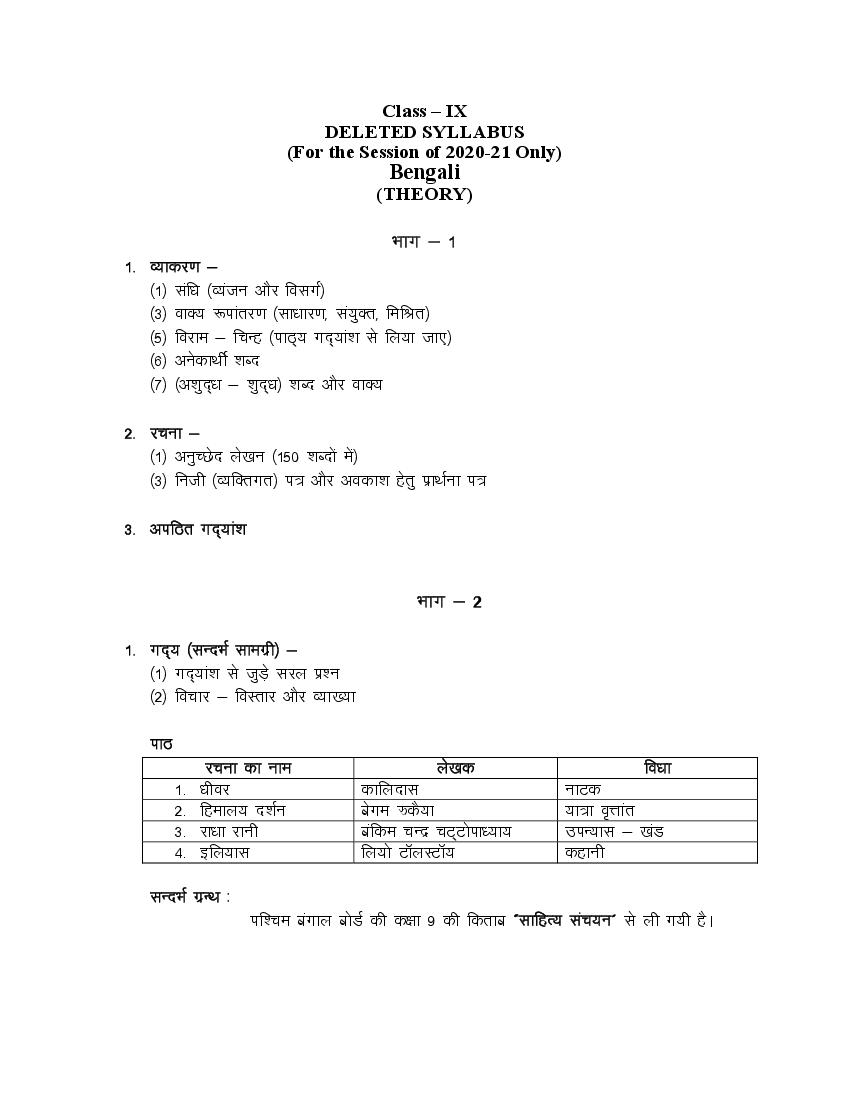
Hkkx & 1
1- O;kdj.k &
¼1½ laf/k ¼O;atu vkSj folxZ½
¼3½ okD; :ikarj.k ¼lk/kkj.k] la;qDr] fefJr½
¼5½ fojke & fpUg ¼ikB~; xn~;ka”k ls fy;k tk,½
¼6½ vusdkFkhZ “kCn
¼7½ ¼v”kqn~/k & “kqn~/k½ “kCn vkSj okD;
2- jPkuk &
¼1½ vuqPNsn ys[ku ¼150 “kCnksa esa½
¼3½ futh ¼O;fDrxr½ i= vkSj vodk”k gsrq izkFkZuk i=
3- vifBr xn~;ka”k
Hkkx & 2
1- xn~; ¼lUnHkZ lkexzh½ &
¼1½ xn~;ka”k ls tqM+s ljy iz”u
¼2½ fopkj & foLrkj vkSj O;k[;k
ikB
jpuk dk uke ys[kd fo/kk
1- /khoj dkfynkl ukVd
2- fgeky; n”kZu csxe #dS;k ;k=k o`Ùkkar
3- jk/kk jkuh cafde pUnz pV~Vksik/;k; miU;kl & [kaM
4- bfy;kl fy;ks VkWyLVkW; dgkuh
lUnHkZ xzUFk %
if”pe caxky cksMZ dh d{kk 9 dh fdrkc ÞlkfgR; lap;uß ls yh x;h gSA
Page 2
¼1½ in~;ka”k ls tqM+s ljy iz”u
¼2½ O;k[;k
ikB~; dfork,a &
vkleku esa lkr rkjs & thokuUn nkl
[kS;k & jfcUnzukFk VSxksj
Hkaxkj xku & dkth ut#y bLyke
,s thou & lquhy xaxksik/;k;
lUnHkZ xzUFk %
if”pe caxky cksMZ dh d{kk 9 dh fdrkc ÞlkfgR; lap;uß ls yh x;h gSA
3- flusek &
lR;thr jkW; ds ÞvIiw Vªhyksthß dh ohfM;ks vfuok;Z :i esa fn[kk;k tk,
Page 3
l= 2020&21 gsrq ikB~;Øe ls fuEufyf[kr ikB gVk fn, x, gS %&
dkO; [k.M dchj&lkf[k;k¡ ,oalcn
lqfe=kuanu iar&xzke Jh
dsnkjukFk vxzoky&panz xguk ls ykSVrh csj
f{kfrt Hkkx& 1 losZ”oj n;ky lDlsuk&es?k vk,
x| [k.M panzdkar nsorkys& ;ejkt dh fn”kk
“;kepj.k nwcs&miHkksDrkokn dh laLd`fr
Piyk nsoh&ukuklkgc dh iq=h nsoh eSukdks HkLe dj fn;k
x;k
Egknsoh oekZ&esjs cpiu ds fnu
gtkjhizlkn f}osnh&,d dqÙkk vkSj ,d eSuk
d`frdk Hkkx& 1 Q.kh”ojukFk js.kq&bl ty izy; esa
“ke”ksj cgknqj flag &fdl rjg vkf[kjdkj eSa fgUnh esa vk;k
laLd`r fouksfnuh izgsfydk
lwfDr lq/kk
lk/kwuk LoHkko%
Page 4
Grammer
Use of Passive Voice
Clauses: Noun, Adverb Clauses of condition and time, Relative
Prepositions
Writing
Letter on a situation
Literature
BEEHIVE
1. The Lake Isle of Innisfree
2. The Snake & The Mirror
3. The Duck & The Kangaroo
4. Kathmandu
5. A Slumber Did My Spirit Seal
MoMENTS
1. Ishwaran the Storyteller
2. The Accidental Tourist
Page 5
l= 2020&21 gsrq ikB~;Øe ls fuEufyf[kr v/;k; gVk fn, x, gS %&
d{kk&9 ikB~;iqLrd&”kseq’kh v/;k;&¼1½ izR;fHkKkue~
¼2½ fldrklsrq%
¼3½ tVk;ks% “kkS;Ze~
¼4½ ok³~eu% izk.kLo:ie~
Page 6
Unit 1 : India and the Contemporary World - I
Chapter Number & Chapter Name Deleted Portion
4. Pastoralista in the modern world.
(a) Pastoralism as a way of life.
(b) Different forms of pastoralism
(c) What happen to pastoralism under colonialism and Complete Chapter Deleted
modern states?
Case studies : focus on two pastoral groups, one from
Africa and one from India.
Unit 2 : India – Land and the People
Chapter Number & Chapter Name Deleted Portion
3. Drainage :major rivers and tributaries, lakes and Complete Chapter Deleted but Map items
seas, role of rivers in the economy, pollution of rivers, question may be asked.
measures to control river pollution.
6. Population : size, distribution, age-sex composition,
population change-migration as a determinant of Complete Chapter Deleted
population change, literacy, health, occupational
structure and nation. Population policy : adolescents
as under-served population group with special needs.
Unit 4 :Understanding Economics - I
Page 7
4. Food Security : Source of foodgrains- variety across
the nation – famines in the past- the need for self
sufficiency-role of government in food security – Complete Chapter Deleted
procurement of foodgrains-overflowing of granaries
and people without food-public distribution system –
role of cooperatives in food security (foodgrains, milk
and vegetables ration shops, cooperative shops, two-
three examples as case studies)
Page 8
Theme : Food
Unit 1 : Food
Plant and animal breeding and selection for quality improvement and management ; use
of fertilizers, manures; protection from pests and diseases; organic farming.
Theme : Materials
Unit 2 : Matter - Nature and behaviour
Definition of matter; solid, liquid and gas; characteristics - shape, volume, density;
change of state-melting (absorption of heat), freezing, evaporation (Cooling by
evaporation), condensation, sublimation.
Theme : The World of the living
Unit 3 : Organization in the living world.
Biological Diversity : Diversity of plants and animals - basic issues in scientific naming,
basis of classification. Hierarchy of categories / groups, Major groups of plants (salient
features) (Bacteria, Thalophyta, Bryo phyta, Pteridophyta, gymnosperms and
Angiosperms). Major groups of animals (salient features) (Non-chordates upto phyla and
chordates upto classes).
Theme : Moving things, people and ideas
Unit 4 : Motion, Force and Work
Floatation : Thrust and pressure. Archimedes' principle, buoyancy, elementary idea
of relative density.
Sound : Nature of sound and its propagation in various media, speed of sound, range
of hearing in humans; ultrasound; reflection of sound; echo and SONAR. Structure of
the human ear (auditory aspect only).
Theme : Natural Resources
Unit 5 : Our Environment
Physical resources : Air, Water, Soil.
Air for respiration, for combustion, for moderating temperatures, movements of air and its
role in bringing rains across India.
Air, water and soil pollution ( brief introduction). Holes in ozone layer and the probable
damages.
Bio-geo chemical cycles in nature : water, oxygen, carbon, nitrogen
Page 10
UNIT I : NUMBER SYSTEMS
1. REAL NUMBERS
Representation of terminating / non-terminating recurring decimals, on the
number line through successive magnification.
Explaining that every real number is represented by a unique point on the number
line and conversely, every point on the number line represents a unique real
number.
UNIT II : ALGEBRA
1. POLYNOMIALS
State and motivate the Remainder
Theorem with examples. Statement and proof of the Factor Theorem.
identities of the type
3 3 3 2 2 2
x + y + z — 3xyz = (x + y + z) (x + y + z — xy — yz — zx) and their use in
factorization of polymonials.
2. LINEAR EQUATIONS IN TWO VARIABLES
Including problems on Ratio and Proportion
UNIT IV : GEOMETRY
1. INTRODUCTION TO EUCLID'S GEOMETRY
History - Euclid and geometry in India. Euclid's method of formalizing observed
phenomenon into rigorous mathematics with definitions, common/obvious
notions, axioms/postulates and theorems. The five postulates of Euclid. Equivalent
versions of the fifth postulate. Showing the relationship between axiom and
theorem.
1. Given two distinct points, there exists one and only one line through them.
2. (Prove) two distinct lines cannot have more than one point in common.
3. TRIANGLES
Page 11
side of one triangle is equal to any two angles and the included side of the
other triangle (ASA Congruence).
2. (Motivate) Triangle inequalities and relation between 'angle and facing
side' inequalities in triangles.
5- AREA
Review concept of area, recall area of a rectangle.
3. (Prove) Parallelograms on the same base and between the same parallels
have the same area.
4. (Motivate) Triangles on the same base and between the same parallels
are equal in area and its converse.
6- CIRCLES
1) (Motivate) There is one and only one circle passing through three given
non-collinear points.
2) (Motivate) If a line segment joining two points subtendes equal angle at
two other points lying on the same side of the line containing the segment,
the four points lie on a circle.
7. CONSTRUCTIONS
1. Construction of a triangle of given perimeter and base angles.
UNIT V : MENSURATION
1. AREAS
Area of a triangle using Hero's formula (without proof) and its application in
finding the area of a quadrilateral.
UNIT VI : STATISTICS AND PROBABILITY
1. STATISTICS
Histograms (with varying base lengths), frequency polygons, Mean, median, mode
of ungrouped data.
Page 12
Unit II : Family-a unit of society : Type & size of family; reasons for change in family types,
effect of size on welfare of its members, role of family members in its smooth functioning.
Unit III : Food and its relation to health: Health, Nutrition, Nutrients and Balanced Diet
Unit V : Functions of a home : Sanitation (brief description of disposal of waste water, garbage and
human excreta & surroundings).
Unit VII : Fabrics available in the market : characterstics of fibres-length, durability,
absorbancy, heat conductivity resilence and elasticity; effect of heat, moth and mildew, acids
and alkali.
Unit VIII : Selection of clothes :
(i) Other factors-climate & cost
Page 13
1- bdkbZ 1 &tyok;qfoKku
?k& o’kkZ ds forj.kdkQlyksarFkkd`f’kfØ;kvksaijizHkko
2- bdkbZ 2 &e`nk;sa
x& e`nktSlinkFkZ] izkfIr ds lzksr] Hkwfeesaforj.k ,oalaj{k.kA
3- bdkbZ 3 &flapkbZ ,oatyfudkl
d& flapkbZ] ifjHkk’kk] vko”;drk
x& e`nkuehlaj{k.k dh vko”;drk ,oamik;
?k& vko”;drk
4- bdkbZ 4 & [kkn ,oamoZjd
[k& ikS/kksa dh o`f) ds fy, vko”;diks’kdrRo ,oa muds izHkkoA
³& vtSfod [kkndkHkwfe ,oaQlyksaijizHkko] iz;ksxfof/k;ka
5- bdkbZ 5 &d’kZ.k
d& mi;ksfxrk ,oaizdkjA
[k& tqrkbZfof/k;kaA
Page 14
Section – A
Applied Grammer
1- Zameen ki Qismein : Mutakallim, Hazir, Ghaeb.
2- Sifat ki Qismein : Zati, Nisbati, Adadi, Miqdari.
Section – B
Prose
Book : Nawa-e-Urdu
Afsana : (i) Magar who toot gaee – Saleh Abid Husain.
Mukhtasar Mazmoon : (ii) Nazeer Ahmad ki kahani kuchh meri aur.
kuch unki zabani – Mirza Farhatullah Beg.
(iii) Jeenay ka saleeqa – Khwaja
Ghulamussayyaden.
Poetry
Book : Nawa-e-Urdu
Ghazal : (i) Firaq Gorakhpuri – Sar mein sauda bhi nahi, dil mein tamanna
bhi
nahi.
(ii) Majrooh Sultanpuri – Ham hein mata-e-koocha-w-bazar ki
tarah.
Nazm : (i) Mohammad Iqbal – Aik arzoo.
(ii) Faiz Ahmad Faiz – Bol.
Qita : (i) Akhtar Ansari – Imkanat, Arzoo, Shab-e-purbahar.
Book : Gulzar-e-Urdu
Ghazal : (i) Nasir Kazmi – Tere khayal se lau de uthi hai tanhaai.
(ii) Khaleel-ur-Rehman Azmi – Teri sada ka hai sadyon se intazar
mujhe.
Page 15
Name : (i) Akbar Ilah Abadi – Farzi Lateefa.
(ii) Israr-ul-Haq Majaz – Raat aur rail.
(iii) Ali Sardar Jafri – Mera Safar.
(iv) Akhtar-ul-Iman – Aitmad.
Page 16
Unit 1: IT BASICS
Concept of Memory:
Input/Output Devices
Mouse, Joy Stick, Scanner, Microphone, OCR, MICR, Light pen, Bar code Reader, Digital
Camera, Printer, Speaker, Plotter.
Storage Devices :
Computer languages :
Machine Language, Assembly Language and High level Languages, Role of Assembler and
Compiler.
Types of software:
System, utility and Application software with examples
UNIT 2 : IT TOOLS
MS-OFFICE
MS Word:
Inserting Tables: Inserting, deleting-rows and columns, merging cells, splitting cells, using
autoformat: Mail Merge
MS Excel:
Inserting tables in worksheet, Embedding Charts of various types: Line, Pie, Scatter, Bar and Area
in a worksheet.
Page 17
3- Course of Business Transactions : Methods of approaching customers, Price list,
Tenders, Estimates and firm offers, Preparing of invoice Debit note and Credit note.
4- Mercantile Agents : Factor and Broker, Del Credere agents, Bought note and Sold note,
Preparation of Account Sales.
5- Warehousing and Storekeeping : Purpose
7- Insurance : General Principles of Insurance-Elementary exposure
Page 18
2- Basic Concepts : The Accounting Equations, Effect of transaction on Accounting
equations, Business entity concept.
3- Natures of Accounts and Rules for debit and credit : Preparation of vouchers and
supporting documents.
4- Journal : Subsidiary books.
6- Recording and Posting of Cash Transactions : Imprest system, Journal proper.
Page 19
iqLrd dk uke & lkfgfR;d ouxh;k¡
1- ?kksV.kk
2- oj/keku egkohj
iqLrd dk uke & lkfgfR;d nhfidk
1- Qty “kkg & lksg.kh ns varys iy
2- Eksgu flag & ns”k I;kj
3- ckok cyoUr & uohu vkl
4- rjyksd flag do¡j & lkMk fpfM;k¡ nk pEck] ohl lanh oh.kh
okjrd &
1- iqjkru tUe lk[kh
2- ufjanj flag diwj
Document Details
| Board / Org | Uttarakhand Board |
| Exam | Class 9 |
| Type | Syllabus |
| Pages | 19 |
| Updated | 22 Jul 2026 |