CBSE Class 9 Elements of Book Keeping and Accounting Syllabus 2021-22 – Text
Read the full text of this syllabus below — useful to quickly search, copy and reference the content online without downloading the PDF.
📄 View text version (2 pages)
Page 1
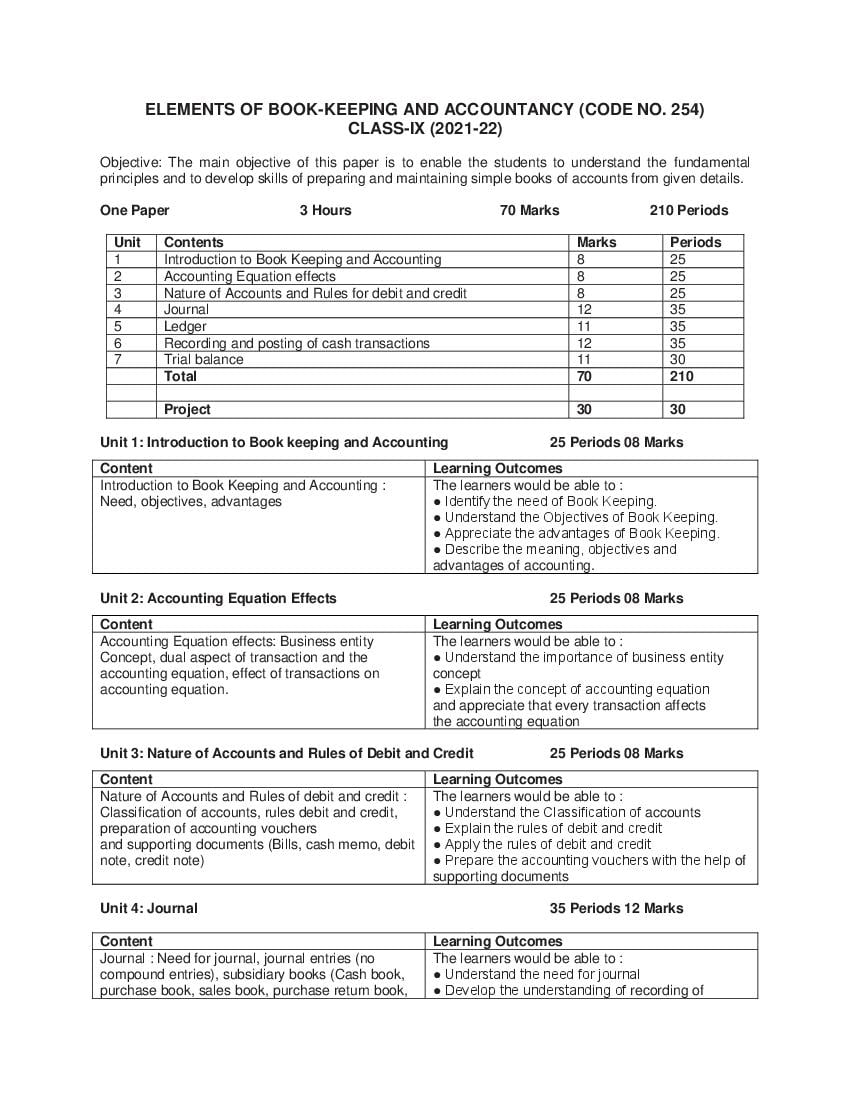
ELEMENTS OF BOOK-KEEPING AND ACCOUNTANCY (CODE NO. 254) CLASS-IX (2021-22) Objective: The main objective of this paper is to enable the students to understand the fundamental principles and to develop skills of preparing and maintaining simple books of accounts from given details. One Paper 3 Hours 70 Marks 210 Periods Unit Contents Marks Periods 1 Introduction to Book Keeping and Accounting 8 25 2 Accounting Equation effects 8 25 3 Nature of Accounts and Rules for debit and credit 8 25 4 Journal 12 35 5 Ledger 11 35 6 Recording and posting of cash transactions 12 35 7 Trial balance 11 30 Total 70 210 Project 30 30 Unit 1: Introduction to Book keeping and Accounting 25 Periods 08 Marks Content Learning Outcomes Introduction to Book Keeping and Accounting : The learners would be able to : Need, objectives, advantages ● Identify the need of Book Keeping. ● Understand the Objectives of Book Keeping. ● Appreciate the advantages of Book Keeping. ● Describe the meaning, objectives and advantages of accounting. Unit 2: Accounting Equation Effects 25 Periods 08 Marks Content Learning Outcomes Accounting Equation effects: Business entity The learners would be able to : Concept, dual aspect of transaction and the ● Understand the importance of business entity accounting equation, effect of transactions on concept accounting equation. ● Explain the concept of accounting equation and appreciate that every transaction affects the accounting equation Unit 3: Nature of Accounts and Rules of Debit and Credit 25 Periods 08 Marks Content Learning Outcomes Nature of Accounts and Rules of debit and credit : The learners would be able to : Classification of accounts, rules debit and credit, ● Understand the Classification of accounts preparation of accounting vouchers ● Explain the rules of debit and credit and supporting documents (Bills, cash memo, debit ● Apply the rules of debit and credit note, credit note) ● Prepare the accounting vouchers with the help of supporting documents Unit 4: Journal 35 Periods 12 Marks Content Learning Outcomes Journal : Need for journal, journal entries (no The learners would be able to : compound entries), subsidiary books (Cash book, ● Understand the need for journal purchase book, sales book, purchase return book, ● Develop the understanding of recording of
Page 2
sales return book and journal proper) transactions in journal ● Explain the importance of preparing subsidiary books. Unit 5: Ledger 35 Periods 11 Marks Content Learning Outcomes Ledger : Definition and importance, relation The learners would be able to : between journal and ledger. Meaning of posting, ● Explain the concept of ledger and its importance guiding rules procedure of posting transactions in accounting process. from journal to ledger and balancing of accounts. ● Appreciate the relationship between journal and ledger. ● Develop the understanding for posting of transactions and balancing of accounts. ● Explain the meaning of ledger posting ● Understand the procedure of ledger posting Unit 6: Recording and Posting of Cash Transactions 35 Periods 12 Marks Content Learning Outcomes Recording and posting of cash transactions : The learners would be able to : Necessity of cash book and its preparation. Simple ● Explain the purpose of maintaining a cash book cash book and cash book with cash and discount ● Develop the skill of preparing the format of column. Petty cash book with imprest system. different types of cash books ● Understand the method of recording cash transactions in simple cash book, double column cash book (cash book with cash and discount column) and petty cash book ● Understand the concept of imprest system ● Develop the skill of maintaining petty cash book on imprest system Unit 7: Trial Balance 30 Periods 11 Marks Content Learning Outcomes Trial Balance : Purpose and Preparation (Only The learners would be able to : Balance Method; No suspense Account) ● State the need and objective of preparing trial balance ● Develop the skill of preparing trial balance by balance method Project Work Project – I 15 Periods 15 Marks Prepare a pictorial/verbal dictionary of accounting terms Or Prepare subsidiary books Or Diagrammatic presentation of principles of accounting (Or any other topic related to the course content) Project – II 15 Periods 15 Marks Preparation of a Cash Book of; i. Your pocket money ii. Help your parent to maintain one month cash statement (OR any other topic related to the course content)