Finished viewing? Save it for later —
Download CBSE Class 9 Syllabus 2022-23 Spanish (PDF · 5 pages)About CBSE Class 9 Syllabus 2022-23 Spanish
CBSE Class 9 Syllabus 2022-23 Spanish is available here for free download. Published by CBSE for Class 9, this syllabus can be viewed online or downloaded as a PDF (5 pages). Candidates preparing for Class 9 can use CBSE Class 9 Syllabus 2022-23 Spanish to understand the exam pattern, the type of questions asked, and the overall difficulty level.
Frequently Asked Questions
How can I download CBSE Class 9 Syllabus 2022-23 Spanish?
Open this page and click the Download button to save CBSE Class 9 Syllabus 2022-23 Spanish as a PDF. It is completely free on AglaSem Docs.
Is CBSE Class 9 Syllabus 2022-23 Spanish free to download?
Yes. CBSE Class 9 Syllabus 2022-23 Spanish can be viewed online and downloaded as a PDF free of cost on AglaSem Docs.
How many pages does CBSE Class 9 Syllabus 2022-23 Spanish have?
CBSE Class 9 Syllabus 2022-23 Spanish contains 5 pages, which you can read online or download together as a single PDF.
Where can I find more Class 9 study material?
You can find more Class 9 question papers, sample papers, syllabus, and answer keys on AglaSem Docs.
CBSE Class 9 Syllabus 2022-23 Spanish – Text
Read the full text of this syllabus below — useful to quickly search, copy and reference the content online without downloading the PDF.
📄 View text version (5 pages)
Page 1
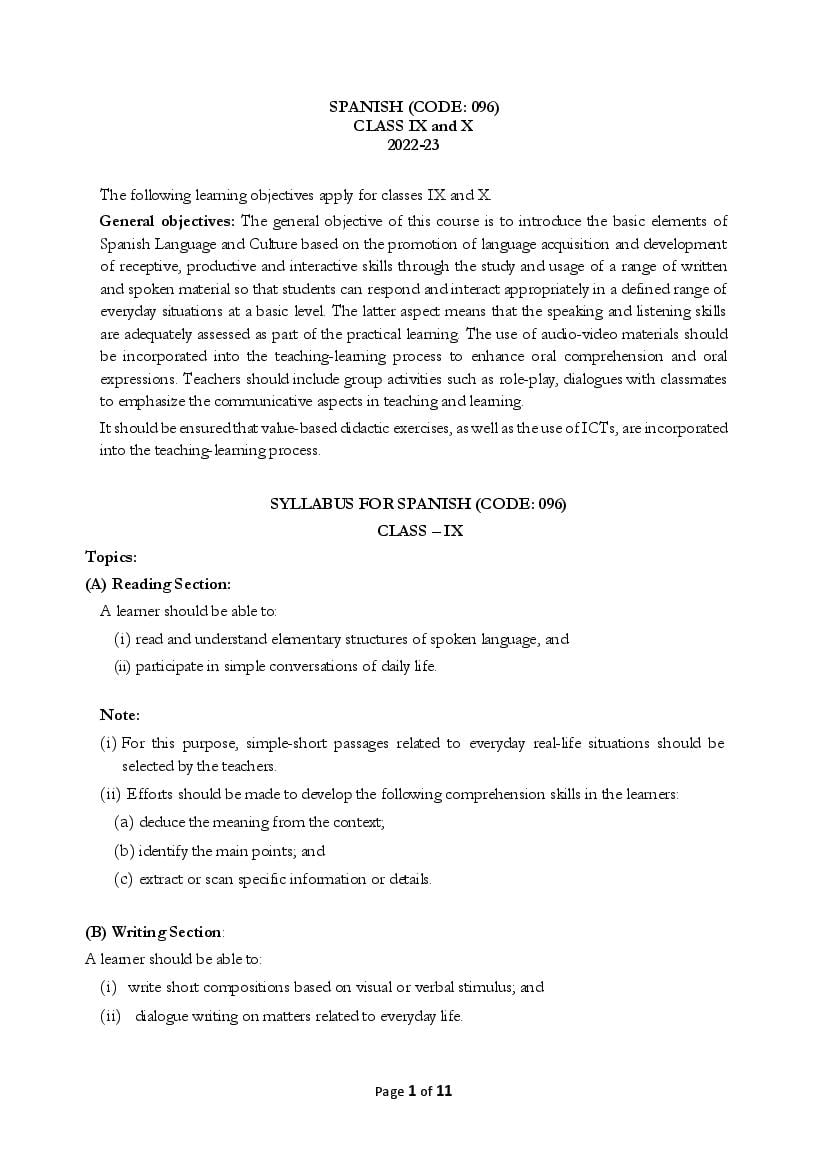
CLASS IX and X
2022-23
The following learning objectives apply for classes IX and X.
General objectives: The general objective of this course is to introduce the basic elements of
Spanish Language and Culture based on the promotion of language acquisition and development
of receptive, productive and interactive skills through the study and usage of a range of written
and spoken material so that students can respond and interact appropriately in a defined range of
everyday situations at a basic level. The latter aspect means that the speaking and listening skills
are adequately assessed as part of the practical learning. The use of audio-video materials should
be incorporated into the teaching-learning process to enhance oral comprehension and oral
expressions. Teachers should include group activities such as role-play, dialogues with classmates
to emphasize the communicative aspects in teaching and learning.
It should be ensured that value-based didactic exercises, as well as the use of ICTs, are incorporated
into the teaching-learning process.
SYLLABUS FOR SPANISH (CODE: 096)
CLASS – IX
Topics:
(A) Reading Section:
A learner should be able to:
(i) read and understand elementary structures of spoken language, and
(ii) participate in simple conversations of daily life.
Note:
(i) For this purpose, simple-short passages related to everyday real-life situations should be
selected by the teachers.
(ii) Efforts should be made to develop the following comprehension skills in the learners:
(a) deduce the meaning from the context;
(b) identify the main points; and
(c) extract or scan specific information or details.
(B) Writing Section:
A learner should be able to:
(i) write short compositions based on visual or verbal stimulus; and
(ii) dialogue writing on matters related to everyday life.
Page 1 of 11
Page 2
• Personal pronouns: yo, tú, usted, él, ella, nosotros/as, vosotros/as, ustedes, ellos/as
• Present tense of the verbs such as: Ser, Llamarse, Dedicarse, Vivir, Trabajar…
• Interrogative pronouns: cómo, cuándo, qué, cuánto, cuál, quién, de dónde…
• Regular verbs: -ar, -er, and -ir ending verbs
• Uses of Ser and Estar: ser + adjetivos de carácter, estar + adjetivos de estado físico o anímico
• Introduction to the idea of comparison (equality/superiority/inferiority)
• Uses of Tener and Hacer
• Introduction to present tense uses of some of the irregular (stem-changing) verbs: Creer, Entender,
Preferir, Querer, Conocer, Saber, Pensar, Hacer, Poner, Traer, Ir, Decir, Entender, Venir, Seguir…
• Tener + ganas de + infinitivo
• Demonstrative adjective and pronoun: este, ese, aquel…
• Negation
• Possessive adjectives: mi(s), tu(s), su(s)…
• Gender/Number/Article (definite and indefinite) – concordance of article – noun and adjective
• Concordance: cuánto/-a/-os/-as
• Ordinal and cardinal numbers
• Prepositions used with expressions of time and adverbs of place
• Gerund: Estar + gerundio
• Personal pronouns (with or without prepositions)
• Simple affirmative commands (singular) along with the use of direct and indirect object pronouns
• Present tense of Gustar and such similar verbs (for example, Encantar, Interesar, Importar, etc.)
• Contrast: Hay (descripción)/Estar (localización con usos de preposiciones y locuciones de lugar para expresar
posición, cercanía, lejanía)
• Uses of Ir a + infinitivo, Empezar a + infinitivo, Terminar de + infinitivo, Antes de+ infinitivo, Después de
+infinitivo
• Indefinite pronouns: unos, bastantes, algunos, alguien, nadie
• Introduction to past indefinite tense (pretérito indefinido)
(D) Culture / Civilization /Literature:
(i) Elementary familiarity with cultural information such as important events and days, monuments,
festivals, cuisines, touristic spots, famous personalities, political and geographical aspects relating
to Spain and the following Latin American countries: México, Costa Rica, El Salvador, , Panamá,
Cuba, Argentina, Bolivia, Chile, Ecuador, Paraguay.
(ii) Selected authors from Spanish-speaking countries (and their most well-known works in
Spanish) namely:
a) Miguel de Cervantes, works such as El ingenioso hidalgo Don Quijote de la Mancha and La Galatea,
b) Benito Pérez Galdós, works such as Fortunata y Jacinta and Doña Perfecta,
Page 2 of 11
Page 3
d) José María Arguedas, works such as Yawar Fiesta and El zorro de arriba y el zorro de abajo,
e) Juan Rulfo, works such as El llano en llamas and Pedro Páramo,
f) Pablo Neruda, works such as Veinte poemas de amor y una canción desesperada and Canto general.
g) José Martí, works such as Versos sencillos and Ismaelillo.
(iii) The learner is expected to identify one or two important works and the subject matter
without going into the details of the work. The learner should be able to write a very short note
using simple sentence structures.
Note for the teacher:
1. The above content should be presented and integrated into didactic materials and
communicative activities (related to the school environment) inside the classroom in such a way
that the learner develops the competencies listed below.
2. Grammatical contents to be presented and integrated into materials and communicative
activities inside the classroom.
Functional competencies:
• saludar y despedirse • hablar de los amigos y de las actividades con ellos
• pedir y dar datos personales: información personal, • llamar al camarero, pedir y pagar en un bar/restaurante
sobre la ocupación, sobre la familia… • preguntar el precio
• presentar formalmente / informalmente a otras • dar y pedir información sobre los platos: hablar de la
personas comida
• hablar de la familia • expresar gustos de comida y bebida
• describir el físico, carácter, estado civil • hablar sobre costumbres y hábitos en la comida
• hablar por teléfono • pedir en una tienda
• preguntar por la existencia de un lugar • hablar de hábitos y su frecuencia – pedir y dar opinión
(clase/escuela/colegio, etc.) sobre hábitos y acciones habituales de otras personas
• dirigirse a alguien • hablar de gustos y preferencias
• preguntar por un lugar • expresar acuerdo y desacuerdo
• dar instrucciones para ir a un lugar, ordenar • proponer actividades y reaccionar: aceptar o rechazar
y verificar informaciones • concertar citas
• describir ciudades, la vivienda y el barrio • preguntar y decir la hora – hablar de horarios
• ubicar e identificar objetos
• pedir y dar información sobre el transporte (taxi, metro,
autobús, tren)
Phonetical and orthographical competencies:
Page 3 of 11
Page 4
• deletrear • sonidos [x] y [g] y sus grafías (j) y (g)
• acentuación de las palabras • diptongos ‘IE’ y ‘UE’ y la HACHE
• letras ‘ce’, ‘zeta’, ‘cu’ y los sonidos [K] y [Q] • exclamativos e interrogativos
• sonidos [y] y sus grafías (y) y (ll)
3. The following suggested lexicon to be integrated into materials and communicative activities in
such a way that the learner practices the target language in real context:
• saludos y despedidas • profesión y dirección
• datos personales • actividades de ocio
• interrogativos • vocabulario de bares, cafeterías y restaurantes: bebidas,
• adjetivos de carácter comidas, ingredientes, platos típicos, utensilios de mesa
• instrucciones de la clase/escuela • productos de alimentación, alimentos: frutas
• familia: relaciones de parentesco y estados y verduras
civiles • nombres de países, capitales, nacionalidades
• adjetivos de descripción física y carácter y moneda de España e Hispanoamérica
• casa • actividades de tiempo libre/ocio: lugares de ocio
• partes de la casa, muebles y electrodomésticos y tiempo libre, espectáculos, música, cine
• tipos de vivienda • establecimientos públicos y comerciales.
• medios de transporte • fórmulas sociales: ofrecimientos, aceptaciones, rechazos,
• colores excusas
• acciones habituales • felicitaciones: expresiones y gestos
• día de la semana, los meses del año, las
estaciones del año y expresiones de la hora
• número 1 – 100
4. Efforts should be made to provide socio-cultural information of Spanish-speaking countries:
• usos de tú y usted • la gestualidad
• formas no verbales de saludo • el bar, las tapas, el aperitivo, el café, productos típicos
• usos de los apellidos en el mundo hispano en la cultura hispánica
• usos de señor, señora, don y doña • pagar, invitaciones, precios en barra y mesa,
propina
• principales capitales y hechos geográficos de
• mercados y supermercados
España e Hispanoamérica
• horarios de comida y cena
• personajes famosos de España e Hispanoamérica
Page 4 of 11
Page 5
• la calle y sus elementos • públicos: horarios laborables y días festivos en
• comprar – alquiler de casas España e Hispanoamérica
• comportamiento social: las visitas • la vida nocturna: teatros, cines, bares cafeterías,
discotecas…
• informaciones sobre las ciudades más
importantes de los países de habla española • elementos proxémicos: la comunicación verbal y la
distancia entre personas en diferentes situaciones de la
• horario de apertura y cierre de los comercios, las
vida cotidiana y en diferentes culturas
oficinas y otros lugares
5. In Section D which is related to Culture/Civilization/Literature, the teacher is expected to
provide very basic features about the cultural and civilizational aspects of the Spanish-speaking
areas. The same for the very famous literary texts of authors cited.
6. The above-mentioned examples are suggestive and the teacher depending on the needs of the
learners may improvise the same within the framework of the prescribed syllabus.
Prescribed book: Relevant chapters may be referred to for use as per the prescribed syllabus:
• Aula International 1 (CD+Workbook) by Jaime Corpas et.al, Difusión, Madrid
Reference books:
• Collins Gem Spanish School Dictionary, Collins
• Learn Spanish through games and activities (Level 1), by Pablo Rocío Domínguez, ELI Publishing
• en acción A1, (CD + workbook) by Elena Verdía, Marisa González, et. al., enClave ELE
• Compañeros 1, (CD+Workbook) by Francisca Castro et.al., SGEL
• En directo, nivel elemental (CD +workbook) by Aquilino Sánchez Pérez
e-Resources:
• “Mi mundo en palabras”: https://cvc.cervantes.es/ensenanza/mimundo/default.htm
• “Lecturas paso a paso” (lecturas adaptadas con actividades interactivas):
https://cvc.cervantes.es/aula/lecturas/
• “Pasatiempos de Rayuela” (actividades interactivas):
https://cvc.cervantes.es/ensenanza/pasatiempos/default.php
• “En sintonía con el español” (podcast en español):
https://cvc.cervantes.es/ensenanza/ese/default.htm
Page 5 of 11
Document Details
| Board / Org | CBSE |
| Exam | Class 9 |
| Type | Syllabus |
| Pages | 5 |
| Updated | 15 Jul 2026 |