CBSE Class 10 Apparel Question Paper 2020
Finished viewing? Save it for later —
Download CBSE Class 10 Apparel Question Paper 2020 (PDF · 7 pages)About CBSE Class 10 Apparel Question Paper 2020
CBSE Class 10 Apparel Question Paper 2020 is available here for free download. Published by CBSE for Class 10, this question paper can be viewed online or downloaded as a PDF (7 pages). Candidates preparing for Class 10 can use CBSE Class 10 Apparel Question Paper 2020 to understand the exam pattern, the type of questions asked, and the overall difficulty level.
Frequently Asked Questions
How can I download CBSE Class 10 Apparel Question Paper 2020?
Open this page and click the Download button to save CBSE Class 10 Apparel Question Paper 2020 as a PDF. It is completely free on AglaSem Docs.
Is CBSE Class 10 Apparel Question Paper 2020 free to download?
Yes. CBSE Class 10 Apparel Question Paper 2020 can be viewed online and downloaded as a PDF free of cost on AglaSem Docs.
How many pages does CBSE Class 10 Apparel Question Paper 2020 have?
CBSE Class 10 Apparel Question Paper 2020 contains 7 pages, which you can read online or download together as a single PDF.
Where can I find more Class 10 study material?
You can find more Class 10 question papers, sample papers, syllabus, and answer keys on AglaSem Docs.
CBSE Class 10 Apparel Question Paper 2020 – Text
Read the full text of this question paper below — useful to quickly search, copy and reference the content online without downloading the PDF.
📄 View text version (7 pages)
Page 1
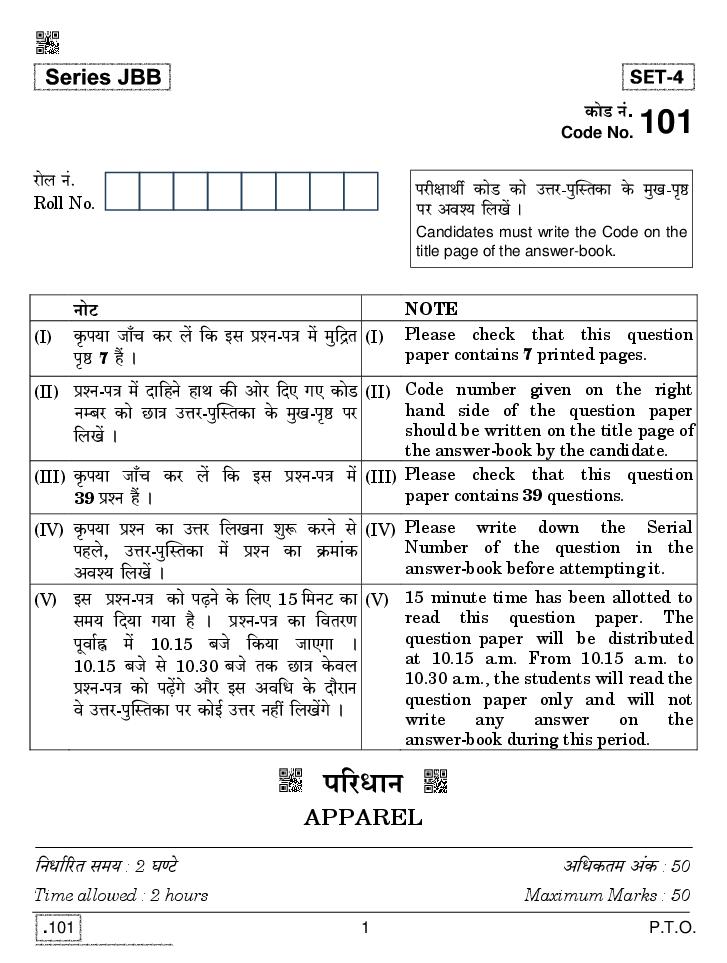
Code No. 101
amob Z§. narjmWu H$moS >H$mo CÎma-nwpñVH$m Ho$ _wI-n¥ð
Roll No. >na Adí` {bIo§ &
Candidates must write the Code on the
title page of the answer-book.
ZmoQ> NOTE
(I) H¥$n`m Om±M H$a b| {H$ Bg àíZ-nÌ _o§ _w{ÐV (I) Please check that this question
n¥ð> 7 h¢ & paper contains 7 printed pages.
(II) àíZ-nÌ _| Xm{hZo hmW H$s Amoa {XE JE H$moS (II) Code number given on the right
>Zå~a H$mo N>mÌ CÎma-nwpñVH$m Ho$ _wI-n¥ð> na hand side of the question paper
{bI| & should be written on the title page of
the answer-book by the candidate.
(III) H¥$n`m Om±M H$a b| {H$ Bg àíZ-nÌ _| (III) Please check that this question
>39 àíZ h¢ & paper contains 39 questions.
(IV) H¥$n`m àíZ H$m CÎma {bIZm ewê$ H$aZo go (IV) Please write down the Serial
nhbo, CÎma-nwpñVH$m _| àíZ H$m H«$_m§H$ Number of the question in the
Adí` {bI| & answer-book before attempting it.
(V) Bg àíZ-nÌ H$mo n‹T>Zo Ho$ {bE 15 {_ZQ >H$m (V) 15 minute time has been allotted to
g_` {X`m J`m h¡ & àíZ-nÌ H$m {dVaU read this question paper. The
nydm©• _| 10.15 ~Oo {H$`m OmEJm & question paper will be distributed
10.15 ~Oo go 10.30 ~Oo VH$ N>mÌ Ho$db at 10.15 a.m. From 10.15 a.m. to
10.30 a.m., the students will read the
àíZ-nÌ H$mo n‹T>|Jo Am¡a Bg Ad{Y Ho$ Xm¡amZ question paper only and will not
do CÎma-nwpñVH$m na H$moB© CÎma Zht {bI|Jo & write any answer on the
answer-book during this period.
n[aYmZ
APPAREL
{ZYm©[aV g_` : 2 KÊQ>o A{YH$V_ A§H$ : 50
Time allowed : 2 hours Maximum Marks : 50
.101 1 P.T.O.
Page 2
{ZåZ{b{IV {ZX}em| H$mo ~hþV gmdYmZr go n{‹T>E Am¡a CZH$m g™Vr go nmbZ H$s{OE :
(a) Bg àíZ-nÌ _| Xmo IÊS> h¢ & IÊS> H$ … amoµOJma H$m¡eb Am¡a IÊS> I … {df` H$m¡eb &
(b) IÊS> H$ … amoµOJma H$m¡eb (10 A§H$)
(i) {XE JE 6 àíZm| _| go {H$Ýht 4 àíZm| Ho$ CÎma Xr{OE & àË`oH$ àíZ 1 A§H$ H$m h¡ &
(ii) {XE JE 5 àíZm| _| go {H$Ýht 3 àíZm| Ho$ CÎma Xr{OE & àË`oH$ àíZ 2 A§H$ H$m h¡ &
(c) IÊS> I … {df` H$m¡eb (40 A§H$)
(i) {XE JE 12 àíZm| _| go {H$Ýht 10 àíZm| Ho$ CÎma Xr{OE & àË`oH$ àíZ 1 A§H$ H$m h¡ &
(ii) {XE JE 6 àíZm| _| go {H$Ýht 4 àíZm| Ho$ CÎma Xr{OE & àË`oH$ àíZ 2 A§H$ H$m h¡ &
(iii) {XE JE 6 àíZm| _| go {H$Ýht 4 àíZm| Ho$ CÎma Xr{OE & àË`oH$ àíZ 3 A§H$ H$m h¡ &
(iv) {XE JE 4 àíZm| _| go {H$Ýht 2 àíZm| Ho$ CÎma Xr{OE & àË`oH$ àíZ 5 A§H$ H$m h¡ &
(d) Bg àíZ-nÌ _| 39 àíZ em{_b h¢ {OZ_| go 27 àíZm| Ho$ CÎma XoZo h¢ &
(e) g^r àíZm| Ho$ {deof ^mJ /IÊS> H$mo ghr H«$_ _| H$s{OE &
(f) A{YH$V_ g_` 2 K§Q>o h¡ &
IÊS> H$
(amoµOJma H$m¡eb) 10 A§H$
{XE JE 6 àíZm| ‘| go {H$Ýht 4 àíZm| Ho$ CÎma Xr{OE & à˶oH$ àíZ 1 A§H$ H$m h¡ & 14=4
[aº$ ñWmZm| H$mo ^[aE &
1. ____________, eara H$s ^mfm, AmdmµO Am¡a ñda ì`{º$JV g§Mma Ho$ VrZ VÎd h¢ & 1
2. emar[aH$, _mZ{gH$ `m ^mdZmË_H$ Q>|eZ (VZmd) H$mo ____________ H$hm OmVm h¡ & 1
3. ___________ ~ma àmoJ«m_ Ho$ Zm_ Ho$ ~mX S>m°Š`y_|Q> Ho$ Zm_ H$mo àX{e©V H$aVm h¡ & 1
4. ___________ ì`dgm` _| {dH«o$Vm IarXma H$mo Hw$N> H$m_ nyam H$aZo _| _XX H$aVm h¡ & 1
5. ___________ _| Or{dV MrµOm| Ho$ gmW-gmW J¡a-Or{dV MrµO| ^r em{_b h¢ & 1
6. ___________ _| eara Am¡a _Z Ho$ {Z`§ÌU H$mo àmßV H$aZo Ho$ {bE Aä`mg {H$E OmZo dmbo
AmgZ Am¡a ídmg Aä`mgm| H$s EH$ ûm¥§Ibm em{_b h¡ & 1
{XE JE 5 àíZm| ‘| go {H$Ýht 3 àíZm| Ho$ CÎma Xr{OE & à˶oH$ àíZ 2 A§H$ H$m h¡ & 23=6
7. g§Mma ~mYm {H$go H$hVo h¢ ? à^mdr g§Mma Ho$ {bE {H$Ýht Xmo ~mYmAm| Ho$ Zm_ ~VmBE & 2
8. VZmd à~§YZ Š`m| _hÎdnyU© h¡ ? Mma {~ÝXþ Xr{OE & 2
.101 2
Page 3
Read the following instructions very carefully and strictly follow them :
(a) This question paper consists of two sections viz. Section A : Employability
Skills and Section B : Subject Skills.
(b) Section A : Employability Skills (10 Marks)
(i) Answer any 4 questions out of the given 6 questions of 1 mark each.
(ii) Answer any 3 questions out of the given 5 questions of 2 marks each.
(c) Section B : Subject Skills (40 Marks)
(i) Answer any 10 questions out of the given 12 questions of 1 mark each.
(ii) Answer any 4 questions out of the given 6 questions of 2 marks each.
(iii) Answer any 4 questions out of the given 6 questions of 3 marks each.
(iv) Answer any 2 questions out of the given 4 questions of 5 marks each.
(d) This question paper contains 39 questions out of which 27 questions are to be
answered.
(e) All questions of a particular part/section must be attempted in the correct
order.
(f) The maximum time allowed is 2 hours.
SECTION A
(Employability Skills) 10 Marks
Answer any 4 questions out of the given 6 questions of 1 mark each. 14=4
Fill in the blanks.
1. ____________, body language, voice and tone are the three elements of
personal communication. 1
2. Physical, mental or emotional strain is referred to as __________ . 1
3. ___________ bar displays the document name followed by the program
name. 1
4. In __________ business, a seller helps the buyer to finish some work. 1
5. ____________ includes both, living things as well as non-living things. 1
6. ____________ includes a series of postures and breathing exercises
practised to achieve control of body and mind. 1
Answer any 3 questions out of the given 5 questions of 2 marks each. 23=6
7. What is a communication barrier ? Name any two barriers to effective
communication. 2
8. Why is stress management important ? Give four points. 2
.101 3 P.T.O.
Page 4
(A) Ý`y
(B) god
(C) Imob|
(D) nyd©dV H$a|
10. CÚ_r Ho$ {H$Ýht Xmo JwUm| H$mo gyMr~Õ H$s{OE & 2
11. Ob {ZH$m`m| Ho$ àXÿfU Ho$ Xmo _w»` H$maU {b{IE & 2
IÊS> I
({df¶ H$m¡eb) 40 A§H$
{XE JE 12 àíZm| ‘| go {H$Ýht 10 àíZm| Ho$ CÎma Xr{OE & à˶oH$ àíZ 1 A§H$ H$m h¡ & 110=10
12. ___________ {H$gr ^r dñÌ H$m g~go à_wI Ñí` VÎd h¡ Š`m|{H$ `h Xÿa go nhbr MrµO h¡
Omo Am±I H$mo {XImB© XoVr h¡ & 1
13. boµOr-S>ogr {gbmB© __________ {gbmB© H$s EH$ {^ÞVm h¡ & 1
14. ___________ YmJo H$m Cn`moJ H$‹T>mB© Ho$ H$m_ _| M_H$ Am¡a ½b¡_a Omo‹S>Vm h¡ & 1
15. `{X H$n‹S>m gµ\o$X h¡, Vmo XmJ hQ>mZo Ho$ {bE ____________ H$m Cn`moJ {H$`m Om gH$Vm
h¡ & 1
16. ___________ Q>m§Ho$ H$m CëQ>m ^mJ e¡S>mo dH©$ (N>m`m H$m`©) H$hbmVm h¡ & 1
17. __________ {h_mMb àXoe H$s nma§n[aH$ H$‹T>mB© e¡br h¡ & 1
18. `{X CËnmX __________ h¡, Vmo J«mhH$ à{VñWmnZ Ho$ {bE H$h gH$Vm h¡ & 1
19. n§Om~ _| àM{bV Xmo H$‹T>mB© e¡{b`m± ___________ Am¡a \w$bH$mar h¢ & 1
20. ___________ pñQ>M âb¡Q> {gbmB© H$m CXmhaU h¡ & 1
21. ___________ gwB© hmW H$s H$‹T>mB© Ho$ {bE BñVo_mb H$s OmZo dmbr _yb H$‹T>mB© gwB© h¡ & 1
22. H$‹T>mB© dmbo CËnmXm| H$m ___________ H$‹T>mB© dmbo H$n‹S>m| Ho$ ~hþV _hÎdnyU© nhbwAm| _| go
EH$ h¡ & 1
23. ___________ H$mo ì`dpñWV g§MbZ H$s EH$ _Z^mdZ ^mdZm Ho$ ê$n _| n[a^m{fV {H$`m
Om gH$Vm h¡ Omo {S>µOmBZ H$mo {Za§VaVm XoVm h¡ & 1
.101 4
Page 5
(A) New
(B) Save
(C) Open
(D) Undo
10. List any two qualities of an entrepreneur. 2
11. Write two main causes of pollution of water bodies. 2
SECTION B
(Subject Skills) 40 Marks
Answer any 10 questions out of the given 12 questions of 1 mark each. 110=10
12. ____________ is the most dominant visual element of a garment as it is
the first thing, from a distance, which is visible to the eye. 1
13. The lazy-daisy stitch is a variation of the ___________ stitch. 1
14. The use of ____________ threads add shine and glamour to embroidery
work. 1
15. If the fabric is white, ___________ can be used for stain removal. 1
16. The reverse side of ___________ stitch is called shadow work. 1
17. ___________ is a traditional embroidery style from Himachal Pradesh. 1
18. If the product is ____________, the customer can ask for a replacement. 1
19. The two embroidery styles prevalent in Punjab are __________ and
Phulkari. 1
20. ___________ stitch is an example of flat stitch. 1
21. ___________ needle is the basic embroidery needle most often used for
hand embroidery. 1
22. ____________ of the embroidered products is one of the very important
aspects of embroidered garments. 1
23. __________ may be defined as a pleasing sense of organised movement
that gives continuity to a design. 1
.101 5 P.T.O.
Page 6
24. {S>µOmBZ Ho$ {gÕm§V Š`m h¢ ? 2
25. H$moB© ^r Xmo ~mV ~VmBE {H$ H$erXmH$mar H$n‹S>m| H$m n[aîH$aU _hÎdnyU© Š`m| h¡ & 2
26. H$mCqMJ {H$go H$hVo h¢ ? 2
27. \w$bH$mar H$mo {Zînm{XV H$aZo Ho$ {bE {H$g _yb H$n‹S>o Am¡a H$‹T>mB© Ho$ YmJo H$m Cn`moJ {H$`m
OmVm h¡ ? 2
28. gr_ [ana {H$go H$hVo h¢ ? 2
29. ñQ´>o YmJo Š`m hmoVo h¢ ? 2
{XE JE 6 àíZm| ‘| go {H$Ýht 4 àíZm| Ho$ CÎma Xr{OE & à˶oH$ àíZ 3 A§H$ H$m h¡ & 34=12
30. AÀN>r H$‹T>mB© Ho$ H$m_ Ho$ {bE H$moB© VrZ _hÎdnyU© {Q>ßg {b{IE & 3
31. nhZZo dmbo na b§~dV aoImAm| H$m Ñí` à^md g_PmVo hþE VrZ {~ÝXþ> Xr{OE & 3
32. aqZJ pñQ>M Am¡a \o$Xa pñQ>M H$s H$moB© ^r Xmo-Xmo {deofVmE± ~VmBE & 3
33. JwOamV H$‹T>mB© _| à`wº$ VrZ AbJ-AbJ H$‹T>mB© e¡{b`m| H$m Zm_ ~VmBE & 3
34. ~Q>Zhmob {gbmB© H$hm± H$s Om gH$Vr h¡ Am¡a H¡$go (Ho$db {MÌU) ? 3
35. n[aîH$aU à{H«$`m Ho$ Xm¡amZ W«oS> byn Am¡a W«oS> Q>ob H$mo H¡$go R>rH$ {H$`m OmVm h¡ ? g_PmBE & 3
{XE JE 4 àíZm| ‘| go {H$Ýht 2 àíZm| Ho$ CÎma Xr{OE & à˶oH$ àíZ 5 A§H$ H$m h¡ & 52=10
36. MoZ Q>m§H$m ~ZmZo H$s à{H«$`m H$m ñQ>ondmBµO {MÌU H$s{OE & 5
37. {H$Ýht Xmo na g§{jßV ZmoQ> {b{IE : 5
(A) H$í_ra H$m H$erXm
(B) CÎma àXoe H$s {MH$ZH$mar
(C) ~§Jmb H$m H$m§Wm
38. EH$ H$‹T>mB© CËnmX H$s bmJV-{ZYm©aU H$s g§jon _| ì`m»`m H$s{OE & 5
39. EH$ n[aYmZ _| H$m¡Z-go VrZ H$maH$ H$‹T>mB© Xmof n¡Xm H$aVo h¢ ? H$moB© ^r Mma g~go A{YH$
hmoZo dmbr g_ñ`mAm| H$m Zm_ ~VmBE {OÝh| n[aîH$aU Ho$ Xm¡amZ R>rH$ {H$`m OmZm Mm{hE & 5
.101 6
Page 7
24. What are the principles of design ? 2
25. Give any two points stating why finishing of embroidered garments is
important. 2
26. What is couching ? 2
27. What is the base material and the embroidery thread used to execute
Phulkari ? 2
28. What is a seam ripper ? 2
29. What are stray threads ? 2
Answer any 4 questions out of the given 6 questions of 3 marks each. 34=12
30. Write any three important tips for good embroidery work. 3
31. Give three points explaining the visual impact of vertical lines on the
wearer. 3
32. Give any two characteristics each of running stitch and feather stitch. 3
33. Name the three different embroidery styles used in Gujarat embroidery. 3
34. Where can buttonhole stitch be done and how (only illustration) ? 3
35. Explain how thread loops and thread tails can be rectified during the
finishing process. 3
Answer any 2 questions out of the given 4 questions of 5 marks each. 52=10
36. Draw step-wise, the method of making a chain stitch. 5
37. Write short notes on any two : 5
(A) Kashida of Kashmir
(B) Chikankari of Uttar Pradesh
(C) Kantha of Bengal
38. Explain in brief the costing of an embroidered product. 5
39. Which three factors lead to embroidery defects in a garment ? Name any
four most commonly occurring issues that should be rectified during
finishing. 5
.101 7 P.T.O.
Document Details
| Board / Org | CBSE |
| Exam | Class 10 |
| Type | Question Paper |
| Pages | 7 |
| Updated | 22 Jul 2026 |