AHSEC HS 1st Year Syllabus 2026 Political Science
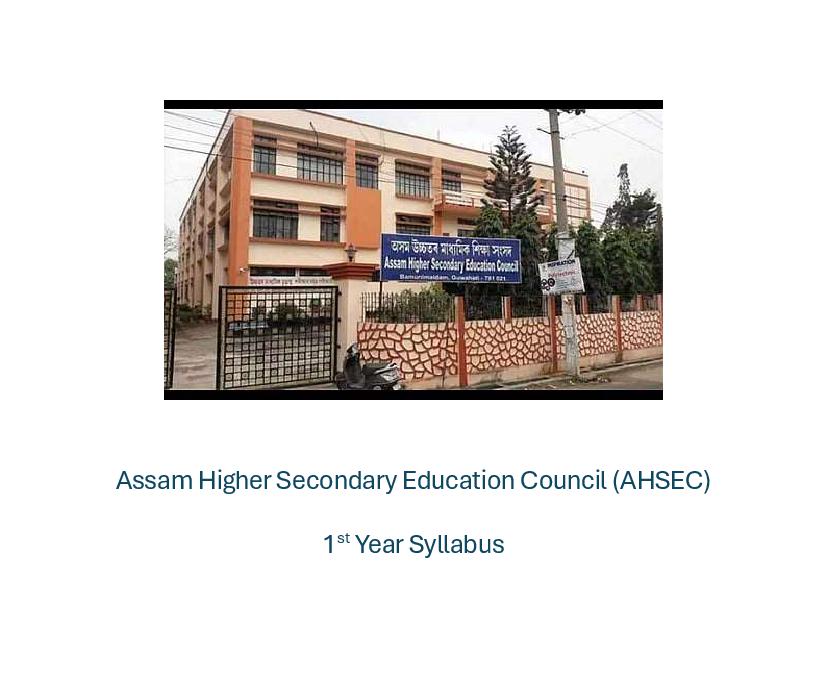
Finished viewing? Save it for later —
Download AHSEC HS 1st Year Syllabus 2026 Political Science (PDF · 6 pages)About AHSEC HS 1st Year Syllabus 2026 Political Science
AHSEC HS 1st Year Syllabus 2026 Political Science is available here for free download. Published by Assam Board for Class 11, this syllabus can be viewed online or downloaded as a PDF (6 pages). Candidates preparing for Class 11 can use AHSEC HS 1st Year Syllabus 2026 Political Science to understand the exam pattern, the type of questions asked, and the overall difficulty level.
Frequently Asked Questions
How can I download AHSEC HS 1st Year Syllabus 2026 Political Science?
Open this page and click the Download button to save AHSEC HS 1st Year Syllabus 2026 Political Science as a PDF. It is completely free on AglaSem Docs.
Is AHSEC HS 1st Year Syllabus 2026 Political Science free to download?
Yes. AHSEC HS 1st Year Syllabus 2026 Political Science can be viewed online and downloaded as a PDF free of cost on AglaSem Docs.
How many pages does AHSEC HS 1st Year Syllabus 2026 Political Science have?
AHSEC HS 1st Year Syllabus 2026 Political Science contains 6 pages, which you can read online or download together as a single PDF.
Where can I find more Class 11 study material?
You can find more Class 11 question papers, sample papers, syllabus, and answer keys on AglaSem Docs.
AHSEC HS 1st Year Syllabus 2026 Political Science – Text
Read the full text of this syllabus below — useful to quickly search, copy and reference the content online without downloading the PDF.
📄 View text version (5 pages)
Page 1
1st Year Syllabus
Page 2
Political Science
One paper Time: Three hours Marks: 100(80+20)
Unit wise Distribution of Marks & Periods
Unit Contents Marks Periods
A. Political Theory
Unit I: An Introduction to Political Theory 06 12
Unit II: Freedom 06 12
Unit III Equality 06 12
Unit IV: Social Justice 06 12
Unit V Rights 06 12
Unit VI: Citizenship 06 12
Unit VII: Nationalism 06
Unit VIII: Secularism 04 06
B. Indian Constitution at work
Unit I: Constitution: why and how 04 12
Unit II: Rights in the Indian Constitution 06 12
Unit III: Election and Representation 03 08
Unit IV: Executive 06 12
Unit V: Legislature 06 12
Unit VI: Judiciary 06 12
Unit VII: Federalism 03 10
Unit VIII: Local Government 03 10
Unit IX: The Constitution as a Living Document 03 08
and its Philosophy
C. Project work 20
Total Marks 100 180
UNIT WISE DISTRIBUTION OF COURSE CONTENTS
A. Political Theory
Unit I: An Introduction to Political Theory
What is Politics- Necessity of studying Political Theory-Scope and utility of Political
Theory.
Unit II: Freedom
Meaning of Freedom-Constraints and its necessity - concept of harm principle,
Negative & Positive Liberty-Freedom of Expression
Unit III: Equality
Meaning of Equality and its significance- Equality of Opportunities- Natural and Social
inequalities – Three dimension of equality - Political Equality, Social equality, Economic
equality - Feminism- Socialism- liberalism - Promotion of Equality- equality through
differential treatment -Affirmative Action.
Page 3
Meaning of Justice- Means of establishing Justice- Equal treatment for equal-
Proportionate justice - John Rawls’ theory of Justice- Recognition of special needs-
Just distribution - Concept of Social Justice- Pursuing Social Justice-Free market vs.
state intervention.
Unit V: Rights
Rights and its origin- Kinds of rights- Legal Right and the state; Right and
responsibilities.
Unit VI: Citizenship
Meaning of Citizenship- Free and equal –Membership-Equal Rights-Citizen and
Nation-Universal and Global citizenship.
Unit VII: Nationalism
Concept of Nation and Nationalism - Elements of Nation - National Self-determination-
Nationalism and Pluralism.
Unit VIII: Secularism
Meaning of secularism; Inter-religious domination-Intra religious domination-
Secular State - Western and Indian Secularism; Criticism of Indian Secularism.
B. Indian Constitution at work
Unit I: Constitution: Why and How
Necessity and functions of the Constitution – Authority of Constitution. Framing of
Indian Constitution and its legacy.
Unit II: Fundamental Rights
Significance of Rights - Fundamental Rights in India and its significance - National
Human right commission; Directive Principles of State Policy and its Relation with
Fundamental Rights.
Unit III: Election and Representation
Election and Democracy- Indian Election System and its Various types- Reservation of
Constituencies. Universal Adult franchise and right to contest – Election commission;
– Electoral reforms
Unit IV: Executive
What is an Executive? Different Types of Executive-Parliamentary Executive in India
Powers and position of the President of India, Prime Minister and Council of
Ministers; Permanent Executive-Bureaucracy.
Page 4
Why do we need a Parliament? Unicameral /Bicameral Legislature, Lok Sabha and
Rajya Sabha – Parliamentary control over executive; Parliamentary committees and
Legislative Procedure.
Unit VI: Judiciary
The meaning and need of Independent Judiciary- Appointment and removal of the
Judges of the Supreme Court of India Composition and Jurisdiction of the Supreme
Court of India -Structure of the Judiciary-Judicial Review- Judicial Activism Judiciary
and Parliament.
Unit VII: Federalism
What is Federalism? Federalism and Indian Constitution-Centralizing tendency -
Conflicts in Indian Federal System – Central State Relationship
Unit VIII: Local Government
Needs of Local Government-Growth of Local Government in India-73rd and 74th
Amendments - Implementation of 73rd and 74th Amendment Acts- State Election
Commission - State finance commission.
Unit IX: The Constitution as a Living Document and its Philosophy
Basic structure of the Constitution- Philosophy of the Constitution of India -
Constitution as a Living Document and Amendment of the Indian Constitution of India.
C. Project Work - 20 Marks
Sample Project
National self –determination and its implication.
Ambedkar and social justice
Necessity of reservation
Citizenship in globalized world.
Legislative Relations
Secularism- Indian vs. Western
Implementation of 73rd and 74th armament and its implications
Basic Structure of Indian Constitution Etc.
Page 6
Notes
Model Papers Class 6 Notes
Sample Papers Class 7 Notes
Half Yearly Sample Papers Class 8 Notes
Class 9 Notes
Important Resources
Class 10 Notes
Periodic Table
Class 11 Notes
Writing Skills / Formats
Maps of India / World Class 12 Notes
Books and Solutions
NCERT Books
NCERT Book Solutions
HC Verma Chapter Wise Solutions
RD Sharma Solutions
CGBSE Solutions
Document Details
| Board / Org | Assam Board |
| Exam | Class 11 |
| Type | Syllabus |
| Pages | 6 |
| Updated | 24 Sep 2026 |