CMI Entrance Exam 2025 Question Paper M.Sc PhD Mathematics
Finished viewing? Save it for later —
Download CMI Entrance Exam 2025 Question Paper M.Sc PhD Mathematics (PDF · 4 pages)About CMI Entrance Exam 2025 Question Paper M.Sc PhD Mathematics
CMI Entrance Exam 2025 Question Paper M.Sc PhD Mathematics is available here for free download. Published by CMI for CMI Entrance Exam, this question paper can be viewed online or downloaded as a PDF (4 pages). Candidates preparing for CMI Entrance Exam can use CMI Entrance Exam 2025 Question Paper M.Sc PhD Mathematics to understand the exam pattern, the type of questions asked, and the overall difficulty level.
Frequently Asked Questions
How can I download CMI Entrance Exam 2025 Question Paper M.Sc PhD Mathematics?
Open this page and click the Download button to save CMI Entrance Exam 2025 Question Paper M.Sc PhD Mathematics as a PDF. It is completely free on AglaSem Docs.
Is CMI Entrance Exam 2025 Question Paper M.Sc PhD Mathematics free to download?
Yes. CMI Entrance Exam 2025 Question Paper M.Sc PhD Mathematics can be viewed online and downloaded as a PDF free of cost on AglaSem Docs.
How many pages does CMI Entrance Exam 2025 Question Paper M.Sc PhD Mathematics have?
CMI Entrance Exam 2025 Question Paper M.Sc PhD Mathematics contains 4 pages, which you can read online or download together as a single PDF.
Where can I find more CMI Entrance Exam study material?
You can find more CMI Entrance Exam question papers, sample papers, syllabus, and answer keys on AglaSem Docs.
CMI Entrance Exam 2025 Question Paper M.Sc PhD Mathematics – Text
Read the full text of this question paper below — useful to quickly search, copy and reference the content online without downloading the PDF.
📄 View text version (4 pages)
Page 1
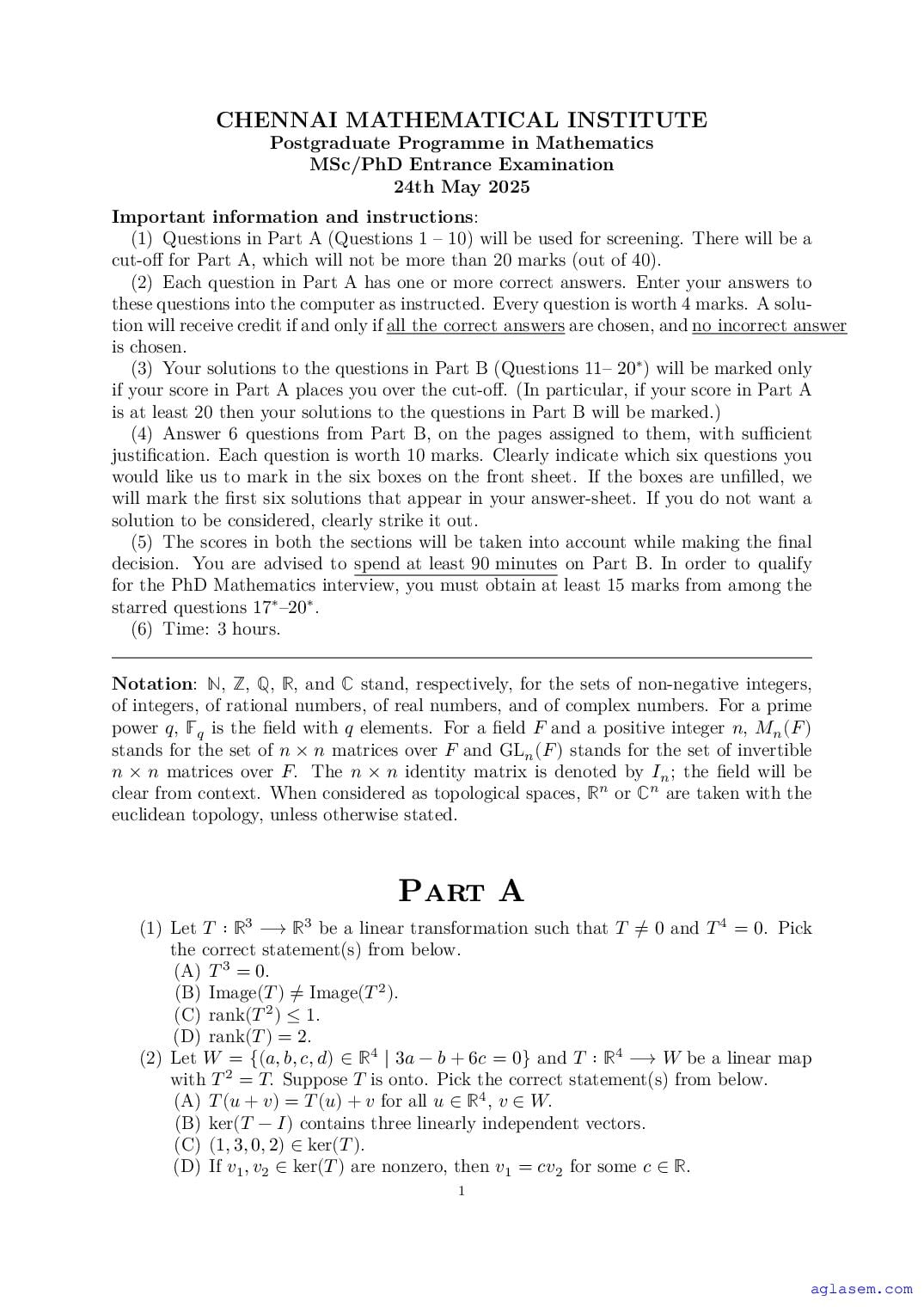
Postgraduate Programme in Mathematics
MSc/PhD Entrance Examination
24th May 2025
Important information and instructions:
(1) Questions in Part A (Questions 1 – 10) will be used for screening. There will be a
cut-off for Part A, which will not be more than 20 marks (out of 40).
(2) Each question in Part A has one or more correct answers. Enter your answers to
these questions into the computer as instructed. Every question is worth 4 marks. A solu-
tion will receive credit if and only if all the correct answers are chosen, and no incorrect answer
is chosen.
(3) Your solutions to the questions in Part B (Questions 11– 20∗ ) will be marked only
if your score in Part A places you over the cut-off. (In particular, if your score in Part A
is at least 20 then your solutions to the questions in Part B will be marked.)
(4) Answer 6 questions from Part B, on the pages assigned to them, with sufficient
justification. Each question is worth 10 marks. Clearly indicate which six questions you
would like us to mark in the six boxes on the front sheet. If the boxes are unfilled, we
will mark the first six solutions that appear in your answer-sheet. If you do not want a
solution to be considered, clearly strike it out.
(5) The scores in both the sections will be taken into account while making the final
decision. You are advised to spend at least 90 minutes on Part B. In order to qualify
for the PhD Mathematics interview, you must obtain at least 15 marks from among the
starred questions 17∗ –20∗ .
(6) Time: 3 hours.
Notation: ℕ, ℤ, ℚ, ℝ, and ℂ stand, respectively, for the sets of non-negative integers,
of integers, of rational numbers, of real numbers, and of complex numbers. For a prime
power 𝑞, 𝔽𝑞 is the field with 𝑞 elements. For a field 𝐹 and a positive integer 𝑛, 𝑀𝑛 (𝐹 )
stands for the set of 𝑛 × 𝑛 matrices over 𝐹 and GL𝑛 (𝐹 ) stands for the set of invertible
𝑛 × 𝑛 matrices over 𝐹. The 𝑛 × 𝑛 identity matrix is denoted by 𝐼𝑛 ; the field will be
clear from context. When considered as topological spaces, ℝ𝑛 or ℂ𝑛 are taken with the
euclidean topology, unless otherwise stated.
PART A
(1) Let 𝑇 ∶ ℝ3 ⟶ ℝ3 be a linear transformation such that 𝑇 ≠ 0 and 𝑇 4 = 0. Pick
(A) 𝑇 3 = 0.
(B) Image(𝑇 ) ≠ Image(𝑇 2 ).
(C) rank(𝑇 2 ) ≤ 1.
(D) rank(𝑇 ) = 2.
(2) Let 𝑊 = {(𝑎, 𝑏, 𝑐, 𝑑) ∈ ℝ4 ∣ 3𝑎 − 𝑏 + 6𝑐 = 0} and 𝑇 ∶ ℝ4 ⟶ 𝑊 be a linear map
with 𝑇 2 = 𝑇. Suppose 𝑇 is onto. Pick the correct statement(s) from below.
(A) 𝑇 (𝑢 + 𝑣) = 𝑇 (𝑢) + 𝑣 for all 𝑢 ∈ ℝ4 , 𝑣 ∈ 𝑊.
(B) ker(𝑇 − 𝐼) contains three linearly independent vectors.
(C) (1, 3, 0, 2) ∈ ker(𝑇 ).
(D) If 𝑣1 , 𝑣2 ∈ ker(𝑇 ) are nonzero, then 𝑣1 = 𝑐𝑣2 for some 𝑐 ∈ ℝ.
1
Page 2
(A) 𝐾 has 𝑝𝑛 elements.
(B) If 𝑝 ∤ 𝑛, then the group of field automorphisms of 𝐾 is isomorphic to the
multiplicative group (ℤ/𝑛ℤ)× .
(C) 𝐾 is a separable extension of 𝔽𝑝 .
(D) There exists 𝑚 > 𝑛 such that 𝐾 is the splitting field of 𝑋 𝑚 − 1 over 𝔽𝑝 .
(4) Let 𝑘 be a finite field of characteristic 𝑝 > 2 and 𝐺 the subgroup of GL2 (𝑘)
1
consisting of all matrices whose first column is [ ]. Pick the correct statement(s)
0
from below.
(A) 𝐺 is a normal subgroup of GL2 (𝑘).
(B) 𝐺 is a 𝑝-group.
1 𝑎
(C) {[ ] ∶ 𝑎 ∈ 𝑘} is a normal subgroup of 𝐺.
0 1
(D) 𝐺 is abelian.
(5) Consider the map 𝑓 ∶ ℝ2 ⟶ ℝ2 , (𝑥, 𝑦) ↦ (−𝑥 − 𝑦2 , 𝑦 + 𝑥2 ). Pick the correct
statement(s) from below.
(A) There exist infinitely many (𝑎, 𝑏) ∈ ℝ2 such that there is an open neighbour-
hood 𝑈 of (𝑎, 𝑏) such that 𝑓|𝑈 is a homeomorphism from 𝑈 to 𝑓(𝑈 ).
(B) The derivative 𝐷𝑓 maps some non-zero tangent vector to ℝ2 at ( 12 , 12 ), to the
zero tangent vector at (− 34 , 34 ).
(C) There exist infinitely many (𝑎, 𝑏) ∈ ℝ2 such that for every open neighbour-
hood 𝑈 of (𝑎, 𝑏), 𝑓|𝑈 is not a homeomorphism from 𝑈 to 𝑓(𝑈 ).
(D) For every differentiable curve 𝛾 through (0, 0), 𝑓 ∘ 𝛾 is differentiable curve.
(6) Let ℝ+ = {𝑥 ∈ ℝ ∶ 𝑥 ≥ 0}. For 𝑥 ∈ ℝ+ , denote by FRAC(𝑥) the fractional part of
𝑥, i.e., 𝑥 − 𝑛 where 𝑛 is the largest integer that is less than or equal to 𝑥. Consider
∞
FRAC(𝑥/𝑛)
the series ∑ . Pick the correct statement(s) from below.
𝑛=1
𝑛
(A) The above series converges for all 𝑥 ∈ ℝ+ − ℤ.
(B) The above series diverges for some non-negative integer 𝑥.
(C) The above series defines a continuous function in a neighbourhood of 12 .
(D) The above series defines a continuous function in a neighbourhood of 1.
(7) Let 𝑓𝑛 (𝑥) = 1+𝑥 1
𝑛 . Pick the correct statement(s) from below.
(A) 𝑓𝑛 converges uniformly on [0, 1/2].
(B) 𝑓𝑛 converges uniformly on [0, 1).
(C) 𝑓𝑛 converges uniformly on [0, 2].
(D) 𝑓𝑛 converges pointwise on [0, ∞).
(8) Pick the correct statement(s) from below.
(A) If 𝑓(𝑧) is a function defined on ℂ that satisfies the Cauchy-Riemann equations
at 𝑧 = 0, then 𝑓(𝑧) is complex-differentiable at 𝑧 = 0.
𝑧−𝑧)𝑧3̄
(B) The function (sin |𝑧| 6 is holomorphic on {𝑧 ∈ 𝐶 ∶ 0 < |𝑧| < 1} and has a
removable singularity at 𝑧 = 0.
(C) There exists a holomorphic function on {𝑧 ∈ ℂ ∶ |𝑧| > 3} whose derivative is
𝑧
.
(𝑧 − 2)2
2
Page 3
𝑧
whose derivative is .
(𝑧 − 2)2 (𝑧2 + 4)
(9) Pick the correct statement(s) from below.
(A) There exists a maximal ideal 𝑀 of ℤ[𝑥] such that 𝑀 ∩ ℤ = (0).
(B) If 𝑀 is a maximal ideal of ℤ[𝑥], then ℤ[𝑥]/𝑀 is finite.
(C) If 𝐼 is an ideal of ℤ[𝑥] such that ℤ[𝑥]/𝐼 is finite, then 𝐼 is maximal.
(D) The ideal (7, 𝑥2 − 14𝑥 − 2) in ℤ[𝑥] is maximal.
(10) Let 𝑀𝑛 (ℝ) be the space of 𝑛 × 𝑛 real matrices. View 𝑀𝑛 (ℝ) as a metric space
with
𝑑([𝑎𝑖,𝑗 ], [𝑏𝑖,𝑗 ]) ∶= max𝑖,𝑗 |𝑎𝑖,𝑗 − 𝑏𝑖,𝑗 |.
Let 𝑈 ⊂ 𝑀𝑛 (ℝ) be the subset of matrices 𝑀 ∈ 𝑀𝑛 (ℝ) such that (𝑀 − 𝐼𝑛 )𝑛 = 0.
(A) 𝑈 is closed.
(B) 𝑈 is open.
(C) 𝑈 is compact.
(D) 𝑈 is neither closed or open.
PART B
(11) Let 𝐺 be an abelian group and let 𝐻 be a nontrivial subgroup of 𝐺, that is,
𝐻 is a subgroup containing at least two elements. Show that the following two
statements are equivalent.
(A) For every nontrivial subgroup 𝐾 of 𝐺, the subgroup 𝐾 ∩ 𝐻 is also nontrivial.
(B) 𝐻 contains every nontrivial minimal subgroup of 𝐺 and every element of the
quotient group 𝐺/𝐻 has finite order.
(12) Consider the ring 𝒞(ℝ) of continuous real-valued functions on ℝ, with point-
wise addition and multiplication. For 𝐴 ⊂ ℝ, the ideal of 𝐴 is 𝐼(𝐴) = {𝑓 ∈
𝒞(ℝ) ∣ 𝑓(𝑎) = 0 for all 𝑎 ∈ 𝐴}. For a subset 𝐼 of 𝒞(ℝ), the zero-set of 𝐼 is
𝑍(𝐼) = {𝑎 ∈ ℝ ∣ 𝑓(𝑎) = 0 for all 𝑓 ∈ 𝐼}. Prove the following:
(A) (3 marks) 𝑍(𝐼 ∩ 𝐽 ) = 𝑍(𝐼𝐽 ) for ideals 𝐼 and 𝐽 of 𝒞(ℝ).
(B) (2 marks) For each 𝑎 ∈ ℝ, 𝐼(𝑎) is a maximal ideal.
(C) (3 marks) The set {𝑓 ∈ 𝒞(ℝ) ∣ 𝑓 has compact support} is a proper ideal, and
its zero set is empty.
(D) (2 marks) True/False: For each prime ideal 𝔭 of 𝒞(ℝ), 𝑍(𝔭) is a singleton
set. (Justify your answer.)
(13) Let 𝑓, 𝑔, ℎ be functions from ℝ to ℝ such that
ℎ(𝑓(𝑥) + 𝑔(𝑦)) = 𝑥𝑦 (∗)
for all 𝑥, 𝑦 ∈ ℝ. Show the following:
(A) (2 marks) ℎ is surjective.
(B) (3 marks) If 𝑓 is continuous then 𝑓 is strictly monotone.
(C) (5 marks) There do not exist continuous functions 𝑓, 𝑔, ℎ satisfying (∗).
(14) Let 𝑓 ∶ [0, 1] ⟶ ℝ and 𝑔 ∶ ℝ ⟶ ℝ be continuous functions. Assume that 𝑔 is
periodic with period 1. Show that
1 1 1
lim ∫ 𝑓(𝑥)𝑔(𝑛𝑥)𝑑𝑥 = (∫ 𝑓(𝑥)𝑑𝑥) (∫ 𝑔(𝑥)𝑑𝑥) .
𝑛↦∞
0 0 0
(15) Prove or disprove each of the statements below.
3
Page 4
and negative values. Then 𝑓 has infinitely many zeros.
(B) (6 marks) Let 𝑓 ∶ ℝ ⟶ ℝ2 be a continuous function. Then 𝑓 is not open.
(16) Prove or disprove the following statements:
(A) (5 marks) Suppose that 𝑓(𝑧) is a complex analytic function in the punctured
unit disk 0 < |𝑧| < 1 such that lim 𝑓( 𝑛1 ) = 0 and lim 𝑓( 2𝑛−1
2
) = 1, then
𝑛⟶∞ 𝑛⟶∞
there exists a positive integer 𝑁 > 0 such that lim |𝑧−𝑁 𝑓(𝑧)| = ∞.
𝑧⟶0
(B) (5 marks) There exists a non-zero entire function 𝑓 such that 𝑓(𝑒2𝜋𝑖𝑒𝑛! ) = 0
for all 𝑛 ≥ 2025.
(17 ) Let 𝑋 ⊆ ℝ𝑛 and 𝑝 ∈ 𝑋. By a tangent vector of 𝑋 at 𝑝, we mean 𝛾 ′ (0), where
∗
𝛾 ∶ (−𝜖, 𝜖) ⟶ 𝑋 is a differentiable function with 𝛾(0) = 𝑝. (𝜖 ∈ ℝ, 𝜖 > 0.) The
tangent space of 𝑋 at 𝑝 is the ℝ-vector space of all the tangent vectors at 𝑝. Think
of GL𝑛 (ℂ) as a subspace of ℝ2𝑛 , with the euclidean topology.
2
Let 𝐺 ∶= {𝐴 ∈ GL2 (ℂ) ∣ 𝐴∗ 𝐴 = 𝐴𝐴∗ = 𝐼2 , det 𝐴 = 1}.
(A) (2 marks) Show that every tangent vector of GL𝑛 (ℂ) at 𝐼𝑛 is of the form
𝛾𝐴′
(0) where 𝐴 is a 𝑛 × 𝑛 complex matrix and 𝛾𝐴 ∶ ℝ ⟶ GL𝑛 (ℂ) is the
function 𝑡 ↦ 𝑒𝑡𝐴 .
𝑖𝑎 𝑧
(B) (3 marks) Show that the tangent space of 𝐺 at 𝐼2 is 𝑉 ∶= {[ ] ∣ 𝑎 ∈ ℝ, 𝑧 ∈ ℂ}.
−𝑧 ̄ −𝑖𝑎
(C) (5 marks) Consider the homeomorphism Φ ∶ 𝐺 ⟶ 𝕊3 (where 𝕊3 denotes the
unit sphere in ℝ4 ) given by
𝛼 𝛽
[ ] ↦ (ℜ(𝛼), ℑ(𝛼), ℜ(𝛽), ℑ(𝛽))
𝛽 𝛼
Define a ‘multiplication’ on 𝑉 by [𝐴, 𝐵] = 𝐴𝐵−𝐵𝐴
2 . Determine the multipli-
cation on the tangent space at Φ(𝐼2 ) induced by the derivative 𝐷Φ. ( Hint:
The map (𝐴, 𝐵) ⟶ [𝐴, 𝐵] is ℝ-bilinear.)
(18∗ ) Let 𝔽𝑞 be the finite field with 𝑞 elements and 𝑃 ∈ 𝔽𝑞 [𝑥] be a monic irreducible
polynomial of even degree 2𝑑. Then show that 𝑃, when considered as a polynomial
in 𝔽𝑞2 [𝑥], decomposes into a product 𝑃 = 𝑄1 𝑄2 of irreducible polynomials 𝑄𝑖 in
𝔽𝑞2 [𝑥] with deg(𝑄𝑖 ) = 𝑑.
(19 ) Show that the power series ∑𝑛=1 𝑧 𝑛! represents an analytic function 𝑓(𝑧) in the
∗ ∞
open unit disk Δ centred at 0. Show that 𝑓(𝑧) cannot be extended to a continuous
function on any connected open set 𝑈 such that 𝑈 is strictly larger than Δ.
(20 ) It is known that there exist surjective continuous maps 𝐼 ⟶ 𝐼 2 where 𝐼 = [0, 1]
∗
is the unit interval.
(A) (4 marks) Using the above result or otherwise, show that there exists a sur-
jective continuous map 𝑓 ∶ ℝ ⟶ ℝ2 .
(B) (6 marks) Let 𝑓 ∶ ℝ ⟶ ℝ2 be a surjective continuous map. Let Γ =
{(𝑥, 𝑓(𝑥)) ∣ 𝑥 ∈ ℝ} ⊂ ℝ3 . Show that ℝ3 Γ is path connected.
4
Document Details
| Board / Org | CMI |
| Exam | CMI Entrance Exam |
| Type | Question Paper |
| Pages | 4 |
| Updated | 23 Oct 2026 |