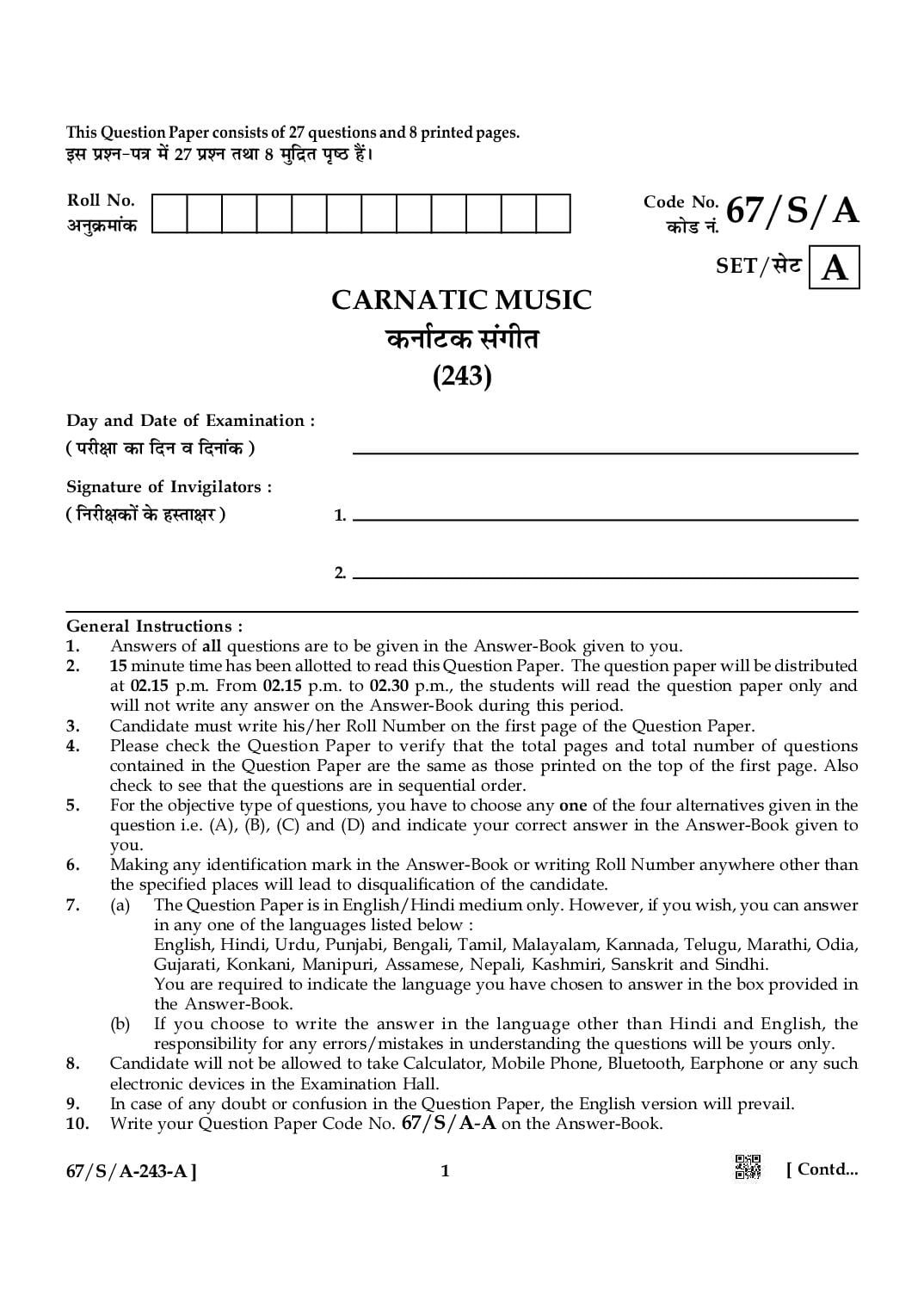
NIOS Class 10 April 2024 Question Paper Carnatic Music
Finished viewing? Save it for later —
Download NIOS Class 10 April 2024 Question Paper Carnatic Music (PDF · 8 pages)About NIOS Class 10 April 2024 Question Paper Carnatic Music
NIOS Class 10 April 2024 Question Paper Carnatic Music is available here for free download. Published by NIOS for National Institute of Open Schooling Class 10, this question paper can be viewed online or downloaded as a PDF (8 pages). Candidates preparing for National Institute of Open Schooling Class 10 can use NIOS Class 10 April 2024 Question Paper Carnatic Music to understand the exam pattern, the type of questions asked, and the overall difficulty level.
Frequently Asked Questions
How can I download NIOS Class 10 April 2024 Question Paper Carnatic Music?
Open this page and click the Download button to save NIOS Class 10 April 2024 Question Paper Carnatic Music as a PDF. It is completely free on AglaSem Docs.
Is NIOS Class 10 April 2024 Question Paper Carnatic Music free to download?
Yes. NIOS Class 10 April 2024 Question Paper Carnatic Music can be viewed online and downloaded as a PDF free of cost on AglaSem Docs.
How many pages does NIOS Class 10 April 2024 Question Paper Carnatic Music have?
NIOS Class 10 April 2024 Question Paper Carnatic Music contains 8 pages, which you can read online or download together as a single PDF.
Where can I find more National Institute of Open Schooling Class 10 study material?
You can find more National Institute of Open Schooling Class 10 question papers, sample papers, syllabus, and answer keys on AglaSem Docs.
NIOS Class 10 April 2024 Question Paper Carnatic Music – Text
Read the full text of this question paper below — useful to quickly search, copy and reference the content online without downloading the PDF.
📄 View text version (8 pages)
Page 1
ß‚ ¬˝‡Ÿ-¬òÊ ◊¥ 27 ¬˝‡Ÿ ÃÕÊ 8 ◊ÈÁŒ˝Ã ¬Îc∆U „Ò¥–
Roll No. Code No.
•ŸÈ∑˝§◊Ê¥∑§ ∑§Ê«U Ÿ¥.
67/S/A
SET/‚ ≈ A
CARNATIC MUSIC
∑§ŸÊ¸≈U∑§ ‚¥ªËÃ
(243)
Day and Date of Examination :
(¬⁄UˡÊÊ ∑§Ê ÁŒŸ fl ÁŒŸÊ¥∑§)
Signature of Invigilators :
(ÁŸ⁄UˡÊ∑§Ê¥ ∑§ „SÃÊˇÊ⁄U) 1.
2.
General Instructions :
1. Answers of all questions are to be given in the Answer-Book given to you.
2. 15 minute time has been allotted to read this Question Paper. The question paper will be distributed
at 02.15 p.m. From 02.15 p.m. to 02.30 p.m., the students will read the question paper only and
will not write any answer on the Answer-Book during this period.
3. Candidate must write his/her Roll Number on the first page of the Question Paper.
4. Please check the Question Paper to verify that the total pages and total number of questions
contained in the Question Paper are the same as those printed on the top of the first page. Also
check to see that the questions are in sequential order.
5. For the objective type of questions, you have to choose any one of the four alternatives given in the
question i.e. (A), (B), (C) and (D) and indicate your correct answer in the Answer-Book given to
you.
6. Making any identification mark in the Answer-Book or writing Roll Number anywhere other than
the specified places will lead to disqualification of the candidate.
7. (a) The Question Paper is in English/Hindi medium only. However, if you wish, you can answer
in any one of the languages listed below :
English, Hindi, Urdu, Punjabi, Bengali, Tamil, Malayalam, Kannada, Telugu, Marathi, Odia,
Gujarati, Konkani, Manipuri, Assamese, Nepali, Kashmiri, Sanskrit and Sindhi.
You are required to indicate the language you have chosen to answer in the box provided in
the Answer-Book.
(b) If you choose to write the answer in the language other than Hindi and English, the
responsibility for any errors/mistakes in understanding the questions will be yours only.
8. Candidate will not be allowed to take Calculator, Mobile Phone, Bluetooth, Earphone or any such
electronic devices in the Examination Hall.
9. In case of any doubt or confusion in the Question Paper, the English version will prevail.
10. Write your Question Paper Code No. 67/S/A-A on the Answer-Book.
67/S/A-243-A ] 1 [ Contd...
Page 2
1. ‚÷Ë ¬˝‡ŸÊ¥ ∑§ ©ûÊ⁄U •Ê¬∑§Ê ŒË ªÿË ©ûÊ⁄U-¬ÈÁSÃ∑§Ê ◊¥ „Ë Á‹π¥–
2. ß‚ ¬˝‡Ÿ-¬òÊ ∑§Ê ¬…∏Ÿ ∑§ Á‹∞ 15 Á◊Ÿ≈U ∑§Ê ‚◊ÿ ÁŒÿÊ ªÿÊ „Ò– ¬˝‡Ÿ-¬òÊ ∑§Ê ÁflÃ⁄UáÊ ŒÊ¬„⁄U ◊¥ 02.15 ’¡ Á∑§ÿÊ ¡Ê∞ªÊ–
02.15 ’¡ ‚ 02.30 ’¡ Ã∑§ ¿UÊòÊ ∑§fl‹ ¬˝‡Ÿ-¬òÊ ∑§Ê ¬…∏¥ª •ÊÒ⁄U ß‚ •flÁœ ∑§ ŒÊÒ⁄UÊŸ fl ©ûÊ⁄U-¬ÈÁSÃ∑§Ê ¬⁄U ∑§Ê߸ ©ûÊ⁄U Ÿ„Ë¥
Á‹π¥ª–
3. ¬⁄UˡÊÊÕ˸ ¬˝‡Ÿ-¬òÊ ∑§ §¬„‹ ¬Îc∆U ¬⁄U •¬ŸÊ •ŸÈ∑˝§◊Ê¥∑§ •fl‡ÿU Á‹π¥–
4. ∑Χ¬ÿÊ ¬˝‡Ÿ-¬òÊ ∑§Ê ¡ÊÚ°ø ‹¥ Á∑§ ¬˝‡Ÿ-¬òÊ ∑§ ∑ȧ‹ ¬Îc∆UÊ¥ ÃÕÊ ¬˝‡ŸÊ¥ ∑§Ë ©ÃŸË „Ë ‚¥ÅUÿÊ „Ò Á¡ÃŸË ¬˝Õ◊ ¬Îc∆ ∑ §‚’‚ ™§¬⁄U
¿U¬Ë „Ò– ß‚ ’Êà ∑§Ë ¡ÊÚ°ø ÷Ë ∑§⁄U ‹¥ Á∑§ ¬˝‡Ÿ ∑˝ Á◊∑§ UM§¬ ◊¥ „Ò¥–
5. flSÃÈÁŸc∆U ¬˝‡ŸÊ¥ ◊¥ •Ê¬∑§Ê øÊ⁄U Áfl∑§À¬Ê¥ (A), (B), (C) ÃÕÊ (D) ◊¥ ‚ ∑§Ê߸ ∞∑§ ©ûÊ⁄U øÈŸŸÊ „Ò ÃÕÊ ŒË ªß¸ ©ûÊ⁄U-¬ÈÁSÃ∑§Ê ◊¥
©‚ ‚„Ë ©ûÊ⁄U ∑§Ê Á‹πŸÊ „Ò–
6. § ©ûÊ⁄U-¬ÈÁSUÃ∑§Ê ◊¥ ¬„øÊŸ-Áøq ’ŸÊŸ •ÕflÊ ÁŸÁŒ¸c≈U SÕÊŸÊ¥ ∑§§•ÁÃÁ⁄UÄà ∑§„Ë¥ ÷Ë •ŸÈ∑˝§◊Ê¥∑§ Á‹πŸ ¬⁄U ¬⁄UˡÊÊÕ˸ ∑§Ê •ÿÊÇÿ
∆U„⁄UÊÿÊ ¡ÊÿªÊ–
7. (∑§) ÿ„ ¬˝‡Ÿ-¬òÊ ∑§fl‹ •¥ª¡ ̋ Ë/Á„¥ŒË ◊¥ „Ò– Á»§⁄U ÷Ë, ÿÁŒ •Ê¬ øÊ„¥ ÃÊ ŸËø ŒË ªß¸ Á∑§‚Ë ∞∑§ ÷Ê·Ê ◊¥ ©ûÊ⁄ Œ ‚∑§Ã „Ò¥ —
•¥ª˝¡Ë, Á„¥ŒË, ©ŒÍ¸, ¬¥¡Ê’Ë, ’°ª‹Ê, ÃÁ◊‹, ◊‹ÿÊ‹◊, ∑§ãŸ«∏, ËȪÍ, ◊⁄UÊ∆UË, ©Á«∏ÿÊ, ªÈ¡⁄UÊÃË, ∑§Ê¥∑§áÊË, ◊ÁáʬÈ⁄UË,
•‚Á◊ÿÊ, Ÿ¬Ê‹Ë, ∑§‡◊Ë⁄UË, ‚¥S∑Χç•ÊÒ⁄U Á‚¥œË–
∑Χ¬ÿÊ ©ûÊ⁄U-¬ÈÁSÃ∑§Ê ◊¥ ÁŒ∞ ª∞ ’ÊÚÄ‚ ◊¥ Á‹π¥ Á∑§ •Ê¬ Á∑§‚ ÷Ê·Ê ◊¥ ©ûÊ⁄U Á‹π ⁄U„ „Ò¥–
(π) ÿÁŒ •Ê¬ Á„¥ŒË ∞fl¥ •¥ª˝¡Ë ∑§ •ÁÃÁ⁄UÄà Á∑§‚Ë •ãÿ ÷Ê·Ê ◊¥ ©ûÊ⁄U Á‹πà „Ò¥, ÃÊ ¬˝‡ŸÊ¥ ∑§Ê ‚◊¤ÊŸ ◊¥ „ÊŸ flÊ‹Ë
òÊÈÁ≈UÿÊ¥/ª‹ÁÃÿÊ¥ ∑§Ë Á¡ê◊UŒÊ⁄Ë ∑ fl‹ •Ê¬∑§Ë „ʪ˖
8. ¬⁄UˡÊÊÕ˸ ∑§Ê ¬⁄UˡÊÊ „ÊÚ‹ ◊¥ ∑Ò§À∑ȧ‹≈U⁄U, ◊Ê’Êß‹ »§ÊŸ, é‹Í≈ÍUÕ, ßÿ⁄U»§ÊŸ, ¡Ò‚ Á∑§‚Ë ÷Ë ß‹Ä≈˛UÊÚÁŸ∑§ ©¬∑§⁄UáÊ ∑§Ê ‹ ¡ÊŸ ∑§Ë
•ŸÈ◊Áà Ÿ„Ë¥ „Ò–
9. ¬˝‡Ÿ-¬òÊ ◊¥ Á∑§‚Ë ÷Ë ¬˝∑§Ê⁄U ∑§ ‚¥Œ„ •ÕflÊ ŒÈÁflœÊ ∑§Ë ÁSÕÁà ◊¥ •¥ª˝¡Ë •ŸÈflÊŒ „Ë ◊Êãÿ „ʪʖ
10. •¬ŸË ©ûÊ⁄U-¬ÈÁSUÃ∑§Ê ¬⁄U ¬˝‡Ÿ-¬òÊ ∑§Ê ∑§Ê«U Ÿ¥. 67/S/A-A Á‹π¥–
67/S/A-243-A ] 2 [ Contd...
Page 3
∑§ŸÊ¸≈U∑§ ‚¥ªËÃ
(243)
Time : 1½ Hours ] [ Maximum Marks : 40
‚◊ÿ — 1½ ÉÊá≈U ] [ ¬ÍáÊÊZ∑§§ — 40
Note :
(i) This question paper consists of 27 questions in all.
(ii) All questions are compulsory.
(iii) Marks are given against each question.
(iv) Section - A consists of
(a) Q.No. 1 to 8 - Multiple Choice type questions (MCQs) carrying 1 mark each. Select and
write the most appropriate option out of the four options given in each of these questions.
An internal choice has been provided in some of these questions. You have to attempt only
one of the given choices in such questions.
(v) Section - B consists of Objective type questions :
(a) Q.No. 9 to 12 - Read the passage carefully then Fill in the blanks carrying 1 mark each. An
internal choice has been provided in some of these questions.
(b) Q.No. 13 to 16 - Read the passage carefully then Match the questions carrying 1 mark each.
An internal choice has been provided in some of these questions.
(c) Q.No. 17 to 20 - Answer the following questions carrying 1 mark each to be
answered in the range of 15 to 25 words. An internal choice has been provided in some of
these questions.
(vi) Section - C consists of Subjective type questions :
(a) Q.No. 21 to 25 - Short Answer type questions carrying 2 marks each to be answered in the
range of 30 to 40 words.
(b) Q.No. 26 to 27 - Long Answer type questions carrying 5 marks each to be answered in the
range of 100 to 120 words.
ÁŸŒ¸‡Ê —
(i) ß‚ ¬˝‡Ÿ-¬òÊ ◊¥ ∑ȧ‹ 27 ¬˝‡Ÿ „Ò¥–
(ii) ‚÷Ë ¬˝‡Ÿ •ÁŸflÊÿ¸ „Ò¥–
(iii) ¬˝àÿ∑§ ¬˝‡Ÿ ∑§ ‚Ê◊Ÿ ©‚∑§ •¥∑§ ÁŒ∞ ª∞ „Ò¥–
(iv) πá«U - ∑§ ◊¥ ‡ÊÊÁ◊‹ „Ò¥ —
(a) ¬˝‡Ÿ ‚¥ÅÿÊ 1 ‚ 8 Ã∑§ ’„ÈÁfl∑§À¬Ëÿ ¬˝∑§Ê⁄U ∑§ ¬˝‡Ÿ „Ò¥ •ÊÒ⁄U ¬˝àÿ∑§ 1 •¥∑§ ∑§Ê „Ò– ߟ◊¥ ‚ ¬˝àÿ∑§ ¬˝‡Ÿ ◊¥ ÁŒ∞ ª∞
øÊ⁄U Áfl∑§À¬Ê¥ ◊¥ ‚ ‚’‚ ©¬ÿÈÄà Áfl∑§À¬ ∑§Ê øÿŸ ∑§⁄U Á‹πŸÊ „Ò– ߟ◊¥ ‚ ∑ȧ¿U ¬˝‡ŸÊ¥ ◊¥ •Ê¥ÃÁ⁄U∑§ Áfl∑§À¬ ÁŒ∞ ª∞
„Ò¥, •Ê¬∑§Ê ∞‚ ¬˝‡ŸÊ¥ ◊¥ ÁŒ∞ ª∞ Áfl∑§À¬Ê¥ ◊¥ ‚ ∑§fl‹ ∞∑§ Áfl∑§À¬ ∑§Ê „Ë ©ûÊ⁄U Á‹πŸÊ „ʪʖ
(v) πá«U - π ◊¥ flSÃÈÁŸc∆U ¬˝∑§Ê⁄U ∑§ ¬˝‡Ÿ ‡ÊÊÁ◊‹ „Ò¥ —
(a) ¬˝‡Ÿ ‚¥ÅÿÊ 9 ‚ 12 - ªlÊ¥‡Ê ∑§Ê äÿÊŸ¬Ífl¸∑§ ¬…∏∑§⁄U Á⁄UÄà SÕÊŸÊ¥ ∑§Ë ¬ÍÁø ∑§ËÁ¡∞– ¬˝àÿ∑§ ¬˝‡Ÿ 1 •¥∑§ ∑§Ê „Ò– ߟ◊¥
‚ ∑ȧ¿U ¬˝‡ŸÊ¥ ◊¥ •Ê¥ÃÁ⁄U∑§ Áfl∑§À¬ ÁŒ∞ ª∞ „Ò¥–
(b) ¬˝‡Ÿ ‚¥ÅÿÊ 13 ‚ 16 - ªlÊ¥‡Ê ∑§Ê äÿÊŸ¬Ífl¸∑§ ¬…∏∑§⁄U ¬˝‡ŸÊ¥ ∑§Ê Á◊‹ÊŸ ∑§ËÁ¡∞– ¬˝àÿ∑§ ¬˝‡Ÿ 1 •¥∑§ ∑§Ê „Ò– ߟ◊¥
‚ ∑ȧ¿U ¬˝‡ŸÊ¥ ◊¥ •Ê¥ÃÁ⁄U∑§ Áfl∑§À¬ ÁŒ∞ ª∞ „Ò¥–
(c) ¬˝‡Ÿ ‚¥ÅÿÊ 17 ‚ 20 - ÁŒ∞ ª∞ ¬˝‡ŸÊ¥ ∑§ ©ûÊ⁄U ŒËÁ¡∞– ¬˝àÿ∑§ ¬˝‡Ÿ 1 •¥∑§ ∑§Ê „Ò– ߟ ¬˝‡ŸÊ¥ ∑§ ©ûÊ⁄U 15 ‚ 25
‡ÊéŒÊ¥ ◊¥ ÁŒ∞ ¡ÊŸ øÊÁ„∞– ߟ◊¥ ‚ ∑ȧ¿U ¬˝‡ŸÊ¥ ◊¥ •Ê¥ÃÁ⁄U∑§ Áfl∑§À¬ ÁŒ∞ ª∞ „Ò¥–
67/S/A-243-A ] 3 [ Contd...
Page 4
(a) ¬˝‡Ÿ ‚¥ÅÿÊ 21 ‚ 25 - ‹ÉÊÈ-©ûÊ⁄UËÿ ¬˝∑§Ê⁄U ∑§ ŒÊ-ŒÊ •¥∑§Ê¥ ∑§ ¬˝‡Ÿ „Ò¥ Á¡Ÿ∑§Ê ©ûÊ⁄U 30 ‚ 40 ‡ÊéŒÊ¥ ◊¥ ÁŒÿÊ ¡ÊŸÊ
„Ò–
(b) ¬˝‡Ÿ ‚¥ÅÿÊ 26 ‚ 27 - ŒËÉʸ - ©ûÊ⁄UËÿ ¬˝∑§Ê⁄U ∑§ ¬Ê°ø-¬Ê°ø •¥∑§Ê¥ ∑§ ¬˝‡Ÿ „Ò¥ Á¡Ÿ∑§Ê ©ûÊ⁄U 100 ‚ 120 ‡ÊéŒÊ¥ ◊¥ ÁŒÿÊ
¡ÊŸÊ „Ò–
SECTION - A / πá«U - ∑§
1. The composer of the musical opera “Kuchelopakhyanam” : 1
(A) Tyagaraja (B) Swati Tirunal
(C) Kshetragna (D) Syama Sastri
‚¥ªËÃ◊ÿ •Ê¬⁄UÊ “∑ȧø‹Ê¬ÊÅÿÊŸ” ∑§ (⁄UøÁÿÃÊ) ‚¥ªËÃ∑§Ê⁄U „Ò¥ —
(A) àÿʪ⁄UÊ¡ (B) SflÊÁà ÁÃL§Ÿ‹
(C) ˇÊòÊÇŸ (D) SÿÊ◊Ê ‡ÊÊSòÊË
2. A dot above the swara indicates : 1
(A) Mandra swara (B) Madhya swara
(C) Tara swara (D) Anumandra swara
Sfl⁄U ∑§ ™§¬⁄U ∞∑§ Á’¥ŒÈ ’ÃÊÃË „Ò —
(A) ◊¥Œ˝ Sfl⁄U (B) ◊äÿ Sfl⁄U
(C) ÃÊ⁄U Sfl⁄U (D) •ŸÈ◊¥Œ˝Ê Sfl⁄U
3. (i) The author of “Swaramela Kalanidhi” : 1
(A) Ramamatya (B) Venkatamakhi
(C) Bharata (D) Vidyaranya
Sfl⁄U◊‹∑§‹ÊÁŸÁœ ª˝¥Õ ∑§ ‹π∑§ ∑§Ê ŸÊ◊ „Ò —
(A) ⁄UÊ◊Ê◊Êàÿ (B) √ÿ¥∑§≈U◊πË
(C) ÷⁄Uà (D) ÁfllÊ⁄Uáÿ
(ii) In the notation small letters correspond to :
(A) Deergha (B) Suddha note
(C) Hrasva (D) Tivra note
Sfl⁄U Á‹Á¬ ◊¥ ¿UÊ≈U •ˇÊ⁄U ‚◊∑§ˇÊ „Ò¥ —
(A) ŒËÉʸ (B) ‡ÊÈh Sfl⁄U
(C) NSfl (D) ÃËfl˝ Sfl⁄U
4. (i) Sankirtanas are composed by : 1
(A) Jayadeva (B) Annamacharya
(C) Kshetragna (D) Narayana Tirtha
“‚¥∑§ËøŸ” ∑§ ‚¥ªËÃ∑§Ê⁄U „Ò¥ —
(A) ¡ÿŒfl (B) •ãŸÊ◊ÊøÊÿ¸
(C) ˇÊòÊÇŸ (D) ŸÊ⁄UÊÿáÊ ÃËÕ¸
67/S/A-243-A ] 4 [ Contd...
Page 5
(A) Music (B) Sahitya
(C) Tala (D) Expression
‚¥ªËÃ◊ÿ ⁄UøŸÊ “∑ΧÁÔ ∑§Ê ◊„àfl ◊ÈÅÿ M§¬ ‚ ß‚◊¥ „Ò —
(A) ‚¥ªËà (B) ‚ÊÁ„àÿ
(C) ÃÊ‹ (D) ÷Êfl
5. The mudra used by Swati Tirunal in her compositions : 1
(A) Syamakrishna (B) Guruguha
(C) Padmanabha (D) Bhadrachala
SflÊÁà ÁÃL§Ÿ‹ Ÿ •¬ŸË ∑ΧÁÃÿÊ¥ ◊¥ ß‚ ◊ÈŒ˝Ê ∑§Ê ¬˝ÿʪ Á∑§ÿÊ „Ò —
(A) ‡ÿÊ◊Ê∑ΧcáÊÊ (B) ªÈL§ªÈ„Ê
(C) ¬Œ˜◊ŸÊ÷ (D) ÷Œ˝ø‹
6. (i) The composer of Lakshmisa tala tillana : 1
(A) Ramnad Srinivasa Iyengar (B) Maha Vaidyanatha Iyer
(C) Patnam Subramanya Iyer (D) Lalgudi Jayaraman
‹ˇ◊Ë‚Ê ÃÊ‹ ÁÃÀ‹ÊŸÊ ∑§ ⁄UøÁÿÃÊ „Ò —
(A) ⁄UÊ◊ŸŒ o˝ËÁŸflÊ‚ •ƒÿ¥ª⁄U (B) ◊„Ê flÒlŸÊÕ •ƒÿ⁄U
(C) ¬≈UŸ¥ ‚È’˝◊ãÿ •ƒÿ⁄U (D) ‹Ê‹ªÈ«UË ¡ÿ⁄U◊Ÿ
(ii) The symbol of Druta :
(A) ¯ (B) 3
(C) 1 (D) 0
Œ˝Èà ∑§Ê Áø„˜Ÿ „Ò —
(A) ¯ (B) 3
(C) 1 (D) 0
7. (i) The notation used in Western Music : 1
(A) Staff (B) Solfa
(C) Musicography (D) Inscription
¬Ê‡øÊàÿ ‚¥ªËà ◊¥ ß‚ Sfl⁄U Á‹Á¬ ∑§Ê ¬˝ÿʪ Á∑§ÿÊ ¡ÊÃÊ „Ò —
(A) S≈UÊ»§ (B) ‚ÊÀ»§Ê
(C) ‚¥ªËÇÊÊSòÊ (D) Á‡Ê‹Ê‹π
(ii) The type of Varnam which is sung at the commencement of a concert :
(A) Tana Varnam (B) Pada Varnam
(C) Chauka Varnam (D) Padam
“fláÊZ” ∑§Ë fl„ ¬˝∑§Ê⁄U ¡Ê ‚÷ʪʟ ∑§ •Ê⁄¥U÷ ◊¥ ªÊ߸ ¡ÊÃË „Ò —
(A) ÃÊŸ fláÊZ (B) ¬Œ fláÊZ
(C) øÊÒ∑§ fláÊZ (D) ¬Œ◊˜
67/S/A-243-A ] 5 [ Contd...
Page 6
(A) Javali (B) Tarana
(C) Bhajan (D) Tarangam
ÁÃÀ‹ÊŸÊ ÷Ê⁄UÃËÿ ‚¥ªËà ∑§ Á∑§‚ ‚¥ªËÃ◊ÿ ÁflœÊ ∑§ •ŸÈM§¬ „Ò ?
(A) ¡Êfl‹Ë (B) Ã⁄UÊŸÊ
(C) ÷¡Ÿ (D) Ã⁄¥Uª¥
SECTION - B / πá«U - π
Read the passage carefully and fill in the blanks given below :
17th century saw the emergence of Chaturdandi Prakasika by Venkatamakhi. The treatise
was a landmark and ushered in the modern era in the history of music. The treatise
enumerated 72 Asampurna melakarta scheme, based on the 16 swarasthanas. All the
72 melas and their janya ragas, the vivadi melas were musical possibilities. The system was
called Kanakambari-Ratnambari scheme. Later the system was revised and revamped by
Govindacharya as 72 sampurna mela paddhati, known as Kanakangi-Ratnangi scheme,
where the melas had krama sampurna Arohana and Avarohana. The 72 melakarta scheme
opened the flood gates for the creation of unlimited number of janya ragas with specific
lakshanas.
ŸËø Á‹π ªlÊ¥‡Ê ∑§Ê äÿÊŸ¬Ífl¸∑§ ¬Á…∏∞ •ÊÒ⁄U ÁŸêŸÁ‹Áπà Á⁄UÄà SÕÊŸÊ¥ ∑§Ë ¬ÍÁø ∑§ËÁ¡∞ —
17 flË ‡ÊÃÊéŒË ◊¥ √ÿ¥∑§≈U◊πË mÊ⁄UÊ ⁄UÁøà “øÃÈ⁄UŒ¥«UË ¬˝∑§ÊÁ‡Ê∑§Ê” ∑§Ê •ÊÁfl÷ʸfl „È•Ê– ÿ„ ∞∑§ ¬Õ ¬˝Œ‡Ê¸∑§ ª˝¥Õ ÕÊ
Á¡‚∑§ ◊Êäÿ◊ ‚ •ÊœÈÁŸ∑§ ‚¥ªËà ∑§ ßÁÄʂ ∑§Ê •Êª◊Ÿ „È•Ê– ß‚ ª˝¥Õ ∑§ •¥Ãª¸Ã 16 Sfl⁄ SÕÊŸÊ¥ ¬⁄U •ÊœÊÁ⁄Uà 72
•‚¥¬Íáʸ ◊‹∑§Ãʸ ¬hÁà ∑§Ê ¬Á⁄UªÁáÊà Á∑§ÿÊ ªÿÊ „Ò– ‚◊Sà 72 ◊‹ ©Ÿ∑§ ¡ãÿ⁄Uʪ ∞fl¥ ÁflflÊŒË ◊‹ ‚¥ªËÃÊà◊∑§
‚¥÷ÊflŸÊ∞° ÕË¥– ß‚ ¬˝áÊÊ‹Ë ∑§Ê ∑§Ÿ∑§Ê¥’⁄UË-⁄UàŸÊ¥’⁄UË ¬hÁà ∑§„Ê ªÿÊ– ’ÊŒ ◊¥ ªÊÁfl¥ŒÊøÊÿ¸ Ÿ ß‚ ¬hÁà ∑§Ê 72 ‚¥¬Íáʸ
◊‹ ¬hÁà ∑§Ë ÷Ê¥Áà ‚¥‡ÊÊÁœÃ ∞fl¥ ¬ÈŸÁŸ¸Á◊¸Ã Á∑§ÿÊ Á¡‚ ∑§Ÿ∑§Ê¥ªË-⁄UàŸÊ¥ªË ¬hÁà ∑§„Ê ªÿÊ– ß‚ ¬hÁà ∑§ •¥Ãª¸Ã
◊‹ ∑˝§◊ ‚¥¬Íáʸ •Ê⁄UÊ„áÊ ∞fl¥ •fl⁄UÊ„áÊ ÿÈÄà Ֆ 72 ◊‹∑§Ãʸ ¬hÁà Ÿ Áfl‡Ê· ‹ˇÊáÊ ÿÈÄà •‚¥Åÿ ¡ãÿ ⁄Uʪʥ ∑§ ©Œ˜÷fl
∑§ Á‹∞ ¡‹ mÊ⁄U πÊ‹ ÁŒ∞–U
9. 17th century saw the emergence of __________ by __________. ½+½
17 flË ‡ÊÃÊéŒË Ÿ __________ ∑§Ê __________ ∑§ mÊ⁄UÊ •ÊÁfl÷ʸfl ŒπÊ–
10. The treatise enumerated __________ based on __________ swarasthanas. ½+½
ß‚ ª˝¥Õ ◊¥ __________ Sfl⁄USÕÊŸÊ¥ ¬⁄U •ÊœÊÁ⁄Uà __________ ∑§Ê ¬Á⁄UªÁáÊà Á∑§ÿÊ ªÿÊ „Ò–
11. All the __________ , vivadi melas were musical possibilities. The system was
called __________.
‚◊Sà __________, ÁflflÊŒË ◊‹ ◊¥ ‚¥ªËÃÊà◊∑§ ‚¥÷ÊflŸÊ∞° ÕË¥– ß‚ ¬˝áÊÊ‹Ë ∑§Ê __________ ∑§„Ê ªÿÊ– ½+½
12. Later the system was revised and revamped by __________ as 72 Sampurna mela paddhati,
known as __________. ½+½
’ÊŒ ◊¥ ß‚ ¬hÁà ∑§Ê 72 ‚¥¬Íáʸ ◊‹ ¬hÁà ∑§Ë ÷Ê¥Áà ‚¥‡ÊÊÁœÃ •ÊÒ⁄U ¬ÈŸÁŸ¸Á◊¸Ã __________ ∑§ mÊ⁄UÊ Á∑§ÿÊ ªÿÊ Á¡‚
__________ ∑§ ŸÊ◊ ‚ ¡ÊŸÊ ªÿÊ–
The __________ opened the flood gates for the creation of unlimited number of __________,
with specific lakshanas.
__________ Ÿ Áfl‡Ê· ‹ˇÊáÊ ÿÈÄà •‚¥Åÿ __________ ∑§ ©Œ˜÷fl ∑§ Á‹∞ ¡‹ mÊ⁄UÊ πÊ‹ ÁŒ∞–
67/S/A-243-A ] 6 [ Contd...
Page 7
Sabhagana comes under the performance part of Carnatic Music where the
musical forms like Varna, Kriti, Padam, Javali, Tillana, Tarangam, Kirtanas etc. are performed.
Among these some of the forms are used for dance concerts also. These forms are
Padam, Javali, Tillana etc. Among these musical forms Kriti ranges supreme in a concert,
where major portion of the programme is occupied by Kriti along with Manodharma Sangita
like Raga Alapana, Swara Kalpana, Niravel etc. The lighter musical forms like Padam, Javali,
Tillana, Tarangam, Kirtana etc. comes towards the end of a music concert.
ÁŸêŸÁ‹Áπà ªlÊ¥‡Ê ∑§Ê äÿÊŸ¬Ífl¸∑§ ¬Á…∏∞ •ÊÒ⁄U ÁŸêŸÁ‹Áπà ◊¥ Á◊‹ÊŸ ∑§ËÁ¡∞ —
‚÷ʪʟ ∑§ŸÊ¸≈U∑§ ‚¥ªËà ∑§ ¬˝SÃÈÁÃ∑§⁄UáÊ ∑§ ÷ʪ ◊¥ •ÊÃÊ „Ò ¡„Ê° fláʸ, ∑ΧÁÃ, ¬Œ◊˜, ¡Êfl‹Ë, ÁÃÀ‹ÊŸÊ, Ã⁄¥Uª¥, ∑§ËøŸ
•ÊÁŒ ‚¥ªËà ÁflœÊ∞° ¬˝SÃÈà ∑§Ë ¡ÊÃË „Ò¥– ߟ◊¥ ‚ ∑ȧ¿U ‚◊M§¬ ‚÷Ê ŸÎàÿÊ¥ ∑§ Á‹∞ ÷Ë ¬˝ÿÈÄà „Êà „Ò¥– ÿ „Ò¥ - ¬Œ◊˜,
¡Êfl‹Ë, ÁÃÀ‹ÊŸÊ •ÊÁŒ– ß‚ ‚¥ªËà ÁflœÊ•Ê¥ ◊¥ ∑ΧÁà ‚÷ʪʟ ◊¥ o˝c∆U o˝áÊË ◊¥ •ÊÃË „Ò ¡„Ê° ∑§Êÿ¸∑˝§◊ ∑§Ê ¬˝◊Èπ ÷ʪ
⁄Uʪ Sfl⁄U •Ê‹Ê¬Ÿ¥, Sfl⁄U ∑§À¬ŸÊ, ÁŸ⁄UÊfl‹ •ÊÁŒ ∑§Ë ÷Ê¥Áà ◊ŸÊœ◊¸ ‚¥ªËà ‚Á„à ∑ΧÁà mÊ⁄UÊ •Áœ∑Χà „Ò– ‚¥ªËà ÁòÊ◊ÍÁø
∑§ ∑§Ê‹ ◊¥ ∑ΧÁà ÁflœÊ ¬˝‡Ê¥‚Ê ¬˝Êåà ∑§⁄U øÈ∑§Ë ÕË– „À∑§Ë ‚¥ªËà ÁflœÊ∞° ¡Ò‚ - ¬Œ◊˜, ¡Êfl‹Ë, ÁÃÀ‹ÊŸÊ, Ã⁄¥Uª¥, ∑§ËøŸ
•ÊÁŒ ‚÷Ê ªÊŸ ∑§ •¥Ã ◊¥ •ÊÃË „Ò–
13. (i) Sabhagana (a) Supreme in a concert 1
‚÷ʪʟ ‚÷ʪʟ ◊¥ o˝c∆U
14. (ii) Padam (b) Lighter musical form 1
¬Œ◊˜ „À∑§Ë ‚¥ªËà ÁflœÊ
15. (iii) Kriti (c) Performance part of Carnatic Music 1
∑ΧÁà ∑§ŸÊ¸≈U∑§ ‚¥ªËà ∑§ ¬˝SÃÈÁÃ∑§⁄UáÊ ∑§Ê ÷ʪ
16. (iv) Manodharma Sangita (d) Both music and dance concerts 1
◊ŸÊœ◊¸ ‚¥ªËà ŸÎàÿ •ÊÒ⁄U ‚¥ªËà ŒÊŸÊ¥ ∑§Ë ‚÷Ê•Ê¥ ∑§ Á‹∞ ¬˝ÿÈÄÃ
(v) Tarangam (e) Swara Kalpana
Ã⁄¥Uª¥ Sfl⁄U ∑§À¬ŸÊ
Answer the following questions :
ÁŸêŸÁ‹Áπà ¬˝‡ŸÊ¥ ∑§ ©ûÊ⁄U ŒËÁ¡∞ —
17. Name the upanishad which mentions about Saptaswaras for the first time. 1
©‚ ©¬ÁŸ·Œ˜ ∑§Ê ŸÊ◊ Á‹Áπ∞ Á¡‚◊¥ ¬„‹Ë ’Ê⁄U ‚åà Sfl⁄UÊ¥ ∑§Ê ©À‹π Á∑§ÿÊ ªÿÊ–
18. How the closing of Tala Avarta is indicated in notation ? 1
ÃÊ‹ •Êflø ∑§ •¥Ã ∑§Ê Á∑§‚ ¬˝∑§Ê⁄U Œ‡ÊʸÿÊ ¡ÊÃÊ „Ò?
19. What is the theme of a Padam ? 1
¬Œ◊˜ ∑§Ë Áfl·ÿ flSÃÈ ÄÿÊ „Ò ?
67/S/A-243-A ] 7 [ Contd...
Page 8
∑§ÊflÍ⁄U ¬¥ø⁄UàŸ ∑§ ⁄UøŸÊ∑§Ê⁄U ∑§Ê ŸÊ◊ Á‹Áπ∞–
(b) Who brought the Sampurna Mela Paddhati into vogue ?
‚¥¬Íáʸ ◊‹ ¬hÁà ∑§Ê ¬˝ø‹Ÿ Á∑§‚Ÿ Á∑§ÿÊ ?
SECTION - C / πá«U - ª
21. Explain the importance of the treatise Chaturdandi Prakasika by Venkatamakhi. 2
√ÿ¥∑§≈U◊πË mÊ⁄UÊ ⁄UÁøà ª˝¥Õ øÃÈ⁄UŒ¥«UË ¬˝∑§ÊÁ‡Ê∑§Ê ∑§Ê ◊„àfl ’ÃÊß∞–
22. Write a short note on Divya Nama Kirtana. 2
ÁŒ√ÿ ŸÊ◊ ∑§ËøŸ ¬⁄U ∞∑§ ‚¥ÁˇÊåà Á≈Uå¬áÊË Á‹Áπ∞–
23. How the swaras of different sthayis are represented in notation ? 2
Sfl⁄U Á‹Á¬ ◊¥ ÁflÁ÷㟠SÕÊÿË ∑§ Sfl⁄U Á∑§‚ ¬˝∑§Ê⁄U Œ‡Êʸ∞ ¡Êà „Ò¥?
24. Explain the term “Sabha Gana”. 2
““‚÷ʪʟ”” ∑§Ë √ÿÊÅÿÊ ∑§ËÁ¡∞–
25. (a) How did the Sampurna mela paddhati came into vogue ? 2
‚¥¬Íáʸ ◊‹ ¬hÁà Á∑§‚ ¬˝∑§Ê⁄U ¬˝ø‹Ÿ ◊¥ •Ê߸?
(b) Define “Tana Varnam”.
ÃÊŸ fláÊZ ∑§Ê ¬Á⁄U÷ÊÁ·Ã ∑§ËÁ¡∞–
26. (a) Briefly explain the contribution of Muthuswami Dikshitar to the world of Carnatic 5
Music.
∑§ŸÊ¸≈U∑§ ‚¥ªËà ∑§ ‚¥‚Ê⁄U ◊¥ ◊ÈûÊÈSflÊ◊Ë ŒËÁˇÊÃ⁄U ∑§ ÿʪŒÊŸ ∑§Ê ‚¥ˇÊ¬ ◊¥ fláʸŸ ∑§ËÁ¡∞–
(b) Explain in detail the musical form ‘Tillana’.
‚¥ªËà ∑§Ë ÁflœÊ “ÁÃÀ‹ÊŸÊ” ∑§Ê ÁflSÃÊ⁄U ‚ fláʸŸ ∑§ËÁ¡∞–
27. (a) Briefly explain the medieval period in the history of Indian Music. 5
÷Ê⁄UÃËÿ ‚¥ªËà ∑§ ßÁÄʂ ◊¥ ◊äÿ ∑§Ê‹ ∑§Ê ‚¥ˇÊ¬ ◊¥ fláʸŸ ∑§ËÁ¡∞–
(b) Discuss the characteristics of the musical forms Padam and Javali.
‚¥ªËà ∑§Ë ÁflœÊ•Ê¥ ¬Œ◊˜ •ÊÒ⁄U ¡Êfl‹Ë ∑§Ë Áfl‡Ê·ÃÊ•Ê¥ ∑§Ê ©À‹π ∑§ËÁ¡∞–
-oOo-
67/S/A-243-A ] 8 [ Contd...
Document Details
| Board / Org | NIOS |
| Exam | National Institute of Open Schooling Class 10 |
| Type | Question Paper |
| Pages | 8 |
| Language | english |
| Updated | 24 Sep 2026 |