NIOS Class 10 April 2024 Question Paper Certificate in Indian Embroidery
Finished viewing? Save it for later —
Download NIOS Class 10 April 2024 Question Paper Certificate in Indian Embroidery (PDF · 4 pages)About NIOS Class 10 April 2024 Question Paper Certificate in Indian Embroidery
NIOS Class 10 April 2024 Question Paper Certificate in Indian Embroidery is available here for free download. Published by NIOS for National Institute of Open Schooling Class 10, this question paper can be viewed online or downloaded as a PDF (4 pages). Candidates preparing for National Institute of Open Schooling Class 10 can use NIOS Class 10 April 2024 Question Paper Certificate in Indian Embroidery to understand the exam pattern, the type of questions asked, and the overall difficulty level.
Frequently Asked Questions
How can I download NIOS Class 10 April 2024 Question Paper Certificate in Indian Embroidery?
Open this page and click the Download button to save NIOS Class 10 April 2024 Question Paper Certificate in Indian Embroidery as a PDF. It is completely free on AglaSem Docs.
Is NIOS Class 10 April 2024 Question Paper Certificate in Indian Embroidery free to download?
Yes. NIOS Class 10 April 2024 Question Paper Certificate in Indian Embroidery can be viewed online and downloaded as a PDF free of cost on AglaSem Docs.
How many pages does NIOS Class 10 April 2024 Question Paper Certificate in Indian Embroidery have?
NIOS Class 10 April 2024 Question Paper Certificate in Indian Embroidery contains 4 pages, which you can read online or download together as a single PDF.
Where can I find more National Institute of Open Schooling Class 10 study material?
You can find more National Institute of Open Schooling Class 10 question papers, sample papers, syllabus, and answer keys on AglaSem Docs.
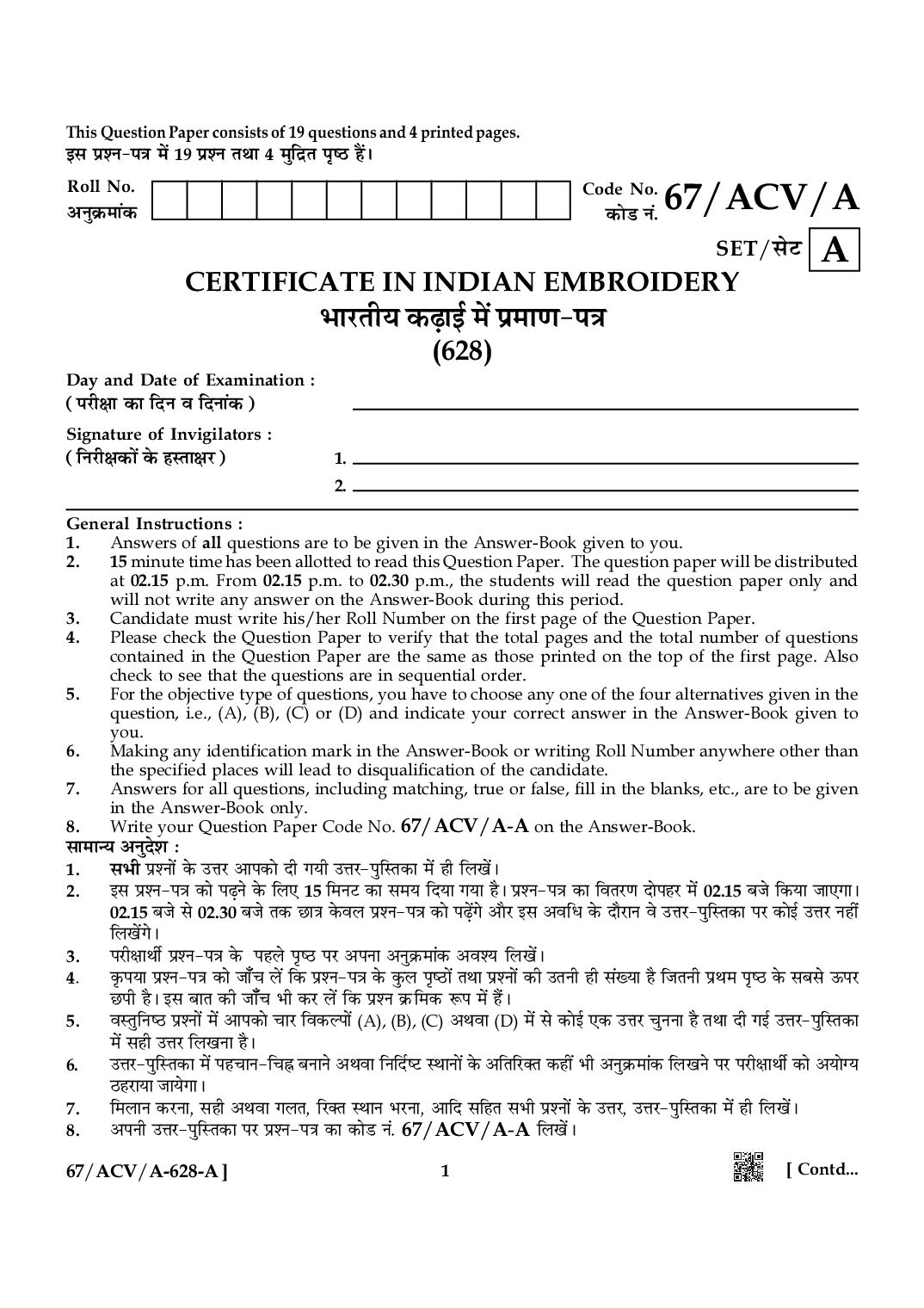
NIOS Class 10 April 2024 Question Paper Certificate in Indian Embroidery – Text
Read the full text of this question paper below — useful to quickly search, copy and reference the content online without downloading the PDF.
📄 View text version (4 pages)
Page 1
ß‚ ¬˝‡Ÿ-¬òÊ ◊¥ 19 ¬˝‡Ÿ ÃÕÊ 4 ◊ÈÁŒ˝Ã ¬Îc∆U „Ò¥–
Roll No. Code No.
•ŸÈ∑˝§◊Ê¥∑§ ∑§Ê«U Ÿ¥.
67/ACV/A
SET/‚ ≈ A
Day and Date of Examination :
(¬⁄UˡÊÊ ∑§Ê ÁŒŸ fl ÁŒŸÊ¥∑§)
Signature of Invigilators :
(ÁŸ⁄UˡÊ∑§Ê¥ ∑§ „SÃÊˇÊ⁄U) 1.
2.
General Instructions :
1. Answers of all questions are to be given in the Answer-Book given to you.
2. 15 minute time has been allotted to read this Question Paper. The question paper will be distributed
at 02.15 p.m. From 02.15 p.m. to 02.30 p.m., the students will read the question paper only and
will not write any answer on the Answer-Book during this period.
3. Candidate must write his/her Roll Number on the first page of the Question Paper.
4. Please check the Question Paper to verify that the total pages and the total number of questions
contained in the Question Paper are the same as those printed on the top of the first page. Also
check to see that the questions are in sequential order.
5. For the objective type of questions, you have to choose any one of the four alternatives given in the
question, i.e., (A), (B), (C) or (D) and indicate your correct answer in the Answer-Book given to
you.
6. Making any identification mark in the Answer-Book or writing Roll Number anywhere other than
the specified places will lead to disqualification of the candidate.
7. Answers for all questions, including matching, true or false, fill in the blanks, etc., are to be given
in the Answer-Book only.
8. Write your Question Paper Code No. 67/ACV/A-A on the Answer-Book.
‚Ê◊Êãÿ •ŸÈŒ‡Ê —
1. ‚÷Ë ¬˝‡ŸÊ¥ ∑§ ©ûÊ⁄U •Ê¬∑§Ê ŒË ªÿË ©ûÊ⁄U-¬ÈÁSÃ∑§Ê ◊¥ „Ë Á‹π¥–
2. ß‚ ¬˝‡Ÿ-¬òÊ ∑§Ê ¬…∏Ÿ ∑§ Á‹∞ 15 Á◊Ÿ≈U ∑§Ê ‚◊ÿ ÁŒÿÊ ªÿÊ „Ò– ¬˝‡Ÿ-¬òÊ ∑§Ê ÁflÃ⁄UáÊ ŒÊ¬„⁄U ◊¥ 02.15 ’¡ Á∑§ÿÊ ¡Ê∞ªÊ–
02.15 ’¡ ‚ 02.30 ’¡ Ã∑§ ¿UÊòÊ ∑§fl‹ ¬˝‡Ÿ-¬òÊ ∑§Ê ¬…∏¥ª •ÊÒ⁄U ß‚ •flÁœ ∑§ ŒÊÒ⁄UÊŸ fl ©ûÊ⁄U-¬ÈÁSÃ∑§Ê ¬⁄U ∑§Ê߸ ©ûÊ⁄U Ÿ„Ë¥
Á‹π¥ª–
3. ¬⁄UˡÊÊÕ˸ ¬˝‡Ÿ-¬òÊ ∑§ §¬„‹ ¬Îc∆U ¬⁄U •¬ŸÊ •ŸÈ∑˝§◊Ê¥∑§ •fl‡ÿU Á‹π¥–
4. ∑Χ¬ÿÊ ¬˝‡Ÿ-¬òÊ ∑§Ê ¡ÊÚ°ø ‹¥ Á∑§ ¬˝‡Ÿ-¬òÊ ∑§ ∑ȧ‹ ¬Îc∆UÊ¥ ÃÕÊ ¬˝‡ŸÊ¥ ∑§Ë ©ÃŸË „Ë ‚¥ÅUÿÊ „Ò Á¡ÃŸË ¬˝Õ◊ ¬Îc∆ ∑ §‚’‚ ™§¬⁄U
¿U¬Ë „Ò– ß‚ ’Êà ∑§Ë ¡ÊÚ°ø ÷Ë ∑§⁄U ‹¥ Á∑§ ¬˝‡Ÿ ∑˝ Á◊∑§ UM§¬ ◊¥ „Ò¥–
5. flSÃÈÁŸc∆U ¬˝‡ŸÊ¥ ◊¥ •Ê¬∑§Ê øÊ⁄U Áfl∑§À¬Ê¥ (A), (B), (C) •ÕflÊ (D) ◊¥ ‚ ∑§Ê߸ ∞∑§ ©ûÊ⁄U øÈŸŸÊ „Ò ÃÕÊ ŒË ªß¸ ©ûÊ⁄U-¬ÈÁSÃ∑§Ê
◊¥ ‚„Ë ©ûÊ⁄U Á‹πŸÊ „Ò–
6. § ©ûÊ⁄U-¬ÈÁSUÃ∑§Ê ◊¥ ¬„øÊŸ-Áøq ’ŸÊŸ •ÕflÊ ÁŸÁŒ¸c≈U SÕÊŸÊ¥ ∑§§•ÁÃÁ⁄UÄà ∑§„Ë¥ ÷Ë •ŸÈ∑˝§◊Ê¥∑§ Á‹πŸ ¬⁄U ¬⁄UˡÊÊÕ˸ ∑§Ê •ÿÊÇÿ
∆U„⁄UÊÿÊ ¡ÊÿªÊ–
7. Á◊‹ÊŸ ∑§⁄UŸÊ, ‚„Ë •ÕflÊ ª‹Ã, Á⁄UÄà SÕÊŸ ÷⁄UŸÊ, •ÊÁŒ ‚Á„à ‚÷Ë ¬˝‡ŸÊ¥ ∑§ ©ûÊ⁄U, ©ûÊ⁄U-¬ÈÁSÃ∑§Ê ◊¥ „Ë Á‹π¥–
8. •¬ŸË ©ûÊ⁄U-¬ÈÁSUÃ∑§Ê ¬⁄U ¬˝‡Ÿ-¬òÊ ∑§Ê ∑§Ê«U Ÿ¥. 67/ACV/A-A Á‹π¥–
67/ACV/A-628-A ] 1 [ Contd...
Page 2
‚◊ÿ — 1½ ÉÊá≈U ] [ ¬ÍáÊÊZ∑§ — 30
Note : (i) This Question Paper consists of four parts, viz. Part-I, Part-II, Part-III and Part-IV
containing 19 questions.
(ii) Part-I contains five Multiple Choice Questions (MCQs). For these questions, you have
to choose the most appropriate answer from amongst the four choices given as (A), (B),
(C) and (D) and write your answer in the Answer-Book. Each question carries 1 mark.
(iii) Part-II contains five True or False statement questions. Write True or False in the
Answer-Book. Each question carries 1 mark.
(iv) Part-III contains seven Short Answer Type Questions. Each question carries 2 marks.
(v) Part-IV contains two Long Answer Type Questions. Each question carries 3 marks.
ÁŸŒ¸‡Ê — (i) ß‚ ¬˝‡Ÿ-¬òÊ ◊¥ 19 ¬˝‡Ÿ „Ò¥, ¡Ê øÊ⁄U ÷ʪʥ - ÷ʪ-I, ÷ʪ-II, ÷ʪ-III ÃÕÊ ÷ʪ-IV ◊¥ Áfl÷ÊÁ¡Ã „Ò¥–
(ii) ÷ʪ-I ◊¥ ¬Ê°ø ’„ÈÁfl∑§À¬Ëÿ (MCQs) ¬˝‡Ÿ „Ò¥– ’„ÈÁfl∑§À¬Ëÿ ¬˝∑§Ê⁄U ∑§ ¬˝‡ŸÊ¥ ∑§ Á‹∞ ©¬‹éœ øÊ⁄U Áfl∑§À¬Ê¥
(A), (B), (C) •ÊÒ⁄U (D) ◊¥ ‚ ‚flʸÁœ∑§ ©¬ÿÈÄà ©ûÊ⁄U øÈŸ∑§⁄U ©ûÊ⁄U-¬ÈÁSÃ∑§Ê ◊¥ Á‹Áπ∞– ¬˝àÿ∑§ ¬˝‡Ÿ ∑§
Á‹∞ 1 •¥∑§ ÁŸœÊ¸Á⁄Uà „Ò–
(iii) ÷ʪ-II ◊¥ ¬Ê°ø ‚„Ë ÿÊ ª‹Ã ∑§ÕŸ ∑§ ¬˝‡Ÿ „Ò¥– ©ûÊ⁄U-¬ÈÁSÃ∑§Ê ◊¥ ‚„Ë ÿÊ ª‹Ã Á‹Áπ∞– ¬˝àÿ∑§ ¬˝‡Ÿ ∑§
Á‹∞ 1 •¥∑§ ÁŸœÊ¸Á⁄Uà „Ò–
(iv) ÷ʪ-III ◊¥ ‚Êà ‹ÉÊÈ-©ûÊ⁄UËÿ ¬˝∑§Ê⁄U ∑§ ¬˝‡Ÿ „Ò¥– ¬˝àÿ∑§ ¬˝‡Ÿ ∑§ Á‹∞ 2 •¥∑§ ÁŸœÊ¸Á⁄Uà „Ò¥–
(v) ÷ʪ-IV ◊¥ ŒÊ ŒËÉʸ-©ûÊ⁄UËÿ ¬˝∑§Ê⁄U ∑§ ¬˝‡Ÿ „Ò¥– ¬˝àÿ∑§ ¬˝‡Ÿ ∑§ Á‹∞ 3 •¥∑§ ÁŸœÊ¸Á⁄Uà „Ò¥–
PART - I / ÷ʪ - I
1. The embroidery work from this region narrates the story of life : 1
(A) Karnataka (B) Punjab
(C) Bengal (D) Kashmir
ß‚ ˇÊòÊ ∑§Ë ∑§…∏Ê߸ ¡ËflŸ ∑§Ë ∑§„ÊŸË ’ÃÊÃË „Ò —
(A) ∑§ŸÊ¸≈U∑§ (B) ¬¥¡Ê’
(C) ’¥ªÊ‹ (D) ∑§‡◊Ë⁄U
2. The background colour for Kanta Embroidery is usually : 1
(A) Red (B) White
(C) Blue (D) Yellow
∑§Ê¥ÕÊ ∑§…∏Ê߸ •Áœ∑§Ã⁄U ß‚ ⁄¥Uª ∑§ ∑§¬«∏ ¬⁄U ∑§Ë ¡ÊÃË „Ò —
(A) ‹Ê‹ (B) ‚»§Œ
(C) ŸË‹Ê (D) ¬Ë‹Ê
67/ACV/A-628-A ] 2 [ Contd...
Page 3
(A) Vata chikan (B) Sozni
(C) Talai bar (D) Kalka
∑§‡ÊËŒÊ ◊¥ ÁòÊ∑§ÊáÊ ∑§ •Ê∑§Ê⁄U ∑§Ê •Ê◊ ∑§Ê ◊ÊÁ≈U»§ ∑§Ê ∑§„à „Ò¥ —
(A) flÊ≈UÊ Áø∑§Ÿ (B) ‚Ê$¡ŸË
(C) ËҒÊ⁄U (D) ∑§Ê‹∑§Ê
4. A motif filled with chain stitch and a small mirror is called : 1
(A) Mochi Bharat (B) Moti Bharat
(C) Badla work (D) Kinari work
ß‚ ∑§…∏Ê߸ ◊¥ øŸ ÁS≈Uø ‚ ◊ÊÁ≈U»§ •ÊÒ⁄U ¿UÊ≈U-¿UÊ≈U ‡ÊˇÊ, ÷⁄UÊ ¡ÊÃÊ „Ò —
(A) ◊ÊøË ÷⁄Uà (B) ◊ÊÃË ÷⁄UÃ
(C) ’ÊŒ‹Ê ∑§Ê ∑§Ê◊ (D) Á∑§ŸÊ⁄UË ∑§Ê ∑§Ê◊
5. This type of communication takes place between the workers in an organization : 1
(A) Exchange of thoughts (B) Internal communication
(C) Telephone (D) Reports
ß‚ ¬˝∑§Ê⁄U ∑§Ê ‚¥øÊ⁄U ∞∑§ „Ë ‚¥SÕÊ ∑§ ∑§Êÿ¸∑§Ãʸ•Ê¥ ∑§ ’Ëø „ÊÃÊ „Ò —
(A) ÁfløÊ⁄UÊ¥ ∑§Ê •ŒÊŸ ¬˝ŒÊŸ (B) •¥ÃÁ⁄U∑§ ‚¥øÊ⁄U
(C) ≈U‹Ë»§ÊŸ (D) Á⁄U¬Ê≈¸U
PART - II / ÷ʪ - II
State whether the following statements are True ‘T’ or False ‘F’
ŸËø ÁŒÿ ªÿ ∑§ÕŸÊ¥ ∑§ •Êª ‚„Ë (P) ÿÊ ª‹Ã (O) ∑§Ê ÁŸ‡ÊÊŸ •¥Á∑§Ã ∑§⁄¥U–
6. Lower number needles are thick. 1
•Áœ∑§ ◊Ê≈UË ‚Í߸ ∑§◊ ‚¥ÅÿÊ ∑§ „Êà „Ò¥–
7. Stem stitch is used for filling a design. 1
S≈U◊ ÁS≈Uø ◊͋× ÷⁄UÊ߸ ∑§Ê ≈UÊ¥∑§Ê „Ò¥–
8. Chambarumal of Bengal State depicts the Ras Mandals of Lord Krishna. 1
’¥ªÊ‹ ⁄UÊíÿ ∑§ øê’ÊL§◊Ê‹ ⁄UÊ‚ ◊á«U‹ •ÊÒ⁄U ∑ΧcáÊ ∑§ ◊ÊÁ≈U»§ Œ‡Êʸà „Ò¥–
9. Geometrical designs are more used in Rajasthan. 1
⁄UÊ¡SÕÊŸ ◊¥ íÿÊÁ◊ÃËÿ Á«U$¡Êߟʥ ∑§Ê ¬˝ÿʪ íÿÊŒÊ „ÊÃÊ „Ò¥–
10. In a proprietary unit, a single individual is the sole owner for the concern. 1
SflÊ◊Ëÿ ‚¥SÕÊŸ ◊¥ ∞∑§ •∑§‹Ê √ÿÁÄà ©‚∑§Ê ◊ÊÁ‹∑§ „ÊÃÊ „Ò–
67/ACV/A-628-A ] 3 [ Contd...
Page 4
Short answer type questions :
‹ÉÊÈ ©ûÊ⁄UËÿ ¬˝‡Ÿ —
11. How will you transfer a design to the fabric by “Back Tracing” technique ? 2
““’Ò∑§ ≈˛UÁ‚¥ª”” Ã∑§ŸË∑§ mÊ⁄UÊ •Ê¬ Á∑§‚Ë Á«U$¡Êߟ ∑§Ê ∑§¬«∏ ¬⁄U ∑Ò§‚ SÕÊŸÊ¥ÃÁ⁄Uà ∑§⁄¥Uª?
12. How do you make a ‘French knot’ stitch ? 2
“»˝¥§ø ŸÊÚ≈U” ∑§…∏Ê߸ ∑Ò§‚ ’ŸÊÿË ¡ÊÃË „Ò?
13. How is the method of Kasuti embroidery different from the other types of embroidery ? 2
∑§‚ÍÃË ∑§…∏Ê߸ ∑§⁄UŸ ∑§Ë ÁflÁœ •ãÿ Á∑§‚Ë ÷Ë ¬˝∑§Ê⁄U ∑§Ë ∑§…∏Ê߸ ‚ ∑Ò§‚ Á÷㟠„Ò?
14. What is the main stitch used in Phulkari embroidery ? How is it done ? 2
»È§‹∑§Ê⁄UË ∑§…∏Ê߸ ¬˝ÿʪ ∑§Ê ◊ÈÅÿ ≈UÊ°∑§Ê ∑§ÊÒŸ ‚Ê „Ò? ß‚ ’ŸÊŸ ∑§Ë ÁflÁœ Á‹π¥–
15. What do you know about ‘Phanda’ embroidery ? 2
“»¥§ŒUÊ” ∑§…∏Ê߸ ‚ •Ê¬ ÄÿÊ ‚◊¤Êà „Ò?
16. Briefly explain the two special tools used in ‘Aari’ embroidery. 2
“•Ê⁄UË” ∑§…∏Ê߸ ◊¥ ¬˝ÿʪ Á∑§ÿ ¡ÊŸ flÊ‹ ŒÊ •ÊÒ¡Ê⁄UÊ¥ ∑§Ê ‚ˇÊ¬ ◊¥ ‚◊¤ÊÊß∞–
17. Write any four precautions to be observed during ironing. 2
ßSòÊË ∑§⁄UŸ ∑§ ŒÊÒ⁄UÊŸ •¬ŸÊÿË ¡ÊŸ flÊ‹Ë ∑§Ê߸ øÊ⁄U ‚ÊflœÊÁŸÿÊ° Á‹π¥–
PART - IV / ÷ʪ - IV
Long answer type questions :
ÁŒÉʸ ©ûÊ⁄UËÿ ¬˝‡Ÿ —
18. How can you enlarge and reduce a design ? 3
Á«U$¡Êߟ ∑§Ê ¬Á⁄Uflœ¸Ÿ •ÊÒ⁄U ‹ÉÊÈ∑§⁄UáÊ •Ê¬ ∑Ò§‚ ∑§⁄¥Uª?
19. Briefly explain the special materials used in Zardozi embroidery. Also list some of the 3
products made using Zardozi.
¡⁄UŒÊ¡Ë ◊¥ ¬˝ÿʪ ∑§Ë ¡ÊŸ flÊ‹Ë ‚Ê◊ª˝Ë ∑§Ê ‚ˇÊ¬ ◊¥ ‚◊¤ÊÊ∞°– ¡⁄UŒÊ¡Ë ‚ ’ŸÊ∞° ¡ÊŸ flÊ‹ ©à¬ÊŒÊ¥ ∑§Ë ‚ÍøË ’ŸÊ∞°–
-oOo-
67/ACV/A-628-A ] 4 [ Contd...
Document Details
| Board / Org | NIOS |
| Exam | National Institute of Open Schooling Class 10 |
| Type | Question Paper |
| Pages | 4 |
| Language | english |
| Updated | 24 Sep 2026 |