JNUEE 2021 Question Paper Ph.D Life Sciences
Finished viewing? Save it for later —
Download JNUEE 2021 Question Paper Ph.D Life Sciences (PDF · 22 pages)About JNUEE 2021 Question Paper Ph.D Life Sciences
JNUEE 2021 Question Paper Ph.D Life Sciences is available here for free download. Published by NTA for Jawaharlal Nehru University Entrance Examination, this question paper can be viewed online or downloaded as a PDF (22 pages). Candidates preparing for Jawaharlal Nehru University Entrance Examination can use JNUEE 2021 Question Paper Ph.D Life Sciences to understand the exam pattern, the type of questions asked, and the overall difficulty level.
Frequently Asked Questions
How can I download JNUEE 2021 Question Paper Ph.D Life Sciences?
Open this page and click the Download button to save JNUEE 2021 Question Paper Ph.D Life Sciences as a PDF. It is completely free on AglaSem Docs.
Is JNUEE 2021 Question Paper Ph.D Life Sciences free to download?
Yes. JNUEE 2021 Question Paper Ph.D Life Sciences can be viewed online and downloaded as a PDF free of cost on AglaSem Docs.
How many pages does JNUEE 2021 Question Paper Ph.D Life Sciences have?
JNUEE 2021 Question Paper Ph.D Life Sciences contains 22 pages, which you can read online or download together as a single PDF.
Where can I find more Jawaharlal Nehru University Entrance Examination study material?
You can find more Jawaharlal Nehru University Entrance Examination question papers, sample papers, syllabus, and answer keys on AglaSem Docs.
JNUEE 2021 Question Paper Ph.D Life Sciences – Text
Read the full text of this question paper below — useful to quickly search, copy and reference the content online without downloading the PDF.
📄 View text version (22 pages)
Page 1
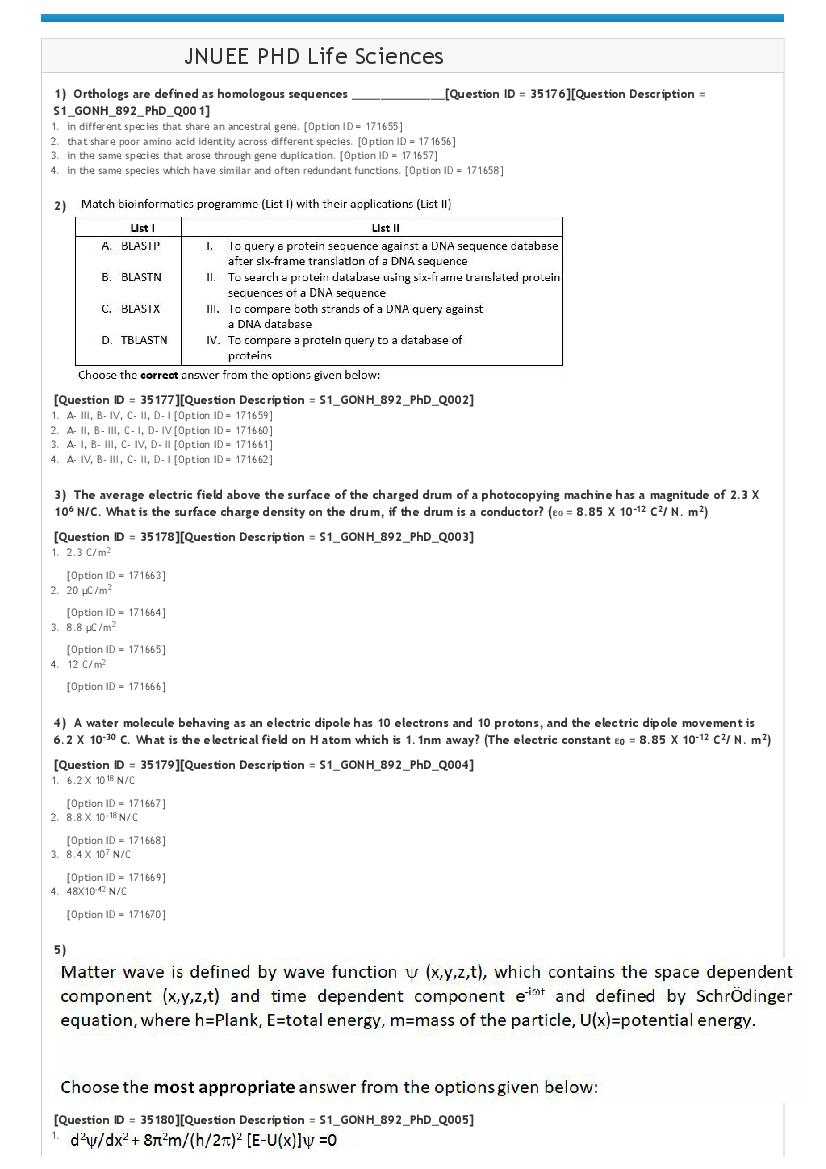
1) Orthologs are defined as homologous sequences _____________[Question ID = 35176][Question Description =
S1_GONH_892_PhD_Q001]
1. in different species that share an ancestral gene. [Option ID = 171655]
2. that share poor amino acid identity across different species. [Option ID = 171656]
3. in the same species that arose through gene duplication. [Option ID = 171657]
4. in the same species which have similar and often redundant functions. [Option ID = 171658]
2)
[Question ID = 35177][Question Description = S1_GONH_892_PhD_Q002]
1. A‐ III, B‐ IV, C‐ II, D‐ I [Option ID = 171659]
2. A‐ II, B‐ III, C‐ I, D‐ IV [Option ID = 171660]
3. A‐ I, B‐ III, C‐ IV, D‐ II [Option ID = 171661]
4. A‐ IV, B‐ III, C‐ II, D‐ I [Option ID = 171662]
3) The average electric field above the surface of the charged drum of a photocopying machine has a magnitude of 2.3 X
106 N/C. What is the surface charge density on the drum, if the drum is a conductor? (ɛ0 = 8.85 X 10‐12 C2/ N. m2)
[Question ID = 35178][Question Description = S1_GONH_892_PhD_Q003]
1. 2.3 C/m2
[Option ID = 171663]
2. 20 µC/m2
[Option ID = 171664]
3. 8.8 µC/m2
[Option ID = 171665]
4. 12 C/m2
[Option ID = 171666]
4) A water molecule behaving as an electric dipole has 10 electrons and 10 protons, and the electric dipole movement is
6.2 X 10‐30 C. What is the electrical field on H atom which is 1.1nm away? (The electric constant ɛ0 = 8.85 X 10‐12 C2/ N. m2)
[Question ID = 35179][Question Description = S1_GONH_892_PhD_Q004]
1. 6.2 X 10¹⁸ N/C
[Option ID = 171667]
2. 8.8 X 10‐18 N/C
[Option ID = 171668]
3. 8.4 X 10⁷ N/C
[Option ID = 171669]
4. 48X10‐42 N/C
[Option ID = 171670]
5)
[Question ID = 35180][Question Description = S1_GONH_892_PhD_Q005]
1.
Page 2
2.
[Option ID = 171672]
3.
[Option ID = 171673]
4.
[Option ID = 171674]
6) The wave function of hydrogen atom’s ground state is defined as___ .[where a=bohr radius]
[Question ID = 35181][Question Description = S1_GONH_892_PhD_Q006]
1.
[Option ID = 171675]
2.
[Option ID = 171676]
3.
[Option ID = 171677]
4.
[Option ID = 171678]
7) When a planet of mass (m) moves in circular orbit of radius (r) , the mechanical energy E is measured as:
[Question ID = 35182][Question Description = S1_GONH_892_PhD_Q007]
1. ‐GMm/r
[Option ID = 171679]
2. ‐GMm/2r
[Option ID = 171680]
3. ‐2GMm/r
[Option ID = 171681]
4. ‐GMm/r2
[Option ID = 171682]
8)
[Question ID = 35183][Question Description = S1_GONH_892_PhD_Q008]
1.
[Option ID = 171683]
2.
[Option ID = 171684]
3.
[Option ID = 171685]
4.
[Option ID = 171686]
9)
[Question ID = 35184][Question Description = S1_GONH_892_PhD_Q009]
1. A‐I, B‐II, C‐III [Option ID = 171687]
2. A‐I, B‐III, C‐II [Option ID = 171688]
3. A‐II, B‐I, C‐III [Option ID = 171689]
4. A‐III, B‐I, C‐II [Option ID = 171690]
Page 3
S1_GONH_892_PhD_Q010]
1. Conversion of primary alcohol to aldehyde [Option ID = 171691]
2. Conversion of secondary alcohol to ketone [Option ID = 171692]
3. Conversion of aldehydes to carboxylic acids [Option ID = 171693]
4. Conversion of primary amine to imine [Option ID = 171694]
11)
[Question ID = 35186][Question Description = S1_GONH_892_PhD_Q011]
1. D < C < B < A
[Option ID = 171695]
2. A < B < C < D
[Option ID = 171696]
3. A < C < D < B
[Option ID = 171697]
4. B < A < D < C
[Option ID = 171698]
12) Which of the following species is responsible for methemoglobinemia or blue baby syndrome?[Question ID = 24983]
[Question Description = S1_GONH_892_PhD_Q012]
1. SO4‐2 [Option ID = 171699]
2. CO3‐2 [Option ID = 171700]
3. NO3‐ [Option ID = 171701]
4. F‐1 [Option ID = 171702]
13)
[Question ID = 24984][Question Description = S1_GONH_892_PhD_Q013]
1. A < B < D < C
[Option ID = 171703]
2. B ≈ C < D < A
[Option ID = 171704]
3. A < D < C ≈ B
[Option ID = 171705]
4. A < C < D < B
[Option ID = 171706]
14) If cos θ = ‐5/13, where θ lies in the third quadrant, then the value of tan θ is _____.
[Question ID = 24985][Question Description = S1_GONH_892_PhD_Q014]
1. 12/5
[Option ID = 171707]
2. 5/12
[Option ID = 171708]
3. 13/12
[Option ID = 171709]
4. 1/5
[Option ID = 171710]
15) The sum of “m” terms of an arithmetic progression is same as sum of “n” terms. The sum of (n+m) terms
is_____________________.[Question ID = 24986][Question Description = S1_GONH_892_PhD_Q015]
1. m+n [Option ID = 171711]
Page 4
3. M‐n [Option ID = 171713]
4. (m+n)(m2‐n2) [Option ID = 171714]
16) Given below are two statements:
Statement I: Arabidopsis leaves are adaxially‐abaxially polarized.
Statement II: Trichomes and stomata are abundantly present in the adaxial and abaxial surface of Arabidopsis leaves,
respectively.
In the light of the above statements, choose the most appropriate answer from the options given below
[Question ID = 24987][Question Description = S1_GONH_892_PhD_Q016]
1. Both Statement I and Statement II are correct.
[Option ID = 171715]
2. Both Statement I and Statement II are incorrect.
[Option ID = 171716]
3. Statement I is correct but Statement II is incorrect.
[Option ID = 171717]
4. Statement I is incorrect but Statement II is correct.
[Option ID = 171718]
17) In Arabidopsis thaliana, zygotic embryo development involves multiple dynamic steps. The development from zygote
to mature embryo involves which one of the following major sequential steps?[Question ID = 24988][Question Description =
S1_GONH_892_PhD_Q017]
1. Zygote ‐‐> Globular stage ‐‐ > Heart shaped stage ‐‐> Transition stage ‐‐>Torpedo/Bent cotyledon stage. [Option ID = 171719]
2. Zygote ‐‐> Heart shaped stage ‐‐> Globular stage ‐‐ > Transition stage ‐‐> Torpedo/Bent cotyledon stage. [Option ID = 171720]
3. Zygote ‐‐> Globular stage ‐‐ > Transition stage ‐‐> Heart shaped stage ‐‐> Torpedo/Bent cotyledon stage. [Option ID = 171721]
4. Zygote ‐‐> Globular stage ‐‐ > Heart shaped stage ‐‐> Torpedo/Bent cotyledon stage ‐‐> Transition stage. [Option ID = 171722]
18) Given below are two statements: one is labelled as Assertion A and the other is labelled as Reason R
Assertion A: In Arabidopsis, quadruple mutants sepalata1 to 4 (sep1, 2, 3, 4) show a conversion of all four‐floral organs
(sepals, petals, stamens, and carpels) types into leaf like structures.
Reason R: In Arabidopsis, SEPALATA1 to 4 genes (E Class) are redundantly involved and essential for floral organ
development.
In the light of the above statements, choose the most appropriate answer from the options given below
[Question ID = 24989][Question Description = S1_GONH_892_PhD_Q018]
1. Both A and R are correct and R is the correct explanation of A.
[Option ID = 171723]
2. Both A and R are correct but R is NOT the correct explanation of A.
[Option ID = 171724]
3. A is correct but R is not correct.
[Option ID = 171725]
4. A is not correct but R is correct.
[Option ID = 171726]
19) Four independently insect‐resistant transgenic cotton plants have been developed by expressing a bacterial gene
through Agrobacterium‐mediated plant transformation method using T‐DNA vector. Experimental method/s for checking the
copy number in transgenic plants may be ‐
A. DNA isolation followed by Southern blotting.
B. RNA isolation and Northern blotting.
C. RNA isolation and quantitative RT‐PCR (Polymerase chain reaction).
D. DNA isolation followed by restriction enzyme digestion on gel electrophoresis.
Choose the correct answer from the options given below:
[Question ID = 24990][Question Description = S1_GONH_892_PhD_Q019]
1. A and D Only
[Option ID = 171727]
2. A Only
[Option ID = 171728]
3. C Only
[Option ID = 171729]
4. B and D Only
[Option ID = 171730]
Page 5
Statement I: Phloem loading and unloading at source and sink, respectively establish pressure gradient.
Statement II: Flow of solution in the sieve element is driven by an osmotically‐generated pressure gradient.
In the light of the above statements, choose the most appropriate answer from the options given below
[Question ID = 24991][Question Description = S1_GONH_892_PhD_Q020]
1. Both Statement I and Statement II are correct.
[Option ID = 171731]
2. Both Statement I and Statement II are incorrect
[Option ID = 171732]
3. Statement I is correct but Statement II is incorrect
[Option ID = 171733]
4. Statement I is incorrect but Statement II is correct
[Option ID = 171734]
21) What do you expect to happen if a carotenoid‐deficient mutant plant is grown under normal sunlight?[Question ID =
24992][Question Description = S1_GONH_892_PhD_Q021]
1. Increased photosynthetic rate. [Option ID = 171735]
2. Increased chlorophyll biosynthesis. [Option ID = 171736]
3. Increased chlorophyll oxidation and necrosis. [Option ID = 171737]
4. Reduced photorespiration. [Option ID = 171738]
22) Which of the following function(s) as GA receptor?
A. GA‐insensitive dwarf1 (GID1)
B. DELLA protein
C. F‐box related SLEEPY1 (SLY1)
Choose the correct answer from following options:
[Question ID = 24993][Question Description = S1_GONH_892_PhD_Q022]
1. A Only
[Option ID = 171739]
2. B Only
[Option ID = 171740]
3. A and C Only
[Option ID = 171741]
4. B and C Only
[Option ID = 171742]
23) Light‐mediated stomatal opening is largely regulated by the perception of________[Question ID = 24994][Question
Description = S1_GONH_892_PhD_Q023]
1. red/far‐red light by phytochrome. [Option ID = 171743]
2. blue/ UV‐light by cryptochrome. [Option ID = 171744]
3. red/far‐red light by phototropin. [Option ID = 171745]
4. blue/ UV light by phototropin. [Option ID = 171746]
24) Differential distribution and intercellular movement of which plant hormone is mainly attributed to the vascular
development?[Question ID = 24995][Question Description = S1_GONH_892_PhD_Q024]
1. Cytokinin [Option ID = 171747]
2. Gibberelins [Option ID = 171748]
3. Auxin [Option ID = 171749]
4. Bassinosteroid [Option ID = 171750]
25) Given below are two statements:
Statement I : A plant that is infected once by a pathogen become resistant to subsequent infections.
Statement II : Plants contain dedicated immune cells for retaining infection memory.
In the light of the above statements, choose the most appropriate answer from the options given below
[Question ID = 24996][Question Description = S1_GONH_892_PhD_Q025]
1. Both Statement I and Statement II are correct.
[Option ID = 171751]
2. Both Statement I and Statement II are incorrect.
[Option ID = 171752]
3. Statement I is incorrect but Statement II is correct.
[Option ID = 171753]
Page 6
[Option ID = 171754]
26) Given below are two statements: one is labelled as Assertion A and the other is labelled as Reason R
Assertion A:
Under light, phytochrome mutants show longer hypocotyls than the wild type plants.
Reason R:
Light suppresses hypocotyl growth and phytochrome is required for the process.
In the light of the above statements, choose the most appropriate answer from the options given below
[Question ID = 24997][Question Description = S1_GONH_892_PhD_Q026]
1. Both A and R are correct and R is the correct explanation of A.
[Option ID = 171755]
2. Both A and R are correct but R is not the correct explanation of A.
[Option ID = 171756]
3. A is correct but R is not correct.
[Option ID = 171757]
4. A is not correct but R is correct.
[Option ID = 171758]
27) Given below are two statements: one is labelled as Assertion A and the other is labelled as Reason R
Assertion A: Cleaved Amplified Polymorphic Sequence (CAPS) marker distinguishes homozygous parents as well as F1
progeny.
Reason R: CAPS is a co‐dominant marker.
In the light of the above statements, choose the most appropriate answer from the options given below
[Question ID = 24998][Question Description = S1_GONH_892_PhD_Q027]
1. Both A and R are correct and R is the correct explanation of A.
[Option ID = 171759]
2. Both A and R are correct but R is not the correct explanation of A.
[Option ID = 171760]
3. A is correct but R is not correct.
[Option ID = 171761]
4. A is not correct but R is correct.
[Option ID = 171762]
28) Mature sieve elements lack several structures that are normally found in living cells. Identify such structures from the
option given below.
A. Nuclei
B. Tonoplast
C. Mitochondria
D. Plastids
E. Smooth ER
Choose correct answer from the options given below:
[Question ID = 24999][Question Description = S1_GONH_892_PhD_Q028]
1. A, B and E Only
[Option ID = 171763]
2. C , D and E Only
[Option ID = 171764]
3. C and D Only
[Option ID = 171765]
4. A and B Only
[Option ID = 171766]
29) A purified circular plasmid DNA sample was cut with two restriction enzymes (RE1 & RE2) and resolved on an agarose
gel.
The following results were observed :
Page 7
B. Sample cut with RE2 : 5 kb band
C. Sample cut with both RE1 and RE2 : 2.8 kb, 1.2 kb, and 1.0 kb bands.
The plasmid has:
[Question ID = 25000][Question Description = S1_GONH_892_PhD_Q029]
1. 3 sites for RE1 and 2 sites for RE2
[Option ID = 171767]
2. 2 sites for RE1 and 2 sites for RE2
[Option ID = 171768]
3. 2 sites for RE1 and 1 site for RE2
[Option ID = 171769]
4. 2 sites for RE1 and 3 sites for RE2
[Option ID = 171770]
30) Which of the following methods can be used for targeted genome editing in plants?
A. CRISPR/Cas9 –based method.
B. TALEN method.
C. Chemical (e.g. EMS) mutagenesis
D. Irradiation by a radioisotope.
Choose the correct answer from the options given below:
[Question ID = 34989][Question Description = S1_GONH_892_PhD_Q030]
1. C and D Only
[Option ID = 171771]
2. A and B Only
[Option ID = 171772]
3. A and D Only
[Option ID = 171773]
4. A Only
[Option ID = 171774]
31) Development of transgenic plants through regeneration‐based method involves multiple steps, the sequence of which
are as follows; identify the correct one.[Question ID = 34990][Question Description = S1_GONH_892_PhD_Q031]
1. Cloning of gene of interest in binary vector‐‐> Molecular confirmation of Transgenic plants ‐‐> Transfer of DNA to plant ‐‐> Regeneration and
selection of transgenic plants. [Option ID = 171775]
2. Cloning of gene of interest in binary vector ‐‐ > Regeneration of plants and selection of transgenic plants ‐‐> Transfer of DNA to plant ‐‐> Molecular
confirmation of Transgenic plants. [Option ID = 171776]
3. Cloning of gene of interest in binary vector ‐‐> Transfer of DNA to plant ‐‐ > Regeneration and selection of transgenic plants ‐‐> Molecular
confirmation of Transgenic plants. [Option ID = 171777]
4. Cloning of gene of interest in binary vector ‐‐> Transfer of DNA to plant ‐‐> Molecular confirmation of Transgenic plants‐‐ > Regeneration and
selection of transgenic plants. [Option ID = 171778]
32) Which of the following plant viruses are known to replicate in nuclei?[Question ID = 34991][Question Description =
S1_GONH_892_PhD_Q032]
1. Tobacco mosaic virus and Tobacco leaf curl virus [Option ID = 171779]
2. Tobacco leaf curl virus and Cauliflower mosaic virus [Option ID = 171780]
3. Tobacco leaf curl virus and Tomato spotted wilt virus [Option ID = 171781]
4. Tobacco mosaic virus and Cauliflower mosaic virus [Option ID = 171782]
33) Which of the following statement(s) related to transplantation are true?
A. In outbred populations, an individual is more likely to be histocompatible with one of its parents than with its siblings.
B. Rejection of an allograft mainly involves hyperacute rejection mediated by antibodies to alloantigens.
C. Second‐set rejection is a manifestation of immunologic memory.
D. All allografts between individuals with identical HLA haplotypes will be accepted.
E. Cytokines produced by host TH cells activated in response to alloantigens play a major role in graft rejection.
Choose the correct answer from the options given below:
[Question ID = 34992][Question Description = S1_GONH_892_PhD_Q033]
1. D only
[Option ID = 171783]
2. A and C Only
[Option ID = 171784]
Page 8
[Option ID = 171785]
4. C and E Only
[Option ID = 171786]
34) You isolate naïve T cells from your own blood and want to polarize them to the TH 1 lineage in vitro. Which among the
following reagents would be most appropriate to do this?
[Question ID = 34993][Question Description = S1_GONH_892_PhD_Q034]
1. Anti‐TCR antibody, IFN , anti‐CD80 antibody
[Option ID = 171787]
2. Anti‐TCR antibody, IL‐12, anti‐CD28 antibody
[Option ID = 171788]
3. Anti‐TCR antibody, IL‐4, anti‐CD28 antibody
[Option ID = 171789]
4. Anti‐TCR antibody, CTLA‐4 Ig, IL‐17
[Option ID = 171790]
35)
[Question ID = 34994][Question Description = S1_GONH_892_PhD_Q035]
1. A‐II, B‐IV, C‐I, D‐III [Option ID = 171791]
2. A‐II, B‐I, C‐III, D‐IV [Option ID = 171792]
3. A‐III, B‐IV, C‐I, D‐II [Option ID = 171793]
4. A‐III, B‐II, C‐IV, D‐I [Option ID = 171794]
36)
[Question ID = 34995][Question Description = S1_GONH_892_PhD_Q036]
1. A‐III, B‐I, C‐II, D‐IV
[Option ID = 171795]
2. A‐III, B‐II C‐I, D‐IV
[Option ID = 171796]
3. A‐III, B‐IV, C‐I, D‐II
[Option ID = 171797]
4. A‐ III, B‐IV, C‐II, D‐I
[Option ID = 171798]
37) Autoinducer of which of the following bacteria freely diffuses in and out of the cell?
A. Staphylococcus aureus
B. Psedomonas aeruginosa
C. Bacillus cereus
D. Streptococcus pneumonia
E. Vibrio fischeri
Choose the correct answer from the options given below: [Question ID = 34996][Question Description =
S1_GONH_892_PhD_Q037]
1. A, D Only [Option ID = 171799]
2. B, E Only [Option ID = 171800]
3. A, B, E Only [Option ID = 171801]
4. A, C, D Only [Option ID = 171802]
38) Given below are two statements:
Page 9
Statement II: Every bacterium can sense other bacteria without any species barrier.
In the light of the above statements, choose the correct answer from the options given below
[Question ID = 34997][Question Description = S1_GONH_892_PhD_Q038]
1. Both Statement I and Statement II are true.
[Option ID = 171803]
2. Both Statement I and Statement II are false.
[Option ID = 171804]
3. Statement I is false but Statement II is true.
[Option ID = 171805]
4. Statement I is true but Statement II is false.
[Option ID = 171806]
39) Binding of chemokine to a cell‐surface receptor results in cellular movement along the chemokine gradient. The
chemokine receptor ____________[Question ID = 34998][Question Description = S1_GONH_892_PhD_Q039]
1. is a G protein coupled receptor. [Option ID = 171807]
2. contains an ITAM (immuno receptor tyrosine activation motif) in its cytoplasmic domain. [Option ID = 171808]
3. contains an ITIM (immuno tyrosine inhibitory motif) in its cytoplasmic domain. [Option ID = 171809]
4. associates with other adapter proteins through its death domain. [Option ID = 171810]
40) Given below are two statements:
Statement I: Ligand gated Ca2+ channel on endoplasmic reticulum is operated by the binding to PIP2.
Statement II: Ca2+ released from endoplasmic reticulum activates protein kinase B.
In the light of the above statements, choose the correct answer from the options given below [Question ID = 34999]
[Question Description = S1_GONH_892_PhD_Q040]
1. Both Statement I and Statement II are true. [Option ID = 171811]
2. Both Statement I and Statement II are false. [Option ID = 171812]
3. Statement I is true but Statement II is false. [Option ID = 171813]
4. Statement I is false but Statement II is true. [Option ID = 171814]
41) Which of the following characteristic features are exhibited by Ras?
A. Ras is a proto‐oncogene.
B. It can be activated by G‐protein coupled receptor.
C. Ras is a transducer protein.
D. It has GTPase activity.
E. Ras has ATP binding site.
Choose the correct answer from the options given below
[Question ID = 35000][Question Description = S1_GONH_892_PhD_Q041]
1. A, B and E Only
[Option ID = 171815]
2. A, C and E Only
[Option ID = 171816]
3. A, B, C and E Only
[Option ID = 171817]
4. A, B, C and D Only
[Option ID = 171818]
42)
[Question ID = 35001][Question Description = S1_GONH_892_PhD_Q042]
1. A‐II, B‐I, C‐III, D‐IV [Option ID = 171819]
2. A‐I, B‐II, C‐III, D‐IV [Option ID = 171820]
3. A‐II, B‐IV, C‐III, D‐I [Option ID = 171821]
4. A‐IV, B‐II, C‐III, D‐I [Option ID = 171822]
43) The following statements indicate the viruses and their association with cancer in humans.
Page 10
B. Epstein‐Barr virus is an RNA virus associated with Burkitts Lymphoma.
C. Hepatitis C virus a DNA virus associated with hepatocellular carcinoma.
D. Hepatitis B virus is a DNA virus associated with hepatocellular carcinoma.
E. Human T‐cell leukemia virus is an RNA virus associated with lymphomas.
Choose the correct option (s) from below that indicates association of viruses with respective cancers they incite.
[Question ID = 35002][Question Description = S1_GONH_892_PhD_Q043]
1. A, B and E Only
[Option ID = 171823]
2. C, B and E Only
[Option ID = 171824]
3. A, B and D Only
[Option ID = 171825]
4. A, D and E Only
[Option ID = 171826]
44)
[Question ID = 35003][Question Description = S1_GONH_892_PhD_Q044]
1. A‐II, B‐III, C‐IV, D‐I [Option ID = 171827]
2. A‐II, B‐III, C‐I, D‐IV [Option ID = 171828]
3. A‐III, B‐II, C‐IV, D‐I [Option ID = 171829]
4. A‐III, B‐II, C‐I, D‐IV [Option ID = 171830]
45) Lactose fermenting, streptomycin sensitive E. coli culture was subjected to mutagenesis by nitrosoguanidine treatment
during growth in LB broth. After 24 h incubation, tenfold serial dilution was made and plated on LB agar, plates were
incubated at 370C for 24 h. A plate giving 225 well isolated colonies was to be processed to know whether or not there exist
Lactose non‐fermenting and Streptomycin resistant mutants. Which of the following methods would be the best that will
address this query?
[Question ID = 35004][Question Description = S1_GONH_892_PhD_Q045]
1. Replica plating
[Option ID = 171831]
2. Pour plating
[Option ID = 171832]
3. Streak plating
[Option ID = 171833]
4. Spread plating
[Option ID = 171834]
46) What are the main advantages of using the indirect method (using labelled secondary antibodies) in a technique like
ELISA?
A. It amplifies the signal.
B. It prevents wastage of expensive primary antibodies during labeling.
C. Same labeled secondary antibody can be used to detect many primary antibodies/serum samples.
D. It blocks non‐specific protein binding sites on the plate.
Choose the correct answer from the options given below:
[Question ID = 35005][Question Description = S1_GONH_892_PhD_Q046]
1. B and C Only
[Option ID = 171835]
2. A and B Only
[Option ID = 171836]
3. A, B and C Only
[Option ID = 171837]
4. A, C and D Only
Page 11
47) Why is it important to use an unstained control in an immunophenotyping experiment by flowcytometry?[Question ID =
35006][Question Description = S1_GONH_892_PhD_Q047]
1. To detect auto‐fluorescence or background staining innate to the cells of interest. [Option ID = 171839]
2. To confirm the specificity of primary antibody binding. [Option ID = 171840]
3. To rule out non‐specific Fc receptor binding or other cellular protein interactions. [Option ID = 171841]
4. To check for proper blocking for non‐specific sites. [Option ID = 171842]
48) Some techniques are mentioned below:‐
A. Fluorescence resonance energy transfer (FRET)
B. BiFluorescence complementation assay (BiFC)
C. Fluorescence recovery after photobleaching (FRAP)
D. Yeast two hybrid assay (Y2H)
Choose the most appropriate techniques that are used for fluorescence‐based protein interaction studies.
[Question ID = 35007][Question Description = S1_GONH_892_PhD_Q048]
1. B and C Only
[Option ID = 171843]
2. A and B Only
[Option ID = 171844]
3. A, B and C Only
[Option ID = 171845]
4. A, B, C and D Only
[Option ID = 171846]
49) Sepharose beads were incubated with p53 antibody overnight. Whole cell extract was added to it and further
incubated for 8 h.
To find which proteins are interacting with p53, following experiments were suggested to complete the whole process.
A. Northern blotting
B. SDS PAGE
C. Western blotting
D. South‐western blotting
Which of the following experiments will bring out the correct outcome?
[Question ID = 35008][Question Description = S1_GONH_892_PhD_Q049]
1. A and B Only
[Option ID = 171847]
2. A, C and D Only
[Option ID = 171848]
3. B and C Only
[Option ID = 171849]
4. C and D Only
[Option ID = 171850]
50)
[Question ID = 25001][Question Description = S1_GONH_892_PhD_Q050]
1. A‐I, B‐II, C‐III, D‐IV [Option ID = 171851]
2. A‐III, B‐I, C‐IV, D‐II [Option ID = 171852]
3. A‐II, B‐III, C‐I, D‐IV [Option ID = 171853]
4. A‐II, B‐I, C‐III, D‐IV [Option ID = 171854]
51)
Page 12
1. A‐II, B‐III, C‐I, D‐IV [Option ID = 171855]
2. A‐IV, B‐I, C‐III, D‐II [Option ID = 171856]
3. A‐II, B‐IV, C‐I, D‐III [Option ID = 171857]
4. A‐III, B‐II, C‐IV, D‐I [Option ID = 171858]
52) Given below are two statements: One is labelled as Assertion A and the other is labelled as Reason R.
Assertion A: A woman who has normal vision is married to a colour blind man. All her sons and daughter have normal vision.
Reason R: Some recessive X chromosome from mother and mother is homozygous for normal vision, so even daughters have
normal vision.
In the light of the above statements choose the most appropriate answer from the options given below
[Question ID = 25003][Question Description = S1_GONH_892_PhD_Q052]
1. Both A and R are true and R is the correct explanation of A.
[Option ID = 171859]
2. Both A and R are true but R is not the correct explanation of A.
[Option ID = 171860]
3. A is true but R is false.
[Option ID = 171861]
4. A is false but R is true.
[Option ID = 171862]
53) Given below are two statements: One is labelled as Assertion A and the other is labelled as Reason R.
Assertion A: wee1 mutants have smaller cell size than the wild type cells.
Reason R: Cdc2 protein is unphosphorylated in wee1 mutants leading to continuous cell division.
In the light of the above statements, choose the correct answer from the options given below.
[Question ID = 25004][Question Description = S1_GONH_892_PhD_Q053]
1. Both A and R are true and R is the correct explanation of A.
[Option ID = 171863]
2. Both A and R are true but R is not the correct explanation of A.
[Option ID = 171864]
3. A is true but R is false.
[Option ID = 171865]
4. A is false but R is true.
[Option ID = 171866]
54)
[Question ID = 25005][Question Description = S1_GONH_892_PhD_Q054]
1. Klenow polymerase and [ ‐32P] dCTP
[Option ID = 171867]
2. Klenow polymerae and [ ‐32P] dCTP
[Option ID = 171868]
3. T4 DNA polymerase and [ ‐32P) dCTP
[Option ID = 171869]
4. T4 DNA polymerase and [ ‐32P] dCTP
[Option ID = 171870]
55) The following statements with respect to sea urchin development are mentioned below.
A. The large micromeres are autonomously specified.
B. Shortly after the hatching of blastula the descendants of the large micromeres undergo epithelial‐ to – mesenchymal
Page 13
C. All cells of the blastula are connected on their outer surface to the basal lamina and on their inner surface to a hyaline
layer.
D. The small micromeres become skeleton of the larva and large micromeres contribute to the coelomic pouches and germ
cells of the adult.
Which one of the following options has all the correct statements?
[Question ID = 25006][Question Description = S1_GONH_892_PhD_Q055]
1. B and C Only
[Option ID = 171871]
2. A and B Only
[Option ID = 171872]
3. A, B and D Only
[Option ID = 171873]
4. B, C and D
[Option ID = 171874]
56)
[Question ID = 25007][Question Description = S1_GONH_892_PhD_Q056]
1. A‐IV; B‐III; C‐I; D‐II [Option ID = 171875]
2. A‐IV; B‐I; C‐III; D‐II [Option ID = 171876]
3. A‐III; B‐I; C‐IV; D‐II [Option ID = 171877]
4. A‐III; B‐II; C‐I, D‐IV [Option ID = 171878]
57) If the telomerase enzyme is mutated and nonfunctional, which of the following is expected to happen as a direct
consequence? [Question ID = 25008][Question Description = S1_GONH_892_PhD_Q057]
1. No DNA replication occurs. [Option ID = 171879]
2. The DNA polymerase enzyme would stall at the origin of replication. [Option ID = 171880]
3. The lifespan of the cell will increase. [Option ID = 171881]
4. Chromosomes would shorten with each new generation. [Option ID = 171882]
58) During DNA replication, the Primase enzyme synthesizes a stretch of________ [Question ID = 25009][Question
Description = S1_GONH_892_PhD_Q058]
1. RNA throughout the Okazaki fragment. [Option ID = 171883]
2. RNA at the beginning of every Okazaki fragment. [Option ID = 171884]
3. DNA at the 3’end of the newly synthesized strand. [Option ID = 171885]
4. DNA only at the 3’end of newly synthesized strand. [Option ID = 171886]
59)
[Question ID = 25010][Question Description = S1_GONH_892_PhD_Q059]
1. A‐ III, B‐ I, C‐ IV, D‐ II [Option ID = 171887]
2. A‐ IV, B‐ III, C‐ II, D‐ I [Option ID = 171888]
3. A‐ III, B‐ II, C‐ I, D‐ IV [Option ID = 171889]
4. A‐ II, B‐ III, C‐ IV, D‐ II [Option ID = 171890]
60) Which of the following histone modification is associated with heterochromatin formation and gene silencing? [Question
ID = 25011][Question Description = S1_GONH_892_PhD_Q060]
1. Histone H3‐trimethyl lysine‐9 [Option ID = 171891]
2. Histone H3‐trimethyl lysine‐4 [Option ID = 171892]
Page 14
4. Histone H3‐acetyl lysine‐27 [Option ID = 171894]
61) In eukaryotic cells, a poly (A) tail is normally added to pre‐mRNA molecules but not to rRNA or tRNA. A recombinant
molecule has been created wherein a protein coding gene that is normally transcribed by RNA pol II, is fused to the
promoter of rRNA, which is transcribed by RNA pol I. This hybrid gene was subsequently transcribed by RNA polymerase I
and the appropriate transcript lacked a poly (A) tail.
Which of the following is/are the correct statements based on the experiment reported above?
A. Pre‐mRNA cleavage is a pre‐requisite for poly (A) addition.
B. Poly (A) tail is rapidly degraded.
C. Pre‐mRNA cleavage and polyadenylation machinery is co‐transcriptionally recruited by RNA pol II
D. RNA pol I is a direct inhibitor of mRNA polyadenylation
Choose the correct answer from the options given below:
[Question ID = 25012][Question Description = S1_GONH_892_PhD_Q061]
1. B, C and D Only
[Option ID = 171895]
2. A, B and C Only
[Option ID = 171896]
3. C and D Only
[Option ID = 171897]
4. A and C Only
[Option ID = 171898]
62)
[Question ID = 25013][Question Description = S1_GONH_892_PhD_Q062]
1. A‐ III, B‐ I, C‐ IV, D‐ II [Option ID = 171899]
2. A‐ III, B‐ II, C‐ I, D‐ IV [Option ID = 171900]
3. A‐ II, B‐ IV, C‐ III, D‐ I [Option ID = 171901]
4. A‐ IV, B‐ III, C‐ II, D‐ I [Option ID = 171902]
63) Given below are two statements.
Statement I: In λ phage vectors, the central part of the phage λ genome is altered by the removal of a cluster of genes so
that a large insert can be cloned.
Statement II: The segment of the λ genome deleted governs lysogenic growth, compelling it to form the lytic plaques for
screening.
In the light of the above statements, choose the correct answer from the options given below.
[Question ID = 25014][Question Description = S1_GONH_892_PhD_Q063]
1. Both Statement I and Statement II are correct.
[Option ID = 171903]
2. Both Statement I and Statement II are incorrect.
[Option ID = 171904]
3. Statement I is correct but Statement II is incorrect.
[Option ID = 171905]
4. Statement I is incorrect but Statement II is correct.
[Option ID = 171906]
64) Given below are two statements:
Statement I: MALDI‐TOF Mass Spectrometry is used for the identification of intact mass of peptides of molecular mass of
maximum up to ~2000 Daltons.
Statement II: ESI‐MS/MS Mass Spectrometry is used for de novo sequencing of peptides.
In the light of the above statements, choose the correct answer from the options given below. [Question ID = 25015]
[Question Description = S1_GONH_892_PhD_Q064]
1. Both Statement I and Statement II are true. [Option ID = 171907]
Page 15
3. Statement I is incorrect but Statement II is true. [Option ID = 171909]
4. Statement I is correct but Statement II is false. [Option ID = 171910]
65) Given below are two statements:
Statement I: Microarray technology cannot be adopted to identify genome‐wide splicing events.
Statement II: RNA‐Seq can be used for identifying unannotated, novel transcripts.
In the light of the above statements, choose the correct answer from the options given below [Question ID = 25016]
[Question Description = S1_GONH_892_PhD_Q065]
1. Both Statement I and Statement II are true. [Option ID = 171911]
2. Both Statement I and Statement II are false. [Option ID = 171912]
3. Statement I is correct but Statement II is false. [Option ID = 171913]
4. Statement I is incorrect but Statement II is true. [Option ID = 171914]
66) Given below are two statements: one is labelled as Assertion A and the other is labelled as Reason R.
Assertion A: The White gene in Drosophila controls eye pigment production. Whereas the normal eye color of fly is red, some
flies despite having normal White+ gene show white patches in the eye.
Reason R: Rare chromosome inversion in some flies caused placement of White+ gene into heterochromatic region.
In the light of the above statements, choose the correct answer from the options given below:
[Question ID = 25017][Question Description = S1_GONH_892_PhD_Q066]
1. Both A and R are true and R gives the correct explanation of A.
[Option ID = 171915]
2. Both A and R are true but R does not give the correct explanation of A.
[Option ID = 171916]
3. A is true but R is false.
[Option ID = 171917]
4. A is false but R is true.
[Option ID = 171918]
67) Given below are two statements: one is labelled as Assertion A and the other is labelled as Reason R.
Assertion A: Anterograde amnesia can be caused by chronic alcoholism (Korsakoff ’s syndrome), which primarily damages
the mammillary bodies. It can also be produced by bilateral damage to the medial temporal lobes.
Reason R: The ability of the brain to consolidate short term memories into long term memories is altered in the patients
suffering from anterograde amnesia.
In the light of the above statements, chose the correct answer from the options given below.
[Question ID = 25018][Question Description = S1_GONH_892_PhD_Q067]
1. Both A and R are true and R is the correct explanation of A.
[Option ID = 171919]
2. Both A and R are true and R is not correct explanation of A.
[Option ID = 171920]
3. A is true but R is false.
[Option ID = 171921]
4. A is false but R is true.
[Option ID = 171922]
68) Given below are two statements:
Statement I: Our ancestors tended to go to sleep when the sun set and wakeup when it rose. Once our ancestors learnt how
to generate and control fire, their daily schedule with sun set and rise changed.
Statement II: In the modern world with the development of cheap and effective electricity, human adopted the habit of
staying up late for several hours after sunset. Considering our biological clock and neural mechanisms (has evolved long ago)
changes in the daily rhythm have not affected our physical and cognitive ability.
In the light of the above statements, choose the most appropriate answer from the options given below.
[Question ID = 34010][Question Description = S1_GONH_892_PhD_Q068]
1. Both statement I and Statement II are correct.
[Option ID = 171923]
2. Both statement I and Statement II are incorrect.
[Option ID = 171924]
3. Statement I is correct but Statement II is incorrect.
[Option ID = 171925]
4. Statement I is incorrect but Statement II is correct.
[Option ID = 171926]
69) The two cerebral hemispheres perform different functions but our perceptions and memories are unified. This unity is
accomplished by the
Page 16
B. corpus callosum.
C. prefrontal cortex.
D. hippocampus.
Choose the most appropriate answer from the options given below:
[Question ID = 34011][Question Description = S1_GONH_892_PhD_Q069]
1. B Only.
[Option ID = 171927]
2. D and C Only.
[Option ID = 171928]
3. A, C, and D Only.
[Option ID = 171929]
4. B, C, and D Only.
[Option ID = 171930]
70)
[Question ID = 34012][Question Description = S1_GONH_892_PhD_Q070]
1. A‐ III, B‐ II, C‐I [Option ID = 171931]
2. A‐ II, B‐ III, C‐I [Option ID = 171932]
3. A‐ II, B‐ I, C‐III [Option ID = 171933]
4. A‐ III, B‐ I, C‐II [Option ID = 171934]
71)
[Question ID = 34013][Question Description = S1_GONH_892_PhD_Q071]
1. Picrotoxin, Tetrodotoxin, and Glutamate [Option ID = 171935]
2. Aflatoxin, Glutamate and Ibotenic Acid [Option ID = 171936]
3. Bungarotoxin, Tetrodotoxin, and Ibotenic Acid [Option ID = 171937]
4. Kainic Acid, Glutamate, and Ibotenic Acid [Option ID = 171938]
72) Which one of the followings is an invasive method to study the brain and its dysfunctions in animal model?[Question ID
= 34014][Question Description = S1_GONH_892_PhD_Q072]
1. Magnetic resonance Imaging [Option ID = 171939]
2. Intracranial magnetic stimulation [Option ID = 171940]
3. Optical Imaging [Option ID = 171941]
4. Computerized Tomography [Option ID = 171942]
73) Following statements are made for electron microscopy.
A. Stains for electron microscopy are salts of heavy metals.
B. Photographs of electron microscopy appear dark.
C. Tissue specimens are generally fixed in 10% formaldehyde.
D. Specimens must be held in a vacuum during imaging. E. No fixation of tissue is required.
Choose the correct statements from the options given below.
[Question ID = 34015][Question Description = S1_GONH_892_PhD_Q073]
Page 17
[Option ID = 171943]
2. A, B and D Only
[Option ID = 171944]
3. D and E Only
[Option ID = 171945]
4. A and C Only
[Option ID = 171946]
74) In histo‐pathological technique, tissue fixation with formaldehyde:
A. causes cell death and immobilize cell constituents.
B. facilitates cross linking between amino groups of proteins with covalent bonds.
C. causes cell swelling.
D. turns the cells into live like appearance.
Choose the correct answers from the options given below.
[Question ID = 34016][Question Description = S1_GONH_892_PhD_Q074]
1. A, B, and D Only
[Option ID = 171947]
2. B and C Only
[Option ID = 171948]
3. C and D Only
[Option ID = 171949]
4. A and B Only
[Option ID = 171950]
75)
[Question ID = 34017][Question Description = S1_GONH_892_PhD_Q075]
1. A‐ III, B‐ II, C‐ I, D‐ IV [Option ID = 171951]
2. A‐ I, B‐ IV, C‐ II, D‐ III [Option ID = 171952]
3. A‐ IV, B‐ I, C‐ II, D‐ III [Option ID = 171953]
4. A‐ III, B‐ IV, C‐ I, D‐ II [Option ID = 171954]
76) Given below are two statements:
Statement I: Asthma is characterized by episodic or chronic wheezing, cough, and feeling of tightness in the chest as a
result of bronchoconstriction. Three airway abnormalities (i) airway obstruction, (ii) airway inflammation, and (iii) airway
hyper responsiveness are usually observed.
Statement II: Inhaled and systemic steroids are used even in mild to moderate cases of asthma to reduce airway
inflammations.
In the light of the above statements, choose thecorrect answer from the options given below.
[Question ID = 34018][Question Description = S1_GONH_892_PhD_Q076]
1. Both statement I and Statement II are correct.
[Option ID = 171955]
2. Both statement I and Statement II are incorrect.
[Option ID = 171956]
3. Statement I is correct but Statement II is incorrect.
[Option ID = 171957]
4. Statement I is incorrect but Statement II is correct.
[Option ID = 171958]
77) Starling’s Law of the heart______[Question ID = 34019][Question Description = S1_GONH_892_PhD_Q077]
1. does not operate in the failing heart. [Option ID = 171959]
2. explains the increase in cardiac output that occurs when venous return is increased. [Option ID = 171960]
3. does not operate during exercise. [Option ID = 171961]
4. explains the increase in heart rate produced by exercise. [Option ID = 171962]
Page 18
Assertion A:
When a giraffe bends down to drink water, the head goes from being several meters above the heart to several meters
below it. The resulting increase in the hydrostatic pressure in the head could cause blood to pool in the veins. It may
potentially cause edema in the tissue of the head (cerebral edema), which could be life threating.
Reason R: The giraffe has an intricate network of highly elastic blood vessels near the brain that act as a pressure reservoir.
It expands to accommodate excess blood when the head is lowered. It prevents the blood from pooling in the venous
system.
In the light of the above statements, chose the correct answer from the options given below.
[Question ID = 34020][Question Description = S1_GONH_892_PhD_Q078]
1. Both A and R are true, and R is the correct explanation of A.
[Option ID = 171963]
2. Both A and R are true but R is not the correct explanation of A.
[Option ID = 171964]
3. A is true but R is false.
[Option ID = 171965]
4. A is false but R is true.
[Option ID = 171966]
79)
[Question ID = 34021][Question Description = S1_GONH_892_PhD_Q079]
1. A‐ I, B‐ IV, C‐II, D –III [Option ID = 171967]
2. A‐ III, B‐ II, C‐I, D –IV [Option ID = 171968]
3. A‐ II, B‐ IV, C‐I, D –III [Option ID = 171969]
4. A‐ III, B‐ I, C‐II, D –IV [Option ID = 171970]
80) The contraction response of the skeletal muscle _____________[Question ID = 34022][Question Description =
S1_GONH_892_PhD_Q080]
1. starts at the end of hyperpolarizing phase of the action potential. [Option ID = 171971]
2. duration is lesser than the action potential. [Option ID = 171972]
3. magnitude decreases with repeated stimulation. [Option ID = 171973]
4. produces more contractile tension when muscle contracts isometrically than isotonically [Option ID = 171974]
81) In salt water crocodile, salt secreting cells are present on ____________[Question ID = 34023][Question Description =
S1_GONH_892_PhD_Q081]
1. tongue. [Option ID = 171975]
2. eye lids. [Option ID = 171976]
3. tails. [Option ID = 171977]
4. nostrils. [Option ID = 171978]
82) Which one among the following photo‐pigments is found in some of the retinal ganglionic cells in the eyes? [Question ID
= 34024][Question Description = S1_GONH_892_PhD_Q082]
1. Rhodopsin [Option ID = 171979]
2. Melanopsin [Option ID = 171980]
3. Cone‐opsin [Option ID = 171981]
4. Chromophore [Option ID = 171982]
83) Given below are two statements: one is labelled as Assertion A and the other is labelled as Reason R.
Assertion A: Carbon monoxide poisoning is toxic because it reacts with haemoglobin to form carboxyhaemoglobin (COHb) and
COHb does not take up oxygen.
Reason R: Carbon monoxide poisoning is often listed as a form of anaemic hypoxia because the amount of haemoglobin that
can carry oxygen is reduced, but the total haemoglobin content in the blood remains unaffected.
[Question ID = 34025][Question Description = S1_GONH_892_PhD_Q083]
1. Both A and R are true, and R is the correct explanation of A.
[Option ID = 171983]
2. Both A and R are true but R is not the correct explanation of A.
Page 19
3. A is true but R is false.
[Option ID = 171985]
4. A is false but R is true.
[Option ID = 171986]
84) The term that is NOT associated with the tRNA structure is__________[Question ID = 34026][Question Description =
S1_GONH_892_PhD_Q084]
1. acceptor arm. [Option ID = 171987]
2. clover leaf. [Option ID = 171988]
3. Pseudouridine. [Option ID = 171989]
4. thymidine monophosphate. [Option ID = 171990]
85) In the glycolytic pathway, the enzyme that catalyzes irreversible reaction is_________[Question ID = 34027][Question
Description = S1_GONH_892_PhD_Q085]
1. glyceraldehyde‐3‐phosphate dehydrogenase. [Option ID = 171991]
2. phosphoglycerate kinase. [Option ID = 171992]
3. pyruvate kinase. [Option ID = 171993]
4. phosphoglycerate mutase. [Option ID = 171994]
86) Given below are two statements:
Statement I: During the electron transport in the mitochondria, protons are pumped out from the mitochondrial matrix to
the intermembrane space, creating the protomotive force.
Statement II: Dinitrophenol destroys the protomotive force and thus it inhibits ATP synthesis.
In the light of the above statements, choose the correct answer from the options given below.
[Question ID = 34028][Question Description = S1_GONH_892_PhD_Q086]
1. Both Statement I and Statement II are true.
[Option ID = 171995]
2. Both Statement I and Statement II are false.
[Option ID = 171996]
3. Statement I is correct but Statement II is false.
[Option ID = 171997]
4. Statement I is incorrect but Statement II is true.
[Option ID = 171998]
87)
[Question ID = 34029][Question Description = S1_GONH_892_PhD_Q087]
1. A and B : III [Option ID = 171999]
2. A and B : I [Option ID = 172000]
3. A and C : III [Option ID = 172001]
4. B and C : I [Option ID = 172002]
88) The reagent that is used for the determination of the N‐terminal amino acid by Edman degradation method is________
[Question ID = 25019][Question Description = S1_GONH_892_PhD_Q088]
1. 1‐fluoro‐2,4‐dinitrobenzene. [Option ID = 172003]
2. dansyl chloride. [Option ID = 172004]
3. phenyl isothiocyanate. [Option ID = 172005]
4. iodoacetic acid. [Option ID = 172006]
89) Which would be the predominant form of glycine in Tris‐glycine buffer at pH=10 ?
[Question ID = 25020][Question Description = S1_GONH_892_PhD_Q089]
1. NH2‐CH2‐COO‐
[Option ID = 172007]
2. +NH3‐CH2‐COO‐
[Option ID = 172008]
3. +NH3‐CH2‐COOH
[Option ID = 172009]
4. NH2‐CH2‐COOH
Page 20
90) Given below are two statements.
Statement I: The Globin domain generally contains eight helices and binds to the heme group.
Statement II: The Globin domain is generally stabilized on the internal core by beta sheets.
In the light of the above statements, choose the correct answer from the options given below.
[Question ID = 25021][Question Description = S1_GONH_892_PhD_Q090]
1. Both Statement I and Statement II are correct.
[Option ID = 172011]
2. Both Statement I and Statement II are incorrect.
[Option ID = 172012]
3. Statement I is correct but Statement II is incorrect.
[Option ID = 172013]
4. Statement I is incorrect but Statement II is correct.
[Option ID = 172014]
91) To solve the protein structures by NMR spectroscopy, some of the following isotopes are incorporated into the protein
structure:
A. 13C
B. 15N
C. 17O
D. 12C.
E. 14N.
Identify the most commonly used isotopes from the following options.
[Question ID = 25022][Question Description = S1_GONH_892_PhD_Q091]
1. A and B only
[Option ID = 172015]
2. B, C and D only
[Option ID = 172016]
3. C and D only
[Option ID = 172017]
4. D and E only
[Option ID = 172018]
92) EF hand motifs in proteins generally binds to which of the following ions?[Question ID = 25023][Question Description =
S1_GONH_892_PhD_Q092]
1. Na+ [Option ID = 172019]
2. Ca2+ [Option ID = 172020]
3. K+ [Option ID = 172021]
4. Zn2+ [Option ID = 172022]
93) If the protein structure is denatured and refolded, the disulfide bonds can be formed in different ways. If there are
eight cysteine residues in a protein molecule, they can form disulfide bonds in___________ different ways. [Question ID =
25024][Question Description = S1_GONH_892_PhD_Q093]
1. 8 [Option ID = 172023]
2. 16 [Option ID = 172024]
3. 64 [Option ID = 172025]
4. 105 [Option ID = 172026]
94) Coiled‐coil motifs in protein structures generally have ________ amino acid repeats.[Question ID = 25025][Question
Description = S1_GONH_892_PhD_Q094]
1. four [Option ID = 172027]
2. seven [Option ID = 172028]
3. ten [Option ID = 172029]
4. twelve [Option ID = 172030]
95) Given below are two statements. Statement I: Generally anti‐parallel beta sheets are more stable than the parallel
beta‐sheets because Hydrogen bonds are longer and there are a greater number of Hydrogen bonds.
Statement II: Generally anti‐parallel beta sheets are more stable than the parallel beta‐sheets because Hydrogen bonds are
shorter and linear. [Question ID = 25026][Question Description = S1_GONH_892_PhD_Q095]
1. Both Statement I and Statement II are correct. [Option ID = 172031]
2. Both Statement I and Statement II are incorrect. [Option ID = 172032]
3. Statement I is incorrect but Statement II is correct. [Option ID = 172033]
4. Statement I is correct but Statement II is incorrect. [Option ID = 172034]
Page 21
A. Thin layer chromatography is used for identifying lipids.
B. Agarose gel is used for separating carbohydrates.
C. SDS PAGE is used for separating proteins.
D. HPLC is used for separating plasmids.
Choose the correct statements from the options given below:
[Question ID = 25027][Question Description = S1_GONH_892_PhD_Q096]
1. A and D Only
[Option ID = 172035]
2. A and C Only
[Option ID = 172036]
3. B and C Only
[Option ID = 172037]
4. C and D Only
[Option ID = 172038]
97) Given below are two statements: one is labelled as Assertion A and the other is labelled as Reason R.
Assertion A: In SDS Polyacrylamide Gel Electrophoresis, proteins are separated based on the number of amino acids in their
primary structure mostly independent of their charges.
Reason R: This is because SDS destroys the secondary structure of the proteins and confers a uniform negative charge on
each amino acid residue.
In the light of the above statements, choose the correct answer from the options given below.
[Question ID = 25028][Question Description = S1_GONH_892_PhD_Q097]
1. Both A and R are correct and R is the correct explanation of A.
[Option ID = 172039]
2. Both A and R are correct but R is not the correct explanation of A.
[Option ID = 172040]
3. A is correct but R is not correct.
[Option ID = 172041]
4. A is not correct but R is correct.
[Option ID = 172042]
98) Consider the following three peptides:
Peptide1: ATDNDASCLVPEHGALMFWDHDQLVSVKPILEEDCH
Peptide2: GPYFGKKPLRVHKKPRRG
Peptide 3: PHLLSAWKGMEGVGKSQSFAALIVILA
A. Peptide 1 will elute first followed by peptide 3 and peptide 2 on gel filtration chromatography.
B. Peptide 1 can be separated from other peptides using cation exchange chromatography.
C. Peptide 2 can be separated from other peptides using cation exchange chromatography.
D. Peptide 1 will elute first followed by peptide 2 and peptide 3 on gel filtration chromatography.
E. Peptide 1 can be separated using anion exchange chromatography.
Choose the most appropriate answer from the options given below:
[Question ID = 25029][Question Description = S1_GONH_892_PhD_Q098]
1. A, B, and C Only
[Option ID = 172043]
2. A, C, and E Only
[Option ID = 172044]
3. C, D, and E Only
[Option ID = 172045]
4. A, B, and D Only
[Option ID = 172046]
99) After performing a Thin Layer Chromatography (TLC) experiment, a researcher determines the Rfvalue of a component
as 0.5. If the solvent travelled a distance of 4 cm on the plate, what can you conclude about the distance travelled by that
component?
[Question ID = 25030][Question Description = S1_GONH_892_PhD_Q099]
1. 8 cm.
Page 22
2. 4 cm.
[Option ID = 172048]
3. 2 cm.
[Option ID = 172049]
4. 0.5 cm.
[Option ID = 172050]
100)
[Question ID = 25031][Question Description = S1_GONH_892_PhD_Q100]
1. 0.5 µM/min; 1 µM [Option ID = 172051]
2. 2 µM/min; 1 µM [Option ID = 172052]
3. 1 µM/min; 2 µM [Option ID = 172053]
4. 2 µM/min, 0.5 µM [Option ID = 172054]
Document Details
| Board / Org | NTA |
| Exam | Jawaharlal Nehru University Entrance Examination |
| Type | Question Paper |
| Pages | 22 |
| Updated | 22 Jul 2026 |