TS ECET 2024 Syllabus B.Sc Mathematics
Finished viewing? Save it for later —
Download TS ECET 2024 Syllabus B.Sc Mathematics (PDF · 4 pages)About TS ECET 2024 Syllabus B.Sc Mathematics
TS ECET 2024 Syllabus B.Sc Mathematics is available here for free download. Published by TGCHE for Telangana Engineering Common Entrance Test, this syllabus can be viewed online or downloaded as a PDF (4 pages). Candidates preparing for Telangana Engineering Common Entrance Test can use TS ECET 2024 Syllabus B.Sc Mathematics to understand the exam pattern, the type of questions asked, and the overall difficulty level.
Frequently Asked Questions
How can I download TS ECET 2024 Syllabus B.Sc Mathematics?
Open this page and click the Download button to save TS ECET 2024 Syllabus B.Sc Mathematics as a PDF. It is completely free on AglaSem Docs.
Is TS ECET 2024 Syllabus B.Sc Mathematics free to download?
Yes. TS ECET 2024 Syllabus B.Sc Mathematics can be viewed online and downloaded as a PDF free of cost on AglaSem Docs.
How many pages does TS ECET 2024 Syllabus B.Sc Mathematics have?
TS ECET 2024 Syllabus B.Sc Mathematics contains 4 pages, which you can read online or download together as a single PDF.
Where can I find more Telangana Engineering Common Entrance Test study material?
You can find more Telangana Engineering Common Entrance Test question papers, sample papers, syllabus, and answer keys on AglaSem Docs.
TS ECET 2024 Syllabus B.Sc Mathematics – Text
Read the full text of this syllabus below — useful to quickly search, copy and reference the content online without downloading the PDF.
📄 View text version (4 pages)
Page 1
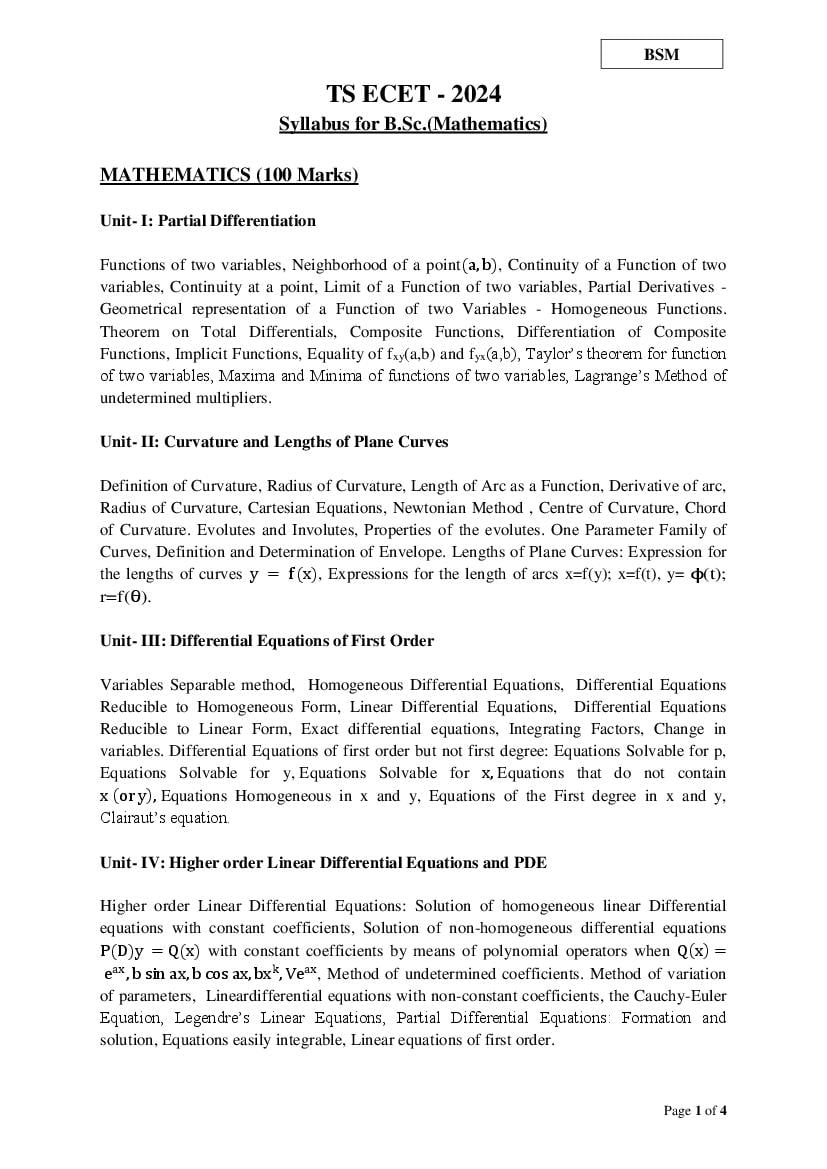
TS ECET - 2024
Syllabus for B.Sc.(Mathematics)
MATHEMATICS (100 Marks)
Unit- I: Partial Differentiation
Functions of two variables, Neighborhood of a point(a, b), Continuity of a Function of two
variables, Continuity at a point, Limit of a Function of two variables, Partial Derivatives -
Geometrical representation of a Function of two Variables - Homogeneous Functions.
Theorem on Total Differentials, Composite Functions, Differentiation of Composite
Functions, Implicit Functions, Equality of fxy(a,b) and fyx(a,b), Taylor’s theorem for function
of two variables, Maxima and Minima of functions of two variables, Lagrange’s Method of
undetermined multipliers.
Unit- II: Curvature and Lengths of Plane Curves
Definition of Curvature, Radius of Curvature, Length of Arc as a Function, Derivative of arc,
Radius of Curvature, Cartesian Equations, Newtonian Method , Centre of Curvature, Chord
of Curvature. Evolutes and Involutes, Properties of the evolutes. One Parameter Family of
Curves, Definition and Determination of Envelope. Lengths of Plane Curves: Expression for
the lengths of curves y = f (x), Expressions for the length of arcs x=f(y); x=f(t), y= ϕ(t);
r=f(θ).
Unit- III: Differential Equations of First Order
Variables Separable method, Homogeneous Differential Equations, Differential Equations
Reducible to Homogeneous Form, Linear Differential Equations, Differential Equations
Reducible to Linear Form, Exact differential equations, Integrating Factors, Change in
variables. Differential Equations of first order but not first degree: Equations Solvable for p,
Equations Solvable for y, Equations Solvable for x, Equations that do not contain
x (or y), Equations Homogeneous in x and y, Equations of the First degree in x and y,
Clairaut’s equation.
Unit- IV: Higher order Linear Differential Equations and PDE
Higher order Linear Differential Equations: Solution of homogeneous linear Differential
equations with constant coefficients, Solution of non-homogeneous differential equations
P(D)y = Q(x) with constant coefficients by means of polynomial operators when Q(x) =
eax , b sin ax, b cos ax, bx k , Veax , Method of undetermined coefficients. Method of variation
of parameters, Lineardifferential equations with non-constant coefficients, the Cauchy-Euler
Equation, Legendre’s Linear Equations, Partial Differential Equations: Formation and
solution, Equations easily integrable, Linear equations of first order.
Page 1 of 4
Page 2
Unit- V: Sequences and Series
Sequences: Limits of Sequences, Limit Theorems for Sequences, Monotone Sequences and
Cauchy Sequences, Subsequences, Limit superior and Limit inferior, Series, Alternating
Series and Integral Tests.
Unit- VI: Continuity, Differentiation and Riemann Integral
Continuity: Continuous Functions, Properties of Continuous Functions, Uniform Continuity,
Limits of Functions, Basic properties of the derivative, the mean value theorems, L-Hospital
Rule, Taylor’s theorem. The Riemann Integral, Properties of Riemann Integral, Fundamental
Theorem of Calculus.
Unit- VII: Groups
Definition and Examples of Groups, Elementary Properties of Groups, Finite Groups,
Subgroups, Subgroup Tests, Cosets and Lagrange’s Theorem, Properties of Cosets, Cyclic
Groups, Properties of Cyclic Groups, Normal Subgroups and Factor Groups, Group
Homomorphisms, Properties of Homomorphisms, The First Isomorphism Theorem,
Automorphisms, Permutation Groups: Definition and Properties of Permutations,
Isomorphisms, Cayley’s Theorem
Unit- VIII: Rings
Rings, Examples of Rings, Properties of Rings, Subrings, Integral Domains, Fields,
Characteristics of a Ring. Ideals, Factor Rings, Prime Ideals and Maximal Ideals. Ring
Homomorphisms and isomorphisms.
Unit- IX: Vector Spaces
Vector Spaces and Subspaces -Null Spaces, Column Spaces, and Linear Transformations,
Linearly Independent Sets, Bases, Coordinate Systems, The Dimension of a Vector space,
Rank, Change of Basis.
Unit- X: Diagonalization and Orthogonality
Eigenvalues and Eigenvectors, The Characteristic Equation, Diagonalization, Eigenvectors of
Linear Transformations, Inner Product spaces, Length and Orthogonality, Orthogonal Sets,
Orthogonal Projections, The Gram-Schmidt Process.
Page 2 of 4
Page 3
ANALYTICAL ABILITY (50 Marks)
Unit- I: Data Sufficiency: A question is given followed by data in the form of two
statements labeled as I and II. If the data given in I alone is sufficient to answer the question
then choice (1) is the correct answer. If the data given in II alone is sufficient to answer the
question, then choice (2) is the correct answer. If both I and II put together are sufficient to
answer the question but neither of the statements alone is sufficient, then Choice (3) is the
correct answer. If both I and II put together are not sufficient to answer the question and
additional data is needed, then choice (4) is the correct answer.
Unit- II: Sequences and Series: Analogies of numbers and alphabets completion of blank
spaces following the pattern in A: b:: C:d relationship, odd thing out; Missing number in a
sequence or a series.
Unit- III: Data Analysis: The data given in a Table, Graph, Bar Diagram, Pie Chart, Venn
diagram or a passage is to be analyzed and the questions pertaining to the data are to be
answered.
Unit- IV: Coding and Decoding Problems: A code pattern of English Alphabet is given. A
given word or a group of letters are to be coded and decoded based on the given code or
codes.
Unit- V: Date, Time and Arrangement Problems: Calendar problems, Clock Problems,
Blood Relationship, Arrivals, Departures and Schedules; Seating Arrangements, Symbol and
Notation Interpretation.
Page 3 of 4
Page 4
COMMUNICATIVE ENGLISH (50 Marks)
Unit- I: Vocabulary
i.) Synonyms
ii.) Antonyms
iii.) Spelling
iv.) One Word Substitutes
v.) Words Often Confused
vi.) Idioms
vii.) Phrasal Verbs
Unit- II: Grammar
i.) Articles
ii.) Prepositions
iii.) Question Tags
iv.) Active / Passive Voice
v.) Tenses
vi.) Concord
vii.) Correction of Sentences
Unit- III: Reading Comprehension
(a) Reading Comprehension (Passage 1)
(b) Reading Comprehension (Passage 2)
*****
Page 4 of 4
Document Details
| Board / Org | TGCHE |
| Exam | Telangana Engineering Common Entrance Test |
| Type | Syllabus |
| Pages | 4 |
| Updated | 09 Jun 2026 |