PSEB 10th Sample Paper 2027 Science
Finished viewing? Save it for later —
Download PSEB 10th Sample Paper 2027 Science (PDF · 11 pages)About PSEB 10th Sample Paper 2027 Science
PSEB 10th Sample Paper 2027 Science is available here for free download. Published by Punjab Board for Class 10, this sample paper can be viewed online or downloaded as a PDF (11 pages). Candidates preparing for Class 10 can use PSEB 10th Sample Paper 2027 Science to understand the exam pattern, the type of questions asked, and the overall difficulty level.
Frequently Asked Questions
How can I download PSEB 10th Sample Paper 2027 Science?
Open this page and click the Download button to save PSEB 10th Sample Paper 2027 Science as a PDF. It is completely free on AglaSem Docs.
Is PSEB 10th Sample Paper 2027 Science free to download?
Yes. PSEB 10th Sample Paper 2027 Science can be viewed online and downloaded as a PDF free of cost on AglaSem Docs.
How many pages does PSEB 10th Sample Paper 2027 Science have?
PSEB 10th Sample Paper 2027 Science contains 11 pages, which you can read online or download together as a single PDF.
Where can I find more Class 10 study material?
You can find more Class 10 question papers, sample papers, syllabus, and answer keys on AglaSem Docs.
PSEB 10th Sample Paper 2027 Science – Text
Read the full text of this sample paper below — useful to quickly search, copy and reference the content online without downloading the PDF.
📄 View text version (12 pages)
Page 1
PSEB 10th Sample
Paper 2027 Science
EXAM YEAR TYPE SUBJECT
Punjab Class 10 2027 Sample Paper Science
Notes · Sample Papers · Previous Year Papers · Mock Tests
Page 2
m c. o
c. o
e m
em l a s
s ag
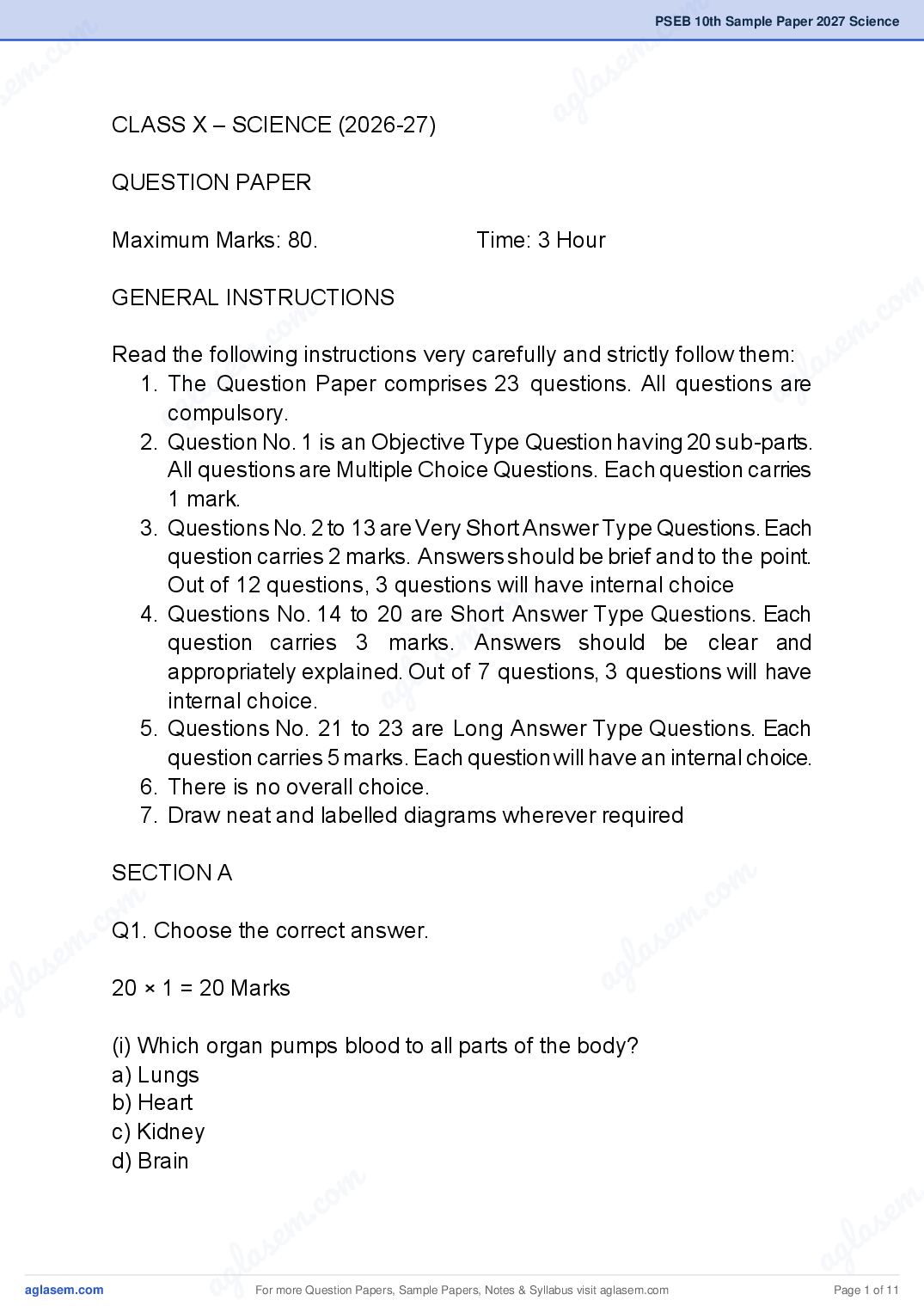
CLASS X – SCIENCE (2026-27)
QUESTION PAPER
Maximum Marks: 80. Time: 3 Hour
m
m .co
GENERAL INSTRUCTIONS
.c o e m
e m la s
s
Read the following instructions very carefully and strictly follow them:
1. TheaQuestion Paper comprises 23 questions. All questions are
l a g
ag
compulsory.
2. Question No. 1 is an Objective Type Question having 20 sub-parts.
All questions are Multiple Choice Questions. Each question carries
1 mark.
3. Questions No. 2 to 13 are Very Short Answer Type Questions. Each
question carries 2 marks. Answers should be brief and to the point.
m
Out of 12 questions, 3 questions will have internal choice
. co
4. Questions No. 14 to 20 are Short Answer Type Questions. Each
s em
question carries 3 marks. Answers should be clear and
g l a
appropriately explained. Out of 7 questions, 3 questions will have
internal choice. a
5. Questions No. 21 to 23 are Long Answer Type Questions. Each
question carries 5 marks. Each question will have an internal choice.
6. There is no overall choice.
7. Draw neat and labelled diagrams wherever required
m
c. o
SECTION A
m
c. oQ1. Choose the correct answer. s e m
s em la
gla ag
a
20 × 1 = 20 Marks
(i) Which organ pumps blood to all parts of the body?
a) Lungs
b) Heart
c) Kidney
d) Brain
m .
.co s e m
e m l a
l a s a g
ag For more Question Papers, Sample Papers, Notes & Syllabus visit Page 1 of 11
Page 3
a) Volt
b) Ampere
c) Ohm
d) Watt
(iii) What is the chemical formula of quicklime?
a) CaCO₃
b) CaO
c) Ca(OH)₂
d) Na₂CO₃
(iv) Which part of a plant prepares food?
a) Root
b) Stem
c) Leaf
d) Flower
(v) Which instrument is used to measure electric current?
a) Voltmeter
b) Ammeter
c) Thermometer
d) Barometer
(vi) Which gas is released when a metal reacts with a dilute acid?
a) Oxygen
b) Nitrogen
c) Hydrogen
d) Carbon dioxide
(vii) Which hormone controls blood sugar level in our body?
a) Insulin
b) Thyroxine
c) Adrenaline
d) Estrogen
For more Question Papers, Sample Papers, Notes & Syllabus visit Page 2 of 11
Page 4
m c. o
c. o
e m
em l a s
s ag
(viii) What is the SI unit of resistance?
a) Volt
b) Ampere
c) Ohm
d) Watt
m
m .co
(ix) What is the pH of a neutral solution?
a) 2
.co s e m
e m l a
s
b) 5
l a ag
ag
c) 7
d) 12
(x) Which organism reproduces by budding?
a) Amoeba
b) Hydra
c) Human being
d) Paramecium
m
c. o
e m
s
(xi) Which lens is used to correct myopia?
a) Convex lens
g l a
b) Concave lens a
c) Plane lens
d) Bifocal lens
(xii) Which metal is liquid at room temperature?
a) Iron
m
c. o
b) Mercury
m
c. o m
c) Copper
s e
em la
d) Aluminium
las ag
ag (xiii) What is the basic unit of heredity?
a) Cell
b) Tissue
c) Gene
d) Organ
(xiv) What is the SI unit of electric power?
m .
.co s e m
e m l a
l a s a g
ag For more Question Papers, Sample Papers, Notes & Syllabus visit Page 3 of 11
Page 5
b) Watt
c) Volt
d) Ohm
(xv) Which functional group is present in ethanoic acid?
a) –OH
b) –CHO
c) –COOH
d) –CO–
(xvi) Which gas is released during photosynthesis?
a) Carbon dioxide
b) Oxygen
c) Nitrogen
d) Hydrogen
(xvii) Which phenomenon causes the splitting of white light into seven
colours?
a) Reflection
b) Refraction
c) Dispersion
d) Absorption
(xviii) A solution having pH 3 is:
a) Basic
b) Acidic
c) Neutral
d) Salt solution
(xix) Which process releases energy from food in cells?
a) Photosynthesis
b) Respiration
c) Transpiration
d) Digestion
(xx) Which of the following is a displacement reaction?
For more Question Papers, Sample Papers, Notes & Syllabus visit Page 4 of 11
Page 6
m c. o
c. o
e m
em l a s
s ag
a) CaO + H₂O → Ca(OH)₂
b) Zn + CuSO₄ → ZnSO₄ + Cu
c) 2H₂ + O₂ → 2H₂O
d) CaCO₃ → CaO + CO₂
m
m .co
SECTION B
12 × 2 = 24 Marks
.co s e m
e m l a
l a s ag
ag
Q2. Why do we breathe faster during exercise? [2]
OR
Why are variations useful for living organisms? [2]
m
co
Q3. Why is series arrangement not used for domestic circuits? [2]
.
OR
s em
g l a
a
Why does a compass needle get deflected when brought near a bar
magnet? [2]
Q4. Why do ionic compounds have high melting points? [2]
m
c. o
OR
m
c. oWhich metals do not corrode easily? [2] s e m
s em g l a
gla a
a Q5. How is the small intestine designed to absorb digested food? [2]
Q6. A bulb is connected to a 220 V supply and draws a current of 0.5 A.
Calculate its power. [2]
m .
.co s e m
e m l a
l a s a g
ag For more Question Papers, Sample Papers, Notes & Syllabus visit Page 5 of 11
Page 7
Q8. Why is oxygen important for our body? [2]
Q9. What happens to the resistance of a wire vary with its area of cross
section? [2]
Q10. What happens when zinc reacts with dilute hydrochloric acid? Name
the gas produced. [2]
Q11. What happens at synapse between two neurons? [2]
Q12. State Ohm’s law and write its formula. [2]
Q13. What is neutralisation? Give one example of a neutralisation
reaction. [2]
SECTION C
7 × 3 = 21 Marks
Q14. Explain the role of the following in digestion:
a) Mouth
b) Stomach
c) Small intestine [3]
OR
For more Question Papers, Sample Papers, Notes & Syllabus visit Page 6 of 11
Page 8
m c. o
c. o
e m
em l a s
s ag
Explain the three main parts of the human respiratory system and their
functions. [3]
15. A doctor has prescribed a corrective lens of power +1.5D. Find the
focal length of the lens. Is the prescribed lens diverging or converging?[3]
m
m .co
OR
.c o e m
e m l a s
s
A ray of light travelling in air enters obliquely into water. Does the light ray
la a g
g
bend towards normal or away from normal. [3]
a
Q16. Write word equations and balance them for the following reactions
(a) Dilute hydrochloric acid reacts with magnesium ribbon.
(b) Dilute sulphuric acid reacts with aluminium powder. [3]
OR
Why does distilled water not conduct electricity whereas rain water does?
[3]
m
. co
s em
g l a
Q17. Why is DNA copying an essential part of the process of
reproduction? [3] a
Q18. Two resistors of resistance 6 Ω and 3 Ω are connected in a circuit.
a) Find the equivalent resistance of the circuit when these are connected
m
c. o
in series.
m
c. o m
b) Find the equivalent resistance of the circuit when these are connected
s e
em a
in parallel. [3]
s g l
gla a
a Q19. Three solutions have pH values 2, 7 and 12.
a) Which solution is acidic?
b) Which solution is neutral?
c) Which solution is basic? [3]
m .
.co s e m
e m l a
l a s a g
ag For more Question Papers, Sample Papers, Notes & Syllabus visit Page 7 of 11
Page 9
where receptors do not work properly. What problems are likely to arise?
[3]
Section - D
3 × 5 = 15 Marks
Q21. Case Study
Every cell in our body needs energy to perform various activities. We
obtain food from our diet, but the energy present in food cannot be used
directly by the cells. The process of respiration helps the body release
energy from food. During aerobic respiration, oxygen taken in through the
respiratory system is transported by the blood to different parts of the
body. The heart continuously pumps blood throughout the body. In cells,
glucose is broken down in the presence of oxygen to release energy,
which is stored in the form of ATP (Adenosine Triphosphate) and used for
various cellular activities.
Answer the following:
a) Which gas is needed by the body to release energy from food? [1]
b) Which organ takes oxygen into the body? [1]
c) Which organ pumps blood to different parts of the body? [1]
d) Name the process by which cells release energy from food. [1]
e) In which form the energy produced is stored in our body. [1]
OR
Answer the following
a) Which male reproductive organ produces sperms and secretes
testosterone.
b) Through which tube sperms are transported from testes towards the
urethra.
For more Question Papers, Sample Papers, Notes & Syllabus visit Page 8 of 11
Page 10
m c. o
c. o
e m
em l a s
s ag
c) Which female reproductive organ produces ova and secretes
female sex hormone.
d) Where does fertilization take place in humans?
e) Where does embryo implantation takes place in humans?
m
m .co
Q22. Case Study
.c o e m
e m l a s
s
A recycling unit uses an electromagnetic crane to lift and move heavy iron
la a soft iron core, the core behaves like a magnet and a g
g
objects. When electric current passes through a coil of insulated wire
wounda around
attracts iron objects. When the current is switched off, the magnetic effect
largely disappears. The strength of the electromagnet can be increased
by increasing the number of turns of the coil or the current flowing through
it. The direction of the magnetic field around a current-carrying conductor
can be determined using the Right-Hand Thumb Rule.
m
c. o
a) What type of magnet is used in the crane to lift iron objects? [1]
s emas the core of an electromagnet? [1]
a
b) Which material is commonly used
g l
a field if the number of turns in the coil is
c) What happens to the magnetic
increased? [1]
d) Which rule is used to determine the direction of the magnetic field
around a straight current-carrying conductor? [1]
e) Why does the crane release the iron objects when the electric current
m
c. o
is switched off? [1]
m
c. o s e m
s em la
gla ag
a
OR
An object is placed at a distance of 10cm from a convex mirror of focal
length of 15cm. Find the position and nature of the image.
Q23. Case Study
m .
.co s e m
e m l a
l a s a g
ag For more Question Papers, Sample Papers, Notes & Syllabus visit Page 9 of 11
Page 11
cooking gas, petrol, plastics, soaps, detergents and medicines, contain
carbon. During a laboratory activity, she studied two compounds, ethanol
and ethanoic acid. Ethanol is used in some sanitising products and can
undergo oxidation to form ethanoic acid. Ethanoic acid is present in
vinegar and gives it its characteristic sour taste. When ethanoic acid
reacts with sodium hydrogen carbonate, carbon dioxide gas is released.
She also learned that carbon forms a large number of compounds
because of its ability to form covalent bonds and to link with other carbon
atoms.
Questions:
(a) Name the functional group present in ethanol. [1]
(b) What is the common name of ethanoic acid? [1]
(c) Name the gas evolved when ethanoic acid reacts with sodium
hydrogen carbonate. [1]
(d) Ethanol undergoes …………… to form ethanoic acid.
(e) Why does carbon form a very large number of compounds? [1]
OR
Pratyush took sulphur powder on a spatula and heated it. He collected
the gas evolved by inverting a test tube over it, as shown in figure below.
For more Question Papers, Sample Papers, Notes & Syllabus visit Page 10 of 11
Page 12
m c. o
c. o
e m
em l a s
s ag
m
co
m m.co
m . s e
se l a
l a ag
ag
(a) What will be the action of gas on:
(i) dry litmus paper?
m
. co
em
(ii) moist litmus paper? [2]
l a s
g
(b) Write a balanced chemical equation for the reaction taking place. [3]
a
m
m c. o
c. o s e m
s em la
gla ag
a
m .
.co s e m
e m l a
l a s a g
ag For more Question Papers, Sample Papers, Notes & Syllabus visit Page 11 of 11
Document Details
| Board / Org | Punjab Board |
| Exam | Class 10 |
| Type | Sample Paper |
| Pages | 11 |
| Updated | 03 Nov 2026 |