JNUEE 2021 Question Paper Ph.D Regional Development Economics
Finished viewing? Save it for later —
Download JNUEE 2021 Question Paper Ph.D Regional Development Economics (PDF · 24 pages)About JNUEE 2021 Question Paper Ph.D Regional Development Economics
JNUEE 2021 Question Paper Ph.D Regional Development Economics is available here for free download. Published by NTA for JNUEE, this question paper can be viewed online or downloaded as a PDF (24 pages). Candidates preparing for JNUEE can use JNUEE 2021 Question Paper Ph.D Regional Development Economics to understand the exam pattern, the type of questions asked, and the overall difficulty level.
Frequently Asked Questions
How can I download JNUEE 2021 Question Paper Ph.D Regional Development Economics?
Open this page and click the Download button to save JNUEE 2021 Question Paper Ph.D Regional Development Economics as a PDF. It is completely free on AglaSem Docs.
Is JNUEE 2021 Question Paper Ph.D Regional Development Economics free to download?
Yes. JNUEE 2021 Question Paper Ph.D Regional Development Economics can be viewed online and downloaded as a PDF free of cost on AglaSem Docs.
How many pages does JNUEE 2021 Question Paper Ph.D Regional Development Economics have?
JNUEE 2021 Question Paper Ph.D Regional Development Economics contains 24 pages, which you can read online or download together as a single PDF.
Where can I find more JNUEE study material?
You can find more JNUEE question papers, sample papers, syllabus, and answer keys on AglaSem Docs.
JNUEE 2021 Question Paper Ph.D Regional Development Economics – Text
Read the full text of this question paper below — useful to quickly search, copy and reference the content online without downloading the PDF.
📄 View text version (24 pages)
Page 1
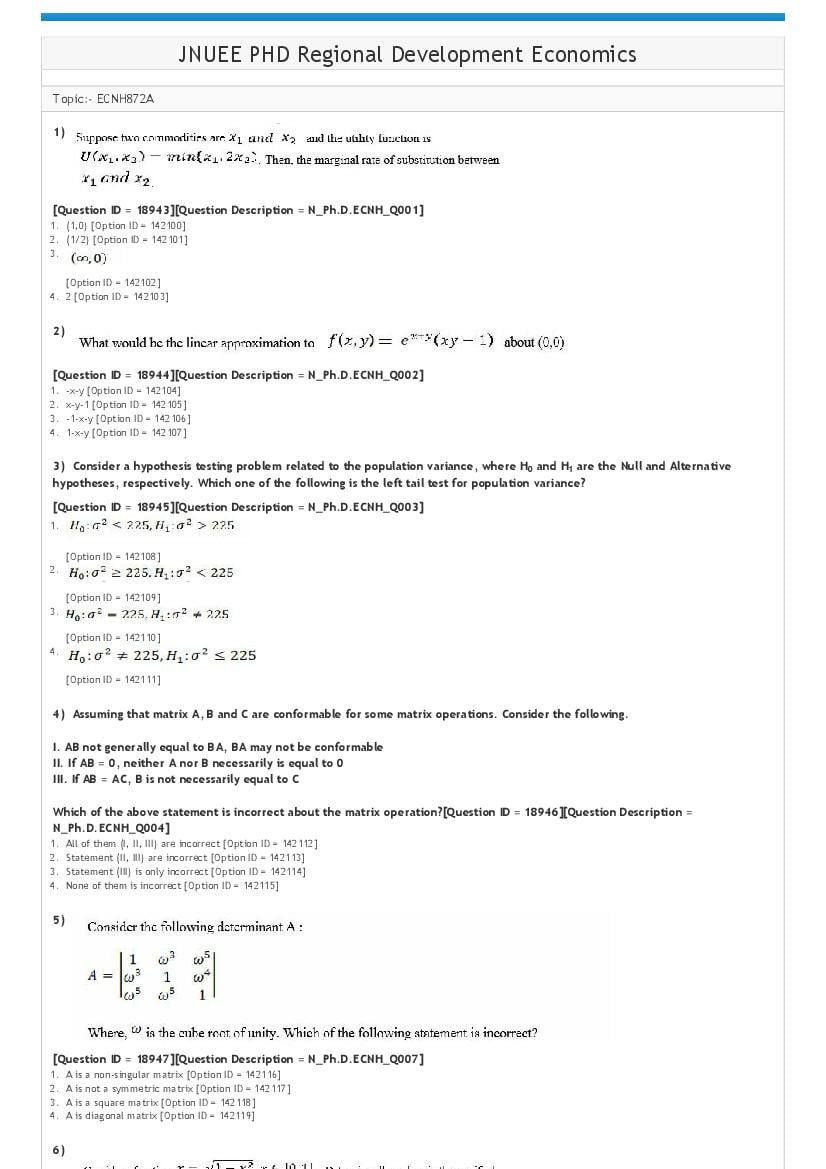
Topic:‐ ECNH872A
1)
[Question ID = 18943][Question Description = N_Ph.D.ECNH_Q001]
1. (1,0) [Option ID = 142100]
2. (1/2) [Option ID = 142101]
3.
[Option ID = 142102]
4. 2 [Option ID = 142103]
2)
[Question ID = 18944][Question Description = N_Ph.D.ECNH_Q002]
1. ‐x‐y [Option ID = 142104]
2. x‐y‐1 [Option ID = 142105]
3. ‐1‐x‐y [Option ID = 142106]
4. 1‐x‐y [Option ID = 142107]
3) Consider a hypothesis testing problem related to the population variance, where H0 and H1 are the Null and Alternative
hypotheses, respectively. Which one of the following is the left tail test for population variance?
[Question ID = 18945][Question Description = N_Ph.D.ECNH_Q003]
1.
[Option ID = 142108]
2.
[Option ID = 142109]
3.
[Option ID = 142110]
4.
[Option ID = 142111]
4) Assuming that matrix A, B and C are conformable for some matrix operations. Consider the following.
I. AB not generally equal to BA, BA may not be conformable
II. If AB = 0, neither A nor B necessarily is equal to 0
III. If AB = AC, B is not necessarily equal to C
Which of the above statement is incorrect about the matrix operation?[Question ID = 18946][Question Description =
N_Ph.D.ECNH_Q004]
1. All of them (I, II, III) are incorrect [Option ID = 142112]
2. Statement (II, III) are incorrect [Option ID = 142113]
3. Statement (III) is only incorrect [Option ID = 142114]
4. None of them is incorrect [Option ID = 142115]
5)
[Question ID = 18947][Question Description = N_Ph.D.ECNH_Q007]
1. A is a non‐singular matrix [Option ID = 142116]
2. A is not a symmetric matrix [Option ID = 142117]
3. A is a square matrix [Option ID = 142118]
4. A is diagonal matrix [Option ID = 142119]
6)
Page 2
1.
[Option ID = 142120]
2.
[Option ID = 142121]
3.
[Option ID = 142122]
4.
[Option ID = 142123]
7) Which of the following is not a non‐probability sampling?[Question ID = 18949][Question Description = N_Ph.D.ECNH_Q011]
1. Quota sampling [Option ID = 142124]
2. Judgement sampling [Option ID = 142125]
3. Stratified sampling [Option ID = 142126]
4. Convenience sampling [Option ID = 142127]
8) Consider the following three statements about quasi‐concave function:
I. Any concave function is a quasi‐concave function.
II. Any monotonically decreasing function is a quasi‐concave function.
III. If (x) is quasi‐concave function, then any monotonically increasing transformation of (x) is also a quasi concave function.
Which of the following statements are correct?
[Question ID = 18950][Question Description = N_Ph.D.ECNH_Q012]
1. All the three statements are correct.
[Option ID = 142128]
2. Statement I, II are correct but III is not correct.
[Option ID = 142129]
3. Statement I, III are correct but II is not correct.
[Option ID = 142130]
4. Statement I, II are incorrect but III is correct.
[Option ID = 142131]
9)
[Question ID = 18951][Question Description = N_Ph.D.ECNH_Q013]
1. The budget set B is an open, bounded and convex set
[Option ID = 142132]
2. The budget set B is not a bounded set
[Option ID = 142133]
3. The budget set B is a closed and non convex set
[Option ID = 142134]
4. The budget set B is a closed, bounded and convex set
[Option ID = 142135]
10) Preston curve exhibits a relation between [Question ID = 18952][Question Description = N_Ph.D.ECNH_Q014]
1. Income and health indicators (like life expectancy) [Option ID = 142136]
2. Income and educational outcome [Option ID = 142137]
3. Malnutrition and life expectancy [Option ID = 142138]
4. Income inequality and health inequality [Option ID = 142139]
11)
Page 3
1.
[Option ID = 142140]
2.
[Option ID = 142141]
3.
[Option ID = 142142]
4.
[Option ID = 142143]
12)
[Question ID = 18954][Question Description = N_Ph.D.ECNH_Q016]
1.
[Option ID = 142144]
2. The marginal product of capital and labour are homogeneous of degree 0.
[Option ID = 142145]
3.
[Option ID = 142146]
4. All the above three statements (a, b and c) are correct.
[Option ID = 142147]
13) Which of the following statement regarding stratified sampling is incorrect ?[Question ID = 18955][Question Description =
N_Ph.D.ECNH_Q017]
1. Stratified sampling is used when population is heterogenous [Option ID = 142148]
2. Units within the strata are heterogeneous and they are drawn randomly [Option ID = 142149]
3. Stratified random sampling is two stage sampling procedure where randomisation takes place in the second stage [Option ID = 142150]
4. Population is heterogenous and units within the stratum are homogenous [Option ID = 142151]
14)
[Question ID = 18956][Question Description = N_Ph.D.ECNH_Q018]
1.
[Option ID = 142152]
2.
[Option ID = 142153]
3.
[Option ID = 142154]
4.
[Option ID = 142155]
15)
[Question ID = 18957][Question Description = N_Ph.D.ECNH_Q019]
Page 4
[Option ID = 142156]
2.
[Option ID = 142157]
3.
[Option ID = 142158]
4.
[Option ID = 142159]
16) Suppose that f is a continuous function over a closed and bounded interval [a, b]. Then there exists a point d in [a, b] where
f has a minimum, and a point c in [a, b] where f has a maximum, so that f (d) ≤ f (x) ≤ f (c) for all x in [a, b]. The statement is
derived from: [Question ID = 18958][Question Description = N_Ph.D.ECNH_Q024]
1. Intermediate Value Theorem [Option ID = 142160]
2. Rolle’s Theorem [Option ID = 142161]
3. Mean Value Theorem [Option ID = 142162]
4. Extreme Value Theorem [Option ID = 142163]
17)
[Question ID = 18959][Question Description = N_Ph.D.ECNH_Q025]
1.
[Option ID = 142164]
2.
[Option ID = 142165]
3.
[Option ID = 142166]
4. None of the above is correct. [Option ID = 142167]
18)
[Question ID = 18960][Question Description = N_Ph.D.ECNH_Q029]
1. A and D [Option ID = 142168]
2. B and C [Option ID = 142169]
3. A and B [Option ID = 142170]
4. B, C and D [Option ID = 142171]
19)
Page 5
1. (i) and (ii); (i) and (iii)
[Option ID = 142172]
2. (i) and (iii); (ii) and (iii)
[Option ID = 142173]
3. (ii) and (iv); (i) and (iii)
[Option ID = 142174]
4. (i) and (iv); (i) and (iii)
[Option ID = 142175]
20) Average cost function is given as AC = Q2 ‐ 4Q + 174. State under what situation the given function is more appropriate.
[Question ID = 18962][Question Description = N_Ph.D.ECNH_Q031]
1. Long run function [Option ID = 142176]
2. Short run function [Option ID = 142177]
3. Medium run function [Option ID = 142178]
4. None of the above 3 options. [Option ID = 142179]
21)
[Question ID = 18963][Question Description = N_Ph.D.ECNH_Q034]
1.
[Option ID = 142180]
2.
[Option ID = 142181]
3.
[Option ID = 142182]
4.
[Option ID = 142183]
22) According to Ramsey tax rule, efficiency in the economy can be promoted by which one of the following ways.[Question ID =
18964][Question Description = N_Ph.D.ECNH_Q035]
1. More tax on those activities that are relatively price inelastic [Option ID = 142184]
2. Less tax on those inputs and outputs that are price elastic in demand or supply [Option ID = 142185]
3. Equal tax on all activities [Option ID = 142186]
4. No tax on those activities that encourage production [Option ID = 142187]
23) Find the characteristic polynomial of the given matrix M.
[Question ID = 18965][Question Description = N_Ph.D.ECNH_Q036]
1.
[Option ID = 142188]
2.
Page 6
3.
[Option ID = 142190]
4.
[Option ID = 142191]
24)
[Question ID = 18966][Question Description = N_Ph.D.ECNH_Q037]
1. Multicollinearity [Option ID = 142192]
2. Homoscedasticity [Option ID = 142193]
3. Autocorrelation [Option ID = 142194]
4. Errors in variables [Option ID = 142195]
25)
[Question ID = 18967][Question Description = N_Ph.D.ECNH_Q038]
1.
[Option ID = 142196]
2.
[Option ID = 142197]
3.
[Option ID = 142198]
4.
[Option ID = 142199]
26)
[Question ID = 18968][Question Description = N_Ph.D.ECNH_Q041]
1.
[Option ID = 142200]
2.
[Option ID = 142201]
3.
[Option ID = 142202]
4.
[Option ID = 142203]
27)
[Question ID = 18969][Question Description = N_Ph.D.ECNH_Q045]
1.
[Option ID = 142204]
2.
[Option ID = 142205]
Page 7
[Option ID = 142206]
4. Limit doesn’t exist
[Option ID = 142207]
28)
[Question ID = 18970][Question Description = N_Ph.D.ECNH_Q046]
1.
[Option ID = 142208]
2.
[Option ID = 142209]
3.
[Option ID = 142210]
4. None of the above is correct [Option ID = 142211]
29)
[Question ID = 18971][Question Description = N_Ph.D.ECNH_Q047]
1.
[Option ID = 142212]
2.
[Option ID = 142213]
3.
[Option ID = 142214]
4.
[Option ID = 142215]
30)
[Question ID = 18972][Question Description = N_Ph.D.ECNH_Q048]
1.
[Option ID = 142216]
2.
[Option ID = 142217]
3.
[Option ID = 142218]
4.
[Option ID = 142219]
31)
Page 8
1.
[Option ID = 142220]
2.
[Option ID = 142221]
3.
[Option ID = 142222]
4. None of the result is correct
[Option ID = 142223]
32)
[Question ID = 18974][Question Description = N_Ph.D.ECNH_Q050]
1.
[Option ID = 142224]
2.
[Option ID = 142225]
3.
[Option ID = 142226]
4. None of the above
[Option ID = 142227]
33)
[Question ID = 18975][Question Description = N_Ph.D.ECNH_Q051]
1. A, B and C are correct [Option ID = 142228]
2. A, B and C are incorrect [Option ID = 142229]
3. A and B are correct but C is incorrect [Option ID = 142230]
4. A and C are correct but B is incorrect [Option ID = 142231]
34)
[Question ID = 18976][Question Description = N_Ph.D.ECNH_Q052]
Page 9
[Option ID = 142232]
2.
[Option ID = 142233]
3.
[Option ID = 142234]
4.
[Option ID = 142235]
35) Consumption function is given as C = a + bY, where a > 0 and 0 < b < 1. The consumption function is inelastic when
[Question ID = 18977][Question Description = N_Ph.D.ECNH_Q053]
1. Y < a + b
[Option ID = 142236]
2. bY > a + bY
[Option ID = 142237]
3. bY < a + bY
[Option ID = 142238]
4. Y > a + b
[Option ID = 142239]
36) When the labour unions raise real wages to very high level, this results in excess supply of labour. The phenomenon is called
as[Question ID = 18978][Question Description = N_Ph.D.ECNH_Q054]
1. Keynesian unemployment [Option ID = 142240]
2. Classical unemployment [Option ID = 142241]
3. Seasonal unemployment [Option ID = 142242]
4. Disguised unemployment [Option ID = 142243]
37) Suppose a square matrix A for which Ak+1 = A, where k is positive integer. If k=1, the matrix A is called[Question ID = 18979]
[Question Description = N_Ph.D.ECNH_Q057]
1. Symmetric matrix [Option ID = 142244]
2. Transpose of matrix [Option ID = 142245]
3. Idempotent matrix [Option ID = 142246]
4. Nilpotent matrix [Option ID = 142247]
38) The weather storm can cause damage to a home in any year. Damage is random from year to year. Let Y be the value of
damage in any given year. Suppose Y = Rs. 0 in 95% of the years and Y = Rs. 20,000 in 5% of the years. What is the mean
damage in any year?[Question ID = 18980][Question Description = N_Ph.D.ECNH_Q058]
1. 6000 [Option ID = 142248]
2. 5000 [Option ID = 142249]
3. 1000 [Option ID = 142250]
4. 4000 [Option ID = 142251]
39)
[Question ID = 18981][Question Description = N_Ph.D.ECNH_Q061]
1.
[Option ID = 142252]
2.
[Option ID = 142253]
3.
[Option ID = 142254]
Page 10
[Option ID = 142255]
40)
[Question ID = 18982][Question Description = N_Ph.D.ECNH_Q062]
1. Zero conditional mean [Option ID = 142256]
2. Homoscedasticity [Option ID = 142257]
3. No perfect collinearity [Option ID = 142258]
4. Linear parameters [Option ID = 142259]
41) Based on the estimated regression model, compute how much wage will increase if years of schooling of individuals increases
for 2 more years?[Question ID = 18983][Question Description = N_Ph.D.ECNH_Q065]
1. 15.80% [Option ID = 142260]
2. 16.50% [Option ID = 142261]
3. 18.40% [Option ID = 142262]
4. 12.30% [Option ID = 142263]
42) If the production function is Q = 10AL2/3K3/4, then it exhibits[Question ID = 18984][Question Description =
N_Ph.D.ECNH_Q066]
1. Constant returns to scale [Option ID = 142264]
2. Increasing returns to scale [Option ID = 142265]
3. Decreasing returns to scale [Option ID = 142266]
4. Diseconomies of scale [Option ID = 142267]
43) The evidence of factor intensity reversal shows that:[Question ID = 18985][Question Description = N_Ph.D.ECNH_Q067]
1. Neither Hecksher Ohlin theorem holds nor the factor price‐equalization theorem holds [Option ID = 142268]
2. Hecksher Ohlin theorem holds but factor‐price equalization theorem does not hold [Option ID = 142269]
3. Hecksher Ohlin theorem does not hold but factor‐price equalization theorem holds [Option ID = 142270]
4. Both Hecksher Ohlin theorem and factor price equalization theorem hold [Option ID = 142271]
44)
[Question ID = 18986][Question Description = N_Ph.D.ECNH_Q068]
1.
[Option ID = 142272]
2.
[Option ID = 142273]
3.
[Option ID = 142274]
4.
[Option ID = 142275]
45) Systematic sampling involves:
[Question ID = 18987][Question Description = N_Ph.D.ECNH_Q069]
1. Selecting the units randomly from each stratum
[Option ID = 142276]
2. Selecting the first unit purposively and subsequent unit at kth interval
[Option ID = 142277]
3. Selecting the first unit purposively and subsequent unit at random
[Option ID = 142278]
4. Selecting the first unit at random and subsequent unit at kth interval
[Option ID = 142279]
46) A research that integrates theoretical framework and methodology from two or more distinct disciplines is called[Question ID
= 18988][Question Description = N_Ph.D.ECNH_Q070]
1. Multidisciplinary research [Option ID = 142280]
2. Transdisciplinary research [Option ID = 142281]
Page 11
4. Social Research [Option ID = 142283]
47) A time series is said to be stationary if its [Question ID = 18989][Question Description = N_Ph.D.ECNH_Q071]
1. Mean, variance and covariance are constant overtime [Option ID = 142284]
2. Mean, variance and covariance are non‐constant over time [Option ID = 142285]
3. Mean reversion is non‐observable [Option ID = 142286]
4. None of the above [Option ID = 142287]
48) When the demand for commodity X is inelastic, an increase in the price of this commodity will cause the total expenditure of
consumers to [Question ID = 18990][Question Description = N_Ph.D.ECNH_Q072]
1. Decrease [Option ID = 142288]
2. Increase [Option ID = 142289]
3. Remain unchanged [Option ID = 142290]
4. None of the above [Option ID = 142291]
49) For a given technology and saving rate, when a country’s GDP is far off from the steady‐state, it may grow faster in the
subsequent years. This is known as :[Question ID = 18991][Question Description = N_Ph.D.ECNH_Q073]
1. Income convergence [Option ID = 142292]
2. Income divergence [Option ID = 142293]
3. Investment convergence [Option ID = 142294]
4. All the above [Option ID = 142295]
50) Cost push inflation leads to[Question ID = 18992][Question Description = N_Ph.D.ECNH_Q074]
1. Decrease in unemployment [Option ID = 142296]
2. Increase in unemployment [Option ID = 142297]
3. Increase in employment [Option ID = 142298]
4. Increase in aggregate output [Option ID = 142299]
51)
[Question ID = 18993][Question Description = N_Ph.D.ECNH_Q075]
1. 117 [Option ID = 142300]
2. 234 [Option ID = 142301]
3. 115 [Option ID = 142302]
4. 243 [Option ID = 142303]
52)
[Question ID = 18994][Question Description = N_Ph.D.ECNH_Q076]
1.
[Option ID = 142304]
2.
[Option ID = 142305]
3.
[Option ID = 142306]
4. None of the above [Option ID = 142307]
53) The systematic bias may lead to:[Question ID = 18995][Question Description = N_Ph.D.ECNH_Q081]
1. Consistently over‐or under‐estimating some population parameters [Option ID = 142308]
2. A misrepresented sample due to recall errors [Option ID = 142309]
3. Error in sampling design and is addressed through hypothesis testing [Option ID = 142310]
4. Errors associated with the quota sampling [Option ID = 142311]
54)
[Question ID = 18996][Question Description = N_Ph.D.ECNH_Q082]
1. 1 [Option ID = 142312]
2. 2 [Option ID = 142313]
3. 3 [Option ID = 142314]
4. 4 [Option ID = 142315]
Page 12
in real GDP. What will be the tax multiplier ?[Question ID = 18997][Question Description = N_Ph.D.ECNH_Q083]
1. – 4.0 [Option ID = 142316]
2. 4 [Option ID = 142317]
3. – 3.0 [Option ID = 142318]
4. 3 [Option ID = 142319]
56) The intra‐industry trade theory[Question ID = 18998][Question Description = N_Ph.D.ECNH_Q084]
1. Explains why China might export cars and import clothing [Option ID = 142320]
2. Explains why China might export and import differentiated versions of the same product, such as different types of cars [Option ID = 142321]
3. Assumes that transport costs are very low or do not exist [Option ID = 142322]
4. Ignores seasonal considerations for agricultural goods [Option ID = 142323]
57) Let 8X‐10Y+66 = 0 and 40X‐18Y = 214 be the lines of regression of Y on X and X on Y, respectively. Find the regression
coefficient of Y on X and the regression coefficient of X on Y.[Question ID = 18999][Question Description = N_Ph.D.ECNH_Q085]
1. 2/5, 3/7 [Option ID = 142324]
2. 1/3, 6/15 [Option ID = 142325]
3. 4/5, 9/20 [Option ID = 142326]
4. 7/12, 8/3 [Option ID = 142327]
58)
[Question ID = 19000][Question Description = N_Ph.D.ECNH_Q086]
1. A, C and D are correct [Option ID = 142328]
2. A and D are correct [Option ID = 142329]
3. A, B and C are correct [Option ID = 142330]
4. B and C are correct. [Option ID = 142331]
59) Vaccinating people for CORONA Virus is aimed to substantially increase net social benefits by improving the health and
productivity of the population is an example of[Question ID = 19001][Question Description = N_Ph.D.ECNH_Q087]
1. Negative externality [Option ID = 142332]
2. Economies of scale [Option ID = 142333]
3. External economies [Option ID = 142334]
4. Net present value [Option ID = 142335]
60) Monetary policy is least effective when[Question ID = 19002][Question Description = N_Ph.D.ECNH_Q088]
1. IS curve is horizontal and LM curve is vertical [Option ID = 142336]
2. LM curve is horizontal and IS curve is downward sloping [Option ID = 142337]
3. IS curve is vertical and LM curve is horizontal [Option ID = 142338]
4. LM curve is upward sloping and IS curve is downward sloping [Option ID = 142339]
61) The Solow residual can be estimated as the difference between[Question ID = 19003][Question Description =
N_Ph.D.ECNH_Q089]
1. Growth in investment and growth in output [Option ID = 142340]
2. Growth in output and growth in inputs [Option ID = 142341]
3. Growth in saving and growth in output [Option ID = 142342]
4. Growth in productivity and investment [Option ID = 142343]
62) Which of the following are NOT true about the likely effects of fiscal stimulus in the economy?
A. Reduction in an inflationary gap
B. Increase in net export spending
C. Fall in investment
Choose the correct answer from the option given below :
[Question ID = 19004][Question Description = N_Ph.D.ECNH_Q090]
1. A only
[Option ID = 142344]
2. A and B
[Option ID = 142345]
3. B and C
[Option ID = 142346]
Page 13
[Option ID = 142347]
63) Which of the following condition is required for an economy to be in a steady state? Let Y is income, K is capital and N is
population.
[Question ID = 19005][Question Description = N_Ph.D.ECNH_Q091]
1. ∆Y/Y > ∆K/K > ∆N/N
[Option ID = 142348]
2. ∆Y/Y = ∆K/K = ∆N/N
[Option ID = 142349]
3. ∆Y/Y< ∆K/K < ∆N/N
[Option ID = 142350]
4. ∆Y/Y > ∆K/K
[Option ID = 142351]
64) Dutch disease is associated with[Question ID = 19006][Question Description = N_Ph.D.ECNH_Q092]
1. Corruption, poor governance, and institutional failures [Option ID = 142352]
2. The abundance of natural resources artificially pushes upward the exchange rate leading to a crowding out of other economic activities [Option ID =
142353]
3. Rent from the natural resource abundance may be misused by the political leaders and bureaucrats leading to corruption and neglect of social sectors
[Option ID = 142354]
4. None of the above [Option ID = 142355]
65) Which of the following are not correct about the Gini Coefficient?[Question ID = 19007][Question Description =
N_Ph.D.ECNH_Q093]
1. It is a statistical measure of inequality, in which a Gini value of 0 implies perfect equality and a Gini score of 1 implies perfect inequality [Option ID =
142356]
2. Countries with different income distributions but equal levels of income can have the same value for the Gini coefficient [Option ID = 142357]
3. In a cross‐country comparison of inequality, the coefficient does not depend upon the size of the population [Option ID = 142358]
4. The coefficient is sensitive to the size of the total wealth of the country [Option ID = 142359]
66) When individuals demand a greater price to induce them to give up a commodity that they already have than they are
willing to pay to acquire that same commodity, it is termed as:[Question ID = 19008][Question Description = N_Ph.D.ECNH_Q094]
1. Endowment effect [Option ID = 142360]
2. Commodity fetishism [Option ID = 142361]
3. Veblen paradox [Option ID = 142362]
4. Wealth effect [Option ID = 142363]
67) What is the annual inflation in an economy where velocity of money equals to 5.0, output grows at 3.0% a year and money
supply grows at 5.0% a year?
[Question ID = 19009][Question Description = N_Ph.D.ECNH_Q095]
1. 2.0%
[Option ID = 142364]
2. 5.0%
[Option ID = 142365]
3. 3.0%
[Option ID = 142366]
4. 0.0%
[Option ID = 142367]
68) Consider the following statements.
A. A Type II error means not rejecting the null hypothesis when it’s actually false.
B. A Type I error means rejecting the null hypothesis when it’s actually true.
C. The Type I and Type II error rates influence each other.
Which of the above are true? [Question ID = 19010][Question Description = N_Ph.D.ECNH_Q096]
1. A and B [Option ID = 142368]
2. B and C [Option ID = 142369]
3. A, B and C [Option ID = 142370]
4. A and C [Option ID = 142371]
69) "Policies aimed at reducing urban unemployment are likely to backfire: they will raise rather than reduce urban
unemployment". This is known as: [Question ID = 19011][Question Description = N_Ph.D.ECNH_Q097]
1. Todaro Paradox [Option ID = 142372]
2. Surplus labour criterion [Option ID = 142373]
3. Voting by feet [Option ID = 142374]
4. Fallacy of Composition [Option ID = 142375]
70) In a share‐cropping tenancy, the risk of output loss is[Question ID = 19012][Question Description = N_Ph.D.ECNH_Q098]
1. Borne only by the landlord. [Option ID = 142376]
2. Borne exclusively by the tenant. [Option ID = 142377]
Page 14
4. Shared by the tenant and the landlord according to the respective shares of the landlord and the tenant. [Option ID = 142379]
71) Which of the following statements about the Human Development Index is NOT correct?
[Question ID = 19013][Question Description = N_Ph.D.ECNH_Q099]
1. The HDI measures the average achievements in a country in three basic dimensions of human development: a long and healthy life, access to knowledge,
and a decent standard of living.
[Option ID = 142380]
2. The HDI is the geometric mean of normalized indices from each of these three dimensions.
[Option ID = 142381]
3. The Inequality‐adjusted Human Development Index (IHDI) accounts for inequalities in HDI dimensions by discounting each dimension’s average value
according to its level of inequality.
[Option ID = 142382]
4. The IHDI equals the HDI when there is no inequality across people but is greater than the HDI as inequality rises.
[Option ID = 142383]
72) Consider the following statements regarding the methodological problems to address the selection bias.
A. Selection bias may occur due to errors of omission and errors of observations.
B. In the presence of selection bias, the error term ε in the regression reflects only observed characteristics that also affect Y.
C. The presence of selection bias may lead to overestimation or underestimation of regression coefficients.
D. In the case of unobserved factors, the error term may contain variables that are also correlated with some of the predictor
variables X.e., i.e., Cov(X, ε)≠0
Which of the above statement(s) is(are) NOT correct?
[Question ID = 19014][Question Description = N_Ph.D.ECNH_Q100]
1. Statement B and C
[Option ID = 142384]
2. Statement B only
[Option ID = 142385]
3. Statement A, B and C
[Option ID = 142386]
4. None of the above 4 statements (1 to 4) are incorrect.
[Option ID = 142387]
Topic:‐ ECNH872B
1) Attempt following questions
Different students of Jawaharlal Nehru University (JNU) have different preferences about the subject Economics. The
Students measure Economics Books along the horizontal axis and Books about other Subjects along the vertical axis. What will be
the indifference curves associated with each of the two following statements and what would the direction of arrow for an
increase in utility?
I care only about the total amount of knowledge I acquire. It is the same whether that is economics knowledge or knowledge of
any other kind.
[Question ID = 19015][Question Description = N_Ph.D.ECNH_Q005]
1. The indifference curves are downward‐sloping parallel lines with a slope of (− 1) and the arrow pointing towards northeast.
[Option ID = 142388]
2. The indifference curves are upward‐sloping with the arrow pointing towards northwest.
[Option ID = 142389]
3. The indifference curves are vertical with the arrow pointing to the right
[Option ID = 142390]
4. The indifference curves are downward‐sloping and convex with the arrow pointing northeast.
[Option ID = 142391]
2) Attempt following questions
Different students of Jawaharlal Nehru University (JNU) have different preferences about the subject Economics. The Students
measure Economics Books along the horizontal axis and Books about other Subjects along the vertical axis. What will be the
indifference curves associated with each of the two following statements and what would the direction of arrow for an increase
in utility?
I hate the Mascollel, Whinston and Green textbook and all other Economics books. On the other hand, I love everything else in
the curriculum.
[Question ID = 19016][Question Description = N_Ph.D.ECNH_Q006]
1. The indifference curves are downward‐sloping parallel lines with a slope of (− 1) and the arrow pointing towards northeast.
Page 15
2. The indifference curves are vertical with the arrow pointing to the right.
[Option ID = 142393]
3. The indifference curves are upward‐sloping with the arrow pointing towards northwest.
[Option ID = 142394]
4. The indifference curves are upward‐sloping with the arrow pointing towards northeast.
[Option ID = 142395]
Topic:‐ ECNH872C
1) Attempt following question
Consider the following Battle of Sexes Game with 2 players: player 1 being the Girl friend and player 2 being the boyfriend. The
partners are looking for some entertainment in the weekend. They can think of the options of either watching a cricket match,
or a movie. Following is the payoff matrix of the two partners for these pair of strategies
What would be the pure strategy Nash equilibrium of the Battle of Sexes Game?
[Question ID = 19017][Question Description = N_Ph.D.ECNH_Q009]
1. Unique Nash equilibrium (Cricket, Cricket)
[Option ID = 142396]
2. Unique Nash equilibrium (Movie, Movie)
[Option ID = 142397]
3. Multiple Nash equilibria in pure strategy (Cricket, Cricket), (Movie, Movie)
[Option ID = 142398]
4.
[Option ID = 142399]
2) Attempt following questions
Consider the following Battle of Sexes Game with 2 players: player 1 being the Girl friend and player 2 being the boyfriend. The
partners are looking for some entertainment in the weekend. They can think of the options of either watching a cricket match,
or a movie. Following is the payoff matrix of the two partners for these pair of strategies
Consider the same Battle of Sexes Game in the above question. Will there be any Mixed Strategy Nash equilibrium for the
partners?
[Question ID = 19018][Question Description = N_Ph.D.ECNH_Q010]
1.
[Option ID = 142400]
2.
Page 16
3.
[Option ID = 142402]
4. No Mixed Strategy Nash equilibrium exists
[Option ID = 142403]
Topic:‐ ECNH872D
1)
What is the equilibrium profit of firm 2 in the short run?[Question ID = 19022][Question Description = N_Ph.D.ECNH_Q_020]
1. π2 = 0.025 [Option ID = 142416]
2. π2 = 0.125 [Option ID = 142417]
3. π2 = ‐0.125 [Option ID = 142418]
4. π2 = 0.75 [Option ID = 142419]
2)
What is the long run profit of firm 1 and firm 2?[Question ID = 19019][Question Description = N_Ph.D.ECNH_Q_021]
1. π1 = 0.025, π2 = 0.125 [Option ID = 142404]
2. π1 = 0, π2 = 0.125 [Option ID = 142405]
3. π1 = 0.25, π2 = 0 [Option ID = 142406]
4. π1 = 0.125, π1 = 0 [Option ID = 142407]
3)
Page 17
1.
[Option ID = 142408]
2.
[Option ID = 142409]
3.
[Option ID = 142410]
4.
[Option ID = 142411]
4)
Do you think the externality can be resolved in the equilibrium outcome (described in question 21) and leads to efficiency?
[Question ID = 19021][Question Description = N_Ph.D.ECNH_Q_023]
1. The externality can't be resolved at all. ,The equilibrium outcome of the firms is just the profit‐maximizing outcome. [Option ID = 142412]
2.
[Option ID = 142413]
3.
[Option ID = 142414]
4.
[Option ID = 142415]
Topic:‐ ECNH872E
Page 18
Assume that the public good is purchased privately, and that person 3 is the first to go to the market and buy the public good.
Assume person 3 completely ignores persons 1 and 2’s decision during his purchase when he buys x, and thinks only of his own
utility maximization problem. His purchase is followed by person 2 and 1, who decide on public goods consumption after
observing person 3’s purchase. How much of the public goods and private goods do person 1 and 2 and 3 buy in the equilibrium?
[Question ID = 19023][Question Description = N_Ph.D.ECNH_Q26]
1. (3, 3, 3) [Option ID = 142420]
2. (1, 1, 3) [Option ID = 142421]
3. (0, 0, 3) [Option ID = 142422]
4. None of the above is correct [Option ID = 142423]
2)
The Samuelson optimality condition to find the Pareto optimal quantity of the public good X * is decided by:[Question ID = 19024]
[Question Description = N_Ph.D.ECNH_Q27]
1.
[Option ID = 142424]
2.
[Option ID = 142425]
3.
[Option ID = 142426]
4.
[Option ID = 142427]
3)
The Lindahl equilibrium is :[Question ID = 19025][Question Description = N_Ph.D.ECNH_Q28]
Page 19
[Option ID = 142428]
2.
[Option ID = 142429]
3.
[Option ID = 142430]
4. The government subsidizes the entire expenses for the creation of public goods. [Option ID = 142431]
Topic:‐ ECNH872F
1)
What is the consumer i’s certainty equivalent of the loss? [Question ID = 19026][Question Description = N_Ph.D.ECNH_Q32]
1. 12.5 [Option ID = 142432]
2. 14.41 [Option ID = 142433]
3. 11.59 [Option ID = 142434]
4. 13.57 [Option ID = 142435]
2)
The risk preference of the consumer is[Question ID = 19027][Question Description = N_Ph.D.ECNH_Q33]
1. Risk neutral because certainty equivalent of the loss is equal to expected value of the loss [Option ID = 142436]
2. Risk averse because certainty equivalent of the loss is greater than the expected value of the loss [Option ID = 142437]
3. Risk lover because certainty equivalent of the loss is greater than the expected value of the loss [Option ID = 142438]
4. Risk averse because certainty equivalent of the loss is less than the expected value of the loss [Option ID = 142439]
Topic:‐ ECNH872G
1) Attempt following questions
Grades on a common admission test for post‐graduate programmes found to have a mean of 1000 for students in India. The test is
administered to 453 randomly selected students in Delhi. For this sample, mean is 1013 and the standard deviation is 108.
What is the 95% confidence interval for the average test score for students in Delhi? [Question ID = 19028][Question Description
= N_Ph.D.ECNH_Q39]
1. [1003.05, 1022.95] [Option ID = 142440]
2. [1004.50, 1035.22] [Option ID = 142441]
3. [995.00, 1013.12] [Option ID = 142442]
4. [870.25, 980.56] [Option ID = 142443]
2) Attempt following questions
Grades on a common admission test for post‐graduate programmes found to have a mean of 1000 for students in India. The test is
administered to 453 randomly selected students in Delhi. For this sample, mean is 1013 and the standard deviation is 108.
What is the test result on the null hypothesis that Delhi students have the same average performance as the students in overall
India? [Question ID = 19029][Question Description = N_Ph.D.ECNH_Q40]
1. Fail to reject the null hypothesis [Option ID = 142444]
2. Reject the null hypothesis [Option ID = 142445]
3. Neither reject nor accept the null hypothesis [Option ID = 142446]
4. Insufficient information [Option ID = 142447]
Page 20
1)
What would be the Stackelberg equilibrium quantities for firm 1 and firm 2?[Question ID = 19030][Question Description =
N_Ph.D.ECNH_Q42]
1.
[Option ID = 142448]
2.
[Option ID = 142449]
3.
[Option ID = 142450]
4.
[Option ID = 142451]
2)
What would the Stackelberg equilibrium price? [Question ID = 19031][Question Description = N_Ph.D.ECNH_Q43]
1.
[Option ID = 142452]
2.
[Option ID = 142453]
3.
[Option ID = 142454]
4.
[Option ID = 142455]
3)
What would be the profit of the two firms, if both the firms believe that they are the Stackelberg leader ?[Question ID = 19032]
[Question Description = N_Ph.D.ECNH_Q44]
1.
[Option ID = 142456]
2.
[Option ID = 142457]
3.
[Option ID = 142458]
Page 21
[Option ID = 142459]
Topic:‐ ECNH872I
1)
[Question ID = 19033][Question Description = Ph.D.ECNH_Q55]
1. 1.90
[Option ID = 142460]
2. 2.50
[Option ID = 142461]
3. 2.19
[Option ID = 142462]
4. 1.81
[Option ID = 142463]
2)
What decision will you take based on the t statistic at 5% level of significance?
[Question ID = 19034][Question Description = Ph.D.ECNH_Q56]
1. Reject the null hypothesis
[Option ID = 142464]
2. Fail to reject the null hypothesis
[Option ID = 142465]
3. Neither reject nor accept the null hypothesis
[Option ID = 142466]
4. Insufficient information
[Option ID = 142467]
Topic:‐ ECNH872J
1)
Page 22
1.
[Option ID = 142468]
2.
[Option ID = 142469]
3.
[Option ID = 142470]
4.
[Option ID = 142471]
2)
[Question ID = 19036][Question Description = N_Ph.D.ECNH_Q60]
1.
[Option ID = 142472]
2.
[Option ID = 142473]
3.
[Option ID = 142474]
4.
[Option ID = 142475]
Topic:‐ ECNH872K
1)
What is the value of test statistic that you will compute to test the null hypothesis (H0) that return to education is zero? [Question
ID = 19037][Question Description = N_Ph.D.ECNH_Q63]
1. 1.77 [Option ID = 142476]
Page 23
3. 1.58 [Option ID = 142478]
4. 10.65 [Option ID = 142479]
2)
What decision will you take based on the test statistic at 5% level of significance? [Question ID = 19038][Question Description =
N_Ph.D.ECNH_Q64]
1. Fail to reject H0 [Option ID = 142480]
2. Reject H0 [Option ID = 142481]
3. Neither reject or accept H0 [Option ID = 142482]
4. Insufficient information [Option ID = 142483]
Topic:‐ ECNH872L
1) Attempt following questions
In the simple Keynesian model, assume that the consumption function is given by: C = 200 + 0.75 (Y – T). Let the planned
investment be Rs.100, government purchases and taxes be both Rs.100.
If government purchases increase to Rs.125, what is the new equilibrium income? [Question ID = 19039][Question Description =
N_Ph.D.ECNH_Q77]
1. Y = 1400 [Option ID = 142484]
2. Y= 1300 [Option ID = 142485]
3. Y = 1200 [Option ID = 142486]
4. Y = 1100 [Option ID = 142487]
2) Attempt following questions
In the simple Keynesian model, assume that the consumption function is given by: C = 200 + 0.75 (Y – T). Let the planned
investment be Rs.100, government purchases and taxes be both Rs.100.
What level of government purchases (G) is needed to achieve an income of Rs. 1,600?[Question ID = 19040][Question Description
= N_Ph.D.ECNH_Q78]
1. G must increase to 170 [Option ID = 142488]
2. G must increase to 175 [Option ID = 142489]
3. G must increase to 180 [Option ID = 142490]
4. G must increase to 185 [Option ID = 142491]
Topic:‐ ECNH872M
1) Attempt following questions
The index of export prices, import prices, the volume of exports, and productivity in the export sector in a country is equal to
100 each in 1980.
What would be the commodity terms of trade in 2000, if the index of its export prices rises by 10 percent but the index of its
import prices rise by 20 percent?[Question ID = 19041][Question Description = N_Ph.D.ECNH_Q79]
1. Commodity terms of trade would be 91.1 [Option ID = 142492]
2. Commodity terms of trade would be 91.2 [Option ID = 142493]
3. Commodity terms of trade would be 91.4 [Option ID = 142494]
4. Commodity terms of trade would be 91.7 [Option ID = 142495]
2) Attempt following questions
The index of export prices, import prices, the volume of exports, and productivity in the export sector in a country is equal to
100 each in 1980.
What would be the country’s single factoral terms of trade if its productivity index in the export sector rises to 140 by 2000?
[Question ID = 19042][Question Description = N_Ph.D.ECNH_Q80]
Page 24
2. Single factoral terms of trade would be 130.4 [Option ID = 142497]
3. Single factoral terms of trade would be 132.4 [Option ID = 142498]
4. Single factoral terms of trade would be 134.4 [Option ID = 142499]