CBSE Class 12 Sample Paper 2027 for Chemistry
Finished viewing? Save it for later —
Download CBSE Class 12 Sample Paper 2027 for Chemistry (PDF · 12 pages)About CBSE Class 12 Sample Paper 2027 for Chemistry
CBSE Class 12 Sample Paper 2027 for Chemistry is available here for free download. Published by CBSE for Class 12, this sample paper can be viewed online or downloaded as a PDF (12 pages). Candidates preparing for Class 12 can use CBSE Class 12 Sample Paper 2027 for Chemistry to understand the exam pattern, the type of questions asked, and the overall difficulty level.
Frequently Asked Questions
How can I download CBSE Class 12 Sample Paper 2027 for Chemistry?
Open this page and click the Download button to save CBSE Class 12 Sample Paper 2027 for Chemistry as a PDF. It is completely free on AglaSem Docs.
Is CBSE Class 12 Sample Paper 2027 for Chemistry free to download?
Yes. CBSE Class 12 Sample Paper 2027 for Chemistry can be viewed online and downloaded as a PDF free of cost on AglaSem Docs.
How many pages does CBSE Class 12 Sample Paper 2027 for Chemistry have?
CBSE Class 12 Sample Paper 2027 for Chemistry contains 12 pages, which you can read online or download together as a single PDF.
Where can I find more Class 12 study material?
You can find more Class 12 question papers, sample papers, syllabus, and answer keys on AglaSem Docs.
CBSE Class 12 Sample Paper 2027 for Chemistry – Text
Read the full text of this sample paper below — useful to quickly search, copy and reference the content online without downloading the PDF.
📄 View text version (13 pages)
Page 1
CBSE Class 12 Sample
Paper 2027 for
Chemistry
EXAM YEAR TYPE SUBJECT
CBSE Class 12 2027 Sample Paper Chemistry
Notes · Sample Papers · Previous Year Papers · Mock Tests
Page 2
m .co
m .co s e m
se g l a
a
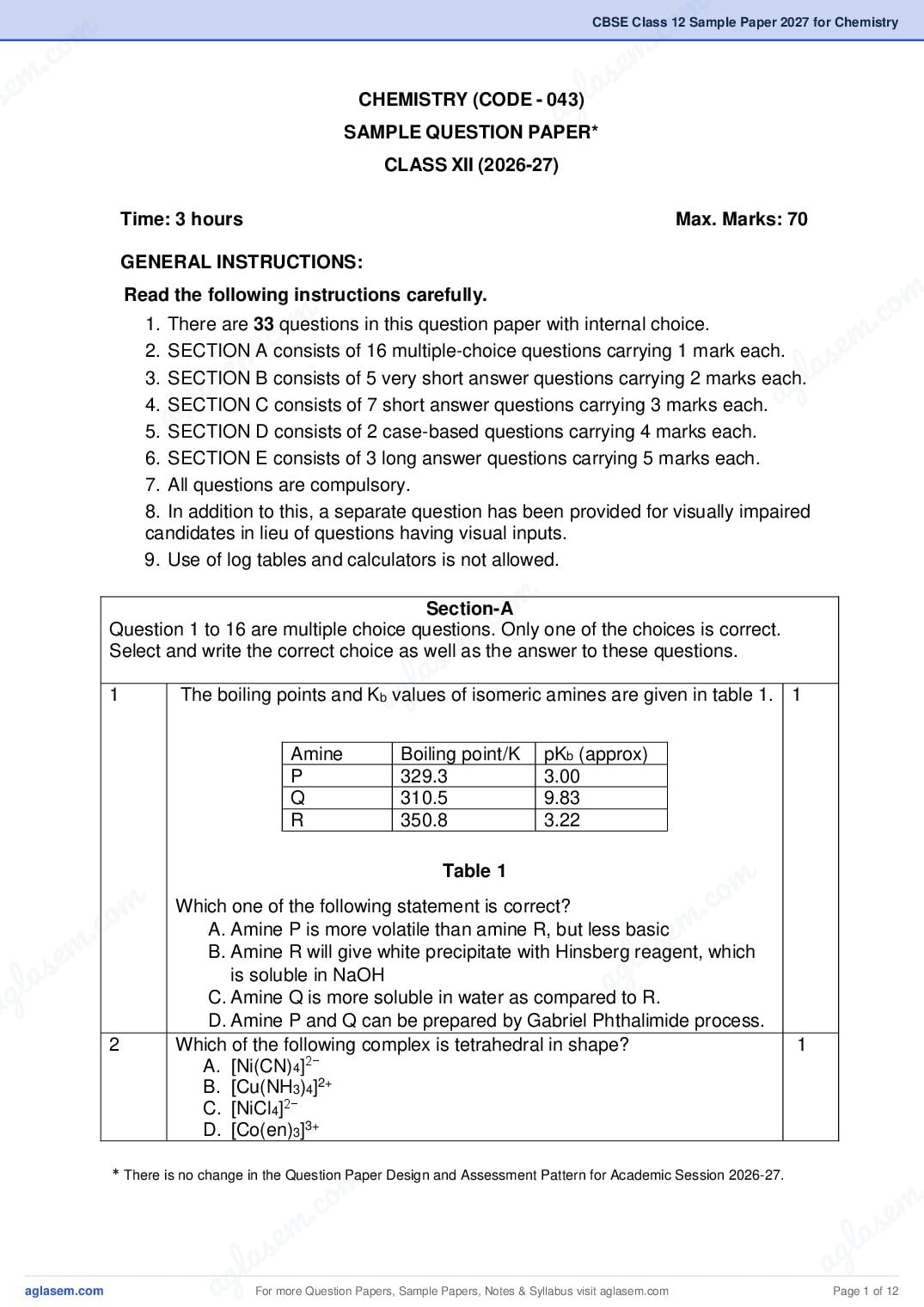
CHEMISTRY (CODE - 043)
SAMPLE QUESTION PAPER*
CLASS XII (2026-27)
Time: 3 hours Max. Marks: 70
GENERAL INSTRUCTIONS:
m
.co
Read the following instructions carefully.
m
.co m
1. There are 33 questions in this question paper with internal choice.
m s e
a
2. SECTION A consists of 16 multiple-choice questions carrying 1 mark each.
s e l
a ag
3. SECTION B consists of 5 very short answer questions carrying 2 marks each.
g l
a
4. SECTION C consists of 7 short answer questions carrying 3 marks each.
5. SECTION D consists of 2 case-based questions carrying 4 marks each.
6. SECTION E consists of 3 long answer questions carrying 5 marks each.
7. All questions are compulsory.
8. In addition to this, a separate question has been provided for visually impaired
candidates in lieu of questions having visual inputs.
9. Use of log tables and calculators is not allowed.
m
.co
Section-A
em
Question 1 to 16 are multiple choice questions. Only one of the choices is correct.
s
Select and write the correct choice as well as the answer to these questions.
la of isomeric amines are given in table 1. 1
1
ag
The boiling points and K values b
Amine Boiling point/K pKb (approx)
P 329.3 3.00
Q 310.5 9.83
R 350.8 3.22
Table 1
m
m .co
.co
Which one of the following statement is correct?
e m
e m
A. Amine P is more volatile than amine R, but less basic
l as
s
B. Amine R will give white precipitate with Hinsberg reagent, which
la is soluble in NaOH
ag
ag C. Amine Q is more soluble in water as compared to R.
D. Amine P and Q can be prepared by Gabriel Phthalimide process.
2 Which of the following complex is tetrahedral in shape? 1
A. [Ni(CN)4]2−
B. [Cu(NH3)4]2+
C. [NiCl4]2−
D. [Co(en)3]3+
m .
.co s e m
s em l a
g la ag
a For more Question Papers, Sample Papers, Notes & Syllabus visit Page 1 of 12
Page 3
is:
A. 1F
B. 6F
C. 3F
D. 2F
4 An organic compound “X” on reaction with chloroform and alcoholic KOH 1
gives foul smelling product.
In which of the following case compound X would be produced:
A. Chloromethane is treated with AgCN.
B. Nitrobenzene is reduced.
C. Benzene diazonium chloride is treated with Cu/KCN
D. Aniline reacts with Acetyl chloride.
5 Consider a system in a state of dynamic equilibrium, as shown in 1
Fig. 1(a). The lower part is solution
and the upper part is gaseous
system at pressure p and
temperature T. If the pressure is
increased over the solution phase
by compressing the gas to a
smaller volume as shown in Fig
1(b).
Which of the following statements is true about figure 1(b)
A. solubility of gas will increase until dynamic equilibrium is reached
B. solubility of gas will decrease until dynamic equilibrium is reached
C. solubility of gas will increase until static equilibrium is reached
D. solubility of gas will decrease until static equilibrium is reached
(For Visually Challenged Learners)
According to Henry’s law partial pressure P of a gas above the liquid at
constant temperature is directly proportional to
A. volume of the gas
B. mole fraction of the gas in the solution
C. atmospheric pressure
D. vapour pressure of the solution
6 Aavya carries out hydrolysis of acetyl chloride. The reaction is 1
represented by the following equation:
CH3COCl + H2O CH3COOH + HCl
She carries out the reaction with (i) equimolar amounts of acetyl chloride
and water (ii) excess of water. The rate law obeyed in the two cases will
be:
A. (i) First order (ii) Second Order
B. (i) First order (ii) First order
C. (i) Second order (ii) Second order
D. (i) Second order (ii) First order
For more Question Papers, Sample Papers, Notes & Syllabus visit Page 2 of 12
Page 4
m .co
m .co s em
The amino acid HOOC-CH -CH -CH (NH ) COOH,la
se 7 2 2
g
can be synthesised
2
a this amino acid?
within our body. Which of the following is true about
1
HOOC-CH2-CH2-CH(NH2) COOH is:
A. an acidic and non-essential amino acid.
B. a neutral and non- essential amino acid.
C. an acidic and essential amino acid
m
D. a neutral and essential amino acid
8
m
Identify the Grignard reagent and carbonyl compound which on reaction 1
.co
.co e m
followed by hydrolysis will give 3-methyl pentan-3-ol.
e m l as
l a s
(i) C2H5COC2H5 + CH3MgCl (ii) C2H5COCH3 + C2H5MgCl
ag
g
a (iii) (iv)
A. (i) and (iii)
B. (ii) and (iv)
C. (iii) and (iv)
D. (i) and (ii)
9 Which one of the following element will be strong oxidising agent in their 1
m
.co
+3 oxidation state? (Atomic no. Cr=24, Mn=25, Ti=22, Fe=26)
A. Cr
B. Mn
e m
C. Ti
las
10
D. Fe
ag
When (–)-2-bromohexane reacts with sodium hydroxide, (+)-hexan-2-ol 1
is formed. Which one of the following observation would be correct?
A. The reaction follows SN2 mechanism and is accompanied by
inversion of configuration.
B. The reaction follows SN1 mechanism and is accompanied by
inversion of configuration.
C. The reaction follows SN2 mechanism and is accompanied by
retention of configuration.
m
.co
D. The reaction follows SN1 mechanism and is accompanied by
om
retention of configuration.
c. 11 If half-life of a first order reaction is 16 minutes, how much time does it
e m 1
e m take to complete 75% of the reaction?
l as
las A. 16 min
ag
ag B. 32 min
C. 48 min
D. 64 min
12 Which solution has the highest conductivity? 1
A. 0.1 M HCl
B. 0.1 M CH₃COOH
C. 0.1 M glucose
D. 0.1 M NH4OH
m .
.co s e m
s em l a
g la ag
a For more Question Papers, Sample Papers, Notes & Syllabus visit Page 3 of 12
Page 5
derivative.
Reason (R): -NH2 is ortho and para directing and highly activating group.
Select the most appropriate answer from the options given below:
A. Both A and R are true, and R is the correct explanation of A.
B. Both A and R are true, and R is not the correct explanation of A.
C. A is true but R is false.
D. A is false but R is true.
14 Assertion (A): Permanganate and manganate ions have tetrahedral 1
structure
Reason (R): In permanganate and manganate ions, pi bonding takes
place which is due to overlap of p orbitals of oxygen with p orbitals of
manganese.
Select the most appropriate answer from the options given below:
A. Both A and R are true, and R is the correct explanation of A.
B. Both A and R are true, and R is not the correct explanation of A.
C. A is true but R is false.
D. A is false but R is true.
15 Assertion (A): Miscibility of ethers with water resembles those of 1
alcohols of the same molecular mass.
Reason (R): The oxygen of ether can also form hydrogen bonds with
water.
Select the most appropriate answer from the options given below:
A. Both A and R are true, and R is the correct explanation of A.
B. Both A and R are true, and R is not the correct explanation of A.
C. A is true but R is false.
D. A is false but R is true
16 Assertion (A): [Co(NH3)6]3+ is diamagnetic. 1
Reason (R): NH3 is a strong field ligand and causes pairing of electrons.
Select the most appropriate answer from the options given below:
A. Both A and R are true, and R is the correct explanation of A.
B. Both A and R are true, and R is not the correct explanation of A.
C. A is true but R is false.
D. A is false but R is true
Section-B
Question No. 17 to 21 are very short answer questions carrying 2 marks each.
Attempt either A or B
17(A) (I) Complete and balance the following reaction
SO32- + MnO4 - + H+ 1
(II) Why does titanium melt at a lower temperature than chromium? 1
OR
For more Question Papers, Sample Papers, Notes & Syllabus visit Page 4 of 12
Page 6
m .co
m .co s em
se a
(I) Why do titanium and scandium forms lcomplex
whereas potassium and calcium do not,ag
17(B) compounds,
although they belong to 1
same period?
(II) Complete and balance the following reaction 1
Fe2+ + Cr2O7 2- + H+
18 “The rate of reaction remains constant during the course of reaction.” Is 2
this statement always true or is true under certain conditions? Reflect on
the statement.
19 (I) Complete the sequence of nitrogenous 1
m
m
bases in the given DNA strand (Figure
.co
.co m
2)
m s e
1 la
(II) Milk contains a protein called casein.
s e
ag
How does the structure of casein
g l a change on addition of a few drops of
a lemon juice to milk?
(For Visually Challenged Learners)
(I) Name the nitrogenous bases in DNA 1
(II) Milk contains a protein called casein. How does the structure of
casein change on addition of a few drops of lemon juice to milk? 1
20 Chlorobenzene can be converted into phenol by heating in aqueous 2
sodium hydroxide solution at a temperature of 623K and 300 atm,
m
however presence of a substituent group effects its activity towards this
.co
nucleophilic substitution reaction.
e m
chlorobenzene and why?
las
Which substituent (i) nitro or (ii) methoxy will increase the reactivity of
21 Account for the following:
ag 2x1
(I) Underground iron pipelines are often protected by connecting them
to a more reactive metal like magnesium.
(II) Write the reactions occurring at cathode and anode during the
electrolysis of molten magnesium chloride.
Section-C
Question No. 22 to 28 are short answer questions, carrying 3 marks each.
22 (I) Which of the following has the highest magnetic moment? Justify
m
m your answer. 1
.co
.co m
Ti2+ ,Co2+ , Fe2+ .
m s e
a
[ Atomic No. Ti = 22 Co = 27 , Fe = 26 ]
s e (II) Which characteristic of iron make it suitable to:ag
l
g la
a a)
b)
act as catalyst in Haber’s process.
form interstitial compound with oxygen.
2
m .
.co s e m
s em l a
g la ag
a For more Question Papers, Sample Papers, Notes & Syllabus visit Page 5 of 12
Page 7
S.No. Log k 1/T (/K)
1. -4.46 0.00333
2. -3.91 0.00323
3. -3.37 0.00313
4. -2.82 0.00303
5. -2.31 0.00294
The plot of log k vs 1/T obtained for the above data is as shown in Figure
3.
1/T (/K)
0
0.00333 0.00323 0.00313 0.00303 0.00294
-0.5
-1
-1.5
-2 -2.31
log k
-2.5 -2.82
-3 -3.37
-3.5 -3.91
-4 -4.46
-4.5
-5
Figure 3
Here k is the rate constant and T is the absolute temperature.
Calculate Ea for the reaction. (Given R= 8.314 JK-1mol-1)
(For Visually Challenged Learners)
Rate constant k of a reaction varies with temperature ‘T’ according to the
equation
𝐸𝑎
log k= log A -
2.303𝑅𝑇
where Ea is the activation energy. When a graph is plotted for log k vs
1/T, a straight line with a slope of − 4250 K is obtained. Calculate Ea for
the reaction. (Given R= 8.314 JK-1mol-1).
24 Identify each name reaction and complete the missing reactant/ product 3x1
in the given reaction sequence.
(I) 2CH3CHO ---?--- CH3CH(OH)CH2CHO
For more Question Papers, Sample Papers, Notes & Syllabus visit Page 6 of 12
Page 8
m .co
m .co s e m
se g l a
a
CH(OCrOHCl ) 2 2 CHO
CH3
(II)
+ __?__CS2 H3O+
NH2NH2
m
.co
(III) >C=O __?________KOH/ethylene glycol >CH2 + N2
m-H2O
.co
Heat
e m
prepared a solution by dissolving 10 ml of Acetone and 10 1+1as
25
s emlmof Carbon
(I) Aman
disulphide. The net volume of resulting solution was gl
g a
l not found to be 20 mL. a
a a) What would be the observation in this case? Comment.
b) In case carbon disulphide is replaced by chloroform in the above
case, what would be the expected changes in volume of the
resulting solution? Support your answer with appropriate reason.
(II) Calculate the concentration of oxygen (in ppm) present in 1 litre of 1
sea water. Given that a litre of sea water weighs 1030 g and
contains about 6 × 10⁻³ g of dissolved oxygen.
m
.co
26 (I) Convert the following; 2
a) Nitrobenzene to flourobenzene
s em
b) Benzoic acid to benzylamine
(II) Aniline undergoes g la
a electrophilic substitution reactions readily. 1
However, acetylation of aniline is required to obtain
monosubstituted products. Give reason for your answer
Attempt either A or B
27(A) (I) Write the IUPAC name of the following compound 1
m
m .co
m .co s em
s e g la
g la a Compound “X” 2
(II) When CH CH CH Cl reacts with AgCN and KCN,
a
3 2 2
and “Y” respectively are formed. Identify “X” and “Y”. Support your
answer with appropriate reason.
OR
27(B) (I) What is the IUPAC nomenclature of the compound: (CH3)3C- 1
C(CH3)Br-CH2CH3
m .
.co s e m
s em l a
g la ag
a For more Question Papers, Sample Papers, Notes & Syllabus visit Page 7 of 12
Page 9
CH2=CH-CH2Cl or (CH3)2CHCl
Support your answer with reason.
28 (I) On adding 100 g of non-volatile solute A in 1000 g of water, the 2
vapour gets reduced by 50 percent. Calculate the molar mass of
solute A.
(II)
It has been observed that nitric acid solution containing 32% of 1
water by mass, cannot be separated into its components through
fractional distillation. Why?
Section D
Question No. 29 & 30 are case-based/data -based questions carrying 4 marks each.
29 Acidity of substituted phenols
Phenol and substituted phenols are relatively more acidic than aliphatic
alcohols. The pKa value is a quantitative measure of the acidic strength.
The effect of substituents on acidity of phenols (pKa values) is given in
Figure 4.
Figure 4
Study the graph and answer the following questions
(I) The pKa value of 2,4,6- trinitrophenol will be: 1
A. more than 8.36
B. between 7.2 and 8.3
C. between 4.09 and 2.3
D. less than 4.09
(II) The order of acidity of p-halophenols is :
A. p-bromophenol > p-chlorophenol > p-flourophenol > phenol 1
B. phenol > p-flourophenol > p-chlorophenol > p-bromophenol
C. p-chlorophenol > p-bromophenol > p-flourophenol > phenol
For more Question Papers, Sample Papers, Notes & Syllabus visit Page 8 of 12
Page 10
m .co
m .co s em
D. phenol > p-flourophenol > p-bromophenolla> p-chlorophenol
se Attempt either (IIIA) or (IIIB). ag
(IIIA) Predict which one of the following two compounds will have lower 2
value of pKa .
OR
Give reason in support of your reason.
m
c o m m .co
. e
OR
em 2,4,6-trinitrophenol? Use the values in the graph to support 2glas
(IIIB) Predict whether 4 chloro-2, 6- dintirophenol is more or less acidic
sthan
laVisually a
g
your answer.
a(For Challenged Learners)
Read the passage and answer the questions that follow
The presence of electron withdrawing groups such as nitro group,
enhances the acidic strength of phenol. It is due to the effective
delocalisation of negative charge in phenoxide ion. On the other hand,
electron releasing groups, such as alkyl groups, in general, do not favour
the formation of phenoxide ion resulting in decrease in acid strength.
m
.co
Cresols, for example, are less acidic than phenol. The pKa value is a
quantitative measure of the acidic strength. Higher the pKa value lower is
the acidic strength.
e m
las
(I) Which of the following will form least stable phenoxide ion?
1
A. phenol
B. o-cresol ag
C. o-nitrophenol
D. o-chlorophenol
1
(II) Which group causes the maximum increase in pKa value of
phenol:
A. – CH3
B. – OCH3
C. – NO2
m
m D. – Cl
.co
m .co s e m
s e Attempt either (IIIA) or (IIIB)
l a
(IIIA). Which of the following will be more acidic? ag
g la
a Nitrophenol or 2,4-Dinitrophenol. Support your answer with
2
appropriate reason?
OR
(IIIB). Predict whether pka value of p-cresol or p-nitrophenol will be 2
higher or lower than phenol. Give reason to support your answer.
m .
.co s e m
s em l a
g la ag
a For more Question Papers, Sample Papers, Notes & Syllabus visit Page 9 of 12
Page 11
Students of class 12 are given a sample of carbohydrate obtained from a
plant extract. They conducted the following tests to identify the
carbohydrate.
The students find that the given carbohydrate is soluble in water. They
take about 1-2 mL of aqueous solution of the carbohydrate in a test tube
and add 2 mL of Benedict's reagent. The test tube is heated in water bath
for 3-5 minutes. A brick red precipitate is obtained.
The sample of the given carbohydrate on hydrolysis with dilute acid, gives
only one type of monosaccharide.
1
Read the passage and answer the following questions:
(I) The sample gives a positive Benedict’s test. We can conclude
that the given carbohydrate is a
A. monosaccharide
B. reducing sugar
C. non-reducing sugar
D. polysaccharide
1
(II) Which of the following is plant based carbohydrate?
(i) sucrose (ii)lactose (iii) starch (iv) glycogen
A. (i) and (ii)
B. (i) and (iii)
C. (iii) and (iv)
D. (i) and (iv)
Attempt either (IIIA) or (IIIB) 2
(IIIA) Considering all observations reported in the passage the sample
is most likely (i) glucose (ii) fructose (iii) sucrose (iv) lactose
(v) maltose. Justify your answer.
2
OR
(IIIB) Ravi reports that the given sample is starch. What could be his
justification, based on the observations in the passage? Do you
agree with Ravi? Why or why not?
Section-E
Question No. 31 to 33 are long answer type questions carrying 5 marks each.
Attempt either A or B
31(A) (I) Account for the following 3x1
a. The pH should be around 3.5 during the addition of ammonia
derivative compounds to aldehyde/ ketone.
b. Alcohols are added to carbonyl compounds in the presence of
dry HCl gas.
c. The reaction of aldehydes with sodium hydrogen sulphite is
commonly used for the separation and purification of
aldehydes.
(II) A student has three colourless samples: methanol, acetaldehyde, 2
and acetic acid. They have only NaHCO₃, and 2,4-DNP reagent
For more Question Papers, Sample Papers, Notes & Syllabus visit Page 10 of 12
Page 12
m .co
m .co s em
se g lausing only these two
Devise a flowchart to identify each compound
reagents.
OR
a
31(B) (I) Arrange the following according to the property indicated
a) CH₃CHO, HCHO, C₆H₅CHO (decreasing order of the ease of 3x1
oxidation)
b) CH₃COCl, CH₃COOH, CH₃CONH₂, CH₃COOCH₃ (increasing
order of nucleophilic acyl substitution)
c) CH₃CHO, CH₃COCH₃, CF₃CHO (increasing order of
electrophilicity of carbonyl carbon)
m
m .co
.co m
(II) Write any two possible isomers of the compound having molecular
formula C₃H₆O. Identify which of these isomer/s will give a positive 2
m s e
s e Tollen’s test and explain the reason.
l a
32(A) g
l a
Attempt either A or B ag
a Answer the following questions:
(I) Two test tubes, X and Y, contain solutions of the complexes
5x1
[Cr(H2O)3Cl3] and [Cr(en)3]3+ respectively. If plane-polarized light is
passed through these solutions, which solution will rotate the plane
of polarization and why?
(II) [Ni(CO)4] and [Ni(H2O)6]2+ are two complexes of Ni. Which complex
will have higher crystal field splitting energy, and which factor
determines this difference?
m
(III) A solution of the coordination compound PdCl2 .4NH3 is treated with
.co
AgNO3, and 2 mole of AgCl precipitate form. Determine the primary
m
valency and secondary valency of Pd in the compound.
s e
(IV) The complex [Fe(CN)6]4- exhibits d2sp3 hybridisation. Based on
la
this, comment on the strength of the ligand CN- and its effect on
g
(V)
the geometry of the complex.
a
Why is anhydrous CuSO4 white, but CuSO4 .5H2O blue in colour?
OR
32(B) Answer the following questions:
(I) Three coordination compounds of cobalt(III) are given: 5x1
Compound A: [Co(NH3)6]Cl3
m
Compound B: [Co(NH3)5Cl]Cl2
.co
Compound C: [Co(NH3)4Cl2]Cl
m
.co m
Which of the three compounds will show maximum electrolytic
m
conductivity and why?
s e
s e (II) On the basis of crystal field theory, write the electronic
g l a
g la configuration for d5 ion if Δ0 > P.
a
a (III) Using IUPAC norms, write the formulae of Diaquadiammine
(oxalato) chromium(III) chloride.
(IV) Compare the optical activity of [Co(NH3)2Cl2(en)]Cl and
[Co(NH3)4Cl2]Cl. Which one is optically active and why?
(V) Explain why [Cu(NH3)4]2+ shows a blue colour while [Cu(H2O)4]2+
shows a greenish colour. Which factor influences the colour
difference?
m .
.co s e m
s em l a
g la ag
a For more Question Papers, Sample Papers, Notes & Syllabus visit Page 11 of 12
Page 13
33(A) (I) A student investigates the effect of concentration on the cell 1+2
potential of a Zn–Cu galvanic cell at 298 K.
The cell is: Zn(s) | Zn2+(aq) ∣∣ Cu2+(aq)∣Cu(s)
standard electrode potentials:
E0(Zn2+/Zn)=−0.76 V, E0Cu2+/Cu=+0.34 V, Eocell=1.10 V
The following experimental data were collected:
Experiment [Zn²⁺] (M) [Cu²⁺] (M) Measured
EMF (V)
1 1.00 1.00 1.10
2 0.1 1.00 1.16
3 1.00 0.10 1.04
4 0.01 1.00 1.22
5 1.00 0.01 0.98
a) Why does experiment 4 show the maximum EMF?
b) For experiment 3, calculate the theoretical EMF using the
Nernst equation. Suggest one possible reason why the
measured EMF differs slightly from the calculated value.
(II) If k is expressed in Sm–1 and the concentration, c in mol m–3 then
the units of molar conductivity are in Sm2mol–1. However, if we use 1
Scm–1 as the units for k and molcm–3, the units of concentration,
then the units of molar conductivity are in Scm2mol–1. Show how 1
Sm2mol–1 is related to 1S cm2mol–1
(III) What happens to the specific gravity of electrolyte in lead storage 1
battery during charging and discharging of battery?
OR
33(B) I. For aqueous NaCl at 25 °C the molar conductivities at two 3
concentrations are measured as:
Λm(0.010 M)=123.9 S cm2 mol−1
Λm(0.040 M)=120.7 S cm2 mol−1
Molar conductivity for strong electrolytes can be represented as
Λm =Λ∘m−A✓c. Determine Λ∘(molar conductivity at infinite dilution)
and the constant 𝐴 for NaCl solution.
II. Write the electrode reactions that occur in a hydrogen–oxygen fuel 2
cell. Also, state two advantages of fuel cells compared to
conventional batteries.
For more Question Papers, Sample Papers, Notes & Syllabus visit Page 12 of 12
Document Details
| Board / Org | CBSE |
| Exam | Class 12 |
| Type | Sample Paper |
| Pages | 12 |
| Updated | 29 Oct 2026 |