Panjab University Ph.D Entrance Exam 2023 Question Paper
Finished viewing? Save it for later —
Download Panjab University Ph.D Entrance Exam 2023 Question Paper (PDF · 187 pages)About Panjab University Ph.D Entrance Exam 2023 Question Paper
Panjab University Ph.D Entrance Exam 2023 Question Paper is available here for free download. Published by Punjab University for PU PhD, this question paper can be viewed online or downloaded as a PDF (187 pages). Candidates preparing for PU PhD can use Panjab University Ph.D Entrance Exam 2023 Question Paper to understand the exam pattern, the type of questions asked, and the overall difficulty level.
Frequently Asked Questions
How can I download Panjab University Ph.D Entrance Exam 2023 Question Paper?
Open this page and click the Download button to save Panjab University Ph.D Entrance Exam 2023 Question Paper as a PDF. It is completely free on AglaSem Docs.
Is Panjab University Ph.D Entrance Exam 2023 Question Paper free to download?
Yes. Panjab University Ph.D Entrance Exam 2023 Question Paper can be viewed online and downloaded as a PDF free of cost on AglaSem Docs.
How many pages does Panjab University Ph.D Entrance Exam 2023 Question Paper have?
Panjab University Ph.D Entrance Exam 2023 Question Paper contains 187 pages, which you can read online or download together as a single PDF.
Where can I find more PU PhD study material?
You can find more PU PhD question papers, sample papers, syllabus, and answer keys on AglaSem Docs.
Panjab University Ph.D Entrance Exam 2023 Question Paper – Text
Read the full text of this question paper below — useful to quickly search, copy and reference the content online without downloading the PDF.
📄 View text version (187 pages)
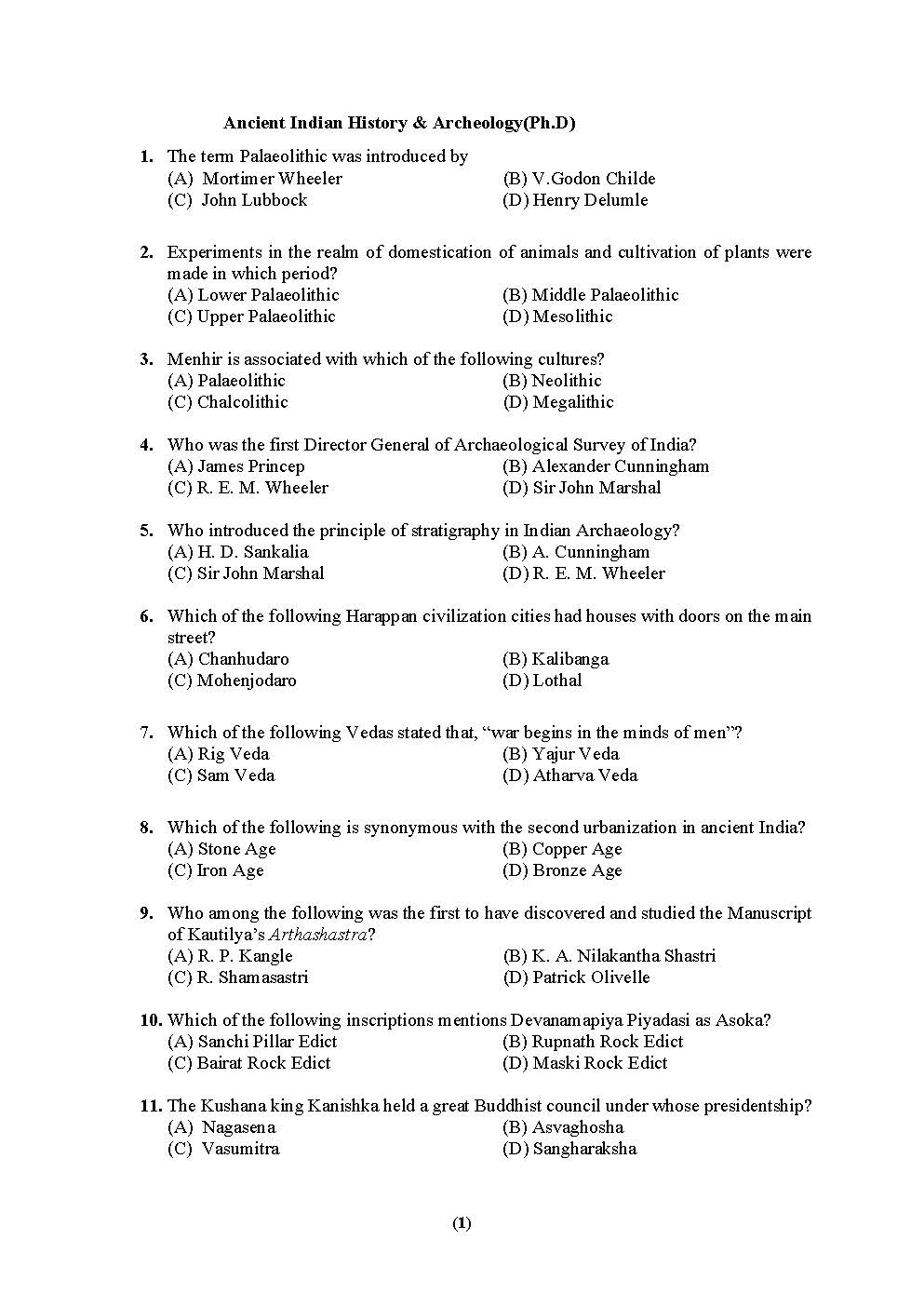
Page 1
1. The term Palaeolithic was introduced by
(A) Mortimer Wheeler (B) V.Godon Childe
(C) John Lubbock (D) Henry Delumle
2. Experiments in the realm of domestication of animals and cultivation of plants were
made in which period?
(A) Lower Palaeolithic (B) Middle Palaeolithic
(C) Upper Palaeolithic (D) Mesolithic
3. Menhir is associated with which of the following cultures?
(A) Palaeolithic (B) Neolithic
(C) Chalcolithic (D) Megalithic
4. Who was the first Director General of Archaeological Survey of India?
(A) James Princep (B) Alexander Cunningham
(C) R. E. M. Wheeler (D) Sir John Marshal
5. Who introduced the principle of stratigraphy in Indian Archaeology?
(A) H. D. Sankalia (B) A. Cunningham
(C) Sir John Marshal (D) R. E. M. Wheeler
6. Which of the following Harappan civilization cities had houses with doors on the main
street?
(A) Chanhudaro (B) Kalibanga
(C) Mohenjodaro (D) Lothal
7. Which of the following Vedas stated that, “war begins in the minds of men”?
(A) Rig Veda (B) Yajur Veda
(C) Sam Veda (D) Atharva Veda
8. Which of the following is synonymous with the second urbanization in ancient India?
(A) Stone Age (B) Copper Age
(C) Iron Age (D) Bronze Age
9. Who among the following was the first to have discovered and studied the Manuscript
of Kautilya’s Arthashastra?
(A) R. P. Kangle (B) K. A. Nilakantha Shastri
(C) R. Shamasastri (D) Patrick Olivelle
10. Which of the following inscriptions mentions Devanamapiya Piyadasi as Asoka?
(A) Sanchi Pillar Edict (B) Rupnath Rock Edict
(C) Bairat Rock Edict (D) Maski Rock Edict
11. The Kushana king Kanishka held a great Buddhist council under whose presidentship?
(A) Nagasena (B) Asvaghosha
(C) Vasumitra (D) Sangharaksha
(1)
Page 2
(A) Sarnath (B) Bodhgaya
(C) Nagarjunakond (D) Gandhara and Mathura
13. Which of the following inscriptions refers to the erection of a Garuda Pillar by a Greek
national?
(A) Eran Inscription (B) Sanchi Inscription
(C) Bharhut Inscription (D) Besnagar Inscription
14. Who assumed the title of Ksitipasatapatih (Lord of hundred kings)?
(A) Ashoka (B) Chandragupta II
(C) Samudragupta (D) Skandagupta
15. Who founded Vikramshila Mahavihar?
(A) Harshavardhan (B) Gopala
(C) Dharmapala (D) Baladitya
16. The Dhamek stupa is located at which of the following places?
(A) Kaushambi (B) Sarnath
(C) Bodhgaya (D) Sanchi
17. The Pallava rulers built temples by using which of the following stones?
(A) Sandstone (B) Granite
(C) Basalt (D) Schist
18. Which of the following Rashtrakuta kings made Manyakheta as his new capital?
(A) Dantidurg (B) Amoghavarsha I
(C) Govinda II (D) Govinda III
19. Who discovered Bhimbetka?
(A) H.D. Sankalia (B) Shyam Sundar Nigam
(C) Vishnu Shridhar Wakankar (D) Rajabali Pandey
20. Which of the following Dharmasutras describes sea voyage as a degrading act?
(A) Baudhayana Dhamasutra (B) Gautama Dharmasutra
(C) Vasishtha Dharmasutra (D) Apastamba Dharmasutra
21. Which of the following places was famous for cotton trade during the rule of the Chola
dynasty?
(A) Tanjore (B) Kaveripattanam
(C) Kalingapattanam (D) Uraiyur
22. The Padirruppattu is a collection of poems in praise of
(A) Pandya Kings (B) Chera Kings
(C) Satavahana Kings (D) Chola Kings
23. Abhinavagupta was a famous Acharya of which of the following schools?
(A) Pasupata (B) Lingayat
(C) Kapalika (D) Pratayabhijna
(2)
Page 3
inscriptions?
(A) Vilsad Pillar Inscription (B) Bhitari Pillar Inscription
(C) Eran Pillar Inscription (D) Bhitargaon Inscription
25. Who is the author of the book, The Oxford Companion to India Archaeology?
(A) D. P. Agrawal (B) D. K. Chakrabarti
(C) H. D. Sankalia (D) B. N. Mukherjee
26. Research is a:
(A) Self-oriented process (B) Discovery oriented process
(C) Value oriented process (D) Passive process
27. Who of the followings define, ‘research’ as ‘a systematized effort to gain knowledge’?
(A) F.W. Taylor (B) Redman and Mory
(C) Chifford Woody (D) D. Slesigner
28. Who among the following has given the statement that “Research is an honest effort
carried out through insight”?
(A) Mouly (B) Cook
(C) Best (D) Watson
29. Research ethics do not include
(A) Objectivity (B) Subjectivity
(C) Honesty (D) Integrity
30. Which of the following is the first step in a research process?
(A) Selection of a topic (B) Formulating Research Problem
(C) Development of a Hypothesis (D) Preparation of a Bibliography
31. One of the essential characteristics of research is:
(A) Replicability (B) Generalizability
(C) Objectivity (D) Usability
32. The fundamental objective of research is to:
(A) summarize the ideas given by others
(B) publish research papers to improve ability
(C) get Ph. D degree for better opportunities in future
(D) create new knowledge and to understand the meaning of current knowledge
33. The ‘sociogram’ technique is used to study:
(A) Professional Competence (B) Vocational Interest
(C) Achievement Motivation (D) Human Relations
34. Longitudinal approach in research refers to:
(A) Short-term researches (B) long-term researches
(C) transverse researches (D) research on environment
(3)
Page 4
(A) brief and meaningful (B) aesthetic and attractive
(C) scientific and logical (D) philosophical and ornamental
36. The bibliography should be arranged:
(A) according to the year of publication (B) according importance of the books
(C) alphabetically (D) logically
37. The study in which the investigators attempt to trace an effect is known as:
(A) Summative Research (B) Ex-post Facto Research
(C) Survey Research (D) Historical Research
38. Field-work based research is classified as
(A) Experimental Research (B) Historical Research
(C) Empirical Research (D) Descriptive Research
39. Research proposal is also called as
(A) an abstract (B) a summary
(C) a Synopsis (D) a Prologue
40. Data collected from published books and journals are called
(A) Primary data (B) Secondary data
(C) Conventional data (D) Tertiary data
41. In a research work reference serves the purpose of
(A) Providing ornamental value to the research
(B) Lending authenticity to the given content
(C) Exhibiting the great achievement of the research work
(D) Making insightful decision by the researcher
42. The method of research reporting should be
(A) Personal (B) Attractive
(C) Globalized (D) Scientific
43. In doing action research what is the useful sequence of steps?
(A) Plan, reflect, observe, act (B) Act, observe, plan, reflect
(C) Plan, act, observe, reflect (D) Reflect, observe, plan, act
44. et al. refers to:
(A) and others (B) and the following
(C) for example (D) and elsewhere
45. N.B. means:
(A) Compare (B) approximately
(C) Note well (D) Not known
(4)
Page 5
(A) In the same place (B) the text following
(C) in the work cited (D) here and there
47. Who of the following is the author of the work The Historians Crafts?
(A) Marc Bloch (B) Fernand Braudel
(C) Lucien Febvre (D) Lewis Mumford
48. Who is the author of the book The Theory and Practice of History?
(A) G. R. Elton (B) Fritz Stern
(C) E. H. Carr (D) Leopold von Ranke
49. Who is the author of The Nature of History?
(A) Arthur Marwick (B) Will Durant
(C) A. Appadorai (D) Arthur F. Wright
50. Who of the following is the author the Idea of History?
(A) John C.B. Webster (B) Patrick Gardiner
(C) R. G. Collingwood (D) Oswald Spengler
x-x-x
ROUGH WORK
(5)
Page 6
1. Ridge lines can be defined as the:
(A) Loci of the Maximum Products (B) Loci of zero Marginal Products
(C) Loci of zero Total Products (D) Loci of zero Average Products
2. The process of negotiation between labor representatives and managers for deciding
agreeable conditions of employment is called:
(A) Collective Bargaining
(B) Arbitrage
(C) Worker Participation in Management
(D) Compensation
3. An increase in imports:
(A) Has the same effect upon the multiplier as an increase in MPC
(B) Has no effect upon the multiplier
(C) Increases the value of multiplier
(D) Decreases the value of multiplier
4. The area where the members remove trade-barriers among themselves but keep their
separate national barriers against trade with the outside world, is known as :
(A) Customs Unions (B) Common Market Area
(C) Economic Union (D) Free Trade Area
5. The Reference Period for the measurement of Neo-Natal Mortality Rate in India is :
(A) Three months after birth (B) Six months after birth
(C) 10 days after birth (D) 28 days after birth
6. Which of the following is considered as the third stage in the Rostow’s stages of
economic growth model?
(A) High mass consumption (B) Traditional society
(C) Pre-conditions for a take-off (D) Take-off
7. SDG ‘ Life Below Water’ aims at conserving and sustainably using:
(A) Groundwater resources
(B) Wetland Ecosystem
(C) Oceans, Seas and Marine Resources
(D) Marshland Resources
8. The Concentration Theory of Tax Shifting and Incidence was developed by:
(A) Mercantilist (B) Physiocrats
(C) Australian School (D) Keynesians
9. A tax is levied at 10% on first Rs 10,000 of income, 15% on next 20,000 and 17% on next
30,000, this would be:
(A) Progressive (B) Degressive
(C) Regressive (D) Proportional
10. When supply of a commodity, for example agricultural commodities, react to price with
a lag of one time period due to gestation period in production, such a phenomenon is
referred to as:
(A) Lag phenomenon (B) Cobweb phenomenon
(C) Inertia (D) Business cycle
11. The 2022, Nobel Prize in Economics has been given to Philip H. Dybvig, Ben S. Bernanke
and Douglas W. Diamond for their work on:
(A) Analysis of market power and regulation
(6)
Page 7
(C) Research on banks and financial crisis
(D) Improvements to auction theory and inventions of new auction formats
12. Environmental Kuznets Curve shows the relationship between:
(A) Green GNP and GNP
(B) Natural Resources and Environmental Quality
(C) Natural Resources and Human Made Resources
(D) Environment Degradation and Income Per Capita
13. For complementary goods, the cross elasticity of demand will be:
(A) Zero (B) Infinity
(C) Positive but less than infinity (D) Negative
14. GNP at factor cost is equal to:
(A) GNP at Market Prices−Total Indirect Taxes + Subsidies
(B) GNP at Market Prices +Total Indirect Taxes − Subsidies
(C) GNP at Market Prices−Total Direct Taxes + Subsidies
(D) GNP at Market Prices−Total Direct Taxes ÷ Subsidies
15. The credit of developing the concept of Modern Economic Growth goes to?
(A) Arthur Lewis (B) Michael P. Todaro
(C) Gunnar Myrdal (D) Simon Kuznets
16. The Purchasing Power Parity Theory postulates that the change in exchange rate
between two currencies is proportional to the change in the ratio in the two countries’
_________
(A) Import duty (B) General price level
(C) Unemployment rate (D) Savings rate
17. The Gender Inequality Index is a composite index of:
(A) Reproductive Health, Empowerment and Labor Market Participation
(B) Reproductive Health, Adult Literacy Rate and Labor Market Participation
(C) Reproductive Health, Empowerment and Life Expectancy
(D) Reproductive Health, Life Expectancy and Adult Literacy
18. Match List - I with List - II:
List-I List –II
(a) Rural-urban migration (i) Arthur Lewis
(b) Economic development with unlimited supply of labour (ii) Gunnar Myrdal
(c) Process of cumulative causation (iii) Raul Prebisch
(d) Decline in terms of trade of primary commodities (iv) Harris-Todaro
(A) (a)-(i), (b)-(iv), (c)-(ii), (d)-(iii) (B) (a)-(iv), (b)-(i), (c)-(ii), (d)-(iii)
(C) (a)-(i), (b)-(iv), (c)-(iii), (d)-(ii) (D) (a)-(i), (b)-(iii), (c)-(ii), (d)-(iv)
19. The total cost function of a firm is 𝐶 = 𝑞 − 3𝑞 + 50𝑞 + 300, where C= Total cost,
q= Output. What is the Marginal cost at q= 10?
(A) 20 (B) 10 (C) 30 (D) 50
20. ‘Bandwagon Effect’ is found in:
(A) Relative Income Hypothesis (B) Permanent Income Hypothesis
(C) Life Cycle Hypothesis (D) Absolute Income Hypothesis
(7)
Page 8
(A) Child Health (B) Mental Health
(C) Communicable Diseases (D) Science and Technology
22. What is the rank of India in the International Intellectual Property Index 2023?
(A) 26 (B) 32 (C) 42 (D) 55
23. A good is called a ‘Giffen Good’ when the income effect is:
(A) Positive and is greater than the substitution effect
(B) Equal to substitution effect
(C) Less than substitution effect
(D) Negative and is greater than the substitution effect
24. Total utility is maximum when:
(A) Marginal utility is zero (B) Marginal utility is maximum
(C) Marginal utility increases (D) Average utility is maximum
25. Core inflation has been described as:
(A) Headline inflation − food inflation
(B) Headline inflation – (food inflation + fuel inflation)
(C) Headline inflation – fuel inflation
(D) Food inflation + fuel inflation
26. In a distribution of 10, 20, 30, 40, 50, the 𝑋 is 30, the sum of deviations from 𝑋 will be:
(A) 0 (B) 60 (C) 30 (D) 15
27. The ratio of the unexplained variation to total variation is defined as the coefficient of:
(A) Determination (B) Non-determination
(C) Dependency (D) None of these
28. Cross-cultural studies are an example of:
(A) Case study (B) Comparative study
(C) Experimental study (D) Cross-sectional study
29. Which type of variable is ‘gender’?
(A) Continuous variable (B) Primary variable
(C) Dependent variable (D) Categorical variable
30. Selecting every sixth female entering the mall is an example of?
(A) Quota Sampling (B) Systematic Sampling
(C) Cluster Sampling (D) Simple Random Sampling
31. Lorenz curve is a graphical representation of:
(A) Variance (B) Dispersion
(C) Standard Deviation (D) Mean Deviation
32. The purpose of giving a ___________ is to refer the reader to the source from which a
quotation is taken:
(A) Citation (B) Footnote (C) Quote (D) Ident
33. A widely used format developed by Rensis Likert is useful for asking questions about:
(A) Attitude (B) Personality (C) Morale (D) None of these
34. Questions in which only two alternatives are possible is called:
(A) Multiple choice questions (B) Dichotomous questions
(C) Open ended questions (D) Unstructured questions
(8)
Page 9
‘Running will increase a person’s heart rate.’
(A) Increase (IV), Person (DV) (B) Increase (DV), Person (IV)
(C) Running (DV), Heart rate (IV) (D) Running (IV), Heart rate (DV)
36. Two types of errors associated with hypothesis testing are Type I and Type II. Type II
error is committed when:
(A) The null hypothesis is rejected whilst the alternative hypothesis is true
(B) The null hypothesis is rejected when it is true
(C) The null hypothesis is not rejected when it is false
(D) Both B and C
37. Which scientific method focuses on testing hypothesis developed from theories?
(A) Deductive method (B) Inductive method
(C) Hypothesis method (D) Pattern method
38. The various steps in Research Process are given below. Place them in ascending order
of the stages?
a. Data collection
b. Report writing
c. Data analysis
d. Problem formulation
Select the answer by using the codes given below:
(A) a, c, d and b (B) a, d, c and b
(C) d, a, c and b (D) c, a, d and b
39. The degree to which an instrument really measures what it intends to measure is
called?
(A) Construct (B) Reliability (C) Validity (D) All of these
40. Binomial distribution approaches the normal distribution when the sample size________
(A) Increases (B) Decreases
(C) Remains constant (D) None of these
41. Which of the following is NOT a style used for referencing?
(A) MLA (B) Chicago (C) APA (D) Munich
42. What are the core elements of a research process?
(A) Introduction; Data Collection; Data Analysis, Conclusions and
Recommendations
(B) Executive Summary; Literature Review, Data Gathered, Conclusions;
Bibliography
(C) Research Plan; Conclusions; Analysis; Research Data
(D) Introduction; Literature Review; Research Methodology; Results; Discussions
and Conclusions
(9)
Page 10
(A) Dividing values (B) Quartile values
(C) Partition values (D) Interpolation values
44. Snowball sampling is the process of selecting a sample using:
(A) Networks (B) Snowballs
(C) Computer Programs (D) None of these
45. The term ibid is often used while citing the reference for which of the following:
(A) To quote the work from a manuscript which has been communicated
(B) To quote the work from a book which is recently published
(C) To quote the work from the same source which has been mentioned in a
previous reference
(D) To quote the work from the different source which has not been mentioned in
earlier references
46. Tippet has prepared:
(A) Table of Lottery Numbers
(B) Table of Sampling Numbers
(C) Table of Systematic Numbers
(D) Table of Random Numbers
47. In the context of survey research, the following steps are taken in certain order, which
of the following options represent correct order?
(I) Sampling
(II) Inference
(III) Data analysis
(IV) Data collection
Select the answer by using the codes given below:
(A) (II), (III), (I), (IV) (B) (I), (IV), (III), (II)
(C) (III), (II), (IV), (I) (D) (IV), (I), (II), (III)
48. In __________scale no initial point can be decided.
(A) Interval (B) Ratio (C) Ordinal (D) Nominal
49. The process of marking segments of data with symbols, descriptive words, or category
names is known as________.
(A) Concurring (B) Coding (C) Colouring (D) Segmenting
50. The geometric mean of the two regression coefficients is the:
(A) Coefficient of skewness (B) Covariance
(C) Coefficient of correlation (D) Coefficient of quartile deviation
x-x-x
(10)
Page 11
1. Historical fact refers to:
(A) All facts about the past (B) Facts on specific events
(C) Assumptions about the past (D) Selected facts about the past
2. Evidence has to be:
(A) Reliable and genuine (B) From government source only
(C) From newspaper only (D) From fiction
3. Primary sources are:
(A) All sources on the theme
(B) Selected sources
(C) Contemporary sources from period selected
(D) Biographies only
4. Secondary sources are based on:
(A) Imagination of scholar (B) Primary sources
(C) Non-government records (D) Non-fiction account
5. The 19th century view of history believed that
(A) Facts had opinion (B) Facts are not objective
(C) Facts are all important (D) Facts have inbuilt interpretation
6. “Imaginative understanding” implies:
(A) Facts are pure
(B) Facts are part of dead past
(C) Historian has no role in selection of facts
(D) Facts are refracted through mind of recorder
7. Wickedness of Hegel refers to:
(A) Chance in history (B) Determinism (C) Causation (D) Laws in history
8. Hypotheses refers to:
(A) General statement of what would happen in a given situation
(B) Conclusion of research
(C) Fixed ideas or ideal type
(D) Lack of verification in research
9. Periodization implies:
(A) Permanent division of time in history (B) Generalization
(C) Unchanging time structure (D) No revision in time frame
10. Which of the following is not an objection to history being a science:
(A) Deals with unique (B) Involves issues of morality
(C) Cannot predict (D) Teaches lessons
11. Primary sources cannot be used:
(A) To settle any difference of opinion (B) To find fresh facts
(C) To raise new questions (D) To give interpretation
12. The purpose of a bibliography is to:
(A) Provide base for plagiarism (B) Limit sources of study
(11)
Page 12
13. Which of the following statements is incorrect about the Annales School:
(A) Provided new orientation to study history
(B) Introduced new methods
(C) Identified new sources
(D) Focused on traditional study of history
14. William Jones established the:
(A) India society (B) Asiatic society
(C) Pan Indian association (D) Asia study circle
15. Cleopatra’s nose refers to:
(A) Role of women in history (B) Rational causes for an event
(C) Chance in history (D) Logic and reason
16. Quantitative history uses:
(A) Only good quality works (B) Only secondary sources
(C) Data and figures (D) Only primary record
17. Psychohistory is a branch of history:
(A) To study psychology (B) To study psychological events
(C) To study crazy personalities in history (D) To use psychology to study history
18. Historiography is the study of:
(A) History (B) Events (C) Historians (D) History writing
19. History is a science because:
(A) It uses observation (B) It utilizes many sources
(C) It uses the scientific method (D) It can be quantified
20. Objectivity in history is:
(A) Not possible (B) Against the nature of the subject
(C) Possible if enforced (D) Possible if scholar is conscious
21. Administrator historians were:
(A) In service of British government (B) Interested in administration
(C) Writers of administrative history only (D) None of these
22. Subaltern history focuses on:
(A) The grassroot level (B) The ruling class
(C) Economic history only (D) Trade and industry
23. In dealing with causation a scholar should:
(A) Use only some causes
(B) Select significant causes
(C) Discuss only 3 causes
(D) Include all known causes and give them proper sequence
(12)
Page 13
(A) Social sciences (B) Natural sciences
(C) Engineering and medicine (D) Vocational disciplines
25. Folklore refers to:
(A) Traditional beliefs, myths, tales etc (B) Non-verbal sources
(C) Contemporary sources (D) None of these
26. Which sect in Buddhism does not believe in idol worship:
(A) Mahayana (B) Vajrayana (C) Hinayana (D) None of these
27. Which of the following dynasty was identified on the basis of coins:
(A) Gupta (B) Rashtrakuta (C) Kushana (D) Chalukya
28. Which of the following towns of the Harappan civilization were located on the
Ghaggar:
(A) Harappa and Mohenjodaro (B) Kalibangan and Banawali
(C) Kalibangan and Harappa (D) Rangpur and Mohenjodaro
29. What was the main source of revenue in the Mauryan time:
(A) Land (B) Forest (C) Irrigation (D) None of these
30. What is the upveda of the Yajurveda:
(A) Shilpaveda (B) Dhanurveda (C) Ayurveda (D)
Gandharvaveda
31. An old sun temple of pre-partition Punjab is located at:
(A) Multan (B) Amritsar (C) Jallandhar (D) Lahore
32. Jahangir’s memoirs record that he called for Guru Arjan Dev because:
(A) He had supported the rebel Khusrau (B) He was collecting an army
(C) He wished to discuss issues (D) The Guru had sought a meeting
33. Tappa and Tope refers to:
(A) Types of cannons (B) Levels of administrative units
(C) Local groups for administration (D) Self-administering units
34. Small towns were all centres of:
(A) Collection and distribution of goods (B) Sociocultural significance
(C) Large scale manufacturing (D) Provincial capitals
35. Tazkira-i-pir Hassuteli is written by:
(A) Sheikh Hassan (B) Banarsi Das (C) Surat Singh (D) Hassan Shah
36. Which of the following is not a work of Amir Khusrau:
(A) Panj ganj (B) Nuh sipihir
(C) Deval Rani Khizar khan (D) Farhang-e-qawas
37. “Great Firm theory” elaborated on:
(A) Agrarian crisis in Mughal India
(B) Wars of succession
(13)
Page 14
(D) Structural flaws in Mughal system
38. Urban revolution in the 13th century refers to:
(A) Religious revolt in towns (B) Increase in number and size of towns
(C) Destruction of towns (D) Political change in towns
39. “Black acts” referred to:
(A) Wartime measures (B) Roulatt act
(C) Government of India act 1919 (D) Government of India act 1935
40. Durand line was:
(A) Boundary established between Afganistan and British India
(B) Line demarcating east and west Bengal
(C) Line separating Pepsu and Punjab
(D) Line dividing eastern and western hill states
41. The Home Rule League intended to:
(A) Establish democracy
(B) Support violence to attain freedom
(C) Create an environment for independence
(D) Mobilize public opinion for self-government
42. The Ilbert Bill sought to allow:
(A) Indian judges to decide cases involving Indians
(B) British officers to control British non-government persons
(C) Senior Indian magistrates to preside over cases involving British subjects
(D) Indian magistrates to decide only civil cases
43. The Red Shirt movement was also called:
(A) Pashtoon movement (B) Khudai Khidmatgar
(C) Labor movement (D) Kisan movement
44. The Doctrine of Lapse was devised to:
(A) Recognize adopted heirs
(B) Decide cases of adoption in princely states
(C) Create conditions for appointing heirs
(D) Assert paramountcy over Hindu states
45. The Lee Commission was appointed to:
(A) Recommend reforms in education
(B) Consider racial composition of Indian public service
(C) Settle disputes between political parties
(D) Finalize service conditions
46. The Janamsakhis are:
(A) Written in the time of Guru Nanak (B) Biographies of the Gurus
(C) Devotional literature (D) Written in Sanskrit
47. Which of the following places in not in Doaba region:
(A) Jalandhar (B) Ambala (C) Kapurthala (D) Ludhiana
(14)
Page 15
(A) An administrative officer
(B) Touring justice
(C) Clerical person in judicial administration
(D) Assistant to Ulama
49. Balance of Trade implies:
(A) Imports exceed exports (B) Exports exceed imports
(C) Import and export is equal (D) There is only export
50. Sehejdhari refers to:
(A) A Sikh who observes Khalsa code (B) A Sikh who is baptized
(C) A non-Khalsa Sikh (D) None of these
x-x-x
ROUGH WORK
(15)
Page 16
1. For Locke, which of the following is not true in case of social contract?
(A) Contract, once made, is irrevocable
(B) Contract to which each generation must not consent
(C) Contract in which men give up some of the rights they possessed in the state of nature
(D) Contract does not put an end to the Law of Nature
2. For Rousseau, which one of the following is not true?
(A) For man’s self-love, which satisfies his real needs, is only too apt to become pride
(B) Pride becomes incompatible with sympathy
(C) From pride all evil has grown
(D) Pride does not seduce reason
3. Who among the following has written the article “The Zigzag of Politics”?
(A) John Rawls (B) H.A. Hayek (C) R. Nozick (D) J. Habermas
4. Who among the following is not a proponent of communitarianism?
(A) Alasdair Maclntyre (B) Michael Sandel
(C) Michael Walzer (D) Friedrich Hayek
5. The Governor of a state in his capacity as Administrator of an adjoining Union
Territory discharges his functions independently of:
(A) The President of India (B) The Union Cabinet
(C) The Union Home Minister (D) The State Council of Ministers
6. Who among the following described bureaucracy as “The continental nuisance”?
(A) Max Weber (B) Thomas Carlyle (C) M. Crozier (D) Karl Marx
7. Which one of the following Commissions was not related to Backward Classes?
(A) Bakshi Commission (B) Mandal Commission
(C) Havnoor Commission (D) Shah Commission
8. Which of the following have been discussed as crisis of India’s national unity by
Paul R. Brass in his book The Politics of India since Independence?
(A) Punjab (B) The North East (C) Casteism (D) Kashmir
9. Who describes Indian federation as a “holding together federation and not a
‘coming together federation”?
(A) P. Bardhan (B) R.L. Watts (C) Douglas Verney (D) D.D. Basu
10. Who calls Election Commission of India as an effective ‘bulwark of free and fair
elections’?
(A) Alistair McMillan (B) Lloyd and Susanne Rudolph
(16)
Page 17
11. Who of the following regard the Supreme Court of India as having a dual
personality – a legal institution and a public institution?
(A) Granville Austin
(B) Upendra Baxi
(C) Madhav Khosla and Ananth Padmanabhan
(D) N. Robinson
12. Who among the following described comparative politics as primarily concerned with
“parties, interests and leadership structure”?
(A) Gabriel Almond (B) Sigmund Neuman
(C) Roy C. Macridis and Ward (D) M.G. Smith
13. Who have argued that far from an objective reality, international politics is a
‘World of our making’?
(A) Realists (B) Feminists (C) Idealists (D) Constructivists
14. Which one of the following is not part of five global commons?
(A) The High Seas (B) The Climate System
(C) The Deep Ocean floor (D) The Arctic region
15. Which one of the following pairs is mismatched?
Books Author
(A) The wretched of the earth Frantz Fanon
(B) World order Henry Kissinger
(C) Implosion of Capitalism Samir Amin
(D) Neo-Colonialism: The last stage of Imperialism Julius Nyerere
16. Which one of the pairs is not correctly matched?
(A) Realism - States (B) Globalizm - Non state actors
(C) Dependency - Economic interests (D) Feminism – Gender
17. Who among the following had started two weeklies, the Karmayogin and the
Dharma?
(A) Mahatma Gandhi (B) Aurobindo (C) Ranade (D) Tilak
18. Given below are two statements, one labelled as Assertion (A) and other as Reason
(R):
Select the correct answer from the code given below:
Assertion (A): M.N. Roy did not accept Marx’s materialistic interpretation of history.
Reason (R): It had an element of determinism and idealism.
Code:
(A) Both (A) and (R) are true and (R) is the correct explanation of (A).
(B) Both (A) and (R) are true, but (R) is not the correct explanation of (A).
(17)
Page 18
(D) (A) is false, but (R) is true.
19. Who among the following said in the context of States Reorganisation Commission
Report: “The Lambs are shorn of the wool” and “They are feeling the intensity of
cold”?
(A) J. Nehru (B) B.R. Ambedkar (C) B.N. Rau (D) K.T. Shah
20. Which of the following statements is not correct?
(A) Traditional political theory is prescriptive and normative
(B) Behavioural political theory concerned with uniformities and regularities
(C) Post-behavioural political theory is tied to action and relevancy
(D) Post-behavioural political theory is not holistic
21. Which one of the following contentions of Isaiah Berlin is not true in the context
of resurgence of political theory (political philosophy)?
(A) Politics exists in a society where ends collide. In a liberal order political theory can
never see its end.
(B) The responsibility for causing decline of political theory should be laid on rank
empiricists who have displaced classical tradition.
(C) Political theory shall continue to exist as a result of the inquisitive and rational
inquiry of man.
(D) He is sceptical about the resurgence of political theory (philosophy).
22. Who among the following conceived society as a ‘Cooperative venture for mutual
advantage’, more or less self-sufficient, and necessarily governed by rules?
(A) Robert Nozick (B) Friedrich Hayek (C) John Rawls (D) Karl Marx
23. Who among the following has written the article “The Zigzag of Politics”?
(A) John Rawls (B) H.A. Hayek (C) R. Nozick (D) J. Habermas
24. Who among the following is not a proponent of communitarianism?
(A) Alasdair Maclntyre (B) Michael Sandel
(C) Michael Walzer (D) Friedrich Hayek
25. “If Hume and other English liberals hoped to use Congress as a safety-valve, the
Congress leaders hoped to use Hume as a lightening-conductor”. Who said this?
(A) S.R. Mehrotra (B) Sumit Sarkar
(C) Bipan Chandra (D) Tapan Raychaudhuri
26. Which of the following is the first step in starting the research process?
(A) Searching sources of information to locate the problem
(B) Survey of related literature
(C) Identification of the problem
(D) Searching for solutions to the problem
27. Manipulation is always a part of
(A) Historical research (B) Fundamental research
(C) Descriptive research (D) Experimental research
(18)
Page 19
(A) when there is no difference between the variables
(B) the same as research hypothesis
(C) subjective in nature
(D) when there is difference between the variables
29. The research which is exploring new facts through the study of the past is called
(A) Philosophical research (B) Historical research
(C) Mythological research (D) Content analysis
30. How can the objectivity of the research be enhanced?
(A) Through its impartiality (B) Through its reliability
(C) Through its validity (D) All of these
31. Action-research is:
(A) Applied research
(B) A research carried out to solve immediate problems
(C) A longitudinal research
(D) All the above
32. The research that applies the laws at the time of field study to draw more and more
clear ideas about the problem is:
(A) Applied research (B) Action research
(C) Experimental research (D) None of these
33. When a research problem is related to heterogeneous population, the most suitable
sampling method is:
(A) Cluster Sampling (B) Stratified Sampling
(C) Convenient Sampling (D) Lottery Method
34. The research is always
(A) verifying the old knowledge (B) exploring new knowledge
(C) filling the gap between knowledge (D) all of these
35. Formulation of hypothesis may NOT be required in:
(A) Survey method (B) Historical studies
(C) Experimental studies (D) Normative studies
36. Authenticity of a research finding is its:
(A) Originality (B) Validity (C) Objectivity (D) All of these
37. Which technique is generally followed when the population is finite?
(A) Area Sampling Technique (B) Purposive Sampling Technique
(C) Systematic Sampling Technique (D) None of these
(19)
Page 20
(A) The manipulation of variables (B) Conceptual parameters
(C) Replication of research (D) Survey of literature
39. The main characteristic of scientific research is:
(A) empirical (B) theoretical (C) experimental (D) all of these
40. The study in which the investigators attempt to trace an effect is known as:
(A) Survey Research (B) 'Ex-post Facto' Research
(C) Historical Research (D) Summative Research
41. To test null hypothesis, a researcher uses:
(A) t test (B) ANOVA (C) X2 (D) factorial analysis
42. Research problem is feasible only when:
(A) it has utility and relevance
(B) it is researchable
(C) it is new and adds something to knowledge
(D) all the above
43. What is the purpose of a research hypothesis?
(A) To summarize the research findings (B) To explain the research methodology
(C) To predict the outcome of the research (D) To describe the research participants
44. What is a dependent variable in a research study?
(A) A variable that is manipulated by the researcher
(B) A variable that is not affected by other variables
(C) A variable that is measured or observed in response to the independent variable
(D) A variable that is controlled by the research participants
45. What is the most common method of data collection in quantitative research?
(A) Interviews (B) Focus groups
(C) Observation (D) Surveys/Questionnaires
46. Which of the following statistical tests is used to determine if there is a significant
relationship between two variables?
(A) T-test (B) ANOVA
(C) Correlation coefficient (D) Chi-square
47. A sampling technique in which units are randomly sampled from a population that has
been divided into categories is called:
(A) Simple random sampling (B) Stratified random sampling
(C) Cluster random sampling (D) Systematic random sampling
48. What is a dependent variable in research?
(A) The variable that is manipulated by the researcher
(B) The variable that remains constant throughout the research
(C) The variable that is measured and observed
(D) The variable that is not relevant to the research question
(20)
Page 21
(A) A plan for data analysis (B) A method for data collection
(C) A statistical technique (D) A framework for conducting research
50. What is the purpose of statistical analysis in research?
(A) To summarize research findings (B) To collect primary data
(C) To draw conclusion from data (D) To develop research hypotheses
x-x-x
ROUGH WORK
(21)
Page 22
1. When a relevant subgroups of the population are randomly sampled in proportion
to its size, it is –
(A) Random sample technique
(B) Stratified random sample technique
(C) Representative sample
(D) Cluster sample technique
2. The tendency of people to behave differently on being knowingly observed is
called –
(A) Placebo effect
(B) Halo effect
(C) Horn effect
(D) Hawthorne effect
3. Which among the following measures of central tendency is most sensitive to
extreme score ?
(A) Mean
(B) Median
(C) Mode
(D) Frequency distribution
4. When we say that the population mean is same as the sample mean, it signifies –
(A) research hypothesis
(B) alternative hypothesis
(C) experimental hypothesis
(D) null hypothesis
5. Type II error is made by the researcher when –
(A) The null hypothesis is true and the null hypothesis is rejected
(B) The null hypothesis is true and the null hypothesis is accepted
(C) The null hypothesis is false and the null hypothesis is accepted
(D) The null hypothesis is false and the null hypothesis is rejected
6. The probability of making a type II error is called –
(A) Alpha
(B) Beta
(C) Gamma
(D) Delta
7. the equality of two frequencies or proportions i.e. categorical data is measured by -
(A) t- test
(B) ANOVA
(C) Chi-square test
(D) Factorial design
(22)
Page 23
(A) Convergent validity
(B) Criterion validity
(C) Content validity
(D) Concurrent validity
9. All else being equal, which of the following signifies strongest correlation
(A) -0.86
(B) -0.14
(C) +0.75
(D) 1.08
10. The design which concerns the question of how many times items are to be
observed and how the information and data gathered is to be analysed is called –
(A) Sampling design
(B) Statistical design
(C) Observational design
(D) Operational design
11. Which scale of measurement has an arbitrary zero
(A) Ratio scale
(B) Interval scale
(C) Ordinal scale
(D) Nominal scale
12. Which of the following is not a type of primary data collection
(A) Observation
(B) Schedule
(C) Interview
(D) Historical documents
13. A data set has a positive skewness when,
(A) Mean<Median<Mode
(B) Mode<Median<Mean
(C) Mode=Median=Mean
(D) None of the above
14. Which of the following is not a type of nonparametric test
(A) Sign test
(B) Wilcoxon Signed Rank Sum Test
(C) Mann Whitney U test
(D) Pearson’s Product Moment Correlation
15. When the size of a sample increases, the sampling error tends to -
(A) Remain the same/unaffected
(B) Increase
(C) Decrease
(D) None of the above
(23)
Page 24
procedure) refers to
(A) Sample Statistics
(B) Population Parameters
(C) Sampling Parameters
(D) None of the above
17. If you conducted a study in which you randomly assigned people to two groups
and tested them on a measure of attention, which statistical test would you use to
determine whether the two groups differed on the measure of attention?
(A) Two-way analysis of variance
(B) One-way analysis of variance
(C) Independent t-test
(D) (B) and (C)
18. At a minimum, how many significance tests are conducted for a standard two-way
ANOVA
(A) 3
(B) 2
(C) 1
(D) 4
19. A technique used to measure the meaning participants attach to various attitudinal
objects or concepts is called
(A) The semantic differential technique
(B) The non-anchored rating scale
(C) The mutually exclusive response list
(D) Thurstone scale
20. A statistical technique that allows one to combine the findings from a number of
studies and determine whether significant trends emerge is called
(A) Ethnographic analysis
(B) Discriminant statistical analysis
(C) Meta-analysis
(D) Path analysis
21. The purpose of grounded theory study is to
(A) Describe cultural characteristics
(B) Inductively generate a theory
(C) Describe one or more individual’s experiences of phenomenon
(D) Describe one or more cases in depth
22. Which is true about this design: QUAL QUAN
(A) It is an equal-status concurrent mixed methods research design
(B) It is an equal-status sequential mixed methods research design
(C) It is a dominant-status concurrent mixed methods research design
(D) It is a dominant-status sequential mixed methods research design
(24)
Page 25
(A) A measure of variability in squared units
(B) A measure of control tendency
(C) The square root of variance
(D) All of the above
24. On the normal curve, the mean, median and mode are -
(A) The same
(B) Different
(C) The mean is greater than the mode
(D) The mean is less than the mode
25. In a simple regression, the regression coefficient tells you
(A) Variability in independent variable
(B) The point where the regression line crosses the X-axis
(C) The amount of change in the dependent variable associated with per unit
change in the independent variable, while holding all other variable constant
(D) The amount of change in the independent variable per one unit change in
dependent variable
26. Who among the following proposed that behavior is learned through imitation –
(A) Ivan Pavlov
(B) William McDougall
(C) B.F. Skinner
(D) Albert Bandura
27. Fritz Heider gave which of the given theories of Attitude
(A) Cognitive Dissonance theory
(B) Self-Perception theory
(C) Balance theory
(D) Persuasion theory
28. Which of the following theories was given by Leon Festinger
(A) Gate-control theory
(B) Drive reduction theory
(C) Cognitive Dissonance theory
(D) Theory of Reasoned Behaviour
29. When the likelihood to help in an emergency decreases because there are greater
number of witnesses in an emergency, it is called
(A) Social influence
(B) Diffusion of responsibility
(C) Negative state relief
(D) Altruism
30. Who among the following used autokinetic effect for studying conformity and
obedience
(A) Solomon Asch
(B) Muzafer Sherif
(C) Stanley Milgram
(D) Albert Bandura
(25)
Page 26
larger request is demonstrated by-
(A) That’s- not-All technique
(B) Lowball techniques
(C) Foot-in-the-Door effect
(D) Door-in-the-Face effect
32. The tendency of decision making group to strive for consensus by not considering
discordant information is called-
(A) Risky shift
(B) Group think
(C) Group polarization
(D) None of the above
33. Which of the following is not a style of leadership categorized by Lewin
(A) Laissez-faire
(B) Autocratic
(C) Democratic
(D) Bureaucratic
34. Discrimination form which component of prejudice –
(A) Affective
(B) Cognitive
(C) Behavioural
(D) None of the above
35. What are implicit attitudes?
(A) Attitudes which are consciously reportable
(B) Attitudes which are not consciously reportable
(C) Attitudes which are controllable
(D) Attitudes which are negative
36. Which of the following does not determine the strength of our attitudes
(A) Attitude extremity
(B) Attitude certainty
(C) Personal experience
(D) None of the above
37. The view that prejudice stems from direct competition between various social
groups over scarce and valued resources is-
(A) Implicit associations
(B) Realistic conflict theory
(C) Social identity theory
(D) Threat to self-esteem theory
38. A type of conditioning in which the presentation of unconditioned stimulus (UCS)
precedes the presentation of conditioned stimulus (CS) is called-
(A) Simultaneous conditioning
(B) Forward conditioning
(C) Backward conditioning
(D) Delay conditioning
(26)
Page 27
the first time it is presented is-
(A) Unconditioned response
(B) Neutral stimulus
(C) Conditioned stimulus
(D) Unconditioned stimulus
40. In an organization, the employer checks the work of the employees at random
periods of time. Therefore, the employees perform in a consistent manner to get
appraisal. This is an example of which schedule of reinforcement?
(A) Fixed ratio schedule
(B) Variable ratio schedule
(C) Fixed interval schedule
(D) Variable interval schedule
41. Which of the followings are the Bottom-Up theories of perception?
i. Gibson’s theory of Direct Perception
ii. Template theories
iii. Feature matching theories
(A) i and iii
(B) i and ii
(C) i only
(D) All of the above
42. Which of the following statements is incorrect?
(A) Dementia is an umbrella term for the loss of cognitive functions.
(B) Alzheimer’s disease is a type of Dementia
(C) Alzheimer’s disease is characterized by the deposition of abnormal lipids in
the brain
(D) All are correct
43. Which of the following living beings don’ts how any signs of REM sleep?
(A) Humans (B) Dogs
(C) Cats (D) Lizards
44. The correlation between IQ scores and college grade point average is.5. What
percent of the variation in college grades is accounted for by knowing IQ scores?
(A) 50
(B) 25
(C) 12.5
(D) 5
45. What is the primary function of the amygdale in the human brain?
(A) Motor control
(B) Language processing
(C) Emotion regulation
(D) Memory consolidation
46. Which defence mechanism involves channelling unacceptable impulses into
socially acceptable behaviours?
(A) Sublimation
(B) Projection
(C) Repression
(D) Rationalization
(27)
Page 28
infancy (0 to 18 months)?
(A) Initiative vs. Guilt
(B) Trust vs. Mistrust
(C) Identity vs. Role Confusion
(D) Autonomy vs. Shame and Doubt
48. Which of the following neurotransmitters is primarily responsible for the "fight or
flight" response?
(A) Dopamine
(B) Serotonin
(C) GABA (Gamma-Aminobutyric Acid)
(D) Norepinephrine
49. A tendency for people based in control group to put forth extraordinary effort in an
attempt to outdo those in the experimental group is known as:
(A) Hawthorne Effect
(B) John Henry Effect
(C) Zeigarnic Effect
(D) All of the above
50. Which leadership style is characterized by low concern for both people and
production?
(A) Laissez-faire leader ship
(B) Democratic leadership
(C) Transformational leadership
(D) Transactional leadership
x-x-x
(28)
Page 29
1. Research Proposal means:
(A) Research Outline (B) Brief Outline of the research work to be done
(C) Research work itself (D) Abstract of the Research
2. Which of the following is not a characteristic of Scientific Method?
(A) Bounded Rationality (B) Objectivity
(C) Predictability (D) Verifiability
3. Who wrote the book ‘Research Methods in Social Science’?
(A) Goode & Hatt (B) Kerlinger
(C) Nichamias & Nichamias (D) Kottari
4. Which of the following are the advantages of Observation as a method of Data
collection?
1. Observation takes place only in natural setting
2. Observation method demands the active participation of subjects in the programme
3. Observations are known for directness
4. Artificiality can be minimized in Observational Studies
5. Recording devices can be used in Observational Studies for accuracy
(A) 1, 2, 3 Only (B) 1, 2, 5 Only (C) 2, 3, 4 Only (D) 3, 4, 5, Only
5. Objectivity in Research implies
(A) Exact judgment of truth (B) Findings consistent with reality
(C) Inter Researcher Agreement (D) Methodological Sophistication
6. Which of the following options will come first among the given steps of the Research
Process below?
(A) Hypothesis Testing (B) Sampling
(C) Research Design (D) Data Analysis
7. Statement-I: After formulating the Research Problem the next task would be to
conduct the Book Review.
Statement-II: A researcher may Review both kinds of literature i.e. conceptual and
empirical literature.
Codes:
(A) Statement-I is correct, statement-II is incorrect
(B) Statement-I is incorrect, statement-II is correct
(C) Both statements-I and statement-II are correct
(D) Both statements-I and statement-II are incorrect
8. The Hypothesis that is introduced at the latter stages of research is known as
(A) Research Hypothesis (B) Null Hypothesis
(C) Statistical Hypothesis (D) Alternate Hypothesis
9. When the universe is vast and units are homogeneous, the best sampling method which
can be adopted is?
(A) Random Sampling Method (B) Purposive Sampling Method
(C) Cluster Sampling Method (D) Stratified Sampling Method
(29)
Page 30
(A) Cluster Sampling (B) Stratified Sampling
(C) Simple Random Sampling (D) Snowball Sampling
11. Which of the following is not a quantitative method of data collection?
(A) Interview (B) Questionnaire (C) Correlation (D) Observation
12. Which of the following type of research do not require the formulation of Hypothesis?
(A) Experimental Studies (B) Survey
(C) Normative Studies (D) Longitudinal Studies
13. Which type of Research is concerned with the formulation of theory?
(A) Applied Research (B) Fundamental Research
(C) Action Research (D) Experimental Research
14. A tentative proposition with unknown validity that specifies a relationship between two
or more variables is known as:
(A) Research Problem (B) Research Design
(C) Research Proposal (D) Research Hypothesis
15. The issue of research ethics is pertinent at which of the following stages of research?
(A) Identifying, defining and delimitation of research problem
(B) Defining the problem and sampling procedures & techniques
(C) Data Collection, Data Analysis and Reporting of the Research findings/result
(D) Deciding on qualitative or quantitative or both the paths to persue research problem
16. Which of the following scale of measurement had a fixed starting point and possesses
a zero point or character of origin?
(A) Ratio Scale (B) Interval Scale (C) Ordinal Scale (D) Nominal scale
17. In an experimental research based study, the observation derived from which of the
following variable is considered:
(A) Independent Variable (B) Dependent Variable
(C) Moderator Variable (D) Control Variable
18. Reliability of a retest refers to the
(A) Impartial Judgment of the Researcher (B) Clarity of the test items
(C) Fulfillment of the aims of the test (D) Consistency of Results
19. Which of the Following is a Positional Average?
(A) Mode (B) Median (C) Mean (D) Harmonic Mean
20. What is the full form of ‘SPSS’?
(A) Systematic Package for the Social Sciences
(B) Statistical Program for the Social Sciences
(C) Sociological Package for the Social Sciences
(D) Statistical Package for the Social Sciences
21. A null hypothesis is
(A) Where there is no difference between variables
(B) The same as Research hypothesis
(C) Subjective in Nature
(D) When there is difference in Variables
(30)
Page 31
(A) Central Tendency of Data (B) Probability
(C) Dispersion of Data (D) Correlation of data
23. Consider the following statement in context of Plagrism
1. Copying of your own work from one research to other amounts to Plagrism
2. If one wants to cite one’s own work then there is no need to mention in references
Which of the following statement is correct?
(A) Only 1 (B) Only 2 (C) Both 1 & 2 (D) Neither 1 nor 2
24. The Research Design is
(A) A common method adopted by all researchers to carry out research
(B) The final Choice between using qualitative or quantitative methods
(C) Presentation of Research Findings
(D) A framework for every stage of the data collection and its Analysis
25. The Format of Thesis Writing is the same as in:
(A) Writing of Seminar Presentation
(B) A Research Dissertation
(C) Preparation of a Research Article
(D) Presentation of a workshop/Conference paper
26. British Concept of Civil Service Neutrality is laid down by:
(A) Fulton Committee (B) Masterman Committee
(C) Assheton Committee (D) None of these
27. The transfer of authority from Central Government to State Government in India
implies:
(A) Delegation (B) Decentralization (C) Deconcentration (D) Devolution
28. Which of the following are not the Federal Features of Indian Constitution?
1. All India Service
2. Bicameral Legislature
3. Supremacy of the Constitution
4. Integrated Judiciary
5. Single Citizenship
6. Independent Judiciary
Select the correct options from the codes given below
(A) 1,4,6 (B) 1,3,5 (C) 1,4,5 (D) 1,5 only
29. Which Government for the first time sought to bring the Prime Minister of India within
the orbit of inquiry by the Lokpal?
(A) Charan Singh Government (B) Rajiv Gandhi Government
(C) Chander Shekher Government (D) Morarji Deshai Government
30. Match List-I with List-II and select the correct answer by using the codes given below
List-I List-II
(a) Training of IAS 1 New Delhi
(b) Training of IPS 2 Dehradun
(c) Training of Indian Forest Services 3 Mussoorrie
(d) Training of Indian Foreign Services 4 Hyderabad
(31)
Page 32
(a) (b) (c) (d)
(A) 3 4 2 1
(B) 2 3 1 4
(C) 2 4 3 1
(D) 1 3 4 1
31. In which year IAS Staff College Shimla and IAS Training School Delhi were clubbed
together to form the National Academy of Administration:
(A) 1953 (B) 1956 (C) 1959 (D) 1961
32. Arrange the following committees on Civil Service Reforms in a chronological order
and select the correct answer from the codes given below:
i) Hota Committee ii) Kothari Committee
iii) Yogendra Kumar Alagh Committee iv) Satish Chandra committee
Codes:
(A) i), iii), ii), iv) (B) iii), i), iv), ii) (C) ii), iv), iii), i) (D) iii), iv), ii), i)
33. Under which article of Constitution, District Planning Committee came into Existence:
(A) 243 ZD (B) 243 ZE (C) 244 ZD (D) 242 ZD
34. The chairman of which of the following Parliamentary Committee is invariably from
the members of Ruling Party:
(A) Public Accounts Committee (B) Estimates Committee
(C) Committee on Delegated Legislation (D) Committee on Public Undertaking
35. The Sustainable Development Goal of ‘Responsible Consumption and Production’
comes at which serial number in the list of SDGs?
(A) 8th (B) 10th (C) 12th (D) 13th
36. The Governor of a State may be removed from the office by the President:
(A) On the Request of Chief Minister(B) On the Advice of Lok Ayukta
(C) On the Advice of Union Cabinet (D) On the Advice of Attorney General of India
37. Match List-I with List-II and select the correct answer by using the codes given below:
List-I List-II
1. Sensitivity Training (a) Chris Argyris
2. Participative Management (b) Herbert Simon
3. Zone of Acceptance (c) Chester Barnard
4. Zone of Indifference (d) Likert
Codes
(a) (b) (c) (d)
(A) 2 3 4 1
(B) 2 3 1 4
(C) 1 3 2 4
(D) 4 3 2 1
38. Preparation of Budget in India is the responsibility of:
(A) Department of Revenue (B) Department of Budget
(C) Department of Expenditure (D) Department of Economic Affairs
(32)
Page 33
the lists
List-I List-II
(a) Appleby Report i) 1944
(b) Gorawala Report ii) 1951
(c) Assheton Report iii) 1953
(d) Fulton Report iv) 1966
Codes
a b c d
(A) ii) i) iii) iv)
(B) iii) ii) iv) i)
(C) ii) iii) iv) i)
(D) iii) ii) i) iv)
40. Given below are two statements, one labeled as Assertion (A) and other labeled as
Reason (R). Select the correct answer from the codes given below:
Assertion (A): The Courts follow the principle of Natural Justice while deciding the
Cases.
Reason (R): Justice should not only be done but should manifestly be seen to be done.
Codes:
(A) Both A and R are true and R is the Correct explanation of A
(B) Both A and R are true and R is not the Correct explanation of A
(C) A is true but R is false
(D) A is false but R is true
41. Which of the following article of the Indian Constitution provides for the post of Deputy
Chief Minister?
(A) Article 153 (I) (B) Article 74 (C) Article 53 (I) (D) None of these
42. Arrange the following institutions of France government in ascending order
i) Region ii) Canton iii) Department iv) Arrondisements v) Commune
Select the correct answer from the codes given below:
Codes:
(A) i), iii), iv), ii) and v) (B) v), ii), iv), iii) and i)
(C) ii), v), iv), iii) and i) (D) iii), i), ii), v) and iv)
43. The Lakhina (Ahmednagar) experiment was related with:
(A) District Administration (B) Rural Administration
(C) Tribal Development (D) Revenue Administration
44. Which of the following did Herbert Simon emphasize?
1. Composite Decision Making
2. Means End Relationship
3. Illusion of Final Authority & Integrated Judiciary
4. Value-Fact Dichotomy
Select the correct options from the codes given below
(A) 1, 2, 3 (B) 2, 3, 4 (C) 2, 4 (D) 1, 2, 4
(33)
Page 34
List-I List-II
1. Reinventing Government (a) Mooney Reiley
2. New Public Administration (b) Vincent Osterom
3. The Intellectual Crisis in Public Administration (c) George Fredrickson
4. Principles of Organization (d) Osborne and Ted Gaebler
Codes
(a) (b) (c) (d)
(A) 3 3 4 2
(B) 4 3 2 1
(C) 2 4 3 1
(D) 4 1 2 3
46. Judicial Activism in India is the result of several factors, but the most important of them
is:
(A) Political Corruption (B) Over Enthusiasm of the Courts
(C) Public Interest Litigation (D) Failure of Parliamentary Control
47. According to Daniel Lerner Public Policy Evaluation can be:
(A) Process Evaluation (B) Effect Evaluation
(C) Total Evaluation (D) All of these
48. Which one of the following is not a type of Public Private Partnership?
(A) BOT (Build-Operate-Transfer) (B) BMO (Build- Maintain- Transfer)
(C) BOO (Build-Own-Operate) (D) Boot (Build-Own-Operate-Transfer)
49. Regarding Public Policy, put the following in a sequential order:
1. Policy Formulation
2. Policy Implementation
3. Agenda Setting
4. Problem Recognition
Select the correct answer by using codes given below:
Codes:
(A) 2, 1, 3, 4 (B) 4, 3, 1, 2 (C) 3, 2, 4, 1 (D) 1, 3, 2, 4
50. Given below are two statements, one labeled as Assertion (A) and other labeled as
Reason (R). Select the correct answer from the codes given below:
Assertion (A): M.P. Follet is the forerunner of Behavioural Approach to organizational
analysis.
Reason (R): She stressed the sociological and psychological aspect of organizational
behaviour.
Codes:
(A) Both A and R are true and R is the Correct explanation of A
(B) Both A and R are true and R is not the Correct explanation of A
(C) A is true but R is false
(D) A is false but R is true
x-x-x
(34)
Page 35
1. Research Methodology is;
(A) Outline of aims and objectives of research
(B) Systematic and valid design of research
(C) Method of writing the thesis
(D) Set of the techniques of research
2. According to C R Kothari types of research methodology are;
(A) 6 (B) 4 (C) 3 (D) 5
3. Qualitative and quantitative are;
(A) Research Methodologies (B) Research Methods
(C) Levels of research (D) Modes of data collection
4. The conceptual framework in which the research is carried out is called;
(A) Research design (B) Hypothesis
(C) Synopsis of research (D) Research paradigm
5. The systematic sampling is;
(A) Dividing total population by desired population
(B) Casually selection of data
(C) Selecting the data free from biases
(D) Separating the population in groups
6. Which of the following is priorly required to pursue the research?
(A) Developing a research design
(B) Formulating a research question
(C) Deciding about the data analysis procedure
(D) Formulating a research hypothesis
7. “Research is a systematic and objective analysis and recording of controlled
observation."Is a Statement of;
(A) Clarke and Clarke (B) John. W. Best
(C) Clifford Woody (D) C S Kothari
8. In research term bibliography stands for;
(A) A list of Books read day to day life
(B) A list of Books available in library
(C) A list of Books to be collected to study
(D) A list of Books and other source material used in research
9. Which is not the core element of a research?
(A) Measurement of objective (B) Survey and data collection
(C) Reporting the research Plan (D) Discussions with public
(35)
Page 36
Religion’ are;
(A) Michael Stausberg and Steven Angler
(B) Jacques Derrida and Gianni Vatimo
(C) Arvind Pal Singh Mander and Anne Murphy
(D) Syed Waqas and Linda Woodhead
11. A hypothesis is;
(A) A statement whose validity cannot be verified
(B) An assumption based on some evidence
(C) An interpretation of facts and statements
(D) None of the above
12. What do you mean by synopsis of a research project?
(A) The blue print of research
(B) Extracts from the research observations
(C) The technique of the research
(D) Summary of the findings of research
13. The use of data in research may be;
(A) Qualitative only (B) Quantitative only
(C) Either ‘A’ or ‘B’ (D) Both ‘A’ and ‘B’
14. Which of the following methods is required for the research in religious studies?
(A) Philosophical (B) Historical
(C) Theoretical (D) Combination of the above
15. Which of the following does not correspond to characteristics of research?
(A) Research is not passive (B) Research is systematic
(C) Research is not a problem-oriented (D) Research is not a process
16. What do you mean by research in Religious studies?
(A) Research into religious beliefs, behaviour and institutions.
(B) Research of religious differences and conflicts.
(C) Research into religions and power relations.
(D) Research in the religion and population ratio.
17. Who defined research as “systematized effort to gain new knowledge.”
(A) Goode and Hatt (B) Redman and Mory
(C) F.W Taylor (D) Ross Taylor
18. Harjot Oberoi pursued his research in field of ;
(A) Anthropology (B) History (C) Religious Studies (D) Philosophy
(36)
Page 37
(A) Sant Singh Sekhon (B) Prof Harbans Singh
(C) Lajwanti Rama Krishna (D) Dr Balkar Singh
20. ‘Travels of Guru Nanak’ is written by;
(A) Christopher Shackle (B) Harpal Singh Pannu
(C) Surinder Singh Kohli (D) Sarbjinder Singh
21. The author of the book Violence and the Sikhs is;
(A) Arvind Pal Singh Mander (B) Gurinder Singh Mann
(C) Harjot Oberoi (D) Pashaura Singh
22. Dr. Kirpal Singh carried out his research on;
(A) Dasam Granth (B) Adi-Granth (C) Janam Sakhis (D) Gurmat Sangeet
23. Dr Gurnam Singh pursued his research in the discipline of ;
(A) Musicology of Guru Nanak (B) Poetics of Gurbani
(C) Philosophy of Sikhs (D) History of Punjab
24. Who had pursued his research in the field of Sikh Philosophy;
(A) Dr Avtar Singh (B) Dr H S Gill
(C) Dr H S Shan (D) Dr Ganda Singh
25. Shamsher Singh Ashok did his research work in the field of;
(A) Janam Sakhis (B) Gurmat Sangeet
(C) Collection of Manuscripts (D) Collection of Sikh art
26. Sri Guru Granth Sahib begins with the Raag.
(A) Malhar (B) Gaudi (C) Bilawal (D) Sri Raag
27. Book Guru Nanak ate Nirgun Dhara is authored by;
(A) Dr. Gurnam Singh (B) Prof. Tara Singh
(C) Dr. Prem Prakash Singh (D) Prof. Kishan Singh
28. How many banikar have used Rag Jayjaywanti;
(A) 6 (B) 3 (C) 5 (D) 1
29. Bani focused on metaphysical struggle of the self is;
(A) Anand Sahib (B) Asa di Vaar (C) Baramaha (D) Sukhmani
30. Bhai Gurdas used the poetic genre of ;
(A) Vaar and Baramaha (B) Vaar and Sweay
(C) Vaar and Qissa (D) Vaar and Parchian
31. ‘Basant ki Vaar’ is written by;
(A) Guru Nanak Dev (B) Guru Ram Das
(37)
Page 38
32. Namdhari Sampardae is ;
(A) A sect of Sikhs (B) Independent religion
(C) School of Interpretation (D) A branch of Khalsa panth
33. Nasdiya Sukat is a part of;
(A) Righveda (B) Samveda (C) Yajurveda (D) Aathharveda
34. Prachin Panth Prakash is related with;
(A) History of Khalsa Panth (B) Life of Sikh Gurus
(C) Philosophy of Sikhs (D) Interpretation of Gurbani
35. How many Sikh Gurus contributed their Bani in Sri Guru Granth Sahib ;
(A) 6 (B) 10 (C) 8 (D) 9
36. The author of History of Religious Ideas is ;
(A) Swami Vivekananda (B) E B Tylor
(C) James Frazer (D) Mircea Eliade
37. “Religion is a belief system that has a supernatural being or God at its centre” is a statement
of:
(A) Peter L. Berger (B) Max Weber
(C) E B Tylor (D) Emile Durkhiem
38. Who has associated the concept of ghosts and spirits with religion;
(A) Animism (B) Totemism (C) Monotheism (D) Polytheism
39. Which school of thought proposes that there are no universal religious or ethical laws?
(A) Existentialism (B) Marxism (C) Post Modernism (D)
Psychoanalysis
40. The Modernist study about religion never focuses on ;
(A) The revival of religion (B) The fall of religion
(C) Scientific construction of religion (D) Mythical construction of human mind
41. Which of the following does not fall in the five pillars of Islam;
(A) Murshad and Shariyat (B) Jihad and Zaqat
(C) Namaz and Roza (D) Haj and Zaqat
42. Martin Buber is a scholar of;
(A) Judaist theology (B) Islamic theology
(C) Christian theology (D) Zoroastrianism
(38)
Page 39
(A) Jainism (B) Shaivism (C) Charvaka (D) Buddhism
44. The Jain scriptures are called;
(A) Agamas (B) Digambaras (C) Śvētāmbaras (D) Tirthankara
45. The main vows for monks of Jainism are;
(A) Ten (B) Six (C) Twelve (D) Five
46. Pashupata and Kapilika are the sect of ;
(A) Vaishnavism (B) Buddhism (C) Jainism (D) Shaivism
47. Tanakh is a religious book of ;
(A) Islam (B) Christianity (C) Judaism (D) Buddhism
48. Shia and Sunni are the sects of ;
(A) Judaism (B) Christianity (C) Islam (D) Zoroastrianism
49. The Sabads of Guru Ravi Das ji compiled in Sri Guru Granth Sahib are;
(A) 675 (B) 541 (C) 130 (D) 40
50. How many Raags are being used by Guru Ram Das ji;
(A) 19 (B) 36 (C) 31 (D) 30
x-x-x
ROUGH WORK
(39)
Page 40
1. Which influential philosopher is often considered the father of positivism, emphasizing
the idea that knowledge should be based on observable facts and empirical evidence?
(A) Immanuel Kant (B) Friedrich Nietzsche
(C) Auguste Comte (D) Jean-Jacques Rousseau
2. Interpretivism critiques positivism by asserting that:
(A) Social phenomena can be reduced to quantitative measures
(B) Human behavior is primarily determined by biological factors
(C) Context and culture are crucial in understanding human actions
(D) Empirical observations are the only valid source of knowledge
3. A population consists of 1000 individuals. If a researcher wants to achieve a 95%
confidence level and a 3% margin of error, what is the minimum required sample size?
(A) 265 (B) 323 (C) 385 (D) 437
4. In a block design, the purpose of creating blocks is to:
(A) Randomly assign participants to groups
(B) Increase the number of conditions in the experiment
(C) Match participants on specific variables to reduce variability
(D) Manipulate the independent variable
5. Which approach emphasizes understanding a phenomenon from the perspective of the
participants and acknowledging the researcher's influence on the study?
(A) Grounded theory (B) Ethnography
(C) Phenomenology (D) Reflexivity
6. Which of the following statements is true regarding hypotheses and propositions?
(A) Hypotheses are used in qualitative research, while propositions are used in
quantitative research.
(B) Propositions are always stated in the form of "if-then" statements, while hypotheses
are more general.
(C) Hypotheses are specific predictions about the outcome of a study, while
propositions are general statements about relationships.
(D) Hypotheses are typically used in exploratory studies, while propositions are used
in confirmatory studies.
7. What type of statistical operations can be performed on data measured using a ratio
scale?
(A) Only descriptive statistics (B) Descriptive and inferential statistics
(C) Inferential statistics only (D) No statistical operations are applicable
8. A researcher collects data from a group of participants at three different time points:
baseline, 6 months, and 1 year. This study design is an example of:
(A) Cross-sectional study (B) Case study
(C) Longitudinal study (D) Experimental study
9. Internal validity refers to the degree to which:
(A) The research findings can be generalized to a larger population
(40)
Page 41
(C) The study is free from external influences and biases
(D) The study accurately reflects the research design
10. In the context of questionnaire design, reliability refers to:
(A) The extent to which the questionnaire measures what it is intended to measure
(B) The consistency of scores obtained from the questionnaire over time
(C) The ability of the questionnaire to capture a wide range of responses
(D) The degree to which the questionnaire is free from measurement errors
11. What is the potential consequence of using leading questions in research?
(A) Participants might refuse to answer the questions
(B) The research findings may lack statistical significance
(C) Response bias and inaccurate data may result
(D) The sample size might become too small for analysis
12. The empirical rule (68-95-99.7 rule) states that for a normal distribution:
(A) 68% of the data falls within one standard deviation of the mean
(B) 95% of the data falls within three standard deviations of the mean
(C) 99.7% of the data falls within two standard deviations of the mean
(D) 68% of the data falls within three standard deviations of the mean
13. What is the term for the process of dealing with missing values in a dataset?
(A) Data visualization (B) Data preprocessing
(C) Data mining (D) Data validation
14. The formula for calculating the t-statistic in a two-sample t-test involves:
(A) The difference between the sample means and the population standard deviation
(B) The ratio of the sample means to the standard error of the difference between means
(C) The ratio of the sample means to the pooled standard deviation
(D) The product of the sample means and the sample size
15. If the p-value from a one-sample t-test is less than the chosen significance level (e.g.,
0.05), what can you conclude?
(A) Reject the null hypothesis (B) Fail to reject the null hypothesis
(C) The test is inconclusive (D) Perform a chi-square test for independence
16. Conceptualization in theory building refers to:
(A) Testing the feasibility of a new theory in practice
(B) Measuring variables using numerical scales
(C) Defining and clarifying abstract ideas and concepts
(D) Comparing the new theory with existing theories
17. Grounded theory is an example of an inductive research approach. What is the primary
aim of grounded theory?
(A) To test pre-existing theories
(B) To validate hypotheses using statistical analysis
(C) To develop a new theory grounded in empirical data
(D) To replicate previous research findings
(41)
Page 42
(A) Positive skewness indicates that the distribution is perfectly symmetrical.
(B) Negative skewness indicates that the tail of the distribution is on the left side.
(C) Skewness measures the spread of data around the mean.
(D) A perfectly symmetric distribution has a skewness value of 0.
19. In bivariate analysis, the p-value associated with the Pearson correlation coefficient is
used to:
(A) Measure the strength of the relationship between the variables
(B) Determine the direction of the relationship between the variables
(C) Assess the statistical significance of the relationship between the variables
(D) Estimate the effect size of the relationship between the variables
20. In multiple regression analysis, multicollinearity refers to:
(A) The presence of outliers in the data
(B) The lack of a linear relationship between variables
(C) The correlation between independent variables
(D) The distribution of residuals around the regression line
21. The process of data transformation in data processing includes:
(A) Removing outliers from the dataset
(B) Aggregating data to a higher level
(C) Disseminating the final results to stakeholders
(D) Collecting raw data from primary sources
22. The APA style is commonly used in academic writing for:
(A) Art and literature essays (B) Scientific and social science papers
(C) Business and marketing reports (D) Personal blog posts
23. How should the references in the reference list be organized in APA style?
(A) Alphabetically by the authors' first names
(B) Chronologically by the publication dates
(C) Alphabetically by the authors' last names
(D) Numerically by the order of citation in the paper
24. Which of the following is a correct way to formulate a hypothesis?
(A) "The participants will perform better."
(B) "There will be a change in the participants' behavior."
(C) "The mean scores of Group A and Group B will be different."
(D) "I think the results will show an effect."
25. What is the primary focus of bibliometric analysis?
(A) Analyzing the content and quality of scientific literature
(B) Identifying the most popular research topics in a specific field
(C) Investigating the relationships between authors' personal lives and their work
(D) Evaluating the design and methodology of research studies
26. What is the purpose of "horizontal analysis" when analyzing financial statements?
(A) Comparing financial ratios between companies in the same industry
(B) Comparing financial data over multiple periods to identify trends and changes
(42)
Page 43
(D) Calculating the net present value of an investment project
27. What does the term "asset allocation" refer to in investment management?
(A) The process of selecting individual stocks for a portfolio
(B) The process of dividing an investment portfolio among different asset classes
(C) The analysis of market trends to predict stock price movements
(D) The calculation of the present value of future cash flows
28. What does the term "hedging" refer to in the context of international financial
management?
(A) Investing in high-risk assets to maximize returns
(B) Taking a position to profit from expected currency movements
(C) Implementing strategies to offset potential losses from adverse currency
movements
(D) Liquidating assets to repatriate funds to the home country
29. What is "co-payment" or "co-pay" in health insurance?
(A) The maximum coverage limit of the policy
(B) The amount the policyholder pays out-of-pocket for each medical service or
prescription
(C) The discount provided by the insurer for early premium payment
(D) The monthly payment made by the insured to the insurer
30. Which of the following is included in the calculation of balance of payments but not in
the calculation of balance of trade?
(A) Imports of goods
(B) Exports of goods
(C) Financial transactions such as foreign investments and loans
(D) The cost of raw materials used in manufacturing
31. What is "cognitive dissonance" in organizational behavior?
(A) A state of equilibrium between personal and professional life
(B) A feeling of discomfort caused by holding contradictory beliefs or attitudes
(C) A form of employee resistance to change
(D) The process of decision-making in a team
32. What role does "cognitive restructuring" play in stress management?
(A) Encouraging overthinking and rumination
(B) Accepting negative thoughts without questioning
(C) Identifying and changing negative thought patterns
(D) Promoting irrational beliefs for coping
33. What does the "PDCA cycle" stand for in the context of Total Quality Management?
(A) Plan-Do-Check-Act (B) Process-Demand-Control-Adjust
(C) Produce-Deliver-Correct-Adapt (D)People-Data-Communication-Achieve
34. In marketing, what does the term "positioning" refer to?
(A) The physical location of a product in a store
(43)
Page 44
(C) Shifting a product's price point
(D) Creating a unique and favorable perception of a product in consumers' minds
35. What is the primary purpose of a "Call to Action" (CTA) in marketing?
(A) To provide information about the company's history
(B) To encourage users to take a specific action
(C) To list product features and specifications
(D) To display customer testimonials
36. Which brand strategy involves positioning a brand as the most expensive option in the
market?
(A) Economy pricing (B) Prestige pricing
(C) Value-based pricing (D) Penetration pricing
37. What does the term "bullwhip effect" refer to in supply chain management?
(A) A sudden increase in demand for a product
(B) The amplification of demand fluctuations along the supply chain
(C) A shipping delay caused by weather conditions
(D) A sudden drop in supplier performance
38. What is "shrinkage" in retail management?
(A) The expansion of retail store space
(B) The practice of offering discounts to attract customers
(C) The difference between recorded and actual inventory due to theft, damage, or
errors
(D) The fluctuation of customer traffic throughout the day
39. What type of business environment analysis focuses on the specific industry a company
operates in?
(A) Macro environment analysis (B) PESTEL analysis
(C) Competitive environment analysis (D) Micro environment analysis
40. What strategy involves using a combination of standardized products and localized
marketing approaches?
(A) Localization strategy (B) Export strategy
(C) Global standardization strategy (D) Transnational strategy
41. How does the "SWOT" analysis differ from the "Five Forces" analysis when examining
the external environment?
(A) SWOT focuses on internal factors, while Five Forces focuses on external industry
factors.
(B) SWOT assesses social and technological factors, while Five Forces assesses
political and economic factors.
(C) SWOT analyzes competitive rivalry, while Five Forces analyze an organization's
strengths.
(D) SWOT considers macro-environmental factors, while Five Forces consider micro-
environmental factors.
(44)
Page 45
targeting"?
(A) Focusing on short and concise keywords for better visibility
(B) Targeting keywords that are lengthy and complicated
(C) Concentrating on keywords related to long articles and blog posts
(D) Optimizing content for specific, less common, and more specific search queries
43. What is "omnichannel retail" in the context of ecommerce?
(A) The process of selling products exclusively through social media platforms
(B) Offering a seamless shopping experience across various online and offline
channels
(C) Restricting online sales to a single platform for better control
(D) Focusing solely on in-store shopping to enhance customer interaction
44. Which data mining technique focuses on classifying data into predefined categories?
(A) Clustering (B) Regression (C) Classification (D)Anomaly detection
45. What concept refers to a situation where a firm produces the quantity of output where
marginal cost equals marginal revenue?
(A) Perfect competition (B) Monopolistic competition
(C) Monopoly equilibrium (D) Profit maximization
46. What does the "residual claimant theory of profit" propose?
(A) Profits are distributed equally among all factors of production
(B) Entrepreneurs receive profits due to their risk-taking after all other costs are paid
(C) Profit is determined solely by the demand and supply of goods
(D) Government intervention determines profit distribution
47. What is the "precautionary motive" for holding money?
(A) To earn interest income
(B) To make speculative investments
(C) To satisfy routine transaction needs
(D) To have a buffer against unexpected expenses
48. Which of the following represents the formula for calculating the expected time (TE)
in PERT?
(A) (Optimistic time + Pessimistic time + 4 × Most likely time) / 6
(B) (Optimistic time + 4 × Pessimistic time + Most likely time) / 6
(C) (Optimistic time + 2 × Pessimistic time + Most likely time) / 4
(D) (Optimistic time + Pessimistic time + Most likely time) / 3
49. What does the "minimax" strategy aim to do in game theory?
(A) Minimize the maximum potential gain
(B) Minimize the maximum potential loss
(C) Maximize the minimum potential gain
(D) Maximize the minimum potential loss
50. What is the primary objective of replacement models in operations management
(A) Maximizing the utilization of existing assets
(45)
Page 46
(C) Maximizing the profit from asset resale
(D) Minimizing the total cost of ownership over time
x-x-x
ROUGH WORK
(46)
Page 47
1. What is the standard deviation of a sampling distribution called?
(A) Sampling error (B) Sample error (C) Standard error (D) Simple error
2. Split-Half method is used to established:
(A) Validity (B) Reliability (C) Norms (D) Objectivity
3. Which is the most reliable measure of variability, when the mean is used as the measure
of central tendency?
(A) Standard Deviation (B) Mean Deviation
(C) Range (D) Quartile Deviation
4. Law of readiness, law of exercise and law of effect are propounded by:
(A) Cattle (B) Pavlov (C) Thorndike (D) Glelio
5. Health-related fitness components include all of the following EXCEPT:
(A) Flexibility (B) Agility
(C) Body composition (D) Muscular Strength
6. Which among them are non-parametric test
(A) Chi-square (B) ‘t’-test (C) ANOVA (D) ANCOVA
7. External and internal criticism is done in
(A) Experimental research (B) Historical research
(C) Philosophical research (D) Survey method
8. The statement of purpose in a research study should:
(A) Identify the design of the study
(B) Identify the intent or objective of the study
(C) Specify the type of people to be used in the study
(D) Describe the study
9. A good way to get a small standard error is to use a ________.
(A) Repeated sampling (B) Small sample (C) Large sample (D)Large population
10. Which of the following is not a type of reliability?
(A) Test-retest (B) Split-half (C) Content (D) Internal consistency
11. The denominator (bottom) of the z-score formula is
(A) The standard deviation (B) The difference between a score and the mean
(C) The range (D) The mean
(47)
Page 48
(A) Negatively skewed (B) Positively skewed
(C) Symmetrically skewed (D) Symmetrical
13. Olympic Flag was hoisted first time in the year:
(A) 1896 (B) 1918 (C) 1920 (D) 1926
14. _____ results if you fail to reject the null hypothesis when the null hypothesis is actually
false.
(A) Type I error (B) Type II error (C) Type III error (D) Type IV error
15. During which year the International Olympic Committee was formed
(A) 1895 (B) 1896 (C) 1892 (D) 1894
16. The Head Quarter of International Olympic Committee is at:
(A) Paris (B) Stockholm (C) Lausanne (D) New York
17. The first National Sports Policy was introduced
(A) 1984 (B) 1992 (C) 2002 (D) 2007
18. Symbol X 2 represents:
(A) Standard deviation (B) Chi-square (C) Variance (D) Quartile deviation
19. To measure the agility of the performance in changing body position rapidly by jumping
(A) Sergeant jump (B) Quadrant jump (C) Shuttle run (D) Harvard step jump
20. Bass stick test is used for measuring
(A) Strength (B) Agility (C) Coordination (D) Balance
21. Dyer test is associated with
(A) Athletics (B) Badminton (C) Football (D) Tennis
22. Which of the following technique is used for genetic research
(A) Survey (B) Longitudinal (C) Electromyography (D) Hypnosis
23. Action Research:
(A) Develops theories by tentative principles
(B) Gives accurate account of past events
(C) Is critical thinking
(D) To solve problems that has a direct application
24. Hypothesis is a:
(A) Suppositions (B) Established fact (C) Proven event (D) True principle
(48)
Page 49
(A) Delimitations (B) Limitations (C) Assumptions (D) Definition
26. Vertical jump, chinning and shuttle run are the test items of
(A) JCR Test (B) Mc Cloys Test (C) IOWA Test (D) Kraus Weber Test
27. In the heterogeneous class, a physical education teacher must take into consideration
(A) Time available (B) Level of school
(C) Background of the student (D) Age of the students
28. Curriculum construction in physical education depends upon
(A) Aim and objectives of physical education
(B) Nature of individuals
(C) Facilities, time available and financial source
(D) Needs and characteristics of individuals
29. Who constructed Harvard step test
(A) Tuttle (B) Hart (C) Cureton (D) Brouha
30. Which of the following instruments measures the wind speed?
(A) Anemometer (B) Stadiometer (C) Galvanometer (D) Ammeter
31. Glycolysis occurs in the cell’s________
(A) Nucleus (B) Cytoplasm (C) Ribosome (D) Lysosome
32. When biking, aerodynamic resistance consist of two forces:
(A) Air pressure and friction (B) Friction and gravity
(C) Air pressure and strength (D) Drag and lift
33. Which is typically the slowest swimming stroke?
(A) Breaststroke (B) Freestyle (C) Backstroke (D) Butterfly
34. The permanent headquarter of IOC is located in
(A) Atlanta (B) Beijing (C) Lausanne (D) Stockholm
35. Sliding Filament theory of muscle contraction was given by
(A) Newton (B) Huxley (C) Darwin (D) Kelvin
36. Kinaesthetic knowledge is an important aspect of
(A) Personal feedback (B) Teacher assisted feedback
(C) Feedback received through tape recorder (D) External feedback
37. Vitamin C is also known as
(A) Ascorbic acid (B) Pyridoxine (C) Pantothenic acid (D) Niacin
(49)
Page 50
proportions, is considered as?
(A) Ratio scale (B) Satisfactory scale
(C) Exponential scale (D) Goodness scale
39. Bass stick test is used for measuring
(A) Strength (B) Balance (C) Agility (D) Coordination
40. Which is a hypokinetic disease?
(A) Typhoid (B) Dengue (C) Malaria (D) Diabetes
41. The most direct method of measuring body composition is:
(A) Under water weighing (B) Skin fold test
(C) Body mass index (D) Weight
42. The Law of acceleration is also known as:
(A) Law of momentum (B) Law of inertia
(C) Law of action and reaction (D) Boyle’s law
43. Tripsin helps in the digest of :
(A) Vitamins (B) Fats (C) Carbohydrates (D) Protein
44. A test is considered to be reliable if it has
(A) Comparability (B) Commonality (C) Consistency (D) Continuity
45. Increase in muscle mass due to heavy weight training is called:
(A) Muscular Hypotrophy (B) Muscular Atrophy
(C) Muscular Hypertrophy (D) Haematoma
46. Which form of reasoning is the process of drawing a specific conclusion from a set of
premises?
(A) Rationalism (B) Deductive reasoning
(C) Inductive reasoning (D) Probabilistic
47. In the human body, the hormone which is secreted into the blood and which controls the
rate of the heart beat is?
(A) Insulin (B) Testosterone (C) Thyroxine (D) Adrenaline
48. Flying Sikh, Milkha Singh received which honour from the Government of India in the
year 1959?
(A) Padma Shri (B) Padma Bhushan (C) Padma Vibhushan (D) Bharat Ratna
49. The scope in research is indicated by
(A) Interpretation of research results (B) Limitations of the study
(C) Definition and explanation of terms (D) Delimitations of the study
(50)
Page 51
(A) Zero skewed (B) Positively skewed
(C) Negatively skewed (D) Leptokurtic skewed
x-x-x
ROUGH WORK
(51)
Page 52
1. The principle according to which an experiment should be repeated more than once for
accuracy is
(A) Principle of local control
(B) Principle of randomization
(C) Principle of replication
(D) Principle of multiplication
2. Sampling errors can be reduced by
(A) Proper division of sampling units
(B) Proper measuring device
(C) Increasing sample size
(D) Proper sampling frame
3. Which type of sampling techniques lead to over or under representation of the population
(A) Restricted sampling
(B) Unrestricted sampling
(C) Systematic sampling
(D) Stratified random sampling
4. The approach of the scale development according to which correlation between different items
is established on the basis of a common factor is
(A) Item analysis approach
(B) Factor analysis approach
(C) Cumulative scale approach
(D) Consensus approach
5. In which method enumerators are used?
(A) Observation method
(B) Interview method
(C) Questionnaire method
(D) Schedule method
6. Partial correlation provides information about the
(A) Mean value
(B) Peakedness of the curve
(C) Scattering of values around mean
(D) Association between one independent and one dependent variable, keeping other
variables constant
(52)
Page 53
students from this class is taken to check whether the variance of the height of 15 students is
same as the variance of the whole class or not. Check this at 5% level of significance. The
height of 15 students is as follows:
(4.5, 4, 4.5, 4.5, 4, 4.2, 4.3, 4.5, 4.5, 4.8, 5, 5.1, 4.9, 5)
(A) The variance of population and that of sample height of students of class 5 are same
(B) The variance of population and that of sample height of students of class 5 are not same
(C) The results cannot be determined
(D) The results can be determined with 1% significance level
8. If Null hypothesis SH0 : µ = 90 and the alternative hypothesis is H1 : 4 < 90, it is appropriate
to use a
(A) Two-tailed test
(B) Right tailed test
(C) Left tailed test
(D) Chi-Square test
9. The incidence of occupational disease in an industry in such that the workmen have 20%
chance of suffering from it. What is the probability that out of 6 workmen 4 or more will
contact disease?
(A) 160/3
(B) 39/169
(C) 53/3125
(D) 3/69
10. Suppose in key punching of 80 column IBM cards, the mean number of mistakes per card is
0.3. What per cent of cards will have no mistake?
(A) 74%
(B) 12%
(C) 30%
(D) 120%
11. Eight coins are tossed together and the occurrence of a head is termed as a success. Write down
the Binomial Distribution of probabilities for the occurrence of 0, 1, 2,…., 8 heads. What is
the arithmetic mean and variance of the distribution?
(A) 2
(B) 9
(C) 3
(D) 5
12. The data on which all the numerical operations can be performed is
(A) Nominal data
(B) Ordinal data
(53)
Page 54
(D) Interval data
13. If the difference between the standard deviation and variance of a data is 12 then find the sum
of the variance and standard deviation of that data
(A) 20
(B) 15
(C) 18
(D) 22
14. If the mean and standard deviation of 75 observations is 40 and 8 respectively, find the new
mean and standard deviation if (i) Each observation is multiplied by 5. (ii) 7 is added to each
observation.
(A) 40 and 8
(B) 40 and 7
(C) 41 and 8
(D) 41 and 7
15. For a moderately skewed distribution, the mean and median are respectively 26.8 and 27.9.
What is the mode of the distribution?
(A) 31.1
(B) 30.1
(C) 30
(D) 31
16. Which of the following is not included in a research proposal?
(A) Purpose
(B) Population
(C) Research design
(D) Organizational profit
17. ____________ is also called false positive.
(A) Type I error
(B) Type II error
(C) Type III error
(D) Type IV error
18. Find the coefficient of correlation between them from the following two regression equations:
4X–5Y+33 = 0
20X–9Y–107 = 0
(A) 0.06
(B) 0.08
(54)
Page 55
(D) 0.6
19. For 5 pairs of observations the following results are obtained ∑X=15, ∑Y=25, ∑X2 =55, ∑Y2
=135, ∑XY=83. Estimate the value of X on the first line when Y=12 and value of Y on the
second line if X=8.
(A) 9
(B) 10
(C) 8
(D) 7
20. A man travels from Jaipur to Agra by a car and takes 4 hours to cover the whole distance. In
the first hour he travels at a speed of 50 km/hr, in the second hour his speed is 64 km/hr, in
third hour his speed is 80 km/hr and in the fourth hour he travels at the speed of 55 km/hr. Find
the average speed of the motorist.
(A) 61.5
(B) 60.5
(C) 65.1
(D) 6.1
21. Which statements are true for harmonic mean?
I – It is rigidly defined
II – It is based on all the observations of the series
III – It is suitable in case of series having wide dispersion
IV – It is the reciprocal of the arithmetic mean of reciprocals of the observations
(A) Only I and II
(B) I, II, III
(C) All statements are true
(D) All statements are not true
22. Which of the following test is used when population is normal and finite, sample size is small
and population variance is unknown?
(A) T test
(B) F test
(C) Z test
(D) Chi – Square Test
23. The one-sample z statistic is used instead of the one-sample t statistic when ______.
(A) μ is known
(B) μ is unknown
(C) σ is known
(D) σ is unknown
24. A random sample of 20 observations produced a sample mean of 𝑥𝑥̅=92.4 and s=25.8. What
is the value of the standard error of 𝑥̅?
(55)
Page 56
(B) 15.9
(C) 1.3
(D) 5.8
25. Confidence intervals are useful when trying to estimate _______.
(A) unknown parameters
(B) known parameters
(C) unknown statistics
(D) known statistics
26. A power system network with a capacity of 100 MVA has a source impedance of 10 % at a
point. The fault level at that point is
(A) 10 MVA
(B) 30 MVA
(C) 3000 MVA
(D) 1000 MVA
27. The voltages across the various discs of a string of suspension insulators having identical discs
is different due to
(A) Surface leakage currents
(B) Series capacitance
(C) Shunt capacitance to ground
(D) Series and shunt capacitances
28. In a power system with negligible resistance, the fault current at a point is 8.00 pu. The series
reactance to be included at the fault point to limit the short-circuit current to 5.00 pu is
(A) 3.000 pu
(B) 0.200 pu
(C) 0.125 pu
(D) 0.075 pu
29. Rated breaking capacity (MVA) of a circuit-breaker is equal to
(A) The product of rated breaking current (kA) and rated voltage(kV)
(B) The product of rated symmetrical breaking current (kA) and rated voltage(kV)
(C) The product of breaking current (kA) and fault voltage(kV)
(D) Twice the value of rated current (kA) and rated voltage(kV)
30. If, in a short transmission line, resistance and inductive reactance are found to be equal and
regulation appears to be zero, then the load will
(A) have unity power factor
(B) have zero power factor
(C) be 0.707 leading
(56)
Page 57
31. A pulse transformer is used in a driver circuit
(A) To prevent dc triggering
(B) To shape the trigger signal
(C) To generate high-frequency pulses
(D) To provide isolation
32. McMurray commutation is superior to parallel commutation in respect of
(A) Number of components
(B) Overload spike at the output
(C) Instantaneous reduction in SCR current
(D) Trigger circuit
33. A purely inductive load is controlled by a single-phase ac voltage controller using back to back
connected SCRs. If the firing angle of each thyristor is 75o, the current through two SCRs will
flow for
(A) 180o and 180o
(B) 160o and 160o
(C) 100o and 100o
(D) 160o and 0o
34. A step-up chopper is fed from a 220 V dc source to deliver a load voltage of 660 V. If the non-
conduction time of the thyristor is 100 microseconds, the required pulse width would be
(A) 100 microseconds
(B) 200 microseconds
(C) 220 microseconds
(D) 660 microseconds
35. A series circuit consists of R=2.4 ohms, L=25 micro Henry and a thyristor. For obtaining self-
commutation in the circuit, the value of C should be equal to
(A) 50 microfarads
(B) 30 microfarads
(C) 20 microfarads
(D) 10 microfarads
36. In a single-phase semi-converter for continuous conduction, each SCR conducts for
(A) α
(B) π
(C) α+π
(D) π-α
(57)
Page 58
(A) The leakage impedances are proportional to their respective kVA ratings
(B) The leakage impedances are equal
(C) Per unit leakage impedances are equal
(D) Per unit leakage impedances are proportional to their respective kVA ratings
38. A 4-pole dc generator runs at 1500 rpm. The frequency of current in the armature winding is
(A) 25 Hz
(B) 50 Hz
(C) zero Hz
(D) 100 Hz
39. A synchronous motor fed from infinite bus, is delivering half of full-load. If an increase in
field current causes an increase in the armature current, then the motor will
(A) Deliver reactive and active power to the bus
(B) Absorb reactive power and active power from the bus
(C) Absorb reactive power from the bus and deliver active power to the bus
(D) Deliver reactive power to the bus and absorb active power from the bus
40. Induction generator deliver power at
(A) Unity power factor
(B) Zero power factor lagging
(C) leading power factor
(D) lagging power factor
41. The instantaneous value of currents in both phases ‘b’ and ‘c’ of a 3-phase balanced system
are -10 A. For a phase sequence value of currents in phase ‘a’ is
(A) 17.32 A
(B) 10 A
(C) 20 A
(D) 34.64 A
42. Which of the following is an open loop control system?
(A) Ward Leonard control
(B) Metadyne
(C) Stroboscope
(D) Field controlled DC machine
43. In a control system the output of the controller is given to
(A) Amplifier
(B) Sensor
(C) Final control element
(58)
Page 59
44. In a temperature control system, what conversion in signal takes place?
(A) Error to digital
(B) Error to analog
(C) Digital to analog
(D) Analog to digital
45. Which of the following element is not used in an automatic control system?
(A) Final control element
(B) Sensor
(C) Oscillator
(D) Error detector
46. In closed loop control system, what is the sensitivity of the gain of the overall system, M to
the variation in G?
(A) G/1+H
(B) G/1+GH
(C) G/1+G
(D) 1/1+GH
47. A 200 microhenry coil has Q of 250 at resonance frequency of 250 kHz. The effective
resistance of the coil is
(A) 8 ohms
(B) 4 ohms
(C) 2 ohms
(D) 1 ohms
48. In a pure inductive circuit if the supply frequency is reduced to half, the current will be
(A) Reduced to one fourth
(B) Reduced by half
(C) Doubled
(D) Four times
49. The transfer function of a system is 10/(1+s). When operated at a unity feedback system, the
steady-state error to a unit step input will be
(A) zero
(B) 1/11
(C) 10
(D) infinity
(59)
Page 60
(A) Has symmetrically located roots
(B) Is not sensitive to variations in gain
(C) Is stable
(D) Unstable
x-x-x
ROUGH WORK
(60)
Page 61
1. Data collection and passing through one statistical method, organisation,
classification, tabulation, computation, etc. are called
(A) Raw Data
(B) Processed Data
(C) Unorganised Data
(D) Personal Data
2. While planning the research is, you have to prepare
(A) Null Hypothesis
(B) Working Hypothesis
(C) Relational Hypothesis
(D) Descriptive Hypothesis
3. Question that can be converted into a problem is called
(A) Solution
(B) Examination
(C) Problem formulation
(D) Problem Solving
4. __________is the first step of Research process.
(A) Formulation of a problem
(B) Collection of Data
(C) Editing and Coding
(D) Selection of a problem
5. Research that follows the case study method is called
(A) Clinical or diagnostic
(B) Causal
(C) Analytical
(D) Qualitative
6. Data which uses humans in studies are called
(A) Territorial data
(B) Organizational data
(C) Peripheral data
(D) Demographic data
7. A Blue print of Research work is called
(A) Research problem
(B) Research design
(C) Research tools
(D) Research methods
8. If you do not acknowledge the borrowed material in your study is called
(A) Acknowledgement
(B) Foot note
(C) Index
(D) Plagiarism
(61)
Page 62
(A) Descriptive
(B) Fact finding
(C) Analytical
(D) Systematic
10. NMR spectroscopy is a technique that exploits the magnetic properties of
(A) electrons
(B) nuclei
(C) positrons
(D) photons
11. Beer-Lambert Law states that
(A) absorbance is proportional to both the path length and concentration of
the absorbing substance
(B) absorbance is proportional to the log of the concentration of the
absorbing substance
(C) absorbance is proportional only to the concentration of the absorbing
substance
(D) absorbance is proportional only to the path length of the absorbing
substance
12. Which of the enzyme is non-proteinaceous in nature
(A) Urease
(B) Peptidase
(C) Ribozyme
(D) Phosphatase
13. Which of the following microscopic techniques uses electrons reflected from
the surface of a specimen to create image
(A) Phase-contrast Microscope
(B) Transmission Electron Microscope
(C) Scanning Electron Microscope
(D) Light Microscope
14. GENSCAN, and CONTRAST are ab initio methods for
(A) Phylogenetic analysis
(B) Multiple Sequence Alignment
(C) Gene prediction
(D) Primer designing
15. Who discovered the recombinant DNA technology
(A) HG Khorana
(B) JD Watson
(C) Sutton and Boveri
(D) Stanley Cohen and Herbert Boyer
16. Inserting a gene encoding a pathogenic microbe's surface protein into a
harmless virus produces a
(A) piggyback vaccine
(62)
Page 63
(C) active disease-causing pathogen
(D) pharmaceutical human protein
17. Restriction endonucleases:
(A) Are synthesized by bacteria as part of their defense mechanism
(B) Are used for in vitro DNA synthesis
(C) Are used in genetic engineering for ligation of two DNA molecules
(D) Are present in mammalian cells for degradation of DNA when the cell
dies
18. In 3° structure of proteins, folding and shaping is done by
(A) hydrophobic interactions
(B) polar interactions
(C) hydrogen bonding
(D) base pairing
19. Ratio between different segregation types arising after sporulation is measure
of
(A) tetratype
(B) linkage
(C) recombination
(D) replication
20. In deamination, amino acid is converted in to
(A) aldol acid
(B) keto acid
(C) hydrochloric acid
(D) carboxylic acid
21. Differentiation potential of stem cells specifies
(A) stochastic differentiation
(B) asymmetric replication
(C) potency
(D) self renewal
22. Tendency of alleles that are located close together on chromosome to be
inherited together during meiosis is
(A) genetic linkage
(B) genetic code
(C) inheritance
(D) gene expression
23. A process by which a protein structure assumes it's functional shape or
conformation is
(A) denaturing
(B) folding
(63)
Page 64
(D) hydrolysis
24. Tunnels which allow specific ions to pass through them are called
(A) selectively permeable tunnels
(B) permeable tunnels
(C) both A and B
(D) channel proteins
25. Pairing between two nucleotides in RNA that does not follow Watson-Crick
base pair rules is called
(A) Degeneracy
(B) Base pairing
(C) Lagervist pairing
(D) Wobble pairing
26. Enzyme that makes ATP by chemiosmosis is
(A) ATP dehydrogenase
(B) Gyraze
(C) ATP synthase
(D) Dehydrogenase
27. Enzymes that catalyse strand transfer step during recombination are called
(A) recombinases
(B) transferases
(C) helicase
(D) gyraze
28. In both meiotic and mitotic cells, recombination between homologous
chromosomes is a common mechanism used in
(A) DNA replication
(B) Transcription
(C) DNA repair
(D) Translation
29. A steroid which decreases membrane fluidity is
(A) cholesterol
(B) cholic acid
(C) estradiol
(D) progesterone
30. Euchromatin is
(A) lightly packed form of chromatin
(B) tightly packed form of chromatin
(C) concentrated form of chromatin
(D) elongated form of chromatin
(64)
Page 65
(A) multiple sequence alignment
(B) pairwise alignment
(C) global alignment
(D) local alignment
32. The computational method that tries to find the best matching between two
molecule, a receptor and ligand is called
(A) Molecular matching
(B) Molecular docking
(C) Molecular fitting
(D) Molecular affinity checking
33. The process of finding relative location of genes on a chromosome is called
(A) gene tracing
(B) genome mapping
(C) genome walking
(D) chromosome walking
34. A compound that has desirable properties to become a drug is called
(A) lead
(B) find
(C) fit drug
(D) fit compound
35. In gas chromatography, the basis for separation of the components of the
volatile material is the difference in
(A) partition coefficients
(B) conductivity
(C) molecular weight
(D) molarity
36. Ion exchange chromatography is based on the
(A) electrostatic attractions
(B) electrical mobility of ionic species
(C) adsorption chromatography
(D) partition chromatography
37. The speed of migration of ions in an electric field depends on
(A) magnitude of charge and mass of molecule
(B) magnitude of charge and shape of molecule
(C) shape and size of the molecule
(D) magnitude of charge, shape and mass of molecule
38. What is the role of SDS in SDS-PAGE
(A) protein denaturing and imparting net negative charge
(65)
Page 66
(C) imparting equal mass to proteins
(D) protein unfolding and imparting net positive charge
39. Which of the following statements about Western Blotting is correct?
(A) The detection of a particular protein by Western Blotting relies on the
very specific interaction between the protein and its antibody
(B) The detection of a particular protein by Western Blotting relies on
labelling the protein with a specific dye
(C) The detection of a particular protein by Western Blotting relies on
labelling the antibody with a specific dye
(D) The detection of a particular protein by Western Blotting relies on the
denaturation of the protein
40. The process that produces a new individual with a known genetic makeup is
called __________.
(A) regenerative medicine
(B) induced pluripotent stem cells
(C) therapeutic cloning
(D) reproductive cloning
41. Nobel prize in medicine to Tu Youyou was given for his discovery of
(A) RNAi
(B) Autophagy
(C) Artimisinin
(D) Stem cells from skin
42. Mechanisms for autophagy was discovered by
(A) Tu Youyou
(B) Yoshinori Ohsumi
(C) Kornberg
(D) Bob Dylan
43. Which of the following viral vectors are most often used in clinical gene
therapy trials?
(A) Lentiviral vectors
(B) Vaccinia vectors
(C) Adeno-associated viral vectors
(D) Adenoviral vectors
44. Chromatin consists of:
(A) Histones only.
(B) DNA and histones only.
(C) Histones and other proteins only.
(D) DNA, histones, and other proteins.
45. HIV attacks:
(A) T helper cells
(B) T cytotoxic cells
(C) B cells
(D) Macrophages
(66)
Page 67
proteins from the same DNA sequence are
(A) RNA editing and alternative splicing
(B) Protein folding and posttranslational covalent modifications
(C) Alternative splicing and posttranslational covalent modifications
(D) Posttranslational covalent modification and transcriptional regulation
47. The Haber-Bosch process is important in the:
(A) Reduction of soil erosion.
(B) Development of pesticides.
(C) Manufacture of fertilizers.
(D) Development of efficient irrigation systems.
48. The inability to distinguish between self and non-self cells may lead to :
(A) Hypersensitivity
(B) Auto-immune diseases
(C) Immunodeficiency
(D) Tolerance
49. ______ is the principal source of nitrogen available to crop plants.
(A) Organic nitrogen
(B) Nitrate
(C) Ammonium
(D) Glutamine
50. The Hybridomas are produced by
(A) Fusing T cells with myeloma cells
(B) Fusing T helper cells with myeloma cells
(C) Fusing B cells with myeloma cells
(D) Fusing WBC with RBC
x-x-x
(67)
Page 68
1. SPSS is an acronym of the following?
(A) Statistical Predictions for Social Sciences.
(B) Sexual Preferences for the Sixties and Seventies.
(C) Statistical Package for the Social Sciences.
(D) Sexual Performance and SAD Syndrome.
2. Random sampling is also called _____________.
(A) Availability sampling (B) Probation sampling C
(C) Probability sampling (D) Prospect sampling
3. What is a sampling unit?
(A) The population.
(B) The basic unit containing the elements of the population to be sampled.
(C) All the individual elements of the final sample, drawn together.
(D) The method used to collect the sample.
4. Action research means ________.
(A) A longitudinal research
(B) An applied research
(C) A research initiated to solve an immediate problem
(D) A research with socioeconomic objective
5. What are the conditions in which Type-I error occurs?
(A) The null hypotheses get accepted even if it is false
(B) The null hypotheses get rejected even if it is true
(C) Both the null hypotheses as well as alternative hypotheses are rejected
(D) Both the null as well as alternative hypotheses are accepted
6. Which of the following is a final stage of a research?
(A) Preparation of the report (B) Analysis of Data
(C) Hypothesis Testing (D) Generalization and Interpretation
7. Which of the following type of research mainly focusing the relationships between
variables without controlling or manipulating any of them?
(A) Longitudinal survey (B) Pooled surveys
(C) Correlational survey (D) Cross-sectional survey
8. Which of the following is not a characteristics of longitudinal survey?
(A) Collecting data from same subjects over a period of time
(B) Observe variables repeatedly
(C) Analysing changes at both individual and group level
(D) Get a “snapshot” or picture of a group
9. Ogives is also known as?
(A) Cumulative frequency curves (B) Frequency distributions
(C) Transcendental Curve (D) Proportional distribution
(68)
Page 69
(A) Research questions (B) Unstructured interviewing
(C) Postal survey questionnaires (D) Participant observation
11. All cause non sampling errors except
(A) Faulty tools of measurement (B) Defect in data collection
(C) Non response (D) Inadequate sample
12. _______ is referred to as "the father of research on teaching"?
(A) N. L. Gage (B) David Berliner (C) Egon Brunswik (D) Donald T.
Campbell
13. Uniting various qualitative methods with quantitative methods can be called as.......
(A) Coalesce (B) Triangulation (C) Bipartite (D) Impassive
14. These are the examples of secondary data –
(A) Statistical survey, respondents’ answers, judgement of the researcher
(B) Telephone survey, mail survey, opinion polls
(C) Statistical survey reports, Government publications, trade journals
(D) Interviews of respondents, questionnaires, direct collection of data in lab
15. Which of the following is the most efficient random sampling technique?
(A) Simple random sampling (B) Proportional stratified sampling
(C) Cluster random sampling (D) Systematic sampling
16. In ANOVA, V stands for -
(A) Variable (B) Vision (C) Visual (D) Variance
17. Type II error occurs when -
(A) H0 is false and is rejected (B) H0 is false and is accepted
(C) H1 is true and rejected (D) H1 is true and accepted
18. How often does the Census Bureau take a complete population count?
(A) Every year (B) Every five years (C) Every ten years (D) Twice a year
19. A number calculated with complete population data and quantifies a characteristic of
the population is called which of the following?
(A) A datum (B) A statistic (C) A parameter (D) A population
20. What is a research design?
(A) The way data is collected in a research study
(B) The way data is analyzed in a research study
(C) The way the research question is formulated
(D) The overall plan for a research study
(69)
Page 70
(A) 2n - 1 (B) n - 2 (C) 2(n - 1) (D) n – 1
22. Qualitative research is associated with
(A) Emphasis on greater sample size
(B) A structured, rigid methodology
(C) Unstructured, flexible and open methodology
(D) Measurement of variables
23. A research design serves two functions: a) specifying methods and procedures that will
be applied during the research process and b) a justification for these methods and
procedures. The second function is also called control of _______________.
(A) Variables (B) Variance (C) Study design (D) Research
design
24. A list of questions which is handed over to the respondent, who reads the questions and
records the answers himself is known as the:
(A) Interview schedule (B) Questionnaire
(C) Interview guide (D) None of these
25. Questions in which only two alternatives are possible is called
(A) Multiple choice questions (B) Dichotomous questions
(C) Open ended questions (D) Structured questions
26. A plot of lnk vs. 1/T, where k is the rate constant is known as
(A) Bode diagram (B) Van’t Hoff plot
(C) Arrhenius plot (D) Heat flow diagram
27. Which of these columns incurs the lowest pressure drop?
(A) Packed column (with stacked packing) (B) Bubble plate column
(C) Packed column (with dumped packing) (D) Pulse column
28. Hydrotreating is a process used for
(A) removal of water from crude oil
(B) treatment of crude oil with water
(C) improving octane number of gasoline
(D) removal of sulphur and nitrogen from petroleum fractions
29. The local velocity of a fluid along a streamline can be measured by
(A) Pitot tube (B) Venturi meter (C) Rotameter (D) Orifice meter
30. In the Mc-Cabe-Thiele diagram, if the x-coordinate of the point of intersection of the q-
line and the VLE curve is greater than the x-coordinate of the feed point, then the quality
of the feed is
(A) Superheated vapour (B) Liquid below bubble point
(C) Saturated vapour (D) Saturated liquid
(70)
Page 71
(A) Buoyancy to inertial forces (B) Buoyancy to viscous forces
(C) Inertial to viscous forces (D) Buoyancy to surface tension forces
32. Nitrous oxide reacts with oxygen to form nitrogen dioxide in a reversible reaction given
below. Calculate the equilibrium constant at 25°C for the reaction
2NO(g) + O2(g) ⇌ 2 NO2(g), given that ΔrG° = -81.2 kJ mol-1.
(A) 5.91 × 10⁻¹³ (B) 28.2 (C) 1.03 (D) 1.71 × 10¹⁴
33. Amino acids react to form peptides and proteins, this process is known as
(A) addition polymerization (B) substitution polymerization
(C) condensation polymerization (D) hydration polymerisation
34. A distillation column at a pilot plant is scaled up by 3 times for industrial use at steady
state. After scaling up
(A) The number of theoretical trays increased by 3 times
(B) The minimum reflux ratio is increased by 3 times
(C) The feed flow rate and product flow rate is increased by 3 times
(D) The feed composition and product composition is increased by 3 times
35. An ideal plug flow reactor should have the following characteristics
(A) no back mixing of the reactants and products
(B) complete back mixing of the reactants and products
(C) uniform temperature, pressure and composition across any section normal to the fluid
motion
(D) uniform temperature, pressure and composition at any location in the longitudinal
direction
36. In Biot number, the characteristic length used is the ratio of the __________ of the solid.
(A) perimeter to surface area (B) surface area to volume
(C) volume to surface area (D) surface area to perimeter
37. Air initially at 101.3 kPa and 40°C and with a relative humidity of 50%, is cooled at
constant pressure to 30°C. The cooled air has a
(A) higher dew point (B) higher absolute (specific) humidity
(C) higher relative humidity (D) higher wet bulb temperature
38. Zeolite ZSM-5 is added to commercial FCC catalyst for
(A) promoting SO2 reduction
(B) promoting CO oxidation
(C) improving tolerance to metal content in feed
(D) enhancing octane number
(71)
Page 72
(A) absorptivity = 1 (B) reflectivity = 1 (C) emissivity = zero (D) transmissibility = 1
40. The chief raw material for the commercial production for methanol is
(A) Synthesis gas (B) Formaldehyde (C) Acetic acid (D) Ethanol
41. If the baffle spacing in a shell and tube heat exchanger increases, then the Reynolds
number of the shell side fluid
(A) remains unchanged
(B) increases
(C) increases or decreases depending on number of shells passes
(D) decreases
42. Steel is heated at about 875°C where the structure consists of entirely austenite. It is then
cooled suddenly at a temperature of about 250°C to 525°C. This process of heat
treatment is known as
(A) Martempering (B) Normalising (C) Austempering (D) Annealing
43. A flow is called sub-sonic, if the Mach number is
(A) less than unity (B) between 1 and 6
(C) unity (D) more than 6
44. Two pipes of same nominal diameter but different schedule numbers will have
(A) The same inside diameter (B) The same outside diameter
(C) The same wall thickness (D) None of these
45. The proportional controller with gain Kc is used to control first order process. The offset
will increase if
(A) Kc is reduced (B) Kc is increased
(C) Integral control action is introduced (D) Derivative control action is
introduced
46. Simultaneous heat and mass transfer are occurring in a fluid flowing over a flat plate.
The flow is laminar. The concentration boundary layer will coincide with the thermal
boundary layer, when
(A) Sc = Nu (B) Sh = Nu (C) Sh = Pr (D) Sc = Pr
47. Saturated vapor is condensed to saturated liquid in a condenser. The heat capacity ratio
is 𝐶 = . The effectiveness (ε) of the condenser is
[ ( )] [ ( )]
(A) (
(B) [ (
) )]
(C) (D) 1 − exp(−𝑁𝑇𝑈)
(72)
Page 73
(A) 1 (B) 5 (C) 7 (D) 9
49. Antioxidants are added to rubber to protect it from the attack of light, heat &
atmospheric ozone. Which of the following is an antioxidant used in rubber?
(A) Carbon (B) Alkylated diphenyl amine
(C) Thiokol (D) Magnesium
50. Tetra fluoro ethylene is the monomer of
(A) Nylon66 (B) Neoprene (C) Teflon (D) PVC
x-x-x
ROUGH WORK
(73)
Page 74
1. Research is an organized and systematic enquiry” Defined by
(A) Marshall (B) P.V. Young (C) Emory (D) Kerlinger
2. Research is a “Scientific undertaking” opined by
(A) Young (B) Kerlinger (C) Kothari (D) Emory
3. A systematic step-by-step Procedure following logical process of reasoning” called
(A) Experiment (B) Observation (C) Deduction (D)Scientific method
4. The research studies that explore the effect of one thing on another and more
specifically, the effect of one variable on another are known as
(A) Causal research (B) Applied research
(C) Conclusive research (D) Exploratory research
5. If the researcher is concerned with finding out who, what, when or how much, then the
study is ________
(A) Descriptive research (B) Exploratory research
(C) Empirical research (D) Causal research
6. Sample size depends on
(A) Type of problem investigated (B) Resources available
(C) Required precision (D) All of these
7. Data obtained by the investigator from personal experimental studies is called
(A) Primary data (B) Arrayed data (C) chronological data (D) None of these
8. Which of the following is a measure of variation?
(A) standard deviation (B) midrange (C) mode (D) median
9. The ratio between experimental and observed results is represented by
(A) theta value (B) chi- square (C) variance ratio (D) correlation
10. A regression line is a straight line which
(A) is located as close as possible to all the points of a scatter chart
(B) is defined by an equation having 2 parameters: the slope and the intercept
(C) provides an approximate relationship between the values of two parameters
(D) is parallel to one of the coordinate axes
11. Ethical Neutrality is a feature of ___________
(A) Deduction (B) Scientific method (C) Observation (D) Experience
12. The Student's t test is
(A) a parametric test (B) a nonparametric test
(C) a test for comparing averages (D) a test for comparing variances
13. What is the alternative name for a repeated measures t- test?
(A) unrelated t-test (B) related t-test
(C) a paired samples t-test (D) unpaired sample t-test
(74)
Page 75
(A) simple perfect squared square (B) statistical product and service solutions
(C) statistical package for social science (D) software package for statistical science
15. A set of all possible data values for a subject under consideration is called
(A) descriptive statistics (B) a sample
(C) a population (D) statistics
16. Preliminary data collection is a part of the________
(A) Descriptive research (B) Exploratory research
(C) Applied research (D) Explanatory research
17. The main purpose of research in education is to _________
(A) Help in the personal growth of an individual
(B) Help the candidate become an eminent educationist
(C) Increase job prospects of an individual
(D) Increase social status of an individual
18. The method by which a sample is chosen
(A) Unit (B) Design (C) Random (D) Census
19. Research is classified on the basis of______ and methods
(A) Purpose (B) Intent (C) Methodology (D) Techniques
20. Scientific method is committed to ___________
(A) Objectivity (B) Ethics (C) Proposition (D) Neutrality
21. A system of systematically interrelated concepts definitions and propositions that are
advanced to explain and predict phenomena _____ is
(A) Facts (B) Values (C) Theory (D) Generalization
22. Research and Development become the index of development of the country. Which of
the following reasons are true with regards to this statement?
(A) R&D targets human development
(B) R&D can enhance people's standard of living in the country
(C) R&D reflects the actual economic and social conditions being prevailed in the
country
(D) All the above
23. Which of the following does not correspond to characteristics of research?
(A) Research is not passive (B) Research is systematic
(C) Research is not a problem-oriented (D) Research is not a process
24. A researcher is interested in studying the prospects of a particular political party in an
urban area. So, what tool should he prefer for the study?
(A) Rating Scale (B) Interview (C) Questionnaire (D) Schedule
25. What does a good thesis involve?
a) Reducing punctuations as well as grammatical errors to minimalist
b) Correct reference citations
(75)
Page 76
d) Well defined abstract
Select the answers from the codes given below:
(A) b, c and d
(B) a, b, c and d
(C) a, b and c
(D) a, b and d
26. A punch of 20 mm diameter is used to punch a hole in 8mm thick plate. If the force 14.
required to create a hole is 110 kN, the average shear stress in the plate will be nearly
(A) 410 MPa (B) 320 Mpa (C) 220 MPa (D) 140 Mpa
27. As per 49. IS-456: 2000, cracking of concrete in tension zone cannot be avoided but
can be limited by
1. Adhering to the codal requirements of minimum steel area
2. Proper and prolonged curing of concrete
3. Increasing water cement ratio to increase workability
(A) 1 and 2 only (B) 1 and 3 only (C) 2 and 3 only (D) 1, 2 and 3
28. A pitot tube is used to measure
(A) pressure (B) difference in pressure
(C) velocity of flow (D) none of these
29. Which one of the following gases is colourless with strong odour, irritates mucous
membranes at common levels, can cause cough, fatigue and interference with lung
functions at higher concentration?
(A) Carbon monoxide (B) Hydrogen (C) Ozone (D) Nitrogen
30. Which one of the following cements is a deliquescent?
(A) Quick setting Portland cement (B) White and Coloured cement
(C) Calcium Chloride cement (D) Water Repellent cement
31. Consider the following data for concrete with mild exposure
Water-cement ratio = 0.50 Water = 191.6 litre
The required cement content will be
(A) 561 kg/m3 (B) 472 kg/m3 (C) 383 kg/m3 (D) 294 kg/m3
32. A steel bar 2m long, 20mm wide and 15mm thick is subjected to a tensile load of 30kN.
If Poisson’s ratio is 0.25 and young’s modulus is 200 GPa, an increase in volume will
be
(A) 160 mm3 (B) 150 mm3 (C) 140 mm3 (D) 130 mm3
33. Which one of the following techniques is not covered in Project Network Analysis?
(A) Critical Path Method (B) Program Evaluation and Review Techniques
(C) Procedure Network Analysis (D) Measurement Book
34. In PERT technique, the time estimate of activities and probability of their occurrence
follow
(76)
Page 77
(C) Poisson distribution (D) β-distribution
35. Which one of the following statement is correct regarding centrifugal pumps?
(A) The discharge is fluctuating and pulsating
(B) It is used for large discharge through smaller heads
(C) The efficiency is low
(D) It runs at low speed
36. A turbine develops 7225 kW power under a head of 25 m at 135 rpm. The specific
speed of the turbine will be nearly
(A) 245 rpm (B) 225 rpm (C) 205 rpm (D) 185 rpm
37. In solid waste management, waste utilization is achieved by
(A) Reduce, Reuse and Recycle (B) Reuse, Reclamation and Recycling
(C) Recover, Recycling and Reproduce (D) Reuse, Reproduce and Recycling
38. How many types of levelling are there?
(A) 2 (B) 3 (C) 4 (D) 5
39. Triaxial compression test is used to find _________ of soil.
(A) Compressive strength (B) Permeability
(C) Specific gravity (D) Shear strength
40. Indian roads are classified into________ based on location
(A) 6 (B) 3 (C) 4 (D) 5
41. Running Speed of vehicle is equal to_________
(A) Travel speed + delay (B) Travel speed
(C) Travel speed - delay (D) Average travel speed and delay
42. Peak hour factor is expressed in percentage of________
(A) ADT (B) AADT (C) PCU (D) DF
43. In the case of dam spillways, the approaching Froude number usually lies in the range
of_____
(A) < 2.5 m (B) > 9.0 m (C) 2.5 to 4.5 m (D) 4.5 to 9.0 m
44. River intakes is usually situated on___________
(A) the concave side of the curve (B) the convex side of the curve
(C) straight reach (D) the downstream of a sewer outfall
45. The ratio of the horizontal stress to the vertical stress is called coefficient of
(A) Active earth pressure (B) Passive earth pressure
(C) Earth pressure (D) Plastic earth pressure
46. A coarse-grained soil has a void ratio of 0.78 and specific gravity as 2.67. The critical
gradient at which a quick sand condition occurs will be
(A) 0.62 (B) 0.74 (C) 0.82 (D) 0.94
47. Electrostatic precipitators are used for removal of
1. Gaseous contaminants
(77)
Page 78
3. Particulate contaminants
(A) 1 only (B) 2 only (C) 3 only (D) 1, 2 and 3
48. The frequency range for hearing the sound by a human ear is in the range of
(A) 20 Hz - 200 kHz (B) 10 Hz - 20 kHz (C) 20 Hz - 20 kHz (D) 10 Hz - 20 Hz
49. The transition region between unsaturated zone and saturated zone is called
(A) Capillary fringe (B) Water table
(C) Yadose water zone (D) Confining bed
50. Indirect cost due to accidents includes
(A) Legal charges
(B) Medical expenses for the injured
(C) Compensation amount to the injured
(D) Over time payment to make up the loss of time
x-x-x
ROUGH WORK
(78)
Page 79
1. Mean, Median and Mode are
(A) Measures of Deviation (B) Measures of Dispersion
(C) Measures of Control Tendency (D) Measures of Central Tendency
2. The Purpose of Statistical Inference is:
(A) To collect sample data and use them to formulate hypotheses about a population
(B) To draw conclusion about populations and then collect sample data to support the
conclusions
(C) To draw conclusions about populations from sample data
(D) To draw conclusions about the known value of population parameter
3. The full form of APA is _____.
(A) American Physical Association (B) American Psychological Association
(C) American Psychological Amendment (D) American Psychological Agreement
4. Which is an excel add-in that performs statistical analyses within an excel workbook.
(A) SPSS (B) MEGASTAT (C) WORKSHEET (D) CHATS
5. The format of thesis writing is the same as in
(A) Writing of Seminar representation
(B) Preparation of research paper/article
(C) A research dissertation
(D) Presenting a workshop/conference paper
6. What is the appropriate statistical test to test the association between two categorical
variables in a research study?
(A) T-test (B) ANOVA (C) Regression Analysis (D) Chi-square test
7. Which is an example of a quantitative research method.
(A) Case study (B) Ethnography
(C) Correlational Study (D) Phenomenological study
8. Which of the following is an example of a qualitative research question?
(A) What is the prevalence of depression in college students?
(B) How does gender influence job satisfaction?
(C) What is the relationship between income and happiness?
(D) What are the factors that contribute to successful weight loss?
9. What is the appropriate statistical analysis for comparing means between two groups?
(A) Chi-squared test (B) Analysis of variance (ANOVA)
(C) Regression analysis (D) T-test
(79)
Page 80
urban area. So, what tool should he prefer for the study?
(A) Rating Scale (B) Interview (C) Questionnaire (D) Schedule
11. Which of the following statistical tests is appropriate to test the relationship between
two continuous variables while controlling other variables?
(A) T-test (B) ANOVA (C) Chi-square test (D) Regression Analysis
12. What is the main purpose of a pilot study in research?
(A) To gather primary data (B) To establish the sample size
(C) To test the research hypothesis (D) To refine the research methodology
13. The answers from respondents of the questionnaire are run in software called _______.
(A) BLAST (B) SPSS (C) APSSP (D) MEGA5
14. Which of the following sampling methods is appropriate to study the prevalence of
AIDS amongst males and females in India in 1992, 2002, 2012 and 2022?
(A) Cluster sampling (B) Systematic sampling
(C) Quota sampling (D) Stratified random sampling
15. The first step of research is:
(A) Selecting a problem (B) Searching a problem
(C) Finding a problem (D) Identifying a problem
16. To test null hypothesis, a researcher uses:
(A) t test (B) ANOVA (C) X2 (D) factorial analysis
17. A null hypothesis is
(A) Hypothesis of no difference
(B) Hypothesis that assigns value of zero to the variable
(C) Hypothesis of zero significance
(D) Hypothesis which can neither be proved nor disproved
18. Inferring about the whole population on the basis of the observations made on a small
part is called
(A) deductive inference (B) inductive inference
(C) objective inference (D) pseudo-inference
(80)
Page 81
then it is known as_______
(A) False Negative Hypothesis (B) False Positive Hypothesis
(C) Specialized Hypothesis (D) Consistent Hypothesis
20. Which statement is CORRECT for the given confusion matrix:
(A) TP=560, TN=60, FP=50, FN=330
(B) TP=560, TN=330, FP=60, FN=50
(C) TP=560, TN=50, FP=330, FN=60
(D) TP=560, TN=330, FP=50, FN=60
21. Which of the following is an example of a dimensionality reduction technique?
(A) Principal component analysis (PCA) (B) Support vector machine (SVM)
(C) K-nearest neighbors (KNN) (D) AdaBoost
22. Which of the following is an example of an unsupervised learning problem?
(A) Predicting the stock market (B) Recommending products to users
(C) Spam filtering (D) Sentiment analysis
23. What is the purpose of the confusion matrix in machine learning?
(A) To visualize the distribution of the data in a dataset
(B) To compare the performance of different models
(C) To evaluate the performance of a classification model
(D) To evaluate the performance of a regression model
24. Which of the following is not the method of Research?
(A) Survey (B) Historical (C) Observation (D) Philosophical
25. A formal document that presents the research objectives, design of achieving these
objectives, and the expected outcomes/deliverables of the study is called
(A) Research design (B) Research proposal
(C) Research hypothesis (D) Research report
(81)
Page 82
(A) LISP (B) PROLOG (C) Python (D) Perl
27. Who is known as the -Father of AI"?
(A) Fisher Ada (B) Alan Turing (C) John McCarthy (D) Allen Newell
28. ChatGPT Model is trained using
(A) HTTP (B) PPP (C) RLHF (D) LLHF
29. Which one of the following regular expressions correctly represents the language of
the finite automaton given below?
(A) ab*bab* + ba*aba* (B) (ab*b)*ab* + (ba*a)*ba*
(C) (ab*b + ba*a)*(a* + b*) (D) (ba*a + ab*b)*(ab* + ba*)
30. A file is organized so that the ordering of data records is the same as or close to the
ordering of data entries in some index. Then that index is called
(A) Dense (B) Sparse (C) Clustered (D) Unclustered
31. In an Entity-Relationship (ER) model, suppose R is a many-to-one relationship from
entity set E1 to entity set E2. Assume that E1 and E2 participate totally in 𝑅 and that
the cardinality of E1 is greater than the cardinality of E2.
Which one of the following is correct about E2?
(A) Some entities in E1 are associated with more than one entity in E2.
(B) Every entity in E2 is associated with exactly one entity in E1.
(C) Every entity in E2 is associated with at most one entity in E1.
(D) Every entity in E1 is associated with exactly one entity in E2.
32. The primary key on table EMP is the EMPNO column. Which of the following
statements will not use the associated index on EMPNO?
(A) select * from EMP where nvl(EMPNO, '00000') = '59384';
(B) select * from EMP where EMPNO = '59384';
(C) select EMPNO, LAST_NAME from EMP where EMPNO = '59384';
(D) select 1 from EMP where EMPNO = '59834';
(82)
Page 83
Cinema(theater, address, capacity)
Which of the following options will be needed at the end of the SQL query
SELECT P1.address
FROM Cinema P1
such that it always finds the addresses of theaters with maximum capacity?
(A) Where P1. capacity >= Any (select P2.capacity from Cinema P2)
(B) Where P1. capacity >= All (select P2.capacity from Cinema P2)
(C) Where P1. capacity >= All (select max (P2.capacity) from Cinema P2)
(D) Where P1. capacity >= Any (select max (P2.capacity) from Cinema P2)
34. Consider the following two tables and four queries in SQL.
Book (isbn, bname), Stock (isbn, copies)
Query 1: SELECT B.isbn, S.copies
FROM Book B INNER JOIN Stock S
ON B.isbn = S.isbn;
Query 2: SELECT B.isbn, S.copies
FROM Book B LEFT OUTER JOIN Stock S
ON B.isbn = S.isbn;
Query 3: SELECT B.isbn, S.copies
FROM Book B RIGHT OUTER JOIN Stock S
ON B.isbn = S.isbn;
Query 4: SELECT B.isbn, S.copies
FROM Book B FULL OUTER JOIN Stock S
ON B.isbn = S.isbn;
Which one of the queries above is certain to have an output that is a superset of the
outputs of the other three queries?
(A) Query 1 (B) Query 2 (C) Query 3 (D) Query 4
35. Consider the following where clause
WHERE A.no=B.no(+)
The above outer join lists
(A) All matching and non-matching rows of table B
(B) All matching and non-matching rows of table A
(C) All non-matching rows of table B
(83)
Page 84
36. Which one of the following kinds of derivation is used by LR parsers?
(A) Rightmost (B) Leftmost in reverse
(C) Rightmost in reverse (D) Leftmost
37. Which one of the following facilitates transfer of bulk data from hard disk to main
memory with the highest throughput?
(A) DMA based I/O transfer (B) Interrupt driven I/O transfer
(C) Polling based I/O transfer (D) Programmed I/O transfer
38. Which languages necessarily need heap allocation in the runtime environment?
(A) Those that support recursion
(B) Those that use dynamic scoping
(C) Those that allow dynamic data structures
(D) Those that use global variables
39. The number of distinct minimum spanning trees for the weighted graph below is __
(A) 6 (B) 7 (C) 5 (D) 8
40. Consider the following rooted tree with the vertex P labeled as root
The order in which the nodes are visited during in-order traversal is
(A) SQPTRWUV (B) SQPTURWV (C) SQPTWUVR (D) SQPTRUWV
41. The preorder traversal sequence of a binary search tree is 30, 20, 10, 15, 25, 23, 39,
35, 42. Which one of the following is the postorder traversal sequence of the same
tree?
(A) 10, 20, 15, 23, 25, 35, 42, 39, 30 (B) 15, 10, 25, 23, 20, 42, 35, 39, 30
(C) 15, 20, 10, 23, 25, 42, 35, 39, 30 (D) 15, 10, 23, 25, 20, 35, 42, 39, 30
(84)
Page 85
in linear time, the data structure to be used is:
(A) Queue (B) Stack (C) Heap (D) B-Tree
43. Hashing collision resolution techniques are
(A) Huffman coding, linear hashing (B) Bucket addressing, Huffman coding
(C) Chaining, Huffman coding (D) Chaining, Bucket addressing
44. Applications of Linked List are
(A) Simulation, event driven systems
(B) Postfix and prefix manipulations
(C) Dictionary systems, polynomial manipulations
(D) Fixed block storage allocation, garbage collection
45. Consider an arbitrary set of CPU-bound processes with unequal CPU burst lengths
submitted at the same time to a computer system. Which one of the following process
scheduling algorithms would minimize the average waiting time in the ready queue?
(A) Shortest remaining time first
(B) Round-robin with time quantum less than the shortest CPU burst
(C) Uniform random
(D) Highest priority first with priority proportional to CPU burst length
46. Consider a process executing on an operating system that uses demand paging. The
average time for a memory access in the system is M units if the corresponding
memory page is available in memory, and D units if the memory access causes a page
fault. It has been experimentally measured that the average time taken for a memory
access in the process is X units.
Which one of the following is the correct expression for the page fault rate
experienced by the process?
(A) (D – M) / (X – M) (B) (X – M) / (D – M)
(C) (D – X) / (D – M) (D) (X – M) / (D – X)
47. On a disk with 1000 cylinders (0 to 999) find the number of tracks, the disk arm must
move to satisfy all the requests in the disk queue. Assume the last request service was
at track 345 and the head is moving toward track 0. The queue in FIFO order contains
requests for the following tracks : 123, 874, 692, 475, 105, 376(Assume SCAN
algorithm)
(A) 2013 (B) 1219 (C) 1967 (D) 1507
(85)
Page 86
frames. How many bits are there in the physical address?
(A) 9 bits (B) 11 bits (C) 14 bits (D) 15 bits
49. In a system, there are three types of resources: E, F and G. Four processes P0, P1, P2
and P3 execute concurrently. At the outset, the processes have declared their
maximum resource requirements using a matrix named Max as given below. For
example, Max[P2,F] is the maximum number of instances of F that P2 would require.
The number of instances of the resources allocated to the various processes at any
given state is given by a matrix named Allocation.
Consider a state of the system with the Allocation matrix as shown below, and in which
3 instances of E and 3 instances of F are the only resources available.
Allocation Max
Process Id E F G E F G
P0 1 0 1 4 3 1
P1 1 1 2 2 1 4
P2 1 0 3 1 3 3
P3 2 0 0 5 4 1
From the perspective of deadlock avoidance, which one of the following is satisfied?
(A) The system is in safe state
(B) The system is not in safe state, but would be safe if one more instance of E were
available
(C) The system is not in safe state, but would be safe if one more instance of F were
available
(D) The system is not in safe state, but would be safe if one more instance of G were
available
50. Consider the following solution to the producer-consumer synchronization problem.
The shared buffer size is N. Three semaphores empty, full and mutex are defined with
respective initial values of 0, N and 1. Semaphore empty denotes the number of
available slots in the buffer, for the consumer to read from. Semaphore full denotes the
number of available slots in the buffer, for the producer to write to. The placeholder
variables, denoted by P, Q, R, and S, in the code below can be assigned either empty or
full. The valid semaphore operations are: wait() and signal().
(86)
Page 87
do{ do{
wait(P); wait(R);
wait(mutex); wait(mutex);
//Add item to buffer //Consume item from buffer signal(mutex);
signal(mutex); signal(S);
signal(Q); }while(1);
}while(1);
Which one of the following assignments to P, Q, R and S will yield the correct solution?
(A) P: full, Q: full, R: empty, S: empty (B) P: empty, Q: empty, R: full, S: full
(C) P: full, Q: empty, R: empty, S: full (D) P: empty, Q: full, R: full, S: empty
x-x-x
ROUGH WORK
(87)
Page 88
1. Mode refers to the value within a series that occurs ________ number of times.
(A) Maximum (B) Minimum (C) Zero (D) Infinite
2. While calculating the standard deviation, the deviations are only taken from.
(A) The mode value of a series (B) The median value of a series
(C) The quartile value of a series (D) The mean value of a series
3. Find the value of the third quartile when the first quartile is 104 and the quartile
deviation is 8.
(A) 136 (B) 146 (C) 120 (D) 130
4. To determine whether the test statistic of ANOVA is statistically significant, it can be
compared to a critical value. What two pieces of information are needed to determine
the critical value?
(A) Sample size, number of groups
(B) Mean, sample standard deviation
(C) Expected frequency, obtained frequency
(D) MSTR, MSE
5. When conducting a one-way ANOVA, the _______ the between-treatment variability
is when compared to the within-treatment variability, the _______ the value of FDATA
will be tend to be.
(A) smaller, larger (B) smaller, smaller
(C) larger, larger (D) smaller, more random
6. For the chi-square test to be effective, the expected value for each cell in the
contingency table has to be at least
(A) 3 (B) 5 (C) 10 (D) 8
7. The number of parameters in Chi-Square distribution is
(A) 1 (B) 4 (C) 3 (D) 2
8. For a 3×3 contingency table, the degrees of freedom is
(A) 3 (B) 6 (C) 9 (D) 4
9. A ________ error is made if H1 is true but H0 is accepted
(A) Type-I (B) Type-II
(C) Sampling error (D) The standard error of the mean
10. The probability of rejecting a true hypothesis is called
(A) Critical region (B) Level of significance
(C) Test statistics (D) Statement of hypothesis
11. If population standard deviation is known and n>30 then appropriate test statistics mean
comparison is
(A) t-test (B) F-test (C) Z-test (D) chi2-test
(88)
Page 89
(A) Half the ranks to be less than the median and half greater than the median
(B) Half the ranks to be less than the mean and half greater than the mean
(C) The lower half the ranks to have the same mean as the upper half
(D) The lower half the ranks to have the same standard deviation as the upper half
13. Confidence intervals are a function of which of the following three things
(A) The population, the sample, and the standard deviation
(B) The sample, the variable of interest, and the degrees of freedom
(C) The data in the sample, the confidence level, and the sample sized
(D) The sampling distribution, the confidence level, and the degrees of freedom
14. If you increase the confidence level, the confidence interval.
(A) decreases
(B) increases
(C) stays the same
(D) may increase or decrease, depending on the sample data
15. As the sample size increases, the t distribution becomes more similar to the -
__________ distribution.
(A) normal (B) exponential (C) F (D) chi-square
16. The normal approximation to the binomial distribution is most useful for finding which
of the following?
(A) The probability P(X = k) when X is a binomial random variable with large n.
(B) The probability P(X ≤ k) when X is a binomial random variable with large n.
(C) The probability P(X = k) when X is a normal random variable with small n.
(D) The probability P(X ≤ k) when X is a normal random variable with small n.
17. Which one of the following probabilities is a "cumulative" probability?
(A) The probability that there are exactly 4 people with Type O+ blood in a sample of
10 people.
(B) The probability of exactly 3 heads in 6 flips of a coin.
(C) The probability that the accumulated annual rainfall in a certain city next year,
rounded to the nearest inch, will be 18 inches.
(D) The probability that a randomly selected woman's height is 67 inches or less.
18. If two events (both with probability greater than 0) are mutually exclusive, then:
(A) They also must be complements (B) They also could be complements
(C) They cannot be complements (D) They also could be independent
19. If X and Y are independent random variables, then E(XY) is equal to which of the
following?
(A) E(X)+E(Y) (B) E(X)*E(Y)
(C) [E(X)+E(Y)] / sqrt[{E(X)*E(Y)}] (D) [E(X)-E(Y)] / sqrt[{E(X)*E(Y)}]
(89)
Page 90
(A) Cumulative frequency (B) Quartile
(C) Mode (D) Median
21. What is the purpose of a research hypothesis?
(A) To summarize the research findings (B) To provide a rationale for the study
(C) To guide the data analysis process (D) To establish the research design
22. Which of the following is an example of a non-probability sampling technique?
(A) Simple random sampling (B) Stratified sampling
(C) Convenience sampling (D) Cluster sampling
23. Which of the following is a measure of dispersion?
(A) Mean (B) Median (C) Standard deviation (D) Mode
24. What is the difference between a population and a sample in research?
(A) A population refers to a subset of individuals, while a sample includes all
individuals.
(B) A population includes all individuals, while a sample refers to a subset of
individuals.
(C) Population and sample are the same concepts and can be used interchangeably.
(D) Population and sample are not important considerations in research.
25. What is the purpose of randomization in experimental research?
(A) To ensure that the sample is representative of the population
(B) To eliminate selection bias
(C) To increase the generalizability of the findings
(D) To control for confounding variables
26. A digital multimeter reads 5 V when fed with a triangular wave, which is symmetric
about the time-axis. What will be the rms and average reading?
(A) 5/√3, 5/3 (B) 5/√2, 5/2 (C) 5,5 (D) 5/2, 5/√3
27. Transient current in an RLC circuit is oscillatory when
(A) 𝑅 > 2 (𝐵) R = 0 (C) 𝑅 < 2 (𝐷) 𝑅 = 2
28. N-channel MOSFET threshold voltage is ____________ by adding extra p type
impurity and is ______________ by implanting n-type impurities.
(A) Decreased, Increased (B) Increased, Decreased
(C) Decreased, not affected (D) Remain same, Increased
29. The impulse response of filter matched to the signal s(t) = g(t) – δ(t – 2)*g(t) is given
as:
(A) s(1 – t) (B) –s(1 – t) (C) –s(t) (D) s(t)
30. The circular convolution of both of these sequences X1(n)={2,1,2,1} and
x2(n)={1,2,3,4} would be:
(A) {14,16,14,16} (B) {2,3,6,4} (C) {16,16,14,14} (D) {14,14,16,16}
(90)
Page 91
semiconductor is known as
(A) Degenerate n type (B) Degenerate p type
(C) Non- Degenerate n type (D) Non-Degenerate p type
32. The loop transfer function of a negative feedback system is
( )
G(s)H(s) = ( )( )
The value of K, for which the system is marginally stable, is ________.
(A) 100 (B) 140 (C) 160 (D) 200
33. Consider a system with input x(t) and output y(t) = x(et), the system is
(A) causal and time invariant (B) non causal and time varying
(C) causal and time varying (D) non causal and time invariant
34. What is the logical effort value of these 3 circuit diagrams
(A) 4/3, 2/3, 3/3 (B) 2/3, 2/3, 3/3 (C) 3/3, 4/3, 5/3 (D) 5/3, 2/3, 3/3
35. Using four cascaded counters with a total of 16 bits, how many states must be deleted
to achieve a modulus of 50,000?
(A) 50,000 (B) 65,536 (C) 25,536 (D) 15,536
36. Which of the following logic families has the shortest propagation delay?
(A) CMOS (B) BiCMOS (C) ECL (D) 74SXX
37. Assertion (A): In FM the frequency of the carrier is varied by the modulating voltage
Reason (R): FM and PM are two forms of angle modulation.
(A) Both A and R are correct and R is correct explanation of A
(B) Both A and R are correct but R is not correct explanation of A
(C) A is correct but R is wrong
(D) A is wrong but R is correct
38. For the system in the given figure. The transfer function C(s)/R(s) is
(A) G1 + G2 + 1 (B) G1 G2 + 1 (C) G1 G2 + G2 + 1 (D) G1 G2 + G1 + 1
(91)
Page 92
respectively 100 microsecond and 100 cm2/sec. The diffusion length is
(A) 0.1 cm (B) 0.01 cm (C) 0.0141 cm (D) 1 cm
40. The v-i characteristics of a FET is shown in figure. In which region is the device biased
for small signal amplification
(A) AB (B) BC (C) CD (D) BD
41. A loss less line of characteristic impedance Z0 is terminated in pure reactance of -
jZ0 value. VSWR is
(A) 10 (B) 2 (C) 1 (D) infinity
42. A 10 km long line has a characteristic impedance of 400 ohms. If line length is 100 km,
the characteristic impedance is
(A) 4000 ohms (B) 400 ohms (C) 40 ohms (D) 4 ohms
43. For the signal flow graph shown in figure, X3/X1 is
(A) 18 (B) 19 (C) 20 (D) 21
44. Which of the following is not related to Kerr effects?
(A) Self-phase modulation (B) Cross-phase modulation
(C) Four-wave mixing (D) Stimulated Raman Scattering
45. Laplace transform of {t cos at} is:
s2 a2 2as 2 2 as s2
( A) ( B) (C ) ( D)
(s2 a 2 )2 (s2 a 2 )2 (s a 2 )
2
(s 2 a 2 )2
46. Which of the following oscillators is suitable for frequencies in the range of megahertz?
(A) RC phase shift (B) Wien bridge (C) Hartley (D) Both (A) and (C)
47. In a FM waveform, the side bands are spaced at intervals equal to
(A) half the modulating frequency (B) four times the modulating frequency
(C) twice the modulating frequency (D) modulating frequency
(92)
Page 93
(A) 8 Ω (B) 780 Ω (C) 7.8 Ω (D)78 Ω
49. An 8085 assembly language program is given below. Assume that the carry flag is
initially unset. The content of the accumulator after the execution of the program is
MVI A,07H
RLC
MOV B,A
RLC
RLC
ADD B
RRC
(A) 8CH (B) 23H (C) 64H (D) 15H
50. In the given figure, A=B=1 and C=D=0. Then Y=
(A) 1 (B) 0 (C) either 1 or 0 (D) Indeterminate
x-x-x
ROUGH WORK
(93)
Page 94
1. The F-test:
(A) Is essentially a two-tailed test.
(B) Is essentially a one-tailed test.
(C) Can be one-tailed as well as two-tailed depending on the hypotheses.
(D) Can never be one-tailed test.
2. _____ is one of the effective ways to avoid plagiarism.
(A) Site (B) Cite (C) Resource (D) Copy
3. A Research Report is a formal statement of:
(A) Research process (B) Research problem
(C) Data collection (D) Data editing
4. ______ is a reference to a published or unpublished source.
(A) Citation (B) Footnotes (C) Bibliography (D) Acknowledgement
5. A researcher conducted a study to have an initial idea of the scope and magnitude of
the problem under study and to test the feasibility of more extensive research. Such a
study is called:
(A) Explanatory study (B) Confirmatory study
(C) Descriptive study (D) Experimental study
6. Research design that needs to collect factual information on a continuing basis is
classified as:
(A) Longitudinal study design (B) Pre and post-study design
(C) Cross-sectional study design (D) Double-control study design
7. In ANOVA, treatment refers to:
(A) Experimental units (B) Different levels of a factor
(C) A factor (D) Variance
8. A member of the population is known as:
(A) Data (B) Family (C) Element (D) Group
9. What is the key feature of probability sampling that distinguishes it from nonprobability
sampling?
(A) Selection of very large samples (B) Use of random selection
(C) Elimination of sampling error (D) Contribution to theoretical understanding
10. ______ is not a non-probability sampling.
(A) Judgemental sampling (B) Convenience sampling
(C) Extensive sampling (D) Cluster sampling
11. Non probability form of sampling is:
(A) Random sampling (B) Non random sampling
(C) Probability sampling (D) Quota sampling
(94)
Page 95
(A) Sampling error (B) Type-I error
(C) Standard error (D) Non-sampling error
13. ______ is not a level of measurement.
(A) Nominal scale (B) Ordinal scale
(C) Internal scale (D) Ratio scale
14. Major problem with all types of scaling is:
(A) Definition of the continuum (B) Reliability
(C) Weighting of items (D) The nature of the item
15. ______ is a statement about a population developed for the purpose of testing.
(A) Hypothesis (B) Test-statistic
(C) Level of significance (D) Level of confidence
16. Null hypothesis is rejected if the value of a test statistic lies in the:
(A) Rejection region (B) Acceptance region
(C) Confidence coefficient (D) Critical region
17. ______ is the number of independent values in a set of values.
(A) Test statistic (B) Level of significance
(C) Degree of freedom (D) Level of confidence
18. The term data came from the Latin term:
(A) Detem (B) Datam (C) Datum (D) Data
19. Data collected for the first time from the source of origin is called:
(A) Primary data (B) Secondary data (C) Internal data (D) External data
20. Report use feature such as:
(A) Mobile (B) Method (C) Account (D) Graphics and
images
21. Full form of DOI in research publications
(A) Digital object identifier (B) Date of issue
(C) Date of incorporation (D) Digitalization of the issue
22. Report discuss a particular problem in:
(A) Brief (B) Detail
(C) Complicated manner (D) Horizontal way
23. In ANOVA F-distribution is derived from:
(A) t-distribution (B) w-distribution (C) z-distribution (D) x-distribution
24. A specific combination of factor levels whose effect is to be compared with other
treatments is called:
(A) Factor (B) Treatment (C) Permutation (D) Effect
25. Performing the same treatment combination more than once is called :
(A) Recitation (B) Randomization (C) Repatriation (D) Replication
(95)
Page 96
(A) To heat the milk (B) Taste enhancement
(C) Evaporation (D) To kill pathogenic microorganisms
27. Freezing point helps to check ______ of adulterated milk.
(A) Water adulteration (B) Sugar adulteration
(C) Color adulteration (D) Gas adulteration
28. ______ is the freezing point of milk.
(A) 0 °C (B) -4 °C (C) 4 °C (D) -0.550 °C
29. ______ provides energy very slowly.
(A) Fats (B) Proteins (C) Carbohydrates (D) Fibers
30. Cereals are a major source of______.
(A) Fat (B) Protein (C) Amino acid (D) Carbohydrate
31. ______ was the first food technologist who wrote the book on food preservation.
(A) Alexander Fleming (B) Louis Pasture
(C) Nicolas Appert (D) K. T. Achaya
32. ______ is the precursor of vitamin A.
(A) Chlorophyll (B) Anthocyanin (C) Beta-carotene (D) Lycopene
33. Which type of packaging is appropriate for fruits?
(A) Ethylene absorbers (B) Nitrogen producing
(C) Oxygen absorbers (D) CO2 absorbers
34. Stationary phase is described as:
(A) No further increase in the cell population after a maximum value
(B) Deceleration of growth and division rate after growth rate reaches a maximum value
(C) Acceleration of growth and division rate after growth rate reaches a maximum value
(D) Deceleration of growth and division rate after growth rate reaches a minimum value
35. A fed batch reactor initially contains 4 litre of medium. If it was fed 2 litre per hour for
5 hours, then the volume of the reactor at the end will be:
(A) 10 litre (B) 4 litre (C) 7 litre (D) 14 litre
36. FSSAI stands for:
(A) Food Safety and standards authority of India
(B) Food standard and safety authority of India
(C) Food storage and standards authority of India
(D) Fruits safety and standards authority of India
37. Which of the following operation reduces the dietary fibre content in cereals?
(A) Drying (B) Retro-gradation (C) Grinding (D) Milling
38. Subjecting fats to high temperature in the presence of oxygen leading to fats
deterioration is called?
(A) Hydrolytic rancidity (B) Auto-oxidation
(96)
Page 97
39. The most common food preservation method is:
(A) Freezing (B) Heating (C) Fermentation (D) Freeze drying
40. Fermentation of glycerol in wine results in:
(A) Mousy flavour (B) Amertume (C) Pousse (D) Tourne
41. ______ is the process of converting sugar into alcohol.
(A) Fermentation (B) Bleaching (C) Pasteurisation (D) Oxidation
42. SWOT stands for:
(A) Strength, weaknesses, opportunities, threats
(B) Strength, weaknesses, opportunities, time
(C) Strength, weaknesses, overall, time
(D) Strength, work, opportunities, threats
43. Which of the following metallic ions has a potential for antimicrobial effect and is used
in active packaging?
(A) Mg (B) Fe (C) Ag (D) Na
44. ______ is considered as primary packaging.
(A) Inner Packing (B) Individual packaging
(C) External packaging (D) Separate packaging
45. Which of the following is not a functional food?
(A) Pills or capsules or sachets of foods as a part of daily diet
(B) Omega-3 polyunsaturated fatty acids
(C) Probiotics
(D) Dietary fiber
46. A small amount of starch not digested in the small intestine is called:
(A) Resistant starch (B) Modified starch
(C) Gelatinized starch (D) Dextrified starch
47. ______ is the performance parameter for the food industry.
(A) Hygiene (B) Labour used
(C) Recommended daily allowance (D) Both (A) and (B)
48. FSS stands for?
(A) Food set and sound (B) Food secure and safe
(C) Food safety and standards (D) Food sour and sign
49. ______ deals with how food is adjudged by the consumer.
(A) Food microbiology (B) Product development
(C) Sensory analysis (D) Food physics
50. Recommended daily allowance (RDA) values in India are determined by:
(A) Pharmacy Council of India (B) Indian Council of Medical Research
(C) Medical Council of India (D) Department of Biotechnology
x-x-x
ROUGH WORK
(97)
Page 98
1. Research is
(A) Searching again and again (C) Working in a scientific way to
search for truth of any problem
(B) Finding solution to any (D) A procedure
problem
2. ……………… is concerned with discovering and testing certain variables with respect to
their association or disassociation
(A) Exploratory (C) Diagnostic
(B) Descriptive (D) Descriptive and diagnostic
3. What is a research design?
(A) The choice between using (C) The style in which you present your
qualitative or quantitative research findings, e.g. a graph
methods
(B) A way of conducting research (D) A framework for every stage of the
that is not grounded in theory collection and analysis of data
4. Preliminary data collection is a part of the________
(A) Descriptive research (C) Applied research
(B) Exploratory research (D) Explanatory research
5. In the process of conducting research ‘Formulation of Hypothesis” is followed by
(A) Statement of Objectives (C) Collection of Data
(B) Selection of Research Tools (D) Analysis of Data
6. The positional average is
(A) mode (C) mean
(B) median (D) harmonic mean
7. Closed ended questions are those that
(A) Have a fixed range of possible (C) Encourage detailed, elaborate
answers responses
(B) Prevent respondents from (D) Relate to the basic demographic
allocating themselves to a characteristics of respondents
category
8. An image, perception or concept that is capable of measurement is called
(A) Scale (C) Type
(B) Hypothesis (D) Variable
9. In an experimental design, the dependent variable is:
(98)
Page 99
and in which any changes are personal values affect research
observed
(B) The one that is manipulated in (D) An ambiguous concept whose
order to observe any effects on meaning depends on how it is
the other defined
10. In order to pursue the research, which of the following is priorly required
(A) Developing a research design (C) Deciding about the data analysis
procedure
(B) Formulating a research question (D) Formulating a research hypothesis
11. The median of a series of numerical values is
(A) The value located exactly (C) A value for which half of the values
midway between the minimum are higher and half of the values are
and maximum of the series lower
(B) The most commonly (D) A measure of the eccentricity of the
encountered values among the series
series
12. A regression line is a straight line which
(A) is located as close as possible to (C) provides a relationship between
all the points of a scatter chart the values of two parameters
(B) passes through all the data (D) is parallel to one of the coordinate
points axes
13. Standard deviation
(A) is measured using the squared (C) has values generally comparable
unit of the variable with the average value
(B) is measured using the unit of the (D) is the square root of variance
variable
14. What is a cross-sectional design?
(A) A study of one particular section (C) The collection of data from more
of society, e.g. the middle classes than one case at one moment in
time
(B) One that is devised when the (D) A comparison of two or more
researcher is in a bad mood variables over a long period of time
15. Which of the following is a measure of variation?
(A) standard deviation (C) mode
(B) midrange (D) median
16. If the average of a series of values is 10 and their variance is 4, then the coefficient of
variation is
(99)
Page 100
(B) 20% (D) 10%
17. The width of a class interval in a frequency distribution will be approximately equal to
the range of the data divided by the
(A) highest value in the data set (C) number of class intervals
(B) lowest value in the data set (D) average of the data set
18. Conducting multiple t- tests increases the likelihood of which of the following?
(A) finding correct conclusions (C) homogeneity
(B) type 1 error (D) type II error
19. Factorial designs allow us to study both ______ effects of the independent variables on
the dependent variables.
(A) main and interactive (C) symbiotic and dichotomous
(B) dependent and independent (D) rank order and correlational
20. The coefficient of skewness is always zero for_________ distribution
(A) symmetrical (C) median
(B) skewed (D) none
21. What is the appropriate statistical test for a factorial design?
(A) the Modes test (C) t-test
(B) ANOVA (D) chi-square
22. Cluster sampling, stratified sampling and systematic sampling are types of
(A) Direct sampling (C) Random sampling
(B) Indirect sampling (D) Non random sampling
23. Which of the following is a method that is commonly used in qualitative
research?
(A) Mailed questionnaire (C) Surveys
(B) Ethnography (D) Structured observation
24. The Student's t test is
(A) a parametric test (C) a test for comparing averages
(B) a nonparametric test (D) a test for comparing variances
25. What is listed in the first column of an ANOVA summary table?
(A) degrees of freedom (C) source of variation
(B) sums of squares (D) significance level
26. Chemical pulping mostly uses which of the following chemical?
(A) Sodium nitrate (C) Calcium carbonate
(B) Potassium hydroxide (D) Sodium hydroxide
(100)
Page 101
(A) Buoyancy to inertial forces (C) Inertial to viscous forces
(B) Buoyancy to viscous forces (D) Buoyancy to surface tension forces
28. For a given ambient air temperature with increase in the thickness of insulation over hot
cylindrical pipe, the rate of heat loss from the surface would
(A) Always decrease (C) First decrease and then increase
(B) Always increase (D) First increase and then decrease
29. Match list-1 with list-2 and select the correct answer:
List-1 List-2
(fertilizer) (Amount of N)
A. Urea 1. 24%
B. Diammonium phosphate 2. 20%
C. Ammonium sulfate 3. 18%
D. Ammonium chloride 4. 46%
(A) A-4, B-3, C-2, D -1 (C) A-1, B-2, C-4, D-3
(B) A-4, B-3, C-1, D-2 (D) A-1, B-3, C-2, D-4
30. Bound moisture in a solid is that liquid which exerts an equilibrium vapour pressure
(A) Equal to that of pure liquid at (C) Greater than that of pure liquid at
the given temperature the given temperature
(B) Less than that of pure liquid at (D) Equal to or less than that of pure
the given temperature liquid at the given temperature
31. Beer Lambert’s law gives the relation between which of the following?
(A) Reflected radiation and (C) Energy absorption and
concentration concentration
(B) Scattered radiation and (D) Energy absorption and reflected
concentration radiation
32. Steady state temperature variation in a plane wall, made of two different solids I and II,
is shown below:
Temp I
II
L L
Distance
The thermal conductivity of material I
(A) Is smaller than that of II (C) Is equal to that of II
(101)
Page 102
that of II
33. Which of the following statements regarding the SN2 mechanism is wrong?
(A) SN2 reactions are bimolecular (C) The SN2 mechanism occurs in one
step
(B) SN2 reactions are usually second (D) SN2 reactions usually occur in two
order steps
34. Two bodies A and B having equal surface areas are maintained at temperatures 10C and
20C. The thermal radiation emitted in a given time by A and B are in the ratio
(A) 1 : 1.15 (C) 1:2
(B) 1:4 (D) 1 : 16
35. For an ideal plate in a distillation column
(A) Vapor and liquid leaving streams (C) Vapor leaving stream is in
are in equilibrium equilibrium with the liquid entering
stream
(B) Vapor and liquid entering (D) Vapor entering stream is in
streams are in equilibrium equilibrium with the liquid leaving
stream
36. Heat transfer occurs by natural convection because change in temperature causes
differences in
(A) Viscosity (C) Thermal conductivity
(B) Density (D) Heat capacity
37. Schmidt number is the ratio of
(A) Momentum diffusivity to mass (C) Thermal diffusivity to mass
diffusivity diffusivity
(B) Mass diffusivity to momentum (D) Momentum diffusivity to thermal
diffusivity diffusivity
38. Concentration of H+ ions in a solution is 0.0001 mol. l-1. The pH of the solution is
(A) 8 (C) 4
(B) 6 (D) 12
39. You look at an IR spectrum and see a collection of bands at 2800-2950 cm-1. What
conclusion can you draw about structure?
(A) The molecule contains oxygen (C) The molecule contains aliphatic C-H
bonds
(B) The molecule contains a C=O (D) The molecule contains an
bond O-H bond
(102)
Page 103
(A) allow hydrolysis to occur (C) transfer electrons from the cathode
to the anode
(B) allow a non-spontaneous (D) permit the migration of ions within
reaction to occur the cell
41. Under the same conditions
(A) 1m3 of dry air is lighter than 1m3 (C) Both 1m3 of dry air and 1m3 of
of humid air humid air have the same weight
(B) 1 m3 of humid air is lighter than (D) Unpredictable
1m3 of dry air
42. Ammonia synthesis gas is produced from natural gas by
(A) Thermal cracking (C) Partial oxidation
(B) Steam reforming (D) Hydrogenation
43. With decrease in temperature, the equilibrium conversion of a reversible endothermic
reaction
(A) Decreases (C) Remains unaffected
(B) Increases (D) Increases linearly with temperature
44. As an element is oxidized, its oxidation number
(A) Increases as electrons are lost (C) Decreases as electrons are lost
(B) Increases as electrons are gained (D) Decreases as electrons are gained
45. Internal energy change of a system over one complete cycle in a cyclic process is
(A) +ve (C) dependent on the path
(B) -ve (D) Zero
46. Identify the correct statement regarding entropy
(A) At 0 C, the entropy of a perfectly (C) At absolute zero of temperature,
crystalline substance is taken to the entropy of all crystalline
be zero substances is taken to be negative
(B) At absolute zero of temperature, (D) At absolute zero of temperature,
the entropy of all perfectly the entropy of a perfectly crystalline
crystalline substances is positive substance is taken to be zero
47. Turbidity of water is an indication of presence of
(A) Suspended inorganic matter (C) Floating solids
(B) Dissolved solids (D) Dissolved gases
48. What does the selectivity factor in chromatography describe?
(A) The proportional difference in (C) The relative separation achieved
widths of two chromatographic between two species
peaks
(B) The maximum number of (D) selectivity factor has nothing to do
different species which a column with chromatography
can separate simultaneously
(103)
Page 104
(A) (C)
(B) (D)
50. The half-life period for a first order reaction is 20 minutes. The time required to change
the concentration of the reactants from 0.08 M to 0.01 M will be
(A) 20 minutes (C) 40 minutes
(B) 60 minutes (D) 50 minutes
x-x-x
ROUGH WORK
(104)
Page 105
1. Which of the following best describes research methodology?
(A) Specific tools used to collect and analyze data
(B) Method for interpretation and validation of results
(C) Investigation aimed at discovery of knowledge
(D) Study of research methods encompassing problem definition, research design,
experimentation, results and their validation
2. The sampling method that involves dividing population into different subgroups and
selecting subjects from each subgroup in a proportionate manner, is known as____
(A) Random sampling (B) Stratified sampling
(C) Quota sampling (D) Group sampling
3. Which of the following is not a valid citation style for research papers?
(A) APA (B) IEEE (C) MLA (D) XML
4. What is the null hypothesis in research methodology?
(A) Null hypothesis is a type of statistical hypothesis that proposes that no statistical
significance exists in a set of given observations.
(B) Null hypothesis states that there is strong relationship between two population
parameters, i.e., an independent variable and a dependent variable.
(C) It is a statement of relationship between two parameters that cannot be proven or
rejected.
(D) It is the statement defining the extraneous variables in research.
5. A type II error is said to occur when____
(A) Researcher fails to reject a false null hypothesis
(B) Researcher rejects a true null hypothesis
(C) Researcher rejects a false null hypothesis
(D) Researcher accepts a false null hypothesis
6. A research design that involves repeated observations of the same variables over long
periods of time is known as_____
(A) Cross-sectional (B) Archival (C) Longitudinal (D) Correlational
7. Which of the following is not a characteristic of a good literature review?
(A) Critical review (B) Conciseness
(C) Only recent references (D) Only relevant references
8. Which of the following should not be a factor in determination of sample size?
(A) Convenience (B) Cost and Time
(C) Confidence level (D) Confidence interval
9. Which of the following statistical tests should be applied to determine whether two
population means are different, given that sample size is large and variances are known?
(A) t-test (B) z-test (C) Spearman’s rho (D) Granger test
10. What is the primary aim of research?
(A) To advance the knowledge in a field (B) To generate funds
(105)
Page 106
11. Which of the following research helps to develop clear and precise statement of the
research problem rather than provide a definitive answer?
(A) Introductory (B) Exploratory (C) Basic (D) One-time
12. Pick the odd one out:
(A) Convenience sampling (B) Snowball sampling
(C) Quota sampling (D) Random sampling
13. The variable that is changed and controlled in a scientific experiment is _____
(A) Dependent (B) Independent (C) Extraneous (D) Control
14. Using work or ideas from another source without giving credit and presenting them as
your own work is known as_____
(A) Fabrication (B) Replication (C) Plagiarism (D) Misconduct
15. Which of the following is not a reference management software?
(A) Urkund (Ouriginal) (B) Mendeley
(C) BibTeX (D) EndNote
16. Unstructured or semi-structured techniques and subjective analysis are a part of____
(A) Qualitative research (B) Quantitative research
(C) Action research (D) Applied research
17. Dataset of anonymized COVID patient records available for researchers is an example
of _____data
(A) Primary (B) Secondary (C) Private (D) Tertiary
18. Consider a set of 18 samples from a standard normal distribution. We square each
sample and sum all the squares. The number of degrees of freedom for a Chi Square
distribution will be?
(A) 17 (B) 18 (C) 19 (D) 20
19. A normal distribution is symmetric about its_______
(A) Mean (B) variance (C) standard deviation (D) covariance
20. Runs scored by batsman in 5 one day matches are 50, 70, 82, 93, and 20. The standard
deviation is ______
(A) 25.69 (B) 25.49 (C) 25.29 (D) 25.79
21. Percentiles divide a series into ______.
(A) Ten equal parts (B) Twenty equal parts
(C) Fifty equal parts (D) Hundred equal parts
22. Which of the following can be used for variables without any quantitative value?
(A) Ratio (B) Ordinal (C) Nominal (D) Interval
23. What of the following is not an important component of a research paper?
(A) Related Work (B) Problem Definition
(C) Conclusion (D) Author Profile
(106)
Page 107
knowledge from actual experience rather than from theory is known as_____
(A) Basic research (B) Pure research
(C) Empirical research (D) Applied research
25. Which of the following type of histogram represents a normal distribution?
(A) Plateau (B) Flat (C) Skewed (D) Bell-shaped
26. Given that p the probability of a page fault in a system is close to zero, that is there are
only few page faults. If the average page fault service time is 25 milliseconds and
memory access time is 100 nanoseconds, then which of the following denotes the
effective access time in nanoseconds?
(A) 100 + 24,999,900 x p (B) 24,999,990 x p
(C) 100 + 25,999,990 x p (D) 100 + 25,000,000 x p
27. Which one of the following statements is false:
(A) Any relation with two attributes is in BCNF
(B) A relation in which every key has only one attribute is in 2NF
(C) A prime attribute can be transitively dependent on a key in a 3NF relation
(D) A prime attribute can be transitively dependent on a key in a BCNF relation
28. An organization has a class B network and wishes to form subnets for 64 departments.
The subnet mask would be:
(A) 255.255.0.0 (B) 255.255.64.0 (C) 255.255.128.0 (D) 255.255.252.0
29. In a timeshare operating system, when the time slot assigned to a process is
completed, the process switches from the current state to?
(A) Suspended state (B) Terminated state
(C) Ready state (D) Blocked state
30. Swapping _______ be done when a process has pending I/O, or has to execute I/O
operations only into operating system buffers.
(A) must never (B) may be (C) can (D) must
31. The operating system keeps a small table containing information about all open files
called ____________
(A) file table (B) directory table (C) open-file table (D) system table
32. In Unix, which system call creates the new process?
(A) create (B) fork (C) new (D) wake
33. Which one of the following is the characteristic of a multimedia system?
(A) high storage (B) high data rates
(C) both high storage and high data rates (D) slow performance
34. What is the major drawback of anomaly detection IDS?
(A) These are very slow at detection (B) It generates many false alarms
(C) It doesn’t detect novel attacks (D) None of the mentioned
(107)
Page 108
(A) Compile-time (B) Run-time
(C) Not an error (D) Not an exception at all
36. What are the advantages of arrays?
(A) Objects of mixed data types can be stored
(B) Elements in an array cannot be sorted
(C) Index of first element of an array is 1
(D) Easier to store elements of same data type
37. The data structure required for Breadth First Traversal on a graph is?
(A) Stack (B) Array (C) Queue (D) Tree
38. In linked list each node contains a minimum of two fields. One field is data field to
store the data, second field is?
(A) Pointer to character (B) Pointer to integer
(C) Pointer to node (D) Node
39. Which of the following traversing algorithm is not used to traverse in a tree?
(A) Post order (B) Pre order (C) Randomized (D) None of these
40. Which of the following statement(s) about stack data structure is NOT correct?
(A) Linked List are used for implementing Stacks
(B) Top of the Stack always contain the new node
(C) Stack is the FIFO data structure
(D) Null link is present in the last node at the bottom of the stack
41. A subset of a network that includes all the routers but contains no loops is called
________
(A) spanning tree (B) spider structure (C) spider tree (D) special tree
42. An endpoint of an inter-process communication flow across a computer network is
called __________
(A) socket (B) pipe (C) port (D) machine
43. The values GET, POST, HEAD etc are specified in ____________ of HTTP message
(A) Request line (B) Header line (C) Status line (D) Entity body
44. In a network, If P is the only packet being transmitted and there was no earlier
transmission, which of the following delays could be zero?
(A) Propagation delay (B) Queuing delay
(C) Transmission delay (D) Processing delay
45. __________ is the data mining functionality that identifies data objects that don’t
comply with the general model or behaviour of the available data:
(A) Evolution analysis (B) Outlier analysis
(C) Classification (D) Prediction
46. Which modulation scheme is used by Bluetooth?
(A) GFSK (B) DQPSK (C) BPSK (D) MSK
(108)
Page 109
cell boundary to hard-to-reach places?
(A) Sectoring (B) Cell splitting
(C) Micro cell zone concept (D) Scattering
48. Which of the following is a type of cloud computing service?
(A) Service-as-a-Software (SaaS) (B) Software-and-a-Server (SaaS)
(C) Software-as-a-Service (SaaS) (D) Software-as-a-Server (SaaS)
49. Which of the following is used to capture data from the physical world in IoT
devices?
(A) Sensors (B) Actuators (C) Microprocessors (D) Microcontrollers
50. Which of the following statement describe the term pixel depth?
(A) It is the number of units used to represent each pixel in RGB space
(B) It is the number of mm used to represent each pixel in RGB space
(C) It is the number of bytes used to represent each pixel in RGB space
(D) It is the number of bits used to represent each pixel in RGB space
x-x-x
ROUGH WORK
(109)
Page 110
1. In which of the following scales of measurements ranking of observations is not
possible
(A) Nominal (B) Ordinal (C) Interval (D) Ratio
2. A sampling technique in which units are randomly sampled from a population that has
been divided into categories is called
(A) Simple random sampling (B) Stratified random sampling
(C) Cluster random sampling (D) Systemic random sampling
3. The degree to which observed values/scores are free from errors of measurement, refers
to
(A) Content validity (B) Construct validity
(C) Criterion validity (D) Reliability
4. In which of the following research methods, manipulation and control of variables, and
randomization of sample are two of the basic requirements
(A) Ex-post facto research (B) Descriptive research
(C) Experimental research (D) Case study research
5. In which of the following research methods, process of hypothesis testing optimally
safeguards the role of extraneous variables
(A) Ex-post facto method (B) Experimental method
(C) Historical method (D) Descriptive survey method
6. Plagiarism in research is
(A) Creative use of previous data
(B) Copying unscrupulously and using
(C) Quoting someone and citing him/her
(D) Referring to previous data and working over it with new objectives
7. The ethical considerations in research include
(a) Free copying from books and journals
(b) Informed consent
(c) Avoiding plagiarism
(d) Proper referencing
(e) Privacy as an insignificant issue
Choose the correct answer from the options given below:
(A) (a), (b), (c) only (B) (b), (c), (d) only
(C) (c), (d), (e) only (D) (a),(d), (e) only
8. In the context of hypothesis testing using paired t-test, if N is the number of pairs in the
two related samples, the degree of freedom is
(A) 2N-1 (B) 2N-2 (C) N-1 (D) N
(110)
Page 111
following issues?
a. What is already known about this area?
b. What concepts and theories are relevant in this area?
c. How to get funding for the research?
d. What are the significant controversies in this area?
e. Are there any inconsistencies in the finding of this area?
Choose correct answer from the options below:
(A) a, b, c & d only (B) b, c, d & e only
(C) a, b, d & e only (D) a, b, c & e only
10. Hypothesis testing is the main concept of which type of research?
(A) Experimental research (B) Historical research
(C) Survey research (D) Exegetic research
11. If a researcher has to test a hypothesis whether the difference between the means of two
groups is significant, she/he will use
(A) Chi-square test (B) Correlation coefficient
(C) Sign-test (D) Student’s t-test
12. A researcher wants the research question to be
(A) Secretive (B) Implicit (C) Explicit (D) Ambiguous
13. When knowledge becomes replicable and verifiable, it is called
(A) Humanistic (B) Impressionistic (C) Subjective (D) Scientific
14. External validity in research refers to
(A) The rigour of the study
(B) The accuracy of a procedure
(C) The relation of the research problem with the researcher’s personal life
(D) The extent of generalizability that the results provide
15. The study of “why does stressful living result in a heart attack?” Can be classified as
(A) Descriptive research (B) Explanatory research
(C) Correlational research (D) Feasibility research
16. The part of research paper that gives an overview of the field to be investigated and the
investigator’s hypotheses about the research outcome, is called
(A) Abstract (B) Introduction
(C) Results & discussion (D) Method
17. An approach to research in which the investigator creates an environment similar to one
of interest in order to study behaviours in a realistic wat, refer to
(A) Simulation (B) Naturalistic observation
(C) Longitudinal research (D) Correlational research
18. A_________ variable is changed & controlled in a scientific experiment
(A) Dependent (B) Independent (C) Subjective (D) Fixed
19. The following type of research is used to recommend a final course of action:
(111)
Page 112
20. When you are searching different search engines & assessing published materials. It is
a ________.
(A) Literature review (B) Literature search
(C) Internet surfing (D) Both A & B
21. What do we call data that are used for a new study but which were collected by an
earlier researcher for a different set of research questions?
(A) Secondary data (B) Field notes
(C) Qualitative data (D) Primary data
22. Which of the following will produce the least sampling error?
(A) A large sample based on convenience sampling
(B) A small sample based on random sampling
(C) A large snowball sample
(D) A large sample based on random sampling
23. The measure of the extent to which responses vary from the mean is called:
(A) The mode (B) The normal distribution
(C) The standard deviation (D) The variance
24. To compare the performance of a group at time T1 and then at T2, we would use:
(A) A chi-squared test (B) One-way analysis of variance
(C) Analysis of variance (D) A paired t-test
25. To predict the value of the dependent variable for a new case based on the knowledge
of one or more independent variables, we would use
(A) Regression analysis (B) Correlation analysis
(C) Kolmogorov-Smirnov test (D) One-way analysis of variance
26. For casting of turbine blades made of high temperature and high strength alloys, the
most suitable process is
(A) Die casting (B) Investment casting
(C) Centrifugal casting (D) Slush casting
27. Increase in carbon content in plain carbon steels raise its
(A) ductility and UTS (B) tensile strength and malleability
(C) tensile strength and hardness (D) ductility and melting temperature
28. Solidification time of a metallic alloy casting is
(A) directly proportional to its surface area
(B) inversely proportional to the thermal diffusivity of the mould material
(C) inversely proportional to the specific heat of the cast material
(D) inversely proportional to the pouring temperature
29. A cube shaped casting solidifies in 5 minutes. The solidification time in minutes for a
cube of the same material which is 8 times heavier than the original casting will be
(112)
Page 113
30. Anisotropy in rolled components is caused by
(A) change in dimension (B) scale formation
(C) closure of defects (D) grain orientation
31. In a rolling process, the state of stress of the material undergoing deformation is
(A) pure compression (B) pure shear
(C) compression and shear (D) tension and shear
32. In resistance welding, heat is generated due to the resistance between
(A) electrode and work piece (B) asperities between touching plates
(C) two dissimilar metals being in contact (D) inter-atomic forces
33. The current in Amperes used in resistance spot welding of plain carbon steel sheets (1
to 3 mm thickness) lies in the range of
(A) 5000 to 50,000 Amps (B) 500 to 5000 Amps
(C) 50 to 500 Amps (D) 10 to 50 Amps
34. When the depth of cut during machining operation is increased, the specific cutting
energy
(A) increases (B) decreases
(C) remains same (D) reaches an optimum value
35. During the turning of a mild steel work material, the maximum temperature is observed
at
(A) primary deformation zone (B) tool and chip interface
(C) tool flank and work interface (D) machined sub-surface
36. The material most commonly used for the manufacturing of machine tool beds is
(A) low carbon steel (B) grey cast iron
(C) white cast iron (D) spring steel
37. The most common interpolation methods in continuous path NC machining are
(A) linear and circular (B) linear and parabolic
(C) circular and parabolic (D) circular and elliptic
38. A shaft of diameter 20 +0.05/-0.15 and a hole of diameter 20+0.20/+0.10 mm when assembled
would yield
(A) transition fit (B) interference fit
(C) clearance fit (D) none of these
39. A rod of length L and diameter D is subjected to a tensile load P. Which of the following
is sufficient to calculate the resulting change in diameter?
(A) Young’s modulus
(B) Shear modulus
(C) Poisson’s ratio
(D) Both Young’s modulus and shear modulus
(113)
Page 114
of elastic material is
(A) 2(1+ µ) (B) 2(1- µ) (C) ½(1+ µ) (D) ½(1- µ)
41. For a simply supported beam on two end supports the Bending moment is maximum
(A) usually on the supports (B) always at mid span
(C) where there is no shear force (D) where the deflection is maximum
42. A simply supported laterally loaded beam was found to deflect more than a specified
value. Which of the following measures will reduce deflection?
(A) Increase the area moment of inertia
(B) Increase the span of the beam
(C) Select a different material having lesser modulus of elasticity
(D) Magnitude of the load to be increased
43. Torque to weight ratio for a circular shaft transmitting power is directly proportional to
the
(A) square root of the diameter (B) diameter
(C) square of the diameter (D) cube of the diameter
44. If the load on a ball bearing is reduced to half, the life of the ball bearing will
(A) Increase 8 times (B) Increase 4 times
(C) Increase 2 times (D) Not change
45. For full depth of involute spur gears, minimum number of teeth of pinion to avoid
interference depends upon
(A) pressure angle (B) speed ratio
(C) circular path (D) pitch diameter
46. Modern gear tooth profile is given involute shape because
(A) this is a very easy curve for manufacturing
(B) sliding does not takes place anywhere on meshing teeth
(C) involute is the only profile that gives conjugate action
(D) change in the centre distance does not change gear ratio
47. A Fluid is said to be Newtonian fluid when the shear stress is
(A) directly proportional to the velocity gradient
(B) inversely proportional to the velocity gradient
(C) independent of the velocity gradient
(D) None of these
48. Naiver Stoke’s equation represents the conservation of
(A) Energy (B) Mass (C) Pressure (D) Momentum
49. In shell and tube heat exchanger, baffles are mainly used to
(A) Increase the mixing of fluid (B) Increase the heat transfer area
(C) Deflect the flow in desired direction (D) Reduce fouling of the tubes surface
50. In DC welding, straight polarity (electrode negative) results in
(A) Lower penetration (B) Lower deposition rate
(C) Less heating of work piece (D) Smaller weld pool
(114)
Page 115
1. Badami caves are located in which state.
(A) Maharashtra (B) Kerala (C) Madhya Pradesh (D) Karnataka
2. Who does Nataraja dances on
(A) Ravana (B) Kaliyuga (C) Apasmara demon (D) None of these
3. Where is the sculpture Descent of Ganges located?
(A) Kanchipuram (B) Mahabalipuram (C) Tanjore (D) None of these
4. Shaibdin is related to which school of miniature Painting.
(A) Jaipur (B) Kota (C) Malwa (D) Mewar
5. What does Dagaba denotes in Ceylonese art
(A) Stupa (B) Wall painting (C) Palace (D) None of these
6. Kotah paintings are famous for
(A) Portraits (B) Literary subject matter
(C) Palace scenes (D) Hunting scenes
7. Kalkacharya katha is related to
(A) Eastern miniature (B) Ajanta paintings
(C) Tanjore (D) Western Indian miniature paintings
8. What is Tondo painting
(A) Circular painting (B) Square painting
(C) Rectangular painting (D) None of these
9. Who said “Show me an angel and I’ll paint one”
(A) Vlaminck (B) Kandinsky (C) Raphael (D) Gustave Courbet
10. Who did Apocalypse series in woodcut
(A) Albert Durer (B) Goya (C) Rembrandt (D) Vermeer
11. The painting School of Athens is painted in
(A) Stanza di Eliodoro (B) Stanza dell Incendio di Borgo
(C) Stanza della Segnatura (D) None of these
12. Pratimalakshana is part of which text
(A) Rupamandana (B) Vishnudharmottara
(C) Natyashastra (D) None of these
13. Michaelangelo learned fresco painting in the work shop of
(A) Verocchio (B) Domenico Ghirlandaio
(C) Filippo Lippi (D) Sandro Botticelli
(115)
Page 116
(A) Paul Gaugin (B) Matisse (C) Paul Cezzane (D) Franz Marc
15. German Expressionism was inspired from
(A) Greek Art (B) Roman Art (C) Acadamic Art (D) Primitive art
16. Who made the sculpture Endless column
(A) Brancussi (B) Barbara Hepworth (C) Matisse (D) Henry moore
17. Copper Buddha from Sultanganj is housed in which museum.
(A) Birmingham museum (B) National museum, Delhi
(C) Indian museum, Calcutta (D) None of these
18. The sculpture Parjanya and Agni, Isurumuniya Vihara is located in
(A) Cambodia (B) Java (C) Ceylon (D) Burma
19. The Maman sculpture is by which artist
(A) Louise Bourgeois (B) Jeff Koons
(C) Rodin (D) Anish Kapoor
20. The side faces in the Vaishnu Vaikuntha sculptures are of
(A) Matsya-Kurma (B) Varaha-Narsimha
(C) Varaha-Kurma (D) Matsya-Narsimha
21. Who did “Disasters of war” a series in print
(A) Durer (B) Rembrandt (C) Kirchner (D) Francesco De Goya
22. Bodhisattva Padmapani painting is in which cave at Ajanta
(A) Cave no.10 (B) Cave no.12 (C) Cave no.1 (D) Cave no.8
23. Who is the author of the book “Moving Focus”
(A) K.G. Subramanyan (B) Roda Ahluwalia
(C) Keshav Malik (D) None of these
24. Who authored the book “Dance of Shiva”
(A) Richard Bartholomew (B) Jaya Appasamy
(C) Ananda Coomaraswamy (D) None of these
25. Who is known as father of Renaissance art
(A) Duccio (B) Massacio (C) Donatello (D) Giotto
26. The degree to which observed values/scores are free from errors of measurement, refers
to
(A) Reliability (B) Elemental validity
(C) Construct validity (D) None of these
(116)
Page 117
and documents, is called
(A) Non observational research (B) Archival research
(C) Non participant research (D) None of these
28. Who can be a good researcher
(A) Who has MA degree (B) Who is a hard worker
(C) Who has studied research methodology (D) Who has reasoning ability
29. What is the first step of research
(A) Writing a synopsis (B) Chapterization
(C) Identifying a problem (D) To write introduction
30. A research problem is feasible only when
(A) It has relevance (B) It can be researched
(C) It adds something to knowledge (D) All of these
31. What is the importance of Bibliography
(A) It helps those who are interested in further research
(B) It has no relevance to research
(C) Shows wider knowledge of the researcher
(D) All of the above
32. Generalised conclusion on the basis of a sample is technically known as.
(A) Statistical inference (B) Parameter inference
(C) Data analysis and interpretation (D) All of these
33. Field work based research is classified as:
(A) Experimental (B) Empirical (C) Biographical (D) None of these
34. The research which is exploring new facts through the study of the past is called
(A) Mythological research (B) Historical research
(C) Philosophical research (D) None of these
35. Summarize & synthesize are characteristics of
(A) Research design (B) Story writing (C) Literature review (D) All of them
36. Participant and systematic are types of which tool of data collection
(A) Observation (B) Content analysis (C) Survey method (D) Introspection
37. Preliminary data collection is a part of
(A) Exploratory research (B) Qualitative research
(C) Explanatory research (D) Quantitative research
(117)
Page 118
(A) Statistics (B) Biostatistics (C) Sociology (D) Philosophy
39. Epistemology is theory of
(A) Physics (B) Metaphysics (C) Knowledge (D) None of these
40. A researcher should do research to establish
(A) Conclusion (B) Truth (C) Information (D) All of these
41. Who authored the book “Ways of seeing”
(A) James Ferguson (B) Karl Khandalwala
(C) Richard Bartholomew (D) John Berger
42. The branch of philosophy that deals with what we see, hear, feel etc. in contrast to what
may actually be real or true about the world
(A) Epistemology (B) Observation (C) Phenomenology (D) None of these
43. Research starts with the first step of
(A) Research type (B) Research ethics (C) Research problem (D) Plagiarism
44. Full form of SPSS
(A) Statistical package for the social sciences
(B) Statistical programming survey software
(C) Statistical programming Simple solutions
(D) None of the above
45. A research is a
(A) Procedure (B) Systematic and scientific enquiry
(C) Report (D) None of these
46. Appropriation of somebody else’s idea, result etc. without giving them the credit is
(A) Literature review (B) Plagiarism
(C) Random ethics (D) Convenience ethics
47. The part where credit is given to any author of previous work is called
(A) Conclusions (B) Publications (C) References (D) None of these
48. Which one is not part of research methodology
(A) Drawing conclusions (B) Publication
(C) Collecting information (D) Follow up
49. Which one is not part of literature review
(A) Headings (B) Introduction (C) Recommendations (D) Conclusion
(118)
Page 119
(A) Iconography (B) Painting technique (C) Dance (D) Drama
x-x-x
ROUGH WORK
(119)
Page 120
1. The term ‘Free Time’ was introduced by
(A) Alan Singewood (B) Theodore Adorno (C) Stuart Hall (D) C P Snow
2. The title of an essay, a story, or a poem in a collection, as a part of a larger whole, is placed in
(A) Italics (B) Single inverted commas
(C) Quotation marks (D) None of these
3. Who is the founder of Phenomenology?
(A) Edmund Husserl (B) Edmund Burke
(C) Bertrand Russell (D) Emmanuel Kant
4. MLA (Modern Language Association) was conceived in
(A) 1185 (B) 1784 (C) 1883 (D) 1889
5. “Monadology”, a literary work was authored by
(A) John Locke (B) Gottfried Wilhelm Leibniz
(C) August Comte (D) Victor Turner
6. Who among them is not an enlightenment philosopher?
(A) Soren Kierkegard (B) John Locke
(C) Thomas Hobbes (D) David Hume
7. Élan vital (roughly translated as "vital impetus" or "vital force") was coined by
(A) Henri Bergson (B) Alice Walker
(C) Homi Bhabha (D) Matthew Arnold
8. “A Cyborg Manifesto: Science, Technology, and Socialist Feminism” is authored by
(A) Richard Stallman (B) Sherry Turkle
(C) Gilles Deleuze (D) Donna J. Haraway
9. ‘Theatre of the Oppressed’ is a term coined by
(A) Augusto Boal (B) Marshall Mcluhan
(C) Jorge Luis Borges (D) Henri Bergson
10. Expression Theory of Art is associated with
(A) Plato (B) Aristotle (C) Cicero (D) Socrates
11. In which essay of bacon the statement, “when dislike prevails against the government, good
actions and bad offend alike” is written?
(A) Of Seditions and Troubles (B) Of Atheism
(C) Of Empire (D) Of Discourse
12. Who first translated derrida’s of grammatology into English?
(A) Aijaz Ahmed (B) Edward Said
(C) Gayatri C. Spivak (D) Homi Bhabha
13. ‘On Reading Old Books’ is authored by
(A) William Shakespeare (B) William James
(120)
Page 121
14. The collection and study of proverbs is called
(A) Paralogy (B) Palillogy (C) Paremiology (D) Pyroballogy
15. Who is the author of the banned book “Ramayana: A True Reading”?
(A) Girish Karnad (B) Periyar E V Ramasamy
(C) Sudhir Kakkar (D) Rabindra Nath Tagore
16. Which one can be best described as Raymond William’s contribution to Marxist Criticism?
(A) Base and Structure (B) Cultural Materialism
(C) Superstructure (D) Historical Materialism
17. The newly coined lexical units or existing lexical units that acquire new sense in a language are
called as:
(A) Collocations (B) Eponyms (C) Neologisms (D) Cultural Terms
18. The title of Cleanth Brook’s book ‘The Well-Wrought Urn: studies in the structure of poetry’
alludes to the poem
(A) Rime of Ancient Mariner (B) The Canonization
(C) To His Coy Mistress (D) Ode To The West Wind
19. Queer Theory 1991 was proposed by
(A) Teresa de Lauretic (B) Charles Fourier
(C) Kingsley Amis (D) Irving Wardle
20. ‘School of Resentment’ is associated with
(A) Harold Bloom (B) Salman Rushdie (C) Gertrude Stein (D) George Orwell
21. CDA stands for
(A) Content discourse analysis (B) Concept discourse analysis
(C) Critical discourse analysis (D) Course discourse analysis
22. C. L. R. James’ work “Beyond a Boundary” focuses on
(A) Cricket Commentary (B) Postmodernist Theory
(C) Partition Poetry (D) None of these
23. Poisoned Bread, an anthology was edited by
(A) Arjun Dangle (B) Namdeo Dhasal
(C) Sharan Kumar Limbale (D) Meena Kandasamy
24. The 2011 play Desdemona arose from a collaboration between
(A) Toni Morrison, Peter Sellars, and Rokia Traore
(B) Paula Vogel, Ben Okri, and Roshni Mooneeram
(C) Amitav Ghosh, Ania Loomba and Martin Orkin
(D) Oshima, Alice and Ann Hogue
(121)
Page 122
(A) Mahatma Gandhi (B) George Orwell
(C) Rabindra Nath Tagore (D) Franz Fanon
26. Coexistence of many possible meanings for a word or phrase is
(A) Synonymy (B) Polyphony (C) Polysemy (D) Polygamy
27. Borges' narrator in The Library of Babel describes how his universe consists of an enormous
expanse of adjacent __________rooms.
(A) Pentagonal (B) Hexagonal (C) Octagonal (D) Rectangular
28. Panopticism is a social theory named after Panopticon, originally developed by
(A) Jean Baudrillard (B) Michel Foucault (C) Terence Hawkes (D) Eric Hobsbawm
29. Jai Bhim Comrade is a documentary film directed by
(A) Anand Patwardhan (B) Jabbar Patel (C) Shekhar Kapoor (D) Nagaraj Manjule
30. Who among the below mentioned critics is known for ‘Dialogic Criticism’?
(A) R. Jacobson (B) V. Propp (C) M. Bakhtin (D) Eichenbaum
31. In Dryden’s essay of Dramatic Poesy there are four interlocuters representing four different
ideologies. Which of them expresses Dryden’s own views?
(A) Lisideius (B) Euginius (C) Neander (D) Crites
32. What does the term meta-language means, according to Andrej Warminski
(A) A language about another language
(B) A supernatural language
(C) A language that does not yet constitute a real language
(D) All of the above answers are correct
33. Which school of literary theory shows a particular interest in the role of testimony in literature?
(A) Trauma theory (B) Eco theory (C) Chaos theory (D) Formalism
34. Who remarked, “Spenser write no language.”?
(A) Alexander Pope (B) Matthew Arnold
(C) Dr Samuel Johnson (D) Ben Jonson
35. Who considers poetry ‘a mother of lies’?
(A) Aristotle (B) Plato (C) Stephen Gosson (D) Alexander Pope
36. Aristotle and Plato belong to which phase of criticism?
(A) Hellenic (B) Hellenistic (C) Renaissance (D) Graeco-Roman
37. Which text argues that, as infants, human beings begin to define their identities against the
identities of others?
(A) Judith Butler’s Gender Trouble (B) W.E.B. Du Bois’s The Souls’ of Black Folk
(C) Roland Barthes’s The Death of the Author (D) Jacques Lacan’s The Mirror Stage
38. What is double consciousness…………………?
(A) An early aspect of ethnic criticism
(122)
Page 123
(C) A concept developed by W.E.B. Du Bois
(D) All of the above answers are correct
39. Which of the following is not a type of research question?
(A) A hypothesis (B) Predicting an outcome
(C) Evaluating a phenomenon (D) Developing a good practice
40. Which school of theorists is most closely associated with phenomenology?
(A) The Moscow School (B) The Chicago School
(C) The Frankfurt School (D) The Geneva School
41. Which of the following texts provide the best example of defamiliarization?
(A) Aristote’s Poetics (B) Leo Tolstoys The Kreutzer Sonata
(C) Joseph Conrad’s Heart of Darkness (D) Charlotte Bronte’s Jane Eyre
42. Who said, ‘theatre is not a hospital’?
(A) F. L. Lucas (B) J K Atkins (C) Jacques Derrida (D) Hillis Miller
43. Which literary theory would most directly explore questions of the role of spatial setting in a
poem?
(A) Trauma theory (B) Eco theory (C) Game Theory (D) Marxist Theory
44. With which theorist is the concept imaginative geography associated?
(A) Julia Kristeva (B) Frederic Jameson (C) Terry Eagleton (D) Edward Said
45. The following is not a collection of poems by Sarojini Naidu:
(A) The Interior Landscape (B) The Broken Wing
(C) The Golden Threshold (D) The Bird of Time
46. Which among the below listed essays is that one of the early essays written by James Stratton
Holmes in which he argues that Translation Studies is a discipline on it’s own right:
(A) “The Name and Nature of Translation Studies”
(B) “Translation as Rewriting”
(C) “The Nature and Role of Norms in Translation”
(D) “The Position of Translated Literature within the Literary Polysystem”
47. The collection of stories about the different lives of Buddha
(A) Netti Prakarna (B) Budha Charita (C) Harsh Charita (D) Jataka Katha
48. A…………………… is a combination of words in a language that happens very often and more
frequently than would happen by chance”:
(A) Compound word (B) Collocation (C) Onomatopoeia (D) Phrasal Word
(123)
Page 124
(A) Sahitya Akademi (B) Central Institute of Indian Languages
(C) Central Institute of Hindi (D) National Book Trust
50. The term gobbledygook meaning unintelligible nonsense was coined by
(A) Maury Maverick (B) Tejaswini Niranjana
(C) W. V. O. Quine (D) Imal Ricouer
x-x-x
ROUGH WORK
(124)
Page 125
1. Term BANI stands for:
(A) Rag (B) Taal (C) Bandish (D) Gharana
2. Founder of Etawah Gharana:
(A) Inayat Khan (B) Imrat Khan (C) Imdad Khan (D) Irshad Khan
3. Auther of Srimallakyasangeetam:
(A) Pt. Onkar Nath (B) Pt. Bhatkhande
(C) Pt. Sharang Dev (D) Pt. Ratanjankar
4. Name the Guru of Ustad Ali Akbar Khan:
(A) Ust. Alladiya Khan (B) Ust. Allauddin Khan
(C) Ust. Imdad Khan (D) Ust. Ishrat Khan
5. Meaning of Research is:
(A) Bibliography (B) Synopsis (C) Research Proposal (D) Anusandhan
6. Swar Sangati of Rag Deshkar is:
(A) Sa - Ma (B) Sa - Pa (C) Sa – Dha (D) Sa – Ga
7. Distance of Shruti of Shadaj – Madhyam Samvad is:
(A) 9 (B) 11 (C) 13 (D) 15
8. What is not the Part of Khayal Shailli?
(A) Aalap (B) Taan (C) Upaj (D) Sargam
9. Vande-Mataram is based on Rag:
(A) Khamaj (B) Jhinjhoti (C) Jai Jaiwanti (D) Des
10. Name the pen name of Ustad Bade Ghulam Ali:
(A) Premrang (B) Sabrang (C) Nehrang (D) Dilrang
11. Name the Taal having 10 Matras:
(A) Teevra (B) Sultal (C) Adachartal (D) Deepchandi
12. Name the Taal having 16 matras used in thumri:
(A) Dhumali (B) Deepchandi (C) Tilwada (D) Jat Taal
13. Rag Vigyan was written by:
(A) Pt. Bhatkhande (B) Pt. Ramashrey Jha
(C) Pt. V.R. Patwardhan (D) Pt. Ahobal
14. Whose Pen Name is Prem Das:
(A) Ust. Natthan Khan (B) Ust. Latafat H. Khan
(C) Ust. Imdad Khan (D) Ust. Fayyiyaz Khan
15. Information about books consulted during research mentions in the thesis under the
head of:
(A) Index (B) Appendix (C) Bibliography (D) Conclusion
(125)
Page 126
(A) Katthak (B) Kuchipudi (C) Odissi (D) Bharatnatyam
17. First string of Tanpura is tuned in Raag Puriya:
(A) Pa (B) Ma (C) Dha (D) Ni
18. Which Raag not sung in the evening?
(A) Puriya (B) Marwa (C) Sohni (D) Poorvi
19. Name the Taal used in Dhamaar Shailly?
(A) Chartaal (B) Sultaal (C) Dhamar (D) Teevra
20. Abhinav Geetanjali is written by:
(A) Pt. Bhatkhande (B) Pt. Ramashrey Jha
(C) Pt. Onkar Nath Thakur (D) Pt. Ranadey
21. Strings are used in sitar of Senia Gharanaare:
(A) 16 (B) 17 (C) 18 (D) 19
22. Pt. Ratnakar Pai belongs to gharana:
(A) Jaipur (B) Agra (C) Kirana (D) Patiala
23. Taals of 7 beats used in classical music are:
(A) 2 (B) 3 (C) 4 (D) 5
24. Which of the following Raag is a type of Bhairavi Thaat?
(A) Malkauns (B) Chandrakauns (C) Kedar (D) Hameer
25. Which is the part of Research?
(A) Footnotes (B) Mixing (C) Editing (D) Anchoring
26. Pt. Nikhil Banerjee is famous for?
(A) Sitar (B) Sarod (C) Violin (D) Flute
27. Name of Guru of Pt. Jagannath Bua Purohit is:
(A) Ust. Vilayat Khan (B) Ust. Vilayat Hussain Khan
(C) Pt. Ratanjankar (D) Pt. Ravi Shamkar
28. Author of ‘Naghmat- E- AAsafi’:
(A) Ghulam Rasool (B) Mohammad Raza
(C) Iliyas Khan (D) M. Siddiqui
29. Which is known as aprachlit Rag?
(A) Ahir Bhairav (B) Lalit (C) Pancham (D) Suha
30. Which Taal has SAM on Khali?
(A) Rudra (B) Rupak (C) Sultaal (D) Teevra
31. Gharana of Vidushi Kesarbai Kerkar is:
(A) Agra (B) Jaipur (C) Kirana (D) Patiala
(126)
Page 127
(A) Khayal (B) Thumri (C) Dhrupad (D) Bhajan
33. Who is famous for Thumri singing?
(A) Vid. Savita Devi (B) Vid. Nirupama Rai
(C) Vid. Monghu Bai (D) Vid. Sitara Devi
34. PEN NAME of Ustad Bade Ghulam Ali Khan:
(A) Premrang (B) Nehrang (C) Sabrang (D) Dilrang
35. Which is not a part of Research?
(A) Data collection (B) Synopsis (C) Composing (D) Footnotes
36. Name the Guru of Pt. Ravi Shankar:
(A) Alladiya Khan (B) Allauddin Khan
(C) Allabande Khan (D) Allarakkha Khan
37. Ada Chartal starts with the Bol:
(A) Dha (B) Dhin (C) Ti (D) Ka
38. Name the granth written by Matang:
(A) Sangeet Ratnakar (B) Natyashastra (C) Sangeet Sar (D) Brihaddeshi
39. Pt. Ronu Majumdar is known for:
(A) Flute (B) Tabla (C) Violin (D) Sarod
40. Name the14 matra Taal having two matras in each vibhag:
(A) Deeapchandi (B) Jhumra (C) Adachartaal (D) Dhamar
41. Which sangati is not being used in Rag Bhatiyar?
(A) Sa-Dha (B) Sa-Ma (C) Pa-Ga (D) Re-Ma
42. Which pair of raag has similar swaras?
(A) Kedar- Hameer (B) Bageshree - Rageshree
(C) Puriya Kalyan – Puriya Dhanashree (D) Megh – Madhumad Sarang
43. Which rag of Basant season?
(A) Bairagi (B) Bahar (C) Bhatiyar (D) Bihag
44. A female famous Kathak Dancer:
(A) Sonal Mansingh (B) Protima Bedi
(C) Meenakshi Sheshadri (D) Kajal Sharma
45. Name the famous Sitarist:
(A) Jaya Biswas (B) Kala Ramnathan
(C) Sharan Rani (D) Zareen Daruwala
46. SA DHA DHA PA, GA PA DHA PA , ga……ReSa………indicates which Raag?
(A) Bhairav (B) Deshkar (C) Kalawati (D) Bilawal
(127)
Page 128
(A) Appendix (B) Notation (C) Sthayi (D) Aesthetics
48. Swarmelkalanidhi was written by
(A) Shree Nivas (B) Vyankatmakhi (C) Ahobal (D) Ramamatyab
49. How many swaras are used in Raag Gunkali:
(A) 5 (B) 6 (C) 7 (D) 8
50. Name the Raag with Two Nishad:
(A) Jog (B) Tilang (C) Basant (D) Kalingda
x-x-x
(128)
Page 129
1. Which of the following antibiotics is not given orally?
(A) Gentamicin (B) Amoxicillin (C) Ciprofloxacin (D) Cotrimoxazole
2. Which sterilization technique is used for sterilization of surgical dressings?
(A) Dry heat sterilization (B) Moist heat sterilization
(C) Radiation sterilization (D) Gaseous sterilization
3. Factor XII is
(A) Stuart factor (B) Stable factor(C) Christmas factor (D) Hageman factor
4. Anticancer agent that acts by inhibition of topoisomerase is
(A) Doxorubicin (B) Methotrexate (C) Busulfan (D) Etoposide
5. Active transport of acetylcholine into synaptic vesicles is blocked by
(A) Hemicholinium (B) Botulinum toxin
(C) Vesamicol (D) Black widow spider toxin
6. The moisture content of a drug is determined by which of the following
(A) Karl Fischer Method (B) Spray drying
(C) HPLC (D) Distillation
7. Sodium nitrate is used in which poisoning
(A) Cyanide (B) Heavy metal poisoning
(C) Barbiturates (D) Alkaloidal poisoning
8. Boric acid is freely soluble in
(A) Alcohol (B) Water (C) Glycerine (D) Chloroform
9. FAD and FMN are co-enzymes form of
(A) Riboflavin (B) Thiamine (C) Ascorbic acid (D) Niacin
10. The limits of sieve numbers for coarse powder
(A) No. 10/44 (B) No. 22/65 (C) No. 44/85 (D) No. 120
11. Hermetically sealed containers are used for
(A) Galenicals (B) Tablets (C) Aerosols (D) Injectables
12. Which of these is not used as a preservative in parenterals:
(A) Benzyl alcohol (B) EDTA (C) Chlorbutanol (D) Parabens
13. Which test is the part of the parametric test?
(A) Sign Test (B) Run Test for Randomness
(C) Kruskal-Willis Test (D) z-test
14. When a drug binds to a silent receptor,
(A) No pharmacological response occurs
(B) The drug gets metabolized
(C) Neuroendocrine hormones get released
(D) DNA changes occur
(129)
Page 130
(A) Body surface area (B) Body mass index
(C) Individual child dose (D) Weight height ratio
16. Nicotinic receptors are found in
(A) Skeletal muscles (B) Smooth muscles
(C) Heart (D) Exocrine glands
17. Loan licences can be granted only for drugs other than those specified in
(A) Schedule X drugs (B) Schedule C drugs
(C) Schedule C & `C(1)` drugs (D) ScheduleZdrugs
18. Example for a tablet disintegrants
(A) Lactose (B) Acacia (C) Primogel (D) Talc
19. Random sampling is also called _____________.
(A) Availability sampling (B) Probation sampling
(C) Probability sampling (D) Prospect sampling
20. Which one will show nonlinear pharmocokinectics?
(A) Phenytoin (B) Lithium (C) Quinidine (D) Carbamazepine
21. Which of the following is not a hot extraction technique.
(A) Infusion (B) Sohxlet extraction (C) Maceration (D) Reflux
22. A patient brings in a vial of cloudy regular insulin. Examination of the medication
profile reveals simultaneous use of NPH and regular insulin. Which of the following is
the MOST PROBABLE explanation for the cloudy appearance?
(A) The insulin has been improperly stored (B) The insulin has expired
(C) The insulin has been contaminated (D) The insulin is expected to be cloudy
23. Tragacanth is used as a ....... in emulsion
(A) Solvent (B) Solute (C) Auxillary Emulsifier (D) Colorant
24. In the prescription, the abbreviation S.O.S. indicates
(A) Before meals (B) Need only (C) After meals (D) Suppository
25. Creaming in emulsions is due to:
(A) Difference in density of two phases (B) Coalescence of particles
(C) Change in volume (D) Both A and B
26. Which of the following drugs has an inotropic effect
(A) Amphetamine (B) Amphotericin (C) Amrinone (D) Allopurinol
27. The appearance of crystals in mannitol injection indicate that the product:
(A) Exposed to cold (B) Settled while shipping
(C) Contains impurities (D) Formulated using sterile saline
28. Which one of the following drugs is to be avoided in diarrhea
(A) Beta receptor blocker (B) Alpha receptor blocker
(C) 1-12 receptor antagonist (D) Muscarinic receptor antagonist
(130)
Page 131
(A) Caffeine (B) Cabbage (C) Coumarin (D) Cheese
30. Which of the following is not a laxative
(A) Liquid paraffin (B) Glycerol
(C) Psyllium husk (D) Aluminium hydroxide
31. Talc, Calamine, Grieseofulvin are the examples of
(A) Diffusible solids (B) Complexing agents
(C) Indiffusible solids (D) Flocculating agents
32. Liniment is applied to skin
(A) With friction (B) Without friction (C) Both A & B (D) None of these
33. Which one of the following is NOT a tabletting defect?
(A) Orange peel effect (B) Blistering
(C) Molting (D) Flocculation
34. Calamine lotion I.P
(A) Zinc oxide and ferric oxide (B) Basic zinc carbonate
(C) Zinc carbonate with ferric oxide (D) Calcium oxide with ferric oxide
35. Which one of the following is NOT true?
(A) Modified release formulations are most useful for drugs with a long half-life
(B) Modified release formulations can often reduce side-effects
(C) Modified release formulations can improve patient compliance
(D) Modified release formulation can be used for local drug delivery
36. Which of the following is a weekly acidic drug?
(A) Ephedrine hydrochloride (B) Phenytoin sodium
(C) Atropine sulphate (D) Chloroquine phosphate
37. Genetic information of nuclear DNA is transmitted to the site of protein synthesis by
(A) TRNA (B) mRNA (C) IRNA (D) Proteosomes
38. A toothpaste contains stannous fluoride and calcium pyrophosphate along with other
formulation constituents. Choose the correct statement out of the following
(A) stannous fluoride is an anticaries agent while calcium pyrophosphate is a dentifrice
(B) stannous fluoride is dentifrice while calcium pyrophosphate is a desensitizing agent
(C) stannous fluoride is desentizing agent while calcium pyrophosphate is anticaries
agent
(D) both are dentrifices while calcium pyrophosphate is additionally a desensitizing
agent
39. T.I.D is abbreviated for
(A) Bis in die (B) Ter in die (C) Desserspoonful (D) Tablespoonful
40. Aurio dextra means which one of the following?
(A) left ear (B) take immediately (C) right ear (D) take as directed
(131)
Page 132
absorbed upto 95% of the administered dose. The drug belongs to which class of BCS
classification.
(A) Class I (B) Class II (C) Class III (D) Class IV
42. Which of the following is not an indole alkaloids:
(A) Physostigmine (B) Vinblastine (C) Reserpine (D) Berberine
43. Which of the following is not a hot extraction technique?
(A) Reflux (B) Maceration (C) Infusion (D) Soxhlet
44. Ligand, matrix and spacer arm are important components of which chromatographic
technique:
(A) Gel chromatography (B) Electrophoresis
(C) Affinity chromatography (D) Ion-exchange chromatography
45. Thalleoquin test is performed for the detection of:
(A) Reserpine (B) Rescinnamine (C) Ajmaline (D) Quinine
46. Which of the following two rings can be traced in a tropane nucleus?
(A) Pyridine and pyrrolidine (B) Pyrrole and piperidine
(C) Pyridine and piperidine (D) Pyrrolidine and piperidine
47. Ephedrine belongs to a class of:
(A) Typical alkaloids (B) Atypical alkaloids
(C) Pseudoalkaloids (D) Coloured alkaloids
48. Keller-Kiliani test is used to detect the presence of:
(A) Aglycone part of digitalis glycosides (B) Glycone part of digitalis glycosides
(C) Digitoxigenin (D) Lactone ring of digitoxigenin
49. The main objective of ………….. study is to acquire knowledge
(A) Exploratory (B) Descriptive
(C) Diagnostic (D) Descriptive and Diagnostic
50. Research is
(A) Searching again and again
(B) Finding solution to any problem
(C) Working in a scientific way to search for truth of any problem
(D) None of the above
x-x-x
ROUGH WORK
(132)
Page 133
1. “A branch of study which is concerned either with a connected body of demonstrated
truths or with observed facts systematically classified and more or less colligated by
being brought under general laws, and which includes trustworthy methods for the
discovery of new truth within its own domain”
(A) Scientific method (B) Science
(C) Research technique (D) Research method
2. When general conclusions are used to arrive at particular conclusions it is known as _______.
(A) Analysis (B) Inductive method
(C) Deductive method (D) Conceptualisation
3. A research method is _______.
(A) cyclical (B) expanding (C) contracting (D) repetitive
4. _______is a short hand representation of a variety of facts.
(A) Theory (B) Fact (C) Variable (D) Concept
5. When concepts are mapped on to a set of values we get _______.
(A) Graph (B) Data (C) Facts (D) Variables
6. The variables that a researcher wishes to explain are _______variables.
(A) Control (B) Explanatory (C) Criterion (D) Predictor
7. __________ is an empirically verifiable observation.
(A) Hypothesis (B) Fact (C) Theory (D) Observation
8. _____________ is a relationship between facts.
(A) Theory (B) Hypothesis (C) Fact (D) Analysis
9. When facts are assembled, ordered, and seen in a relationship, they constitute a _______.
(A) Theory (B) Hypothesis (C) Fact (D) Analysis
10. A _______ is a defined size of population on which the study is to be performed.
(A) Sample (B) Universe (C) Unit of study (D) Pilot
11. A smooth curve connecting the top mid points of the bars of a histogram is called a
(A) Bar diagram (B) Frequency curve
(C) Frequency polygon (D) Cumulative frequency curve
12. Ogives refer to
(A) Pie-diagrams (B) Bar diagrams
(C) Frequency curve (D) Cumulative frequency curve
(133)
Page 134
(A) Solve mathematical problems (B) Create confusion with data
(C) Make inferences (D) Take measurements
14. The coefficient of Variation is a ratio involving
(A) Mean and variance (B) Mean and standard deviation
(C) Mean and mode (D) Mean and median
15. The first moment about the mean is equal to
(A) 0 (B) 1 (C) Variance (D) Standard deviation
16. Bibliography given in a research report:
(A) Shows the vast knowledge of the researcher
(B) Helps those interested in further research
(C) Has no relevance to research
(D) All of the above
17. The study in which the investigators attempt to trace an effect is known as:
(A) Survey research (B) ‘ex-post facto’ research
(C) Historical research (D) Summative research
18. Generalised conclusion on the basis of a sample is technically known as:
(A) Data analysis and interpretation (B) Parameter inference
(C) Statistical inference (D) All of the above
19. The experimental study is based on:
(A) The manipulation of variables (B) Conceptual parameters
(C) Replication of research (D) Survey of literature
20. Which technique is generally followed when the population is finite?
(A) Area Sampling Technique (B) Purposive Sampling Technique
(C) Systematic Sampling Technique (D) All of the above
21. Formulation of hypothesis may NOT be required in:
(A) Survey method (B) Historical studies
(C) Experimental studies (D) Normative studies
22. Field-work based research is classified as:
(A) Empirical (B) Historical (C) Experimental (D) Biographical
23. A research that applies laws at the time of field study to draw more and more clear ideas
about the problem is:
(A) Applied research (B) Action research
(C) Experimental research (D) None of the above
24. When a research problem is related to a heterogenous population, the most suitable
sampling method is:
(A) Cluster sampling (B) Stratified sampling
(134)
Page 135
25. Action research is:
(A) An applied research
(B) A research carried out to solve immediate problems
(C) A longitudinal research
(D) All of the above
26. Who among the following has worked on the ‘tribe-caste continuum’?
(A) T.C. Das (B) R. Redfield (C) S. Sinha (D) V. Elwin
27. Which one of the following processes is considered equivalent to socialization in Anthropology?
(A) Enculturation (B) Acculturation (C) Assimilation (D) Mobilization
28. Who among the following is a proponent of Cultural Ecology?
(A) Daryll Forde (B) Ralph Linton (C) Julian Steward (D) Clifford Geertz
29. One can judge the level of a culture by “the amount of energy harnessed and put … to use per
capita per year by the group.” This is a statement that was proposed by:
(A) Leslie White (B) Abram Kardiner (C) V.G. Childe (D) Cora Du-Bois
30. Psychic unity of mankind is associated with the school of:
(A) Diffusionism (B) Evolutionism
(C) Neo-evolutionism (D) Culture and Personality
31. Match it:
List I List II
(a) The Raw and the Cooked (i) W.J. Perry
(b) The Children of the Sun (ii) Claude Levi-Strauss
(c) A Tribe in Transition (iii) D.N. Majumdar
(d) Ancient Society (iv) L.H. Morgan
Codes:
(a) (b) (c) (d)
(A) (ii) (i) (iv) (iii)
(B) (i) (ii) (iii) (iv)
(C) (iv) (iii) (i) (ii)
(D) (ii) (i) (iii) (iv)
32. Consider the following statements and find the correct ones:
1. PVTGs are abbreviated from Particularly Vulnerable Tribal Groups
2. PVTGs are found in 18 states and one UT of India
3. Odisha state is having the highest number of PVTGs
(A) 1 Only (B) 1 and 2 (C) 2 and 3 (D) All of these
33. As per 2011 census the total population of Scheduled Tribes in India is (in %):
(A) 8.2 (B) 8.5 (C) 8.6 (D) 8.7
(135)
Page 136
(A) It was the first Backward Classes Commission
(B) It was set up in 1958 under the Chairmanship of Kaka Kalelkar
(C) One of the Commission’s recommendations was treating all men and women as a class
as ‘backward’
(D) All of the above
35. Which school is known as ‘Moderate Diffusionism’?
(A) American Diffusion School (B) German Diffusion School
(C) British Diffusion School (D) Neo-Evolutionism
36. The cranial capacity of Australopithecus africanus is:
(A) 780 cc (B) 630 cc (C) 680 cc (D) 520 cc
37. Who among the following is the contemporary of Homo habilis?
(A) Paranthropusrobustus (B) Australopithecus premotheus
(C) Zinjanthropusboisei (D) Telanthropuscapaensis
38. Match the following:
1. South Africa a. Homo habilis
2. East Africa b. Paranthropuscrassidens
3. Palestine c. Meganthropusrateojavanicus
4. Java d. Australopithecus
Code:
1 2 3 4
(A) a b c d
(B) b c a d
(C) d b a c
(D) b a d c
39. Which one of the following materials is suitable for Potassium-argon dating?
(A) Varves (B) Parchment (C) Tree ring (D) Biotite
40. Which of the following are Lower Palaeolithic sites from India?
(i) Chirand (ii) Chauntra (iii) Didwana (iv) Vadamadurai
Code:
(A) (ii), (iii) and (iv) are correct
(B) (i), (iii) and (iv) are correct
(C) (i), (ii) and (iii) are correct
(D) (i) and (iii) are correct
(136)
Page 137
List-I List-II
(i) Cultural Resource Management a. GIS
(ii) Thermoluminescence dating b. Tell
(iii) Large mound formed due to successive occupation c. TL
(iv) Geographical Information d. CRM
Codes:
(a) (b) (c) (d)
(A) (iii) (iv) (i) (ii)
(B) (ii) (i) (iii) (iv)
(C) (i) (ii) (iv) (iii)
(D) (iv) (iii) (ii) (i)
42. Match it:
List-I List-II
(i) Sand dune a. Mahadaha
(ii) Coastal area b. Adamgarh
(iii) Rock Shelter c. Langhnaj
(iv) River Valley d. Patne
(a) (b) (c) (d)
(A) (iv) (iii) (i) (ii)
(B) (iii) (ii) (iv) (i)
(C) (ii) (iv) (i) (iii)
(D) (i) (ii) (iv) (iii)
43. Arrange in correct sequence the chronological appearance of the following stone-tool making
techniques:
i. Block-on-block
ii. Punching technique
iii. Prepared core technique
iv. Cylinder hammer technique
Codes:
(A) (i), (iv), (iii), (ii)
(B) (iv), (iii), (ii), (i)
(C) (iii), (iv), (i), (ii)
(D) (ii), (i), (iii), (iv)
44. Arrange the following sites chronologically according to the culture they represent:
(i) Kalibangan
(ii) Gufkral
(iii) Bagor
(iv) Nevasa
Codes:
(137)
Page 138
(B) (iii), (ii), (iv), (i)
(C) (iv), (iii), (ii), (i)
(D) (ii), (i), (iii), (iv)
45. In the case of skeletalized human remains, which of the following features is not of potential use
in making personal identifications?
(A) Bone disorders (B) Dentition (C) Tattoos (D) Surgical implants
46. The term used to refer to biological maximum number of births is:
(A) Sex ratio (B) Fertility (C) Fecundity (D) Natural increase
47. Biological characteristics distinguishing male from female is called:
(A) Heterosexuality (B) Gender (C) Sex (D) Homosexuality
48. The Polynesian term taboo means:
(A) Custom (B) Tradition (C) Prohibition (D) Forbidden
49. Mana is a ______________ term meaning ‘Power’.
(A) French (B) Melanesian (C) Greek (D) Latin
50. Gerontology is the study of the:
(A) Human beings (B) Special groups (C) Aged and aging (D) All of these
x-x-x
(138)
Page 139
1. The research that is especially carried out to test and validate the study hypothesis is
termed
(A) Fundamental Research (B) Exploratory Research
(C) Applied Research (D) Conclusive Research
2. Patent Cooperation Treaty (PCT) entered into force in
(A) 1978 (B) 1987 (C) 1950 (D) 1991
3. What is the major attribute of Correlation Analysis?
(A) Association among variables (B) Difference among variables
(C) Regression among variables (D) Variations among variables
4. The assumption about the expected result of the research is called the ___________.
(A) Result (B) Hypothesis (C) Objective (D) Conclusion
5. Which of the following are the indices to measure quality of a research paper
(A) Impact factor (B) Journal citation indicator
(C) Source Normalized Impact per Paper (D) All of these
6. Why sign test is the parametric test?
(A) It is used when the data happen to be nominal and relate to two related samples
(B) It is based on the direction of the plus or minus signs of observations in a sample
(C) It is based on the numerical magnitudes of the samples
(D) It determines both, the direction and magnitude of difference between matched
values of two related samples
7. Common laboratory hazards include
(A) Inhalation of Toxic Fumes (B) Cuts to the Skin
(C) Thermal and Chemical Burns (D) All of these
8. Which of the following is not an exact aspect of interpretation?
(A) Establishing continuity in research through linking the results
(B) Establishing explanatory concepts
(C) Reasonable explanations of the relations
(D) Generation of hypothesis
9. ISBN stands for
(A) International Social Book Number (B) Indian Standard Book Number
(C) Institutional Standard Book Number (D) International Standard Book Number
10. Which of the following is not a form of plagiarism
(A) Cutting and pasting from the Internet without clear acknowledgement
(B) Accurate citation
(C) Failure to acknowledge assistance
(D) Verbatim quotation without clear acknowledgement
11. Which one of the following is not a genuine research paper
(A) Dissertation(B) Project Report (C) Newspaper article (D) Research Article
(139)
Page 140
(A) Drawing graph (B) Drawing bar code
(C) Drawing figures (D) Freehand drawing
13. A hypothesis is NOT ______.
(A) An informed assumption about a certain phenomenon, predicting a factor or
interpreting an observation
(B) A conjecture that is grounded in support background originating from secondary
research
(C) An educated claim
(D) A guess that directs the course of a research
14. The level of certainty that samples actually include the true population parameter is
known as ______.
(A) Confidence interval (B) Confidence range
(C) Confidence level (D) Confidence limit
15. Analysis of variance is a statistical method of comparing the …………. Of several
populations.
(A) Standard deviation (B) Variances
(C) Mean (D) Proportions
16. Parameter is
(A) A constant that describes a sample
(B) A constant that describes a population
(C) A characteristic based on which a population can be categorized
(D) A variable
17. Data structure in which all elements have similar name is called
(A) String structure (B) Positive structure
(C) Data structure (D) Array
18. According to Sturges rule, no. of classes (k) can be calculated for given observations
(N) as
(A) k = logN (B) k = 1 + 3.322logN
(C) k = 1 - 3.322logN (D) k = 1 + logN
19. What is malware?
(A) A malicious software used to disrupt computer or mobile operations
(B) A code to enhance performance of the computer
(C) A company selling slip
(D) A microprocessor chip
20. Which of the following statement is True
(A) Mean is not sensitive to outliers
(B) Mode is sensitive to outliers
(C) Median is sensitive to outliers
(D) Both mode and median are not sensitive to outliers
(140)
Page 141
(A) Positive (B) Negative (C) Perfect positive (D) Perfect negative
22. Intellectual Property Right (IPR) protects the use of information and ideas that are of
(A) Ethical value (B) Monetary Value
(C) Commercial Value (D) Sentimental value
23. Median of the following data (6, 13, 9, 14, 8, 17) is
(A) 11 (B) 9 (C) 13 (D) 22
24. Rejecting the null hypothesis when it is actually true, is known as
(A) Type II error (B) Type I error
(C) Both Type I and Type II errors (D) None of these
25. Which of the following is one-way ANOVA post-hoc test when equal variances are not
assumed
(A) Student-Newman-Keuls test (B) Bonferroni’s test
(C) Tukey’s test (D) Games-Howell test
26. The bending of a beam of light when it passes obliquely from one medium to another
is known as _______.
(A) Reflection (B) Refraction (C) Dispersion (D) Deviation
27. A plant cell that is placed in an isotonic solution will _____.
(A) gain more water (B) not gain any water
(C) will lose water (D) none of these
28. Which of the following nuclei will have a magnetic moment?
(A) 2D1 (B) 16O8 (C) 12C6 (D) 32S16
29. Which type of microscope would be best to use if you wanted a 3-Dimenstional view
of a bacteria cell?
(A) Compound light microscope (B) Transmission electron microscope
(C) Scanning electron microscope (D) None of these
30. Which of the following statements is always true for a reaction in which there is no
non-expansion work?
(A) ΔU = qp (B) ΔH = qp (C) ΔU = 0 (D) ΔH= 0
31. Biological membranes are normally permeable to:
(A) large, hydrophilic molecules (B) small, hydrophilic molecules
(C) large, hydrophobic molecules (D) small, hydrophobic molecules
32. What is a cover slip?
(A) The cover that is placed on the jars that protects the living specimens.
(B) Glass cover that slips onto the objective lense.
(C) The small glass or plastic cover that is placed over the objects you view on a slide.
(D) The plastic cover that covers and protects scope.
33. The successive nucleotides of DNA are covalently linked through:
(A) Hydrogen bond (B) Glycosidic bond
(C) Phosphodiester bond (D) Ioinic bond
(141)
Page 142
Ramachandran plot:
(A) β-sheet (B) Left handed α-helix
(C) Right handed α-helix (D) Random coil
35. Separation of one protein from the other on the basis of size can be achieved by:
(A) SDS-PAGE (B) Ion-exchange chromatography
(C) Isoelectric Focusing (D) Affinity Chromatography
36. The stress response is controlled primarily by the:
(A) Kidneys (B) Adrenal glands (C) Hypothalamus (D) Thyroid gland
37. Ventricular hypertrophy will result in
(A) High Voltage electrocardiogram (B) Low Voltage electrocardiogram
(C) Isoelectric electrocardiogram (D) Decreased Heart Rate
38. Which of the following property is not related to water?
(A) High Dielectric constant
(B) Dipolar nature
(C) Bond angle 109.5°
(D) Low heat of vaporization
39. Which is the major force of attraction that stabilizes the three-dimensional structure of
globular proteins.
(A) Peptide Bond (B) Van der Waal’s interaction
(C) Hydrophobic interaction (D) Hydrogen bond
40. A set of microfuge tubes containing DNA, RNA and protein samples have lost their
labels. Which of the following strategies will you adopt to distinguish them?
(A) Measuring absorption at 260 nm and 280 nm
(B) Measuring absorption at 240 nm, 260 nm and 280 nm
(C) Measuring absorption at 260 nm and 280 nm at 30°C and 80°C
(D) Measuring absorption at 240 nm, 260 nm and 280 nm at 30°C and 80°C
41. Which of the following pairs is inter-converted in the process of mutarotation?
(A) α-D-glucose and β-D-glucose
(B) D-glucose and C-glucose
(C) D-glucose and D-fructose
(D) α-D-glucopyranose and β-D-glucofuranose
42. dsDNA is made radioactive in both its strands. It is allowed to replicate twice in non-
radioactive medium. The result would be
(A) all strands have radioactivity
(B) half of the strands have radioactivity
(C) three of the strands have radioactivity
(D) radioactivity is absent in all the cells
(142)
Page 143
(A) more than one code can code for one amino acid
(B) the codons degenerate after the synthesis of the polypeptide
(C) one code can code for more than one amino acid
(D) some codons degenerate as they are not involved in coding for any amino acid
44. The shine-dalgarno sequence is responsible for
(A) binding of RNA polymerase to gene during transcription
(B) binding of DNA polymerase to origin of replication during DNA replication
(C) binding of ribosomes to mRNA during initiation of translation
(D) binding of snurps during splicing
45. Which pair of amino acids will have the highest absorbance at 280nm?
(A) Thr and His (B) Phe and Pro (C) Trp and Tyr (D) Phe and His
46. The first bioinformatics database was created by
(A) Pearson (B) Richard Durbin (C) Michael J. Dunn (D) Dayhoff
47. If a solution of double stranded DNA is heated above its melting temperature, its
absorbance will:
(A) Decrease (B) Increase
(C) Remain unchanged (D) Initially increase and then decrease
48. The melting temperature (tm) of DNA is:
(A) Directly proportional to the length of DNA
(B) Directly proportional to the GC content
(C) Not related to the base content
(D) Directly proportional to the AT content
49. The most abundant intracellular free nucleotide is:
(A) FAD+ (B) ATP (C) NAD+ (D) NADP+
50. Glucose and mannose are epimers. This means that:
(A) They are mirror images of each other
(B) One is an aldose and the other a ketone
(C) They rotate plane polarized light in opposite directions
(D) They differ only in the configuration of one carbon atom
x-x-x
(143)
Page 144
1. Who discovered electron microscopy?
(A) Ruska and Knoll (B) Mullis and Boyer
(C) Sanger and Cohn (D) Smith and Nathans
2. In Column chromatography, the stationary phase is made of________ and the mobile
phase is made of ________
(A) Solid, liquid (B) Liquid, liquid
(C) Liquid, gas (D) Solid, gas
3. Chromatogram is
(A) Solute concentration vs Elution time(B) Solute concentration vs Elution volume
(C) Both A and B (D) A only
4. Which of the following techniques would be most useful to identify as well as quantify
the presence of a known impurity in a drug substance?
(A) NMR (B) LCMS/MS (C) IR (D) HPLC
5. Which of the following is a protein specific florescent dye?
(A) DAPI (B) Acridine orange
(C) Ethidium bromide (D) Rhodamine
6. Which technique is also known as colour writing?
(A) NMR (B) Mass spectroscopy
(C) Chromatography (D) PCR
7. Which of the following is a common nuclear stain?
(A) Safaranin (B) Fast Green (C) Hematoxylin (D) Erythrosine
8. The properties of integral membrane proteins can be studied by
(A) Atomic force microscopy
(B) Cryo-sectioning and electron microscopy
(C) Freeze-fracture technique and electron microscopy
(D) NMR spectroscopy
9. What is the wavelength range of the UV spectrum?
(A) 100 nm to 500 nm (B) 200 nm to 800 nm
(C) 300 nm to 1000 nm (D) 400 nm to 1600 nm
10. Which among the following is the physical method for direct transfer of genes into the
cell cytoplasm without lysosomal degradation?
(A) PEG mediated (B) Dextran mediated
(C) Electroporation (D) Liposome fusion
11. Southern blotting is
(A) Attachment of probes to DNA fragments
(B) Transfer of DNA fragments from electrophoretic gel to a nitrocellulose sheet
(C) Comparison of DNA fragments to two sources
(D) Transfer of DNA fragments to electrophoretic gel from cellulose membrane
12. In which type of chromatography, the stationary phase is held in a narrow tube and the
mobile phase is forced through it under pressure?
(144)
Page 145
(C) Liquid chromatography (D) Gas chromatography
13. ELISA is
(A) Using radiolabelled second antibody
(B) Usage of RBCs
(C) Using complement-mediated cell lysis
(D) Addition of substrate that is converted into a coloured end product
14. Some floral characters and their taxonomic status are shown below
Floral Characters Taxonomic status
i) Actinomorphic a. Advanced
ii) Elongated thalamus and cyclic whorls b. Advanced
iii) Resupination c. Primitive
iv) Gynobasic style d. Primitive
(A) i-a, ii-c, iii-b, iv-d (B) i-c, ii-a, iii-b, iv-d
(C) i-b, ii-c, iii-a, iv-d (D) i-c, ii-d, iii-a, iv-b
15. Plasmids are used as cloning vectors for which of the following reasons?
(A) Can be multiplied in culture
(B) Self-replication in bacterial cells
(C) Can be multiplied in laboratories with the help of enzymes
(D) Replicate freely outside bacterial cells
16. The electron microscopy gives higher magnification than an optical microscope
because
(A) The wavelength of electron used is smaller compared to that of visible light
(B) The electron microscope use more powerful lenses
(C) The velocity of electron is less than that of light
(D) The electron has more energy than light particles
17. Which bacterium is used in the production of insulin by genetic engineering?
(A) Saccharomyces (B) Rhizobium (C) Escherichia (D) Mycobacterium
18. A foreign DNA and plasmid cut by the same restriction endonuclease can be joined to
form a recombinant plasmid using
(A) Taq polymerase (B) Polymerase III (C) Ligase (D) Eco RI
19. Agarose extracted from sea weeds finds use in
(A) Spectrophotometry (B) Gel electrophoresis
(C) PCR (D) Fungal culture
20. Which of the following centrifuges works against the gravitational acceleration
(A) Conical disc centrifuge (B) Continuous horizontal centrifuge
(C) Perforated basket centrifuge (D) Semi-continuous centrifuge
21. Which of the following is (are) the application of lyophilization?
i. To process microorganisms like bacteria for storage
ii. To concentrate enzyme
iii. To process molds, protozoa, and most viruses for storage
(A) i and ii only (B) ii and iii only (C) i and iii only (D) iii only
(145)
Page 146
(A) Maceration (B) Sublimation (C) Digestion (D) Percolation
23. In electron microscopy, to detect specific macromolecule or structure such as spindle
pole body, the frequently used procedure is to couple secondary antibody with
(A) Alexe 568 (B) Cy5 (C) Gold particle(D) Osmium tetraoxide
24. Developer of Backcross method is
(A) Johannsen (B) Jenkins (C) Flor (D) Harlan and Pope
25. Klenow fragment is derived from
(A) DNA Ligase (B) DNA Pol-I (C) DNA Pol-II (D) Reverse Transcriptase
26. Karnal bunt is caused by:
(A) Neovossia indica (B) Ustilago nuda
(C) Puccinia graminis (D) Claviceps purpurea
27. Which type of polyploidy is bread wheat?
(A) Autopolyploid (B) Allopolyploid
(C) Auto-allopolyploid (D) Segmental allopolyploid
28. Perianth is represented by small scaly lodicules in:
(A) Asteraceae (B) Apiaceae (C) Gentianaceae (D) Poaceae
29. Phycobillins are found in:
(A) Cyanophyta and Dinophyta (B) Rhodophyta and Dinophyta
(C) Rhodophyta and Cryptophyta (D) Cyanophyta and Chlorophyta
30. Which of the following is not bound by a membrane?
(A) Mitochondria (B) Peroxisome (C) Ribosome (D) Chloroplast
31. Gamma radiations are:
(A) Corpuscular (B) Non-ionizing (C) Particulate (D) Electromagnetic
32. Cycocel is the inhibitor of:
(A) Auxin translocation (B) Gibberellin biosynthesis
(C) Gibberellin translocation (D) Ethylene biosynthesis
33. The tropane alkaloids are obtained from the members of:
(A) Convolvulaceae (B) Solanaceae (C) Apocynaceae (D) Cactaceae
34. The heaviest wood is obtained from:
(A) Hardwickia binate (B) Tectona grandis
(C) Erythrina suberosa (D) Krugiodendron ferrum
35. Mutualism occurs between
(A) Butterfly and Flower (B) Escherichia coli and ma
(C) Zoochlorellae and Hydra (D) Hermit crab and Sea Anemone
36. Regions of roots from base to root tips are
(A) Maturation zone---Cell division zone---Elongation zone
(B) Maturation zone---Elongation zone---Cell division zone
(C) Cell division zone---Elongation zone---Maturation zone
(146)
Page 147
37. Which one of these is a thermophilic algae?
(A) Chlamydomonas nivalis (B) Mastigocladus laminosus
(C) Spirulina platensis (D) Oscillatoria prenceps
38. The sex organs of hypodrmal origin are characteristics of
(A) Marchantiales(B) Metzgeriales(C) Jungermanniales (D) Anthocerotales
39. Morchella belongs to
(A) Mycomycotina(B) Deuteromycotina(C) Ascomycotina (D) Basidiomycotina
40. The fern gametophyte is known as a prothallus because
(A) It is internally differentiated (B) It is internally not differentiated
(C) It bears both the sex organs (D) It is small
41. The innermost layer of anther wall, the tapetum, attains its maximum development at
(A) Pollen grain stage (B) Tetred stage of microsporangium
(C) Dyad stage of microsporangium (D) Initial stage of microsporangium
42. Swimming spermatozoids are found in
(A) Araucaria (B) Gnetum (C) Welwitschia (D) Ginkgo
43. Nucleolus is the site of
(A) Protein synthesis (B) DNA synthesis
(C) Ribosomal assembly (D) Lipid synthesis
44. Three point test cross is used for
(A) Gene regulation (B) Gene cloning
(C) Gene mapping (D) Gene conversion
45. The geotropic response is mainly attributed to
(A) IAA and Calcium (B) ABA and IAA
(C) ABA and Calcium (D) GA3 and Calcium
46. Which one of the following mineral elements does not appear to be structurally bound
in plants
(A) Nitrogen (B) Calcium (C) Phosphorus (D) Potassium
47. The wood seasoning is a process of
(A) Cutting wood in a particular season
(B) Chemical treatment of wood
(C) Painting of wood
(D) Controlled removal of water from wood
48. The fossil Palmoxylon belongs to
(A) Angiosperm (B) Gymnosperms (C) Pteridophyte (D) Bryophyte
(147)
Page 148
(A) Co-enzyme A
(B) Isomerization of the cytochrome
(C) The formation of NADH
(D) The differentiation of protons from the intermembrane space to the matrix of the
mitochondria
50. When a plant is not reproducing, most of its cytokinins are produced in its
(A) Leaves (B) Lateral buds (C) Shoot apex (D) Roots
x-x-x
ROUGH WORK
(148)
Page 149
1. Which indicator (identified by a letter) could be used to titrate aqueous NH3 with HCl
solution?
Indicator Acid Range Color Color-Change pH Basic Range Color
(A) Pink 1.2 - 2.8 Yellow
(B) Blue 3.4 - 4.6 Yellow
(C) Yellow 6.5 - 7.8 Purple
(D) Colorless 8.3 - 9.9 Red
2. Which of the following salts give acidic aqueous solutions?
(1) KNO3 (2) KCH3COO (3) NH4NO3 (4) RbI
(5) (NH4)2SO4 (6) BaCl2 (7) NaCN (8) KNO2
(A) 2, 7, 8 (B) 3, 5 (C) 2, 4, 6 (D) 1, 4, 7, 8
3. The number 0.005436 has how many significant figures?
(A) 7 (B) 6 (C) 4 (D) 5
4. The number 10.00 has how many significant figures?
(A) 1 (B) 2 (C) 3 (D) 4
5. Guanidin, HNC(NH2)2, is a fertilizer. To three significant figures, what is the percent
by mass of nitrogen in the fertilizer?
(A) 45.2% (B) 71.1% (C) 54.8% (D) 65.1%
6. A 0.500 g sample of a compound containing only antimony and oxygen was found to
contain 0.418 g of antimony and 0.082 g of oxygen. What is the simplest formula for
the compound?
(A) SbO (B) SbO2 (C) Sb3O4 (D) Sb2O3
7. What is the correct sequence of events for the processes occurring in a mass
spectrometer
(A) vaporization, ionization, acceleration, deflection
(B) vaporization, acceleration, ionization, deflection
(C) ionization, vaporization, acceleration, deflection
(D) ionization, vaporization, deflection, acceleration
8. In the following questions a statement of assertion followed by a statement of reason is
given. Choose the correct answer out of the following choices.
Assertion: Graphite is a good conductor of electricity however diamond belongs to the
category of insulators.
Reason: Graphite is soft in nature on the other hand diamond is very hard and brittle
(A) Assertion and reason both are correct statements and reason is correct explanation
for assertion.
(149)
Page 150
explanation for assertion.
(C) Assertion is correct statement but reason is wrong statement.
(D) Assertion is wrong statement but reason is correct statement.
9. In the process of conducting research ‘Formulation of Hypothesis” is followed by
(A) Statement of Objectives (B) Analysis of Data
(C) Selection of Research Tools (D) Collection of Data
10. Final stage in the Research Process is
(A) Problem formulation (B) Data collection
(C) Data Analysis (D) Report Writing
11. The research that is especially carried out to test and validate the study hypotheses is
termed
(A) Fundamental research (B) Applied research
(C) Conclusive research (D) Exploratory research
12. An image, perception or concept that is capable of measurement is called__________.
(A) Scale (B) Hypothesis (C) Type (D) Variable
13. What do you understand by the term "Anusandhan"?
(A) Goal-oriented (B) Following an aim
(C) Attaining an aim (D) Praying to achieve an aim
14. The depth of any research can be judged by?
(A) By research title (B) By research duration
(C) By research objectives (D) By total expenditure on research
15. The appropriation of other person’s ideas, results, words without giving appropriate
credit is called
(A) Falsification (B) Plagiarism (C) Fabrication (D) Jurisdiction
16. Identify one which does not come under the Chemical methods of qualitative analysis?
(A) Gravimetric (B) Titrimetric
(C) Volumetric (D) Magnetic Susceptibility
17. Identify the test which is not a part of qualitative analysis?
(A) Litmus test (B) Castle-Meyer test
(C) Iodine test (D) Flame test
18. The constituents those present in amounts between 100 ppm (0.01%) and 1 ppb are
called
(A) Major constituents (B) Minor constituents
(C) Trace constituents (D) Ultra trace constituents
19. Systematic errors can be eliminated by……..
(A) Exercizing care
(B) By calibration
(C) By the proper use of standards, blanks, and reference materials
(D) All of the above
(150)
Page 151
(A) Standardized reagent called as titrant (B) Standardized reagents called calibrant
(C) Reactants (D) Products
21. A liquid which decomposes at its boiling point can be purified by:
(A) Distillation at atmospheric pressure (B) Distillation under reduced pressure
(C) Fractional distillation (D) Steam distillation
22. Accuracy is defined as:
(A) A measure of how often an experimental value can be repeated
(B) The closeness of a measured value to the real value
(C) The number of significant figures used in a measurement
(D) The scale of measurement
23. The difference between a molecular and structural formula is that:
(A) Molecular formulas give you the ratios of the elements in a compound, while
structural formulas tell you how many atoms of each element are present.
(B) Molecular formulas tell you where the atoms in a compound are, while structural
formulas don’t.
(C) Molecular formulas don’t tell you where the atoms in a compound are, while
structural formulas do.
(D) None of the above is correct.
24. To prevent the contamination of microscopes and surrounding areas disenfect/clean
used slides, prepared by student, with
(A) 70% ethanol and lens paper (B) acetone and lens paper
(C) 5% methylene blue and lens paper (D) water and lens paper
25. Carbon disulfide undergoes a single displacement reaction with oxygen to form carbon
dioxide. If 100 grams of carbon dioxide are reacted with 50 grams of oxygen, what
will the limiting reagent be?
(A) carbon disulfide (B) carbon dioxide (C) oxygen (D) sulfur
26. The average value of radius in the 1s state of hydrogen atom is (ao is Bohr’s radius)
(A) 1.5 a0 (B) a0 (C) 0.75 a0 (D) 0.5 a0
27. Entropy of the system always………… in a reversible system
(A) increases (B) decreases (C) remains constant (D) zero
28. The reaction A→B has an equilibrium constant of K = 10–4. Which one of the following
statements is always correct?
(A) The reaction will have 50% product B and 50% reactant A at equilibrium.
(B) The reaction is very favourable and will have mostly product B at equilibrium.
(C) The reaction is unfavourable and will not have very much product B at equilibrium.
(D) The equilibrium constant only relates to the speed of a reaction and not to the
amount of product formed.
(151)
Page 152
metal?
(A) 1.00 (B) 1.50 (C) 3.00 (D) 0.111
30. The electron transition between which two levels releases the most energy
(A) first to third (B) fourth to seventh
(C) sixth to third (D) second to first
31. A buffer solution contains ethanoic acid and its conjugate base; the pKa of ethanoic
acid is 4.74. At what pH does the solution buffer?
(A) 3.0 (B) 4.0 (C) 5.0 (D) 6.0
32. A solution of a dye absorbs light of wavelength 480 nm, and for this absorption, the
extinction coefficient is 18600 dm3 mol–1 cm–1. A sample of the dye of unknown
concentration is placed in an optical cell of path length 1 cm and the absorbance reading
is 0.18. What is the concentration of the solution?
(A) 9.7 × 10⁻⁶mol dm–3 (B) 3.0 × 10⁻⁶mol dm–3
(C) 2.0 × 10⁻⁶mol dm–3 (D) 0.026 mol dm–3
33. Which observation(s) reflect(s) colligative properties?
(I) A 0.5 m NaBr solution has a higher vapor pressure than a 0.5 m BaCl2 solution.
(II) A 0.5 m NaOH solution freezes at a lower temperature than pure water.
(III) Pure water freezes at a higher temperature than pure methanol.
(A) only I (B) only II (C) only III (D) I and II
34. The nitrate of which of the following cations would exhibit paramagnetism to the
GREATEST extent?
(A) Co3+ (B) Cr3+ (C) Fe3+ (D) Mn3+
35. What is the total number of electrons in the correct Lewis dot formula of the sulfite ion?
(A) 8 (B) 24 (C) 26 (D) 30
36. Consider a solution which is 0.10 M in CH3COOH and 0.20 M in NaCH3COO. Which
of the following statements is true?
(A) If a small amount of NaOH is added, the pH decreases very slightly.
(B) If NaOH is added, the OH- ions react with the CH3COO- ions.
(C) If a small amount of HCl is added, the pH decreases very slightly.
(D) If more CH3COOH is added, the pH increases.
37. What terms can arise from the configuration 2p13p1?
(A) 3D,1D,3P,1P,3S,1S (B) 3F, 1F, 3D, 1D, 3S, 1S
(C) 3F, 1F, 3P, 1P, 3S, 1S (D) 1D,3P,3S
(152)
Page 153
with a half-life of 4 days to a stable nuclide of element Z. Which of the following
statements is CORRECT?
(A) After 8 days the sample will consist of one-fourth element Z and three-fourths
element X.
(B) Element Z will weigh exactly the same as element X when decay is complete
(weighed to an infinite number of significant figures).
(C) 2.0 g of element X is required to produce 1.5 g of element Z after 8 days (to 2
significant figures).
(D) If element X as an atomic number equal to n, then element X has an atomic number
equal to n-1.
39. Which of the following is an amorphous solid?
(A) Graphite (B) Quartz glass (SiO2)
(C) Chrome alum (D) Silicon carbide (SiC)
40. Which of the following crystals has unit cell such that a ≠ b ≠ c, α ≠ β ≠ γ ≠ 90
(A) K2Cr2O7 (B) NaNO3 (C) KNO3 (D) A8B7
41. Strong field ligands such as CN-:
(A) usually produce high spin complexes and small crystal field splittings.
(B) usually produce low spin complexes and small crystal field splittings.
(C) usually produce low spin complexes and high crystal field splittings.
(D) usually produce high spin complexes and high crystal field splittings.
42. Mark the relationship between following structures X and Y:
(A) Enantiomers (B) Diastereomers (C) Meso (D) Same
43. The intermediacy of triplet carbene in a reaction can be detected by reaction with:
(A) cis-2 Butene (B) 2-Butyene (C) n-Butane (D) 1-Butene
44. In Stevens rearrangement which reaction intermediate is involved?
(A) Ylide (B) Carbocation (C) Carbanion (D) Carbene
45. The major product formed by reaction of benzene with isobutyl alcohol in presence of
Con. H3PO4 is:
(A) n-Butyl benzene (B) iso-Butyl benzene
(C) sec-Butyl benzene (D) tert.-butyl benzene
46. The product Y in following sequence of reactions is:
(153)
Page 154
(C) Hexane (D) 3-Ethyl but-1-yne
47. Product Y in the following sequence of reaction is:
(A) Cyclohexanol (B) Cyclohexanone
(C) Cyclohex-2-ene-1-one (D) Cyclohex-3-ene-1-one
48. Reaction of dimethylsulfolium methylide (CH3)2S+CH2- with benzaldehyde results in
formation of:
(A) Acetophenone (B) Styrene oxide
(C) α-Phenyl ethyl alcohol (D) 2-Phenyl propane-2-ol
49. Which intermediate is involved in Favorskii rearrangement?
(A) Cypclopropane (B) Cyclopropene
(C) Cyclopropanol (D) Cyclopropanone
50. The best reagent to achieve the following transformation is:
(A) CrO3 /H2SO4 (B) CrO3 /Pyridine
(C) Active MnO2 (D) DMSO-(COCl)2/ Et3N
x-x-x
ROUGH WORK
(154)
Page 155
1. What will be the strike of a vertical sandstone bed that is dipping N30°W?
(A) N60°W-S60°E (B) N60°E-S60°W (C) N30°E-S30°W (D) N30°W-S30°E
2. What is the nature of unconformity between the horizontal beds of Cretaceous and
Silurian age?
(A) Disconformity (B) Paraconformity
(C) Buttress unconformity (D) Blended unconformity
3. Which one of the following distances is correct between two objects lying on a uniform
slope and are 4 cm apart in a 1:50,000 scale topographic map?
(A) 1 km (B) 2 km (C) 4 km (D) 8 km
4. Using a Brunton compass, if the bearing from A to B is N30°W, the bearing from B to
A will be
(A) S30°W (B) S30°E (C) S60°W (D) S60°E
5. The white needle of the Brunton compass gives the direct reading of bearing because
(A) E and W markings are transposed (B) E and W markings are unchanged
(C) N and S markings are transposed (D) N and S markings are unchanged
6. Which one of the following structures is suitable in the field for determination of current
direction?
(A) Cross bedding (B) Mud cracks
(C) Asymmetrical ripple marks (D) Symmetrical ripple marks
7. Which one of the following rocks is suitable to determine attitude of beds?
(A) Mudrock (B) Siltstone (C) Claystone (D) Shale
8. Which one of the following rocks will require more quantity of sample for
representative geochemical analysis?
(A) Andesite (B) Granodiorite (C) Rhyolite (D) Dunite
9. Which one of the following rocks is preferred to acquire accurate whole-rock
geochemical analysis?
(A) Basalt devoid of amygdales and veins (B) Amygdaloidal basalt
(C) Basalt with calcite veins (D) Basalt with quartz veins
10. Which one of the following instruments is used to know the chemical composition of
minerals?
(A) WD-XRF (B) ED-XRF (C) EPMA (D) SMRIMP
11. Flame Photometer is used to determine absolute concentrations of
(A) Na and Ca (B) Na and K (C) K and Ca (D) Ca and Mg
(155)
Page 156
a high-grade metamorphic rock derived from an igneous protolith?
(A) U-Pb whole-rock isochron (B) U-Pb zircon Concordia
(C) U-Pb monazite Concordia (D) U-Pb whole-rock Concordia
13. Which one of the following is used in acid maceration to extract organic fossils from
silicate rocks?
(A) Hydrofluoric acid (B) Hydrochloric acid
(C) Nitric acid (D) Acetic acid
14. What kind of method is applied for sampling of microfossils on an outcrop scale?
(A) Drill sampling (B) Bulk sampling
(C) Spot sampling (D) Grab sampling
15. Becke line is used to determine the relative _________ between two minerals.
(A) Birefringence (B) Refractive index
(C) Retardation (D) Optic orientation
16. Which one of the following interference colours is shown by quartz when it is viewed
in a section cut perpendicular to its C axis?
(A) Yellow (B) Black (C) Dark grey (D) Light grey
17. A mineral with extremely high birefringence may show interference colour of
(A) Grey of first order (B) Yellow of first order
(C) Grey of fourth order (D) Pink of fourth order
18. During sample preparation for SEM studies, the gold sputtering is carried out to
(A) Avoid specimen charge-up (B) Strengthen the sample material
(C) Find penetration of Au in sample (D) Prevent sample disintegration
19. Which one of the following analytical instruments is used for complete REE analysis?
(A) Flame Photometer (B) Atomic Absorption Spectrophotometer
(C) X-ray Fluorescence (D) Inductively Coupled Plasma
20. Staining a thin section makes it easy to distinguish between colourless K-feldspar and
plagioclase as they become
(A) Yellow K-feldspar and pink plagioclase (B) Blue K-feldspar and pink plagioclase
(C) Yellow K-feldspar and blue plagioclase (D) Pink K-feldspar and blue plagioclase
21. On a photo scale of 1:100000, a square shaped open cast iron ore mine of 1.5 km2 would
have an area of (in cm2)
(A) 1.5 (B) 2.25 (C) 4.25 (D) 4.50
22. Water samples are filtered and acidified during collection to determine
(156)
Page 157
(C) Hydrogen isotopes (D) Oxygen isotopes
23. Which of the following onsite parameters are measured during sampling of surface and
groundwater?
(A) pH, dissolved oxygen and TDS
(B) pH, dissolved organic carbon and trichlorobenzene
(C) Dissolved oxygen, dissolved organic carbon and trichlorobenzene
(D) Trichlorobenzene, dissolved organic carbon and TDS
24. What would be the resultant topography if contour lines of different elevations unite to
form one line?
(A) Steep slope (B) Vertical cliff (C) Overhanging cliff (D) Ridge
25. Which one of the following statements is correct?
(A) Contour lines can intersect each others
(B) The spacing between contour lines represents the angle of saddle
(C) Contour lines lie perpendicular to rivers
(D) Contour lines are connected by unequal elevations above a datum line
26. Which one of the following is the correct sequence of elements in Earth crust in
decreasing order?
(A) O > Al > Fe > Si (B) O > Si > Al > Fe
(C) Si > Al > Fe > O (D) Si > Fe > Al > O
27. Which one of the following regions shows intraplate mafic volcanism?
(A) The Andes (B) The Alps
(C) The Caribbean islands (D) The Hawaiian islands
28. A transform fault indicates plate movement
(A) Parallel to the strike of the fault plane(B) Perpendicular to the strike of the fault plane
(C) 60° to the strike of the fault plane (D) 45° to the strike of the fault plane
29. Mineralogically, tonalite can be distinguished from trondhjemite on the basis of
(A) Higher amount of quartz (B) Lower amount of quartz
(C) Lower amount of biotite (D) Higher amount of biotite
30. Consider the following statements:
1. Fractional crystallisation of basaltic magma would increase the concentrations of Ni
and Cr in the late liquid
2. Fractional crystallisation of basaltic magma would decrease the concentrations of Ni
and Cr in the late liquid
3. Partial melting of mantle would lead to enrichment of Ni and Cr concentrations in
the early generated melts
(157)
Page 158
the early generated melts
Which of the following statements given above is/are correct?
(A) 1, 2 and 3 (B) 2, 3 and 4 (C) 2 and 4 (D) 3 only
31. Compared to post-Archean granitoids, the Archean TTG gneisses are characterised by
(A) High (Gd/Yb)N and high (Yb)N (B) Low (Gd/Yb)N and low (Yb)N
(C) High (La/Yb)N and low (Yb)N (D) Low (La/Yb)N and high (Yb)N
32. A rock with higher 143Nd/144Nd ratio indicates that it has formed by partial melting of
(A) Lower crust (B) Middle crust (C) Upper crust (D) Upper mantle
33. Zircon acts as an ideal mineral for U-Pb and Lu-Hf isotopic studies because it has
(A) Very high U/Pb and Lu/Hf ratios
(B) Very low U/Pb and Lu/Hf ratios
(C) Very low U/Pb and very high Lu/Hf ratios
(D) Very high U/Pb and very low Lu/Hf ratios
34. Dunham classification of sedimentary rocks is based on
(A) Texture and mud content of limestone (B) Chemical composition of limestone
(C) Texture and mud content of sandstone (D) Chemical composition of sandstone
35. The carbonate-hosted Pb-Zn deposits are commonly known as
(A) Mississippi Valley-type (B) Broken Hill-type
(C) Superior-type (D) Suwalki-type
36. Accumulation of material at the foot of a slope can lead to the formation of
(A) Proluvial placer (B) Eluvial placer (C) Lateral placer (D) Deluvial placer
37. The largest REE deposit in the world is located at
(A) Bayan Obo (B) Olympic Dam (C) Mount Weld (D) Mangistau Plains
38. Which one of the following is the correct sequence for the evolution of horse?
(A) Eohippus – Miohippus – Hipparion – Parahippus - Equus
(B) Eohippus – Pliohippus – Meryhippus – Parahippus - Equus
(C) Eohippus – Miohippus – Parahippus – Pliohippus – Equus
(D) Eohippus – Parahippus – Miohippus - Hipparion - Equus
39. Corals will record a period
(A) During a glacial maxima (B) After a glacial maxima
(C) After a thermal maxima (D) During a thermal maxima
40. Tonian marks the beginning of
(A) Early Neoproterozoic (B) Early Mesoproterozoic
(C) Early Paleoproterozoic (D) Early Paleoarchean
(158)
Page 159
younger?
(A) Alwar quartzite – Closepet granite – Muth quartzite – Kioto limestone
(B) Alwar quartzite – Closepet granite – Kioto limestone - Muth quartzite
(C) Closepet granite - Alwar quartzite – Muth quartzite – Kioto limestone
(D) Closepet granite - Alwar quartzite – Kioto limestone - Muth quartzite
42. Which one of the following natural inorganic constituents has a laxative effect when
dissolved in ground water at higher concentrations (600-1000 mg/L)?
(A) Sulphate (B) Nitrate (C) Carbonate (D) Bicarbonate
43. Extremely high intakes of Se in drinking water can affect the
(A) Teeth (B) Kidneys (C) Hair (D) Nails
44. Acid mine drainage is caused by
(A) Weathering of limestone and sandstone (B) Weathering of shale and sandstone
(C) Acidic rain water (D) Dissolution of sulfide minerals
45. Which one of the following statements is correct?
(A) Ozone forms only in stratosphere
(B) Carbon dioxide is the only gas responsible for acid rain
(C) Temperature inversion in troposphere causes decrease in temperature with height
(D) Nitrogen is the most abundant gas in the atmosphere
46. Which of the following seismic body waves are released during an earthquake?
(A) P and S waves (B) P waves only
(C) S waves only (D) P, S and Rayleigh waves
47. The Bauguer correction is the adjustment to a measurement of gravitational
acceleration, allowing for the attraction of rock between the observing station and
(A) Average composition of continental crust
(B) Average composition of oceanic crust
(C) Mean heat flow value of Earth
(D) Local datum plane
48. The variation in reflectivity and emissivity as a function of wavelength is called
(A) Temporal variation (B) Temporary variation
(C) Spectral variation (D) Spatial variation
49. Which one of the following is the most suitable clay mineral that is used in oil refining
and drilling?
(A) Bentonite (B) Fire clay (C) Ball clay (D) Kaoline
(159)
Page 160
compressive strength?
(A) Shale < Dolomite < Sandstone < Limestone
(B) Shale < Dolomite < Limestone < Sandstone
(C) Shale < Sandstone < Dolomite < Limestone
(D) Shale < Sandstone < Limestone < Dolomite
x-x-x
ROUGH WORK
(160)
Page 161
1. ___________ is the first step of research
(A) Searching a research problem (B) Selecting a research problem
(C) Finding a problem (D) Identifying a research problem
2. Which of these is the most important feature in qualitative research?
(A) Data collection with standardised tools
(B) Design sampling with Probability sample techniques
(C) Data Collection with bottom up empirical evidence
(D) Data Collection with top down schematic evidence
3. Which of the following statement is true for testing of Hypotheses
(A) Only the Alternative hypothesis can be tested
(B) Only the Null hypotheses can be tested
(C) Both alternative and null hypotheses can be tested
(D) Both alternative and null hypotheses cannot be tested
4. The main objective of Interdisciplinary research is __________.
(A) To generate a new trend in research methodology
(B) To reduce the focus of single subject in the research area
(C) To simplify the research problem
(D) To bring out the holistic approach of research
5. Amongst the following, results of which type of research cannot be generalised?
(A) Comparative study (B) Descriptive Research
(C) Historical Research (D) Experimental Research
6. ‘Theory of Cognitive Development of Humans’ given by Jean Piaget was developed
on the basis of ____________.
(A) Applied Research (B) Evaluation Research
(C) Longitudinal Research (D) Fundamental Research
7. Factorial Analysis is used ________.
(A) To understand the difference between various variables
(B) To understand the relationship between the two variables
(C) To understand the difference between the two variables
(D) For setting up the hypotheses
8. Calculate the range of given sets of data 4, 17, 96, 74, 1, 42, 47, 56, 2, 75, 93, 42
(A) 16 (B) 94 (C) 70 (D) 48
9. Identify the correct statement amongst the following
(A) Reliability ensure validity
(B) Validity ensures reliability
(C) Reliability does not depend upon objectivity
(D) Reliability and validity are independent of each other
10. ___________ is the major characteristic of Correlation Analysis
(A) Association among variables (B) Difference among Variables
(161)
Page 162
11. ‘Causal Comparative Research is also called ______?
(A) Historical research (B) Ex -Post Facto research
(C) Comparative Research (D) Descriptive Research
12. Find the arithmetic mean of the following data set 21, 09, 01, 11, 15, 10, 17, 13
(A) 21 (B) 01 (C) 13 (D) 12
13. When the population is finite, which sampling technique is most likely to be followed
(A) Purposive sampling (B) Cluster sampling
(C) Convenience sampling (D) Systematic Sampling
14. Calculate the range of given sets of data 4, 17, 96, 74, 1, 42, 47, 56, 75, 93, 42, 2
(A) 16 (B) 94 (C) 70 (D) 48
15. A research study carried out to solve immediate problems is
(A) A Longitudinal research (B) A Fundamental research
(C) An Applied research (D) An Action research
16. Random sample is a sample selected
(A) on the basis of specific criterion (B) as per researchers judgement
(C) using a random process (D) as per convenience
17. _______________is not a type of research design
(A) Correlational design (B) Experimental design
(C) Probability design (D) Descriptive design
18. What are the variables whose calculations is done according to weight, height and
length known as
(A) Measuring variables (B) Continuous Variables
(C) Discrete Variables (D) Flow Chart
19. Dependent variable in the research study is ________
(A) A variable manipulated by the researcher
(B) A variable not affected by other variables
(C) A variable controlled by research participants
(D) A variable that is measured or observed in response to the independent variable
20. Pilot study is done to
(A) to collect base line data (B) to calculate appropriate sample size
(C) to try out statistical tests (D) to test feasibility of research design
21. The purpose of Control group in an experimental design is
(A) to control the study
(B) to eliminate the effects of extraneous variables
(C) to manipulate independent variables
(D) to provide baseline against which experimental group can be compared
(162)
Page 163
(A) allows generalisation to larger population
(B) can establish causation
(C) involves large sample size
(D) can provide in depth detailed data
23. Which of the following is not the characteristic of qualitative research
(A) allows for multiple perspectives
(B) focusses on subjective experiences
(C) uses statistical analysis
(D) emphasizes context and complexity
24. The variance is zero if all observations are
(A) Different (B) Square (C) Square Root (D) Same
25. The χ2 test should not be used if any expected frequency is
(A) Less than 10 (B) Less than 5
(C) Equal to 5 (D) More than 5
26. Identify the term/s associated with cereal cookery
(A) Coagulation (B) Gelatinization (C) Germination (D) Fermentation
27. International Literacy Day is celebrated on
(A) 8th March (B) 8th June (C) 8th September (D) 8th October
28. _______ symptom is observed in Kidney failure patients
(A) GFR 80 ml/min (B) GFR 20 ml/min or less
(C) Polyphagia (D) Polyuria
29. National Mission for Empowerment of women was launched on
(A) 15 August 2011 (B) 15 April 2011
(C) 15 August 2021 (D) 15 April 2012
30. Which of the following is a toxic component not found in pulses
(A) Haemagglutinins (B) Lathyrogens
(C) Alkaline Phosphatase (D) Trypsin Inhibitors
31. ___________ can finish hundreds of garments at one time by a single operator
(A) Stream dolly (B) Tunnel finisher
(C) Carousel jeans finisher (D) Suction Counter Table
32. __________is an intense activity for motivating and mobilising community to action.
(A) Conference (B) Colloquium (C) Campaign (D) Consultation
33. Which of these is not a natural dye
(A) Heena (B) Indigo (C) Turmeric (D) Alum
34. Human cells contain ___________pairs of chromosomes
(A) 21 (B) 22 (C) 23 (D) 24
35. Which of the following is not a simple yarn?
(163)
Page 164
36. Total Parenteral Nutrition involves
(A) Use of peripheral veins to deliver nutrients
(B) Ingestion of food through the oral route
(C) Use of tube to deliver all nutrients including fluids
(D) Use of large central vein to deliver life sustaining nourishment
37. Which of the following is not a theory of Clothing
(A) Modesty (B) Amnesty (C) Protection (D) Adornment
38. Performance appraisals and review committees in an organisation are examples of
(A) External Evaluation (B) Internal Evaluation
(C) Summative Evaluation (D) Outline Evaluation
39. Degree of polymerisation for polyester ranges between
(A) 50-75 (B) 75-115 (C) 115-140 (D) 140-165
40. Food delivery system used for students in hostels is
(A) Decentralised system (B) Buffet
(C) Scrambled (D) Centralised
41. Chemical used in artificial ripening of fruits is
(A) Calcium Carbide (B) Benzene (C) Methanol (D) Xanthiol
42. Marionettes are also called
(A) Finger Puppets (B) Glove Puppets
(C) Shadow Puppets (D) String Puppets
43. _____________called adolescence a stage of ‘Stress and Storm’
(A) Hurlock (B) Aristotle (C) Stanley Hall (D) Ross
44. The thrust of Home Science Extension is
(A) Learning by doing (B) Part to Whole
(C) Simple to complex (D) Concrete to abstract
45. FSSAI stands for
(A) Food Safety and Standards Authority of India
(B) Food Standards and Safety Authority of India
(C) Food Safety and Standard Activity of India
(D) Food Satiety and Social Authority of India
46. The standards for space to be provided all around the building is referred to as
(A) Back Space (B) Front Space (C) Open space (D) Landscape
47. According to Wilson and Gallop, the first step in Extension teaching is
(A) Convincing the learner (B) Arousing learners desire
(C) Getting attention (D) Stimulating Learners Interest
(164)
Page 165
(A) Iron (B) Iodine (C) Inositol (D) Insulin
49. Graphical mistakes and verbalism are the examples of
(A) Physical Barriers (B) Language Barriers
(C) Cultural Barriers (D) Psychological Barriers
50. MOOCs stand for
(A) Massive Open Online Courses (B) Mass Online Original Copies
(C) Machine Online Open Competitions (D) Manually Operated Open Courses
x-x-x
ROUGH WORK
(165)
Page 166
1. If a measurement does not have units we say that it is which of the following?
(A) Unitary (B) Infinite (C) Qualitative (D) Dimensionless
2. “My friend Raju has more than 1000 books”, said Ram. “Oh no, he has less than 1000
books”, said Shyam. “Well, Raju certainly has at least one book”, said Geeta. If only
one of these statements is true, how many books does Raju have?
(A) 1 (B) 1000 (C) 999 (D) 1001
3. A student appearing for an exam is declared to have failed the exam if his/her score is
less than half the median score. This implies
(A) 1/4 of the students appearing for the exam always fail.
(B) if a student scores less than 1/4 of the maximum score, he/she always fails.
(C) if a student scores more than 1/2 of the maximum score, he/she always passes.
(D) it is possible that no one fails.
4. Which of the following statements is logically incorrect?
(A) I always speak the truth (B) I occasionally lie
(C) I occasionally speak the truth (D) I always lie
5. Brothers Santa and Banta walk to school from their house. The former takes 40 minutes
while the latter, 30 minutes. One day Santa started 5 minutes earlier than Banta. In how
many minutes would Banta overtake Santa?
(A) 5 (B) 15 (C) 20 (D) 25
6. How many times starting at 1:00 pm would the minute and hour hands of a clock make
an angle of 40⁰ with each other in the next 6 hours?
(A) 6 (B) 7 (C) 11 (D) 12
7. Fill in the blank: F2, _____, D8, C16, B32, A64.
(A) C4 (B) E4 (C) C2 (D) G16
8. The random errors associated with the measurement of P and Q are 10% and 2%,
respectively. What is the percentage random error in P/Q?
(A) 12.0 (B) 9.8 (C) 8.0 (D) 10.2
9. Two cockroaches of the same species have the same thickness but different lengths and
widths. Their ability to survive in oxygen deficient environments will be compromised
if
(A) their thickness increases, and the rest of the size remains the same
(B) their thickness remains unchanged, but their length increases
(C) their thickness remains unchanged, but their width decreases
(D) their thickness decreases, but the rest of the size remains unchanged
10. A research student conducting experiments in lab and collecting data comes under
(A) primary data (B) derived data (C) secondary data (D) no data
(166)
Page 167
dose of 20 mg of fluid per kg of body weight, in 1 hour. What should be the drip rate
(in drops/min) of IV fluid? (1mg = 20 drops)
(A) 7 (B) 80 (C) 120 (D) 4
12. Accuracy and precision during a measurement are
(A) required (B) not required
(C) has no meaning during measurement (D) zero during a measurement
13. A man buys alcohol at Rs. 75/L, adds water, and sells it at Rs.75/L making a profit of
50%. What is the ratio of alcohol to water?
(A) 2:1 (B) 1:2 (C) 3:2 (D) 2:3
14. A and B walk up an escalator one step at a time, while the escalator itself moves up at
a constant speed. A walks twice as fast as B. A reaches the top in 40 steps and B in 30
steps. How many steps of the escalator can be seen when it is not moving?
(A) 30 (B) 40 (C) 50 (D) 60
15. IPR stands for
(A) Individual property rights (B) Intellectual property rights
(C) Individual propriety rights (D) Intellectual propriety rights
16. A publication in a scientific journal is called as
(A) essay (B) research paper/article
(C) story (D) thesis
17. Statement-A. The following statement is true Statement-B. The preceding statement is
false. Choose the correct inference from the following:
(A) Statements A and B are always true
(B) Statements A and B can be true if there is at least one statement between A and B
(C) Statements A and B can be true if there are at least two statements between A and
B
(D) Statements A and B can never be true, independently
18. “All living organisms are made up of cells, tiger is a living organism, thus tiger is made
up of cells.” The reasoning used here is
(A) inductive (B) deductive (C) hypothetical (D) imaginary
19. A film projector and microscope give equal magnification. But a film projector is not
used to see living cells because
(A) a living cell cannot be placed in a film projector
(B) the viewer’s eye is close to a microscope hereas it is far away from the projector’s
screen
(C) a microscope produces a virtual image whereas a projector produces a real image
(D) a microscope has greater resolving power than a projector
20. . The imitation of a real thing or process is called as
(A) simulation (B) imitation (C) virtual testing (D) In vitro
(167)
Page 168
membrane. If a cell is pierced up to 1/5th of its diameter with a very sharp needle, after
taking the needle out
(A) no effect will be observed
(B) protoplasm will leak out from the hole made by the needle for a few minutes until
the cell heals the wound
(C) protoplasm will keep on leaking out till the cell is dead
(D) the cell will burst like a balloon
22. In a group of siblings there are seven sisters and each sister has one brother. How many
siblings are there in total?
(A) 15 (B) 14 (C) 8 (D) 7
23. A job interview is taking place with 21 male and 17 female candidates. Candidates are
called randomly. What is the minimum number of candidates to be called to ensure that
at least two male or two female candidates have been interviewed?
(A) 17 (B) 3 (C) 2 (D) 21
24. A 100m long train crosses a 200m long and 20m wide bridge in 20secs. What is the
speed of the train in km/hr?
(A) 45 (B) 36 (C) 54 (D) 57.6
25. A dice was thrown three times and the outcome was repeatedly six. If the dice is thrown
again, what is the possibility of getting six?
(A) 1/6 (B) 1/216 (C) 1 (D) 1/1296
26. With respect to their surrounding membrane system, which is the odd one out?
(A) Nucleus (B) Endoplasmic reticulum
(C) Mitochondria (D) Chloroplasts
27. Which of the following statements about glycolysis is correct?
(A) Glycolysis requires oxygen since it is involved in the oxidation of glucose
(B) The end products of glycolysis are always pyruvate and ATP
(C) The end products of glycolysis are always lactate and ATP
(D) Although glycolysis is a stage in the oxidation of glucose it can occur anaerobically
28. Which second messenger signals the release of Ca++ from the endoplasmic reticulum?
(A) Cyclic AMP (B) Cyclic GMP
(C) 1,2diacyl glycerol (D) Inositol triphosphate
29. Which of the following statements about the active site of an enzyme is correct?
(A) The active site of an enzyme binds the substrate of the reaction it catalyses more
tightly than it does the transition state intermediate.
(B) The active site of an enzyme binds the substrate of the reaction it catalyses less
tightly than it does the transition state intermediate.
(C) The active site of an enzyme binds the product of the reaction it catalyses more
tightly than it does the transition state intermediate.
(168)
Page 169
catalyses.
30. Which of the following reactions is required for proofreading (i.e. correcting replication
errors) during DNA replication by DNA polymerase III?
(A) 3' - 5' exonuclease activity (B) 5' - 3' exonuclease activity
(C) 3' - 5' endonuclease activity (D) 5' - 3' endonuclease activity
31. Which of the following can be described as 'a sequence that can be several thousand
base pairs upstream or downstream of a eukaryotic promoter and which increases gene
expression as much as 200-fold.'
(A) CAAT box (B) TATA box (C) Insulator (D) Enhancer
32. What would be the effect on the primary structure of the coded protein if a single base
was deleted from a messenger RNA transcript?
(A) No effect
(B) A single amino acid residue is changed
(C) A complete change in amino acid sequence from the point of the deletion
(D) A premature termination of the chain at the point of mutation
33. In bacterial promoters, which of the following describes the 'Pribnow box'?
(A) The 5' untranslated region (B) The -10 box
(C) The -35 box (D) The termination sequence
34. A mouse, true breeding for normal gait, was crossed with a mouse, true breeding for an
odd gait called 'dancing'. The F1 animals all showed normal gait. What is the most
likely proportion of dancing mice in the F2 generation?
(A) 1/3 (B) 1/4 (C) 3/4 (D) 0
35. What is the purpose of QTL analysis?
(A) The calculation of a concordance value
(B) The identification of chromosome regions associated with a complex trait
(C) The identification of additive genes
(D) The discrimination between traits that vary continuously and discontinuously
36. Schizophrenia has a heritability of 0.8. Choose the most accurate from the following
options.
(A) Schizophrenia is inherited from a parent 80% of the time
(B) Schizophrenia is 100% dependent upon genetic inheritance
(C) Schizophrenia is largely influenced by environmental factors
(D) Schizophrenia is both influenced by environmental factors and dependent upon
genetic inheritance
37. Which of the following would you calculate to investigate whether there is a
relationship between two variables?
(A) Correlation coefficient (B) Variance
(169)
Page 170
38. Which of the following defines the Hardy-Weinberg equilibrium?
(A) constant allele frequencies which do not change from generation to generation
(B) heterozygosity at all loci
(C) elimination of all lethal alleles
(D) elimination of genetic drift
39. In an EMSA experiment free DNA is separated from protein-DNA complexes in a
native gel by which following principle?
(A) Charge (B) Molecular weight
(C) DNA digestion with DNAse (D) Antibody immunoprecipitation
40. A single celled spherical bacteria contains 70%. If it loses 10% of its water content,
how much its surface area will change by approximately?
(A) 3% (B) 5% (C) 6% (D) 7%
41. Only one amino acid has two identical groups attached to its central carbon atom.
Which of the following amino acids is it?
(A) Alanine (B) Valine (C) Glycine (D) Cysteine
42. Which one of the following relationships is true in water at 25ºC?
(A) [H+] = [H2O] (B) [OH-] = [H2O-]
(C) Kw> 1 10-14 (D) [H+] = [OH-]
43. In a typical polymerase chain reaction (PCR), the reaction mixture was cycled between
95°C, 55°C and 72°C. If the composition/length of the primer is altered, which
temperature(s) should be altered?
(A) 95°C (B) 55°C (C) 72°C (D) 55°C and 72°C
44. 2D Gel-electrophoresis can be used to separate all the proteins expressed in a tissue (the
'proteome'). Separation in each of the two dimensions is achieved by
(A) 1st dimension native protein electrophoresis, 2nd dimension SDS-PAGE
(B) 1st dimension SDS-PAGE under oxidising conditions, 2nd dimension SDS PAGE
under reducing conditions
(C) 1st dimension SDS PAGE, 2nd dimension isoelectric focussing
(D) 1st dimension isoelectric focussing, 2nd dimension SDS PAGE
45. Which one of the following best defines an oncogene?
(A) An oncogene never codes for a cell cycle protein, which promotes cell
proliferation
(B) Oncogenes are always involved in inherited forms of cancer
(C) An oncogene codes for a protein that prevents a cell from undergoing apoptosis
(D) An oncogene is a dominantly expressed mutated gene that renders a cell
advantageous towards survival
(170)
Page 171
polymorphism (AFLP)?
(A) PCR using a combination of random and gene-specific primers
(B) PCR amplification followed by digestion with restriction enzymes
(C) Digestion of DNA with restriction enzymes followed by one PCR step
(D) Digestion of DNA with restriction enzymes followed by two PCR steps
47. As topoisomerases play an important role during replication, a large number of
anticancer drugs have been developed that inhibit the activity of these enzymes. Which
of the following statements is NOT true about topoisomerases as a potential anticancer
drug target?
(A) As cancer cells are rapidly growing cells, they usually contain higher level of
topoisomerases
(B) The transient DNA breaks created by topoisomerases are usually converted to
permanent breaks in the genome in the presence of topoisomerase targeted drugs
(C) As cancer cells often have impaired DNA repair pathways, they are more
susceptible towards topoisomerase targeted drugs
(D) The drugs which specifically target topoisomerases, usually do not affect normal
fast growing cells
48. Cancer is often believed to arise from stem cells rather than fully differentiated cells.
Following are certain views related to the above statement. Which one of the following
is NOT correct?
(A) Stem cells do not divide and therefore require fewer changes to become a cancer
cell.
(B) Cancer stem cells can self-renew as well as generate the non-stem cell populations
of the tumor.
(C) Teratocarcinomas prove tumors arise from stem cells without further mutations.
(D) Stemness genes can often function as oncogenes.
49. Two interacting genes (independently assorting) were involved in the same pathway.
Absence of either genes function leads to absence of the end product of the pathway.
A dihybrid cross involving the two genes is carried out. What fraction of the F2
progeny will show the presence of the end product?
(A) 1/4 (B) 3/4 (C) 9/16 (D) 15/16
50. As cancer progresses, several genome rearrangements including translocation, deletion,
duplications etc. occur. If these rearrangements are to be identified, which of the
following techniques would be most suitable?
(A) RAPD (B) Microarray
(C) Multi-colour FISH (D) Flow cytometry
x-x-x
ROUGH WORK
(171)
Page 172
1. Who was the author of the book named "Methods in Social Research"?
(A) Kerlinger (B) CR Kothari (C) Goode and Hatt (D) Wilkinson
2. What is the major attribute of Correlation Analysis?
(A) Association among variables (B) Difference among variables
(C) Regression among variables (D) Variations among variables
3. What is the name of the conceptual framework in which the research is carried out?
(A) Research hypothesis (B) Synopsis of Research
(C) Research paradigm (D) Research design
4. Which of the following features are considered as critical in qualitative research?
(A) Collecting data with the help of standardized research tools.
(B) Design sampling with probability sample techniques.
(C) Collecting data with bottom-up empirical evidence.
(D) Gathering data with top-down schematic evidence.
5. In order to pursue the research, which of the following is priorly required?
(A) Developing a research design
(B) Formulating a research question
(C) Deciding about the data analysis procedure
(D) Formulating a research hypothesis
6. What is the main aim of interdisciplinary research?
(A) To over simplify the problem of research
(B) To bring out the holistic approach to research
(C) To create a new trend in research methodology
(D) To reduce the emphasis on a single subject in the research domain
7. The Mean of a constant 'x' is
(A) 0 (B) x/2 (C) x (D) 1
8. Ethical norms in research do not involve guidelines for:
(A) Copyright (B) Thesis format (C) Patenting policy (D) Data sharing policies
9. Sampling error decreases with the
(A) Process of analysis (B) Increase in sample size
(C) Decrease in sample size (D) Process of randomization
10. A researcher is interested in studying the prospects of a particular political party in an
urban area. What tool should he prefer for the study?
(A) Interview (B) Schedule (C) Rating scale (D) Questionnaire
11. Participant observation is the process of immersing yourself in the study of
(A) People (B) Options (C) Methods (D) Outcomes
(172)
Page 173
(A) It is researchable
(B) It has utility and relevance
(C) It is new and adds something to knowledge
(D) It consists of independent and dependent variables
13. Research ethics has a direct connection more often with which stages of research?
(A) Defining and delimiting the scope of research
(B) Deciding about statistical techniques and data analysis
(C) Problem formulation and reporting of research findings
(D) Defining the population and deciding the sampling technique for research
14. The core elements of dissertation are
(A) Research Plan; Research Data; Analysis; References
(B) Executive Summary; Literature review; Data gathered; Conclusions; Bibliography
(C) Introduction; Literature Review; Research Methodology; Results; Discussion and Conclusion
(D) Introduction; Data Collection; Data Analysis; Conclusions and Recommendations
15. Which of the following is not the critical feature of qualitative research?
(A) Researcher becomes immersed in the situation, present or past related to the
phenomena.
(B) Seeking to establish relationships among measured social facts.
(C) Actual settings are the direct source of data.
(D) Data take the forms of words or pictures.
16. A detailed description of methodology of research is required in
(A) Thesis/Dissertation
(B) Symposium/Workshop
(C) Seminar paper/Articles
(D) Conference and Seminar Paper
17. In qualitative research paradigm, which of the following features may be considered
critical?
(A) Data collection with standardized research tools.
(B) Data collection with bottom-up empirical evidences.
(C) Sampling design with probability sample techniques.
(D) Data gathering to take with top-down systematic evidences
18. Which one of the following is the most comprehensive source of population data?
(A) Census
(B) National Sample Surveys
(C) Demographic Health Surveys
(D) National Family Health Surveys
19. Which one of the following principles is not applicable to sampling?
(A) Sample units must be clearly defined
(B) Sample units must be dependent on each other
(C) Same units of sample should be used throughout the study
(D) Sample units must be chosen in a systematic and objective manner
(173)
Page 174
(A) It is one of the most valid measure of statistics.
(B) It is a non-parametric method of statistical analysis.
(C) There is a linear relationship between the correlated variables.
(D) It allows one to determine the degree or strength of the association between two
variables.
21. The F-test:
(A) is essentially a two tailed test.
(B) is essentially a one tailed test.
(C) can be one tailed as well as two tailed depending on the hypothesis.
(D) can never be a one tailed test.
22. Which statistical test is used to compare group means in a sample?
(A) Correlation (B) Regression (C) Covariance (D) ANOVA
23. Which one is called non-probability sampling?
(A) Quota sampling (B) Cluster sampling
(C) Systematic sampling (D) Stratified random sampling
24. Which one among the following phrases does not correspond to the meaning of
research as a process?
(A) Problem Solving (B) Trial and Error
(C) Objective Observation (D) Systematic Activity
25. Find the arithmetic mean of the set of data: 6,1,5,8, and 10
(A) 4 (B) 5 (C) 6 (D) 7
26. Which part of the compound microscope helps in gathering and focusing light rays on
the specimen to be viewed?
(A) Condenser lens (B) Magnifying lens (C) Objective lens (D) Eyepiece lens
27. Competitive inhibitor of an enzyme is
(A) Structural analogue of enzyme (B) Functional analogue of enzyme
(C) Functional analogue of substrate (D) Structural analogue of substrate
28. Which of the following is the reason for Gout disease?
(A) Deficiency of Xanthine Oxidase enzyme
(B) Overproduction of Xanthine Oxidase
(C) Deficiency of ß-galactosidase enzyme
(D) Deficiency of Lipase enzyme
29. Deficiency of the enzyme ß-glucocerebrosidase results in
(A) Gaucher’s Disease (B) Faber’s disease
(C) Krabbe’s disease (D) Lesh-Nyhan Syndrome
(174)
Page 175
(A) Hepatitis (B) Serum Glutamate Pyruvate Trasmittase
(C) Acid Phosphatase (D) Glutamyl transpeptidase
31. Which is the most abundant biomolecule on earth?
(A) Mineral salts (B) Proteins (C) Lipids (D) Carbohydrates
32. Which of the following statements is true about the IgM of humans?
(A) IgM can cross the placenta
(B) IgM can protect the mucosal surface
(C) IgM is produced by high-affinity plasma cells
(D) IgM is primarily restricted in the circulation
33. Name the cytokines which are released in response to virus infection?
(A) Interferons (B) Monokines (C) Lymphokines (D) Interleukins
34. Which of the following bacterium is called as superbug that could clean up oil spills?
(A) Bacillus subtilis (B) Pseudomonas putida
(C) Pseudomonas denitrificans (D) Bacillus denitrificans
35. The 2023 World Intellectual Property Day theme is
(A) Innovate for a Green Future
(B) IP and Youth Innovating for a Better Future
(C) Focused on Women and IP: Accelerating Innovation and Creativity
(D) Reach for Gold: IP and Sports
36. Name the group of pattern recognition molecules which functions exclusively as a
signaling receptor.
(A) CRP (B) Toll-like receptor (C) MBL (D) LPS
37. The human genome project was launched in the year
(A) 1980 (B) 1973 (C) 1990 (D) 1989
38. Paper chromatography is an example of which form of chromatography?
(A) solid-solid (B) liquid-liquid (C) gas-liquid (D) solid-liquid
39. Where is the World Intellectual Property Organization located?
(A) Geneva (B) London (C) Perth (D) Florida
40. Name the nerve stimulator which is responsible for the pain of the inflammation.
(A) Bradykinins (B) Prostaglandin (C) Histamines (D) Kinins
41. The first transgenic plant to be produced is
(A) Brinjal (B) Tobacco (C) Rice (D) Cotton
42. The expression of a transgene in the target tissue is identified by a
(A) Transgene (B) Promoter (C) Enhancer (D) Reporter
43. The first clinical application of gene therapy over a 4 years old girl was for
(A) Adenosine deaminase deficiency (B) Adenosine deficiency
(175)
Page 176
44. Which one is a criteria for the registration of a new seed variety?
(A) Market demand (B) Distinctiveness
(C) Customer acceptance (D) Insect-pests resistance
45. The first vaccine developed from animal cell culture was
(A) Small pox vaccine (B) Influenza vaccine
(C) Hepatitis B vaccine (D) Polio vaccine
46. Milk fermentation to produce cheese is done initially by inoculating with
(A) Saccharomyces cerevisiae
(B) Streptococcus lactis and Lactobacillus spp.
(C) Acetobacter and Gluconobacter
(D) Lactobacillus bulgaricus and Streptococcus thermophilus
47. What is the percentage of acetic acid in commercially available vinegar?
(A) 4% (B) 2% (C) 10% (D) 12%
48. Name the phenomenon which shows the lack of correlation in genome size and
genetic complexity.
(A) Histogram (B) Karyogram (C) Dendrogram (D) C-value
paradox
49. Statute of Anne got Royal assent on
(A) 5th April 1710 (B) 25th April 1710 (C) 1st July 1842 (D) 30th April 1842
50. Which of the following is the first completed and published gene sequence?
(A) ΦX174 (B) T4 phage (C) M13 phage (D) Lambda phage
x-x-x
(176)
Page 177
1. Which of the following is NOT a characteristic of qualitative research?
(A) Objective and numerical data (B) Subjective interpretation
(C) In-depth understanding (D) Flexible research design
2. Which of the following sampling techniques is commonly used when the population is
geographically dispersed?
(A) Cluster sampling (B) Snowball sampling
(C) Convenience sampling (D) Stratified sampling
3. Which of the following statistical tests is used to compare means between two groups?
(A) Chi-square test (B) t-test
(C) ANOVA (D) Regression analysis
4. Which of the following is an example of a non-parametric statistical test?
(A) t-test (B) ANOVA
(C) Chi-square test (D) Pearson correlation
5. Which of the following is a method of data collection commonly used in quantitative
research?
(A) Focus groups (B) In-depth interviews
(C) Participant observation (D) Surveys
6. Which of the following is a common measure of association used in regression analysis?
(A) R-squared (B) p-value
(C) Chi-square statistic (D) Odds ratio
7. What is the purpose of random sampling in research?
(A) To select a representative sample (B) To increase sample size
(C) To control for confounding variables (D) To ensure internal validity
8. Which of the following is a type of research bias?
(A) Random error (B) Sampling error
(C) Selection bias (D) Type II error
9. What is the purpose of statistical significance testing in research?
(A) To summarize data
(B) To make predictions
(C) To determine the relationship between variables
(D) To assess the likelihood of obtaining results by chance
10. Which of the following is a measure of association used in bivariate analysis?
(A) Analysis of variance (ANOVA) (B) t-test
(C) Pearson correlation coefficient (D) Chi-square test
11. Which of the following is a type of probability sampling technique?
(177)
Page 178
(C) Convenience sampling (D) Stratified sampling
12. What is the purpose of research participant recruitment?
(A) To report research findings
(B) To analyze research data
(C) To obtain informed consent from participants
(D) To select appropriate statistical tests
13. The regression equation of x on y is expressed as ___________.
(A) y=a+b (B) y=ab (C) y=a+bx (D) y = a/bx
14. The hypothesis is true but our test rejects it. It is known as ___________ .
(A) Type I error. (B) Type II error.
(C) Wrong decision. (D) None of these
15. __________curve should begin and end at the baseline.
(A) ogives (B) frequency
(C) histogram (D) none of these
16. Decrease in one variable influences the decrease in other variable is _________.
(A) multiple correlations (B) simple correlation
(C) negative correlation (D) positive correlation
17. The spearman rank correlation coefficient is a___________ measure of rank correlation.
(A) parametric (B) non-parametric
(C) linear (D) non-linear
18. In a positively skewed distribution mean>median is ____________.
(A) lesser than mode (B) equal to mode
(C) greater than mode (D) none
19. A grouped distribution can be represented by __________.
(A) Frequency polygon. (B) Histogram.
(C) Frequency curve. (D) Ogives.
20. Preliminary data collection is a part of the________
(A) Descriptive research (B) Exploratory research
(C) Applied research (D) Explanatory research
21. If a solution has to be a buffer, its pH should be
(A) at its pka value (B) at its ka value
(C) at 7 (D) at 14
22. If DNA is digested by endonucleases in four sites giving rise to fragments of which two are
equal in length how many bands would be seen after electrophoresis?
(A) 3 (B) 4
(C) 5 (D) 6
(178)
Page 179
(A) CH3CN (B) He
(C) H2O (D) Air
24. The eluent strength is a measure of
(A) solvent absorption energy (B) solvent adsorption energy
(C) solvent diffusivity (D) solvent mixing index
25. Beer Lambert’s law gives the relation between which of the following?
(A) Reflected radiation and concentration
(B) Scattered radiation and concentration
(C) Energy absorption and concentration
(D) Energy absorption and reflected radiation
26. Which of the following is a method used for the scale-up of fermentation processes?
(A) Decreasing the agitation rate (B) Reducing the aeration rate
(C) Increasing the reactor volume (D) Lowering the temperature
27. Which of the following is an example of a lignocellulosic substrate used in second-
generation bioethanol production?
(A) Glucose (B) Sucrose
(C) Corn starch (D) Corn stover
28. Which of the following is an example of an intracellular metabolite produced during
fermentation?
(A) Ethanol (B) Lactic acid (C) Acetic acid (D) ATP
29. The process by which mRNA molecules are synthesized from a DNA template is called:
(A) Transcription (B) Translation (C) Replication (D)
Recombination
30. Which of the following is responsible for catalyzing the formation of peptide bonds during
protein synthesis?
(A) tRNA (B) mRNA (C) rRNA (D) DNA
31. Which of the following techniques is used to analyze gene expression patterns on a genome-
wide scale?
(A) Polymerase chain reaction (PCR) (B) Western blotting
(C) Microarray analysis (D) Gel electrophoresis
32. Which of the following is a toxin produced by Staphylococcus aureus that causes food
poisoning?
(A) Botulinum toxin (B) Shiga toxin
(C) Enterotoxin (D) Hemolysin
33. Which of the following is a commonly used antimicrobial agent in food to inhibit microbial
growth?
(179)
Page 180
(C) Sodium benzoate (D) Calcium carbonate
34. Which of the following is an example of a foodborne pathogen commonly associated with
contaminated meats and unpasteurized dairy products?
(A) Listeria monocytogenes (B) Clostridium perfringens
(C) Vibrio parahaemolyticus (D) Staphylococcus aureus
35. Which of the following is a sexually transmitted infection caused by the bacterium
Treponema pallidum?
(A) Chlamydia (B) Gonorrhea (C) Syphilis (D) Herpes
36. Which of the following microorganisms is responsible for causing infectious diarrhea in
infants and young children?
(A) Rotavirus (B) Norovirus
(C) Campylobacter jejuni (D) Escherichia coli
37. Which of the following microorganisms is commonly associated with nosocomial
(hospital-acquired) infections?
(A) Escherichia coli (B) Staphylococcus aureus
(C) Streptococcus pneumonia (D) Clostridium difficile
38. Which of the following is the primary function of natural killer (NK) cells?
(A) Phagocytosis
(B) Antibody production
(C) Cytotoxicity against virus-infected cells and tumor cells
(D) Antigen presentation
39. Which of the following is a protein complex that enhances the inflammatory response and
attracts immune cells to the site of infection?
(A) Interleukin-1 (IL-1) (B) Interleukin-2 (IL-2)
(C) Tumor necrosis factor-alpha (TNF-alpha) (D) Interferon-gamma (IFN-gamma)
40. Which of the following is the process by which antibodies and complement proteins coat
microorganisms, promoting their recognition and phagocytosis?
(A) Opsonization (B) Complement activation
(C) Neutralization (D Antigen presentation
41. Which of the following is a process used to reduce the concentration of heavy metals in
contaminated soil using microorganisms?
(A) Phytoremediation (B) Bioleaching
(C) Chemical precipitation (D) Electrochemical remediation
42. Which of the following microorganisms is commonly used in the biodegradation of
recalcitrant organic pollutants, such as polychlorinated biphenyls (PCBs)?
(A) Escherichia coli (B) Pseudomonas aeruginosa
(C) Bacillus subtilis (D) White-rot fungi
(180)
Page 181
through industrial processes?
(A) Nitrification (B) Denitrification
(C) Ammonification (D) Haber-Bosch process
44. Which of the following is a bacterium responsible for causing dental caries (tooth decay)?
(A) Streptococcus mutans (B) Escherichia coli
(C) Staphylococcus aureus (D) Pseudomonas aeruginosa
45. Which of the following is a technique used to analyze the expression of genes in a sample?
(A) Southern blotting
(B) Western blotting
(C) Polymerase chain reaction (PCR)
(D) Reverse transcription-polymerase chain reaction (RT-PCR)
46. Which of the following is a technique used to study the interactions between
microorganisms within a community?
(A) Metagenomics (B) Proteomics (C) Transcriptomics (D) Genomics
47. Which of the following is a type of immunization that uses antibodies derived from human
or animal sources to provide immediate protection against an infectious agent?
(A) Passive immunization (B) Active immunization
(C) Herd immunity (D) Natural immunity
48. Which of the following is a mechanism used by pathogens to evade host immune
responses?
(A) Antibiotic resistance (B) Toxin production
(C) Biofilm formation (D) Antigenic variation
49. Which of the following is a key component of the CRISPR-Cas9 system used for genome
editing?
(A) RNA polymerase (B) DNA helicase
(C) RNA interference (RNAi) (D) Guide RNA (gRNA)
50. Which of the following is involved in the processing of pre-mRNA molecules into mature
mRNA molecules?
(A) tRNA (B) mRNA (C) rRNA (D) Spliceosome
x-x-x
(181)
Page 182
1. If BROTHER is coded as 2456784, SISTER is coded as 919684, then what is the code for ROBBERS?
(A) 18252251819 (B) 4562684 (C) 9245784 (D) 4522849
2. Which of the following statements is correct?
(A) In research, objective can be worded in question form
(B) In research, objectives can be worded in statement form
(C) Objectives are to be stated in the middle of the thesis
(D) Objectives can be worded either in statement or question form
3. Which one of the following is the least important in effective communication?
(A) Full control on language
(B) Good vocabulary
(C) Attractive personality of messenger
(D) Full control over communicable subject
4. Which of the following will be acceptable for establishing a scientific fact?
(A) Opinion of a large number of people
(B) Traditionally in practice over a long period of time
(C) References in ancient literature
(D) Availability of observable evidences
5. A family has a man, his wife, their 4 sons and their wives. The family of every son also has three
sons and one daughter. Find out the total number of male members.
(A) 1 (B) 12 (C) 04 (D) 17
6. Research is done for
(A) Improving qualification (B) Adding to one’s reputation
(C) Adding to the existing knowledge (D) Meeting the job requirements
7. A and B are sisters. R and S are brothers. A’s daughter is R’s sister. What is B’s relation to S?
(A) Mother (B) Grandmother (C) Sister (D) Aunt
(182)
Page 183
deviations, the resultant resistance can be expressed as
(A) 250Ω ± 20Ω (B) 250Ω ± 10Ω (C) 250Ω ± 15.8Ω (D) 250Ω ± 10.6Ω
9. 15,000,000 cm can be expressed by two significant numbers as
(A) 150 km (B) 1.5×107 cm (C) 0.15 × 106 cm (D) 0.0150 × 109 cm
10. If a map is magnified from 1:20,000 to 1:1,00,000 then its area will be
(A) 25 times of original area (B) 20 times of original area
(C) 10 times of original area (D) 5 times of original area
11. What is the name of the conceptual framework in which the research is carried out?
(A) Research hypothesis (B) Synopsis of research
(C) Research paradigm (D) Research design
12. The format of thesis writing is the same as in
(A) Writing of seminar representation
(B) Preparation of research paper/article
(C) A research dissertation
(D) Presenting a workshop/conference paper
13. How to judge the depth of any research?
(A) By research title (B) By research duration
(C) By research objectives (D) By total expenditure on research
14. A man is facing south. He turns 135 degrees in the anticlockwise direction and then 180 degrees
in the clockwise direction. Which direction he is facing now?
(A) North-east (B) North-west (C) South-east (D) South-west
15. There are two bunches of resistors. The first bunch of resistor has one third more resistors than
the second bunch. If the second bunch has three resistors less than the first bunch, how many
resistors has the first bunch?
(A) 6 (B) 9 (C) 12 (D) 15
16. In which of the following types of communication methods can “Audio conferencing” be
classified?
(A) One sided verbal (B) Two sided verbal
(C) One sided non-verbal (D) Two sided non-verbal
17. If 2/3 of a number is 1/4th of another number, what is the ratio between these two numbers?
(A) 3:7 (B) 2:12 (C) 3:8 (D) 2:8
(183)
Page 184
for a new course. The process may be termed as
(A) Seminar (B) Conference (C) Workshop (D) Symposium
19. If 60% of the students in a school are boys and the number of girls is 972, how many boys are
there in the school?
(A) 1258 (B) 1458 (C) 1324 (D) 1624
20. If the confidence level is 0.95, then the values lying outside the confidence interval are
(A) 1 in 5 (B) 1 in 20 (C) 1 in 100 (D) 1 in 1000
21. A set of measurement of an experimental data shows the values 28.7, 28.9 and 28.8 while the
true value is 24.4, thus the experimental data shows
(A) Good accuracy but poor precision (B) Good accuracy and good precision
(C) Poor accuracy but good precision (D) Poor accuracy and poor precision
22. Keeping all the parameter same if the standard deviation is doubled, variance would be
(A) No effect (B) Doubled (C) Quadrupled (D) Halved
23. The degree to which numerical data tend to spread about an average value is known as
(A) Mean (B) Measure of variation
(C) Both (A) and (B) (D) Kutosis
24. A statistical inference can be defined as
(A) Reaching conclusions from a sample (B) Analysing statistical data
(C) Applying statistical methods (D) Developing statistical theories
25. The value of the middle most observation, when the data are arranged in ascending or descending
order of magnitude is known as
(A) Arithmetic mean (B) Median (C) Mode (D) None of these
5
26. What is the value of ?
2
8 10
(A) (B) (C) (D)
15 15 2
1
27. What is the singularity of the complex function f z ?
z
(A) 𝑧 = 0 is an isolated singular point
(184)
Page 185
(C) 𝑧 = 0 𝑎𝑛𝑑 1 are singular points
(D) 𝑧 = 1 is an isolated singular point
1
28. What is the value of P x dx for l=0 ( P x is the Legendre polynomials)?
0
l l
1 1
(A) (B) (C) 0 (D) 1
4 2
29. Consider a Maxwellian distribution of the velocity of the molecules of an ideal gas. Let 𝑣 and
𝑣 denote the most probable velocity and the root mean square
velocity, respectively. The magnitude of the ratio is
(A) (B) (C) (D)
30. For the differential equation x 2 y '' xy ' ( x 2 m 2 ) y 0
(A) x = 0 is a regular singular point
(B) x = 0 is not a regular singular point
(C) x = 0 is a irregular singular point
(D) x = 0 can’t be a singular point of any type
31. What is the approximate Fermi Kinetic energy of the nucleons (either proton or
neutron) in case of a self-conjugate nuclei with N=Z=A/2 ?
(A) 150 MeV (B) 33 MeV (C) 0.5 MeV (D) 200 MeV
32. A gas behaves as an ideal gas at
(A) Very low pressure and high temperature (B) High pressure and low temperature
(C) High temperature and high pressure (D) Low pressure and low temperature
33. Which of the following statement is not correct for a compound nuclear reaction
(A) Compound nuclear reaction is symmetric around 90 degree
(B) Mass distribution obtained in case of compound nuclear reaction is symmetric
(C) The reaction products peak around the grazing angle
(D) Light ion induced compound nuclear reaction follow Bohr’s independence
hypothesis
(185)
Page 186
(A) Non-degenerate
(B) Doubly degenerate
(C) Infinitely degenerate
(D) As energy is continuous we can’t find degeneracy
35. Which of the following statement is true about a vibrational nucleus.
(A) Vibrational nucleus are mostly deformed in nature.
(B) Adding a two quadrupole phonon to the ground state of the vibrational nucleus
results in 0+, 4+ and 2+ state.
(C) Vibrational nucleus normally show 0+, 2+, 4+ and 6+ like spectrum.
(D) The highest mode of a vibrational nucleus is limited to λ=2 (quadrupole)
vibration.
36. Which one of the following sets corresponds to fundamental particles?
(A) Proton, electron and neutron (B) Proton, electron and photon
(C) Electron, photon and neutrino (D) Quark, electron and meson
37. When a system is held at constant temperature and pressure in a state of equilibrium, then it
attains a minimum value of
(A) Internal energy (B) Enthalpy
(C) Helmholtz energy (D) Gibb’s free energy
38. Which of the following statements about Hall coefficient of a material is true?
(A) It can be negative
(B) It cannot be negative
(C) It has value equal to zero for some material
(D) It can be a complex number for some material
39. Meissner effect implies that in superconducting state, a material has a magnetic susceptibility
equal to
(A) 𝜒 = 0 (B) 𝜒 = −1 (C) 𝜒 = 1 (D) 𝜒 = ∞
40. The critical magnetic field for a solid in superconducting sate
(A) Does not depend on temperature
(B) Increases if the temperature increases
(C) Increases if the temperature decreases
(D) Does not depend on transition temperature
41. Which of the following condition on electrostatic potential 𝑉 is incorrect?
(A) Must be zero if boundary is earthed
(B) Must go to zero at infinite if charge distribution are finite
(C) Must be constant throughout any conductor
(D) Must be discontinuous across any boundary
(186)
Page 187
(A) Irrotational (B) Solenoidal (C) Non-solenoidal (D) Both (A) and (C)
43. The Eigen values of a observable associated with a physical quantity are 0 𝑎𝑛𝑑 1. The expectation
value of measurement is
(A) 0 (B) Either 0 or 1 (C) Between 0 and 1 (D) 1
44. How many electron (fermions) can be adjusted into three dimensional harmonic oscillator upto
energy level ℏ𝜔
(A) 10 electron (B) 12 electron (C) 19 electron (D) 20 electron
45. Consider the following three equations
I. Schrödinger equation,
II. Klein-Gordon equation and
III. Dirac equation
Which of the above is/are of first order in
(A) I only (B) I and II (C) II and III (D) I, II and III
46. The Joule-Thomson expansion produced cooling:
(A) At all initial temperatures and pressures (B) Above certain initial temperature
(C) Above certain initial pressure (D) Below certain initial temperature
47. For a 12-bit A/D converter, the range of input signal is 0 𝑡𝑜 + 10 𝑉. The voltage corresponding to
1𝐿𝑆𝐵 will be
(A) 0 (B) 0.0012V (C) 0.0024V (D) 0.833V
48. If 𝐽 is angular momentum of system and 𝐻is Hamiltonian of system, then the value of Poission
Bracket [𝐽, 𝐻] gives
(A) Force (B) Torque (C) Power (D) Energy
49. A particle is moving in an inverse square field. If the total energy of the particle is positive, then
the trajectory of the particle is
(A) Circular (B) Elliptical (C) Parabolic (D) Hyperbolic
50. If transformations 𝑄 = 𝑞 + 𝑖𝛼𝑝, 𝑃 = 𝑞 − 𝑖𝛼𝑝 are canonically transformed, then the value of 𝛼 is
given by
(A) (B) − (C) 2𝑖 (D) −2𝑖
x-x-x
ROUGH WORK
(187)
Document Details
| Board / Org | Panjab University |
| Exam | PU PhD |
| Type | Question Paper |
| Pages | 187 |
| Updated | 22 Jul 2026 |