CBSE Class 10 Question Paper 2024 Solution Social Science
Finished viewing? Save it for later —
Download CBSE Class 10 Question Paper 2024 Solution Social Science (PDF · 36 pages)About CBSE Class 10 Question Paper 2024 Solution Social Science
CBSE Class 10 Question Paper 2024 Solution Social Science is available here for free download. Published by CBSE for Class 10, this solution can be viewed online or downloaded as a PDF (36 pages). Candidates preparing for Class 10 can use CBSE Class 10 Question Paper 2024 Solution Social Science to understand the exam pattern, the type of questions asked, and the overall difficulty level.
Frequently Asked Questions
How can I download CBSE Class 10 Question Paper 2024 Solution Social Science?
Open this page and click the Download button to save CBSE Class 10 Question Paper 2024 Solution Social Science as a PDF. It is completely free on AglaSem Docs.
Is CBSE Class 10 Question Paper 2024 Solution Social Science free to download?
Yes. CBSE Class 10 Question Paper 2024 Solution Social Science can be viewed online and downloaded as a PDF free of cost on AglaSem Docs.
How many pages does CBSE Class 10 Question Paper 2024 Solution Social Science have?
CBSE Class 10 Question Paper 2024 Solution Social Science contains 36 pages, which you can read online or download together as a single PDF.
Where can I find more Class 10 study material?
You can find more Class 10 question papers, sample papers, syllabus, and answer keys on AglaSem Docs.
CBSE Class 10 Question Paper 2024 Solution Social Science – Text
Read the full text of this solution below — useful to quickly search, copy and reference the content online without downloading the PDF.
📄 View text version (36 pages)
Page 1
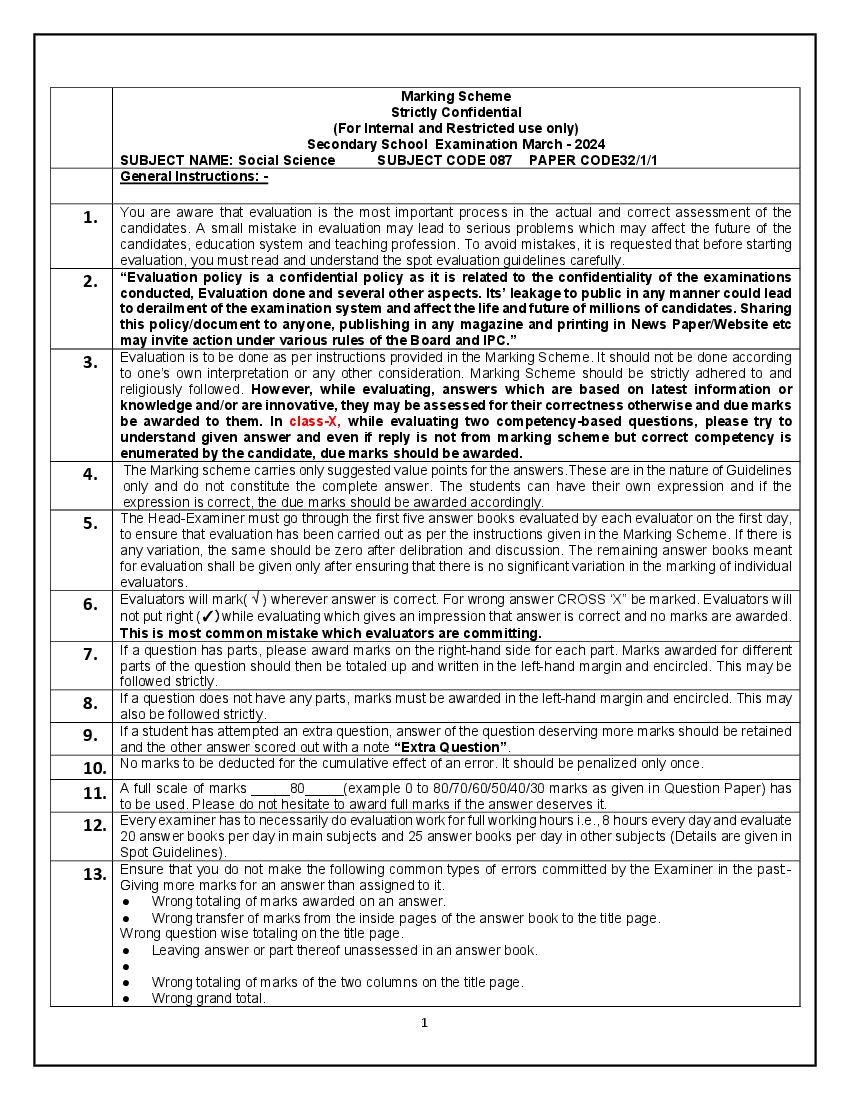
Strictly Confidential
(For Internal and Restricted use only)
Secondary School Examination March - 2024
SUBJECT NAME: Social Science SUBJECT CODE 087 PAPER CODE32/1/1
General Instructions: -
1. You are aware that evaluation is the most important process in the actual and correct assessment of the
candidates. A small mistake in evaluation may lead to serious problems which may affect the future of the
candidates, education system and teaching profession. To avoid mistakes, it is requested that before starting
evaluation, you must read and understand the spot evaluation guidelines carefully.
2. “Evaluation policy is a confidential policy as it is related to the confidentiality of the examinations
conducted, Evaluation done and several other aspects. Its’ leakage to public in any manner could lead
to derailment of the examination system and affect the life and future of millions of candidates. Sharing
this policy/document to anyone, publishing in any magazine and printing in News Paper/Website etc
may invite action under various rules of the Board and IPC.”
3. Evaluation is to be done as per instructions provided in the Marking Scheme. It should not be done according
to one’s own interpretation or any other consideration. Marking Scheme should be strictly adhered to and
religiously followed. However, while evaluating, answers which are based on latest information or
knowledge and/or are innovative, they may be assessed for their correctness otherwise and due marks
be awarded to them. In class-X, while evaluating two competency-based questions, please try to
understand given answer and even if reply is not from marking scheme but correct competency is
enumerated by the candidate, due marks should be awarded.
4. The Marking scheme carries only suggested value points for the answers.These are in the nature of Guidelines
only and do not constitute the complete answer. The students can have their own expression and if the
expression is correct, the due marks should be awarded accordingly.
5. The Head-Examiner must go through the first five answer books evaluated by each evaluator on the first day,
to ensure that evaluation has been carried out as per the instructions given in the Marking Scheme. If there is
any variation, the same should be zero after delibration and discussion. The remaining answer books meant
for evaluation shall be given only after ensuring that there is no significant variation in the marking of individual
evaluators.
6. Evaluators will mark( √ ) wherever answer is correct. For wrong answer CROSS ‘X” be marked. Evaluators will
not put right (✓)while evaluating which gives an impression that answer is correct and no marks are awarded.
This is most common mistake which evaluators are committing.
7. If a question has parts, please award marks on the right-hand side for each part. Marks awarded for different
parts of the question should then be totaled up and written in the left-hand margin and encircled. This may be
followed strictly.
8. If a question does not have any parts, marks must be awarded in the left-hand margin and encircled. This may
also be followed strictly.
9. If a student has attempted an extra question, answer of the question deserving more marks should be retained
and the other answer scored out with a note “Extra Question”.
10. No marks to be deducted for the cumulative effect of an error. It should be penalized only once.
11. A full scale of marks _____80_____(example 0 to 80/70/60/50/40/30 marks as given in Question Paper) has
to be used. Please do not hesitate to award full marks if the answer deserves it.
12. Every examiner has to necessarily do evaluation work for full working hours i.e., 8 hours every day and evaluate
20 answer books per day in main subjects and 25 answer books per day in other subjects (Details are given in
Spot Guidelines).
13. Ensure that you do not make the following common types of errors committed by the Examiner in the past:-
Giving more marks for an answer than assigned to it.
● Wrong totaling of marks awarded on an answer.
● Wrong transfer of marks from the inside pages of the answer book to the title page.
Wrong question wise totaling on the title page.
● Leaving answer or part thereof unassessed in an answer book.
●
● Wrong totaling of marks of the two columns on the title page.
● Wrong grand total.
1
Page 2
● Wrong transfer of marks from the answer book to online award list.
● Answers marked as correct, but marks not awarded. (Ensure that the right tick mark is correctly and clearly
indicated. It should merely be a line. Same is with the X for incorrect answer.)
● Half or a part of answer marked correct and the rest as wrong, but no marks awarded.
14. While evaluating the answer books if the answer is found to be totally incorrect, it should be marked as cross
(X) and awarded zero (0)Marks.
15. Any un assessed portion, non-carrying over of marks to the title page, or totaling error detected by the candidate
shall damage the prestige of all the personnel engaged in the evaluation work as also of the Board. Hence, in
order to uphold the prestige of all concerned, it is again reiterated that the instructions be followed meticulously
and judiciously.
16. The Examiners should acquaint themselves with the guidelines given in the “Guidelines for spot Evaluation”
before starting the actual evaluation.
17. Every Examiner shall also ensure that all the answers are evaluated, marks carried over to the title page,
correctly totaled and written in figures and words.
18. The candidates are entitled to obtain photocopy of the Answer Book on request on payment of the prescribed
processing fee. All Examiners/Additional Head Examiners/Head Examiners are once again reminded that they
must ensure that evaluation is carried out strictly as per value points for each answer as given in the Marking
Scheme.
2
Page 3
Class X -Social Science (087)
SET-32/1/1
SET -1 MM-80
S.No. Values Points Page Marks-
No.
Section A (20X1=20)
Multiple Choice Question
1 (b) Italy 21-H 1
2 (a) Both (A) and (R) are true and (R) is correct explanation of (A). 26 – H 1
3 Marks to be given if the question has been attempted by the candidate. H 1
4 (d) Jawahar Lal Nehru – Oudh Kisan Sabha 35 - H 1
5 (c) Non – Metallic Minerals - Limestone 43 - G 1
6 (c) I, II and IV 32- G 1
7 (c) Laterite soil 9-G 1
8 (d) Feminists 31- P 1
9 (b) Secular 37-P 1
10 (d) I-B, II-A, III-C, IV-D 16-P 1
11 (d) Ensuring Linguistic accommodation. 20-P 1
12 (b) United Kingdom 22-H 1
13 (b) To create a separation of powers to prevent from authoritarianism. 8-P 1
14 (c) 32,500/- 9-E 1
15 (d) Per capita Income 8-E 1
16 (c) Liberalization 64-E 1
17 (d) A teacher taking classes in a government school. 30-E 1
18 (c) II and III are correct. 4-E 1
19 (d) To mitigate the risk of loan default. 44-E 1
20 (b) The difference of amount of interest between what is charged from 40-E 1
borrowers and what is paid to depositors.
For visually impaired Students only 48-E
(a) Reserve Bank of India
3
Page 4
Very Short Answer Type Questions
21 “The Silk Route was a good example of vibrant pre - modern trade and 54 H 2X1=2
the cultural link between distant parts of the world”. Explain the
statement with any two examples.
i. The Silk routes are the good example of vibrant pre-modern trade and
cultural links between distant parts of the world.
ii. The name silk route points to be the importance of West –bound
Chinese silk cargoes along this route.
iii. Historians have identified several silk routes, over land and by sea,
knitting together vast regions of Asia, and linking Asia with Europe
and northern Africa.
iv. They are known to have existed since before the Christian Era and
thrived almost till the fifteenth century.
v. Chinese pottery also travelled the same route, as did textiles and spices
from India and Southeast Asia. In return precious metals- gold and
silver- flowed from Europe.
vi. Any other relevant point.
Any two examples to be explained
22 (A) Suggest any two measures for the conservation of the forest. 13-14 2X1=2
i. Excessive cutting down of forest trees should not be allowed by the
G
Government to conserve forests.
ii. More trees should be planted in the forest in place of cut down trees
to conserve forests.
iii. Paper products such as old newspapers, magazines, books and
notebooks etc. should be recycled.
iv. Laws should be implemented to save the forest.
v. Communities should be made aware about conservations of forests.
vi. Any other relevant point.
Any two points to be explained.
OR
(B) Suggest any two measures for the conservation of wildlife. 13-14G 2X1=2
i. To survey and collect all the information about wildlife, especially,
their number of growth.
ii. To protect habitat by protecting forests.
iii. To delimit the areas of their natural habitat.
iv. To protect wildlife from pollution and from natural hazard.
v. In order to protect animals, many national parks, sanctuaries and
biosphere reserves should be set up.
vi. Laws should be implemented to save the wildlife.
vii. Programmes such as Joint Forest Management should be encouraged.
viii. Any other relevant point.
Any two points to be explained.
4
Page 5
i. Power sharing helps to reduce the possibility of conflict between social
groups.
ii. Power sharing is a good way to ensure the stability of political order.
iii. It controls social conflicts, violence and political instability.
iv. It helps to unite the nation.
v. A legitimate government is one where citizens, through participation,
acquire a stake in the system.
vi. Power Sharing is the very spirit of democracy.
vii. Any other relevant points.
Any two points to be explained.
24 Differentiate between public and private sector. 33 E 2X1=2
Public Sector Private Sector
i. The government owns most i. The ownership of assets is in
of the assets. the hands of private
individuals or companies.
ii. Activities in the public ii. Activities in the private
sectors are guided by the sectors are guided by the
motive towards the welfare motive to earn profits.
of society.
iii. Railways or Post offices are iii. Tata Steel, Reliance
some examples. Industries are some
examples.
Any other relevant point.
Any two points of differences to be explained.
Section C (5X3=15)
Short Answer Type Questions
25 (A) Describe any three causes that led to the Non-Cooperation 31-32 3X1=3
movement.
H
i. Rowlatt Act
ii. Government of India Act 1919.
iii. Jallianwala Bagh incident.
iv. Khilafat Movement.
v. Demand of Swaraj
vi. Congress Session of 1920s
vii. Any other relevant point.
Any three points to be described.
5
Page 6
(B) Describe any three causes of ‘Civil Disobedience Movement.’ 39 H 3X1=3
i. The constituent of the Simon Commission with no Indian members.
ii. The death of Lala Lajpat Rai while protesting against the Commission
enraged the entire nation.
iii. Oppression by the British government in response to anti Simon
protest.
iv. Imposition of Salt law.
v. Vague offers of Lord Irwin for dominion status
vi. Lahore Session of Congress (1929).
vii. Demand of “Poorna Swaraj.”
viii. Neglecting seven demands of Gandhi.
ix. Any other relevant point.
Any three points to be described.
26 ‘Manufacturing industries are considered the backbone of the economic 58 G 3X1=3
development.’ Justify the statement.
i. Manufacturing industries help in modernizing agriculture.
ii. They reduce the heavy dependence of people on agricultural income
by providing them jobs in secondary and tertiary sectors.
iii. Industrial development is a precondition for eradication of
unemployment and poverty from our country.
iv. Public sector industries and joint sector ventures in India also aimed
at bringing down regional disparities by establishing industries in
tribal and backward areas.
v. Export of manufactured goods expands trade and commerce, and
brings in much needed foreign exchange.
vi. India has increased and diversified its manufacturing industries
quickly to be able to transform their raw materials into a wide variety
of finished goods of higher value.
vii. The agro-industries in India have given a major boost to agriculture
by raising its productivity.
Any three points to be explained.
27 Analyse the role of political parties in a democracy. 49 P 3X1=3
i. Political parties exercise political power and form government.
ii. Parties contest election.
iii. Parties put forward different policies and programs.
iv. Parties play a decisive role in making laws for the country.
v. Parties play the role of opposition.
vi. Parties shape public opinion.
vii. Parties provide people access to government machinery and welfare
schemes, implemented by government.
viii. Any other relevant point.
Any three points to be analyzed.
28 How is credit essential for economic activities? Explain with examples. 42-43 3X1=3
i. Credit helps to set up Industries.
E
ii. Credit helps to start businesses.
6
Page 7
iv. In rural areas credit helps in the development of agriculture by
providing funds to farmers to buy seeds, fertilizers, expensive
pesticides etc.
v. It helps to generate employment.
vi. Examples may be taken from the story of Salim or Students may
provide examples from their day to day life.
vii. Any other relevant point.
Any three points to be considered.
29 How is the issue of sustainability important for the development? 14-15 3X1=3
Explain.
E
i. Sustainability is important for development because it results in
protecting the people against pollution ensuring their quality of life
and health.
ii. Conserving the environment which is necessary for development.
iii. Development can be sustained in any economy by using renewable
resources such as groundwater, wind energy and solar energy.
iv. Groundwater is an example of renewable resource. These resources
are replenished by nature as in the case of crops and plants. However,
even these resources may be overused. For example, in the case of
groundwater, if we use more than what is being replenished by rain
then we would be overusing this resource.
v. Non-renewable resources are those which will get exhausted after a
few years of use. We have a fixed stock on earth which cannot be
replenished. Over usage of resources need to be checked
vi. Conservation of resources for the future generations.
vii. We do discover new resources that we did not know earlier. New
sources in this way add to the stock. However, over time, even this
will get depleted/used.
viii. Any other relevant point.
Any three points to be explained.
Section D (4X5=20)
Long Answer Type Questions
30 (A) How did the ideology of liberalism affect the Europe in the early 9 H 5X1=5
nineteenth century? Explain.
i. Ideas of national unity in early-nineteenth – century Europe were
closely allied to the ideology of liberalism.
ii. Since the French Revolution, liberalism had stood for the end of
autocracy and clergical privileges.
iii. Politically, it emphasized the concept of government by consent.
iv. In the economic sphere, liberalism stood for the freedom of markets
and the abolition of state – imposed restrictions on the movement of
goods and capital.
v. It also stood for constitution and representative government through
Parliament.
7
Page 8
vii. Yet, equality before the law did not necessarily stand for universal
suffrage.
viii. Any other relevant point.
Any Five points to be Explained.
OR
(B) Explain the process of formation of United Kingdom of Great 22 H 5X1=5
Britain?
i. Britain was not a nation-state prior to the 18th century. England had
people of many ethnic groups such as English, Welsh, Scot and Irish
with their own cultural and political traditions.
ii. The English nation steadily grew in wealth, importance, and power
and extended its influence over other nations of the islands.
iii. In 1688, nation – state with England at its center came to be forged
English parliament seized power from the monarchy.
iv. In 1707 the Act of Union between England and Scotland led to the
formation of the ‘United Kingdom of Great Britain.’
v. England dominated Scotland and Ireland in all spheres.
vi. British Parliament was dominated by English members.
vii. Thus formation of United Kingdom of Great Britain was not the result
of a sudden upheaval or revolution. It was a long drawn process.
viii. Any other relevant point.
Any Five points to be Explained.
31 (A) How is energy a basic requirement for economic development? 50 G 5X1=5
Explain.
i. Energy is required for all activities for example cooking, light,
propelling vehicles, run machinery in industries, etc.
ii. Energy can be classified as conventional and non- conventional
sources of energy.
iii. Energy is required for large scale manufacturing that is essential for
economic development.
iv. Energy is also required for the development of small scale industries.
v. Energy is required to modernise agriculture and increase agricultural
production.
vi. Examples of conventional sources of energy are firewood, cattle dung
cake, coal, petroleum, natural gas, electricity (thermal) etc.
vii. Examples of non-conventional sources of energy are solar, wind, tidal,
geo-thermal, biogas, etc.
viii. Any other relevant point.
Any five points to be explained
OR
8
Page 9
conventional sources? Explain.
G
i. Conventional sources of energy are exhaustible, non-conventional
sources are renewable.
ii. Conventional sources of energy take a long time to form. Non-
conventional forms of energy are readily available
iii. Conventional forms of energy are usually derived from fossil fuels.
Non-conventional sources of energy are derived from sources like
sun, wind and Earth.
iv. Conventional sources of energy are relatively cheaper. Non-
Conventional energy sources are initially expensive but become
cheaper in due course of time.
v. Non-conventional sources of energy are sustainable while
Conventional sources of energy are not sustainable.
vi. Conventional sources of energy often cause air and water pollution.
Non-conventional sources of energy cause less damage to the
environment.
vii. Examples of Conventional sources of energy are firewood,
petroleum, coal, natural gas etc. Examples of non- conventional
energy sources are solar, tidal, wind, hydel power.
viii. Any other relevant point.
Any five points of difference to be explained
32 (A) How are democratic government better than other forms of 64 P 5X1=5
government? Explain.
i. Democratic government promote equality among its citizens.
ii. Democratic government enhances the dignity of the individual.
iii. Democratic government improves the quality of decision – making.
iv. Democratic government provides a method to resolve conflicts.
v. Democratic government allows room to correct mistakes.
vi. Democratic government is accountable to its citizens.
vii. Democratic government accommodates the social diversity.
viii. Democratic government respects the civil and human rights.
ix. Democratic government is a transparent government.
x. Any other relevant point.
Any five points to be explained
OR
(B) How do democracy lead to peaceful and harmonious life among
citizen? Explain. 70 P 5X1=5
i. Democracies try to produce harmonious social life
ii. Democracies can better accommodate various social divisions.
iii. Democracies usually develop a procedure to conduct their
competition. This reduces the possibility of tensions becoming
explosive or violent.
iv. Democracies are better able to evolve mechanisms to handle and
negotiate the social differences, divisions and conflict.
9
Page 10
vi. Majority works with minority so that governments function to
represent the general view.
vii. Democracy promotes dignity and freedom of individuals
viii. Promotes equality among citizens;
ix. Improves the quality of decision-making;
x. Provides a method to resolve conflict
xi. Any other relevant point.
Any five points to be explained
33 (A) Globalisation is the process of rapid integration or 62-63 5X1=5
interconnection between countries. Explain the statement with
E
examples.
i. Globalisation has encouraged foreign investments.
ii. MNCs set up production close to the markets and availability of
skilled and unskilled labour at low costs.
iii. MNCs will choose countries which have policies which enable easy
operations.
iv. MNCs set up production jointly with local companies.
v. There is better exchange of technologies.
vi. Globalisation has increased the interdependence between countries.
vii. Consumers have more access to global products.
viii. Globalisation helps the integration of markets of the countries.
ix. It makes countries culturally rich.
x. Sharing technology between countries benefitted human being.
xi. Kargil foods, Reliance Industries and other MNCs are the prime
examples of industries which are help to integrate the countries.
xii. Any other relevant point.
Any five points to be explained
OR
(B) Improvement in technology has stimulated the globalisation
process. Explain the statement with examples. 62-63 5X1=5
i. Rapid improvement in technology has been one major factor that has
E
stimulated the globalisation process.
ii. For instance, the past fifty years have seen several improvements in
transportation technology.
iii. This has made much faster delivery of goods across long distances
possible at lower costs.
iv. Even more remarkable have been the developments in information
and communication technology. In recent times, technology in the
areas of telecommunications, computers, Internet has been changing
rapidly.
v. Telecommunication facilities (telegraph, telephone including mobile
phones, fax) are used to contact one another around the world.
vi. The rush of new ideas and his intelligence’s easy adoption of them
suggests that reading catalysis cognitive growth and encourages new
perspectives and insights.
10
Page 11
written word to captivate, stimulate thought, and bring about
intellectual transformations.
viii. Any other relevant point.
Any five points to be explained
Section E 3X4=12
CASE BASED QUESTIONS
(4X5=20)
34 Read the following source carefully and answer the questions that follow: 115 H 1+1+2=4
Printed Words
This is how Mercier describe the impact of the printed word and
the power of reading in one of his books:
'Anyone who had seen me reading would have compared me to a
man dying of thrust who was gulping down some fresh, pure
water... lightning my map with extraordinary caution, I threw
myself hungry into the reading. And easy eloquence and animated
carried me from one page to the next without my notation it. Of
the hours in the silence of the shadows and I heard nothing. Only
appeal light but still I read on. I could not even take out time to
raise the wick for fear of interrupting my pleasure. How those new
ideas rust into my brain! How my intelligence adopted them!’
34.1 How does the passage reflect the immersive nature of reading of
Mercier? 1
i. Reading was like, thrust of fresh pure water.
ii. External distractions did not bother him.
iii. Pale light even did not affects his attention.
iv. Mercier’s description of being carried effortlessly from one page to
the next by the eloquence of the text highlights the engrossing nature
of his reading experience.
v. Any other relevant points
Any one point to be explained.
34.2 Why did Mercier describe himself as a virtual writer? 1
i. Mercier became deeply engaged with the text.
11
Page 12
iii. He was connected to the process of writing so intimately that he
reading it and was absorbing new ideas.
iv. Any other relevant points
Any one point to be explained.
34.3 How did reading influence Mercier’s intellectual capacity and his
engagement with new concepts? Explain in any two points. 2x1=2
i. Mercier is so deeply immersed in reading that he loses track of time
and running out of oil for his lamp.
ii. He mentions new ideas rushing into his brain and his intelligence
adopting them.
iii. New concepts fuelled his ideas and sparked his intellectual ability.
iv. Receptiveness towards knowledge was reflected.
v. He was ready to embrace new ideas.
vi. He showed willingness to integrate his ideas into the understanding
of world.
vii. Any other relevant points
Any two points to be mentioned.
35 Read the following source carefully and answer the questions 29 G 1+1+2=4
that follow:
FLOODS
Basic safety precautions to be taken:
Listen to radio oblique TV for the latest weather bulletin and
warning pass on the information to others.
Make a family emergency kit which should include a portable
radio public transistor, torch batteries first aid box along with
essential medicines or is dry food items drinking water, match
boxes and other essential item.
Keep hurricane lamps, ropes umbrella and bamboo stick in
your house. These could be useful.
Keep your cash, jewellery, valuables and important documents
etc in a safe place.
12
Page 13
cattle to save play areas like relief camps centres elevated
grounds where you can take shelter.
Turn off power and gas connections before leaving your house.
During floods:
Don't enter into flood waters it could be dangerous.
Don't allow children to play in or near flood waters.
Stay away from sewerage lines gutters, dreams and culverts
etc.
Be careful of snakes; snake bites are common during floods.
Stay away from electric poles and fallen power lines to avoid
electrocution.
Don't use with electrical appliance get them check before use.
Eat freshly cooked and dry food. Always keep your food
covered.
Use boiled and filtered drinking water.
Keep all dreams gutters near your house clean.
Stagnation of water can breed vector/water – borne diseases.
In case of sickness, seek medical assistance.
Use bleaching powder and line to disinfect the surroundings.
35.1 Mention any two essential items that should be included in a ‘family
emergency kit.’ 1/2+1/2=1
The family emergency kit should include items such as:
i. Portable radio/ transistors
ii. Torch
iii. Spare Batteries
iv. First Aid Box
v. Essential Medicines (such as ORS)
vi. Essential Foods (dry food items, drinking water)
vii. Matchboxes, Candles and other essential supplies.
viii. Any other relevant points
Any Two
35.2 Why are the items of family emergency kit important during flood
situation? 1
These items are crucial to ensuring survival and maintaining basic necessities
during flood situations.
Any Other relevant point
35.3 In case of a flood, what are the recommended actions to ensure the
safety of your family and belongings? Describe any two. 2x1=2
i. It is recommended to move to safe areas along with your family
members.
13
Page 14
elevated grounds where shelter can be taken.
iii. Additionally, individuals should turn off power and gas connections
before leaving their houses to prevent potential hazards.
iv. Any other relevant points.
Any two points to be described.
36 Read the following source carefully and answer the questions that follow: 24 P 1+1+2=4
LOCAL GOVERNMENT
This new system of local government is the largest experiment in
democracy conducted anywhere in the world. There are now about
36 lakh electric elected representatives in the panchayats and
municipalities etc all over the country. This number is bigger than
the population of many countries in the world first of
constitutional status for local government has helped to
democracy in our country. It has also increase presentation and
voice in our democracy. At the same time there are many
difficulties. While elections are held regularly and enthusiastically
gram sabhas are not held regularly. Most state government have
not transferred significant powers to the local government
resources long way from realising the ideal of self government.
36.1 Analyse the significance of the elected representatives in the
Panchayats. 1
i. The Large number of elected representatives in panchayats and
municipalities signifies the extensive scale of the democratic
experiment in India.
ii. Large number of problems and issues are settled at the local level.
iii. Direct participation of people in the decision making and socio-
political participation process.
iv. Any other relevant point
Any one point to be analyzed.
36.2 In what way has the representation of women in democracy
influenced by Constitutional status for local government? 1
i. It deepens democracy.
14
Page 15
representation and voice of women in democracy.
iii. It promotes inclusivity
iv. It promotes gender equality.
v. Any other relevant point.
Any one point to be analyzed.
36.3 What has been the impact of granting Constitutional status to local
government on the democratic landscape of the country? Analyse any
two impacts. 2X1=2
i. Granting constitutional status to local government is described as
having deepened democracy in the country.
ii. It has also enhanced women’s representation and women’s
participation in the democratic process.
iii. This constitutional recognition has played a role in empowering
grassroots governance.
iv. It promotes inclusive decision – making.
v. Solution of local societal issues at local levels
vi. Any other relevant point.
Any two points to be explained.
Section F (2+3=5)
Map Based Questions
37 Two places ‘A’ and ‘B’ have been marked on the given Political outline map
of India. Identify them with the help of the following information and write
their correct names on the lines drawn near them:
i. The place where Mahatma Gandhi broke the salt law. 1
ii. The place where Session of Indian National Congress was held in 1
1927.
Please see the attached Map.
On the same Political outline map of India, locate and label any three of the 1x3=3
following with suitable symbols:
15
Page 16
ii. Mumbai – Software Technology Park
iii. Raja Sansi – International Airport
iv. Naraura – Nuclear Power Plant
Please see the attached Map.
Note: The following questions are for the Visually Impaired Candidates 1x5=5
only, in lieu of Q.NO. 37.
i. Name the place where Mahatma Gandhi broke Salt Law.
Dandi
ii. Name the place where the Indian National Congress Session was
held in 1927.
Madras/Chennai
iii. Name the state where Hirkud dam is located.
Odisha
iv. Name the state where Mumbai Software Technology Park is
located.
Maharashtra
v. Name the state where Raja Sansi International Airport is located.
Punjab
vi. Name the state where Naraura Nuclear Power Plant is located.
Uttar Pradesh
16
Page 17
Page 18
Strictly Confidential
(For Internal and Restricted use only)
Secondary School Examination March - 2024
SUBJECT NAME: Social Science SUBJECT CODE 087 PAPER CODE32/1/1
General Instructions: -
1. You are aware that evaluation is the most important process in the actual and correct assessment of the
candidates. A small mistake in evaluation may lead to serious problems which may affect the future of the
candidates, education system and teaching profession. To avoid mistakes, it is requested that before starting
evaluation, you must read and understand the spot evaluation guidelines carefully.
2. “Evaluation policy is a confidential policy as it is related to the confidentiality of the examinations
conducted, Evaluation done and several other aspects. Its’ leakage to public in any manner could lead
to derailment of the examination system and affect the life and future of millions of candidates. Sharing
this policy/document to anyone, publishing in any magazine and printing in News Paper/Website etc
may invite action under various rules of the Board and IPC.”
3. Evaluation is to be done as per instructions provided in the Marking Scheme. It should not be done according
to one’s own interpretation or any other consideration. Marking Scheme should be strictly adhered to and
religiously followed. However, while evaluating, answers which are based on latest information or
knowledge and/or are innovative, they may be assessed for their correctness otherwise and due marks
be awarded to them. In class-X, while evaluating two competency-based questions, please try to
understand given answer and even if reply is not from marking scheme but correct competency is
enumerated by the candidate, due marks should be awarded.
4. The Marking scheme carries only suggested value points for the answers.These are in the nature of Guidelines
only and do not constitute the complete answer. The students can have their own expression and if the
expression is correct, the due marks should be awarded accordingly.
5. The Head-Examiner must go through the first five answer books evaluated by each evaluator on the first day,
to ensure that evaluation has been carried out as per the instructions given in the Marking Scheme. If there is
any variation, the same should be zero after delibration and discussion. The remaining answer books meant
for evaluation shall be given only after ensuring that there is no significant variation in the marking of individual
evaluators.
6. Evaluators will mark( √ ) wherever answer is correct. For wrong answer CROSS ‘X” be marked. Evaluators will
not put right (✓)while evaluating which gives an impression that answer is correct and no marks are awarded.
This is most common mistake which evaluators are committing.
7. If a question has parts, please award marks on the right-hand side for each part. Marks awarded for different
parts of the question should then be totaled up and written in the left-hand margin and encircled. This may be
followed strictly.
8. If a question does not have any parts, marks must be awarded in the left-hand margin and encircled. This may
also be followed strictly.
9. If a student has attempted an extra question, answer of the question deserving more marks should be retained
and the other answer scored out with a note “Extra Question”.
10. No marks to be deducted for the cumulative effect of an error. It should be penalized only once.
11. A full scale of marks _____80_____(example 0 to 80/70/60/50/40/30 marks as given in Question Paper) has
to be used. Please do not hesitate to award full marks if the answer deserves it.
12. Every examiner has to necessarily do evaluation work for full working hours i.e., 8 hours every day and evaluate
20 answer books per day in main subjects and 25 answer books per day in other subjects (Details are given in
Spot Guidelines).
13. Ensure that you do not make the following common types of errors committed by the Examiner in the past:-
Giving more marks for an answer than assigned to it.
● Wrong totaling of marks awarded on an answer.
● Wrong transfer of marks from the inside pages of the answer book to the title page.
Wrong question wise totaling on the title page.
● Leaving answer or part thereof unassessed in an answer book.
●
● Wrong totaling of marks of the two columns on the title page.
● Wrong grand total.
● Marks in words and figures not tallying/not same.
● Wrong transfer of marks from the answer book to online award list.
1
Page 19
indicated. It should merely be a line. Same is with the X for incorrect answer.)
● Half or a part of answer marked correct and the rest as wrong, but no marks awarded.
14. While evaluating the answer books if the answer is found to be totally incorrect, it should be marked as cross
(X) and awarded zero (0)Marks.
15. Any un assessed portion, non-carrying over of marks to the title page, or totaling error detected by the candidate
shall damage the prestige of all the personnel engaged in the evaluation work as also of the Board. Hence, in
order to uphold the prestige of all concerned, it is again reiterated that the instructions be followed meticulously
and judiciously.
16. The Examiners should acquaint themselves with the guidelines given in the “Guidelines for spot Evaluation”
before starting the actual evaluation.
17. Every Examiner shall also ensure that all the answers are evaluated, marks carried over to the title page,
correctly totaled and written in figures and words.
18. The candidates are entitled to obtain photocopy of the Answer Book on request on payment of the prescribed
processing fee. All Examiners/Additional Head Examiners/Head Examiners are once again reminded that they
must ensure that evaluation is carried out strictly as per value points for each answer as given in the Marking
Scheme.
2
Page 20
Lkkekftd foKku ¼087½
32/1/1
SET -1 MM-80
iz-la- [k.M d Ik`’B vad
¼cgqfodYih; iz”u½ la[;k 20x1
=20
1. (b) bVYkh 21-H 1
2. (a) (A) ,oa (R) nksuksa lgh gaS ,oa (R)] (A) dh lgh O;k[;k gSA 26 – H 1
3. ;fn ijh{kkFkhZ us (a),(b),(c) vkSj (d) dksbZ Hkh fodYi fy[krk gS rks mls vad H 1
iznku fd, tk,A
4. (d) tokgj yky usg: & vo/k fdlku lHkk 35 - H 1
5. (c) v/kkfRod [kfut & cyqvk iRFkj 43 - G 1
6. (c) I, II vkSj IV 32- G 1
7. (c) ySVjkbV e`nk 9-G 1
8. (d) ukjhoknh 31- P 1
9. (b) iaFkfujis{k 37-P 1
10. (d) I-B, II-A, III-C, IV-D 16-P 1
11. (d) Hkk’kk;h lek;kstu lqfuf”pr djukA 20-P 1
12. (b) fczVsu 22-H 1
13. (b) vf/kuk;dokn dks jksdus ds fy, “kfDr;ksa dk i`FkDdj.k djukA 8-P 1
14. (c) 32]500 9-E 1
15. (d) izfr O;fDr vk; 8-E 1
16. (c) mnkjhdj.k 64-E 1
17. (d) ljdkjh Ldwy esa f”k{kd dk Dykl ysukA 30-E 1
18. (c) dsoy II vkSj III lgh gSA 4-E 1
19. (d) _.k pwd ds tksf[ke dks de djus ds fy,A 44-E 1
20. (b) dtZ+nkj ls fy, x, C;kt vkSj tekdÙkkZvksa dks fn, x, C;kt dh jde 40-E 1
ds chp varjA
dsoy n`f’Vckf/kr ijh{kkfFkZ;ksa ds fy,
48-E
(a) Hkkjrh; fjtoZ cSad
3
Page 21
¼vfr y?kq&mÙkjh; iz”u½ =8
21. Þvkèkqfud dky ls igys ds ;qx esa nqfu;k ds nwj fLFkr Hkkxksa ds chp 54 H 2X1=2
O;kikfjd vkSj lkaLd`frd laidksZa dk thoar mnkgj.k flYd ekxZ FkkAß
bl dFku dh O;k[;k fdUgha nks mnkgj.kkaas lfgr dhft,A
(i) flYd ekxZ nqfu;k ds nwj&njkt ds fgLlksa ds chp iwoZ&vkèkqfud O;kikj
vkSj lkaL—frd lacaèkksa dk thoar mnkgj.k gSaA
(ii) bldk uke ^flYd ekxZ^ Lo;a gh if'pe dh vksj tkus okys phuh js'ke
ds egRo dks bafxr djrk gSA
(iii) bfrgkldkjksa us tehu vkSj leqæ ds jkLrs dbZ js'ke ekxksZa dh igpku
dh gS] tks ,f'k;k ds fo'kky {ks=ksa dks ,d lkFk tksM+rs gSa rFkk ,f'k;k
dks ;wjksi vkSj mÙkjh vÝhdk ls tksM+rs gSaA
(iv) ,slk ekuk tkrk gS fd ;s bZlk iwoZ ls gh vfLrRo esa Fks vkSj yxHkx
iaægoha 'krkCnh rd Qyrs&Qwyrs jgsA
(v) blh ekxZ ls phuh feêh ds crZuksa ¼ikWVjh½ tkrs Fks ,oa blh ekxZ ls Hkkjr
vkSj nf{k.k iwoZ ,f'k;k ls diM+k vkSj elkysa nqfu;k ds nwljs Hkkxksa esa
igqp¡rs FksA okilh esa cgqewY; èkkrq,¡&lksuk vkSj pk¡nh&;wjksi ls ;gk¡
igq¡phA
(vi) dksbZ vU; çklafxd fcanqA
fdUgha nks mnkgj.kksa dh O;k[;k visf{kr gSA
22. 13-14 2X1=2
A.ou laj{k.k ds dksbZ nks mik; lq>kb,A
G
(i) ouksa ds laj{k.k ds fy, ljdkj dks o`{kksa dh vR;fèkd dVkbZ dh vuqefr
iznku ugha djuh pkfg,A
(ii) ouksa ds laj{k.k ds fy, dkVs x, isM+ksa dh rqyuk esa taxy esa vfèkd isM+
yxk, tkus pkfg,A
(iii) iqjkus v[kckj] if=dk,a] fdrkcsa vkSj uksVcqd vkfn dkxt mRiknksa dks
iqupZfØr fd;k tkuk pkfg,A
(iv) taxy cpkus ds fy, dkuwu ykxw fd, tkus pkfg,A
(v) leqnk;ksa dks ouksa ds laj{k.k ds ckjs esa tkx:d fd;k tkuk pkfg,A
(vi) dksbZ vU; çklafxd fcanqA
fdUgha nks fcUnqvksa dh O;k[;k visf{kr gSA
vFkok
B. oU;thoksa ds laj{k.k ds fy, dksbZ nks mik; lq>kb, A 13- 2X1=2
14G
4
Page 22
,d= djuk ,oa mudk losZ{k.k djukA
(ii) ouksa dh j{kk ds ek/;e ls oU;thoksa ds vkokl dh j{kk djukA
(iii) muds çk—frd vkokl ds {ks=ksa dk ifjlheu djukA
(iv) oU;thoksa dks çnw"k.k vkSj çk—frd [krjs ls cpkukA
(v) tkuojksa dh lqj{kk ds fy, dbZ jk"Vªh; m|ku] vHk;kj.; vkSj ck;ksLQh;j
fjtoZ LFkkfir fd, tkus pkfg,A
(vi) oU; thoksa dks cpkus ds fy, dkuwu ykxw fd;k tkuk pkfg,A
(vii) ^la;qä ou çcaèku^ tSls dk;ZØe dks çksRlkfgr fd;k tkuk pkfg,A
(viii) dksbZ vU; çklafxd fcanqA
fdUgha nks fcUnqvksa dh O;k[;k visf{kr gSA
23. lÙkk dh lk>snkjh D;ksa t:jh gS\ Li"V dhft,A 6P 2X1=2
(i) lÙkk dh lk>snkjh lkekftd lewgksa ds chp la?k"kZ dh laHkkouk dks de
djus esa enn djrh gSA
(ii) jktuhfrd O;oLFkk dh fLFkjrk lqfuf'pr djus ds fy, lÙkk dh
lk>snkjh ,d vPNk rjhdk gSA
(iii) ;g lkekftd la?k"kksZa] fgalk vkSj jktuhfrd vfLFkjrk dks fu;af=r djrk
gSA
(iv) ;g jk"Vª dks ,dtqV djus esa enn djrh gSA
(v) ,d oSèk ljdkj og gS tgka ukxfjd] Hkkxhnkjh ds ekè;e ls] “kklu
ç.kkyh esa fgLlsnkjh gkfly djrs gSaA
(vi) lÙkk dh lk>snkjh yksdra= dh ewy Hkkouk gSA
(vii) dksbZ vU; çklafxd fcanqA
fdUgha nks fcUnqvksa dh O;k[;k visf{kr gSA
24. lkoZtfud vkSj futh {ks=d ds chp varj Li"V dhft,A 33 E 2X1=2
lkoZtfud {ks=d futh {ks=d
I. lkoZtfud {ks=d esa vf/kdka”k I. futh {ks=d esa vf/kdka”k
ifjlaifÙk;ksa ij ljdkj dk ifjlaifÙk;ksa ij futh O;fDr
LokfeRo gksrk gSA vFkok daifu;ksa dk LokfeRo
gksrk gSA
II. lkoZtfud {ks=d dh II. futh {ks=d dh xfrfof/k;ksa
xfrfof/k;ksa dk mÌs”; dk mÌs”; ykHk vftZr djuk
lkekftd dY;k.k gksrk gSA gksrk gSA
III. Hkkjrh; jsyos ,oa Mkd foHkkx III. VkVk LVhy] fjyk;al
vkfn blds dqN mnkgj.k gSA baMLVªht vkfn blds dqN
mnkgj.k gSA
5
Page 23
varj ds nks fcUnqvksa dh O;k[;k visf{kr gSA
[k.M x 5x3
¼y?kq&mÙkjh; iz”u½ =15
25. A. fdUgha rhu dkj.kksa dk o.kZu dhft, tks vlg;ksx vkanksyu ds 31-32 3X1=3
fy, mrjnk;h FksA H
(i) jkWysV ,DV
(ii) Hkkjr ljdkj vfèkfu;e 1919
(iii) tfy;kaokyk ckx gR;kdkaM
(iv) f[kykQr vkanksyu
(v) Lojkt dh ekax
(vi) 1920 ds dkaxzsl ds vf/kos”ku
(vii) dksbZ vU; çklafxd fcanqA
fdUgha rhu dkj.kksa dk o.kZu fd;k tkuk visf{kr gSA
vFkok
B. lfou; voKk vkanksyu ds fdUgha rhu dkj.kksa dk o.kZu dhft,A 39 H 3X1=3
(i) lkbeu deh'ku dk xBu ftlesa dksbZ Hkkjrh; lnL; ugha FkkA
(ii) vk;ksx ds fojksèk esa çn'kZu djrs le; ykyk yktir jk; dh e`R;q us
iwjs ns'k es vkØks”k dh Hkkouk dks c<+kok fn;kA
(iii) lkbeu deh”ku ds fojksèk ds nkSjku vaxzst ljdkj dk neupØA
(iv) ued dkuwu ykxw djukA
(v) Mksfefu;u LVsVl ds fy, y‚MZ bjfou ds vLi"V çLrkoA
(vi) dkaxzsl dk ykgkSj vfèkos'ku ¼1929½A
(vii) ^iw.kZ Lojkt^ dh ekaxA
(viii) xkaèkhth dh lkr ekaxksa dh mis{kkA
(ix) dksbZ vU; çklafxd fcanqA
fdUgha rhu fcUnqvksa dk o.kZu fd;k tkuk visf{kr gSA
26. ^fofuekZ.k m|ksx vkfFkZd fodkl dh jh<+ le>s tkrs gSaA^ bl dFku 58 G 3X1=3
dks U;k;laxr Bgjkb;sA
(i) fofuekZ.k m|ksx —f"k dks vkèkqfud cukus esa enn djrs gSaA
(ii) os yksxksa dks f}rh;d vkSj r`rh;d {ks=dksa esa ukSdfj;k¡ çnku djds —f"k
vk; ij mudh Hkkjh fuHkZjrk dks de djrs gSaA
6
Page 24
,d iwoZ 'krZ gSA
(iv) Hkkjr esa lkoZtfud {ks= ds m|ksxksa vkSj la;qä {ks= ds m|eksa dk mís';
vkfnoklh vkSj fiNM+s {ks=ksa esa m|ksx LFkkfir djds {ks=h; vlekurkvksa
dks de djuk gSA
(v) fofufeZr oLrqvksa ds fu;kZr ls O;kikj vkSj okf.kT; dk foLrkj gksrk gS
vkSj vko';d fons'kh eqæk vkrh gSA
(vi) Hkkjr us vius fofuekZ.k m|ksxksa dks rsth ls c<+k;k vkSj fofoèkrkiw.kZ
cuk;k gS ftlls dPps eky dks rS;kj eky esa cnydj mPp ewY; ds
fy, l{ke gq, gSA
(vii) Hkkjr esa —f"k&m|ksxksa us viuh mRikndrk c<+kdj —f"k dks c<+kok fn;k
gSA
(viii) dksbZ vU; çklafxd fcanqA
fdUgha rhu fcUnqvksa dh O;k[;k visf{kr gSA
27. yksdra= esa jktuhfrd nyksa dh Hkwfedk dk fo'ys"k.k dhft,A 49 P 3X1=3
(i) jktuhfrd ny jktuhfrd 'kfä dk ç;ksx djrs gSa vkSj ljdkj cukrs
gSaA
(ii) jktuhfrd ny pquko yM+rs gSaA
(iii) jktuhfrd ny vyx&vyx uhfr;k¡ vkSj dk;ZØe dks vkxs c<+krss gSaA
(iv) ns'k ds fy, dkuwu cukus esa jktuhfrd ny fu.kkZ;d Hkwfedk fuHkkrs gSaA
(v) jktuhfrd ny foi{k dh Hkwfedk fuHkkrs gSaA
(vi) jktuhfrd ny tuer dk fuekZ.k djrs gSaA
(vii) jktuhfrd ny yksxksa dks ljdkjh ra= vkSj ljdkj }kjk dk;kZfUor
dY;k.kdkjh ;kstukvksa rd igq¡p çnku djkusa esa lgk;rk iznku djrs
gSaA
(viii) dksbZ vU; çklafxd fcanqA
fdUgha rhu fcUnqvksa dk fo”ys’k.k visf{kr gSA
28. vkfFkZd xfrfofèk;ksa ds fy, _.k fdl çdkj vko';d gS\ mnkgj.kkas 42-43 3X1=3
lfgr Li"V dhft,A E
(i) _.k m|ksx LFkkfir djus esa lgk;d gSA
(ii) _.k O;olk; 'kq: djus esa enn djrs gSA
(iii) _.k yksxksa ds thou Lrj dks csgrj cukus esa enn djrsa gSA
(iv) xzkeh.k {ks=ksa esa _.k fdlkuksa dks cht] moZjd] egaxs dhVuk'kd [kjhnus
ds fy, èku miyCèk djkdj —f"k ds fodkl esa enn djrk gSA
(v) _.k jkstxkj mRiUu djus esa lgk;rk djrk gSA
7
Page 25
thou ls dksbZ mnkgj.k ns ldrs gSaA
(vii) dksbZ vU; çklafxd fcanqA
fdUgha rhu fcUnqvksa dk Li’Vhdj.k visf{kr gSA
29. èkkj.kh;rk dk fo"k; fodkl ds fy, fdl çdkj egRoiw.kZ gS\ Li"V 14-15 3X1=3
dhft,A E
(i) fodkl ds fy, /kkj.kh;rk egRoiw.kZ gS D;ksafd blds ek/;e ls yksxksa dks
çnw"k.k ls cpk;k tkrk gS ftlls muds thou vkSj LokLF; dh xq.koÙkk
lqfuf'pr gksrh gSA
(ii) i;kZoj.k dk laj{k.k djuk fodkl ds fy, vfr vko';d gSA
(iii) Hkwty] iou ÅtkZ vkSj lkSj ÅtkZ tSls uohdj.kh; lalkèkuksa dk mi;ksx
djds fdlh Hkh vFkZO;oLFkk esa fodkl dks cuk, j[kk tk ldrk gSA
(iv) Hkwty uohdj.kh; lalkèkuksa dk ,d mnkgj.k gSA bu lalkèkuksa dh iwfrZ
ç—fr }kjk dh tkrh gS tSls fd Qlyksa vkSj ikSèkksa ds ekeys esaA gkyk¡fd]
bu lalkèkuksa dk vR;fèkd mi;ksx Hkh gks ldrk gSA mnkgj.k ds fy,
;fn ge Hkwty dk o"kkZ }kjk iqu%iwfrZ dh tkus okyh ek=k ls vfèkd dk
mi;ksx djrs gSa rks ge bl lalkèku dk vR;fèkd mi;ksx dj jgs gksaxsA
(v) xSj&uohdj.kh; lalkèku os gSa tks dqN o"kksZa ds mi;ksx ds ckn lekIr
gks tk,axsA gekjs ikl i`Foh ij ,d fuf'pr HkaMkj gS ftldh HkjikbZ
ugha dh tk ldrhA lalkèkuksa ds vfèkd mi;ksx ij jksd yxkus dh
vko”;drk gSA
(vi) Hkkoh ihf<+;ksa ds fy, lalkèkuksa dk laj{k.kA
(vii) ge u, lalkèkuksa dh [kkst djrs gSa ftuds ckjs esa ge igys ugha tkurs
FksA bl rjg ls u, lzksr LV‚d esa tqM+rs gSaA gkyk¡fd] le; ds lkFk]
;g Hkh [k+Re gks tk,saxsA
(viii) dksbZ vU; çklafxd fcanqA
fdUgha rhu fcUnqvksa dk O;k[;k visf{kr gSA
[k.M ?k 4x5
¼nh?kZ&mÙkjh; iz”u½ =20
30. A. 19oha 'krkCnh ds vkjafHkd o"kksZa esa mnkjokn dh fopkjèkkjk us 9 H 5X1=5
;wjksi dks fdl çdkj çHkkfor fd;k\ Li"V dhft,A
(i) mUuhloha lnh dh 'kq#vkr esa ;wjksi esa jk"Vªh; ,drk ds fopkj mnkjokn
dh fopkjèkkjk ls fudVrk ls tqM+s gq, FksA
(ii) Ýkalhlh Økafr ds ckn ls] mnkjokn fujadq'krk vkSj iknjhoxZ ds
fo'ks"kkfèkdkjksa ds var ds fy, [kM+k FkkA
(iii) jktuhfrd :i ls] blus lgefr ls ljdkj dh voèkkj.kk ij tksj fn;kA
8
Page 26
vkoktkgh ij yxk, x, jkT;ksa ds çfrcaèkksa ds mUewyu ds i{k esa FkkA
(v) ;g laln ds ekè;e ls lafoèkku vkSj çfrfufèk ljdkj dk i{k/kj FkkA
(vi) blus futh laifÙk dh vuqYya?kuh;rk ij Hkh tksj fn;kA
(vii) fQj Hkh] dkuwu ds le{k lekurk vko';d :i ls lkoZHkkSfed erkfèkdkj
dk çrhd ugha gSA
(viii) dksbZ vU; çklafxd fcanqA
fdUgha ik¡p fcUnqvksa dk Li’Vhdj.k visf{kr gSA
vFkok
B. ;wukbVsM fdaxMe v‚Q xzsV fczVsu ds xBu dh çfØ;k dh O;k[;k
22 H 5X1=5
dhft,A
(i) 18oha lnh ls igys fczVsu ,d jk"Vª&jkT; ugha FkkA baXySaM esa vaxzst]
osY'k] Ld‚V vkSj vk;fj'k tSls dbZ u`tkrh; lewgksa ds yksx Fks ftudh
viuh lkaL—frd vkSj jktuhfrd ijaijk,¡ FkhA
(ii) vakXy& jk"Vª dh laifÙk] egRo vkSj 'kfä esa yxkrkj o`f) gq bZ vkSj mlus
}hiksa ds vU; jk’Vªksa ij viuk çHkko c<+k;kA
(iii) 1688 esa] baXySaM dks dsaæ esa j[kdj ,d jk"Vª&jkT; dk xBu gqvk] vakXy
laln us jkt'kkgh ls lÙkk Nhu yhA
(iv) 1707 esa baXySaM vkSj Ld‚VySaM ds chp ,sDV vkWQ ;wfu;u ds ek/;e ls
^;wukbVsM fdaxMe v‚Q xzsV fczVsu^ dk xBu gqvkA
(v) lHkh {ks=ksa esa Ld‚VySaM vkSj vk;jySaM ij baXySaM gkoh jgkA
(vi) fczfV'k laln esa vaxzst+ lnL;ksa dk çHkqRo FkkA
(vii) bl çdkj xzsV fczVsu ds ;wukbVsM fdaxMe vkWQ xzsV fczVsu dk xBu
vpkud mFky&iqFky ;k Økafr dk ifj.kke ugha FkkA ;g ,d yach
çfØ;k dk ifj.kke FkkA
(viii) dksbZ vU; çklafxd fcanqA
fdUgha ik¡p fcUnqvksa dh O;k[;k visf{kr gSA
31. A. vkfFkZdfodkl ds fy, ÅtkZ fdl çdkj ,d vkèkkjHkwr 50 G 5X1=5
vko';drk gS \Li"V dhft, A
(i) lHkh xfrfofèk;ksa ds fy, ÅtkZ dh vko';drk gksrh gS] mnkgj.k ds fy,
[kkuk cukuk] jks'kuh] okgu pykuk] m|ksxksa esa e'khujh pykuk vkfnA
(ii) ÅtkZ dks ikjaifjd vkSj xSj&ikjaifjd ÅtkZ lzksrksa ds :i esa oxÊ—r
fd;k tk ldrk gSA
(iii) cM+s iSekus ij fofuekZ.k ds fy, ÅtkZ dh vko';drk gksrh gS tks vkfFkZd
fodkl ds fy, vko';d gSA
(iv) y?kq m|ksxksa ds fodkl ds fy, Hkh ÅtkZ dh vko';drk gksrh gSA
9
Page 27
vko';drk gSA
(vi) ÅtkZ ds ikjaifjd lzksrksa ds mnkgj.k gSa tykou ydM+h] xkscj ds miys]
dks;yk] isVªksfy;e] çk—frd xSl] fctyh ¼FkeZy½ vkfnA
(vii) ÅtkZ ds xSj&ikjaifjd lzksrksa ds mnkgj.k lkSj] iou] Tokjh;] Hkw&rkih;]
ck;ksxSl] vkfn gSaA
(viii) dksbZ vU; çklafxd fcanqA
fdUgha ik¡p fcUnqvksa dk O;k[;k visf{kr gSA
vFkok 50-54
B. ÅtkZ ds ijaijkxr lzksr fdl çdkj vijaijkxr lzksrksa ls fHkUu 5X1=5
G
gS\ Li"V dhft,A
(i) ÅtkZ ds ijaijkxr lzksr lekIr gksus ;ksX; gSa tcfd vijaijkxr lzksr
uohdj.kh; gSaA
(ii) ÅtkZ ds ijaijkxr lzksrkas dks cuus esa dkQh le; yxrk gSA ÅtkZ ds
vijaijkxr lzksr yxkrkj miyCèk gSaA
(iii) ÅtkZ ds ijaijkxr lzksr vkerkSj ij thok'e bZaèku ls çkIr gksrs gSaA ÅtkZ ds
vijaijkxr lzksr lw;Z] ok;q vkSj i`Foh tSls uohdj.kh; lzksrksa ls çkIr gksrs gSaA
(iv) ÅtkZ ds ijaijkxr lzksr vis{kk—r lLrs gSaA vijaijkxr ÅtkZ lzksr 'kq: esa
egaxs gksrs gSa ysfdu le; ds lkFk lLrs gks tkrs gSaA
(v) ÅtkZ ds ijaijkxr lzksr iks’k.kh; ugha gksrs gSa tcfd ÅtkZ ds vijaijkxr
lzksr iks’k.kh; gksrs gSaA
(vi) ÅtkZ ds ijaijkxr lzksr vDlj ok;q vkSj ty çnw"k.k dk dkj.k curs gSaA
ÅtkZ ds vijaijkxr lzksr i;kZoj.k dks de uqdlku igqapkrs gSaA
(vii) ÅtkZ ds ijaijkxr lzksrksa ds mnkgj.k gSa tykou ydM+h] isVªksfy;e] dks;yk]
çk—frd xSlA vijaijkxr ÅtkZ lzksrksa ds mnkgj.k lkSj] Tokjh;] iou] ty
fo|qr gSaA
(viii) dksbZ vU; çklafxd fcanqA
fdUgha ik¡p fcUnqvksa dk O;k[;k visf{kr gSA
32. A. yksdrkaf=d ljdkjsa] vU; 'kklu O;oLFkk dh rqyuk esa fdl 64 P 5X1=5
çdkj csgrj gSa\ Li"V dhft,A
(i) yksdrkaf=d ljdkjsa vius ukxfjdksa ds chp lekurk dks c<+kok nsrh gaSA
(ii) yksdrkaf=d ljdkjsa O;fä dh xfjek dks c<+krh gSA
(iii) yksdrkaf=d ljdkjsa fu.kZ; ysus dh xq.koÙkk esa lqèkkj djrh gSA
(iv) yksdrkaf=d ljdkjsa la?k"kksZa dks lqy>kus dk ,d rjhdk çnku djrh gSA
(v) yksdrkaf=d ljdkjsa xyfr;ksa dks lqèkkjus dh xqatkb'k nsrh gSA
(vi) yksdrkaf=d ljdkjsa vius ukxfjdksa ds çfr tokcnsg gksrh gSA
10
Page 28
(viii) yksdrkaf=d ljdkjsa ukxfjd vkSj ekuokfèkdkjksa dk lEeku djrh gSA
(ix) yksdrkaf=d ljdkj ,d ikjn'kÊ ljdkj gSA
(x) dksbZ vU; çklafxd fcanqA
fdUgha ik¡p fcUnqvksa dk O;k[;k visf{kr gSA
vFkok
B. yksdrkaf=d 'kklu O;oLFkk,a fdl çdkj 'kkafr vkSj ln~Hkko dk thou 70 P 5X1=5
thus esa ukxfjdksa ds fy, ennxkj lkfcr gksrh gSa Li"V dhft,A
(i) yksdrkaf=d 'kklu O;oLFkk,a lkeatL;iw.kZ lkekftd thou iznku djus
dk ç;kl djrh gSaA
(ii) yksdrkaf=d 'kklu O;oLFkk,a fofHkUu lkekftd foHkktuksa dks csgrj <ax
ls lek;ksftr dj ldrh gSaA
(iii) yksdrkaf=d 'kklu O;oLFkk,a vkerkSj ij viuh çfrLièkkZ lapkfyr djus
ds fy, ,d çfØ;k fodflr djrh gSa] blls ruko ds foLQksVd ;k
fgald gksus dh laHkkouk de gks tkrh gSA
(iv) yksdrkaf=d 'kklu O;oLFkk,a lkekftd erHksnksa] foHkktuksa vkSj la?k"kZ dks
laHkkyus rFkk ckrphr djus ds fy, ra= fodflr djus esa csgrj l{ke
gSaA
(v) yksdrkaf=d 'kklu O;oLFkk,a dsoy cgqer dh jk; dk 'kklu ugha gSA
(vi) cgqer vYier ds lkFk dke djrk gS rkfd ljdkjsa lkekU; –f"Vdks.k
dk çfrfufèkRo djus ds fy, dk;Z dj ldsaA
(vii) yksdrkaf=d 'kklu O;oLFkk,a O;fä;ksa dh xfjek vkSj Lora=rk daks c<+kok
nsrh gSA
(viii) ukxfjdksa ds chp lekurk dks c<+kok nsrk gSA
(ix) fu.kZ; ysus dh xq.koÙkk esa lqèkkjA
(x) la?k"kZ dks lqy>kus dk ,d rjhdk çnku djrh gSaA
(xi) dksbZ vU; çklafxd fcanqA
fdUgha ik¡p fcUnqvksa dh O;k[;k visf{kr gSA
33. A. ^fofHkUu ns'kksa ds chp ijLij lacaèk vkSj rhoz ,dhdj.k dh çfØ;k 62-63 5X1=5
gh oSÜohdj.k gSA^ bl dFku dh mnkgj.k lfgr O;k[;k dhft,A E
(i) oSÜohdj.k us fons'kh fuos'k dks c<+kok fn;k gSA
(ii) cgqjk"Vªh; daifu;k¡ cktkjksa ds fudV mRiknu LFkkfir djrh gSa tgk¡ de
ykxr ij dq'ky vkSj vdq'ky Je dh miyCèkrk gksrh gSA
(iii) cgqjk"Vªh; daifu;k¡ mu ns'kksa dk p;u djrh gS tgk¡ ls mudh uhfr;ksa
dk vklkuh ls fØ;kUo;u fd;k tk ldsA
(iv) cgqjk"Vªh; daifu;k¡ LFkkuh; daifu;ksa ds lkFk la;qä :i ls mRiknu
LFkkfir djrh gSaA
11
Page 29
(vi) oSÜohdj.k us ns'kksa ds chp ijLij fuHkZjrk c<+k nh gSA
(vii) miHkksäkvksa ds ikl oSfÜod mRiknksa rd igqap vfèkd gSA
(viii) oSÜohdj.k ns'kksa ds cktkjksa ds ,dhdj.k esa enn djrk gSA
(ix) ;g ns'kksa dks lkaL—frd :i ls le`) cukrk gSA
(x) ns'kksa ds chp çkS|ksfxdh lk>k djus ls ekuo tkfr dks ykHk gqvkA
(xi) dkjfxy QwM~l] fjyk;al baMLVªht vkSj vU; cgqjk"Vªh; daifu;k¡ mu
m|ksxksa ds çeq[k mnkgj.k gSa tks ns'kksa dks ,dh—r djus esa enn djrs
gSaA
(xii) dksbZ vU; çklafxd fcanqA
fdUgha ik¡p fcUnqvksa dh O;k[;k visf{kr gSA
vFkok
62-63 5X1=5
B. çkS|ksfxdh dh mUufr us oSÜohdj.k dh çfØ;k dks mRçsfjr fd;k
E
gSA bl dFku dh mngkj.k lfgr O;k[;k dhft,A
(i) oSÜohdj.k çfØ;k dks mRçsfjr djus esa izkS|ksfxdh ,d izeq[k dkjd jgk
gSA
(ii) mnkgj.k ds fy,] fiNys ipkl o"kksZa esa ifjogu çkS|ksfxdh esa dbZ lqèkkj
gq, gSaA
(iii) blls de ykxr ij yach nwjh rd eky dh vfèkd rsth ls igq¡pkuk
laHko gks x;k gSA
(iv) blls Hkh vfèkd mYys[kuh; fodkl lwpuk vkSj lapkj çkS|ksfxdh ds {ks=
esa gqvk gSA gky ds fnuksa esa nwjlapkj] daI;wVj] baVjusV ds {ks= esa rduhd
rsth ls cny jgh gSA
(v) nqfu;k Hkj esa ,d nwljs ls laidZ djus ds fy, nwjlapkj lqfoèkkvksa
¼VsyhxzkQ] VsyhQksu lfgr] eksckby Qksu] QSDl½ dk mi;ksx fd;k tkrk
gSA
(vi) u, fopkjksa dh HkhM+ vkSj mudh cqf)eÙkk }kjk mUgsa vklkuh ls viukus
ls irk pyrk gS fd i<+uk laKkukRed fodkl dks mRçsfjr djrk gS vkSj
u, –f"Vdks.k vkSj varnZ̀f"V dks çksRlkfgr djrk gSA
(vii) ;g lkfgR; ,oa fopkj dks mÙksftr djus vkSj ckSf)d ifjorZu djus
tSl O;kid fo"k;ksa ls esy [kkrk gSA
(viii) dksbZ vU; çklafxd fcanqA
fdUgha ik¡p fcUnqvksa dh O;k[;k visf{kr gSA
12
Page 30
¼dsl & vk/kkfjr iz”u½ =12
34. fuEufyf[kr lzksr dks è;kuioZd if<+, vkSj mlds uhps fn, x, ç'uksa ds mÙkj 115 H 1+1+
fyf[k,% 2=4
मुि त श
मिसए ने अपनी एक िकताब म छपे श की ताकत को यूं बयान िकया:
‘अगर िकसी ने मुझे पढ़ते दे खा होगा तो उसने मुझे उस ासे की तरह पाया होगा जो शु
ताजा पानी िमलने पर गटगट पीने लगता है ... बड़े एहितयात से लालटे न जलाने के बाद म
खुद को िकताबों म डु बो दे ता था और वाक और अथ के वाह म म प ा-दर-प ा बहता
चला जाता था, अनायास और अनजाने । ख़ामोशी के साये म घिड़याल हर घं टे बजता चला
जाता था, पर मुझे सु नाई नही ं पड़ता था। ते ल ख होने से मेरी लालटे न की लौ पीली पड़ने
लगती थी, पर म था िक पढ़ता जाता। म ब ी उठाने की जहमत भी नही ं लेता था, िक मेरे
आनं द म वधान ना पड़े । और वे नए िवचार िकस वेग से से मेरे िसर म घु सते थे ! मेरे बु
कैसे उ आ सात करती थी!’
34-1 ;g lzksr eflZ, dh i<+us dh xgu ç—fr dks fdl çdkj n'kkZrk gS\
1
(i) i<+uk ,slk Fkk tSls] I;kls ds fy, rktk 'kq) ikuh A
(ii) ckgjh fod"kZ.kksa ls mls dksbZ ijs'kkuh ugha gksrh FkhA
(iii) /khek gksrs çdk'k Hkh mlds è;ku ij dksbZ çHkko ugha iM+kA
(iv) eflZ, dk ,d iUus ls nwljs iUUks rd dk cgko dk o.kZu mlds i<+us
ds vuqHko dh euksjatd ç—fr dks mtkxj djrk gSA
(v) dksbZ vU; izklafxd fcUnq
fdlh ,d fcUnq dk o.kZu visf{kr gSA
34-2 eflZ, us vius vki dks vkHkklh ys[kd D;ksa of.kZr fd;k\ 1
(i) eflZ, ikB ds lkFk xgjkbZ ls tqM+ gq, FksA
(ii) og l`tu fcanq rd Mwcs gq, FksA
(iii) ys[ku dh çfØ;k ls os bruh xgjkbZ ls tqM+s Fks fd cl mls i<+rs gh
jgrs ftlls mudk eu u;s fopkjksa ds l`tu esa yhu jgrk FkkA
(iv) dksbZ vU; izklafxd fcUnq
fdlh ,d fcUnq dk o.kZu visf{kr gSA
13
Page 31
tqM+ko dks dSls çHkkfor fd;k\ fdUgha nks fcanqvksa dh O;k[;k dhft,A 2X1=2
(i) eflZ, i<+us esa bruk Mwc x;k fd mls le; dk irk gh ugha pyk
vkSj mlds ySai dk rsy Hkh [kRe gksus okyk FkkA
(ii) og vius efLr"d esa vkus okys u, fopkjksa vkSj viuh cqf) }kjk mUgsa
viukus dk mYys[k djrk gSA
(iii) ubZ voèkkj.kkvksa us muds fopkjksa dks c<+kok fn;k vkSj mudh ckSf)d
{kerk dks c<+k;kA
(iv) Kku ds çfr xzg.k'khyrk ifjyf{kr gqbZA
(v) og u, fopkjksa dks viukus ds fy, rS;kj FksA
(vi) mlus vius fopkjksa dks nqfu;k dh le> esa ,dh—r djus dh bPNk
fn[kkbZA
(vii) dksbZ vU; izklafxd fcUnq
fdlh ,d fcUnq dk O;k[;k visf{kr gSA
35. fuEufyf[kr lzksr dks è;kuioZd if<+, vkSj mlds uhps fn, x, ç'uksa ds 29 G 1+1+
mÙkj fyf[k,& 2=4
ck<+
बु िनयादी सुर ा सावधािनयाँ लेनी होंगी:
रे िडयो/ टे लीिवज़न सर नवीनतम मौसम बुलेिटन और बाढ़ चेताविनयों को सुनना, सूचनाओं
को दू सरों को सं ेिषत करना।
प रवार की एक आपातकालीन िकट बनाना िजसम एक वहनीय पोटबल), रे िडयो/ टां िज र,
बैटरी (टॉच), अित र बैटरी, आव क औषिधयों के साथ फ ऐड बॉ , ओ. आर. एस.,
सूखे मे वे, पीने का पानी, िदयासलाई, मोमब ी और दू सरे ज री सामान हो।
ह रकेन लप, र ी, रबड़ ूब, छाता और बाँ स की छड़ी अपने घर म र खए, ये लाभदायक
होंगी। अपनी नगदी, जे वरात, मू वान, मह पूण कागजात आिद को एक सुरि त थान पर
र खए।
यिद बाढ़ आ जाय तो अपने प रवार के सद ों और पशु ओं के साथ सुरि त ान जैसे
सहायता कप, िनकासी क , ऊँचाई वाले मै दानों म चले जाएं , जहाँ आप आ य ले सक।
घर छोड़ने से पूव िबजली के च और गैस कने न को बंद कर द।
बाढ़ के दौरान:
बाढ़ के पानी म न घुस, यह खतरनाक हो सकता है।
ब ों को बाढ़ के पानी म या उसके समीप न खे लने द।
सीवरे ज लाइन, नाले -नािलयों, पुिलया आिद से दू र रह।
14
Page 32
िबजली के खंभों से दू र रह और िगरे ए िबजली के तारों से दू र रह।
गीले िबजली के सामानों से दू र रह; उनका उपयोग करने से पूव उनकी जाँ च कर ल।
ताज़ा पका आ खाना और सूखे मेवा खाएं । हमे शा अपने खाने को ढँ क कर रख।
गम िकये ए और िफ ड पानी का उपयोग कर।
अपने घर के समीप सभी नाले-नािलयों को साफ़ रख।
के ए पानी से रोगवाहक/ जल जिनत रोग उ हो सकते ह। बीमारी की अव था म
मे िडकल सहायता ल।
ीिचंग पाउडर और नीब
ं ू का उपयोग कण और आसपास के इलाके को िवसं िमत रख।
35-1 fdUgh nks vko';d oLrqvksa dk mYys[k dhft, ftUgsa ikfjokfjd
vkikrdkyhu fdV esa 'kkfey fd;k tkuk pkfg,A 1/2+1/2=1
ikfjokfjd vkikrdkyhu fdV esa fuEufyf[kr phtsa 'kkfey gksuh pkfg,%
(i) iksVZscy jsfM;ks@VªkaftLVj
(ii) VkWpZ
(iii) vfrfjä cSVfj;ka
(iv) çkFkfed mipkj isVh
(v) vko';d nok,a ¼tSls vksvkj,l½
(vi) vko';d [kk| inkFkZ ¼lw[kk [kk| inkFkZ] ihus dk ikuh½
(vii) ekfpl] eksecfÙk;k¡ vkSj vU; vko';d vkiwfrZ;k¡A
(viii) dksbZ vU; izklafxd fcUnq
fdUgha nks oLrqvksa dk mYys[k visf{kr gSA
35-2 ck<+ dh fLFkfr esa ikfjokfjd vkikrdkyhu fdV dh oLrq,a D;ksa egRoiw.kZ
gS\ 1
i. ;s oLrq,¡ ck<+ dh fLFkfr ds nkSjku vfLrRo lqfuf'pr djus vkSj cqfu;knh
vko';drkvksa dks cuk, j[kus ds fy, egRoiw.kZ gSaA
ii. dksbZ vU; izklafxd fcUnq
fdlh ,d fcUnq dk o.kZu visf{kr gSA
35-3 ck<+ vkus ij vkids ifjokj vkSj lkeku dh lqj{kk lqfuf'pr djus ds D;k
vuq'kaflr dk;Z gSa\ fdUgha nks dk o.kZu dhft,A 2X1=2
(i) ifjokj ds lnL;ksa ds lkFk lqjf{kr {ks=ksa esa tkus dh lykgA
(ii) jkgr f'kfojksa] fudklh dsaæksa] ;k Åaps eSnkuksa tSls lqjf{kr {ks=ksa esa
LFkkukarfjr djuk tgka vkJ; fy;k tk ldrk gSA
(iii) blds vfrfjä] laHkkfor [krjksa dks jksdus ds fy, O;fä;ksa dks vius
?kj NksM+us ls igys fctyh vkSj xSl dusD'ku can dj nsuk pkfg,A
(iv) dksbZ vU; izklafxd fcUnq
fdUgha nks fcUnqvksa dk o.kZu visf{kr gSA
15
Page 33
mÙkj fyf[k,& 2=4
LFkkuh; Lkjdkj
थानीय सरकारों की नई व था दु िनया म लोकतं का अबतक का सबसे बड़ा योग है। पूरे दे श
म ाम पं चायतों और नगर पािलका आिद म करीब 36 लाख चुने ए ितिनिध ह। ये सं ा ही अपने
आप म दु िनया के कई दे शों की कुल आबादी से ादा है । थानीय सरकारों को संवैधािनक दजा
िदए जाने से हमारे यहाँ लोकतं की जड़ और मजबूत ई है। इसने मिहलाओं का ितिनिध बढ़ाने
के साथ ही हमारे लोकतं म उनकी आवाज को मजबूत िकया है। बहरहाल, इन सबके बावजूद अभी
भी अने क परे शािनयां कायम है । पंचायतों के चु नाव तो िनयिमत प से होते ह और लोग बड़े उ ाह
से इनम िह ा भी लेते ह, ले िकन ाम सभाओं की बैठक िनयिमत प से नहीं होती। सरकारों ने
थानीय सरकारों को पया अिधकार नही ं िदए ह और ना ही पया संसाधन िदए ह। इस कार
हम शासन की आदश थित से काफी दू र है ।
36-1 iapk;r esa fuokZfpr çfrfufèk;ksa ds egRo dk fo'ys"k.k dhft,A 1
(i) iapk;rksa vkSj uxj ikfydkvksa esa fuokZfpr çfrfufèk;ksa dh cM+h la[;k
Hkkjr esa yksdrkaf=d ç;ksx ds O;kid iSekus dk çrhd gSA
(ii) cM+h la[;k esa leL;kvksa vkSj eqíksa dk fuiVkjk LFkkuh; Lrj ij fd;k
tkrk gSA
(iii) fu.kZ; ysus vkSj lkekftd&jktuhfrd Hkkxhnkjh çfØ;k esa yksxksa dh
lhèkh HkkxhnkjhA
(iv) dksbZ vU; izklafxd fcUnq
fdlh ,d fcUnq dk fo”ys’k.k visf{kr gSA
36-2 yksdra= esa efgykvksa dk çfrfufèkRo LFkkuh; ljdkj ds laoSèkkfud fLFkfr
ls fdl çdkj çHkkfor gqvk gS\ 1
(i) ;g yksdra= dks xgjk djrk gS-
(ii) LFkkuh; ljdkj dks laoSèkkfud ntkZ feyus ls yksdra= esa efgykvksa dk
çfrfufèkRo vkSj vkokt+ c<+h gSA
(iii) ;g lekosf'krk dks c<+kok nsrk gS
(iv) ;g ySafxd lekurk dks c<+kok nsrk gSA
(v) dksbZ vU; izklafxd fcUnq
fdlh ,d fcUnq dk o.kZu visf{kr gSA
16
Page 34
ij D;k çHkko iM+k gS\ fdUgha nks çHkkoksa dk fo'ys"k.k dhft,A 2X1=2
(i) LFkkuh; ljdkj dks laoSèkkfud ntkZ nsus dks ns'k esa yksdra= dks xgjk
djus okyk crk;k x;k gSA
(ii) blus efgykvksa ds çfrfufèkRo vkSj yksdrkaf=d çfØ;k esa efgykvksa dh
Hkkxhnkjh dks Hkh c<+k;k gSA
(iii) bl laoSèkkfud ekU;rk us tehuh Lrj ij 'kklu dks l'kä cukus esa
Hkwfedk fuHkkbZ gSA
(iv) ;g lekos'kh fu.kZ; ysus dks c<+kok nsrk gSA
(v) LFkkuh; Lrj ij LFkkuh; lkekftd eqíksa dk lekèkku
(vi) dksbZ vU; izklafxd fcUnq
fdUgha nks fcUnqvksa dk o.kZu visf{kr gSA
[k.M p 2+3
¼ekufp= vk/kkfjr iz”u½ =5
37. (i) Hkkjr ds fn, x, jktuhfrd js[kk&ekufp= ij fn, x, nks LFkkuksa dks 2X1=2
A vkSj B ls vafdr fd;k x;k gS A bu LFkkuksa dks uhps nh xbZ tkudkjh dh
lgk;rk ls igpkfu, vkSj muds lgh uke muds lehi [khaph xbZ js[kkvksa ij
fyf[k, &
a. og LFkku tgk¡ egkRek xka/kh us ued dkuwu rksM+kA
b. og LFkku tgk¡ Hkkjrh; jk"Vªh; dk¡xzsl dk vfèkos'ku 1927 esa gqvk FkkA
layXu ekufp= dks nsf[k,A
(ii) Hkkjr ds blh jktuhfrd js[kk&ekufp= esa] fuEufyf[kr esa ls fdUgha rhu 3X1=3
dks mi;qä fpUgksa ls vafdr dhft, vkSj muds uke fyf[k, &
i. ghjkdqM & ck¡èk
ii. eqacbZ & l‚¶Vos;j VsDuksy‚th ikdZ
iii. jktk lkalh & varjkZ’Vªh; gokbZ iÙku
iv. ujkSjk & ijek.kq ÅtkZ la;a=
layXu ekufp= dks nsf[k,A
fuEufyf[kr ç'u dsoy n~`f"Vckfèkr ijh{kkfFkZ;ksa ds fy, ç'u la[;k 37 ds LFkku 5X1=5
ij gSa&
fdUgha ik¡p ç'uksa ds mÙkj fyf[k,A
i. ml LFkku dk uke fyf[k, tgka egkRek xkaèkh us ued dkuwu rksM+kA
nkaMh
ii. ml LFkku dk uke fyf[k, tgka Hkkjrh; jk"Vªh; dkaxzsl dk vfèkos'ku
1927 esa gqvkA
enzkl@psUubZ
iii. ml jkT; dk uke fyf[k, tgka ghjkdqn ckaèk fLFkr gSA
17
Page 35
iv. ml jkT; dk uke fyf[k, tgka eqacbZ l‚¶Vos;j çkS|ksfxdh ikdZ vofLFkr
gSA
egkjk’Vª
v. ml jkT; dk uke fyf[k, tgka jktk lkalh varjjk"Vªh; gokbZ vìk fLFkr
gSA
iatkc
vi. ml jkT; dk uke fyf[k, tgka ujkSjk ijek.kq la;a= fLFkr gSA
mÙkj izns”k
18
Page 36
Document Details
| Board / Org | CBSE |
| Exam | Class 10 |
| Type | Solution |
| Pages | 36 |
| Updated | 30 Apr 2026 |