PU M.Phil & Ph.D Entrance Exam 2020 Question Paper Faculty of Education
Finished viewing? Save it for later —
Download PU M.Phil & Ph.D Entrance Exam 2020 Question Paper Faculty of Education (PDF · 11 pages)About PU M.Phil & Ph.D Entrance Exam 2020 Question Paper Faculty of Education
PU M.Phil & Ph.D Entrance Exam 2020 Question Paper Faculty of Education is available here for free download. Published by Panjab University for PU PhD, this question paper can be viewed online or downloaded as a PDF (11 pages). Candidates preparing for PU PhD can use PU M.Phil & Ph.D Entrance Exam 2020 Question Paper Faculty of Education to understand the exam pattern, the type of questions asked, and the overall difficulty level.
Frequently Asked Questions
How can I download PU M.Phil & Ph.D Entrance Exam 2020 Question Paper Faculty of Education?
Open this page and click the Download button to save PU M.Phil & Ph.D Entrance Exam 2020 Question Paper Faculty of Education as a PDF. It is completely free on AglaSem Docs.
Is PU M.Phil & Ph.D Entrance Exam 2020 Question Paper Faculty of Education free to download?
Yes. PU M.Phil & Ph.D Entrance Exam 2020 Question Paper Faculty of Education can be viewed online and downloaded as a PDF free of cost on AglaSem Docs.
How many pages does PU M.Phil & Ph.D Entrance Exam 2020 Question Paper Faculty of Education have?
PU M.Phil & Ph.D Entrance Exam 2020 Question Paper Faculty of Education contains 11 pages, which you can read online or download together as a single PDF.
Where can I find more PU PhD study material?
You can find more PU PhD question papers, sample papers, syllabus, and answer keys on AglaSem Docs.
PU M.Phil & Ph.D Entrance Exam 2020 Question Paper Faculty of Education – Text
Read the full text of this question paper below — useful to quickly search, copy and reference the content online without downloading the PDF.
📄 View text version (11 pages)
Page 1
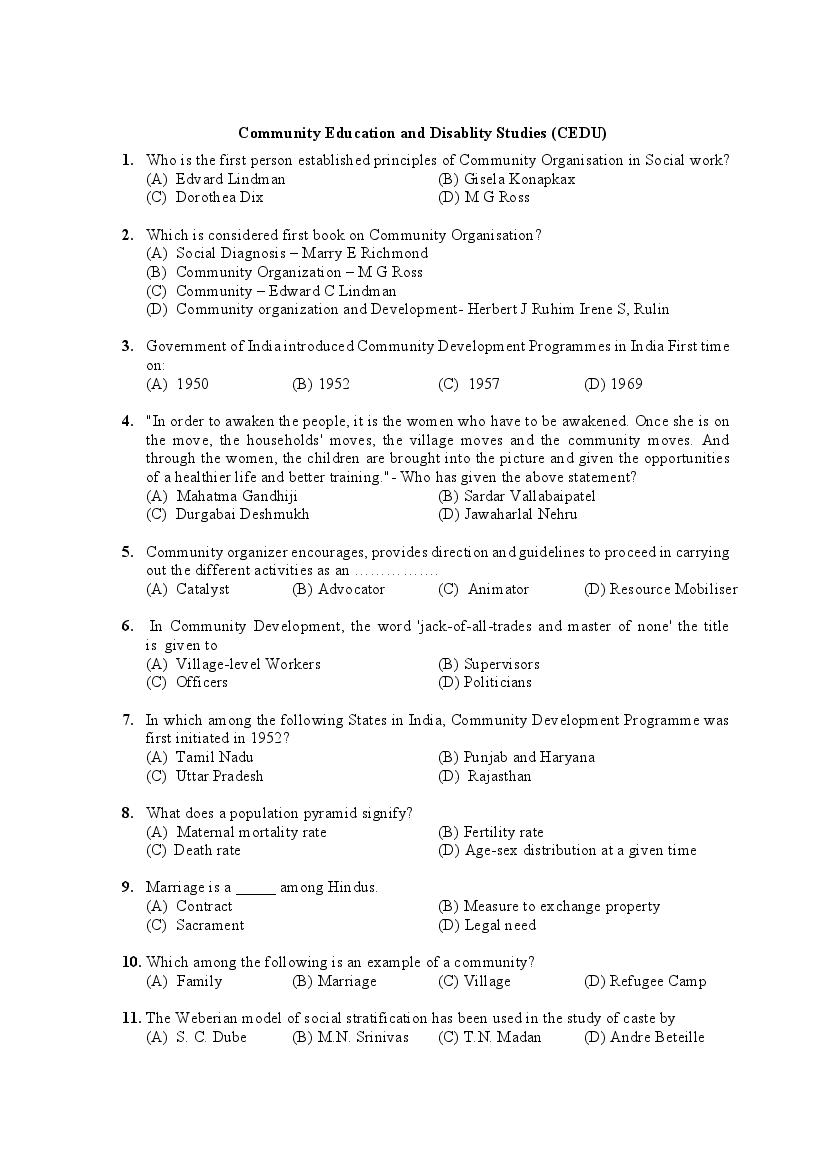
1. Who is the first person established principles of Community Organisation in Social work?
(A) Edvard Lindman (B) Gisela Konapkax
(C) Dorothea Dix (D) M G Ross
2. Which is considered first book on Community Organisation?
(A) Social Diagnosis – Marry E Richmond
(B) Community Organization – M G Ross
(C) Community – Edward C Lindman
(D) Community organization and Development- Herbert J Ruhim Irene S, Rulin
3. Government of India introduced Community Development Programmes in India First time
on:
(A) 1950 (B) 1952 (C) 1957 (D) 1969
4. "In order to awaken the people, it is the women who have to be awakened. Once she is on
the move, the households' moves, the village moves and the community moves. And
through the women, the children are brought into the picture and given the opportunities
of a healthier life and better training."- Who has given the above statement?
(A) Mahatma Gandhiji (B) Sardar Vallabaipatel
(C) Durgabai Deshmukh (D) Jawaharlal Nehru
5. Community organizer encourages, provides direction and guidelines to proceed in carrying
out the different activities as an …………….
(A) Catalyst (B) Advocator (C) Animator (D) Resource Mobiliser
6. In Community Development, the word 'jack-of-all-trades and master of none' the title
is given to
(A) Village-level Workers (B) Supervisors
(C) Officers (D) Politicians
7. In which among the following States in India, Community Development Programme was
first initiated in 1952?
(A) Tamil Nadu (B) Punjab and Haryana
(C) Uttar Pradesh (D) Rajasthan
8. What does a population pyramid signify?
(A) Maternal mortality rate (B) Fertility rate
(C) Death rate (D) Age-sex distribution at a given time
9. Marriage is a _____ among Hindus.
(A) Contract (B) Measure to exchange property
(C) Sacrament (D) Legal need
10. Which among the following is an example of a community?
(A) Family (B) Marriage (C) Village (D) Refugee Camp
11. The Weberian model of social stratification has been used in the study of caste by
(A) S. C. Dube (B) M.N. Srinivas (C) T.N. Madan (D) Andre Beteille
Page 2
(A) Marriage (B) Education (C) Policing (D) Pick-pocketing
13. According to Durkheim, religion consists in the distinction between
(A) The sacred and the secular (B) The pure and the impure
(C) The sacred and the profane (D) The gods and the ghosts
14. The technique involved in guidance which is called “The heart of the guidance programme”
is
(A) The case study (B) The interview
(C) The cumulative record (D) Aptitude test
15. Social and cognitive psychologists use computers for:
(A) Measuring cognition (B) Simulating cognition
(C) Describing cognition (D) All of these
16. During which decade did India see a negative population growth?
(A) 1901-11 (B) 1931-41 (C) 1911-21 (D) 1951-61
17. The first National Policy on Education in free India was launched in the year
(A) 1947 (B) 1964 (C) 1968 (D) 1986
18. Modernization is a type of social change in which society becomes
(A) More open (B) More stratified (C) Less orderly (D) More closed
19. Who have signed MOU for accreditation of Teacher Education Institutions in India?
(A) NAAC and UGC (B) NCTE and NAAC
(C) UGC and NCTE (D) None of these
20. ‘Socialization’ is a process by which the individual is adapted to his
(A) Classroom environment (B) Social environment
(C) Political environment (D) Cultural environment
21. The movement from one social class to another is known as
(A) Social status (B) Social control (C) Social change (D) Social mobility
22. Which of the following is not a factor for social change in India?
(A) Caste (B) Regionalism (C) Language (D) Census
23. An example of Social Stratification is
I. People with different status living in an area
II. A society divided into different social status
III. A separate colony in which only class III government employees live
IV. A society consisting of upper and lower castes
(A) All the above statements are correct (B) Statements I, II and IV are correct
(C) Statements I, II and III are correct (D) Statements II, III and IV are correct
24. The convenient place to store contact information for quick retrieval in e-mail is
(A) Address box (B) Message box (C) Address book (D) Message book
(2)
Page 3
(A) AW (B) .MOV (C) .MP4 (D) .JPEG
26. Which of the following is a non-conventional learning programme in higher education?
(A) Swayam (B) Face-to-face teaching-learning
(C) Tutorial class (D) Seminar
27. The curved line type relationship is referred by
(A) Linear Correlation (B) Non-Linear Correlation
(C) Simple Correlation (D) Multiple Correlation
28. Which of the following is not regarded as the characteristic feature of scientific method?
(A) Reliability (B) Validity
(C) Replicability (D) Common sense observation
29. The purpose of the survey is
(A) In depth study of social phenomena (B) Extensive coverage of population
(C) Testing of a theory (D) Establishing causal linkage
30. In which of the following types of research, hypothesis is a prerequisite?
(A) Biographical study (B) Experimental study
(C) Interpretative research (D) Critical research
31. Participant observation method is ideally suited for the study of
a) Tribal Culture b) National Culture
c) Ethnographic study d) Phenomenon of Globalisation
Select the correct answer from the codes given below:
(A) (a) and (b) (B) (a) and (c) (C) (a) and (d) (D) (c) and (b)
32. Which one of the following is the stable measure of dispersion?
(A) Range (B) Quartile Deviation
(C) Average Deviation (D) Standard Deviation
33. A researcher is generally expected to
(A) Study the existing literature in a field (B) Generate new principles and theories.
(C) Synthesize the ideas given by others (D) Evaluate the findings of a study
34. The Government of India conducts Census after every 10 years. The method of research
used in this process is
(A) Case Study (B) Developmental
(C) Survey (D) Experimental
35. An investigator studied the census data for a given area and prepared a write up based on
them. Such a write-up is called
(A) Research Paper (B) Article (C) Thesis (D) Research Report
36. Which of the following is NOT a measure of dispersion?
(A) Range (B) Mode (C) Mean Deviation (D) Standard Deviation
(3)
Page 4
(A) Have norms as well as technical support
(B) Have greater flexibility
(C) Are more valid and easy
(D) Have inform administration and scoring procedure
38. Which one of the following is a not characteristic of a good test?
(A) Reliability (B) Validity (C) Continuity (D) Objectivity
39. To test null hypothesis of two groups, a researcher uses
(A) T test (B) ANOVA (C) X² (D) Factorial analysis
40. The type of sampling in which major purpose is to reduce cost per element sample is
(A) Simple random sampling (B) Cluster sampling
(C) Systematic sampling (D) Stratified random sampling
41. The validity of a tool depends on
(A) The responses of the respondents (B) The clarity of the items
(C) What it exactly measures (D) The objectivity of measurement
42. Action research is in general concerned with problems
(A) Of general nature
(B) Historical institution
(C) Of immediate concern and call for solution
(D) Have long range implications
43. Which of the following is a type of reliability?
(A) Construct (B) Split half (C) Content (D) Internal consistency
44. No Fixed zero point is present in:
(A) Scale (B) Interval (C) Ratio (D) All of these
45. The best type of objective test is
(A) Completion type (B) Matching type
(C) Multiple choice type (D) True false type
46. Equivalence is one aspect of which of the following?
(A) Reliability (B) Creativity (C) Practicability (D) Objectivity
47. Which one of the following is a research tool?
(A) Graph (B) Illustration (C) Questionnaire (D) Diagram
48. Sampling technique, which requires reference is called:
(A) Quota (B) Cluster (C) Systematic (D) Snowball
49. Research refers to:
(A) Systematic investigation (B) Collection of material
(C) Conducting experiment (D) Collection of facts
50. Hypothesis is:
(A) Tentative supposition (B) Shrewd guess
(C) Anticipated value (D) All of these
x-x-x
(4)
Page 5
1. Specifically to solve local problems, the following form of research typically conducted by
teachers, counselors, and other professionals to answer questions they have.
(A) Action research (B) Basic research
(C) Predictive research (D) Orientation research
2. The development of a solid foundation of reliable knowledge typically is built from which
type of research?
(A) Basic research (B) Action research
(C) Evaluation research (D) Orientational research
3. Which form of reasoning is the process of drawing a specific conclusion from a set of
premises?
(A) Rationalism (B) Deductive reasoning
(C) Inductive reasoning (D) Probabilistic
4. Research that is done to examine the findings of someone else using the "same variables but
different people" is which of the following?
(A) Exploration (B) Hypothesis (C) Replication (D) Empiricism
5. According to your text, what are the five key objectives of science?
(A) Prediction, summary, conclusion, explanation, description
(B) Influence, prediction, questions, exploration, answers
(C) Exploration, description, explanation, prediction, influence
(D) Questions, answers, prediction, explanation, summary
6. Which of the following is not a characteristic of a good theory or explanation?
(A) It is parsimonious
(B) It is testable
(C) It is general enough to apply to more than one place, situation, or person
(D) All of the above are characteristics of good theories
7. Rene Descartes is associated with which of the following approached to knowledge
generation?
(A) Empiricism (B) Rationalism
(C) Expert opinion (D) None of these
8. Which scientific method is a top-down or confirmatory approach?
(A) Deductive method (B) Inductive method
(C) Hypothesis method (D) Pattern method
Page 6
(A) Deductive method (B) Inductive method
(C) Hypothesis method (D) Pattern method
10. Which research paradigm is least concerned about generalizing its findings?
(A) Quantitative research (B) Qualitative research
(C) Mixed research (D) None of these
11. A variable that is presumed to cause a change in another variable is called a(n):
(A) Categorical variable (B) Dependent variable
(C) Independent variable (D) Intervening variable
12. What is the key defining characteristic of experimental research?
(A) Extraneous variables are never present
(B) A positive correlation usually exists
(C) A negative correlation usually exists
(D) Manipulation of the independent variable
13. The statement of purpose in a research study should:
(A) Identify the design of the study
(B) Identify the intent or objective of the study
(C) Specify the type of people to be used in the study
(D) Describe the study
14. Which of the following is necessary in obtaining informed consent?
(A) A description of the statistical analyses that will be carried out
(B) A description of the purpose of the research
(C) A description of the reliability and validity of test instruments
(D) A list of publications that the researcher has had in the last ten years
15. What is the primary approach that is used by the IRB to assess the ethical acceptability of a
research study?
(A) Utilitarianism (B) Deontology
(C) Ethical skepticism (D) Comparativeism
16. Which of the following is not true?
(A) Misrepresenting and creating fraudulent data is dishonest
(B) Misrepresenting data is very easy to detect
(C) Misrepresenting data can be difficult to detect
(D) Breaking confidentiality is not a problem
Page 7
time by a different person for a different purpose?
(A) Primary data (B) Secondary data
(C) Experimental data (D) Field notes
18. In a changing-criterion design, changes in criterion are best done:
(A) As soon as the prior criterion is met
(B) When the previous criterion is met and the behavior has stabilized
(C) Regardless of the previous criteria
(D) After a fixed number of trials
19. A treatment effect is demonstrated in the regression discontinuity design by:
(A) A discontinuity in the regression line
(B) A significant difference in the pretest and posttest scores
(C) Analysis of covariance
(D) The demonstration of an interaction
20. A design consisting of an experimental and a control group but participants are not randomly
assigned to the groups is which of the following?
(A) Interrupted time-series design
(B) Nonequivalent comparison-group design
(C) Single case design
(D) A-B-A-B design
21. The use of a qualitative research objective, collection of qualitative data, and performance
of quantitative analysis is an example of:
(A) Mixed method research
(B) Within-stage mixed model research
(C) Across-stage mixed model research
(D) Monomethod research
22. Which of the following is a weakness of qualitative research?
(A) The results are more easily influenced by the researcher’s personal idiosyncrasies
(B) Data are based on the participant’s own categories of meaning
(C) Can determine idiographic causation
(D) Useful for describing complex phenomena
Page 8
interviews several teachers who used the new math during the 1960s. These teachers are
considered:
(A) Primary sources (B) Secondary Sources
(C) External critics (D) Internal critics
24. The process of dealing with concerns over the authenticity of a source is referred to as:
(A) Sourcing (B) Internal criticism
(C) Secondary criticism (D) External criticism
25. What is the standard deviation of a sampling distribution called?
(A) Sampling error (B) Sample error
(C) Standard error (D) Simple error
26. Presentism in historical sources ________.
(A) Is the presence of the author in a historical source
(B) Is a first-hand accounts of events
(C) Is the assumption that the present-day connotations of terms also existed in the past
(D) Is the assumption that the past influences the present
27. Which of the following tests is not a p of J. Johnson motor educability test?
(A) Front roll (B) Vertical jump
(C) Stagger jump (D) Back roll
28. Which theory of anxiety suggests that stress and anxiety will influence performance and
that each athlete will respond is a unique; way to competitive anxiety?
(A) Drive theory (B) Inverted U-hypothesis
(C) Catastrophe theory (D) Optimal arousal theory
29. A number calculated with complete population data and quantifies a characteristic of the
population is called which of the following?
(A) A datum (B) Statistic (C) A parameter (D) A population
30. The value of coefficient of correlation ranges between
(A) 00 – 1.00 (B) (–1) – 00 (C) 1.00 – 00 (D) (–1.00) – 1.00
Page 9
(A) A fluid will exert an upward force on an object immersed in it equal to the weight
of the fluid displaced by the object.
(B) An object will float if it is lighter than the fluid it is immersed in.
(C) When surface tension is in equilibrium with the downward force applied by the
immersed object.
(D) When surface tension is in unequilibrium with the downward force applied.
32. What are the two main factors that affect the range of a projectile (when ignoring air
resistance)?
(A) Vertical projection velocity and time of flight
(B) Angle of release and time of flight
(C) Horizontal projection velocity and angle of release
(D) Horizontal projection velocity and time of flight
33. Select the correct option. To determine what is needed and who will do it, is an important
task of a manager. Technically it is known as
(A) Staffing (B) Organizing (C) Leading (D) Controlling
34. From the following, identify the one which is not innovating in Sports management.
(A) Evolving (B) Influencing (C) Searching (D) Directing
35. Metabolism is determined by the:
(A) Size of proteins in the cell
(B) Availability of amino acids
(C) Proteins formed as dictated by the genetic material
(D) Protein composition of the DNA
36. The two principal contractile proteins found in skeletal muscle are:
(A) Actin and troponin (B) Actin and myosin
(C) Troponin and tropomyosin (D) Myosin and tropomyosin
37. The total amount of time dedicated to training by a group of athletes/team during a
specific training lesson or phase of training is referred as
(A) Absolute Volume (B) Absolute Intensity
(C) Relative Volume (D) Relative Intensity
38. Blue print of the team competition plan is called
(A) Tactics (B) Skill (C) Technique (D) Strategy
39. Psychological core of personality is the most basic level of personality is
(A) Adjustment to environment (B) Internal and constant
(C) Role related behaviour (D) External & dynamic
Page 10
(A) Direction (B) Intensity (C) Persistence (D) All of these
41. Which of the following is not a dietary antioxidant?
(A) Vitamin C (B) Lipoic acid (C) Vitamin K (D) Beta-carotene
42. Curriculum is
(A) Learner oriented system (B) Programmed instruction
(C) Graded course study (D) Instructional task system
43. Effective teaching in physical education primarily depends on
(A) Optimizing the amount of time for instruction and practice
(B) Discipline in class
(C) Prosocial behaviour of group
(D) Good command
44. Which of the following is not included among the objectives of health education?
(A) Guiding people into action (B) Rehabilitating people
(C) Motivating people (D) Informing people
45. Common injury to the Basketball players is
(A) Head injury (B) Interio lateral ligament injury of ankle
(C) Shoulder injury (D) Lateral collateral ligament injury of hip
46. Which of the following is against the principles of organization?
(A) Overlapping of authority (B) Proper decentralization
(C) Delegation of power (D) Proper communication
47. All India Council of Sport was formed in
(A) 1947 (B) 1950 (C) 1954 (D) 1958
48. Harward Step Test measures
(A) Muscular efficiency of the knee muscles
(B) Cardio-respiratory efficiency
(C) Cardio-pulmonary index
(D) Respiratory pulmonary index
49. The Olympic Games due to political compulsion was boycott
(A) Paris Olympic (B) Berlin Olympic
(C) Moscow Olympic (D) Rome Olympic
Page 11
(A) Proteins (B) Carbohydrates (C) Vitamins (D) Minerals
x-x-x
Document Details
| Board / Org | Panjab University |
| Exam | PU PhD |
| Type | Question Paper |
| Pages | 11 |
| Updated | 30 Apr 2026 |