PU M.Phil & Ph.D Entrance Exam 2020 Question Paper Faculty of Business Management and Commerce
Finished viewing? Save it for later —
Download PU M.Phil & Ph.D Entrance Exam 2020 Question Paper Faculty of Business Management and Commerce (PDF · 8 pages)About PU M.Phil & Ph.D Entrance Exam 2020 Question Paper Faculty of Business Management and Commerce
PU M.Phil & Ph.D Entrance Exam 2020 Question Paper Faculty of Business Management and Commerce is available here for free download. Published by Punjab University for PU PhD, this question paper can be viewed online or downloaded as a PDF (8 pages). Candidates preparing for PU PhD can use PU M.Phil & Ph.D Entrance Exam 2020 Question Paper Faculty of Business Management and Commerce to understand the exam pattern, the type of questions asked, and the overall difficulty level.
Frequently Asked Questions
How can I download PU M.Phil & Ph.D Entrance Exam 2020 Question Paper Faculty of Business Management and Commerce?
Open this page and click the Download button to save PU M.Phil & Ph.D Entrance Exam 2020 Question Paper Faculty of Business Management and Commerce as a PDF. It is completely free on AglaSem Docs.
Is PU M.Phil & Ph.D Entrance Exam 2020 Question Paper Faculty of Business Management and Commerce free to download?
Yes. PU M.Phil & Ph.D Entrance Exam 2020 Question Paper Faculty of Business Management and Commerce can be viewed online and downloaded as a PDF free of cost on AglaSem Docs.
How many pages does PU M.Phil & Ph.D Entrance Exam 2020 Question Paper Faculty of Business Management and Commerce have?
PU M.Phil & Ph.D Entrance Exam 2020 Question Paper Faculty of Business Management and Commerce contains 8 pages, which you can read online or download together as a single PDF.
Where can I find more PU PhD study material?
You can find more PU PhD question papers, sample papers, syllabus, and answer keys on AglaSem Docs.
PU M.Phil & Ph.D Entrance Exam 2020 Question Paper Faculty of Business Management and Commerce – Text
Read the full text of this question paper below — useful to quickly search, copy and reference the content online without downloading the PDF.
📄 View text version (8 pages)
Page 1
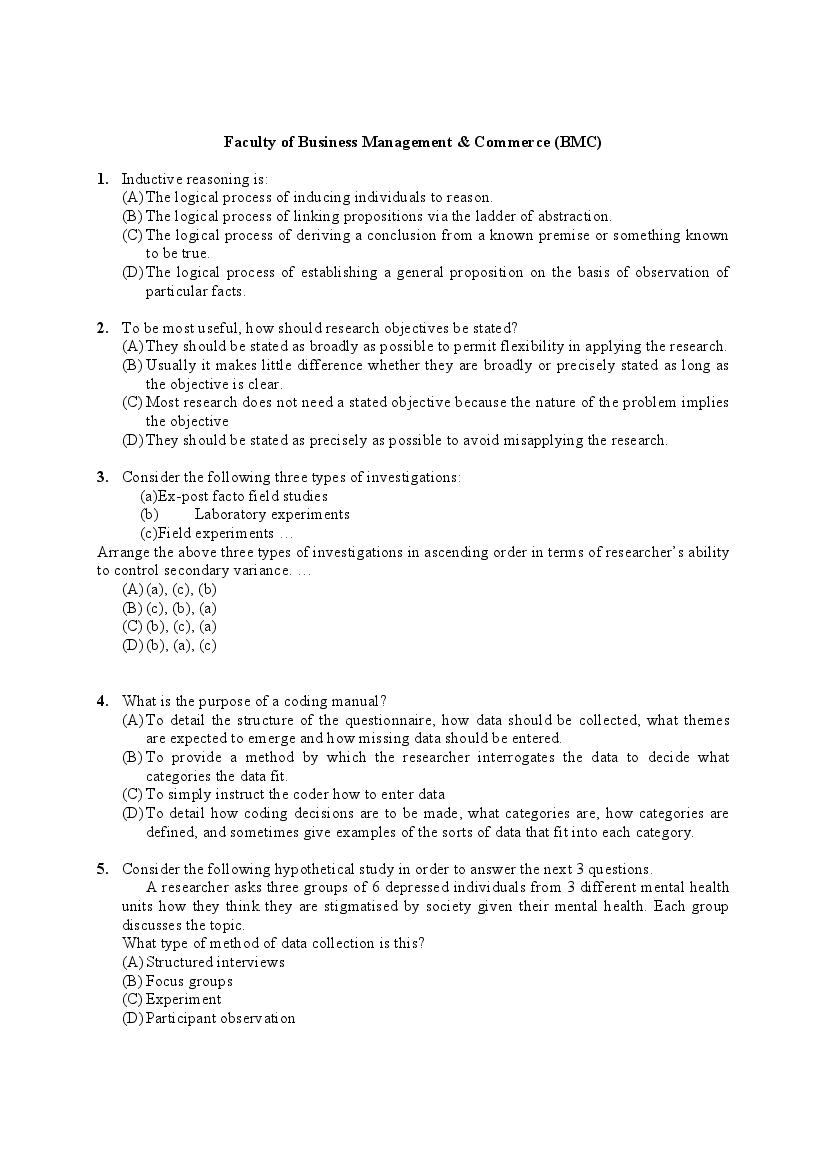
1. Inductive reasoning is:
(A) The logical process of inducing individuals to reason.
(B) The logical process of linking propositions via the ladder of abstraction.
(C) The logical process of deriving a conclusion from a known premise or something known
to be true.
(D) The logical process of establishing a general proposition on the basis of observation of
particular facts.
2. To be most useful, how should research objectives be stated?
(A) They should be stated as broadly as possible to permit flexibility in applying the research.
(B) Usually it makes little difference whether they are broadly or precisely stated as long as
the objective is clear.
(C) Most research does not need a stated objective because the nature of the problem implies
the objective
(D) They should be stated as precisely as possible to avoid misapplying the research.
3. Consider the following three types of investigations:
(a)Ex-post facto field studies
(b) Laboratory experiments
(c)Field experiments …
Arrange the above three types of investigations in ascending order in terms of researcher’s ability
to control secondary variance. …
(A) (a), (c), (b)
(B) (c), (b), (a)
(C) (b), (c), (a)
(D) (b), (a), (c)
4. What is the purpose of a coding manual?
(A) To detail the structure of the questionnaire, how data should be collected, what themes
are expected to emerge and how missing data should be entered.
(B) To provide a method by which the researcher interrogates the data to decide what
categories the data fit.
(C) To simply instruct the coder how to enter data
(D) To detail how coding decisions are to be made, what categories are, how categories are
defined, and sometimes give examples of the sorts of data that fit into each category.
5. Consider the following hypothetical study in order to answer the next 3 questions.
A researcher asks three groups of 6 depressed individuals from 3 different mental health
units how they think they are stigmatised by society given their mental health. Each group
discusses the topic.
What type of method of data collection is this?
(A) Structured interviews
(B) Focus groups
(C) Experiment
(D) Participant observation
Page 2
studies?
(A) Non-manipulation studies.
(B) Passive observational studies
(C) Non-experiments
(D) Non-randomized
7. Which of the following is true of the hypothetico-deductive method?
(A) It is a computer problem to help researchers to improve the quality of their hypotheses.
(B) It encourages the use of exploratory studies.
(C) It is the basis for testing for testing for statistical significance.
(D) It encourages the development of specific hypotheses based on empirically derived
theories.
8. A meta-analysis would allow you to:
(A) Identify the antecedents of a behaviour.
(B) Replicate many studies.
(C) Explore the variations or inconsistencies in the outcomes of lots of studies.
(D) Assess the reliability of a study.
9. What is the difference between "scratch notes" and "full field notes"?
(A) Full field notes are quicker and easier to write than scratch notes
(B) Scratch notes are just key words and phrases, rather than lengthy descriptions
(C) Scratch notes are written at the end of the day rather than during key events
(D) Full field notes do not involve the researcher scratching their head while thinking
10. What is a "probing question"?
(A) One that inquires about a sensitive or deeply personal issue
(B) One that encourages the interviewee to say more about a topic
(C) One that asks indirectly about people's opinions
(D) One that moves the conversation on to another topic
11. If a study is "reliable", this means that:
(A) It was conducted by a reputable researcher who can be trusted
(B) The measures devised for concepts are stable on different occasions
(C) The findings can be generalized to other social settings.
(D) The methods are stated clearly enough for the research to be replicated
12. The term 'data processing error' refers to:
(A) Activities or events related to the sampling process, e.g. non-response
(B) Problems with the implementation of the research process
(C) The unavoidable discrepancy between the sample and the population
(D) Faulty techniques of coding and managing data
13. The standard error is a statistical measure of:
(A) The normal distribution of scores around the sample mean
(B) The clustering of scores at each end of a survey scale
(C) The extent to which a sample mean is likely to differ from the population mean
(D) The degree to which a sample has been accurately stratified
(2)
Page 3
(A) The study of semi-detached houses
(B) A half-baked attempt at social research
(C) The method of semi-structured interviewing
(D) The science of signs
15. How does qualitative content analysis differ from quantitative content analysis?
(A) It is always preceded by ethnographic research
(B) It is less rigid, as researchers are constantly revising their concepts.
(C) It is less likely to be used by feminist researchers.
(D) It involves counting the number of times certain words appear in a text
16. A _____ can be used to present absolute and relative magnitudes, differences, and change.
(A) Line chart
(B) Pictograph
(C) Bar chart
(D) Histogram
17. Which method of analysis does not classify variables as dependent or independent?
(A) Regression analysis
(B) Discriminant analysis
(C) Analysis of variance
(D) Factor analysis
18. Which of the following is not a problem associated with multicollinearity?
(A) It becomes difficult to compute the correct test statistic.
(B) The partial regression coefficients may not be estimated precisely. The standard errors
are likely to be high.
(C) It becomes difficult to assess the relative importance of the independent variables in
explaining the variation in the dependent variables.
(D) Predictor variables may be incorrectly included or removed in stepwise regression.
19. How consumers’ intentions to buy the brand varies with different price levels is best
analyzed via _____.
(A) t tests
(B) One-way ANOVA
(C) ANCOVA
(D) Regression
20. The _____ is a symmetric bell-shaped distribution that is useful for small sample (n < 30)
testing.
(A) t distribution
(B) Frequency distribution
(C) Chi-square distribution
(D) F distribution
(3)
Page 4
identify illegible, incomplete, inconsistent, or ambiguous responses.
(A) Questionnaire checking
(B) Editing
(C) Coding
(D) Data cleaning
22. Which method of improving response rate involves sending potential respondents a letter
notifying them of the imminent mail, telephone, personal, or Internet survey?
(A) Incentives
(B) Prior notification
(C) Motivating the respondents
(D) Follow-up
23. _____ is a probability sampling technique that uses a two-step process to partition the
population into subpopulations, or strata. Elements are selected from each stratum by a
random procedure.
(A) Stratified sampling
(B) Cluster sampling
(C) Simple random sampling
(D) Systematic sampling
24. Cluster sampling and stratified sampling differ in all of the following ways except:
(A) Their objectives
(B) Classification of sampling technique
(C) With respect to homogeneity and heterogeneity.
(D) The number of subpopulations chosen
25. In a _____, respondents rate the objects by placing a mark at the appropriate position on a
line that runs from one extreme of the criterion variable to the other.
(A) Semantic differential scale
(B) Likert scale
(C) Continuous rating scale
(D) Stapel scale
26. Which of the following is not an approach to assess multi-item scale reliability?
(A) Test-retest reliability
(B) Construct reliability
(C) Alternative forms reliability
(D) Internal consistency reliability
27. Which statement is true about the interval scale?
(A) Ratios of scale values can be computed.
(B) Both the zero point and the units of measurement are arbitrary.
(C) Any positive linear transformation of the form y = a + bx will preserve the properties of
the scale.
(D) Both b and c are correct.
(4)
Page 5
(A) Research plan; Research data; Analysis; References
(B) Introduction; Literature review; Research methods; Results; Discussion; Conclusion.
(C) Introduction; Data collection; Data analysis; Conclusions and recommendations.
(D) Executive summary; Literature review; Data gathered; Conclusions; Bibliography.
29. When using a Likert scale with a long list of items, it is usually better to:
(A) Omit any instructions about how to select an answer
(B) Arrange the answers horizontally, in abbreviated form
(C) List the answers vertically, for each consecutive item
(D) List all questions on one page and all answers on another
30. _____ refers to an extraneous variable attributable to the loss of test units while the
experiment is in progress.
(A) Interactive testing effect
(B) Maturation
(C) Mortality
(D) Main testing effect
31. In _____, an individual is presented with a stimulus and asked to respond with the first thing
that comes to mind.
(A) Completion techniques
(B) Focus groups
(C) Association techniques
(D) Depth interviews
32. The basic steps recommended in hypothesis testing, in the correct order, are
(A) Analyze data which support an alternative hypothesis or position, conceptualize a null
hypothesis, raise the question of the probability that the empirical "evidence" supporting
the original position could have been a statistical accident, calculate the p-value.
(B) Estimate a p-value, develop and analyze data, conceptualize a null hypothesis, cluster the
data into two testable groups.
(C) Conceptualize a null hypothesis, raise the question of the probability that the empirical
"evidence" supporting the original position could have been a statistical accident, develop
and analyze data, calculate the p-value.
(D) Cluster the data into two or three groups, analyze the data, calculate the p-value, test the
null hypothesis.
33. The basic assumption of cluster analysis is that
1. It is always possible to group data into well-defined homogeneous groups.
2. The basic measurement of similarity is a valid measurement of proximity between
objects.
3. There is theoretical justification for structuring the objects into clusters.
Which of the following statement/statements are true.
(A) 1 only
(B) 1 and 2
(C) 3 only
(D) 2 and 3
(5)
Page 6
Factor Loadings
Variable Factor 1 Factor 2 Communality
1 -.97 .05 .86
2 .85 .22 .95
3 .06 .87 .57
4 .92 .15 .69
5 -.05 .99 .92
Which of the following statements is true?
(A) Factor 2 is composed of variables 1 and 2.
(B) Factor 2 is composed of variables 1, 2, and 4.
(C) Factor 2 is composed of variables 3 and 5.
(D) Factor 1 is composed of variables 1, 2, and 4.
35. Data modeling and analysis techniques involves all of the following EXCEPT:
(A) Use of people, processes and systems
(B) Use of tools such as customer profiling, customer segmentation, customer profitability,
predictive modeling, etc.
(C) Formulating uniform strategy across all customer groups
(D) ‘What-if’ analysis
36. Which of the following is NOT true of continuous panels?
1. They are usually a representative sample of the population.
2. Panel members who drop out usually differ from the members of the panel who remain.
3. They provide a vehicle for testing the effects of changes in price or advertising copy.
4. They have an advantage of accuracy over interview methods.
Which of the following statement is true?
(A) 1
(B) 2
(C) 3
(D) 4
37. A phenotypic source of refusals refers to
(A) Characteristics of the data collection procedure (questions asked, length of the interview)
(B) Respondents who refuse to clarify their answers and who seem anxious to end the
interview.
(C) Respondents who forget how many times in the past month they have been shopping and
who underestimate or overestimate the number of times when asked.
(D) The indigenous characteristics of respondents (such as age, sex and occupation)
38. Purchase Intercept technique
(A) Is to schedule personal interview surveys with questions provided by a number of clients.
(B) Combines both in-store observation and in-store interviewing to asses shopping behavior.
(C) Dominates the personal interview with respect to speed, absence of administrative
problems, and lower cost per completed interview.
(D) It does not give the researcher adequate control over a number of variables and may make
it hard for the researcher to predict response rates.
(6)
Page 7
(A) Are also called the method of equal-appearing intervals because the objective is to obtain
a unidimensional scale with interval properties.
(B) Are generally hard to construct and administer.
(C) Require a neutral midpoint at the center of each scale.
(D) Are also called summated scales because the scores on individual items or statements are
summed to produce a total score for each respondent.
40. All of the following are true about the sequence of questions in a survey except
(A) The interview should not begin with difficult questions.
(B) The questionnaire should be easy for the interviewer to administer.
(C) The questionnaire should flow logically from one topic to the next.
(D) Sensitive questions should be asked in the beginning before the respondent is tired of the
interview.
41. The marketing researcher for a game company is conducting an experiment to test customer
reaction to the pricing of a new game designed for use by adults. A list of customers who had
sent the company complaint letters was readily available, and the researcher rearranged this
list by ZIP code, sending every third person a color brochure on the new game. Each
respondent was asked to return a postcard, stating an intention to purchase or not to purchase
the game at the listed price. Which of the following is true?
(A) The sampling method ensures that all geographic areas are represented.
(B) The external validity of the study is ensured, since respondents who are sitting in their
homes are reacting under real life circumstances.
(C) The sample is likely to over-represent the lower class.
(D) The design of the study suffers from selection bias.
42. A researcher is doing a study on champagne consumption. She has defined three different
income groups and has assigned interviewers a specific number of interviews with
respondents in each group. This is an example of
(A) Quota sampling.
(B) Convenience sampling.
(C) Random sampling.
(D) Cluster sampling.
43. _____ is a class of procedures for representing perceptions and preferences of respondents
spatially by means of a visual display.
(A) Conjoint analysis
(B) Correspondence analysis
(C) Hybrid conjoint analysis
(D) Multidimensional scaling (MDS)
44. The number of participants needed for a study can be calculated using:
(A) Power level, effect size and criterion significance level.
(B) Type of design, power level, previous research and criterion significance level.
(C) Statistical test, power level, effect size and criterion significance level.
(D) Effect size, hypotheses, design, type of statistical test and criterion significance level.
(7)
Page 8
(A) Case study design
(B) Comparative design
(C) Experimental design
(D) Longitudinal design
46. What component of attitude would be measured by the following question: "What airlines do
you know of that fly from San Francisco to Denver?"
(A) The cognitive component
(B) The affective component
(C) The liking component
(D) The action component
47. In SPSS, where do you find the option for Spearman's Rho?
(A) Analyze, Correlation, Bivariate
(B) Analyze, Descriptive statistics, Explore.
(C) Analyze, Non-parametric tests.
(D) Analyze, Regression, Linear
48. A representative sample is an essential element of the
(A) Survey method.
(B) Psychoanalytic method.
(C) Natural experiment or case study.
(D) Clinical method.
49. In a weight-reduction experiment, an overweight individual was given what the researcher
called a new type of diet pill that would help curb the desire to eat. In fact, the pill really
contained powdered milk, but ever since the individual started taking the diet pill, he has
reported that his desire to eat has decreased. This illustrates the
(A) Curvilinear relationship
(B) Effect of extraneous variables
(C) Natural experiment
(D) Placebo effect
50. In _____, each case or respondent in the database is assigned a weight to reflect its
importance relative to other cases or respondents.
(A) Standardization
(B) Variable respecification
(C) Scale transformation
(D) Weighting
x-x-x
(8)
Document Details
| Board / Org | Panjab University |
| Exam | PU PhD |
| Type | Question Paper |
| Pages | 8 |
| Updated | 30 Apr 2026 |