Finished viewing? Save it for later —
Download NCERT Book Class 11 Geography (India Physical Environment) Chapter 3 Drainage System (PDF · 10 pages)About NCERT Book Class 11 Geography (India Physical Environment) Chapter 3 Drainage System
NCERT Book Class 11 Geography (India Physical Environment) Chapter 3 Drainage System is available here for free download. Published by NCERT for Class 11, this books can be viewed online or downloaded as a PDF (10 pages). Candidates preparing for Class 11 can use NCERT Book Class 11 Geography (India Physical Environment) Chapter 3 Drainage System to understand the exam pattern, the type of questions asked, and the overall difficulty level.
Frequently Asked Questions
How can I download NCERT Book Class 11 Geography (India Physical Environment) Chapter 3 Drainage System?
Open this page and click the Download button to save NCERT Book Class 11 Geography (India Physical Environment) Chapter 3 Drainage System as a PDF. It is completely free on AglaSem Docs.
Is NCERT Book Class 11 Geography (India Physical Environment) Chapter 3 Drainage System free to download?
Yes. NCERT Book Class 11 Geography (India Physical Environment) Chapter 3 Drainage System can be viewed online and downloaded as a PDF free of cost on AglaSem Docs.
How many pages does NCERT Book Class 11 Geography (India Physical Environment) Chapter 3 Drainage System have?
NCERT Book Class 11 Geography (India Physical Environment) Chapter 3 Drainage System contains 10 pages, which you can read online or download together as a single PDF.
Where can I find more Class 11 study material?
You can find more Class 11 question papers, sample papers, syllabus, and answer keys on AglaSem Docs.
NCERT Book Class 11 Geography (India Physical Environment) Chapter 3 Drainage System – Text
Read the full text of this books below — useful to quickly search, copy and reference the content online without downloading the PDF.
📄 View text version (1 page)
Page 1
DRAINAGE SYSTEM
Y
ou have observed water flowing through 2024) in this class . Can you, then, explain
the rivers, nalas and even channels the reason for water flowing from one direction
during rainy season which drain the to the other? Why do the rivers originating from
excess water. Had these channels not been the Himalayas in the northern India and the
there, large-scale flooding would have Western Ghat in the southern India flow towards
occurred. Wherever channels are ill-defined or the east and discharge their waters in the Bay
choked, flooding is a common phenomenon.
The flow of water through well-defined
channels is known as ‘drainage’ and the
network of such channels is called a
‘drainage system’. The drainage pattern
of an area is the outcome of the geological
time period, nature and structure of
rocks, topography, slope, amount of
water flowing and the periodicity of
the flow.
Do you have a river near your village or city?
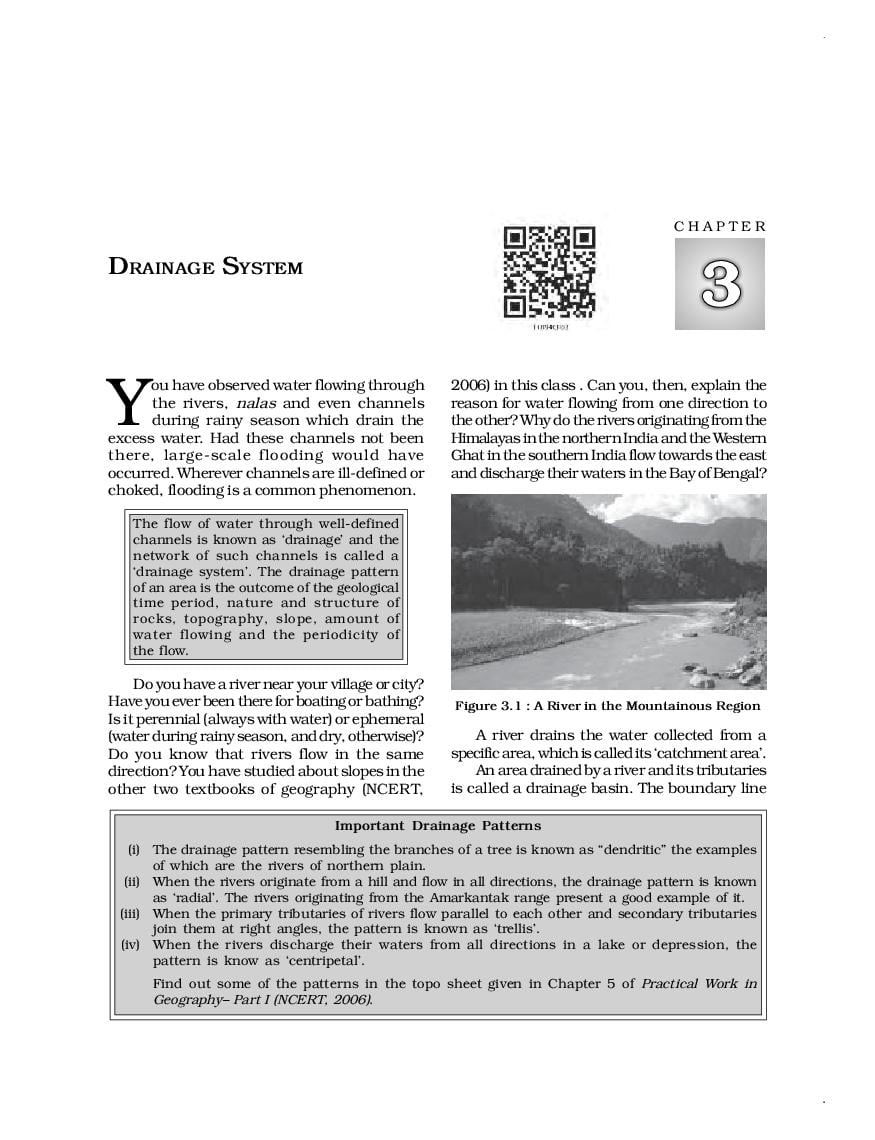
Have you ever been there for boating or bathing? Figure 3.1 : A River in the Mountainous Region
Is it perennial (always with water) or ephemeral
(water during rainy season, and dry, otherwise)? of Bengal?
Do you know that rivers flow in the same A river drains the water collected from a
direction? You have studied about slopes in the specific area, which is called its ‘catchment area’.
other two textbooks of geography (NCERT, An area drained by a river and its tributaries
Important Drainage Patterns
(i) The drainage pattern resembling the branches of a tree is known as “dendritic” the examples
of which are the rivers of northern plain.
(ii) When the rivers originate from a hill and flow in all directions, the drainage pattern is known
as ‘radial’. The rivers originating from the Amarkantak range present a good example of it.
(iii) When the primary tributaries of rivers flow parallel to each other and secondary tributaries
join them at right angles, the pattern is known as ‘trellis’.
(iv) When the rivers discharge their waters from all directions in a lake or depression, the
pattern is know as ‘centripetal’.
Find out some of the patterns in the topo sheet given in Chapter 5 of Practical Work in
Geography– Part I (NCERT).
Showing the first page only. Download the PDF above for the complete document.
Document Details
| Board / Org | NCERT |
| Exam | Class 11 |
| Type | Books |
| Pages | 10 |
| Updated | 29 Aug 2026 |