Finished viewing? Save it for later —
Download NCERT Book Class 11 Geography (India Physical Environment) Chapter 5 Natural Vegetation (PDF · 10 pages)About NCERT Book Class 11 Geography (India Physical Environment) Chapter 5 Natural Vegetation
NCERT Book Class 11 Geography (India Physical Environment) Chapter 5 Natural Vegetation is available here for free download. Published by NCERT for Class 11, this books can be viewed online or downloaded as a PDF (10 pages). Candidates preparing for Class 11 can use NCERT Book Class 11 Geography (India Physical Environment) Chapter 5 Natural Vegetation to understand the exam pattern, the type of questions asked, and the overall difficulty level.
Frequently Asked Questions
How can I download NCERT Book Class 11 Geography (India Physical Environment) Chapter 5 Natural Vegetation?
Open this page and click the Download button to save NCERT Book Class 11 Geography (India Physical Environment) Chapter 5 Natural Vegetation as a PDF. It is completely free on AglaSem Docs.
Is NCERT Book Class 11 Geography (India Physical Environment) Chapter 5 Natural Vegetation free to download?
Yes. NCERT Book Class 11 Geography (India Physical Environment) Chapter 5 Natural Vegetation can be viewed online and downloaded as a PDF free of cost on AglaSem Docs.
How many pages does NCERT Book Class 11 Geography (India Physical Environment) Chapter 5 Natural Vegetation have?
NCERT Book Class 11 Geography (India Physical Environment) Chapter 5 Natural Vegetation contains 10 pages, which you can read online or download together as a single PDF.
Where can I find more Class 11 study material?
You can find more Class 11 question papers, sample papers, syllabus, and answer keys on AglaSem Docs.
NCERT Book Class 11 Geography (India Physical Environment) Chapter 5 Natural Vegetation – Text
Read the full text of this books below — useful to quickly search, copy and reference the content online without downloading the PDF.
📄 View text version (1 page)
Page 1
NATURAL VEGETATION
H
ave you ever been to a forest for a picnic? Tropical Evergreen and
You might have surely gone to a park if Semi Evergreen Forests
you live in a city or to a mango, guava
These forests are found in the western slope
or coconut orchard, if you live in a village. How
do you differentiate between the natural of the Western Ghats, hills of the northeastern
vegetation and the planted vegetation? The same region and the Andaman and Nicobar Islands.
variety may be found growing wild in the forest They are found in warm and humid areas with
under natural conditions and the same tree an annual precipitation of over 200 cm and
may be the planted one in your garden under mean annual temperature above 22 o C.
human supervision. Tropical evergreen forests are well stratified,
Natural vegetation refers to a plant with layers closer to the ground and are
community that has been left undisturbed over covered with shrubs and creepers, with short
a long time, so as to allow its individual species structured trees followed by tall variety of trees.
to adjust themselves to climate and soil In these forests, trees reach great heights up
conditions as fully as possible. to 60 m or above. There is no definite time for
India is a land of great variety of natural trees to shed their leaves, flowering and
vegetation. Himalayan heights are marked with fruition. As such these forests appear green
temperate vegetation; the Western Ghats and all the year round. Species found in these
the Andaman Nicobar Islands have tropical forests include rosewood, mahogony, aini,
rain forests, the deltaic regions have tropical ebony, etc.
forests and mangroves; the desert and semi The semi evergreen forests are found in the
desert areas of Rajasthan are known for cactii, less rainy parts of these regions. Such forests
a wide variety of bushes and thorny vegetation. have a mixture of evergreen and moist
Depending upon the variations in the climate deciduous trees. The undergrowing climbers
and the soil, the vegetation of India changes provide an evergreen character to these forests.
from one region to another. Main species are white cedar, hollock and kail.
On the basis of certain common features
such as predominant vegetation type and
climatic regions, Indian forests can be divided
into the following groups:
TYPES OF FORESTS
(i) Tropical Evergreen and Semi
Evergreen forests
(ii) Tropical Deciduous forests
(iii) Tropical Thorn forests
(iv) Montane forests
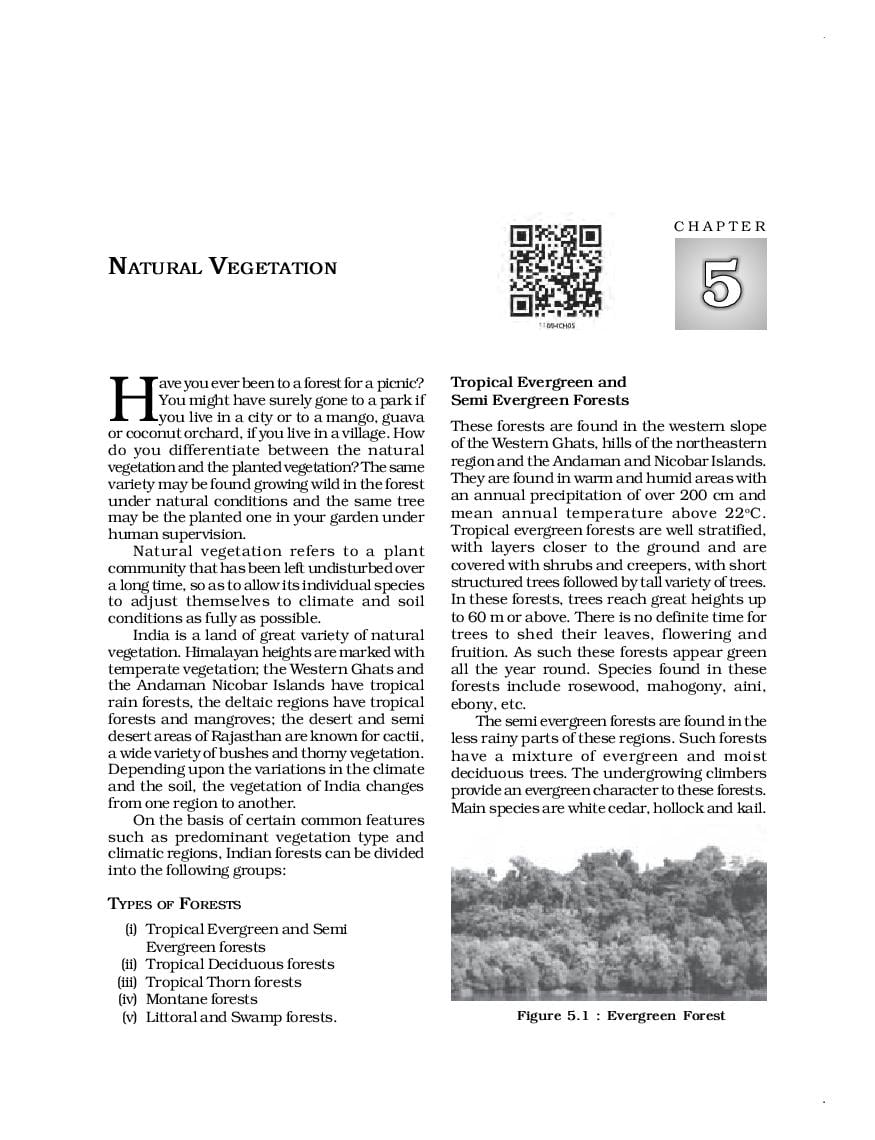
(v) Littoral and Swamp forests. Figure 5.1 : Evergreen Forest
Showing the first page only. Download the PDF above for the complete document.
Document Details
| Board / Org | NCERT |
| Exam | Class 11 |
| Type | Books |
| Pages | 10 |
| Updated | 29 Aug 2026 |