CBSE Class 12 Sample Paper 2027 for History
Finished viewing? Save it for later —
Download CBSE Class 12 Sample Paper 2027 for History (PDF · 10 pages)About CBSE Class 12 Sample Paper 2027 for History
CBSE Class 12 Sample Paper 2027 for History is available here for free download. Published by CBSE for Class 12, this sample paper can be viewed online or downloaded as a PDF (10 pages). Candidates preparing for Class 12 can use CBSE Class 12 Sample Paper 2027 for History to understand the exam pattern, the type of questions asked, and the overall difficulty level.
Frequently Asked Questions
How can I download CBSE Class 12 Sample Paper 2027 for History?
Open this page and click the Download button to save CBSE Class 12 Sample Paper 2027 for History as a PDF. It is completely free on AglaSem Docs.
Is CBSE Class 12 Sample Paper 2027 for History free to download?
Yes. CBSE Class 12 Sample Paper 2027 for History can be viewed online and downloaded as a PDF free of cost on AglaSem Docs.
How many pages does CBSE Class 12 Sample Paper 2027 for History have?
CBSE Class 12 Sample Paper 2027 for History contains 10 pages, which you can read online or download together as a single PDF.
Where can I find more Class 12 study material?
You can find more Class 12 question papers, sample papers, syllabus, and answer keys on AglaSem Docs.
CBSE Class 12 Sample Paper 2027 for History – Text
Read the full text of this sample paper below — useful to quickly search, copy and reference the content online without downloading the PDF.
📄 View text version (11 pages)
Page 1
CBSE Class 12 Sample
Paper 2027 for History
EXAM YEAR TYPE SUBJECT
CBSE Class 12 2027 Sample Paper History
Notes · Sample Papers · Previous Year Papers · Mock Tests
Page 2
.co s e m
s em l a
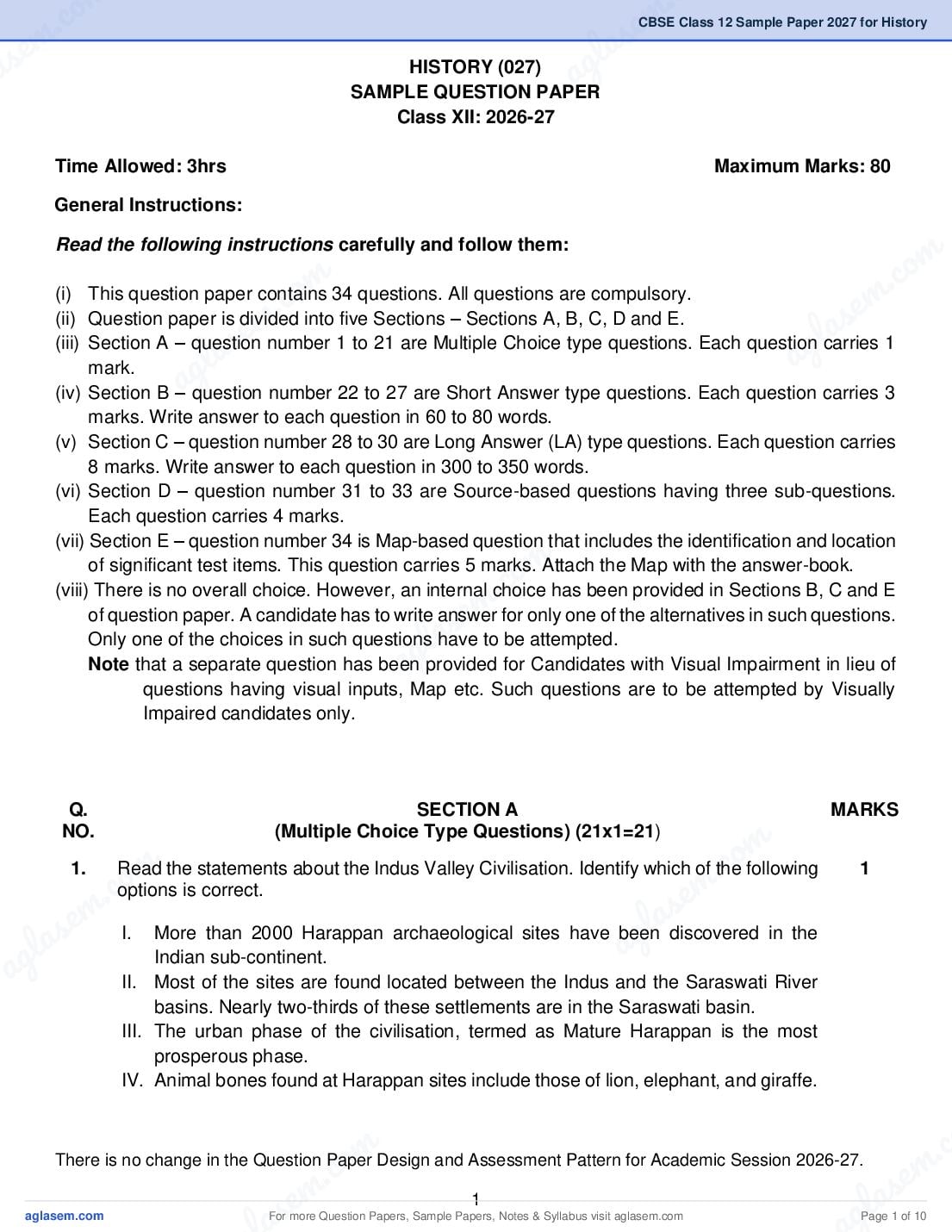
a HISTORY (027)
ag
SAMPLE QUESTION PAPER
Class XII: 2026-27
Time Allowed: 3hrs Maximum Marks: 80
General Instructions:
Read the following instructions carefully and follow them:
o m
m
o 34 questions. All questions are compulsory. . c
. c
(i) This question paper contains
e m
(ii) Question paper is divided into five Sections – Sections A, B, C, D and E. s
emnumber 1 to 21 are Multiple Choice type questions. Each questionglcarries
a 1
las
(iii) Section A – question
a
g
(iv) Section B –aquestion number 22 to 27 are Short Answer type questions. Each question carries 3
mark.
marks. Write answer to each question in 60 to 80 words.
(v) Section C – question number 28 to 30 are Long Answer (LA) type questions. Each question carries
8 marks. Write answer to each question in 300 to 350 words.
(vi) Section D – question number 31 to 33 are Source-based questions having three sub-questions.
Each question carries 4 marks.
(vii) Section E – question number 34 is Map-based question that includes the identification and location
m
.co
of significant test items. This question carries 5 marks. Attach the Map with the answer-book.
m
(viii) There is no overall choice. However, an internal choice has been provided in Sections B, C and E
s e
of question paper. A candidate has to write answer for only one of the alternatives in such questions.
l a
ag
Only one of the choices in such questions have to be attempted.
Note that a separate question has been provided for Candidates with Visual Impairment in lieu of
questions having visual inputs, Map etc. Such questions are to be attempted by Visually
Impaired candidates only.
Q. SECTION A MARKS
m
NO. (Multiple Choice Type Questions) (21x1=21)
1.
c. o
m
Read the statements about the Indus Valley Civilisation. Identify which of the following
m .co 1
options is correct.
s e
s em I. More than 2000 Harappan archaeological sites have been g l adiscovered in the
g la a
a Indian sub-continent.
II. Most of the sites are found located between the Indus and the Saraswati River
basins. Nearly two-thirds of these settlements are in the Saraswati basin.
III. The urban phase of the civilisation, termed as Mature Harappan is the most
prosperous phase.
IV. Animal bones found at Harappan sites include those of lion, elephant, and giraffe.
m . c
c. o
s e m
s em 1
For more Question Papers, Sample Papers, Notes & Syllabus visit
gl a
Page 1 of 10
Page 3
(A) I, II and III
(B) II, III and IV
(C) I, II and IV
(D) I, III and IV
2. Which of the following sites of Harappan civilization was a source of carnelian? 1
(A) Shortughai
(B) Bharuch
(C) Kalibangan
(D) Banawali
3. Megasthenes mentions a committee with six subcommittees for coordinating military 1
activity in the Mauryan empire. Match the subcommittees listed in Column I with the
military divisions given in Column II and select the correct answer.
Column I Column II
a. Third subcommittee i. Chariots
b. Fourth subcommittee ii. Horses
c. Fifth subcommittee iii. Foot-soldiers
d. Sixth subcommittee iv. Elephants
Options:
a b c d
(A) ii i iv iii
(B) i iv iii ii
(C) iii ii i iv
(D) iv iii ii i
4. Two statements labelled as Assertion (A) and Reason (R) are given below. Read them 1
carefully and select the correct option:
Assertion (A): Mandasor inscription provides a fascinating glimpse of complex social
processes and provides insights into the nature of guilds or shrenis.
Reason (R): They collectively decided to invest their wealth, earned through their
craft, to construct a splendid temple in honour of the Sun God.
Options:
(A) Both Assertion (A) and Reason (R) are true and Reason (R) is the correct
explanation of the Assertion (A).
(B) Both Assertion (A) and Reason (R) are true, but Reason (R) is not the correct
explanation of the Assertion (A).
(C) Assertion (A) is true, but Reason (R) is false.
(D) Assertion (A) is false, but Reason (R) is true.
2
For more Question Papers, Sample Papers, Notes & Syllabus visit Page 2 of 10
Page 4
.co s e m
s em l a
a 5. ag Hastinapura in Meerut
Name the archaeologist who excavated at a village named 1
(Uttar Pradesh) in 1951-52.
(A) Rakhal Das Banerji
(B) Daya Ram Sahni
(C) S.N. Roy
(D) B.B. Lal
6. Which of the following is NOT a vow taken by Jaina monks and nuns? 1
m
co
(A) To practise non-violence towards all living beings
. c om
(B) To abstain from taking what is not given
e m .
s
(C) To observe complete celibacy
m e l a
s
(D) To maintain personal property for religious use
Read the g l a g
a 1
a
7. following lines and identify the source from which these are taken.
In five ways should a master look after his servants and employees … by assigning
them work according to their strength, by supplying them with food and wages, by
tending them in sickness; by sharing delicacies with them and by granting leave at
times …
Choose the correct option:
(A) Sutta Pitaka
(B) Ashokavadana
m
.co
(C) Mahavamsa
(D) Vinaya Pitaka
e m
8.
as
Read the statements about the traveller. Identify which of the following option is
l
1
ag
correct.
❖ He was a French jeweller, who travelled to India at least six times.
❖ He was particularly fascinated with the trading conditions in India, and compared
India to Iran and the Ottoman empire.
(A) Manucci
(B) Duarte Barbosa
m
(C) François Bernier
om the correct statement from the following options with reference .co
(D) Jean-Baptiste Tavernier
c. Choose e m to Kitab-ul-
9.
em Hind. l as 1
las (A) It is divided into 90 chapters.
ag
ag (B) It covers various subjects such as astrology etc.
(C) Generally, each chapter is beginning with a question, following this up with a
description.
(D) It is based on Arabic traditions, and concluding with a comparison with other
cultures.
m . c
c. o
s e m
s em 3
For more Question Papers, Sample Papers, Notes & Syllabus visit
gl a
Page 3 of 10
Page 5
(A) John Marshall
(B) Robert Redfield
(C) Cyril Radcliffe
(D) Francis Buchanan
11. Which of the following Chola ruler had consecrated metal images of Appar, 1
Sambandar and Sundarar in a Shiva temple?
(A) Parantaka I
(B) Parantaka II
(C) Rajaraja Chola I
(D) Rajaraja Chola II
12. Look at the image given below and identify it correctly from the given options: 1
Source - NCERT HISTORY BOOK 2, Chapter-7, Fig. 7.3, PAGE 172
(A) A fortified gateway of a medieval South Indian city
(B) The Lotus Mahal at Hampi
(C) The interior hall of the Meenakshi Temple at Madurai
(D) The gopuram or gateway of the Brihadishvara temple at Thanjavur
Note: The following question is for the Candidates with Visual Impairment only
in lieu of Q. No. 12.
The rulers of Vijayanagara were called__________.
(A) Gajapati
(B) Ashvapati
(C) Nayakas
(D) Rayas
13. Eighteenth-century records tell us of zamindars in Bengal remunerated blacksmiths, 1
carpenters, even goldsmiths for their work by paying them “a small daily allowance
and diet money.” This arrangement later came to be known as the__________.
(A) Ryotwari system
(B) Jajmani system
(C) Mahalwari system
(D) Peshkash system
4
For more Question Papers, Sample Papers, Notes & Syllabus visit Page 4 of 10
Page 6
m .co s e m
e l a
as 14. Which of the following was NOT a jins-i-kamil crop? ag 1
(A) Cotton
(B) Sugarcane
(C) Rice
(D) Oilseeds
15. Which of the following tribe was demarcated the area named as Damin-i-Koh? 1
(A) The Mundas
m
co
(B) The Paharias
om .
(C) The Gonds
(D) The Santhals
. c e m
e m as
l 1
16.
s
Match the following.
l a ag
agColumn I Column II
a. Jotedar i. Rajmahal
b. Paharias ii. Rich Peasants
c. Sharecroppers iii. Territorial unit
d. Taluq iv. Adhiyars
Choose the correct option:
m
(A) a-iv, b-i, c-ii, d-iii
m .co
(B) a-ii, b-i, c-iv, d-iii
s e
(C) a-i, b-ii, c-iv, d-iii
l a
(D) a-iv, b-i, c-iii, d-ii ag
17. Two statements labelled as Assertion (A) and Reason (R) are given below. Read 1
them carefully and select the correct option:
Assertion: Deprived of his armed forces, the Nawab became increasingly dependent
on the British to maintain law and order within the kingdom.
Reason: By the terms of the alliance the Nawab had to disband his military force,
allow the British to position their troops within the kingdom, and act in accordance with
m
m
the advice of the British Resident who was now to be attached to the court.
.co
m .co s e m
s e Options:
g la
g la (A) Both A and R are true and R is the correct explanation of A
a
a (B) Both A and R are true and R is not the correct explanation of A
(C) A is true but R is false
(D) A is false but R is true
m . c
c. o
s e m
s em 5
For more Question Papers, Sample Papers, Notes & Syllabus visit
gl a
Page 5 of 10
Page 7
Column I Column II
a. Subsidiary i. The designation of a representative of the Governor General
Alliance who lived in a state which was not under direct British rule.
b. Resident ii. “A cherry that will drop into our mouth one day.”
c. Ishtahars iii. Lord Wellesly
d. Awadh iv. Notifications
Choose the correct option:
(A) a-iii, b-i, c-iv, d-ii
(B) a-ii, b-i, c-iv, d-iii
(C) a-i, b-ii, c-iv, d-iii
(D) a-iv, b-i, c-iii, d-ii
19. Consider the following statements regarding Mahatma Gandhi and the Indian National 1
Movement. Identify the correct statement(s):
I. By 1922, Gandhiji had transformed Indian nationalism, thereby redeeming the
promise he made in his BHU speech of February 1916.
II. The National movement was no longer a movement of workers and peasants,
but of intellectuals and professionals.
III. Many venerated Gandhiji, referring to him as their “Mahatma.”
Choose the correct option:
(A) Only I
(B) I and II
(C) I and III
(D) I, II and III
20. Which of the following statements best describes the significance of 9 December 1
1946?
(A) The first meeting of the Constituent Assembly was held.
(B) The Constitution of India came into force.
(C) The Objectives Resolution was introduced in the Constituent Assembly.
(D) The Constitution of India was signed by the members of the Assembly.
21. Who described separate electorates as a “poison that had entered the body politic of 1
our country”?
(A) Jawaharlal Nehru
(B) B.R. Ambedkar
(C) Sardar Patel
(D) Subhash Chandra Bose
6
For more Question Papers, Sample Papers, Notes & Syllabus visit Page 6 of 10
Page 8
.co s e m
s em g l a
a SECTION B a
SHORT ANSWER TYPE QUESTIONS (6x3=18)
22. A Compare Harappan town planning with modern town planning. Which features of 3
Harappan towns reflect their advanced nature? Support your answer with reasons.
OR
22. B “Exchanges were regulated by a precise system of weights in the Harappan
civilisation.” Analyse this statement and support your answer with evidence.
o m
m . c
23. Describe how Buddha’s
. co first journey into the outside world transformed his life.
s
3
e m
emShankaradeva as one of the leading proponents of Vaishnavism?gla 3
24. Discuss the role of
s
a women play in agrarian society in the sixteenth and seventeenth
25. What role ldid
g a 3
a
centuries?
26. Why did the East India Company introduce the Permanent Settlement in Bengal? 3
27. A ‘Attempts to reconstruct what happened in 1857, are heavily and inevitably dependent 3
on what the British wrote.’ Justify the statement with suitable examples.
OR
m
‘It was remarkable that during the uprising religious divisions between Hindus and
.co
27 B
Muslim were hardly noticeable despite British attempts to create such divisions.’
e m
Justify the statement with suitable examples in the context of the 1857 uprising.
l as C
agTYPE QUESTIONS (8x3=24)
SECTION
LONG ANSWER
28. A Explain how land grants provide some insight into the relationship between cultivators 8
and the state.
OR
28. B How has the study of coins helped the Numismatists to reconstruct possible
commercial networks?
m
.co
29. A ‘‘The fortification walls not only encircled the city of Vijayanagara but also its
om
8
agricultural hinterland and forests.’’ Which traveller was impressed with this feature of
. c e m
e m
Vijayanagara? Analyse the above given statement to explain the significance of
las
las fortification.
ag
g
a 29. B If you were a traveller like Abdur Razzaq or Domingo Paes witnessing celebrations on
OR
4+4
the Mahanavami Dibba, why do you think such a grand structure was constructed
specifically for the Mahanavami festival? What does this reveal about the relationship
between religion and kingship in the Vijayanagara Empire? Justify your answer.
m . c
c. o
s e m
s em 7
For more Question Papers, Sample Papers, Notes & Syllabus visit
gl a
Page 7 of 10
Page 9
enhanced by his ascetic lifestyle, and by his use of symbols such as the dhoti and the
charkha. Examine how the masses perceived his ‘miraculous’ powers, in the light of
the statement.
OR
30. B Mahatma Gandhi’s American biographer Louis Fischer wrote “Non-cooperation,
became the name of an epoch in the life of India and of Gandhiji. Non-cooperation
was negative enough to be peaceful but positive enough to be effective. It entailed
denial, renunciation, and self-discipline. It was training for self rule.” Do you agree with
the biographer? Give reasons to support your answer.
SECTION D
SOURCE BASED QUESTIONS (4x3=12)
31. Read the following source carefully and answer the questions that follow:
A Mother’s Advice
The Mahabharata describes how, when war between the Kauravas and the Pandavas
became almost inevitable, Gandhari made one last appeal to her eldest son
Duryodhana: By making peace you honour your father and me, as well as your well-
wishers … it is the wise man in control of his senses who guards his kingdom. Greed
and anger drag a man away from his profits; by defeating these two enemies a king
conquers the earth … You will happily enjoy the earth, my son, along with the wise
and heroic Pandavas … There is no good in a war, no law (dharma) and profit (artha),
let alone happiness; nor is there (necessarily) victory in the end – don’t set your mind
on war … Duryodhana did not listen to this advice and fought and lost the war.
Source -NCERT HISTORY BOOK 1, Chapter-3
(31.1) What was the last appeal made by Gandhari to her eldest son? 1
(31.2) Which two vices does Gandhari feel a king should overcome, to conquer the 1
earth?
(31.3) Analyse the impact of his mother’s advice on Duryodhana and discuss what it 2
reveals about his character
32. Read the following source carefully and answer the questions that follow:
Slaves were generally used for domestic labour, and Ibn Battuta found their services
particularly indispensable for carrying women and men on palanquins or dola. The
price of slaves, particularly female slaves required for domestic labour, was very low,
and most families who could afford to do so kept at least one or two of them.
Source-NCERT HISTORY BOOK 2, Chapter-5
(32.1) Who was Ibn Battuta?
(32.2) Why were palanquins used for carrying men and women? 1
(32.3) Do you think there was gender and class discrimination in 18 th century Indian 1
society? Give an example in support of your answer.
2
8
For more Question Papers, Sample Papers, Notes & Syllabus visit Page 8 of 10
Page 10
m .co s e m
e l a
as 33. Read the following source carefully and answer the questions
ag that follow:
The discussions within the Constituent Assembly were also influenced by the opinions
expressed by the public. As the deliberations continued, the arguments were reported
in newspapers, and the proposals were publicly debated. Criticisms and counter-
criticisms in the press in turn shaped the nature of the consensus that was ultimately
reached on specific issues. In order to create a sense of collective participation the
public was also asked to send in their views on what needed to be done. Many of the
linguistic minorities wanted the protection of their mother tongue, religious minorities
m
co
asked for special safeguards, while dalits demanded an end to all caste oppression
. c om
and reservation of seats in government bodies. Important issues of cultural rights and
e m .
s
social justice raised in these public discussions were debated on the floor of the
Assembly.
em a
l 1
l as
(33.1) What do you understand by the term ‘consensus’? a
Source-NCERT HISTORY BOOK 3 Chapter-12
g
ag
(33.2) How was the consensus reached on specific issues within the constituent
assembly with the help of the press? 1
(33.3.) Do you think the Constituent Assembly wanted to create a sense of collective
2
participation which henceforth helped in formulating the main ideals of the
constitution? Give any two illustrations in support of your answer.
SECTION E
MAP BASED QUESTIONS (5X1=5)
m
34
.co
(34.1) On the given political map of India, locate and label the following with appropriate
symbols:
m
s e
a
I Nageshwar - Harappan site 1
l
ag
II. Bharhut - a Buddhist Site 1
III. Vijayanagar 1
OR
Kanchipuram
(34.2) On the same outline map, two places have been marked as A and B, as the 2
centres of the Revolt of 1857. Identify them and write their correct names on
the lines drawn near them.
Note: The following questions are for the Candidates with Visual Impairment only, in
m
.co
lieu of Q.No.34:
om Mention any two Indus Valley sites located in Gujarat.
c. (34.1) em 2
em (34.2) (A) Which is the birth placeOR las
s
of Gautama Buddha?
la ag
ag 1. (B) When was the Vijayanagara kingdom established? 1
(34.3) Who were famous as Lal-Bal-Pal? 2
m . c
c. o
s e m
s em 9
For more Question Papers, Sample Papers, Notes & Syllabus visit
gl a
Page 9 of 10
Page 11
10
For more Question Papers, Sample Papers, Notes & Syllabus visit Page 10 of 10
Document Details
| Board / Org | CBSE |
| Exam | Class 12 |
| Type | Sample Paper |
| Pages | 10 |
| Updated | 29 Oct 2026 |