NIOS Class 10 April 2024 Question Paper Indian Culture and Heritage
Finished viewing? Save it for later —
Download NIOS Class 10 April 2024 Question Paper Indian Culture and Heritage (PDF · 20 pages)About NIOS Class 10 April 2024 Question Paper Indian Culture and Heritage
NIOS Class 10 April 2024 Question Paper Indian Culture and Heritage is available here for free download. Published by NIOS for National Institute of Open Schooling Class 10, this question paper can be viewed online or downloaded as a PDF (20 pages). Candidates preparing for National Institute of Open Schooling Class 10 can use NIOS Class 10 April 2024 Question Paper Indian Culture and Heritage to understand the exam pattern, the type of questions asked, and the overall difficulty level.
Frequently Asked Questions
How can I download NIOS Class 10 April 2024 Question Paper Indian Culture and Heritage?
Open this page and click the Download button to save NIOS Class 10 April 2024 Question Paper Indian Culture and Heritage as a PDF. It is completely free on AglaSem Docs.
Is NIOS Class 10 April 2024 Question Paper Indian Culture and Heritage free to download?
Yes. NIOS Class 10 April 2024 Question Paper Indian Culture and Heritage can be viewed online and downloaded as a PDF free of cost on AglaSem Docs.
How many pages does NIOS Class 10 April 2024 Question Paper Indian Culture and Heritage have?
NIOS Class 10 April 2024 Question Paper Indian Culture and Heritage contains 20 pages, which you can read online or download together as a single PDF.
Where can I find more National Institute of Open Schooling Class 10 study material?
You can find more National Institute of Open Schooling Class 10 question papers, sample papers, syllabus, and answer keys on AglaSem Docs.
NIOS Class 10 April 2024 Question Paper Indian Culture and Heritage – Text
Read the full text of this question paper below — useful to quickly search, copy and reference the content online without downloading the PDF.
📄 View text version (20 pages)
Page 1
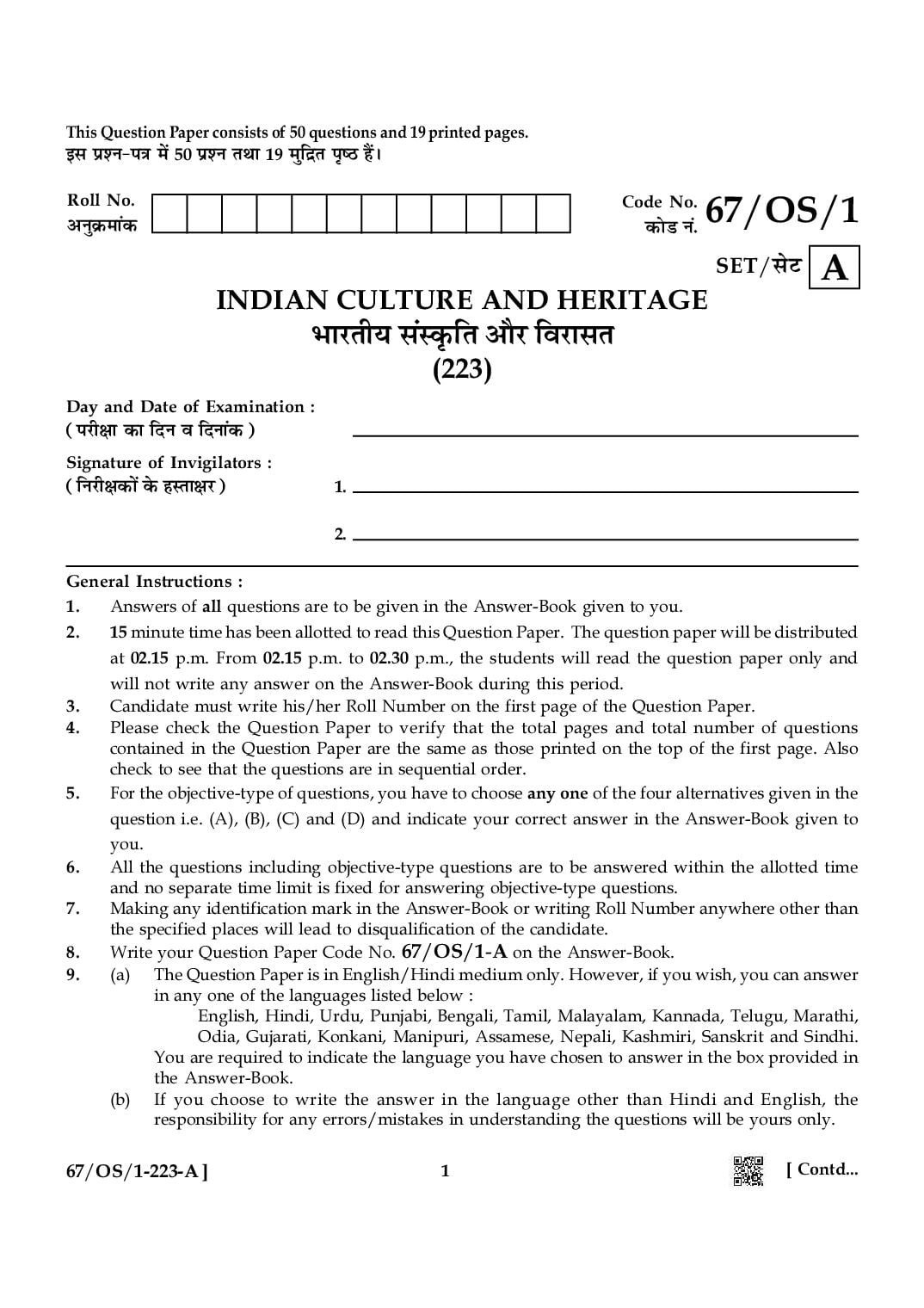
ß‚ ¬˝‡Ÿ-¬òÊ ◊¥ 50 ¬˝‡Ÿ ÃÕÊ 19 ◊ÈÁŒ˝Ã ¬Îc∆U „Ò¥–
Roll No. Code No.
•ŸÈ∑˝§◊Ê¥∑§ ∑§Ê«U Ÿ¥.
67/OS/1
SET/‚ ≈ A
INDIAN CULTURE AND HERITAGE
÷Ê⁄UÃËÿ ‚¥S∑ΧÁà •ÊÒ⁄U Áfl⁄UÊ‚Ã
(223)
Day and Date of Examination :
(¬⁄UˡÊÊ ∑§Ê ÁŒŸ fl ÁŒŸÊ¥∑§)
Signature of Invigilators :
(ÁŸ⁄UˡÊ∑§Ê¥ ∑§ „SÃÊˇÊ⁄U) 1.
2.
General Instructions :
1. Answers of all questions are to be given in the Answer-Book given to you.
2. 15 minute time has been allotted to read this Question Paper. The question paper will be distributed
at 02.15 p.m. From 02.15 p.m. to 02.30 p.m., the students will read the question paper only and
will not write any answer on the Answer-Book during this period.
3. Candidate must write his/her Roll Number on the first page of the Question Paper.
4. Please check the Question Paper to verify that the total pages and total number of questions
contained in the Question Paper are the same as those printed on the top of the first page. Also
check to see that the questions are in sequential order.
5. For the objective-type of questions, you have to choose any one of the four alternatives given in the
question i.e. (A), (B), (C) and (D) and indicate your correct answer in the Answer-Book given to
you.
6. All the questions including objective-type questions are to be answered within the allotted time
and no separate time limit is fixed for answering objective-type questions.
7. Making any identification mark in the Answer-Book or writing Roll Number anywhere other than
the specified places will lead to disqualification of the candidate.
8. Write your Question Paper Code No. 67/OS/1-A on the Answer-Book.
9. (a) The Question Paper is in English/Hindi medium only. However, if you wish, you can answer
in any one of the languages listed below :
English, Hindi, Urdu, Punjabi, Bengali, Tamil, Malayalam, Kannada, Telugu, Marathi,
Odia, Gujarati, Konkani, Manipuri, Assamese, Nepali, Kashmiri, Sanskrit and Sindhi.
You are required to indicate the language you have chosen to answer in the box provided in
the Answer-Book.
(b) If you choose to write the answer in the language other than Hindi and English, the
responsibility for any errors/mistakes in understanding the questions will be yours only.
67/OS/1-223-A ] 1 [ Contd...
Page 2
1. ‚÷Ë ¬˝‡ŸÊ¥ ∑§ ©ûÊ⁄U •Ê¬∑§Ê ŒË ªÿË ©ûÊ⁄U-¬ÈÁSÃ∑§Ê ◊¥ „Ë Á‹π¥–
2. ß‚ ¬˝‡Ÿ-¬òÊ ∑§Ê ¬…∏Ÿ ∑§ Á‹∞ 15 Á◊Ÿ≈U ∑§Ê ‚◊ÿ ÁŒÿÊ ªÿÊ „Ò– ¬˝‡Ÿ-¬òÊ ∑§Ê ÁflÃ⁄UáÊ ŒÊ¬„⁄U ◊¥ 02.15 ’¡ Á∑§ÿÊ ¡Ê∞ªÊ–
02.15 ’¡ ‚ 02.30 ’¡ Ã∑§ ¿UÊòÊ ∑§fl‹ ¬˝‡Ÿ-¬òÊ ∑§Ê ¬…∏¥ª •ÊÒ⁄U ß‚ •flÁœ ∑§ ŒÊÒ⁄UÊŸ fl ©ûÊ⁄U-¬ÈÁSÃ∑§Ê ¬⁄U ∑§Ê߸ ©ûÊ⁄U Ÿ„Ë¥
Á‹π¥ª–
3. ¬⁄UˡÊÊÕ˸ ¬˝‡Ÿ-¬òÊ ∑§ §¬„‹ ¬Îc∆U ¬⁄U •¬ŸÊ •ŸÈ∑˝§◊Ê¥∑§ •fl‡ÿU Á‹π¥–
4. ∑Χ¬ÿÊ ¬˝‡Ÿ-¬òÊ ∑§Ê ¡ÊÚ°ø ‹¥ Á∑§ ¬˝‡Ÿ-¬òÊ ∑§ ∑ȧ‹ ¬Îc∆UÊ¥ ÃÕÊ ¬˝‡ŸÊ¥ ∑§Ë ©ÃŸË „Ë ‚¥ÅUÿÊ „Ò Á¡ÃŸË ¬˝Õ◊ ¬Îc∆ ∑ §‚’‚ ™§¬⁄U
¿U¬Ë „Ò– ß‚ ’Êà ∑§Ë ¡ÊÚ°ø ÷Ë ∑§⁄U ‹¥ Á∑§ ¬˝‡Ÿ ∑˝ Á◊∑§ UM§¬ ◊¥ „Ò¥–
5. flSÃÈÁŸc∆U ¬˝‡ŸÊ¥ ◊¥ •Ê¬∑§Ê øÊ⁄U Áfl∑§À¬Ê¥ (A), (B), (C) ÃÕÊ (D) ◊¥ ‚ ∑§Ê߸ ∞∑§ ©ûÊ⁄U øÈŸŸÊ „Ò ÃÕÊ ŒË ªß¸ ©ûÊ⁄U-¬ÈÁSÃ∑§Ê ◊¥
•Ê¬ ‚„Ë ©ûÊ⁄U Á‹Áπ∞–
6. flSÃÈÁŸc∆U ¬˝‡ŸÊ¥ ∑§ ‚ÊÕ-‚ÊÕ ‚÷Ë ¬˝‡ŸÊ¥ ∑§ ©ûÊ⁄U ÁŸœÊ¸Á⁄Uà •flÁœ ∑§ ÷ËÃ⁄U „Ë ŒŸ „Ò¥– flSÃÈÁŸc∆U ¬˝‡ŸÊ¥ ∑§ Á‹∞ •‹ª ‚
‚◊ÿ Ÿ„Ë¥ ÁŒÿÊ ¡Ê∞ªÊ–
7. § ©ûÊ⁄U-¬ÈÁSUÃ∑§Ê ◊¥ ¬„øÊŸ-Áøq ’ŸÊŸ •ÕflÊ ÁŸÁŒ¸c≈U SÕÊŸÊ¥ ∑§§•ÁÃÁ⁄UÄà ∑§„Ë¥ ÷Ë •ŸÈ∑˝§◊Ê¥∑§ Á‹πŸ ¬⁄U ¬⁄UˡÊÊÕ˸ ∑§Ê •ÿÊÇÿ
∆U„⁄UÊÿÊ ¡ÊÿªÊ–
8. •¬ŸË ©ûÊ⁄U-¬ÈÁSUÃ∑§Ê ¬⁄U ¬˝‡Ÿ-¬òÊ ∑§Ê ∑§Ê«U Ÿ¥. 67/OS/1-A Á‹π¥–
9. (∑§) ¬˝‡Ÿ-¬òÊ ∑§fl‹ •¥ª˝¡Ë/Á„¥ŒË ◊¥ „Ò– Á»§⁄U ÷Ë, ÿÁŒ •Ê¬ øÊ„¥ ÃÊ ŸËø ŒË ªß¸ Á∑§‚Ë ∞∑§ ÷Ê·Ê ◊¥ ©ûÊ⁄ Œ ‚∑§Ã „Ò¥ —
•¥ª˝¡Ë, Á„¥ŒË, ©ŒÍ¸, ¬¥¡Ê’Ë, ’°ª‹Ê, ÃÁ◊‹, ◊‹ÿÊ‹◊, ∑§ãŸ«∏, ËȪÍ, ◊⁄UÊ∆UË, ©Á«∏ÿÊ, ªÈ¡⁄UÊÃË, ∑§Ê¥∑§áÊË,
◊ÁáʬÈ⁄UË, •‚Á◊ÿÊ, Ÿ¬Ê‹Ë, ∑§‡◊Ë⁄UË, ‚¥S∑Χç•ÊÒ⁄U Á‚¥œË–
∑Χ¬ÿÊ ©ûÊ⁄U-¬ÈÁSÃ∑§Ê ◊¥ ÁŒ∞ ª∞ ’ÊÚÄ‚ ◊¥ Á‹π¥ Á∑§ •Ê¬ Á∑§‚ ÷Ê·Ê ◊¥ ©ûÊ⁄U Á‹π ⁄U„ „Ò¥–
(π) ÿÁŒ •Ê¬ Á„¥ŒË ∞fl¥ •¥ª˝¡Ë ∑§ •ÁÃÁ⁄UÄà Á∑§‚Ë •ãÿ ÷Ê·Ê ◊¥ ©ûÊ⁄U Á‹πà „Ò¥, ÃÊ ¬˝‡ŸÊ¥ ∑§Ê ‚◊¤ÊŸ ◊¥ „ÊŸ flÊ‹Ë
òÊÈÁ≈UÿÊ¥/ª‹ÁÃÿÊ¥ ∑§Ë Á¡ê◊UŒÊ⁄Ë ∑ fl‹ •Ê¬∑§Ë „ʪ˖
67/OS/1-223-A ] 2 [ Contd...
Page 3
÷Ê⁄UÃËÿ ‚¥S∑ΧÁà •ÊÒ⁄U Áfl⁄UÊ‚Ã
(223)
Time : 3 Hours ] [ Maximum Marks : 100
‚◊ÿ — 3 ÉÊá≈U ] [ ¬ÍáÊÊZ∑§§ — 100
Note :
(i) This question paper consists of total 50 questions in all.
(ii) All questions are compulsory.
(iii) Marks are given against each question.
(iv) Section-A consists of :
(a) Q.No. 1 to 20 - Multiple Choice type questions (MCQs) carrying 1 mark each. Select and
write the most appropriate option out of the four options given in each of these questions.
An internal choice has been provided in some of these questions. You have to attempt
only one of the given choices in such questions.
(v) Section-B consists of :
(b) Q.No. 21 to 35 - Objective type questions. Q.No. 21 to 35 carry 2 marks each (with
2 sub - parts of 1 mark each). Attempt these questions as per the instructions given for each
of the questions.
(vi) Section-C consists of :
(c) Q.No. 36 to 40 - Very short questions carrying 2 marks each to be answered in about
25 words.
(vii) Section-D consists of :
(d) Q.No. 41 to 45 - Short Answer type questions carrying 3 marks each to be answered in the
range of 40 to 50 words.
(viii) Section-E consists of :
(e) Q.No. 46 to 50 - Long Answer type questions carrying 5 marks each to be answered in the
range of 150 to 200 words.
ÁŸŒ¸‡Ê —
(i) ß‚ ¬˝‡Ÿ-¬òÊ ◊¥ ∑ȧ‹ 50 ¬˝‡Ÿ „Ò¥–
(ii) ‚÷Ë ¬˝‡Ÿ •ÁŸflÊÿ¸ „Ò¥–
(iii) ¬˝àÿ∑§ ¬˝‡Ÿ ∑§ ‚Ê◊Ÿ ©‚∑§ •¥∑§ ÁŒ∞ ª∞ „Ò¥–
(iv) πá«U - ∑§ ◊¥ ‡ÊÊÁ◊‹ „Ò¥ —
(a) ¬˝‡Ÿ ‚¥ÅÿÊ 1 ‚ 20 Ã∑§ ’„ÈÁfl∑§À¬Ëÿ ¬˝∑§Ê⁄U ∑§ ¬˝‡Ÿ „Ò¥ •ÊÒ⁄U ¬˝àÿ∑§ 1 •¥∑§ ∑§Ê „Ò– ߟ◊¥ ‚ ¬˝àÿ∑§ ¬˝‡Ÿ ◊¥ ÁŒ∞ ª∞
øÊ⁄U Áfl∑§À¬Ê¥ ◊¥ ‚ ‚’‚ ©¬ÿÈÄà Áfl∑§À¬ ∑§Ê øÿŸ ∑§⁄U Á‹πŸÊ „Ò– ߟ◊¥ ‚ ∑ȧ¿U ¬˝‡ŸÊ¥ ◊¥ •Ê¥ÃÁ⁄U∑§ Áfl∑§À¬ ÁŒ∞ ª∞
„Ò¥, •Ê¬∑§Ê ∞‚ ¬˝‡ŸÊ¥ ◊¥ ÁŒ∞ ª∞ Áfl∑§À¬Ê¥ ◊¥ ‚ ∑§fl‹ ∞∑§ Áfl∑§À¬ ∑§Ê „Ë ©ûÊ⁄U Á‹πŸÊ „ʪʖ
(v) πá«U - π ◊¥ ‡ÊÊÁ◊‹ „Ò¥ —
(b) ¬˝‡Ÿ ‚¥ÅÿÊ 21 ‚ 35 Ã∑§ flSÃÈÁŸc∆U ¬˝∑§Ê⁄U ∑§ ¬˝‡Ÿ „Ò¥– ¬˝‡Ÿ ‚¥ÅÿÊ 21 ‚ 35 Ã∑§ ¬˝àÿ∑§ ¬˝‡Ÿ 2 •¥∑§ ∑§ „Ò¥
(¬˝àÿ∑§ 1 •¥∑§ ∑§ 2 ©¬-÷ʪʥ ∑§ ‚ÊÕ)– ¬˝àÿ∑§ ¬˝‡Ÿ ∑§ Á‹∞ ÁŒ∞ ª∞ ÁŸŒ¸‡ÊÊ¥ ∑§ •ŸÈ‚Ê⁄U ߟ ¬˝‡ŸÊ¥ ∑§ ©ûÊ⁄U Á‹π¥–
(vi) πá«U - ª§ ◊¥ ‡ÊÊÁ◊‹ „Ò¥ —
(c) ¬˝‡Ÿ ‚¥ÅÿÊ 36 ‚ 40 Ã∑§ •Áà ‹ÉÊÈ-©ûÊ⁄UËÿ ¬˝∑§Ê⁄U ∑§ ŒÊ-ŒÊ •¥∑§Ê¥ ∑§ ¬˝‡Ÿ „Ò¥– ߟ ¬˝‡ŸÊ¥ ∑§ ©ûÊ⁄U 25 ‡ÊéŒÊ¥ ◊¥ ÁŒ∞
¡ÊŸ øÊÁ„∞–
(vii) πá«U - Éʧ ◊¥ ‡ÊÊÁ◊‹ „Ò¥ —
(d) ¬˝‡Ÿ ‚¥ÅÿÊ 41 ‚ 45 ‹ÉÊÈ-©ûÊ⁄UËÿ ¬˝∑§Ê⁄U ∑§ ÃËŸ-ÃËŸ •¥∑§Ê¥ ∑§ ¬˝‡Ÿ „Ò¥– ߟ ¬˝‡ŸÊ¥ ∑§ ©ûÊ⁄U 40 ‚ 50 ‡ÊéŒÊ¥ ◊¥ ÁŒ∞
¡ÊŸ øÊÁ„∞–
(viii) πá«U - 槧 ◊¥ ‡ÊÊÁ◊‹ „Ò¥ —
(e) ¬˝‡Ÿ ‚¥ÅÿÊ 46 ‚ 50 ŒËÉʸ-©ûÊ⁄UËÿ ¬˝∑§Ê⁄U ∑§ ¬Ê°ø-¬Ê°ø •¥∑§Ê¥ ∑§§ ¬˝‡Ÿ „Ò¥– ߟ ¬˝‡ŸÊ¥ ∑§ ©ûÊ⁄U 150 ‚ 200 ‡ÊéŒÊ¥
◊¥ ÁŒ∞ ¡ÊŸ øÊÁ„∞–
67/OS/1-223-A ] 3 [ Contd...
Page 4
Question number 1 to 20 are multiple choice questions carrying 20 marks. 20x1=20
¬˝‡Ÿ ‚¥ÅÿÊ 1 ‚ 20 Ã∑§ ’„ÈÁfl∑§À¬Ëÿ ¬˝∑§Ê⁄U ∑§ ¬˝‡Ÿ „Ò¥ ‚÷Ë ∑§ Á‹∞ 20 •¥∑§ „Ò–
1. Answer any one of the questions given below : 1
ŸËø ÁŒ∞ ª∞ ¬˝‡ŸÊ¥ ◊¥ ‚ Á∑§‚Ë ∞∑§ ∑§Ê ©ûÊ⁄U ŒËÁ¡ÿ–
(i) The first railway line from Bombay to Thane was started in the year :
(A) 1852 (B) 1859 (C) 1855 (D) 1853
’ÊÚê’ ‚ ∆UÊáÊ Ã∑§ ¬„‹Ë ⁄UÀfl ‹Êߟ Á∑§‚ fl·¸ ‡ÊÈM§ ∑§Ë ªß¸ ÕË?
(A) 1852 (B) 1859 (C) 1855 (D) 1853
(ii) Identify the Bhakti saint with the help of the following information.
• A saint from Bengal
• Devotee of Lord Krishna
• Used to go into a trance singing devotional songs in praise of Lord Krishna
(A) Mirabai (B) Chaitanya
(C) Namdev (D) Ramanujan
ŸËø ŒË ªÿË ¡ÊŸ∑§Ê⁄UË ∑§Ë ‚„ÊÿÃÊ ‚ ÁŸêŸÁ‹Áπà ◊¥ ‚ ÷ÁÄà ‚¥Ã ∑§Ë ¬„øÊŸ ∑§ËÁ¡ÿ–
• ’¥ªÊ‹ ∑§ ∞∑§ ‚¥Ã
• ÷ªflÊŸ ∑ΧcáÊ ∑§ ÷ÄÃ
• ÷ªflÊŸ ∑ΧcáÊ ∑§Ë SÃÈÁà ◊¥ ÷ÁÄà ªËà ªÊà „È∞ ‚◊ÊÁœ ◊¥ ø‹ ¡Êà Ֆ
(A) ◊Ë⁄UÊ’Ê߸ (B) øÒÃãÿ
(C) ŸÊ◊Œfl (D) ⁄UÊ◊ÊŸÈ¡Ÿ
2. Answer any one of the questions given below : 1
ŸËø ÁŒ∞ ª∞ ¬˝‡ŸÊ¥ ◊¥ ‚ Á∑§‚Ë ∞∑§ ∑§Ê ©ûÊ⁄U ŒËÁ¡ÿ–
(i) Neeldarpan, the play was written by :
(A) Bankim Chandra (B) Dinabandhu Mitra
(C) Bhartendu Harish Chandra (D) Altaf Hussain
ŸË‹Œ¬¸áÊ, ŸÊ≈U∑§ Á∑§‚∑§ mÊ⁄UÊ Á‹πÊ ªÿÊ ÕÊ?
(A) ’¥Á∑§◊ ø¥Œ˝ (B) ŒËŸ’¥œÈ Á◊òÊÊ
(C) ÷Ê⁄UÃ¥ŒÈ „Á⁄U‡ø¥Œ˝ (D) •ÀÃÊ»§ „È‚ÒŸ
67/OS/1-223-A ] 4 [ Contd...
Page 5
(A) Raidas (B) Swami Ramananda
(C) Gobinda (D) Mirabai
∑§’Ë⁄U, __________ ∑§ Á‡Êcÿ Õ–
(A) ⁄ÒUŒÊ‚ (B) SflÊ◊Ë ⁄UÊ◊ÊŸ¥Œ
(C) ªÊÁ’¥ŒÊ (D) ◊Ë⁄UÊ’Ê߸
3. Answer any one of the questions given below : 1
ŸËø ÁŒ∞ ª∞ ¬˝‡ŸÊ¥ ◊¥ ‚ Á∑§‚Ë ∞∑§ ∑§Ê ©ûÊ⁄U ŒËÁ¡ÿ–
(i) The Prarthana Samaj was established in Bombay by :
(A) Swami Vivekananda (B) H.P. Blavatsky
(C) Dr. Atma Ram Pandurang (D) Jyotiba Phule
¬˝ÊÕ¸ŸÊ ‚◊Ê¡ ∑§Ë SÕʬŸÊ ’ÊÚê’ ◊¥ __________ ∑§ mÊ⁄UÊ ∑§Ë ªß¸ ÕË–
(A) SflÊ◊Ë Áflfl∑§ÊŸãŒ (B) ∞ø.¬Ë. é‹ÊflÊàS∑§Ë
(C) «UÊÚ. •Êà◊Ê⁄UÊ◊ ¬Ê¥«ÈU⁄¥Uª (D) íÿÊÁÃ’Ê »È§‹
(ii) A Muslim poet who was a devotee of Lord Krishna :
(A) Sir Syed Ahmad Khan (B) Syed Ameer Ali
(C) Raskhan (D) Abdus Samad
∞∑§ ◊ÈÁS‹◊ ∑§Áfl ¡Ê ÷ªflÊŸ ∑ΧcáÊ ∑§ ÷ÄÃ Õ —
(A) ‚⁄U ‚ÒÿŒ •„◊Œ πÊŸ (B) ‚ÒÿŒ •◊Ë⁄U •‹Ë
(C) ⁄U‚πÊŸ (D) •éŒÈ‚ ‚◊Œ
4. Answer any one of the questions given below : 1
ŸËø ÁŒ∞ ª∞ ¬˝‡ŸÊ¥ ◊¥ ‚ Á∑§‚Ë ∞∑§ ∑§Ê ©ûÊ⁄U ŒËÁ¡ÿ —
(i) Identify the Bhakti saint with the help of the following information.
He is from Bengal. He was a devotee of Lord Krishna. He condemned the caste system
and emphasised on the equality of all.
(A) Chaitanya Mahaprabhu (B) Mirabai
(C) Ramanuja (D) Namadeva
ŸËø ŒË ªÿË ¡ÊŸ∑§Ê⁄UË ∑§Ë ‚„ÊÿÃÊ ‚ ÷ÁÄà ‚¥Ã ∑§Ë ¬„øÊŸ ∑§ËÁ¡ÿ–
fl„ ’¥ªÊ‹ ‚ „Ò– fl„ ÷ªflÊŸ ∑ΧcáÊ ∑§ ÷Äà Ֆ ©ã„Ê¥Ÿ ¡ÊÁà ∑§Ë ‚◊ÊŸÃÊ ¬⁄U ¡Ê⁄U ÁŒÿÊ–
(A) øÒÃãÿ ◊„ʬ˝÷È (B) ◊Ë⁄UÊ’Ê߸
(C) ⁄UÊ◊ÊŸÈ¡ (D) ŸÊ◊Œfl
67/OS/1-223-A ] 5 [ Contd...
Page 6
the French & the British from the following options.
(A) Tipu Sultan (B) Bahadur Shah Zafar
(C) Ahmad Shah Abdali (D) Nadir Shah
◊Ò‚Í⁄U ◊¥ ÷Ê⁄UÃËÿ ‡ÊÊ‚∑§, Á¡‚Ÿ »˝§Ê¥‚ËÁ‚ÿÊ¥ •ÊÒ⁄U •¥ª˝¡Ê¥ ∑§ ’Ëø ¬˝ÁÃm¥Œ˜ÁflÃÊ ∑§Ê »§ÊÿŒÊ ©∆UÊŸ ∑§Ë ∑§ÊÁ‡Ê‡Ê ∑§Ë
ÕË —
(A) ≈UË¬Í ‚ÈÀÃÊŸ (B) ’„ÊŒÈ⁄U ‡ÊÊ„ ¡»§⁄U
(C) •„◊Œ ‡ÊÊ„ •éŒÊ‹Ë (D) ŸÊÁŒ⁄U ‡ÊÊ„
5. Answer any one of the questions given below : 1
ŸËø ÁŒ∞ ª∞ ¬˝‡ŸÊ¥ ◊¥ ‚ Á∑§‚Ë ∞∑§ ∑§Ê ©ûÊ⁄U ŒËÁ¡ÿ —
(i) Identify the book from the clues given below :
• It is an account of exploits of Prithviraj Chauhan.
• In its imitation several other rasos were written.
• It is supposed to be the first book in the Hindi Language.
(A) Prithviraj Raso (B) Natyashastra
(C) Geetanjali (D) Nirala
ŸËø ŒË ªÿË ¡ÊŸ∑§Ê⁄UË ∑§Ë ‚„ÊÿÃÊ ‚ ¬ÈSÃ∑§ ∑§Ë ¬„øÊŸ ∑§ËÁ¡ÿ–
• ÿ„ ¬ÎâflË⁄UÊ¡ øÊÒ„ÊŸ ∑§ ∑§Ê⁄UŸÊ◊Ê¥ ∑§Ê ‹πÊ-¡ÊπÊ „Ò–
• ß‚∑§ •ŸÈ∑§⁄UáÊ ◊¥ •ãÿ ∑§ß¸ ⁄UÊ‚ Á‹π ªÿ–
• ÿ„ Á„¥ŒË ÷Ê·Ê ∑§Ë ¬„‹Ë ¬ÈSÃ∑§ ◊ÊŸË ¡ÊÃË „Ò–
(A) ¬ÎâflË⁄UÊ¡ ⁄UÊ‚Ê (B) ŸÊ≈K‡ÊÊSòÊ
(C) ªËÃÊ¥¡Á‹ (D) ÁŸ⁄UÊ‹Ê
(ii) Mahadevi Verma is a recipient of :
(A) Padma Vibhushan (B) Padma Shree
(C) Padma Bhushan (D) Bharat Ratna
◊„ÊŒflË fl◊ʸ ∑§Ê ÁŸêŸÁ‹Áπà ◊¥ ‚ ∑§ÊÒŸ ‚Ê ¬È⁄US∑§Ê⁄U Á◊‹Ê „Ò¥?
(A) ¬k Áfl÷Í·áÊ (B) ¬kÊ üÊË
(C) ¬k ÷Í·áÊ (D) ÷Ê⁄Uà ⁄UàŸ
67/OS/1-223-A ] 6 [ Contd...
Page 7
ŸËø ÁŒ∞ ª∞ ¬˝‡ŸÊ¥ ◊¥ ‚ Á∑§‚Ë ∞∑§ ∑§Ê ©ûÊ⁄U ŒËÁ¡ÿ —
(i) Identify the type of painting from the clues given below :
• Small work is done on perishable materials.
• Buddhist, Jain and Hindu manuscripts were illustrated, on palm leaves.
• Merchants used to donate them in the temples and monasteries.
(A) Phad Painting (B) Miniature Painting
(C) Pata Painting (D) Kalighat Painting
ŸËø ÁŒ∞ ª∞ ‚¥∑§ÃÊ¥ ‚ ÷Ê⁄UÃËÿ ‹Ê∑§ ÁøòÊ∑§‹Ê ∑§Ë ¬„øÊŸ ∑§ËÁ¡ÿ–
• ¡ÀŒË π⁄UÊ’ „ÊŸ flÊ‹Ë ‚Ê◊Áª˝ÿÊ¥ ¬⁄U ¿UÊ≈UÊ-◊Ê≈UÊ ∑§Ê◊ Á∑§ÿÊ ¡ÊÃÊ „Ò–
• ÃÊ«∏ ∑§ ¬àÃÊ¥ ¬⁄U ’ÊÒh, ¡ÒŸ •ÊÒ⁄U Á„¥ŒÍ ¬Ê¥«ÈUÁ‹Á¬ÿÊ¥ ∑§Ê ÁøòÊáÊ Á∑§ÿÊ ªÿÊ ÕÊ–
• √ÿʬÊ⁄UË ßã„¥ ◊¥ÁŒ⁄UÊ¥ •ÊÒ⁄U ◊∆UÊ¥ ◊¥ ŒÊŸ ŒÃ Õ–
(A) »§«∏ ÁøòÊ∑§Ê⁄UË (B) ‹ÉÊÈ ÁøòÊ∑§Ê⁄UË
(C) ¬Ê≈UÊ ¬¥Á≈¥Uª (D) ∑§Ê‹ËÉÊÊ≈U ¬¥Á≈¥Uª
(ii) __________ furniture is an example of unique traditional decorative arts and craft
which constitute the heritage of modern India.
(A) Sandal Wood (B) Walnut Wood
(C) Teak Wood (D) Oak Wood
__________ »§ŸË¸ø⁄U •ÁmÃËÿ ¬Ê⁄¥U¬Á⁄U∑§ ‚¡Êfl≈UË ∑§‹Ê •ÊÒ⁄U Á‡ÊÀ¬ ∑§Ê ∞∑§ ©ŒÊ„⁄UáÊ „Ò ¡Ê •ÊœÈÁŸ∑§ ÷Ê⁄UÃ
∑§Ë Áfl⁄UÊ‚Ã ∑§Ê ª∆UŸ ∑§⁄UÃÊ „Ò–
(A) ø¥ŒŸ ∑§Ë ‹∑§«∏Ë (B) •π⁄UÊ≈U ∑§Ë ‹∑§«∏Ë
(C) ‚ʪÊÒŸ ∑§Ë ‹∑§«∏Ë (D) •Ê∑§ ∑§Ë ‹∑§«∏Ë
7. Answer any one of the questions given below : 1
ŸËø ÁŒ∞ ª∞ ¬˝‡ŸÊ¥ ◊¥ ‚ Á∑§‚Ë ∞∑§ ∑§Ê ©ûÊ⁄U ŒËÁ¡ÿ —
(i) ‘Mithila painting’ also known as :
(A) Decorative Painting (B) Madhubani Folk Art
(C) Batik Print (D) Warli Painting
Á◊ÁÕ‹Ê ¬¥Á≈¥Uª ∑§Ê ß‚ ŸÊ◊ ‚ ÷Ë ¡ÊŸÊ ¡ÊÃÊ „Ò —
(A) ‚¡Êfl≈UË ¬¥Á≈¥Uª (B) ◊œÈ’ŸË ‹Ê∑§ ∑§‹Ê
(C) ’ÊÁ≈U∑§ Á¬˝¥≈U (D) fl‹Ë¸ ¬¥Á≈¥Uª
(ii) ‘Kitab-e-Navras’ was written by :
(A) Allaudin Adil Shah - II (B) Muhammed Adil Shah - II
(C) Ibrahim Adil Shah - II (D) Firoz Adil Shah - II
“Á∑§ÃÊ’-ÿ-Ÿfl⁄U‚” Á∑§‚∑§ mÊ⁄UÊ Á‹πÊ ªÿÊ ÕÊ?
(A) •‹Ê©gËŸ •ÊÁŒ‹ ‡ÊÊ„ ÁmÃËÿ (B) ◊È„ê◊Œ •ÊÁŒ‹ ‡ÊÊ„ ÁmÃËÿ
(C) ß’˝ÊÁ„◊ •ÊÁŒ‹ ‡ÊÊ„ ÁmÃËÿ (D) Á»§⁄UÊ¡ •ÊÁŒ‹ ‡ÊÊ„ ÁmÃËÿ
67/OS/1-223-A ] 7 [ Contd...
Page 8
ŸËø ÁŒ∞ ª∞ ¬˝‡ŸÊ¥ ◊¥ ‚ Á∑§‚Ë ∞∑§ ∑§Ê ©ûÊ⁄U ŒËÁ¡ÿ —
(i) Which one of the following is not a feature of Warli Painting ?
(A) Decorative painting on floor.
(B) From tribal regions of Maharashtra.
(C) Trees, birds, men and women collaborate to create a composite whole in a
Warli painting.
(D) Employ religious iconography.
ÁŸêŸÁ‹Áπà ◊¥ ‚ ∑§ÊÒŸ ‚Ë fl‹Ë¸ ÁøòÊ∑§‹Ê ∑§Ë Áfl‡Ê·ÃÊ Ÿ„Ë¥ „Ò?
(A) »§‡Ê¸ ¬⁄ U‚¡Êfl≈UË ¬¥Á≈¥Uª
(B) ◊„Ê⁄UÊc≈˛U ∑§ •ÊÁŒflÊ‚Ë ˇÊòÊÊ¥ ‚
(C) ¬«∏, ¬ˇÊË, ¬ÈL§· •ÊÒ⁄U ◊Á„‹Ê•Ê¥ ◊¥ ‚◊ª˝ÃÊ
(D) œÊÁ◊¸∑§ ¬˝ÁÃ◊Ê ÁflôÊÊŸ ∑§Ê ÁŸÿÊ¡Ÿ
(ii) ‘Gulraj folklore’ is associated with which State ?
(A) Madhya Pradesh (B) Rajasthan
(C) Kashmir (D) Bengal
“ªÈ‹⁄UÊ¡ ‹Ê∑§∑§ÕÊ” Á∑§‚ ⁄UÊíÿ ‚ ‚¥’¥ÁœÃ „Ò?
(A) ◊äÿ ¬˝Œ‡Ê (B) ⁄UÊ¡SÕÊŸ
(C) ∑§‡◊Ë⁄U (D) ’¥ªÊ‹
9. Answer any one of the questions given below : 1
ŸËø ÁŒ∞ ª∞ ¬˝‡ŸÊ¥ ◊¥ ‚ Á∑§‚Ë ∞∑§ ∑§Ê ©ûÊ⁄U ŒËÁ¡ÿ —
(i) Which one of the following is not a decorative art form ?
(A) Rangoli (B) Alpana
(C) Kollam (D) Ajanta
ÁŸêŸÁ‹Áπà ◊¥ ‚ ∑§ÊÒŸ ‚Ê ‚¡Êfl≈UË ∑§‹Ê ∑§Ê M§¬ Ÿ„Ë¥ „Ò?
(A) ⁄¥UªÊ‹Ë (B) •À¬ŸÊ
(C) ∑§ÊÀ‹◊ (D) •¡¥ÃÊ
(ii) Who amongst the following is an author of ‘Swapna Vasabdatta’ ?
(A) Bhasa (B) Vidyapati
(C) Bharata (D) Lebedev
“SflåŸ fl‚Ê’ŒàÃÊ” Á∑§‚ ‹π∑§ ∑§Ê ©à∑Χc≈U ŸÊ≈U∑§ „Ò?
(A) ÷Ê‚Ê (B) ÁfllʬÁÃ
(C) ÷⁄UÃ (D) ‹’«Ufl
67/OS/1-223-A ] 8 [ Contd...
Page 9
ŸËø ÁŒ∞ ª∞ ¬˝‡ŸÊ¥ ◊¥ ‚ Á∑§‚Ë ∞∑§ ∑§Ê ©ûÊ⁄U ŒËÁ¡ÿ —
(i) Which one of the following instruments is not used as props in folk theatre ?
(A) Dhol (B) Manjira (C) Khanjira (D) Sitar
ÁŸêŸÁ‹Áπà flÊl ÿ¥òÊÊ¥ ◊¥ ‚ Á∑§‚∑§Ê ©¬ÿʪ ‹Ê∑§ ⁄¥ª◊¥ø ◊¥ ‚Ê◊ª˝Ë ∑§ M§¬ ◊¥ Ÿ„Ë¥ Á∑§ÿÊ ¡ÊÃÊ „Ò?
(A) …UÊ‹ (B) ◊¥¡Ë⁄UÊ (C) π¥¡Ë⁄UÊ (D) Á‚ÃÊ⁄U
(ii) Identify the type of painting from the following hints :
• These are done on walls and rock surfaces like roofs and sides.
• They depict religious scenes from the life of the Buddha and the Buddhist Jataka
stories.
(A) Kalamkari painting (B) Mural painting
(C) Warli painting (D) Mithila painting
ÁŸêŸÁ‹Áπà ‚¥∑§ÃÊ¥ ‚ ÁøòÊ ∑§‹Ê M§¬ ∑§Ë ¬„øÊŸ ∑§ËÁ¡ÿ–
• ÿ ∑§‹Ê ŒËflÊ⁄UÊ¥ •ÊÒ⁄U ¿UÃÊ¥ •ÊÒ⁄U Á∑§ŸÊ⁄UÊ¥ ¡Ò‚Ë ø^ÊŸË ‚Äʥ ¬⁄U Á∑§∞ ¡Êà „Ò¥–
• ÿ ∑§‹Ê ’Èh ∑§ ¡ËflŸ •ÊÒ⁄U ’ÊÒh ¡ÊÃ∑§ ∑§„ÊÁŸÿÊ¥ ∑§ œÊÁ◊¸∑§ ŒÎ‡ÿÊ¥ ∑§Ê ÁøÁòÊà ∑§⁄Uà „Ò¥–
(A) ∑§‹◊∑§Ê⁄UË ¬¥Á≈¥Uª (B) Á÷ÁàÃÁøòÊ
(C) fl‹Ë¸ ¬¥Á≈¥Uª (D) Á◊ÁÕ‹Ê ¬¥Á≈¥Uª
11. Answer any one of the questions given below : 1
ŸËø ÁŒ∞ ª∞ ¬˝‡ŸÊ¥ ◊¥ ‚ Á∑§‚Ë ∞∑§ ∑§Ê ©ûÊ⁄U ŒËÁ¡ÿ —
(i) Which one of the following is the work of G.S. Carr ?
(A) Synopsis of elementary results in Pure Mathematics
(B) Theory of Stringed Instruments
(C) Electromagnetic Radiation and Polarization of Electric Ray
(D) Theory of Prithvi and Electric Ray
ÁŸêŸÁ‹Áπà ◊¥ ‚ ¡Ë.∞‚. ∑Ò§⁄U mÊ⁄UÊ Á‹Áπà ¬ÈSÃ∑§ ∑§ÊÒŸ ‚Ë „Ò?
(A) ‡ÊÈh ªÁáÊà ◊¥ ¬˝Ê⁄¥UÁ÷∑§ ¬Á⁄UáÊÊ◊Ê¥ ∑§Ê ‚Ê⁄UÊ¥‡Ê
(B) ÃÊ⁄UflÊ‹ flÊl ÿ¥òÊÊ¥ ∑§Ê Á‚hÊ¥Ã
(C) ÁfllÈà øÈê’∑§Ëÿ ÁflÁ∑§⁄UáÊ •ÊÒ⁄U ÁfllÈà Á∑§⁄UáÊ ∑§Ê œ˝ÈflË∑§⁄UáÊ
(D) ¬ÎâflË •ÊÒ⁄U ÁfllÈà Á∑§⁄UáÊ ∑§Ê Á‚hÊ¥Ã
67/OS/1-223-A ] 9 [ Contd...
Page 10
(A) Ganesa Daivajna (B) Tantrasamgraha
(C) Bijaganita Vatamsa (D) Tajik
ÁŸ‹Ê∑§Ê ‚Ê◊‚ÈÃflŸ Ÿ __________ ∑§Ê ÁŸ◊ʸáÊ Á∑§ÿÊ– ß‚◊¥ ÁòÊ∑§ÊáÊÁ◊Áà ∑§ÊÿÊZ ∑§ ÁŸÿ◊ „Ò¥–
(A) ªáÊ‡Ê ŒÒflôÊ (B) Ã¥òÊ‚¥ª˝„
(C) ’Ë¡ªÁáÊà flÊÃ◊˜‚Ê (D) ÃÊÁ¡∑§
12. Who amongst the following was the first head of Defence Research and Development 1
Organisation (DRDO) ?
(A) Dr. Vikram Sarabhai (B) Dr. Homi Jehangir Bhabha
(C) Dr. Jagadish Chandra Bose (D) Dr. A.P.J. Abdul Kalam
⁄UˇÊÊ •ŸÈ‚¥œÊŸ ∞fl¥ Áfl∑§Ê‚ ‚¥ª∆UŸ (DRDO) ∑§ ¬„‹ ¬˝◊Èπ ∑§ÊÒŸ Õ?
(A) «UÊÚ. Áfl∑˝§◊ ‚Ê⁄UÊ÷Ê߸ (B) «UÊÚ. „Ê◊Ë ¡„Ê¥ªË⁄U ÷Ê÷Ê
(C) «UÊÚ. ¡ªŒË‡Ê ø¥Œ˝ ’Ê‚ (D) «UÊÚ. ∞.¬Ë.¡. •éŒÈ‹ ∑§‹Ê◊
13. Maharaja Sawai Man Singh-II of Jaipur was a patron of astronomy. He had setup astronomical 1
observatories at __________.
(A) Delhi (B) Ujjain (C) Jaipur (D) Patna
¡ÿ¬È⁄U ∑§ ◊„Ê⁄UÊ¡Ê ‚flÊ߸ ◊ÊŸ Á‚¥„ ÁmÃËÿ πªÊ‹ ÁflôÊÊŸ ∑§ ‚¥⁄UˇÊ∑§ Õ– ©ã„Ê¥Ÿ __________ ◊¥ πªÊ‹Ëÿ
flœ‡ÊÊ‹Ê∞° SÕÊÁ¬Ã ∑§Ë–
(A) ÁŒÀ‹Ë (B) ©í¡ÒŸ (C) ¡ÿ¬È⁄U (D) ¬≈UŸÊ
14. Identify the centre of paper production during medieval period : 1
(A) Murshidabad (B) Delhi (C) Mathura (D) Varanasi
◊äÿ∑§Ê‹ ∑§ ŒÊÒ⁄UÊŸ ∑§Êª¡ ©à¬ÊŒŸ ∑§ ∑¥§Œ˝ ∑§Ë ¬„øÊŸ ∑§ËÁ¡ÿ —
(A) ◊ÈÁ‡Ê¸ŒÊ’ÊŒ (B) ÁŒÀ‹Ë (C) ◊ÕÈ⁄UÊ (D) flÊ⁄UÊáÊ‚Ë
15. BARC stands for : 1
(A) Bhabha Acidic Research Centre
(B) Bhabha Atomic Research Centre
(C) Bhabha Alkaline Research Centre
(D) Bhabha Apsara Research Centre
BARC ∑§Ê ◊Ë’ „Ò —
(A) ÷Ê÷Ê •ê‹Ëÿ •ŸÈ‚¥œÊŸ ∑¥§Œ˝
(B) ÷Ê÷Ê ¬⁄U◊ÊáÊÈ •ŸÈ‚¥œÊŸ ∑¥§Œ˝
(C) ÷Ê÷Ê ˇÊÊ⁄UËÿ •ŸÈ‚¥œÊŸ ∑¥§Œ˝
(D) ÷Ê÷Ê •å‚⁄UÊ •ŸÈ‚¥œÊŸ ∑¥§Œ˝
67/OS/1-223-A ] 10 [ Contd...
Page 11
(A) April 2010 (B) April 2011 (C) April 2012 (D) April 2013
__________◊¥ ’ìÊÊ¥ ∑§Ê ÁŸ—‡ÊÈÀ∑§ ∞fl¥ •ÁŸflÊÿ¸ Á‡ÊˇÊÊ ∑§Ê •Áœ∑§Ê⁄U •ÁœÁŸÿ◊ ¬ÊÁ⁄Uà Á∑§ÿÊ ªÿÊ–
(A) •¬˝Ò‹ 2010 (B) •¬˝Ò‹ 2011 (C) •¬˝Ò‹ 2012 (D) •¬˝Ò‹ 2013
17. The ‘Charak Samhita’ was the important work in the field of : 1
(A) Astronomy (B) Metallurgy (C) Medicine (D) Philosophy
“ø⁄U∑§ ‚¥Á„ÃÊ” Á∑§‚ ˇÊòÊ ◊¥ ◊„àfl¬Íáʸ ∑§Êÿ¸ ÕÊ?
(A) πªÊ‹ÁflôÊÊŸ (B) œÊÃÈ∑§◊¸ (C) ÁøÁ∑§à‚Ê (D) Œ‡Ê¸Ÿ
18. Identify the famous political leader from the following who said these lines “If all is well with 1
universities, all would be well with the Nation” ?
(A) Dr. S. Radhakrishnan (B) Jawaharlal Nehru
(C) Sardar Vallabh Bhai Patel (D) Atal Bihari Vajpayee
ÁŸêŸÁ‹Áπà ◊¥ ‚ ©‚ ¬˝Á‚h ⁄UÊ¡ŸËÁÃ∑§ ŸÃÊ ∑§Ë ¬„øÊŸ ∑§ËÁ¡ÿ Á¡‚Ÿ ∑§„Ê ÕÊ Á∑§ ““ÿÁŒ Áfl‡flÁfllÊ‹ÿÊ¥ ∑§ ‚ÊÕ
‚’ ∆UË∑§ „Ò, ÃÊ ⁄UÊc≈˛U ∑§ ‚ÊÕ ÷Ë ‚’ ∆UË∑§ „ʪʔ”?
(A) «UÊÚ. ∞‚. ⁄UÊœÊ∑ΧcáÊŸ (B) ¡flÊ„⁄U‹Ê‹ Ÿ„M§
(C) ‚⁄UŒÊ⁄U flÀ‹÷÷Ê߸ ¬≈U‹ (D) •≈U‹ Á’„Ê⁄UË flÊ¡¬ÿË
19. During the Vedic period, education was imparted in the : 1
(A) Vidyalayas (B) Monastries (C) Ashramas (D) Madarasas
ÁŸêŸÁ‹Áπà ◊¥ ‚ Á∑§‚ SÕÊŸ ¬⁄U flÒÁŒ∑§ ∑§Ê‹ ◊¥ Á‡ÊˇÊÊ ¬˝ŒÊŸ ∑§Ë ¡ÊÃË ÕË?
(A) ÁfllÊ‹ÿ (B) ◊∆U (C) •ÊüÊ◊ (D) ◊Œ⁄U‚
20. Manu noted __________ caste whereas on latter text counted hundred of mixed castes. 1
(A) 51 (B) 61 (C) 71 (D) 81
◊ŸÈ Ÿ __________ ¡ÊÁà ∑§Ê ©À‹π Á∑§ÿÊ „Ò ¡’ Á∑§ ’ÊŒ flÊ‹ ¬ÈSÃ∑§Ê¥ ◊¥ ‚Ò∑§«∏Ê¥ Á◊ÁüÊà ¡ÊÁÃÿÊ¥ ∑§Ë ªáÊŸÊ ∑§Ë
ªÿË–
(A) 51 (B) 61 (C) 71 (D) 81
67/OS/1-223-A ] 11 [ Contd...
Page 12
Question numbers 21 to 35 are objective type questions with two sub-questions of one mark
each. 15x2=30
¬˝‡Ÿ ‚¥ÅÿÊ 21 ‚ 35 flSÃÈÁŸc∆U ¬˝∑§Ê⁄U ∑§ ¬˝‡Ÿ „Ò¥ Á¡Ÿ◊¥ ∞∑§-∞∑§ •¥∑§ ∑§ ŒÊ ©¬-¬˝‡Ÿ „Ò¥–
21. Read the following sentences and tick the correct answer. 2
(a) Different knowledge embodied in culture cannot be passed from one generation to
another generation. (True/False)
(b) Culture we inherit from our predecessors is called our cultural heritage.
(True/False)
ÁŸêŸÁ‹Áπà flÊÄÿÊ¥ ∑§Ê ¬Á…∏∞ •ÊÒ⁄U ‚„Ë ©àÃ⁄U ∑§Ë ¬„øÊŸ ∑§ËÁ¡ÿ–
(a) ‚¥S∑ΧÁà ◊¥ ‚ÁãŸÁ„à ÁflÁ÷㟠ôÊÊŸ ∑§Ê ∞∑§ ¬Ë…∏Ë ‚ ŒÍ‚⁄UË ¬Ë…∏Ë Ã∑§ ¬ÊÁ⁄Uà Ÿ„Ë¥ Á∑§ÿÊ ¡Ê ‚∑§ÃÊ „Ò–
(‚„Ë/ª‹Ã)
(b) ¡Ê ‚¥S∑ΧÁà „◊¥ •¬Ÿ ¬Ífl¸flÁøÿÊ¥ ‚ Áfl⁄UÊ‚Ã ◊¥ Á◊‹ÃË „Ò, fl„ „◊Ê⁄UË ‚Ê¥S∑ΧÁÃ∑§ Áfl⁄UÊ‚Ã ∑§„‹ÊÃË „Ò–
(‚„Ë/ª‹Ã)
22. Read the following sentences and tick the correct answer. 2
(a) B.R. Ambedkar and Mahatma Gandhi were champions of the backward classes.
(True/False)
(b) In 1930, the Sharda Act was passed fixing the minimum age for marriage for boys at
20 and girls at 16. (True/False)
ÁŸêŸÁ‹Áπà flÊÄÿÊ¥ ∑§Ê ¬Á…∏∞ •ÊÒ⁄U ‚„Ë ©àÃ⁄U ∑§Ë ¬„øÊŸ ∑§ËÁ¡ÿ–
(a) ’Ë.•Ê⁄U. •¥’«U∑§⁄U •ÊÒ⁄U ◊„Êà◊Ê ªÊ¥œË Á¬¿U«∏ flªÊZ ∑§ ‚◊Õ¸∑§ Õ– (‚„Ë/ª‹Ã)
(b) 1930 ◊¥, ‡ÊÊ⁄UŒÊ •ÁœÁŸÿ◊ ¬ÊÁ⁄Uà Á∑§ÿÊ ªÿÊ Á¡‚◊¥ ‹«∏∑§Ê¥ ∑§ Á‹∞ ÁflflÊ„ ∑§Ë ãÿÍŸÃ◊ •ÊÿÈ 20 fl·¸ •ÊÒ⁄U
‹«∏Á∑§ÿÊ¥ ∑§Ë 16 fl·¸ ÁŸœÊ¸Á⁄Uà ∑§Ë ªß¸– (‚„Ë/ª‹Ã)
23. Read the following sentences and tick the correct answer. 2
(a) __________ was the sanctified water offered by a master to the pupil as a token of his
being accepted as a trainee on his march to godliness.
(b) In 1935 only __________% of population could vote.
ÁŸêŸÁ‹Áπà flÊÄÿÊ¥ ∑§Ê ¬Á…∏∞ •ÊÒ⁄U ‚„Ë ©àÃ⁄U ∑§Ë ¬„øÊŸ ∑§ËÁ¡ÿ–
(a) __________ fl„ ¬ÁflòÊ ¡‹ ÕÊ ¡Ê ∞∑§ ªÈL§ mÊ⁄UÊ Á‡Êcÿ ∑§Ê ©‚∑§ ߸‡fl⁄Uàfl ∑§Ë •Ê⁄U •ª˝‚⁄U „ÊŸ ¬⁄U ∞∑§
¬˝Á‡ÊˇÊÈ ∑§ M§¬ ◊¥ SflË∑§Ê⁄U Á∑§∞ ¡ÊŸ ∑§ ¬˝ÃË∑§ ∑§ M§¬ ◊¥ ÁŒÿÊ ¡ÊÃÊ ÕÊ–
(b) 1935 ◊¥ ∑§fl‹ __________% ¡Ÿ‚¥ÅÿÊ „Ë ◊Ìʟ ∑§⁄U ‚∑§ÃË ÕË–
67/OS/1-223-A ] 12 [ Contd...
Page 13
(i) Mahavir Prasad Dwivedi (a) Bangla
(ii) Bankim Chandra Chatterji (b) Sanskrit
(iii) Munshi Prem Chand (c) Hindi
(iv) Swami Dayanand (d) Urdu
ŸËø ÁŒ∞ ª∞ ŒÊ SÃê÷Ê¥ ◊¥ ‚ Á∑§ã„Ë¥ ŒÊ ∑§Ê Á◊‹ÊŸ ∑§ËÁ¡ÿ–
(i) ◊„ÊflË⁄U ¬˝‚ÊŒ ÁmflŒË (a) ’ʥNjÊ
(ii) ’¥Á∑§◊ ø¥Œ˝ ø≈U¡Ë¸ (b) ‚¥S∑ΧÃ
(iii) ◊È¥‡ÊË ¬˝◊ø¥Œ (c) Á„¥ŒË
(iv) SflÊ◊Ë ŒÿÊŸ¥Œ (d) ©ŒÍ¸
25. Match any two from the following two columns given below. 2
(i) 1813 (a) Education is a part of Concurrent list
(ii) 1857 (b) University of Punjab
(iii) 1882 (c) University of Madras
(iv) 1976 (d) The East India Company Charter Act
ŸËø ÁŒ∞ ª∞ ŒÊ SÃê÷Ê¥ ◊¥ ‚ Á∑§ã„Ë¥ ŒÊ ∑§Ê Á◊‹ÊŸ ∑§ËÁ¡ÿ–
(i) 1813 (a) Á‡ÊˇÊÊ ‚◊flÃ˸ ‚ÍøË ∑§Ê ∞∑§ Á„S‚Ê „Ò
(ii) 1857 (b) ¬¥¡Ê’ Áfl‡flÁfllÊ‹ÿ
(iii) 1882 (c) ◊Œ˝Ê‚ Áfl‡flÁfllÊ‹ÿ
(iv) 1976 (d) ÁŒ ߸S≈U ߥÁ«UÿÊ ∑¥§¬ŸË øÊ≈¸U⁄U •ÁœÁŸÿ◊
26. Match any two from the following two columns given below. 2
(i) Kandukuri Veeresalingam (a) One Caste, One Religion, One God for all men
(ii) Veda Samaj (b) Challenge the dominance of Brahmins
(iii) Shree Narayana Guru (c) Supported widow remarriage and girls education in
Andhra Pradesh
(iv) Jyotiba Phule (d) Caste distinction and rituals of orthodox Hinduism
ŸËø ÁŒ∞ ª∞ ŒÊ SÃê÷Ê¥ ◊¥ ‚ Á∑§ã„Ë¥ ŒÊ ∑§Ê Á◊‹ÊŸ ∑§ËÁ¡ÿ–
(i) ∑¥§ŒÈ∑ȧ⁄UË flË⁄‚Á‹¥ª◊ (a) ‚÷Ë ◊ŸÈcÿÊ¥ ∑§ Á‹∞ ∞∑§ ¡ÊÁÃ, ∞∑§ œ◊¸, ∞∑§ ÷ªflÊŸ
(ii) flŒ ‚◊Ê¡ (b) ’˝ÊrÊáÊÊ¥ ∑§ ¬˝÷Èàfl ∑§Ê øÈŸÊÒÃË
(iii) üÊË ŸÊ⁄UÊÿáÊ ªÈL§ (c) •Ê¥œ˝ ¬˝Œ‡Ê ◊¥ ÁflœflÊ ¬ÈŸÁfl¸flÊ„ •ÊÒ⁄U ‹«∏Á∑§ÿÊ¥ ∑§Ë Á‡ÊˇÊÊ ∑§Ê
‚◊Õ¸Ÿ Á∑§ÿÊ
(iv) íÿÊÁÃ’Ê »È§‹ (d) ¡ÊÁà ÷Œ •ÊÒ⁄U M§Á…∏flÊŒË Á„¥ŒÍ œ◊¸ ∑§ •ŸÈc∆UÊŸ
67/OS/1-223-A ] 13 [ Contd...
Page 14
(i) Acharya Kamalasheel (a) China
(ii) Kashyapa Martanga (b) Tibet
(iii) Wayung (c) Odantapuri
(iv) Pala Kings (d) South East Asia
ŸËø ÁŒ∞ ª∞ ŒÊ SÃê÷Ê¥ ◊¥ ‚ Á∑§ã„Ë¥ ŒÊ ∑§Ê Á◊‹ÊŸ ∑§ËÁ¡ÿ–
(i) •ÊøÊÿ¸ ∑§◊‹‡ÊË‹ (a) øËŸ
(ii) ∑§‡ÿ¬ ◊ÊÃZªÊ (b) ÁÃé’Ã
(iii) flÿÈ¥ª (c) •ÊŒ¥Ã¬È⁄UË
(iv) ¬Ê‹ ⁄UÊ¡Ê (d) ŒÁˇÊáÊ ¬Ífl¸ ∞Á‡ÊÿÊ
28. Match any two from the following two columns given below. 2
(i) Bengal (a) Bhawaii
(ii) Gujarat (b) Jatra
(iii) Uttar Pradesh (c) Raas
(iv) Rajasthan (d) Svaang
ŸËø ÁŒ∞ ª∞ ŒÊ SÃê÷Ê¥ ◊¥ ‚ Á∑§ã„Ë¥ ŒÊ ∑§Ê Á◊‹ÊŸ ∑§ËÁ¡ÿ–
(i) ’¥ªÊ‹ (a) ÷flÊ߸
(ii) ªÈ¡⁄UÊà (b) ¡ÊòÊÊ
(iii) ©àÃ⁄U ¬˝Œ‡Ê (c) ⁄UÊ‚
(iv) ⁄UÊ¡SÕÊŸ (d) SflÊ¥ª
29. Match any two from the following two columns given below. 2
(i) Nandalal Bose (a) Oriental Traditions
(ii) Binod Behari Mukherjee (b) Orissa Pata Painting
(iii) Jamini Roy (c) Paris and Budapest
(iv) Amrita Shergil (d) Japanese Painting
ŸËø ÁŒ∞ ª∞ ŒÊ SÃê÷Ê¥ ◊¥ ‚ Á∑§ã„Ë¥ ŒÊ ∑§Ê Á◊‹ÊŸ ∑§ËÁ¡ÿ–
(i) Ÿ¥Œ‹Ê‹ ’Ê‚ (a) •ÊÁ⁄U∞¥≈U‹ ¬⁄¥U¬⁄UÊ∞°
(ii) Á’ŸÊŒ Á’„Ê⁄UË ◊Èπ¡Ë¸ (b) ©«∏Ë‚Ê ¬Ê≈UUÊ ¬¥Á≈¥Uª
(iii) ¡ÊÁ◊ŸË ⁄UÊÚÿ (c) ¬Á⁄U‚ •ÊÒ⁄U ’È«UʬS≈U
(iv) •◊ÎÃÊ ‡Ê⁄UÁª‹ (d) ¡Ê¬ÊŸË ¬¥Á≈¥Uª
67/OS/1-223-A ] 14 [ Contd...
Page 15
given below :
(a) The National Policy on Education 1986 emphasized on ‘Universal Access and
Enrolment.’ (True/False)
(b) Sarva Shiksha Abhiyan was a flagship programme of the State Government for
‘Universalization of Elementary Education’ that was started in 2001. (True/False)
(c) ‘National Literacy Mission’ (NLM) has been started for imparting literacy amongst the
15-35 years age group. (True/False)
(d) The 86th Constitutional amendment making education a Fundamental Right, was passed
by Parliament in 2003. (True/False)
ÁŸêŸÁ‹Áπà flÊÄÿÊ¥ ∑§Ê ¬Á…∏∞ •ÊÒ⁄U ‚„Ë ©àÃ⁄U ∑§Ë ¬„øÊŸ ∑§ËÁ¡ÿ– ŸËø ÁŒ∞ ª∞ ÁflœÊŸÊ¥ ◊¥ ‚ Á∑§‚Ë ŒÊ ∑§Ê ©ûÊ⁄U
ŒËÁ¡∞–
(a) ⁄UÊc≈˛UËÿ Á‡ÊˇÊÊ ŸËÁà 1986 ◊¥ ‚Êfl¸÷ÊÒÁ◊∑§ ¬„È¥ø •ÊÒ⁄U ŸÊ◊Ê¥∑§Ÿ ¬⁄U ¡Ê⁄U ÁŒÿÊ ªÿÊ– (‚„Ë/ª‹Ã)
(b) ‚fl¸ Á‡ÊˇÊÊ •Á÷ÿÊŸ ¬˝Ê⁄¥UÁ÷∑§ Á‡ÊˇÊÊ ∑§ ‚Êfl¸÷ÊÒÁ◊∑§⁄UáÊ ∑§ Á‹∞ ⁄UÊíÿ ‚⁄U∑§Ê⁄U ∑§Ê ∞∑§ ¬˝◊Èπ ∑§Êÿ¸∑˝§◊ ÕÊ Á¡‚
2001 ◊¥ ‡ÊÈM§ Á∑§ÿÊ ªÿÊ ÕÊ– (‚„Ë/ª‹Ã)
(c) 15-35 fl·¸ •ÊÿÈ flª¸ ∑§ ’Ëø ‚ÊˇÊ⁄UÃÊ ¬˝ŒÊŸ ∑§⁄UŸ ∑§ Á‹∞ ⁄UÊc≈˛UËÿ ‚ÊˇÊ⁄UÃÊ Á◊‡ÊŸ (∞Ÿ∞‹∞◊) ‡ÊÈM§ Á∑§ÿÊ
ªÿÊ „Ò– (‚„Ë/ª‹Ã)
(d) Á‡ÊˇÊÊ ∑§Ê ◊ÊÒÁ‹∑§ •Áœ∑§Ê⁄U ’ŸÊŸ flÊ‹Ê 86flÊ¥ ‚¥flÒœÊÁŸ∑§ ‚¥‡ÊÊœŸ 2003 ◊¥ ‚¥‚Œ mÊ⁄UÊ ¬ÊÁ⁄Uà Á∑§ÿÊ ªÿÊ ÕÊ–
(‚„Ë/ª‹Ã)
31. Read the following sentences and tick the correct answer. 2
(a) Charles Wood’s Despatch was passed in 1854. (True/False)
(b) Punjabi is a language with several shades. It is being written in two scripts, Gurmukhi
and Persian. (True/False)
ÁŸêŸÁ‹Áπà flÊÄÿÊ¥ ∑§Ê ¬Á…∏∞ •ÊÒ⁄U ‚„Ë ©àÃ⁄U ∑§Ë ¬„øÊŸ ∑§ËÁ¡ÿ–
(a) øÊÀ‚¸ flÈ«U ∑§Ê Á«US¬Òø 1854 ◊¥ ¬ÊÁ⁄Uà Á∑§ÿÊ ªÿÊ ÕÊ– (‚„Ë/ª‹Ã)
(b) ¬¥¡Ê’Ë ∑§ß¸ ⁄¥UªÊ¥ flÊ‹Ë ÷Ê·Ê „Ò– ÿ„ ŒÊ Á‹Á¬ÿÊ¥ ªÈL§◊ÈπË •ÊÒ⁄U $»§Ê⁄U‚Ë ◊¥ Á‹πË ¡ÊÃË „Ò– (‚„Ë/ª‹Ã)
67/OS/1-223-A ] 15 [ Contd...
Page 16
(a) According to the Sanyasa Ashrama the two stages of life began not with physical birth
but with sacred thread ceremony. (True/False)
(b) Untouchability, took roots during the last phase of the Vedic period and crystallized
into a separate identity in the age of the Buddha. (True/False)
ÁŸêŸÁ‹Áπà flÊÄÿÊ¥ ∑§Ê ¬Á…∏∞ •ÊÒ⁄U ‚„Ë ©àÃ⁄U ∑§Ë ¬„øÊŸ ∑§ËÁ¡ÿ–
(a) ‚¥ãÿÊ‚ •ÊüÊ◊ ∑§ •ŸÈ‚Ê⁄U ¡ËflŸ ∑§ ŒÊ ø⁄UáÊ ‡ÊÊ⁄UËÁ⁄U∑§ ¡ã◊ ‚ Ÿ„Ë¥ ’ÁÀ∑§ ¬ÁflòÊ œÊªÊ ‚◊Ê⁄UÊ„ ‚ ‡ÊÈM§ „È∞–
(‚„Ë/ª‹Ã)
(b) •S¬Î‡ÿÃÊ ¬˝ÕÊ Ÿ flÒÁŒ∑§ ∑§Ê‹ ∑§ •¥ÁÃ◊ ø⁄UáÊ ∑§ ŒÊÒ⁄UÊŸ ¡«∏¥ ¡◊Ê‹Ë¥ •ÊÒ⁄U ’Èh ∑§ ÿȪ ◊¥ ∞∑§ •‹ª ¬„øÊŸ
’Ÿ ªß¸– (‚„Ë/ª‹Ã)
33. Read the following sentences and tick the correct answer. 2
(a) The first monasteries built in Sri Lanka were Mahavihar and Abhayagiri.
(True/False)
(b) People coming from the port towns of Amaravati and Tamralipti often settled down in
China after the second century AD. (True/False)
ÁŸêŸÁ‹Áπà flÊÄÿÊ¥ ∑§Ê ¬Á…∏∞ •ÊÒ⁄U ‚„Ë ©àÃ⁄U ∑§Ë ¬„øÊŸ ∑§ËÁ¡ÿ–
(a) üÊË‹¥∑§Ê ◊¥ ÁŸÁ◊¸Ã ¬„‹ ◊∆U ◊„ÊÁfl„Ê⁄U •ÊÒ⁄U •÷ÿÁªÁ⁄U „Ò¥– (‚„Ë/ª‹Ã)
(b) ŒÍ‚⁄UË ‡ÊÃÊéŒË ߸SflË ∑§ ’ÊŒ •◊⁄UÊflÃË •ÊÒ⁄U ÃÊ◊˝Á‹Áåà ∑§ ’¥Œ⁄UªÊ„ ‡Ê„⁄UÊ¥ ‚ •ÊŸ flÊ‹ ‹Êª •Ä‚⁄U øËŸ ◊¥ ’‚
ª∞– (‚„Ë/ª‹Ã)
34. Read the following sentences and tick the correct answer. 2
(a) Gadadhar Chattopadhyay believed in the divinity in humanity and looked upon the
service of mankind to salvation. (True/False)
(b) Vivekananda participated in the All-World Religious conference at New York in 1895.
(True/False)
ÁŸêŸÁ‹Áπà flÊÄÿÊ¥ ∑§Ê ¬Á…∏∞ •ÊÒ⁄U ‚„Ë ©àÃ⁄U ∑§Ë ¬„øÊŸ ∑§ËÁ¡ÿ–
(a) ªŒÊœ⁄U ø^ʬÊäÿÊÿ ◊ÊŸflÃÊ ◊¥ ÁŒ√ÿÃÊ ◊¥ Áfl‡flÊ‚ ∑§⁄UÃ Õ •ÊÒ⁄U ◊ÊˇÊ ∑§ Á‹∞ ◊ÊŸfl ¡ÊÁà ∑§Ë ‚flÊ ∑§Ê ŒπÃ
Õ– (‚„Ë/ª‹Ã)
(b) Áflfl∑§ÊŸãŒ Ÿ 1895 ◊¥ ãÿÍÿÊÚ∑¸§ ◊¥ •Áπ‹ Áfl‡fl œÊÁ◊¸∑§ ‚ê◊‹Ÿ ◊¥ ÷ʪ Á‹ÿÊ– (‚„Ë/ª‹Ã)
67/OS/1-223-A ] 16 [ Contd...
Page 17
(a) Thonmi Sambhot devised a new script for Tibet which influenced the scripts of Mongolia
and Manchuria. (True/False)
(b) In the fourth century AD Wei Dynasty came to power in China. Its first Emperor
declared Buddhism as the state religion. (True/False)
ÁŸêŸÁ‹Áπà flÊÄÿÊ¥ ∑§Ê ¬Á…∏∞ •ÊÒ⁄U ‚„Ë ©àÃ⁄U ∑§Ë ¬„øÊŸ ∑§ËÁ¡ÿ–
(a) ÕÊŸ◊Ë ‚ê÷Ê≈U Ÿ ÁÃé’à ∑§ Á‹∞ ∞∑§ Ÿß¸ Á‹Á¬ ÃÒÿÊ⁄U ∑§Ë Á¡‚Ÿ ◊¥ªÊÁ‹ÿÊ •ÊÒ⁄U ◊¥øÍÁ⁄UÿÊ ∑§Ë Á‹Á¬ÿÊ¥ ∑§Ê
¬˝÷ÊÁflà Á∑§ÿÊ– (‚„Ë/ª‹Ã)
(b) øÊÒÕË ‡ÊÃÊéŒË ߸SflË ◊¥ øËŸ ◊¥ fl߸ ⁄UÊ¡fl¥‡Ê ‚àÃÊ ◊¥ •ÊÿÊ– ß‚∑§ ¬˝Õ◊ ‚◊˝Ê≈U Ÿ ’ÊÒh œ◊¸ ∑§Ê ⁄UÊ¡ œ◊¸ ÉÊÊÁ·Ã
Á∑§ÿÊ– (‚„Ë/ª‹Ã)
SECTION - C / πá«U - ª
Question Nos. 36 to 40 are to be answered in about 25 words. 5x2=10
¬˝‡Ÿ ‚¥ÅÿÊ 36 ‚ 40 ∑§Ê ©àÃ⁄U ‹ª÷ª 25 ‡ÊéŒÊ¥ ◊¥ ÁŒÿÊ ¡ÊŸÊ „Ò–
36. The period between 1905 and 1918 is called the Era of extremists. What were their ideologies ? 2
1905 ‚ 1918 ∑§ ’Ëø ∑§ ∑§Ê‹ ∑§Ê Ÿ⁄U◊ Œ‹ ∑§Ê ÿȪ ∑§„Ê ¡ÊÃÊ „Ò– ©Ÿ∑§Ë ÁfløÊ⁄UœÊ⁄UÊ∞¥ ÄÿÊ ÕË?
OR/•ÕflÊ
‘Delhi at one time was a magnificent city’. Elucidate the Statement given by Ibn Battuta.
“Á∑§‚Ë ‚◊ÿ ÁŒÀ‹Ë ∞∑§ ‡ÊÊŸŒÊ⁄U ‡Ê„⁄U ÕÊ–” ßéŸ ’ÃÍÃÊ mÊ⁄UÊ ÁŒ∞ ª∞ ∑§ÕŸ ∑§Ê S¬c≈U ∑§ËÁ¡∞–
37. “Persian language was developed during Medieval Period” Support the statement with two 2
points.
““$»§Ê⁄U‚Ë ÷Ê·Ê ∑§Ê Áfl∑§Ê‚ ◊äÿ ∑§Ê‹ ◊¥ „È•Ê””– ß‚ ∑§ÕŸ ∑§Ë ŒÊ Á’ãŒÈ•Ê¥ ◊¥ √ÿÊÅÿÊ ∑§ËÁ¡ÿ–
OR/•ÕflÊ
Why was Bulley Shah famous ?
’ÈÀ‹ ‡ÊÊ„ ÄÿÊ¥ ¬˝Á‚h Õ? S¬c≈U ∑§ËÁ¡ÿ–
38. What were the duties performed by men when he entered the ‘Vanaprastha Ashrama’ ? 2
“flÊŸ¬˝SÕ •ÊüÊ◊” ◊¥ ¬˝fl‡Ê ∑§⁄UŸ ¬⁄U ◊ŸÈcÿ mÊ⁄UÊ Á∑§∞ ¡ÊŸ flÊ‹ ∑§Ã¸√ÿ ÄÿÊ ◊ÊŸ ¡Êà Õ?
OR/•ÕflÊ
Mention the changes in the caste system in the modern times.
•ÊœÈÁŸ∑§ ∑§Ê‹ ◊¥ ¡ÊÁà √ÿflSÕÊ ◊¥ •Êÿ ¬Á⁄UfløŸÊ¥ ∑§Ê ©À‹π ∑§ËÁ¡ÿ–
39. Explain any two contributions of Dipankara Sreejnana. 2
ŒË¬Ê¥∑§⁄U üÊËôÊÊŸ ∑§ Á∑§ã„Ë¥ ŒÊ ÿʪŒÊŸÊ¥ ∑§Ê S¬c≈U ∑§ËÁ¡∞–
40. Mention any two features of Bhartanatyam. 2
÷⁄UßÊ≈˜ÿ◊ ∑§ Á∑§ã„Ë¥ ŒÊ ‹ˇÊáÊÊ¥ ∑§Ê S¬c≈U ∑§ËÁ¡ÿ–
67/OS/1-223-A ] 17 [ Contd...
Page 18
Question Nos. 41 to 45 are to be answered in about 40-50 words. 5x3=15
¬˝‡Ÿ ‚¥ÅÿÊ 41 ‚ 45 Ã∑§ ∑§Ê ©àÃ⁄U ‹ª÷ª 40-50 ‡ÊéŒÊ¥ ◊¥ ÁŒÿÊ ¡ÊŸÊ „Ò–
41. ‘Culture refers to a human-made environment’. Explain the statement. 3
“‚¥S∑ΧÁà ∑§Ê ÃÊà¬ÿ¸ ◊ÊŸfl ÁŸÁ◊¸Ã ¬ÿʸfl⁄UáÊ ‚ „Ò”– ß‚ ∑§ÕŸ ∑§Ë √ÿÊÅÿÊ ∑§ËÁ¡ÿ–
OR/•ÕflÊ
‘Culture is dynamic’. Explain the statement.
“‚¥S∑ΧÁà Á∑§‚ ¬˝∑§Ê⁄U ªÁÇÊË‹ „Ò”? ß‚ ∑§ÕŸ ∑§Ë √ÿÊÅÿÊ ∑§ËÁ¡ÿ–
42. Describe the development of Hindi literature and language. 3
Á„ãŒË ‚ÊÁ„àÿ ∞fl¥ ÷Ê·Ê ∑§ Áfl∑§Ê‚ ∑§Ê fláʸŸ ∑§ËÁ¡∞–
OR/•ÕflÊ
Describe the growth of Gujarati literature.
ªÈ¡⁄UÊÃË ‚ÊÁ„àÿ ∑§ Áfl∑§Ê‚ ∑§Ë M§¬⁄UπÊ ∑§Ê fláʸŸ ∑§ËÁ¡∞–
43. Describe the role of Annie Besant played in ‘Theosophical Society’. 3
“ÁÕÿÊ‚ÊÁ»§∑§‹ ‚Ê‚Êß≈UË” ◊¥ ∞ŸË ’‚¥≈U ∑§Ë ÷ÍÁ◊∑§Ê ∑§Ê fláʸŸ ∑§ËÁ¡∞–
OR/•ÕflÊ
Assess the features of Vivekananda’s Social Philosophy.
Áflfl∑§ÊŸãŒ ∑§ ‚Ê◊ÊÁ¡∑§ Œ‡Ê¸Ÿ ∑§Ë Áfl‡Ê·ÃÊ•Ê¥ ∑§Ê fláʸŸ ∑§ËÁ¡∞–
44. Your sister has recently bought a Kalamkari saree from Dilli Haat. As a student of Indian 3
Culture and Heritage, explain to her any three distinctive features of Kalamkari Art.
•Ê¬∑§Ë ’„Ÿ Ÿ „Ê‹„Ë ◊¥ ÁŒÀ‹Ë „Ê≈U ‚ ∞∑§ ∑§‹◊∑§Ê⁄UË ‚Ê«∏Ë π⁄UËŒË „Ò– ÷Ê⁄UÃËÿ ‚¥S∑ΧÁà •ÊÒ⁄U Áfl⁄UÊ‚Ã ∑§Ë ∞∑§
¿UÊòÊÊ ∑§ M§¬ ◊¥, ©‚ ∑§‹◊∑§Ê⁄UË ∑§‹Ê ∑§Ë Á∑§ã„Ë¥ ÃËŸ ÁflÁ‡Êc≈U Áfl‡Ê·ÃÊ•Ê¥ ∑§ ’Ê⁄U ◊¥ Á‹Áπ∞–
45. Mention any three features of the education system under the Mughals. 3
◊Ȫ‹Ê¥ ∑§ •œËŸ Á‡ÊˇÊÊ ¬˝áÊÊ‹Ë ∑§Ë Á∑§ã„Ë¥ ÃËŸ Áfl‡Ê·ÃÊ•Ê¥ ∑§Ê ◊ÍÀÿÊ¥∑§Ÿ ∑§ËÁ¡ÿ–
67/OS/1-223-A ] 18 [ Contd...
Page 19
Question Nos. 46 to 50 are to be answered in about 150-200 words. 5x5=25
¬˝‡Ÿ ‚¥ÅÿÊ 46 ‚ 50 ∑§Ê ©àÃ⁄U ‹ª÷ª 150-200 ‡ÊéŒÊ¥ ◊¥ ÁŒÿÊ ¡ÊŸÊ „Ò–
46. What are the universal characteristics of culture ? Illustrate with example. 5
‚¥S∑ΧÁà Á∑§ ‚Êfl¸÷ÊÒÁ◊∑§ Áfl‡Ê·ÃÊ∞° ÄÿÊ „Ò¥? ©ŒÊ„⁄UáÊ ‚Á„à S¬c≈U ∑§ËÁ¡ÿ–
OR/•ÕflÊ
Illustrate with examples that Culture is linked with life.
©ŒÊ„⁄UáÊ ‚Á„à S¬c≈U ∑§ËÁ¡∞ Á∑§ ‚¥S∑ΧÁà ¡ËflŸ ‚ ¡È«∏Ë „È߸ „Ò?
47. ‘India in the 18th century was a picture of many contrast and contradiction’. Explain the 5
statement.
‘18flË¥ ‚ŒË ◊¥ ÷Ê⁄Uà ∑§ß¸ Áfl·◊ÃÊ•Ê¥ •ÊÒ⁄U •¥ÃÁfl¸⁄Uʜʥ ∑§Ë ÃSflË⁄U ÕÊ–” ß‚ ∑§ÕŸ ∑§Ë √ÿÊÅÿÊ ∑§ËÁ¡ÿ–
OR/•ÕflÊ
‘The Mughals rulers were great lovers of nature.’ Describe the different gardens constrcuted
by them.
“◊Ȫ‹ ‡ÊÊ‚∑§ ¬˝∑ΧÁà ∑§ ◊„ÊŸ ¬˝◊Ë Õ–” ©Ÿ∑§ mÊ⁄UÊ ÁŸÁ◊¸Ã ÁflÁ÷㟠©lÊŸÊ¥ ∑§Ë √ÿÊÅÿÊ ∑§ËÁ¡ÿ–
48. Why is Raja Rammohan Roy known as father of Modern India ? Explain. 5
⁄UÊ¡Ê ⁄UÊ◊◊Ê„Ÿ ⁄UÊÚÿ ∑§Ê •ÊœÈÁŸ∑§ ÷Ê⁄Uà ∑§Ê ¡Ÿ∑§ ÄÿÊ¥ ∑§„Ê ¡ÊÃÊ „Ò? S¬c≈U ∑§ËÁ¡ÿ–
49. Describe the contributions of Srinivas Ramanujan in the field of Mathematics. 5
ªÁáÊà ∑§ ˇÊòÊ ◊¥ üÊËÁŸflÊ‚ ⁄UÊ◊ÊŸÈ¡Ÿ ∑§Ê ÿʪŒÊŸ S¬c≈U ∑§ËÁ¡ÿ–
50. ‘Slavery was an established institution’. Explain the statement. 5
“ŒÊ‚àfl ∞∑§ SÕÊÁ¬Ã ‚¥SÕÊ ÕË–” ß‚ ∑§ÕŸ ∑§Ë √ÿÊÅÿÊ ∑§ËÁ¡ÿ–
-oOo-
67/OS/1-223-A ] 19 [ Contd...
Page 20
Document Details
| Board / Org | NIOS |
| Exam | National Institute of Open Schooling Class 10 |
| Type | Question Paper |
| Pages | 20 |
| Language | english |
| Updated | 24 Sep 2026 |