Telangana Class 9 Syllabus Science (Physical)
Finished viewing? Save it for later —
Download Telangana Class 9 Syllabus Science (Physical) (PDF · 6 pages)About Telangana Class 9 Syllabus Science (Physical)
Telangana Class 9 Syllabus Science (Physical) is available here for free download. Published by Telangana Board for Class 9, this syllabus can be viewed online or downloaded as a PDF (6 pages). Candidates preparing for Class 9 can use Telangana Class 9 Syllabus Science (Physical) to understand the exam pattern, the type of questions asked, and the overall difficulty level.
Frequently Asked Questions
How can I download Telangana Class 9 Syllabus Science (Physical)?
Open this page and click the Download button to save Telangana Class 9 Syllabus Science (Physical) as a PDF. It is completely free on AglaSem Docs.
Is Telangana Class 9 Syllabus Science (Physical) free to download?
Yes. Telangana Class 9 Syllabus Science (Physical) can be viewed online and downloaded as a PDF free of cost on AglaSem Docs.
How many pages does Telangana Class 9 Syllabus Science (Physical) have?
Telangana Class 9 Syllabus Science (Physical) contains 6 pages, which you can read online or download together as a single PDF.
Where can I find more Class 9 study material?
You can find more Class 9 question papers, sample papers, syllabus, and answer keys on AglaSem Docs.
Telangana Class 9 Syllabus Science (Physical) – Text
Read the full text of this syllabus below — useful to quickly search, copy and reference the content online without downloading the PDF.
📄 View text version (6 pages)
Page 1
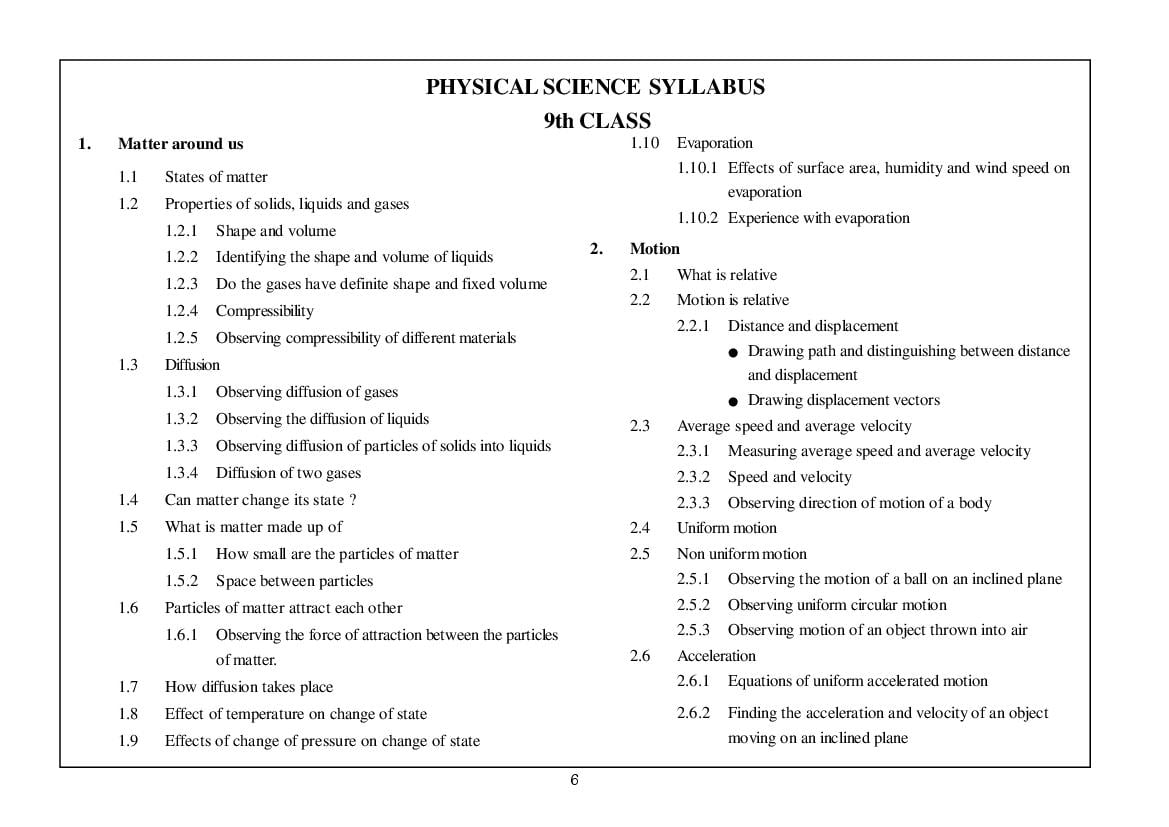
9th CLASS
1. Matter around us 1.10 Evaporation
1.10.1 Effects of surface area, humidity and wind speed on
1.1 States of matter
evaporation
1.2 Properties of solids, liquids and gases
1.10.2 Experience with evaporation
1.2.1 Shape and volume
2. Motion
1.2.2 Identifying the shape and volume of liquids
2.1 What is relative
1.2.3 Do the gases have definite shape and fixed volume
2.2 Motion is relative
1.2.4 Compressibility
2.2.1 Distance and displacement
1.2.5 Observing compressibility of different materials
Drawing path and distinguishing between distance
1.3 Diffusion
and displacement
1.3.1 Observing diffusion of gases Drawing displacement vectors
1.3.2 Observing the diffusion of liquids 2.3 Average speed and average velocity
1.3.3 Observing diffusion of particles of solids into liquids 2.3.1 Measuring average speed and average velocity
1.3.4 Diffusion of two gases 2.3.2 Speed and velocity
1.4 Can matter change its state ? 2.3.3 Observing direction of motion of a body
1.5 What is matter made up of 2.4 Uniform motion
1.5.1 How small are the particles of matter 2.5 Non uniform motion
1.5.2 Space between particles 2.5.1 Observing the motion of a ball on an inclined plane
1.6 Particles of matter attract each other 2.5.2 Observing uniform circular motion
1.6.1 Observing the force of attraction between the particles 2.5.3 Observing motion of an object thrown into air
of matter. 2.6 Acceleration
1.7 How diffusion takes place 2.6.1 Equations of uniform accelerated motion
1.8 Effect of temperature on change of state 2.6.2 Finding the acceleration and velocity of an object
1.9 Effects of change of pressure on change of state moving on an inclined plane
Page 2
3.1 An introduction into laws of motion - thought of Gelileo 4.4 Total internal reflection
3.2 First law of motion 4.4.1 Mirages
3.2.1 Observing motion of coin kept on thick paper 4.5 Applications of total internal reflection
3.2.2 Observing motion of the the coins hit by a striker 4.5.1 Brilliance of diamands
3.3 Inertia and mass 4.5.2 Optical Fibres
3.3.1 Pushing two wooden blocks with same force 4.6 Reflection through a glass slab
3.4 Second law of motion 4.6.1 Lateral shift
3.4.1 Linear momentum 4.6.2 Vertical shift
Net force - accelaration
5. Gravitation
Mass - acceleration
5.1 Uniform circular motion
Atwood machine
5.1.1 Observing the motion of an object moving in circular
3.5 Third law of motion
path
3.5.1 Pulling two spring balances
5.1.2 Drawing velocity vectors in uniform circular motions
3.5.2 Balloon rocket
5.1.3 Centripetal acceleration, Centripetal Force
3.5.3 Action and reaction forces acting on two different
5.2 Universal law of gravitation
objects
3.6 Conservation of momentum 5.2.1 Acceleration is independent of masses
5.2.2 What is the direction of 'g' ?
3.6.1 Dropping eggs on different surfaces - net force on egg
5.3 Weight
4. Refraction of light at plane surface
5.3.1 Can we measure the weight of free fall body ?
4.1 Refraction
5.3.2 Observing changes during the free fall of a body
4.2 Refractive index
4.3 Relative refractive index 5.4 Centre of gravity
4.3.1 Obtaining the relation between angle of incidence and 5.4.1 Balancing objects
angle of refraction - Snells law 5.4.2 Locating centre of gravity
Page 3
5.6 Shift of the centre of gravity and its effects 6.9.1 Can we separate Sulpher and Oxygen from Copper
6 Is matter pure ? Sulphate
6.1 Is full cream pure ? 6.9.2 Understanding the nature of elements, compounds and
6.2 What is mixture ? mixtures
6.3 Types of mixtures (homogenous, heterogeneous) 7. Atoms Molecules and Chemical Reaction
6.4 Solutions 7.1 An introduction about atoms
6.4.1 Properties of Solutions 7.2 Change of mass in chemical reactions
6.4.2 Concentration of Solutions 7.3 Law of conservation of mass
6.4.3 Preparation of saturated and unsaturated solutions 7.4 Law of constant proportions
6.4.4 Factors affecting on the rate of dissolving 7.5 Darton's atomic theory
6.5 Suspensions and colloids 7.5.1 Atoms and molecules
6.5.1 Finding of heterogeneous mixture - suspensions and 7.6 Why do we name elements ?
colloids 7.7 Symbols of elements
6.6 Separations of components of a mixture 7.8 Some unusual symbols
6.6.1 Sublimation - Separation of mixtures by sublimation
7.9 Elements with more than one atom in their molecules
6.6.2 Evaporation - Process of Evaporation of Water
7.10 Atomicity
6.7 Chromatography - Paper Chromatography
7.11 Valency
6.8 Separation of immiscible and miscible liquids
7.12 What is ion ?
6.8.1 Separation of immiscible liquids
7.13 Atomic mass
6.8.2 Separation of mixture of two immiscible liquids
7.14 Molecules of compounds
6.8.3 Distillation - Separation of two miscible liquids by
7.14.1 Chemical formulae of compounds(Criss-Cross method)
distillation
6.8.4 Fractional distillation 7.15 Molecular mass
Page 4
7.17 Mole concept 8.4.1 Do objects denser than water float on it ?
7.17.1 Molar mass 8.4.2 Is the weight of object and weight of water displaced
by it equal ?
7.18 Types of Chemical Reactions 8.4.3 Making aluminium to float
7.18.1 Combinations reaction : (Exothermic chemical reactions, 8.5 Upward force in liquids
Endothermic reactions) 8.6 Pressure of Air
7.18.2 Decomposition reaction : (Thermal, Electrolytic, Photo- 8.6.1 Atmospheric pressure
chemical reactions- examples only without mentioning 8.6.2 Measuring atmospheric pressure
names) 8.7 Pressure at a depth 'h' in a liquid
7.18.3 Displacement reaction 8.7.1 Pressure difference at different levels of depth in fluids
7.18.4 Double displacement reaction 8.8 Measuring the force of buoyancy
7.19 Oxidation and Reduction 8.8.1 Measuring the weight of the water displaced by the
7.20 How you observe the effects of Oxidation reactions in dialy life immersed stone
8.9 Archimedes' principles
7.20.1 Corrosion and prevention of corrosion
8.10 Pascal's principle - Bramah press
7.20.2 Combustion
7.20.3 Yeast reaction 9. What is inside atom
7.20.4 Bleaching 9.1 Sub-atomic particles
9.1.1 Electrons, protons, neutrons
7.20.5 Rancidity
9.2 Structure of atom
8. Floating bodies 9.2.1 Sketch the structure of atom as you imagine
8.1 Can objects sink or float ? (fun activity) 9.3 Thomson's Model of atom
8.2 Density - relative density 9.4 Rutherford's alpha particles scattering experiment - Rutherford's
8.3 Relative density of liquids observations
8.3.1 Making of lactometer 9.4.1 Nuclear model of an Atom - Limitations of Rutherford's
atomic model
Page 5
9.6 Distribution of electrons in different orbits (shells) 10.6 Conversion of energy
9.7 Valency 10.6.1 Conservation of mechanical energy
9.7.1 Importance of valency 10.6.2 Calculating total energy of free fall at different heights
9.8 Atomic number 10.7 Power
9.9 Atomic mass number 10.8 Sources of Engery
9.10 Writing symbols of atoms 10.8.1 Source of Engery
9.11 Isotopes 10.8.2 Fuels
9.11.1 Applications of isotopes 10.9 Renuable energy Resources
10. Work and Energy 10.9.1 Solar energy, Solar Cells
10.9.2 Biomass
10.1 Work
10.9.3 Biogas
10.1.1 Scientific meaning of the work
10.9.4 Ocean energy
10.1.2 Definition of work in science
Tidal energy
10.2 Energy
Motion Thermal energy
10.2.1 Energy transfer and work
10.9.5 Geo Thermal energy
10.2.2 Understanding the increase and decrease in energy of
10.9.6 Wind energy
an object
10.9.7 Atomic energy
10.3 Kinetic energy
Nuclear Fission
10.3.1 Mathematical Expression for Kinetic energy
Nuclear Fusion
10.4 Potential energy
11. Heat
10.4.1 Observing energy in stretched rubber band 11.1 Thermal equilibrium - Heat and Temperature
10.4.2 Observing the energy in an object at some height 11.1.1 Heat
11.1.2 Temperature and Kinetic Energy
Page 6
11.2.1 Applications of Specific Heat capacity 12.6.3 Quality
11.3 Methods of mixtures 12.7 Reflection of sound
11.3.1 Principle of method of mixtures - Determination of
12.7.1 Listening reflected sound - Echo
specific heat of a solid
12.7.2 Reverberation
11.4 Evoporation, Condensation, Humidity, Dew and Fog, Bioling,
12.7.3 Uses of multiple reflection of sound
Melting, Freezing
Megaphone, Horm
12. Sound
Stethoscope
12.1 Sound is a form of energy
Designing of Concert halls and Cinema halls
12.2 Production of sound
12.8 Range of Hearing
12.2.1 Observing the vibration of tuning fork
12.3 How does sound travel 12.9 Applications of ultrasounds
12.3.1 Propagation of sound 12.9.1 Industrial applications
12.4 Types of waves 12.9.2 Medical applications
12.4.1 Transvers waves 12.10 Sonar
12.4.2 Sound waves are Longitudinal waves
12.5 Characteristics of sound wave
12.5.1 Wave length
12.5.2 Amplitude
12.5.3 Time period, frequency
12.5.4 Speed of sound wave
12.6 Characteristics of musical waves
12.6.1 Pitch