Telangana Class 9 Syllabus Biology
Finished viewing? Save it for later —
Download Telangana Class 9 Syllabus Biology (PDF · 4 pages)About Telangana Class 9 Syllabus Biology
Telangana Class 9 Syllabus Biology is available here for free download. Published by Telangana Board for Class 9, this syllabus can be viewed online or downloaded as a PDF (4 pages). Candidates preparing for Class 9 can use Telangana Class 9 Syllabus Biology to understand the exam pattern, the type of questions asked, and the overall difficulty level.
Frequently Asked Questions
How can I download Telangana Class 9 Syllabus Biology?
Open this page and click the Download button to save Telangana Class 9 Syllabus Biology as a PDF. It is completely free on AglaSem Docs.
Is Telangana Class 9 Syllabus Biology free to download?
Yes. Telangana Class 9 Syllabus Biology can be viewed online and downloaded as a PDF free of cost on AglaSem Docs.
How many pages does Telangana Class 9 Syllabus Biology have?
Telangana Class 9 Syllabus Biology contains 4 pages, which you can read online or download together as a single PDF.
Where can I find more Class 9 study material?
You can find more Class 9 question papers, sample papers, syllabus, and answer keys on AglaSem Docs.
Telangana Class 9 Syllabus Biology – Text
Read the full text of this syllabus below — useful to quickly search, copy and reference the content online without downloading the PDF.
📄 View text version (4 pages)
Page 1
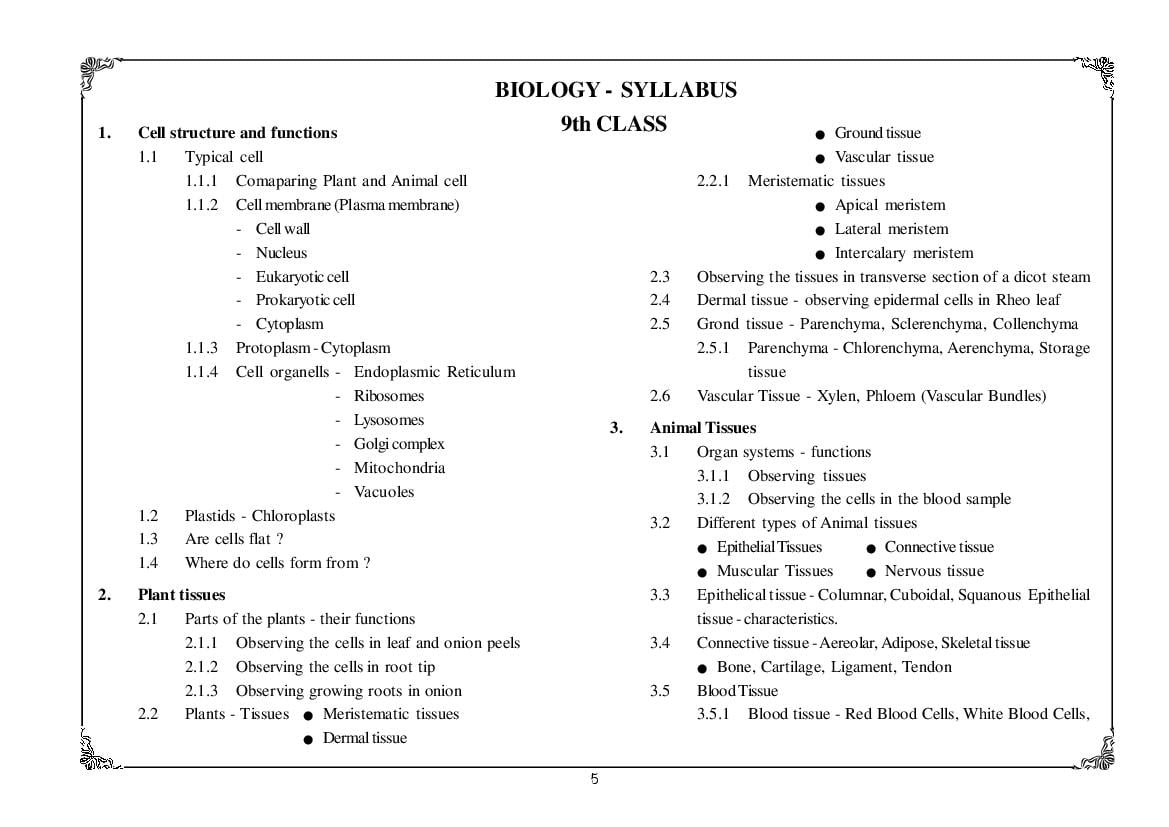
1. Cell structure and functions 9th CLASS Ground tissue
1.1 Typical cell Vascular tissue
1.1.1 Comaparing Plant and Animal cell 2.2.1 Meristematic tissues
1.1.2 Cell membrane (Plasma membrane) Apical meristem
- Cell wall Lateral meristem
- Nucleus Intercalary meristem
- Eukaryotic cell 2.3 Observing the tissues in transverse section of a dicot steam
- Prokaryotic cell 2.4 Dermal tissue - observing epidermal cells in Rheo leaf
- Cytoplasm 2.5 Grond tissue - Parenchyma, Sclerenchyma, Collenchyma
1.1.3 Protoplasm - Cytoplasm 2.5.1 Parenchyma - Chlorenchyma, Aerenchyma, Storage
1.1.4 Cell organells - Endoplasmic Reticulum tissue
- Ribosomes 2.6 Vascular Tissue - Xylen, Phloem (Vascular Bundles)
- Lysosomes 3. Animal Tissues
- Golgi complex 3.1 Organ systems - functions
- Mitochondria 3.1.1 Observing tissues
- Vacuoles 3.1.2 Observing the cells in the blood sample
1.2 Plastids - Chloroplasts 3.2 Different types of Animal tissues
1.3 Are cells flat ? Epithelial Tissues Connective tissue
1.4 Where do cells form from ? Muscular Tissues Nervous tissue
2. Plant tissues 3.3 Epithelical tissue - Columnar, Cuboidal, Squanous Epithelial
2.1 Parts of the plants - their functions tissue - characteristics.
2.1.1 Observing the cells in leaf and onion peels 3.4 Connective tissue - Aereolar, Adipose, Skeletal tissue
2.1.2 Observing the cells in root tip Bone, Cartilage, Ligament, Tendon
2.1.3 Observing growing roots in onion 3.5 Blood Tissue
2.2 Plants - Tissues Meristematic tissues 3.5.1 Blood tissue - Red Blood Cells, White Blood Cells,
Dermal tissue
Page 2
White Blood Cells - Granulocytes (Nutrophile, 5.2.1 Observing external characters in Insects
Basophile, Esinophile 5.2.2 Variations / Diversity in Human beings, Diversity in
- Agranulocytes plants (based on selected characters)
(Lymphocytes, 5.3 Classification - the concept, its need - evolution of life
monocytes) 5.3.1 Classification - its Historic elements; binomial
3.5.2 Blood Flow, Blood clotting nomenclature
3.6 Blood Groups - Universal Acceptors, universal donors, Blood 5.3.2 Method of classification - the five kingdom classification
grouping - Testing. proposed by Whittaker
3.7 Nervous tissue Monera Protista Plantae Fungi Animalia
4. Movement of materials across the cell membrance 5.4 Classification of Plant Kingdom
4.1 The Substances that get into and go out of the cell 5.5 Classification of Animal Kingdom
4.1.1 Solutions and their concentration (Sugar solution) 6. Sense Organs
4.1.2 Observing the changes of kishmish when placed in 6.1 Sense organs - Opinions of our ancestors
sugar solution and tap water. 6.2 What do our sense do ? / How do sense organs help us ?
4.2 Osmosis - the flow of liquids through selectively permiable 6.2.1 Stimulus - Response
membrane 6.3 Eye-its structure, cells and tissues / structure of the eye-cells
4.2.1 Filtration - and tissues in the eye
4.2.2 Functions of Plasma membrane 6.3.1 Functioning of the eye
4.2.3 Flow of substances through Plasma membrane 6.3.2 Eye and Illusions
4.2.4 Importance of Osmosis in living organisms 6.3.3 Taking care of our eyes, diseases and defects of the
4.3 Diffusion Eye - An understanding
5. Diversity in living organisms 6.4 Ear - its external and internal structure
5.1 Observing diversity in plants 6.4.1 Ear - the hearing / auditory sensation
5.1.1 Identifying the plants based on selected characters / 6.4.2 Functions of the ear, caring for the ears
features 6.5 Structure of the Nose
5.1.2 Observing the seeds 6.5.1 The smell or olfactory sense - How do we know the
5.1.3 Observing the characters of monot and dicot plants sense of smell ?
Page 3
6.6 Structure of the Tongue 8.2.2 Plant nutrients / or nutrients needed by the plants
6.6.1 How do we know the taste ? 8.2.3 Crop Rotation
6.6.2 Taking care of the Tongue 8.2.4 Cultivating mixed crops
6.7 Structure of the skin 8.2.5 Organic manure
6.7.1 How does the skin convey the sense of touch ? 8.2.6 Chemical Fertilizers
6.7.2 Skin diseases, taking care of skin 8.3 Soil testing
7. Animal behaviour 8.4 Conventional manures
7.1 Animals behave in different ways / or Animals exhibit Vermi compost
different behaviour Panchagavya
7.2 Different types of Animal behaviour 8.5 Organic farming
Instinct 8.5.1 The long-term effect of chemical fertilizers on the
Imprinting yield of the crop
Conditioning 8.6 Crop protection
Imitation 8.6.1 Weeds
7.3 Pavlov Experiments on conditioning 8.6.2 Plant - Diseases - Prevention (Pesticides)
7.4 Human behaviour : Instinct, imitation, conditioning 9. Adaptations in different Ecosystems
7.4.1 Investigating behaviour in the field, laboratory 9.1 Ecosystems
7.4.2 Investigation in the field - tagging 9.1.1 Ecosystems - Adaptations in Plants
7.5 Animals - and their intelligence 9.2 Desert Ecosystem - Adaptations in plants and animals
8. Challenges in improving agricultural products 9.3 Aquatic Ecosystem - Adaptations in plants and animals
8.1 Relationship between growth of population and the need for 9.3.1 Marine Ecosystem - Adaptations in plants and
food animals
8.2.1 Need of improving agricultural produce 9.3.2 Aquatic organisms - The secrets of swimming
8.2 How to increase the food production ? 9.3.3 The zones in the marine ecosystem on the basis of
High yielding varieties availability of light at different depths.
Irrigation facilities Euphotic zone
Bathyal zone
Page 4
9.3.4 Zones in the fresh water Ecosystem 10.6 Control measures of soil pollution
Littoral zone 10.6.1 Bioremidiation, soil conservation
Limnetic zone 11. Biogeochemical cycles
Profundal zone 11.1 Pollution, concept of biogeochemical cycles in relation to
9.4 Water salinity - Adaptations the ecosystems - an understanding
9.5 Adaptations to temperature in plants, animals 11.2 Water cycle
Hibernation and Aestivation 11.3 Nitrogen cycle
Symbiosis (Lichens) 11.3.1 Nitrogen fixation
9.6 Adaptations - Evolution (story of Darwin's Finches) 11.3.2 Nitrification
10. Soil Pollution 11.3.3 Assimilation
10.1 What is soil ? 11.3.4 Ammonification
10.1.1 What is soil ? 11.3.5 Denitrification
10.1.2 Soil properties - Physical, Chemical and Biological 11.3.6 Nitrogen cycle and human intervention
properties of the soil 11.4 Carbon cycle
10.2 Soil fertility 11.4.1 Photosynthesis - Carbon - fixation
10.3 Soil pollution 11.4.2 Carbondioxide cycling and storage
10.3.1 Fertility of soil due to decomposition of wastes 11.4.3 Carbon cycle - Human intervention
10.3.2 Soil pollution - Wastes Global warming The green house effect
Biodegradable wastes 11.5 Oxygen cycle
Non-biodegradable wastes 11.5.1 Oxygen cycle
10.4 Causes of land pollution 11.5.2 Ozone layer and its effect
10.4.1 Manures and Chemicals
10.4.2 Biomagnification
10.4.3 Solid wastes
10.4.4 Deforestation
10.4.5 Urbanization
10.4.6 Pollution of undreground soil