Telangana Class 9 Syllabus Maths
Finished viewing? Save it for later —
Download Telangana Class 9 Syllabus Maths (PDF · 13 pages)About Telangana Class 9 Syllabus Maths
Telangana Class 9 Syllabus Maths is available here for free download. Published by Telangana Board for Class 9, this syllabus can be viewed online or downloaded as a PDF (13 pages). Candidates preparing for Class 9 can use Telangana Class 9 Syllabus Maths to understand the exam pattern, the type of questions asked, and the overall difficulty level.
Frequently Asked Questions
How can I download Telangana Class 9 Syllabus Maths?
Open this page and click the Download button to save Telangana Class 9 Syllabus Maths as a PDF. It is completely free on AglaSem Docs.
Is Telangana Class 9 Syllabus Maths free to download?
Yes. Telangana Class 9 Syllabus Maths can be viewed online and downloaded as a PDF free of cost on AglaSem Docs.
How many pages does Telangana Class 9 Syllabus Maths have?
Telangana Class 9 Syllabus Maths contains 13 pages, which you can read online or download together as a single PDF.
Where can I find more Class 9 study material?
You can find more Class 9 question papers, sample papers, syllabus, and answer keys on AglaSem Docs.
Telangana Class 9 Syllabus Maths – Text
Read the full text of this syllabus below — useful to quickly search, copy and reference the content online without downloading the PDF.
📄 View text version (13 pages)
Page 1
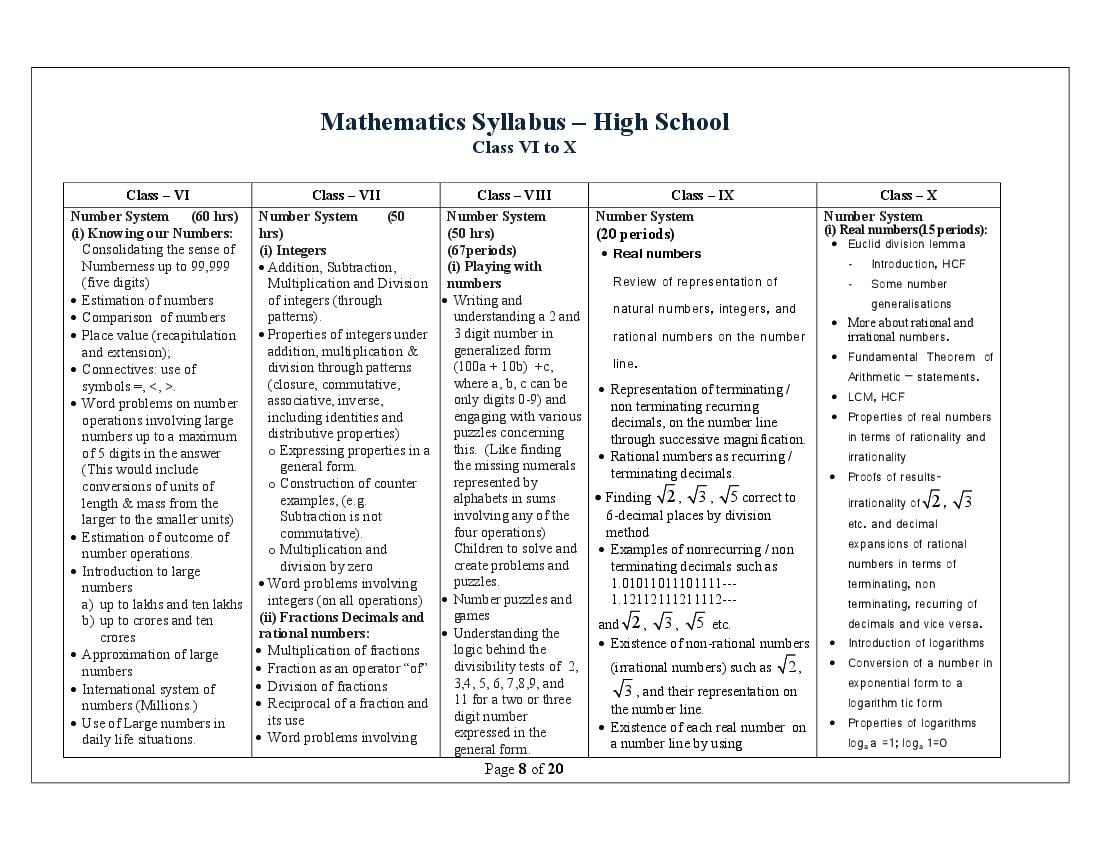
Class VI to X
Class – VI Class – VII Class – VIII Class – IX Class – X
Number System (60 hrs) Number System (50 Number System Number System Number System
(i) Knowing our Numbers: hrs) (50 hrs) (20 periods) (i) Real numbers(15 periods):
Consolidating the sense of (i) Integers (67periods) Euclid division lemma
Real numbers
Numberness up to 99,999 Addition, Subtraction, (i) Playing with - Introduction, HCF
(five digits) Multiplication and Division numbers Review of representation of - Some number
Estimation of numbers of integers (through Writing and generalisations
natural numbers, integers, and
Comparison of numbers patterns). understanding a 2 and More about rational and
Place value (recapitulation Properties of integers under 3 digit number in rational numbers on the number irrational numbers.
and extension); addition, multiplication & generalized form Fundamental Theorem of
Connectives: use of division through patterns (100a + 10b) +c, line.
where a, b, c can be Arithmetic – statements.
symbols =, <, >. (closure, commutative, Representation of terminating /
associative, inverse, only digits 0-9) and LCM, HCF
Word problems on number non terminating recurring
operations involving large including identities and engaging with various decimals, on the number line Properties of real numbers
numbers up to a maximum distributive properties) puzzles concerning through successive magnification. in terms of rationality and
of 5 digits in the answer o Expressing properties in a this. (Like finding Rational numbers as recurring / irrationality
(This would include general form. the missing numerals
terminating decimals. Proofs of results-
conversions of units of o Construction of counter represented by
length & mass from the examples, (e.g. alphabets in sums Finding 2 , 3 , 5 correct to irrationality of 2, 3
larger to the smaller units) Subtraction is not involving any of the 6-decimal places by division
etc. and decimal
Estimation of outcome of commutative). four operations) method
o Multiplication and Children to solve and Examples of nonrecurring / non expansions of rational
number operations.
division by zero create problems and terminating decimals such as numbers in terms of
Introduction to large
numbers Word problems involving puzzles. 1.01011011101111--- terminating, non
a) up to lakhs and ten lakhs integers (on all operations) Number puzzles and 1.12112111211112--- terminating, recurring of
b) up to crores and ten (ii) Fractions Decimals and games
and 2 , 3 , 5 etc. decimals and vice versa.
crores rational numbers: Understanding the
Existence of non-rational numbers Introduction of logarithms
Approximation of large Multiplication of fractions logic behind the
Fraction as an operator “of” divisibility tests of 2, (irrational numbers) such as 2 , Conversion of a number in
numbers
International system of Division of fractions 3,4, 5, 6, 7,8,9, and exponential form to a
3 , and their representation on
numbers (Millions.) Reciprocal of a fraction and 11 for a two or three logarithm tic form
digit number the number line.
Use of Large numbers in its use Existence of each real number on Properties of logarithms
Word problems involving expressed in the
daily life situations. a number line by using loga a =1; loga 1=0
general form.
Page 8 of 20
Page 2
(ii) Whole numbers mixed fractions ( related to General rule of Pythogorian result. Laws of logarithms
Natural numbers, whole daily life) divisibility by any Square root of a surd of the form log xy = logx + logy;
numbers Introduction to rational number. a+ b (simple problems) log x/y = logx – logy
Properties of whole numbers (ii) Rational Number Concept of a Surd. log xn = n log x,
numbers (closure, Multiplication and division Properties of rational
Rationalisation of a monomial, N
commutative, associative, of decimal fractions numbers. (including a loga N
binomial surds of second order.
distributive, additive Conversion of units (length identities). Standard base of
identity, multiplicative & mass) Using general form of
logarithms and usage
identity) Comparison of rational expression to describe
Division by zero numbers. properties. (ii) Sets (8 periods):
Number line- Binary Appreciation of Sets and their
operations (addition, properties. representations : Empty
subtraction, multiplication) Representation of set, Finite and infinite sets.
on the number line rational numbers on Equal sets. Subsets,
Seeing patterns, identifying the number line subsets of the set of real
and formulating rules to be Between any two numbers (especially
done by children. rational numbers intervals with notations).
Utility of properties in there lies another Universal set and
fundamental operations rational number cardinality of sets.
(iii) Playing with Numbers: Representation of Venn diagrams
Consolidating divisibility rational numbers as
rules of 2,3,5,6,9,10 decimal - Sets, subsets
Discovering divisibility (denominators other - Disjoint sets.
rules of 4,8,11 through than 10, 100,….)
Basic operations on sets
observing patterns. Representation of
Multiples and factors, decimal numbers - Union, intersection,
Prime & composite (terminating, non difference of sets
numbers, Co-prime terminating but
numbers and twin prime recurring) in rational
numbers, form.
Prime factorization, every Consolidation of
number can be written as operations on rational
products of prime factors. numbers.
Word problems on
HCF and LCM, prime rational numbers (all
factorization and division operations)
method. Word problem
Property LCM × HCF = (higher logic, all
Page 9 of 20
Page 3
product of two numbers. operations, including
LCM & HCF of co-primes. ideas like area)
(iv) Negative Numbers and (iii) Square numbers,
Integers cube numbers,
How negative numbers Square roots, Cubes,
arise, models of negative Cube roots.
numbers, connection to Square numbers and
daily life, ordering of square roots.
negative numbers, Square roots using
representation of negative factor method and
numbers on number line. division method for
Understanding the numbers containing.
definition of integers, a)not more than 4
identification of integers on digits and
the number line b)not more than 2
Comparison of integers, decimal places
ordering of integers by Pythagorean triplets
using symbols and problems
Operation of addition and involving
subtraction of integers, Pythagorean triplets.
showing the operations on Cube numbers and
the number line cube roots (only
(Understanding that the factor method for
addition of negative integer numbers containing at
reduces the value of the most 3 digits).
number) Estimating square
(V) Fractions and roots and cube roots.
Decimals: Learning the process
Revision of what a fraction is, of moving nearer to
Fraction as a part of whole the required number.
Representation of fractions
(pictorially and on number line)
Fraction as a division,
proper, improper & mixed
fractions, equivalent
fractions, like, unlike
fractions.
Comparison of fractions
Page 10 of 20
Page 4
Addition and subtraction of
fractions
Word problems (Avoid large
and complicated calculations)
Review of the idea of a
decimal fraction
Place value in the context of
decimal fraction, inter
conversion of fractions and
decimal fractions (avoid
recurring decimals at this
stage)
Word problems involving
addition and subtraction of
decimals (word problems
should involve two
operations)
Contexts: money, mass,
length.
Algebra (15 hrs) Algebra (20 hrs) Algebra (20 hrs) Algebra Algebra
(i) Introduction to Algebra (i)Exponents and powers (27 periods) (i)Polynomials (25 periods) (i) Polynomials (8 periods)
Introduction to variable Meaning of x in ax where Exponents & powers Definition of a polynomial in one Zeroes of a polynomial
(Linear, Quadratic cubic
through patterns and aZ i) Powers variable, its coefficients, with polynomials).
through appropriate word Writing a number in the Decimal numbers in examples and counter examples, Geometrical meaning of
problems and exponential form through exponential notation. its terms, zero polynomial. Zeroes of quadratic and
generalizations (example prime factorization. Integers as exponents. Constant, linear, quadratic, cubic cubic polynomials using
5 × 1 = 5 etc.) Laws of exponents polynomials; monomials, graphs.
Laws of exponents Relationship between
Generate such patterns with (through observing with integral powers binomials, trinomials. Zero / roots
Zeroes and coefficients of
more examples. patterns to arrive at 5 Representing large of a polynomial / equation. a polynomial with
Introduction to unknowns generalizations) numbers in standard Division of polynomials particular reference to
through examples with where m, n N (scientific) notation. State and motivate the Remainder quadratic polynomials.
simple contexts (single m n
(i) a a = a m+n ii) Algebraic Theorem with examples and Statement and simple
operations) m n mn Expressions analogy to integers (motivate). problems on division
(ii) (a ) = a algorithm for polynomials
Rules from Geometry and (iii) am/an = am-n, where Addition and Statement and verification of the with integral coefficients.
Menstruation. (m, n) N subtraction of Factor Theorem. Zeroes of a biquadratic
(ii)Simple Equations (iv) am.bm = (ab)m algebraic expressions Recall of algebraic expressions polynomial.
Introduction (v) number with exponent Multiplications of and identities. (ii) Pair of Linear
Solution of simple equation zero algebraic expressions Further identities of the type: Equations in Two
Variables (15 periods)
(Coefficient should
Page 11 of 20
Page 5
Terms with negative base. be integers) (x+y+z)2 = x2+y2+x2+2xy+2yz+2zx
Pair of linear equations in
Identities: Derivation two variables. Geometric
by Trial and Error method. and geometric (xy)3 = x3y33xy (xy) representation of different
Expressing large number possibilities of solutions /
in standard form (Scientific verification of x3 +y3 +z3 -3xyz = (x+y+z)
inconsistency.
Notation) (a ± b)2 = a2 ± 2ab (x2 +y2 +z2 –xy-yz-zx) Algebraic conditions for
(ii)Algebraic Expressions + b2, number of solutions
x3 +y3 = (x+y)(x2 – xy + y2)
Introduction a2 – b2 = (a – b) (a (Consistent, inconsistent).
Generate algebraic + b) x3 -y3 = (x-y)(x2 + xy + y2) Solution of pair of linear
expressions (simple) Factorization (simple and their use in factorization of equations in two variables
involving one or two cases only) as polynomials. Simple expressions algebraically – by
variables examples of the reducible to these polynomials. substitution, by elimination
following types methods – Simple situational
Identifying constants, (ii)Linear Equations in Two problems.
coefficient, powers a(x + y), (x ± y)2, x2 – Variables (12 periods) Simple problems on
Like and unlike terms, y2, Recall of linear equations in one equations reducible to linear
degree of expressions e.g., (x + a).(x + b) variable. equations in two variables.
2
x y etc. (exponent ≤ 3, Division of algebraic Introduction to the equation in
number of variables ≤ 2) (iii) Quadratic Equations
expression two variables. (12 periods)
Types of algebraic Solution of a linear equation in Standard form of a
expressions. (iii)Simple equations two variables substitution and quadratic equation
Addition, subtraction of Solving linear graphical methods ax2+bx+c=0, (a ≠ 0).
algebraic expressions equations in one Graph of a linear equation in two Solutions of quadratic
(coefficients should be variable in contextual variables equations (only real roots) by
integers). problems involving Equations of lines parallel to x- factorization and by
multiplication and completing the square, i.e.,
Finding the value of the axis and y-axis.
division (word by using formula to find
expression. Simple word problems related to roots of quadratic equation.
(iii)Simple equations problems) (with linear equations Relationship between
Simple linear equations in integral coefficient in discriminant and nature of
one variable (in contextual the equations) roots.
problems) with two Problems related to day-
operations (integers as to-day life situations.
coefficients) (iv) Progressions (11
periods)
Sequence and series
Progressions –
introduction
Motivation for studying AP.
Derivation of standard
results of finding the nth
Page 12 of 20
Page 6
term and sum of first n
terms of A.P.
Motivation for studying G.P
nth term of G.P.
Ratio and Ratio - Applications (20 Business Trigonometry
Proportion(15hrs) hrs) Mathematics (25 hrs) (i) Introduction (15
Concept of Ratio Ratio and proportion Compound ratio – periods)
Ratio in different situations. (revision) Word problems. Trigonometric ratios of an
Comparison of ratios of Unitary method continued, Problems involving acute angle by using right-
different units consolidation, general applications on angled triangle i.e. sine,
Division of a quantity in a expression. percentages, profit & cosine, tangent, cosecant
given ratio. Direct proportion loss, overall and cotangent.
Proportion as equality of Percentage- an introduction. expenses, discount, Values (with proofs) of
two ratios Understanding percentage tax. (Multiple the trigonometric ratios of
Unitary method (with only as a fraction with transactions) 300, 450 and 600.
direct variation implied) denominator 100. Difference between Motivate the ratios,
Word problems Converting fractions and simple and compound whichever are defined at
Understanding ratio and decimals into percentage interest (compounded 00 and 900.
proportion in Arithmetic. and vice-versa. yearly up to 3 years Relationship between the
Application to profit and or half-yearly up to 3 ratios.
loss (single transaction steps only), Arriving Trigonometric Identities:
only) at the formula for Proof and applications of
Discount. compound interest the identities
Application to simple through patterns and sin2A+cos2A=1.
interest (time period in using it for simple 1+tan2A=sec2A
complete years). problems. cot2+1=cosec2A
Direct variation – Simple problems on
Simple and direct identities
word problems. Trigonometric ratios of
Inverse variation – complementary angles.
Simple and direct (ii) Applications of
word problems. trigonometry (8 periods)
Mixed problems on Angle of elevation, angle
direct , inverse of depression
variation Simple and daily life
Time & work problems on heights and
problems– Simple distances. Problems
and direct word should not involve more
Page 13 of 20
Page 7
problems than two right triangles
Time & distance : and angles elevation/
Simple and direct depression should be only
word problems 300, 450, 600.
Coordinate geometry Coordinate geometry
(9 periods) Lines (In two-dimensions)
Introduction (15 periods)
Cartesian system Review the concepts of
Representation of a point in a coordinate geometry done
plane by its location. by the graphs of linear
equations.
Plotting a point in a plane if its Distance between two
co-ordinates are given. points i.e. P (x1, y1) and
Q (x2, y2)
Section formula (internal
division of a line segment
in the ratio m:n).
Area of a triangle on
coordinate plane.
Slope of a line joining two
points.
Geometry (65 hrs) Geometry (60 hrs) Geometry Geometry Geometry
i) Basic geometrical ideas (i) Lines and Angles (40 hrs) (i) Introduction to Euclid’s (i) Similar triangles (18
(2-D): Pairs of angles (linear pair) (i) Construction of Geometry (6 periods) periods)
Introduction to geometry. 1. complementary, Quadrilaterals: (54 History – Euclid and geometry in Meaning, examples,
Its linkage with and 2. supplementary, periods) India. Euclid’s method of properties of similar
reflection in everyday 3. adjacent, vertically Review of formalizing observed triangles.
experience. opposite angles. quadrilaterals and phenomenon onto rigorous Difference between
Point, Line, line segment, (verification and simple their properties. mathematics with definitions, congruency and similarity
ray. proof of vertically opposite Four sides, one angle common / obvious notions, of triangles.
Open and closed figures. angles) Four sides, one axioms / postulates, and theorems. (Prove) If a line is drawn
Curvilinear and linear Transversal – Angles diagonal The five postulates of Euclid. parallel to one side of a
boundaries formed by the transversal. Two adjacent sides, Equivalent varies of the fifth triangle to intersect the
Interior and exterior of Properties of parallel lines three angles postulate. Showing the other two sides in distinct
closed figures. with transversal (alternate, Three sides, two relationship between axiom and points, the other two sides
Angle — Vertex, arm, corresponding, interior, diagonals. theorem. are divided in the same
interior and exterior, exterior angles, interior Three sides, two Given two distinct points, there ratio.
Triangle — vertices, sides, angles on the same side of angles in between. exists one and only one line (Motivate) If a line divides
angles, interior and transversal. Construction of through them. two sides of a triangle in
Page 14 of 20
Page 8
exterior. special type of (Prove) Two distinct lines cannot the same ratio, the line is
Quadrilateral — Sides, (ii) Triangles: quadrilaterals. have more than one point in parallel to the third side.
vertices, angles, diagonals, Definition of triangle. (ii) Representing 3-D common. (Motivate) If in two
adjacent sides and opposite Types of triangles according in 2-D (ii) Lines and Angles
triangles, the corresponding
sides, adjacent and opposite to sides and angles Identify and Match angles are equal, their
(10 periods)
angles (only convex Properties of triangles pictures with objects corresponding sides are
Pair of angles.
quadrilateral are to be Sum of the sides, difference [more complicated proportional and the
discussed), interior and e.g. nested, joint 2-D (Motivate) If a ray stands on a line, triangles are similar
of two sides. then the sum of the two adjacent
exterior of a quadrilateral. Angle sum property (with and 3-D shapes (not (AAA).
angles so formed is 1800 and it’s
Circle — Centre, radius, notion of proof and more than 2)]. (Motivate) If the
converse.
diameter, chord, arc, sector, verification through paper Drawing 2-D corresponding sides of two
(Prove) If two lines intersect, the
segment, semicircle, folding, proofs , using representation of 3-D vertically opposite angles are equal.
triangles are proportional,
circumference, interior and property of parallel lines , objects (Continued their corresponding angles
(Motivate) Relation between
exterior. difference between proof and extended) with are equal and the two
corresponding angles, alternate
and verification isometric sketches. triangles are similar (SSS).
angles, interior angles when a
Exterior angle property of Counting vertices, transversal intersects two parallel (Motivate) If one angle of a
(ii) Measures of Lines and triangle edges & faces & triangle is equal to one
lines.
Angles: Median and Altitude of a verifying Euler’s angle of another triangle
Concurrent lines concurrent point.
Measure of Line segment triangle, centriod. relation for 3-D and the sides including
(Motivate) Lines, which are
Types of angles- acute, obtuse, (iii) Congruence: figures with flat faces these angles are
right, straight, reflex, complete parallel to given line, are parallel.
Congruence through (cubes, cuboids, proportional, the two
and Zeroes angle. tetrahedrons, prisms (Prove) The sum of the angles of triangles are similar.
superposition ex. Blades, interior triangle is 1800.
Examples of angles in the and pyramids) (Prove) The ratio of the
stamps etc.. (Motivate) If a side of a triangle is
surroundings. (iii)Exploring areas of two similar
Extend congruence to simple produced, the exterior angle so
Measure of angles geometrical figures triangles is equal to the
geometrical shapes formed is equal to the sum of the
Classifying angles according Congruent figures ratio of the squares on their
ex: Triangle , Circles, two interior opposite angles.
to their measure. Similar figures corresponding sides.
Criteria of congruence (by
Pair of lines Intersecting Symmetry in (iii) Triangles (20 periods) (Motivate) If a
verification only)
and perpendicular lines and geometrical figures (Motivate) Two triangles are perpendicular is drawn
Property of congruencies of
parallel lines w.r.t. to triangles, congruent if any two sides and the from the vertex of the right
iii) Practical Geometry triangles SAS, SSS, ASA,
RHS Properties with figures quadrilaterals and included angle of one triangle are angle to the hypotenuse, the
(Constructions) circles. Revision of equal to any two sides and the triangles on each side of the
Drawing of a line segment (iv) Construction of reflection symmetry, included angle of the other triangle perpendicular are similar to
(using Straight edged Scale, triangles rotational symmetry (SAS Congruence). the whole triangle and to
compasses) (all models)
and it’s applications (Prove) Two triangles are congruent if each other.
Construction of circle Constructing a Triangles any two angles and the included side of
Point symmetry (Prove) In a right triangle,
when the lengths of its 3 one triangle are equal to any two angles
Perpendicular bisector Estimation of heights the square on the
sides are known (SSS and the included side of the other
Drawing a line and distances by hypotenuse is equal to the
Criterion) triangle (ASA Congruence).
Page 15 of 20
Page 9
perpendicular to a given Constructing a triangle similar figures (Motivate) Two triangles are sum of the squares on the
line from a point when the lengths of 2 sides Dilations congruent if the three sides of one other two sides.
a)on the line b)outside the and the measures of the Tessellations triangle are equal to three sides of (Prove) In a triangle, if the
line. angles between them are the other triangle (SSS square on one side is equal
Construction of angles known (SAS criterion) Congruence). to sum of the squares on the
(using protractor) Constructing triangle when (Motivate) Two right triangles are other two sides, the angles
Angle equal to a given the measures of 2 of its congruent if the hypotenuse and a opposite to the first side is a
angle (using compass) angles and length of the side side of one triangle are equal to the right triangle.
Angle 60°, 120° (Using included between them is hypotenuse and a side of the other Problems based on above
Compasses) given (ASA criterion) triangle. theorems.
Angle bisector- making Constructing a right angle (Prove) The angles opposite to Construction:
angles of 30°, 45°, 90° etc. triangle when the length of equal sides of a triangle are equal. Division of a line segment
(using compasses) one leg hypotenuse are (Motivate) The sides opposite to using basic proportionality
vi) Understanding 3D, 2D given (RHS criterion). equal angles of a triangle are equal. theorem.
shapes Constructing a triangle (Motivate) Triangle inequalities and A triangle similar to given
Identification of 3-D when the lengths of 2 sides relation between ‘angle and facing triangle as per the given
shapes: Cubes, Cuboids, and the measures of the non side’; inequalities in a triangle. scale factor.
cylinder, sphere, cone, included angle are known (iv)Quadrilaterals (ii) Tangents and secants to
prism (triangular), pyramid (SSA criterion) (10 periods) a circle (15 periods)
(triangular and square) (v) Quadrilaterals (Prove) The diagonal divides a Tangents to a circle
Identification and locating Quadrilateral-definition. parallelogram into two congruent
in the surroundings Quadrilateral, sides, angles, triangles. motivated by chords
Elements of 3-D figures. diagonals. (Motivate) In a parallelogram
(Faces, Edges and vertices) Interior, exterior of opposite sides are equal and its drawn from points coming
Polygons- introduction, quadrilateral converse.
types of polygons, regular Convex, concave (Motivate) In a parallelogram closer and closer to the
polygons quadrilateral differences opposite angles are equal and its
v) Symmetry: (reflection) with diagrams converse. point.
Observation and identification Angle sum property (By (Motivate) A quadrilateral is a
of 2-D symmetrical objects for
(Prove) The tangent at any
verification) , problems parallelogram if a pair of its point of a circle is
reflection symmetry Types of quadrilaterals opposite sides is parallel and equal.
Operation of reflection perpendicular to the radius
Properties of parallelogram, (Motivate) In a parallelogram, the through the point of
(taking mirror images) of trapezium, rhombus, diagonals bisect each other and its
simple 2-D objects contact.
rectangle, square and kite. converse. (Prove) The lengths of
Recognizing reflection
(vi) Symmetry (Motivate) In a triangle, the line tangents drawn from an
symmetry (identifying axes)
Recalling reflection, line segment joining the mid points of external point to a circle are
Demonstrates an under
standing of line symmetry by symmetry, lines of any two sides is parallel to the third equal.
(one line) linear symmetry. symmetry for regular side and its converse.
Page 16 of 20
Page 10
Multiple lines of symmetry. polygons. (v)Area (4 periods) Segment of a circle made
Creating symmetrical 2-D Idea of rotational symmetry, Review concept of area, recall area by the secant.
shapes. observations of rotational of a rectangle. Finding the area of the
symmetry of 2-D objects. (Prove) Parallelograms on the same minor/ major segment of a
(90, 120, 180) base and between the same parallels circle.
Operation of rotation have the same area. Constructions
through 90 and 180 of (Motivate) Triangles on the same A tangent to a circle
simple figures. base and between the same parallels through point given on it.
Order of rotational are equal in area and its converse. Pair of tangents to a circle
symmetry If A parallelogram and a triangle are on drawn from an external
Examples of figures with the same base and between the same point.
both rotation and reflection parallels. The area of the triangle is
equal to half the area of the
symmetry (both operations) parallelogram.
Examples of figures that (vi)Circles (15 periods)
have reflection and rotation Definitions of circle related concepts of
symmetry and vice-versa circle; radius, circumference, diameter,
(vii) Understanding 3-D chord, arc, subtended angle. The points
in 2-D shapes: within, on outside the circle.
Nets for cube, cuboids, (Prove) Equal chords of a circle
cylinders, cones and subtend equal angles at the centre and
(motivate) its converse.
tetrahedrons.
(Motivate) The perpendicular from the
Drawing 3-D figures in 2-D centre of a circle to a chord bisects the
showing hidden faces chord and its converse
through oblique sketches (Motivate) There is one and only one
and Isometric sketches. circle passing through three non-
collinear points.
(Motivate) Equal chords of a circle (or
of congruent circles) are equidistant
from the centre (s) and its converse.
(Prove) The angle subtended by an arc
at the centre is double the angle
subtended by it at any point on the
remaining part of the circle.
(Motivate) Angles in the same
segment of a circle are equal.
(Motivate) If a line segment joining
two points subtends equal angle at two
other points lying on the same side of
Page 17 of 20
Page 11
the line segment, the four points lie on
a circle.
(Motivate) The sum of the either pairs
of the opposite angles of a cyclic
quadrilateral is 1800 and its converse.
(vii)Constructions
(10 periods)
Construction of a triangle given its
base, sum / difference of the other
two sides and one base angles.
Construction of a triangle when its
perimeter and base angles are
given.
Construct of segment of a circle
containing given chord and angle.
Mensuration (15 hrs) Mensuration (15 hrs) Mensuration Mensuration (15 hrs) Mensuration
Perimeter and Area Area and Perimeter (15 hrs) Surface Areas and Volumes (14 I. Surface Areas and
Introduction and general Revision of perimeter and Area of a triangle: periods) Volumes (10 periods)
understanding of perimeter Area of Rectangle, Square. formulae (without Areas of Plane figures Problems on finding
using many shapes. Area of parallelogram. proof) and its (4 periods) surface areas and volumes
Shapes of different kinds Area of a triangle application in Revision of surface area and of combinations of any of
with the same perimeter. Area of rhombus. finding the area of a volume of cube, cuboid the following: cubes,
Perimeter of a rectangle – Idea of Circumference of quadrilateral. Surface areas of right circular cuboids, spheres,
and its special case – a Circle. Area of a trapezium cylinder, cone, sphere, hemi hemispheres and right
square. Area of rectangular paths. Area of the sphere. circular cylinders / cones.
Perimeter of regular quadrilateral and Volume of right circular cylinder, Problems involving
polygons other polygons. cone, sphere and hemi sphere converting one type of
Deducing the formula of Area of the circle & Word problems on cylinder, cone, metallic solid into another
the perimeter for a circular paths and sphere, hemi sphere. and other mixed problems.
rectangle and then a square area of sector – Relationship between surface areas (Problems with
through Simple word of any two comparable solids. combination of not more
pattern and generalization. problems. Relationship in between volumes than two different solids be
Concept of area, Area of a Surface area of a two comparable solids. taken.)
rectangle and a square. cube, cuboid
Counter examples to Concept of volume,
different misconcepts measurement of
related to perimeter and volume
area. using a basic unit,
Page 18 of 20
Page 12
Word problems on volume of a cube,
perimeter and area. cuboid
Volume and
capacity.
Data handling (10 hrs) Data handling (15 hrs) Data handling Data handling (15 hrs) Data handling (15 hrs)
What is data Collection and organisation (15 hrs) Statistics (13 periods) (i) Statistics (15 periods)
Collection and organisation of data. Revision of Mean, Frequency distribution for Revision of Mean, median
of data - examples of Mean median and mode of Median and Mode of ungrouped and grouped data and mode of ungrouped
organizing it in tally marks ungrouped data – ungrouped data. Mean, Median and Mode of (frequency distribution)
and a table. understanding what they Determination of ungrouped frequency distributions data.
Pictograph- Need for scaling represent. mean by Deviation (weighted scores). Understanding, the
in pictographs interpretation Reading bar-graphs Method. Probability (12 periods) concept of Arithmetic
& construction. Constructing double bar Scope and necessity Feel of probability using data Mean, Median and Mode
Bar graphs: Interpreting bar graphs. of grouped data. through experiments. Notion of for grouped (classified)
graphs, drawing vertical and Simple pie charts with Preparation of chance in events like tossing data.
horizontal bar graphs for reasonable data numbers frequency distribution coins, dice etc. The meaning and purpose
given data. table Tabulating and counting of arithmetic Mean,
Cumulative occurrences of 1 to 6 in a number Median and Mode
frequency distribution of throws. Simple problems on
table Comparing the observation with finding Mean, Median and
Frequency graphs that for a coin. Observing strings Mode for grouped /
(histogram for equal of throws, notion of randomness. ungrouped data.
and unequal class Consolidating and generalizing Usage and different values
intervals, frequency the notion of chance in events like and central tendencies
polygon, frequency tossing coins / dice. through Ogives.
curve, cumulative Relating probability to chances in
frequency curves) life-events. (ii) Probability (10 periods)
Visual representation of Concept and definition of
frequency outcomes of repeated Probability.
throws of the same kind of coins Simple problems (day to
or dice. day life situation) on
Throwing a large number of single events simple using
identical dice/coins together and set notation.
aggregating the result of the Concept of complimentary
throws to get large number of events.
individual events.
Observing and aggregating numbers
Page 19 of 20
Page 13
over a large number of repeated
events. Observing strings of throws,
notion of randomness
Proofs in Mathematics Mathematical Modeling
Mathematical Statement, (8 periods)
Verification of statement Concept of Mathematical
Mathematical Reasoning, modeling
Deductive reasoning
Theorems, Conjectures and Discussing the broad
Axioms stages of modeling – real
life, situations (Simple
What is a Mathematical proof?
Interest, probability, fare
Steps of Mathematical proofs.
installments, payments
etc.)
Page 20 of 20