CBSE Class 12 Sample Paper 2027 for Maths
Finished viewing? Save it for later —
Download CBSE Class 12 Sample Paper 2027 for Maths (PDF · 8 pages)About CBSE Class 12 Sample Paper 2027 for Maths
CBSE Class 12 Sample Paper 2027 for Maths is available here for free download. Published by CBSE for Class 12, this sample paper can be viewed online or downloaded as a PDF (8 pages). Candidates preparing for Class 12 can use CBSE Class 12 Sample Paper 2027 for Maths to understand the exam pattern, the type of questions asked, and the overall difficulty level.
Frequently Asked Questions
How can I download CBSE Class 12 Sample Paper 2027 for Maths?
Open this page and click the Download button to save CBSE Class 12 Sample Paper 2027 for Maths as a PDF. It is completely free on AglaSem Docs.
Is CBSE Class 12 Sample Paper 2027 for Maths free to download?
Yes. CBSE Class 12 Sample Paper 2027 for Maths can be viewed online and downloaded as a PDF free of cost on AglaSem Docs.
How many pages does CBSE Class 12 Sample Paper 2027 for Maths have?
CBSE Class 12 Sample Paper 2027 for Maths contains 8 pages, which you can read online or download together as a single PDF.
Where can I find more Class 12 study material?
You can find more Class 12 question papers, sample papers, syllabus, and answer keys on AglaSem Docs.
CBSE Class 12 Sample Paper 2027 for Maths – Text
Read the full text of this sample paper below — useful to quickly search, copy and reference the content online without downloading the PDF.
📄 View text version (9 pages)
Page 1
CBSE Class 12 Sample
Paper 2027 for Maths
EXAM YEAR TYPE SUBJECT
CBSE Class 12 2027 Sample Paper Maths
Notes · Sample Papers · Previous Year Papers · Mock Tests
Page 2
m .co
m .co SUBJECT: MATHEMATICS (041)
s e m
se SAMPLE QUESTION PAPER
g l a
CLASS- XII (2026 - 27)
a
Maximum Marks:80 Time Allowed: 3 Hours
General Instructions:
Read the following instructions very carefully and strictly follow them:
1. This question paper contains 38 questions. All questions are compulsory.
2. This question paper is divided into five Sections - A, B, C, D and E.
m
.co
3. In Section A, Question no. 1 to 18 are multiple choice questions (MCQs) and Questions
m
.co m
no. 19 and 20 are Assertion-Reason based questions of 1 mark each.
m
4. In Section B, Question no. 21 to 25 are Very Short Answer (VSA)-type questions, carrying s e
s e l a
ag
2 marks each.
g l a
5. In Section C, Question no. 26 to 31 are Short Answer (SA)-type questions, carrying 3
a
marks each.
6. In Section D, Question no. 32 to 35 are Long Answer (LA)-type questions, carrying 5
marks each.
7. In Section E, Question no. 36 to 38 are case study-based questions carrying 4 marks
each.
8. There is no overall choice. However, an internal choice has been provided in 2 questions
in Section B, 3 questions in Section C, 2 questions in Section D and one sub-part each in
2 questions of Section E.
o m
9. Draw neat and clean figures wherever required. c
. Take π = 22
wherever required, if not
e m 7
stated.
las
10. Use of calculators is not allowed.
ag
SECTION – A (20 x 1 = 20)
This section comprises of 18 multiple choice questions and two assertion and reason
type questions of 1 mark each.
Q.No. Questions Marks
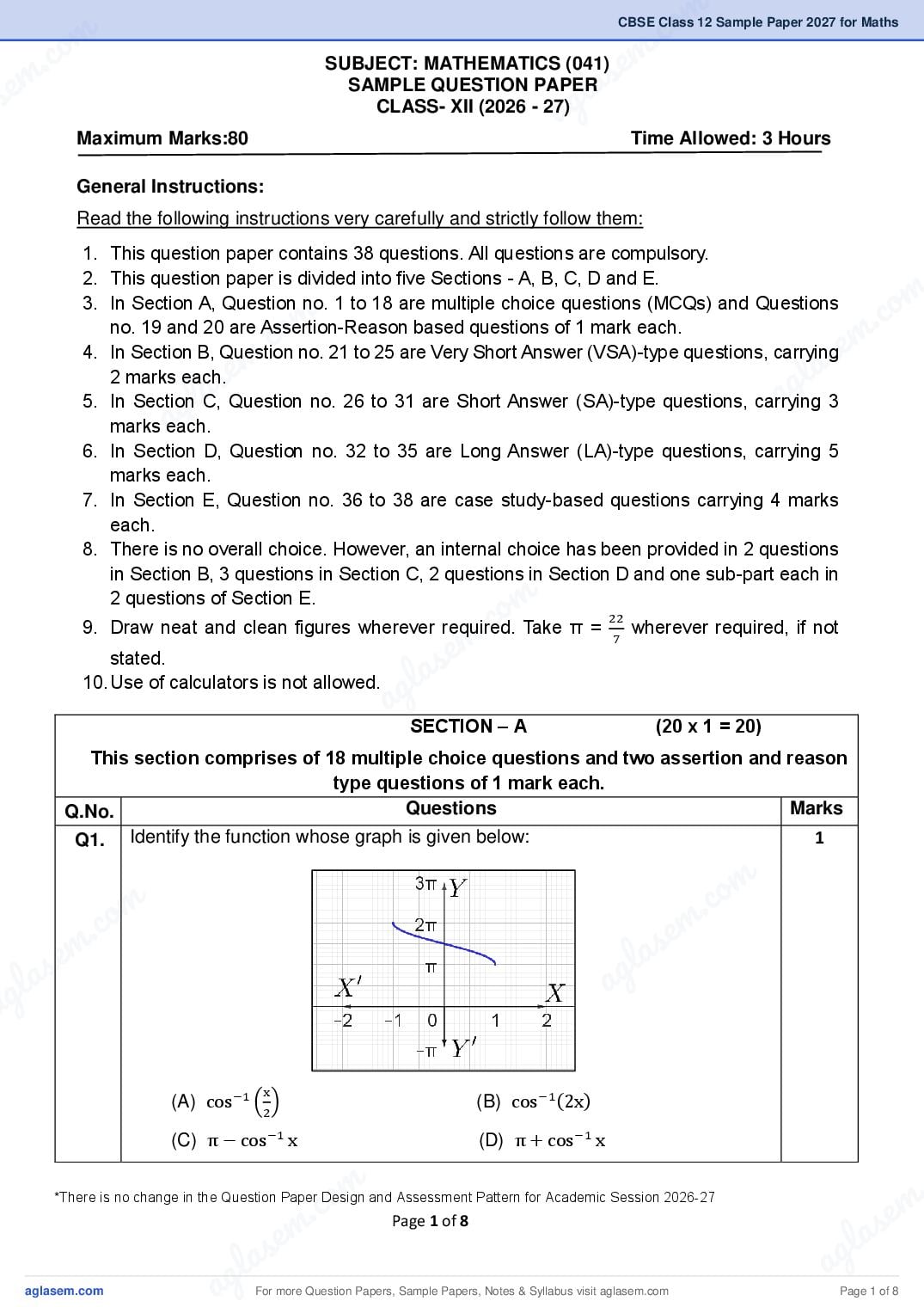
Q1. Identify the function whose graph is given below: 1
m
m .co
m .co s e m
s e g l a
g la a
a
x
(A) cos −1 ( ) (B) cos −1(2x)
2
(C) π − cos −1 x (D) π + cos −1 x
m .
.co e m
em
Page 1 of 8
l as
l as ag
ag For more Question Papers, Sample Papers, Notes & Syllabus visit Page 1 of 8
Page 3
𝜋 𝑥
Find the range of + sec −1 ( )
2 2
𝜋
(A) [0, 𝜋] (B) [0, 𝜋] − { }
2
𝜋 3𝜋 𝜋 3𝜋
(C) [ , ] (D) [ , ] − {𝜋}
2 2 2 2
Q2. Domain of the function: sec −1 (2𝑥) is 1
1 1
(A) (−∞, ∞) (B) (− , )
2 2
1 1 1 1
(C) (−∞, − ) ∪ (2 , ∞) (D) (−∞, − ] ∪ [ , ∞)
2 2 2
1 √3 1
Q3. Value of cot −1 (2 cos ( sin−1 ( )))
2 2
𝜋 π π 𝜋
(A) (B) (C) (D)
6 4 3 2
Q4. 2 1 −2 1
If 𝐴 = [3𝑎 0 4 ] is a symmetric matrix, then value of √6𝑎 + 2𝑏 + 3𝑐 is:
𝑏 2𝑐 1
(A) −2 (B) 2 (C) ±2 (D) 4
Q5. 2 1 |𝑄| 1
If 𝑃 and 𝑄 are matrices of same order such that 𝑃 = [ ], = 3, then find
0 1
|𝑎𝑑𝑗(𝑃𝑄)|
(A) -3 (B) 1 (C) 6 (D) 36
Q6. 1 0 4 1
If [1 𝑥] [ ] [ ] = 𝑂, then value of 𝑥 is
0 2 −1
(A) −2 (B) −1 (C) 1 (D) 2
Q7. The derivative of cos −1 (2𝑥 2 − 1) with respect to cos −1 (𝑥) is 1
1
(A) 2 (B) ±1 (C) (D) −3
2
Q8. If 𝑎, 𝑏, 𝑐 are arbitrary constants such that the function defined by 1
𝑎𝑥 2 + 𝑏 , 𝑏 ≠ 0 , 𝑥 ≤ 1
𝑓(𝑥) = { is differentiable at 𝑥 = 1, then which of the
𝑏𝑥 2 + 𝑎𝑥 + 𝑐 , 𝑥 > 1
following could be a triplet for (𝑎, 𝑏, 𝑐)?
3 3
(A) (3,2,0) (B) (0,0,3) (C) ( , 2,0) (D) (3, , 0)
2 2
𝑥 1
Q9. If 𝑦 = 𝑎 {𝑥 + 2𝑎 sin ( )} , 𝑎 > 0, 𝑥 ∈ [0, 𝜋𝑎]; is a decreasing function, then the
𝑎
interval in which 𝑥 lies is
5𝜋 2𝜋 5𝜋𝑎 2𝜋𝑎
(A) ( , 𝜋] (B) ( , 𝜋] (C) ( - , 𝜋𝑎] (D) ( , 𝜋𝑎]
6 3 6 3
Page 2 of 8
For more Question Papers, Sample Papers, Notes & Syllabus visit Page 2 of 8
Page 4
m .co
c. oQ10. The values of 𝑥 for which the derivative of the function 𝑦 =se𝑥mis greater 4
m
1
se g la
than the value of the function are
a
(A) 0<𝑥<4 (B) 0 < 𝑥 ≤ 4
(C) 𝑥 < 0 𝑜𝑟 𝑥 > 4 (D) 𝑥 < 0 𝑜𝑟 𝑥 ≥ 4
2
Q11. 𝑑𝑦 3 𝑑2 𝑦 1
The degree and order of the differential equation 𝑦 − 𝑥 ( ) = 𝑎 (𝑦 + )
𝑑𝑥 𝑑𝑥 2
are respectively
m
.co
(A) 3 , 1 (B) 2 , 2 (C) 3 , 2 (D) 4 , 2
o m m
1
𝑑𝑥 m
c
= 𝑥. − 𝑃 𝑙𝑜𝑔(1 + 𝑒 ) + 𝐶, then ‘𝑃’ is equal to 1
s e
a
Q12. If ∫ 2𝑥
1+𝑒
s e 2𝑥
l
g a
l− 2
1
(B) −
1 1 1 ag
a
(A)
3
(C)
3
(D)
2
Q13. If vector 2𝑖̂ − 𝑢𝑗̂ + 3𝑘̂ has magnitude 4, then value of ‘𝑢’ is 1
(A) 1 (B) √2 (C) ±√3 (D) ±2
Q14. Angle made by the vector 𝑖̂ + 𝑗̂ + √2 𝑘̂ with positive direction of z-axis is 1
𝜋 𝜋 𝜋 𝜋
(A) (B) (C) (D)
6 4
o m 3 2
Q15. A vector perpendicular to the vectors 𝑖̂ + 𝑗̂ and 𝑖̂ − 𝑗̂ is . c 1
e (C) 2𝑖̂ m
(A) −2 𝑗̂
l as(B) 3𝑘̂ (D) 2𝑖̂ + 𝑘̂
a g
Q16. The probability that it rains on a particular day is . Assuming weather
1
1
5
conditions of any two days are independent, find the probability that it rains on
three consecutive days.
4 1 1 1
(A) (B) (C) (D)
5 5 25 125
A die is thrown twice. What is the probability that at least one number is 4, 1
om
Q17.
o mgiven the sum of the numbers appearing is a multiple of 5? . c
.c e4 m
e m 3 4 3
a
l 7s
l as (A)
5
(B)
5
(C)
7
a g
(D)
ag Q18. 𝐴 and 𝐵 are two independent events such that 𝑃(𝐴) = 16 , 𝑃(𝐵) = 𝑘. If the 1
1
probability of occurrence of exactly one of them is , then find the value of 𝑘.
3
1 2 3 5
(A) (B) (C) (D)
4 3 4 6
m .
.co e m
em
Page 3 of 8
l as
l as ag
ag For more Question Papers, Sample Papers, Notes & Syllabus visit Page 3 of 8
Page 5
Directions: Question numbers 19 and 20 are Assertion and Reason based
questions carrying 1 mark each. Two statements are given, one labelled
Assertion (A) and the other labelled Reason (R).
Select the correct answer from the options (A), (B), (C) and (D) as given
below:
(A) Both Assertion (A) and Reason (R) are true and Reason (R) is the correct
explanation of Assertion (A).
(B) Both Assertion (A) and Reason (R) are true but Reason (R) is not the correct
explanation of Assertion (A).
(C) Assertion (A) is true but Reason (R) is false.
(D) Assertion (A) is false but Reason (R) is true.
1
Q19. Assertion: The value of the integral ∫−1|𝑥 − 2| 𝑑𝑥 is 4 1
𝑎 𝑎
Reason: If 𝑓(−𝑥) = 𝑓(𝑥) then ∫−𝑎 𝑓(𝑥)𝑑𝑥 = 2 ∫0 𝑓(𝑥)𝑑𝑥
Q20. Assertion: The general solution of a differential equation represents a family 1
of curves.
Reason: The derivative of an arbitrary constant is zero.
SECTION – B (5 x 2 = 10)
This section comprises of 5 very short answer (VSA) type questions of 2 marks each
1
Q21 Evaluate ∫ 𝑑𝑥
𝑥 √𝑥 6 −1
(A).
OR 2
𝑐𝑜𝑠 𝑥−sin 𝑥
Q21 Evaluate ∫ 𝑑𝑥
(B). √sin(2𝑥)
𝑑𝑦
Q22. If 𝑦 = sin(𝑥 + 𝑦) and = 0 , then prove that 𝑦 = ± 1. 2
𝑑𝑥
Q23 A line passing through the points (2,6,5), 𝑎𝑛𝑑 (3, 𝑝, 7) is parallel to the line
𝑞
(A). joining the points (−4, 3,4) and (−1,0, 𝑞). Find the value of .
𝑝
OR 2
Q23 ⃗⃗⃗⃗⃗ = 𝑢
A rectangle ABCD is such that 𝐴𝐶 ⃗ , 𝑎𝑛𝑑 ⃗⃗⃗⃗⃗⃗
𝐵𝐷 = 𝑣, then find the vectors
(B). representing four sides of the rectangle (in a cyclic order starting from ⃗⃗⃗⃗⃗
𝐴𝐵 ).
Q24. For two non-zero vectors 𝑎 and 𝑏⃗, |𝑎| = √6 , 𝑎 ∙ 𝑏⃗ = 1 and 𝑏⃗ × 𝑎 = 3𝑖̂ + 4𝑗̂ −
2
2𝑘̂. Find |𝑏⃗|.
Page 4 of 8
For more Question Papers, Sample Papers, Notes & Syllabus visit Page 4 of 8
Page 6
m .co
c. oQ25. The feasible region of a linear programming problem is shown
s e min the given
m
2
se figure:
g la
a
m
m .co
Write all the constraints on the decision variables involved
. c o e m
em
For Visually Impaired:
l as
For a linearsprogramming g
g l a problem, the maximum value of an objective
a
𝑞
a
function 𝑍 = 3𝑥
between 𝑝 and 𝑞.
+ 4𝑦 exists at the points (𝑝, 𝑞) and (2𝑝, ). Find the relation 2
SECTION – C (6 x 3 = 18)
This section comprises of 6 short answer (SA) type questions of 3 marks each.
Q26. 1 0
2 0 0
For two matrices, 𝑃 = [ ] and 𝑄 = [0 2], find 𝑃𝑄 and 𝑄𝑃, whichever
0 1 2
om
1 0 3
. c
is defined. Also, find the inverse of the product matrix, if it exists.
e m
Q27.
las
The circular area of vision on the ground by a surveillance
ag
drone fitted with camera increases at the rate of
44 𝑚2 per metre as it gains vertical height. The radius of
the circle on the ground increases at the rate of 6 m/s. 3
Find the rate at which the height of the drone increases
with time, at the instant when the radius of the circular
22
area on the ground is 14 m. (𝑈𝑠𝑒 𝜋 = )
7
𝑑2 𝑦 1 1
Q28 If 𝑥 = 𝑠𝑖𝑛3 𝑡 , 𝑦 = 𝑐𝑜𝑠 3 𝑡 , 𝐸𝑣𝑎𝑙𝑢𝑎𝑡𝑒 𝑎𝑡 ( , ).
𝑑𝑥 2 2√2 2√2
m
(A).
om
c If 𝑦 = 𝑥
OR
m .co 3
.
Q28
m
𝑙𝑜𝑔𝑥
+ (𝑙𝑜𝑔𝑥)𝑥 ; 𝑥 > 1, then evaluate
𝑑𝑦
s e
s e (B).
𝑑𝑥
g l a
l a a
ag (A). 𝑥𝑑𝑦 + (𝑦 − 𝑥 𝑒 )𝑑𝑥 = 0, given that y (1) =0
Q29 Find the particular solution of the differential equation
2 𝑥
OR 3
Q29 Find the particular solution of the differential equation (𝑥 2 + 𝑦 2 )𝑑𝑦 = 𝑥𝑦𝑑𝑥,
(B). given that 𝑦(0) = 1
m .
.co e m
em
Page 5 of 8
l as
l as ag
ag For more Question Papers, Sample Papers, Notes & Syllabus visit Page 5 of 8
Page 7
2𝑦+3
(A). 𝑥−2= = 2 − 𝑧. Also find the equation of the line passing through this
4
point and the point (2,1,4).
OR
3
𝑥−1 𝑦−1 𝑧−2 𝑥−5 1
Q30 Find the angle between the lines: = = and =𝑦− =
2 2 1 2 2
(B). 3−𝑧
. Also find the cartesian equation of a line passing through the point (1,1,1)
2
and perpendicular to both lines.
Q31. Solve the linear programming problem graphically: 3
Maximize 𝑍 = 40𝑥 + 30𝑦
Subject to constraints: 𝑥 + 𝑦 ≤ 6, 2𝑥 ≥ 𝑦, 𝑦 ≥ 2
For Visually Impaired:
For a linear programming problem, vertices of the feasible region are
(20,0), (40,0), (30,10), (0,20) and (0,10). Minimize and maximize the objective
function 𝑍 = 50𝑥 − 20𝑦
SECTION – D (4 x 5 = 20)
This section comprises of 4 long answer (LA) type questions of 5 marks each.
Q32 Let 𝐴 = 𝑁 × 𝑁, where 𝑁 is the set of natural numbers and a relation 𝑅 is
(A). defined on 𝐴 such that (𝑎, 𝑏)𝑅(𝑐, 𝑑) 𝑖𝑓 𝑎𝑛𝑑 𝑜𝑛𝑙𝑦 𝑖𝑓 𝑎2 + 𝑑2 = 𝑏 2 + 𝑐 2 .
Check whether 𝑅 is an equivalence relation or not?
OR
Q32 A relation 𝑅: (−∞, ∞) → [0, ∞) is defined as 𝑅 = {(𝑥, 𝑦): 𝑦 = 𝑥 2 + 5}
(B). Draw its graph and check whether it is a function or not.
If the given relation is a function, then examine whether the function is 5
injective, and whether it is surjective or not.
For Visually Impaired:
A relation 𝑅: (−∞, ∞) → [0, ∞) is defined as 𝑅 = {(𝑥, 𝑦): 𝑦 = 𝑥 2 + 7}.
Check whether it is a function or not. If the given relation is a function, then
examine whether the function is injective, surjective, or both, and conclude
whether it is bijective or not.
Q33. 𝑎 𝑎−𝑥
Evaluate ∫−𝑎 √ 𝑑𝑥 5
𝑎+𝑥
Q34 Using Integration, find the area of the region
(A).
{(𝑥, 𝑦): 0 ≤ 𝑦 ≤ √4 − 𝑥 2 , 𝑥 ≥ 2 − 𝑦}.
OR 5
Q34 Using Integration, find the area of the region bounded by the curve
(B). 𝑦 2 = 2𝑥 and the line 𝑥 − 2𝑦 = 0.
Page 6 of 8
For more Question Papers, Sample Papers, Notes & Syllabus visit Page 6 of 8
Page 8
m .co
m .co For Visually Impaired:
s e m
se Q34 400 la 25𝑥 + 16𝑦 =
Using Integration, find the area of the region enclosedgwithin 2 2
(A). a
OR 5
Q34 Using Integration find the area of the region in the first quadrant bounded by
(B). the curve 𝑦 2 = 8𝑥, and the lines 𝑥 = 2, 𝑥 = 5 and x-axis.
Q35. A fitness app syncs with four types of smartwatches: Alpha, Beta, Gamma 5
and Delta. 45% of the users use Alpha, 30% use Beta,15% use Gamma and
m
.co
10% use Delta.
m
.co m
Due to device errors, the probabilities of getting a false heart-rate alert from
s e
em
the Alpha, Beta, Gamma and Delta smartwatches are respectively 0.01, 0.02,
s l a
la ag
0.05, and 0.01.
g
Based on the given information, answer the following questions:
(i)a Find the probability that a randomly selected user gets a false alert.
(ii) If a false alert occurs, what is the probability that it came from a Beta
smartwatch?
SECTION – E (3 x 4 = 12)
This section comprises of 3 case-study/passage-based questions of 4 marks each with
sub parts. The first two case study questions have three sub parts (i), (ii), (iii) of marks 1,
o m
c
1, 2 respectively. The third case study question has two sub parts of 2 marks each.
m .emit laser beams for movement
detection. Three of these beams travelse
Q36. Two security sensors in a multi-storey mall
a along the following lines:
gl𝜆)𝑘̂ ̂and
1
a
𝑙 : 𝑟 = (𝜆 + 1)𝑖̂ + (3𝜆 + 2)𝑗̂ + (3 −
𝑙 : 𝑟 = 2(𝜇 + 1)𝑖̂ + (3𝜇 − 1)𝑗̂ + (𝜇 + 1) 𝑘
2
𝑙3 : 𝑟 = (𝛾 + 3)𝑖̂ + (3𝛾 − 1)𝑗̂ + (1 − 𝛾) 𝑘̂
m
m .co
.co s e m
s em g l a
g la a
a
Based on the given information, answer the following questions:
(i) Show that the lines 𝑙 and 𝑙 are not parallel to each other.
1 2
1
(ii) Show that the lines 𝑙1 and 𝑙3 are parallel to each other. 1
(iii) (a) Find the shortest distance between the lines 𝑙1 and 𝑙2 .
OR
2
(b) Find the shortest distance between the lines 𝑙1 and 𝑙3 .
m .
.co e m
em
Page 7 of 8
l as
l as ag
ag For more Question Papers, Sample Papers, Notes & Syllabus visit Page 7 of 8
Page 9
Water is essential
essential for
for life,
life, and
and rivers
rivers are
are vital
vital water
water sources
sources across
across the
the world.
world.
The Yamuna Action Plan (YAP), one of India’s India's largest river restoration
projects, was
projects, was launched
launched to to clean
clean the
the Yamuna,
Yamuna, but but its
its effectiveness
effectiveness must
(WQI)bethe
Water Quality
measured Indexcost-benefit,
through must be measured
economic through cost-benefit, economic
and environmental analysis. and
environmental
Therefore, analysis. Therefore,
comprehensive pollutantcomprehensive pollutant
treatment, prevention of treatment,
further
prevention of further
contamination, contamination,
and community and community
awareness are crucialawareness are crucial
for sustainable river for
sustainable river management.
management.
Implementing the same concept to the river Yamuna, if an initial base line
WQI is 35, a quadratic expression is formed to measure the impact of
investment of ₹𝑥 crore on the WQI i.e., 𝑊(𝑥) as
𝑊(𝑥) = 35 + 1.6𝑥 − 0.02𝑥 2, where 𝑥 is in Rupees in crores
Use the given 𝑊(𝑥) to answer the following questions:
(i) Find the value of 𝑥 at the stationary point for the function 𝑊(𝑥). 1
(ii) Find the maximum value of the WQI using the second derivative
1
test?
(iii) (a) If the investment is ₹ 35 crores, find by how much the WQI is
short of its maximum achievable value.
Or 2
(b) Evaluate the WQI when the investment is ₹60 crore. Determine
whether this indicates an enhancement or a diminishing return in
our objective when compared with the optimum WQI.
Q38. To celebrate their child's birthday, a family decided to distribute fruits among
children in three orphanages. The fruit vendor packed three different types of
baskets, according to the quantity required at each orphanage, details are
given as follows:
Basket A contains 5 kg Apples, 10 kg Oranges and 5 kg Pomegranate
Basket B contains 10 kg Apples, 10 kg Oranges and 5kg Pomegranate
Basket C contains 8 kg Apples, 15 kg Oranges and 7kg Pomegranate
Cost of basket A, B and C are respectively ₹2750, ₹3500, and ₹4100.
Based on the given information, answer the following questions:
(i) Write the matrix form of the equations involved in this situation and
2
find the adjoint of the coefficient matrix involved.
(ii) Using inverse of the matrix, calculate the price of each fruit per kg. 2
Page 8 of 8
For more Question Papers, Sample Papers, Notes & Syllabus visit Page 8 of 8
Document Details
| Board / Org | CBSE |
| Exam | Class 12 |
| Type | Sample Paper |
| Pages | 8 |
| Updated | 29 Oct 2026 |