HBSE Class 11 Sample Paper 2026 Chemistry
Finished viewing? Save it for later —
Download HBSE Class 11 Sample Paper 2026 Chemistry (PDF · 16 pages)About HBSE Class 11 Sample Paper 2026 Chemistry
HBSE Class 11 Sample Paper 2026 Chemistry is available here for free download. Published by Haryana Board for Class 11, this sample paper can be viewed online or downloaded as a PDF (16 pages). Candidates preparing for Class 11 can use HBSE Class 11 Sample Paper 2026 Chemistry to understand the exam pattern, the type of questions asked, and the overall difficulty level.
Frequently Asked Questions
How can I download HBSE Class 11 Sample Paper 2026 Chemistry?
Open this page and click the Download button to save HBSE Class 11 Sample Paper 2026 Chemistry as a PDF. It is completely free on AglaSem Docs.
Is HBSE Class 11 Sample Paper 2026 Chemistry free to download?
Yes. HBSE Class 11 Sample Paper 2026 Chemistry can be viewed online and downloaded as a PDF free of cost on AglaSem Docs.
How many pages does HBSE Class 11 Sample Paper 2026 Chemistry have?
HBSE Class 11 Sample Paper 2026 Chemistry contains 16 pages, which you can read online or download together as a single PDF.
Where can I find more Class 11 study material?
You can find more Class 11 question papers, sample papers, syllabus, and answer keys on AglaSem Docs.
HBSE Class 11 Sample Paper 2026 Chemistry – Text
Read the full text of this sample paper below — useful to quickly search, copy and reference the content online without downloading the PDF.
📄 View text version (16 pages)
Page 1
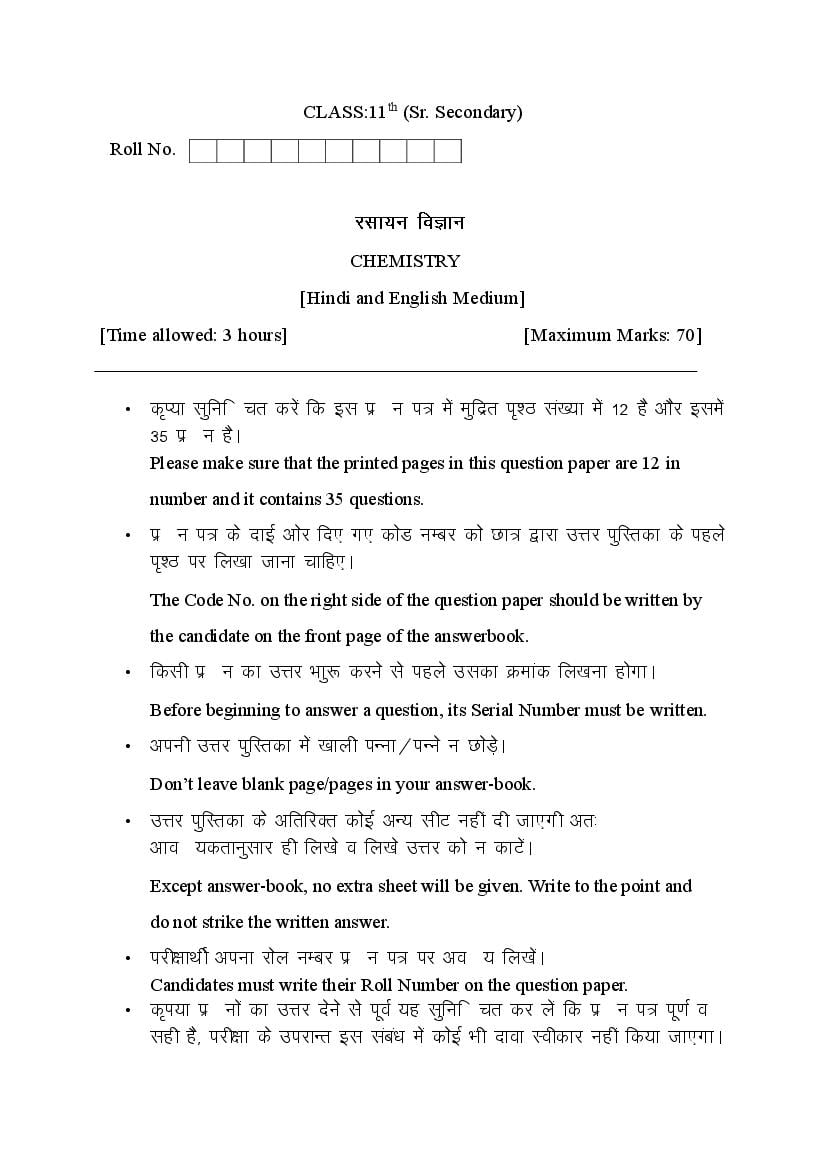
Roll No.
CHEMISTRY
[Hindi and English Medium]
[Time allowed: 3 hours] [Maximum Marks: 70]
• d`I;k lqfuf”pr djsa fd bl iz”u i= esa eqfnzr i`’B la[;k esa 12 gS vkSj blesa
35 iz”u gSA
Please make sure that the printed pages in this question paper are 12 in
number and it contains 35 questions.
• iz”u i= ds nkbZ vksj fn, x, dksM uEcj dks Nk= }kjk mÙkj iqfLrdk ds igys
i`’B ij fy[kk tkuk pkfg,A
The Code No. on the right side of the question paper should be written by
the candidate on the front page of the answerbook.
• fdlh iz”u dk mÙkj “kq: djus ls igys mldk Øekad fy[kuk gksxkA
Before beginning to answer a question, its Serial Number must be written.
• viuh mÙkj iqfLrdk esa [kkyh iUuk@iUus u NksMA+s
Don’t leave blank page/pages in your answer-book.
• mÙkj iqfLrdk ds vfrfjDr dksbZ vU; lhV ugha nh tk,xh vr%
vko”;drkuqlkj gh fy[ks o fy[ks mÙkj dks u dkVsAa
Except answer-book, no extra sheet will be given. Write to the point and
do not strike the written answer.
• ijh{kkFkhZ viuk jksy uEcj iz”u i= ij vo”; fy[ksaA
Candidates must write their Roll Number on the question paper.
• d`Ik;k iz”uksa dk mÙkj nsus ls iwoZ ;g lqfuf”pr dj ysa fd iz”u i= iw.kZ o
lgh gS] ijh{kk ds mijkUr bl laca/k esa dksbZ Hkh nkok Lohdkj ugha fd;k tk,xkA
Page 2
correct and complete question paper, no claim in this regard, will be
entertained after examination.
lkekU; funsZ”k %
(i) lHkh iz”u vfuok;Z gSA
(ii) oLrqfu’B iz”uksa ds mÙkj lgh fodYi fy[ksAa
(iii) izR;sd iz”u ds vad mlds lkeus n”kkZ, x, gSaA
General Instructions:
i) All questions are compulsory.
ii) Write the correct option in objective type questions.
iii) Marks of each question are indicated against it.
1. Which of the following is independent of temperature? 1
(a) Molarity (b) Formality
(c) Normality (d) Molality
fuEufyf[kr esa ls dkSu rkieku ls Lora== gS\
(a) eksyfjVh (b) vkSipkfjdrk
(c) lk/kkj.k voLFkk (d) eksySfyVh
2. Number of significant figures in 2.005 are : 1
(a) 1 (b) 2
(c) 3 (d) 4
2-005 esa lkFkZd vadks dh la[;k gS %
(a) 1 (b) 2
(c) 3 (d) 4
3. Which series series of lines is the only series in the hydrogen spectrum
which appears in the visible region of electromagnetic spectrum ? 1
(a) Lymen (b) Balmer
(c) Paschen (d) Bracket
Page 3
LisVªe ds n`”;&{ks= esa izkIr gksrh gS\
(a) ykbeSu (b) ckej
(c) ik”pu (d) czsdsV
4. Out of isoelectronic ions 0 2- ,F - , Na + and Mg 2+ , which will have
smallest radius ? 1
(a) 0 2- (b) Na+
(c) Mg 2+ (d) F-
lebysDVªkWfud vk;uksa 0 2- ,F - , Na + vkSj Mg 2+ esa ls fdldh f=T;k U;wure
gS\
(a) 0 2- (b) Na+
(c) Mg 2+ (d) F-
𝐶𝐶𝑙4
5. CH 2 = CH 2 + Br 2 → X
Here X is : 1
(a) CH 2 – CH 2 (b) CH 2 = CHBr
Br Br
(c) CH CH (d) CH = CH
Br Br
𝐶𝐶𝑙4
CH 2 = CH 2 + Br 2 → X
;gk¡ mRikn gS%
(a) CH 2 – CH 2 (b) CH 2 = CHBr
Br Br
(c) CH CH (d) CH = CH
Br Br
6. The repulsive interaction of electron pair decrease in the order
(Here lp = lone pair, bp = bond pair) 1
(a) bp – bp > lp – bp > lp – lp
Page 4
(c) lp – lp > bp – bp > lp – bp
(d) bp – bp > lp – lp > lp – bp
bysDVªku ;qXeksa ds chp izfrd’kZ.k vU;ksU; fdz;k,¡ fuEufyf[kr Øe esa ?kVrh gSa
¼;gk¡ ,dkdh ;qXe] vkca/kh ;qXe½ %
(a) bp – bp > lp – bp > lp – lp
(b) lp – lp > lp – bp > bp - bp
(c) lp – lp > bp – bp > lp – bp
(d) bp – bp > lp – lp > lp – bp
7. State of hybridisation of carbon in HCHO is: 1
(a) sp (b) sp 2
(c) sp 3 (d) dsp 2
HCHO esa dkcZu dh ladj.k voLFkk gS %
(a) sp (b) sp 2
(c) sp 3 (d) dsp 2
8. If concentration of hydrogen ion [H +] changes by a factor of 100, then
the value of pH changes by:- 1
(a) one unit (b) 2 unit
(c) 10 unit (d) 100 unit
;fn gkbMªkstu vk;u lkanzrk esa 100 xq.kd dk ifjorZu gks] rks ds eku esa
ifjorZu gksxk %
(a) ,d bdkbZ (b) 2 bdkbZ
(c) 10 bdkbZ (d) 100 bdkbZ
9. Which of the following species do not show disproportionation
reaction? 1
(a) 𝐶𝑙𝑂− (b) 𝐶𝑙𝑂2−
(c) 𝐶𝑙𝑂3− (d) 𝐶𝑙𝑂4−
Page 5
(a) 𝐶𝑙𝑂− (b) 𝐶𝑙𝑂2−
(c) 𝐶𝑙𝑂3− (d) 𝐶𝑙𝑂4−
Fill in the blanks in following questions (10-12) :
fuEufyf[kr iz”uksa ¼10&12½ esa fjDr LFkku Hkjsa %
10. Oxidation number of Sulphur (S) in H2S2O7 is …………………. 1
H2S2O7 esa lYQj dh vkWDlhdj.k la[;k ------------------------ gSaA
11. Total number of sigma (𝜎) and pi () bonds in C2H2 is …………………. 1
C2H2 v.kq esa flXek (𝜎) rFkk ikbZ () vkca/kksa dh dqy la[;k ----------------------- gSA
12. The conjugate base of 𝑁𝐻2− is ………………… 1
𝑁𝐻2− dk la;qXeh {kkjd --------------------------------- gSA
Answer the following questions (13-15) in one word/sentence:
fuEufyf[kr iz”uksa ¼13&15½ ds mRrj ,d “kCn@okD; esa nhft, %
13. Draw the Lewis structure for H2S. 1
H2S v.kq dh ywbl lajpuk fyf[k,A
14. Write the formula of the compound Iron (III) sulphate. 1
vk;ju (III) lYQsV ;kSfxd dk lw= fyf[k,A
15. Given the standard electrode potentials, arrange these metals in their increasing
order of reducing power: 1
K+ / K = -2.93 V, Ag+ / Ag = 0.80V
Hg2+ / Hg = 0.79 V, Mg2+ / Mg = -2.37V
uhps fn, x, ekud bysDVªksM foHkoksa ds vk/kkj ij /kkrqvksa dks mudh c<+rh
vipk;d {kerk ds Øe esa fyf[k,%
K+ / K = -2.93 V, Ag+ / Ag = 0.80V
Hg2+ / Hg = 0.79 V, Mg2+ / Mg = -2.37V
Note: In the following questions (Q. Nos. 16, 17 and 18 ) two statements are given for
each. Assertion (A) and Reason (R). Study both the statement carefully and
Page 6
the given options (a), (b), (c), & (d):
Options:
(a) Both Assertion (A) and Reason (R) are true and Reason (R) is the correct
explanation of Assertion (A).
(b) Both Assertion (A) and Reason (R) are true, but Reason (R) is not the
correct explanation of Assertion (A).
(c) Assertion (A) is true, but Reason (R) is false.
(d) Assertion (A) is false, but Reason (R) is true.
uksV % fuEufyf[kr iz”uksa ¼iz0 la0 16] 17 ,oa 18½ esa nks dFku fn;s x;s gSaA
vfHkdFku(A) rFkk dkj.k(R) nksuksa dFkuksa dk /;kuiwoZd v/;;u djsa ,oa fu.kZ;
yhft, dh dkSu&lk mRrj fodYi lgh gS rFkk lgh mRrj dks fn;s x;s fodYi
(a), (b), (c), & (d) ,oa esa ls pqudj fyf[k, %
fodYi %
(a) vfHkdFku rFkk dkj.k nksuksa lR; gS vkSj dkj.k vfHkdFku dh lgh
O;k[;k gSA
(b) vfHkdFku rFkk dkj.k nksuksa lR; gS] ijUrq dkj.k vfHkdFku dh lgh
O;k[;k ugh gSA
(c) vfHkdFku lR; gS] ijUrq dkj.k vlR; gSA
(d) vfHkdFku vlR; gS] ijUrq dkj.k lR; gSA
16. Assertion (A) : Trans-But-2-ene has higher melting point than cis form. 1
Reason (R): Cis-But-2-ene is more polar than trans form.
vfHkdFku (A) % foi{k&C;wV&2&bZu dk xyukad lei{k C;wV&2&bZu ls mPp
gksrk gSA
dkj.k (R) % ,Ydhu dk lei{k :i] foi{k dh rqyuk esa vf/kd /kzqoh;
gksrk gSA
17. Assertion (A): Noble gases are highly reactive. 1
Reason (R): Noble gases have stable closed shell electronic configuration.
vfHkdFku (A) % mRd`’V xSlsa vf/kd fØ;k”khy gksrh gSA
Page 7
18. Assertion (A) : The bond order of helium molecule is zero. 1
Reason (R) : The number of electrons in bonding molecular orbitals and
anti-bonding molecular orbitals are equal in helium
molecule.
vfHkdFku (A) % ghfy;e v.kq dk vkca/k dksfV “kwU; gSA
dkj.k (R) % ghfy;e esa vkca/kh vkf.od d{kdksa ,oa izfr&vkca/kh vkf.od
d{kdksa esa mifLFkr bysDVªkWuksa dh la[;k cjkcj gksrh gSA
Section – B
[k.M & c
(Very Short Answer Type Questions)
¼vfr&y?kwÙkjkRed iz”u½
19. What is law of multiple proportion? Explain with example. 2
xqf.kr vuqikr dk fu;e D;k gS\ mnkgj.k lfgr Li’V dhft,A
20. State and explain ‘Heisenberg Uncertainty Principle’. 2
^gkbtsucxZ dk vfuf”prrk fl)kUr* crkb, o le>kb,A
21. How do atomic radius vary in a period and in a group? How do you explain the
variation? 2
fdlh oxZ ;k vkorZ esa ijek.kq f=T;k fdl izdkj ifjofrZr gksrh gS\ bl
ifjorZu dh O;k[;k vki fdl izdkj djsx a s\
22. What is the basic difference between the terms ‘electron gain enthalpy’ and
‘electronegativity’? 2
^bysDVªkWu yfC/k ,UFkSYih* vkSj ^bysDVªkWu _.kkRedrk* esa D;k ewy vUrj gS \
23. Describe the effect of : 2
(i) addition of H2 (ii) removal of CH3OH on the
equilibrium 2H2(g) + CO (g) ←
⃑⃑⃑ CH3OH(g)
lkE; 2H2(g) + CO (g) ←
⃑⃑⃑ CH3OH(g) ij fuEufyf[kr dk izHkko crkb, %
(i) H2 feykus ij (ii) CH3OH gVkus ij
Page 8
vFkok
What are buffer solutions? Give example.
cQj&foy;u D;k gSa \ mnkgj.k nhft,A
24. Balance the following redox reaction by ion-electron method: 2
Mn𝑂4− (𝑎𝑞) + 𝐼 − (𝑎𝑞) → 𝑀𝑛𝑂2 (𝑠) + 𝐼2 (𝑠)
(In acidic medium)
vk;u&bysDVªkWu fof/k }kjk fuEufyf[kr jsMkWDl vfHkfØ;k dks larqfyr dhft, %
Mn𝑂4− (𝑎𝑞) + 𝐼 − (𝑎𝑞) → 𝑀𝑛𝑂2 (𝑠) + 𝐼2 (𝑠)
¼vEyh; ek/;e½
(OR)
vFkok
Consider the elements: Cs, Ne, I and F identify the element that:
(i) exhibits only negative oxidation state.
(ii) exhibits only positive oxidation state.
(iii) exhibits both negative and positive oxidation state.
(iv) exhibits neither negative nor positive oxidation state.
Cs, Ne, I rFkk F esa ,sls rRoksa dh igpku dhft,] tks %
(i) dsoy _.kkRed vkWDlhdj.k voLFkk iznf”kZr djrk gSA
(ii) dsoy /kukRed vkWDlhdj.k voLFkk iznf”kZr djrk gSA
(iii) _.kkRed rFkk /kukRed nksuksa vkWDlhdj.k voLFkk iznf”kZr djrk gSA
(iv) u _.kkRed vkSj u gh /kukRed vkWDlhdj.k voLFkk iznf”kZr djrk gSA
25. Explain ‘functional group isomerism’ with the help of suitable example. 2
^fØ;kRed lewg leko;ork* dks mi;qDr mnkgj.k dh lgk;rk ls Li’V
dhft,A
(OR)
Page 9
Write IUPAC names of the following compounds: 2
(i) CH2 = CH – CH – COOH
OH
(ii) OH
Br
fuEufyf[kr ;kSfxdksa ds vkbZ0;w0ih0,0lh0 uke fyf[k, %
(i) CH2 = CH – CH – COOH
OH
(ii) OH
Br
Section – C
[k.M & l
(Short Answer Type Questions)
¼y?kwÙkjkRed iz”u½
26. (i) Define the term mole fraction. 1
eksy&va”k dks ifjHkkf’kr dhft,A
(ii) Calculate the molarity of NaOH in the solution prepared by dissolving its
5 gram in enough water to form 250ml of solution. 2
NaOH ds ,sls foy;u dh eksyjrk dk ifjdyu dhft,] ftls 5 xzke
NaOH dks ty dh i;kZIr ek=k esa feykdj izkIr fd;k x;k gks] rkfd
foy;u 250 feyhyhVj gks tk;sA
27. (i) For the reaction 2𝐶𝑙(𝑔) → 𝐶𝑙2 (𝑔), what are the sign of H and S? 1
vfHkfØ;k 2𝐶𝑙(𝑔) → 𝐶𝑙2 (𝑔) ds fy, H ,o S ads fpg~u D;k gksx
a s\
Page 10
value of G0? (R = 8.314 JK-1 mol-1) 2
300 K ij ,d vfHkfØ;k ds fy, lkE; fLFkjkad 10 gSA G0 dk eku D;k
gksxk\ (R = 8.314 JK-1 mol-1)
28. (i) What is pH? 1
pH D;k gS \
(ii) Assuming complete dissociation, calculate the pH of 0.002 M KOH. 2
iw.kZ fo;kstu ekurs gq, 0.002 M KOH foy;u dh pH Kkr dhft,A
29. (i) Identify the underlined reagent in the following equations as nucleophile
or elctrophile: 1
(a) CH3Br + HO- → CH3OH + Br- COCH3
(b) + 𝐶𝐻3 𝐶𝑂 →
fuEufyf[kr lehdj.kksa esa js[kkafdr vfHkdeZdksa dh ukfHkdLusgh rFkk
bysDVªkWuLusgh ds rkSj ij igpku dhft, %
(a) CH3Br + HO- → CH3OH + Br- COCH3
(b) + 𝐶𝐻3 𝐶 + 𝑂 →
(ii) Which of the following is expected to be more stable and why? 2
NO2CH2CH2O- and CH3CH2O-
fuEufyf[kr esa ls dkSu&lk vf/kd LFkk;h gS rFkk D;ksa\
NO2CH2CH2O- vkSj CH3CH2O-
(OR)
vFkok
What is resonance effect? Explain its types by giving one example of each.
vuqukn izHkko D;k gS \ izR;sd dk ,d mnkgj.k nsrs gq,] blds izdkjksa dks Li’V
dhft,A
Page 11
𝐻𝑔2+ /𝐻 +
CH3-C CH + H2O →
333k
vfHkfØ;k dks iwjk djsa %
𝐻𝑔2+ /𝐻 +
CH3-C CH + H2O →
333k
(ii) Explain ozonolysis with example. 2
vkstksuh vi?kVu dh mnkgj.k lfgr O;k[;k dhft,A
(OR)
vFkok
(i) Write the name and structural formula of the alkane used for the
preparation toluene by the process of ‘aromatization’. 1
^,sjkseSVhdj.k* izfØ;k }kjk VkWywbZu ds fojpu ds fy, iz;ksx fd;s tkus
okys ,Ydsu dk lajpukRed lw= o uke fyf[k,A
(ii) What happened when 1, 2-Dichloroethane is treated with alcoholic KOH
followed by reaction with sodamide.
D;k gksrk gS] tc 1] 2&MkbDyksjksbFksu dks ,Ydksgfyd ds lkFk mipkfjr
djds bldh vfHkfØ;k lksMkekbM ds lkFk dh tkrh gSA
Section – D
[k.M & n
(Case Study Type Questions)
¼dsl v/;;u izdkj ds iz”u½
31. The following questions (31 & 32) are case based. Read the case carefully and
answer the questions that follow:
fuEufyf[kr iz”u ¼31 ,oa 32½ dsl vk/kkfjr gSA dsl dks /;kuiwoZd i<+sa vkSj
uhps fn;s x;s iz”uksa ds mRrj nsa %
Case :
Neither decrease in enthalpy nor increase in entropy alone can determine the
direction of spontaneous change for a system. For this purpose, a new
thermodynamic function is defined, which is Gibbs energy or Gibbs function. It
Page 12
enthalpy and S is entropy of system. Gibbs function G is extensive property and
state function. If change in Gibbs energy G is negative, the process is
spontaneous. If G is positive, the process is non – spontaneous and if G is
zero, the process is in equilibrium.
Questions :
(i) Define the term extensive properties. 1
(ii) Write the unit of G. 1
(iii) For the reaction : 2
2 A(g) + B(g) → 2 D(g)
𝑈 0 = -10.5 kJ and 𝑆 0 = -44.1 J𝐾 − . Calculate 𝐺 0 for the reaction and
predict whether the reaction may occur spontaneously?
(R = 8.314 x 10⁻³ kJ K-1mol-1, T = 298K)
(OR)
Comment on the spontaneity of a reaction at constant temperature and
pressure in the following cases: 2
(i) H < 0 and S > 0 (ii) H > 0 and S < 0
(iii) H < 0 and S < 0 (iv) H > 0 and S > 0
dsl %
u rks dsoy ,UFkSYih esa deh vkSj] u gh ,UVªkWih esa o`f) Lor% izofrZr izdeksa dh
fn”kk fu/kkZfjr djrh gSA bl iz;kstu gsrq ge ,d u, Å’ekxfrdh Qyu dks
ifjHkkf’kr djrs gSaA tks fxCt ÅtkZ ;k fxCt Qyu gSA bls G }kjk fu:fir
fd;k tkrk gS vkSj xf.krh; :i ls G = H - TS ds :i esa O;Dr fd;k tkrk gSA
;gk¡ ,UFkSYih vkSj S fudk; dh ,UVªkWih gSA fxCt Qyu G foLrh.kZ xq.k ,oa ,d
voLFkk Qyu gSA ;fn fudk; dh fxCt ÅtkZ esa ifjorZu G _.kkRed gS] rc
izØe Lor% izofrZr gksrk gSA ;fn G /kukRed gS] rc vLor% izofrZr gksxk vkSj
;fn G “kwU; gS] rks izØe lkE; voLFkk esa gksxkA
iz”u %
(i) foLrh.kZ xq.k dks ifjHkkf’kr dhft,A
(ii) G dh bdkbZ fyf[k,A
Page 13
44.1 J𝐾 − gSA vfHkfØ;k ds fy, 𝐺 0 dh x.kuk dhft, vkSj crkb, fd
D;k vfHkfØ;k Lor% izofrZr gksxh \
(R = 8.314 x 10⁻³ kJ K-1mol-1, T = 298K)
vFkok
fuEufyf[kr ifjfLFkfr;ksa esa fLFkj rki o nkc ij fdlh vfHkfØ;k dh Lor%
izofrZr gksus ij fVIi.kh dhft, %
(i) H < 0 vkSj S > 0 (ii) H > 0 vkSj S < 0
(iii) H < 0 vkSj S < 0 (iv) H > 0 vkSj S > 0
32. During the organic reaction, a covalent bond between two carbon atoms or a
carbon atom and some other atom is broken and a new bond is formed. The
fission of bonds may be homolytic or heterolytic forming free radicals,
carbocations, carbanions etc. This depends upon the displacement of electron in
a bond and is governed by inductive effect, eletromeric effect, resonance effect
hyperconjugation.
(i) Give correct order of relative stability of the following carbanions: 1
𝐶𝐻3 , 𝐶𝐻3 , 𝐶𝐻2 , 𝐶𝐻2 𝐶𝑙, 𝐶𝐻𝐶𝑙2 , 𝐶𝐶𝑙3
(ii) What happened when 𝐶𝐻3 𝐶𝑙 undergo homolytic fission? 1
(iii) Do (𝐶𝐻3 )3 𝐶 + and (𝐶𝐻3 )3 𝐶 − have same structure? Explain. 2
(OR)
Which of the two Pℎ3 𝐶 + or (𝐶𝐻3 )3 𝐶 + is more stable and why? 2
dsl %
dkcZfud vfHkfØ;kvksa ds nkSjku nks dkcZu ijek.kqvksa vFkok ,d dkcZu vkSj ,d
vU; ijek.kq ds chp lgla;kstd vkca/k VwVdj ,d u;k vkca/k curk gSA vkca/kksa
dk fonyu leki?kVuh vFkok fo’ke vi?kVuh gks ldrk gSA ftlesa eqDr ewyd]
dkcZ/kuk;u] dkcZ_.kk;u bR;kfn curs gSaA ;g ,d vkca/k esa foLFkkiu ij fuHkZj
djrk gS vkSj izsjf.kd izHkko] bysDVªksejs h izHkko] vuqukn izHkko vkSj vfrla;qXeu
}kjk fu;af=r gksrk gSA
iz”u %
(i) fuEufyf[kr dkcZ_.kk;uksa ds LFkkf;Ro dk lgh Øe nhft, %
Page 14
(ii) D;k gksrk gS tc 𝐶𝐻3 𝐶𝑙 dk leki?kVuh fonyu gksrk gS\
(iii) D;k (𝐶𝐻3 )3 𝐶 + vkSj (𝐶𝐻3 )3 𝐶 − dh lajpuk leku gS \ Li’V dhft,A
vFkok
nksuksa Pℎ3 𝐶 + vFkok (𝐶𝐻3 )3 𝐶 + esa ls dkSu&lk vf/kd LFkk;h gS\ vkSj
D;ks\a
Section – E
[k.M & ;
(Long Answer Type Questions)
¼nh?kZ mÙkjkRed iz”u½
33. (i) Write de – Broglie equation. 1
ns&czkWXyh lehdj.k fyf[k,A
(ii) The mass of an electron is 9.1 x 10⁻³¹kg. If its kinetic energy is 3.0 x 10⁻²⁵J
Calculate its wavelength. 2
,d bysDVªkWu dk nzO;eku 9.1 x 10⁻³¹ fdxzk0 gSA ;fn bldh xfrt ÅtkZ
3.0 x 10⁻²⁵ twy gS] rks bldk rjax&nS/;Z D;k gksxk \
(iii) State and explain Aufbau Principle. 2
vkWQckÅ fl)kUr crkb, vkSj le>kb,A
(OR)
vFkok
(i) What is the significance of the square of wave function (𝜑 2 )? 1
rjax Qyu ds oxZ (𝜑2 ) dk D;k egRo gS \
(ii) What are the reasons for the failure of the Bohr model of hydrogen atom?
gkbMªkstu ijek.kq ds cksj ekWMy dh foQyrk ds D;k dkj.k gSa \ 2
(iii) What will be the wavelength of light emitted when the electron in H –
atom undergoes transition from an energy level n = 4 to n = 2? 2
Page 15
bysDVªkWu tkrk gS] rks fdl rjaxnS/;Z dk izdk”k mRlftZr gksxk \
34. (i) Explain why BeH2 molecule has zero dipole moment although the Be –H
bonds are polar. 1
;|fi vkca/k ?kzqoh; gS] rFkkfi v.kq dk f}/kzqo vk?kw.kZ “kwU; gSA Li’V
dhft,A
(ii) By writing molecular orbital electronic configuration, compare the
relative stability of following species and indicate their magnetic
properties: 𝑂2 , 𝑂2+ , 𝑂2− (Peroxide) 4
vkf.od d{kd bysDVªkWfud foU;kl fyf[krs gq,] fuEufyf[kr Lih”kht ds
vkisf{kd LFkkf;Ro dh rqyuk dhft, rFkk muds pqacdh; xq.k bafxr
dhft, %
𝑂2 , 𝑂2+ , 𝑂2− ¼ijvkWDlkbM½
(OR)
vFkok
(i) Describe the hybridisation in case of 𝑃𝐶𝑙5 . Why are axial bonds longer as
compared to equatorial bonds? 3
𝑃𝐶𝑙5 v.kq esa ladj.k dk o.kZu dhft,A buesa v{kh; vkca/k] fo’kqorh;
vkca/kksa dh vis{kk vf/kd yacs D;ksa gksrs gSa \
(ii) Distinguish between Sigma () and Pi () bond. 2
flXek () vkSj ikbZ () vkca/k esa vUrj dhft,A
35. (i) How will you convert benzene in to:
csthu dks fuEufyf[kr esa dSls ifjofrZr djsx
a s\
(a) p – nitrochlorobenzene
p – ukbVªksDyksjks cst
a hu
(b) m – nitrochlorobenzene 2
m – ukbVªksDyksjks cst
a hu
(ii) Write chemical equations for the preparation of Butane by following
reactions:
Page 16
fyf[k, %
(a) Wurtz reaction
oqVZt vfHkfØ;k
(b) Decarboxylation reaction 2
fodkcksZfDlyhdj.k vfHkfØ;k
(iii) What is Huckel Rule? 1
gdy fu;e D;k gS \
(OR)
vFkok
What is peroxide effect? Explain with the help of suitable example by giving
mechanism. Why peroxide effect is not observed in addition of HCl and HI? 5
ijkWDlkbM izHkko D;k gS \ mi;qDr mnkgj.k dh lgk;rk ls fØ;kfof/k nsdj Li’V
dhft,A ijkWDlkbM izHkko HCl rFkk HI ladyu esa iznf”kZr D;ksa ugha gksrk\
Document Details
| Board / Org | Haryana Board |
| Exam | Class 11 |
| Type | Sample Paper |
| Pages | 16 |
| Updated | 24 Sep 2026 |