NIOS Class 10 April 2024 Question Paper Painting
Finished viewing? Save it for later —
Download NIOS Class 10 April 2024 Question Paper Painting (PDF · 11 pages)About NIOS Class 10 April 2024 Question Paper Painting
NIOS Class 10 April 2024 Question Paper Painting is available here for free download. Published by NIOS for National Institute of Open Schooling Class 10, this question paper can be viewed online or downloaded as a PDF (11 pages). Candidates preparing for National Institute of Open Schooling Class 10 can use NIOS Class 10 April 2024 Question Paper Painting to understand the exam pattern, the type of questions asked, and the overall difficulty level.
Frequently Asked Questions
How can I download NIOS Class 10 April 2024 Question Paper Painting?
Open this page and click the Download button to save NIOS Class 10 April 2024 Question Paper Painting as a PDF. It is completely free on AglaSem Docs.
Is NIOS Class 10 April 2024 Question Paper Painting free to download?
Yes. NIOS Class 10 April 2024 Question Paper Painting can be viewed online and downloaded as a PDF free of cost on AglaSem Docs.
How many pages does NIOS Class 10 April 2024 Question Paper Painting have?
NIOS Class 10 April 2024 Question Paper Painting contains 11 pages, which you can read online or download together as a single PDF.
Where can I find more National Institute of Open Schooling Class 10 study material?
You can find more National Institute of Open Schooling Class 10 question papers, sample papers, syllabus, and answer keys on AglaSem Docs.
NIOS Class 10 April 2024 Question Paper Painting – Text
Read the full text of this question paper below — useful to quickly search, copy and reference the content online without downloading the PDF.
📄 View text version (11 pages)
Page 1
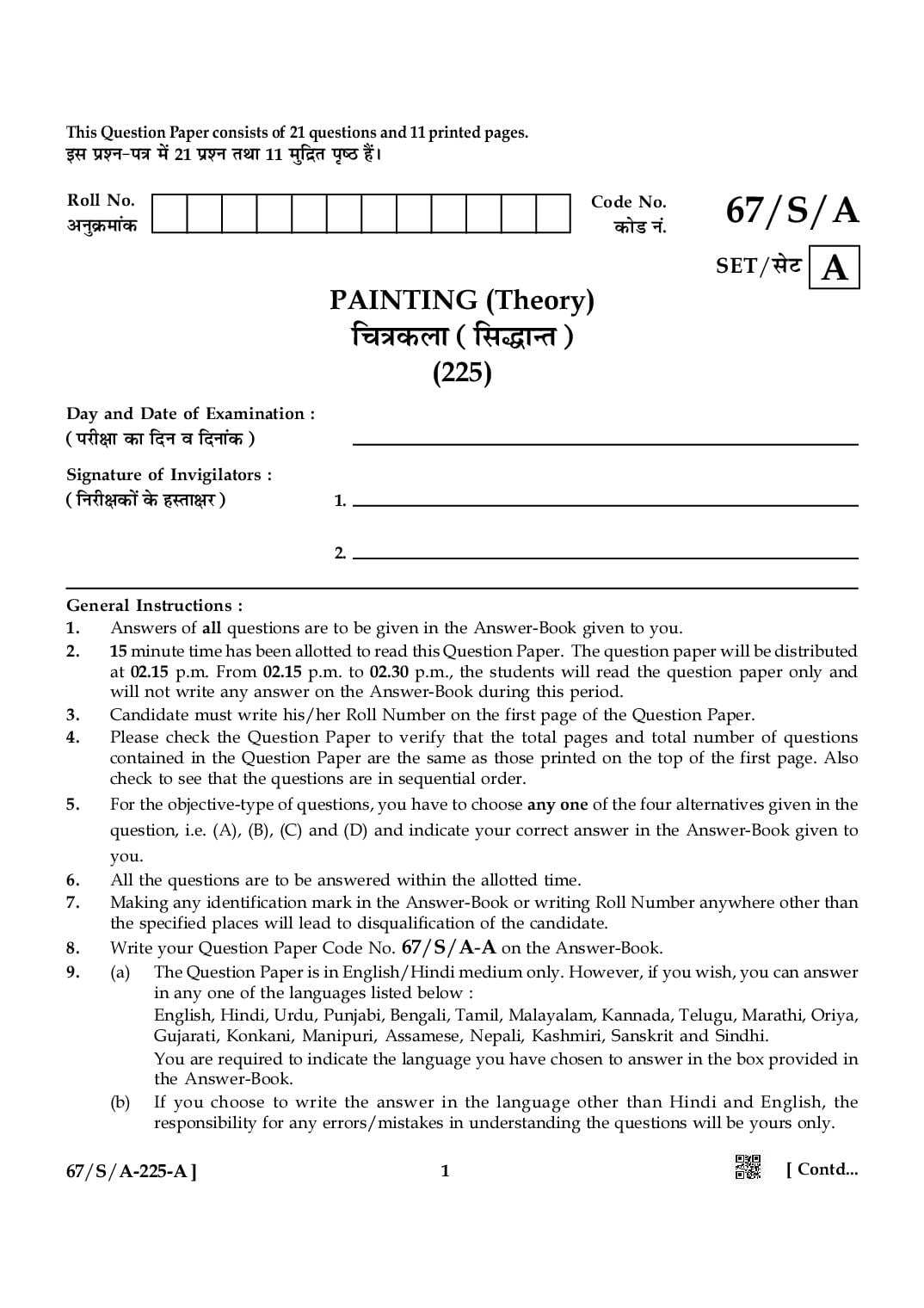
ß‚ ¬˝‡Ÿ-¬òÊ ◊¥ 21 ¬˝‡Ÿ ÃÕÊ 11 ◊ÈÁŒ˝Ã ¬Îc∆U „Ò¥–
Roll No. Code No.
•ŸÈ∑˝§◊Ê¥∑§ ∑§Ê«U Ÿ¥.
67/S/A
SET/‚ ≈ A
PAINTING (Theory)
ÁøòÊ∑§‹Ê (Á‚hÊãÃ)
(225)
Day and Date of Examination :
(¬⁄UˡÊÊ ∑§Ê ÁŒŸ fl ÁŒŸÊ¥∑§)
Signature of Invigilators :
(ÁŸ⁄UˡÊ∑§Ê¥ ∑§ „SÃÊˇÊ⁄U) 1.
2.
General Instructions :
1. Answers of all questions are to be given in the Answer-Book given to you.
2. 15 minute time has been allotted to read this Question Paper. The question paper will be distributed
at 02.15 p.m. From 02.15 p.m. to 02.30 p.m., the students will read the question paper only and
will not write any answer on the Answer-Book during this period.
3. Candidate must write his/her Roll Number on the first page of the Question Paper.
4. Please check the Question Paper to verify that the total pages and total number of questions
contained in the Question Paper are the same as those printed on the top of the first page. Also
check to see that the questions are in sequential order.
5. For the objective-type of questions, you have to choose any one of the four alternatives given in the
question, i.e. (A), (B), (C) and (D) and indicate your correct answer in the Answer-Book given to
you.
6. All the questions are to be answered within the allotted time.
7. Making any identification mark in the Answer-Book or writing Roll Number anywhere other than
the specified places will lead to disqualification of the candidate.
8. Write your Question Paper Code No. 67/S/A-A on the Answer-Book.
9. (a) The Question Paper is in English/Hindi medium only. However, if you wish, you can answer
in any one of the languages listed below :
English, Hindi, Urdu, Punjabi, Bengali, Tamil, Malayalam, Kannada, Telugu, Marathi, Oriya,
Gujarati, Konkani, Manipuri, Assamese, Nepali, Kashmiri, Sanskrit and Sindhi.
You are required to indicate the language you have chosen to answer in the box provided in
the Answer-Book.
(b) If you choose to write the answer in the language other than Hindi and English, the
responsibility for any errors/mistakes in understanding the questions will be yours only.
67/S/A-225-A ] 1 [ Contd...
Page 2
1. ‚÷Ë ¬˝‡ŸÊ¥ ∑§ ©ûÊ⁄U •Ê¬∑§Ê ŒË ªÿË ©ûÊ⁄U-¬ÈÁSÃ∑§Ê ◊¥ „Ë Á‹π¥–
2. ß‚ ¬˝‡Ÿ-¬òÊ ∑§Ê ¬…∏Ÿ ∑§ Á‹∞ 15 Á◊Ÿ≈U ∑§Ê ‚◊ÿ ÁŒÿÊ ªÿÊ „Ò– ¬˝‡Ÿ-¬òÊ ∑§Ê ÁflÃ⁄UáÊ ŒÊ¬„⁄U ◊¥ 02.15 ’¡ Á∑§ÿÊ ¡Ê∞ªÊ–
02.15 ’¡ ‚ 02.30 ’¡ Ã∑§ ¿UÊòÊ ∑§fl‹ ¬˝‡Ÿ-¬òÊ ∑§Ê ¬…∏¥ª •ÊÒ⁄U ß‚ •flÁœ ∑§ ŒÊÒ⁄UÊŸ fl ©ûÊ⁄U-¬ÈÁSÃ∑§Ê ¬⁄U ∑§Ê߸ ©ûÊ⁄U Ÿ„Ë¥
Á‹π¥ª–
3. ¬⁄UˡÊÊÕ˸ ¬˝‡Ÿ-¬òÊ ∑§ §¬„‹ ¬Îc∆U ¬⁄U •¬ŸÊ •ŸÈ∑˝§◊Ê¥∑§ •fl‡ÿU Á‹π¥–
4. ∑Χ¬ÿÊ ¬˝‡Ÿ-¬òÊ ∑§Ê ¡ÊÚ°ø ‹¥ Á∑§ ¬˝‡Ÿ-¬òÊ ∑§ ∑ȧ‹ ¬Îc∆UÊ¥ ÃÕÊ ¬˝‡ŸÊ¥ ∑§Ë ©ÃŸË „Ë ‚¥ÅUÿÊ „Ò Á¡ÃŸË ¬˝Õ◊ ¬Îc∆ ∑ §‚’‚ ™§¬⁄U
¿U¬Ë „Ò– ß‚ ’Êà ∑§Ë ¡ÊÚ°ø ÷Ë ∑§⁄U ‹¥ Á∑§ ¬˝‡Ÿ ∑˝ Á◊∑§ UM§¬ ◊¥ „Ò¥–
5. flSÃÈÁŸc∆U ¬˝‡ŸÊ¥ ◊¥ •Ê¬∑§Ê øÊ⁄U Áfl∑§À¬Ê¥ (A), (B), (C) ÃÕÊ (D) ◊¥ ‚ ∑§Ê߸ ∞∑§ ©ûÊ⁄U øÈŸŸÊ „Ò ÃÕÊ ŒË ªß¸ ©ûÊ⁄U-¬ÈÁSÃ∑§Ê ◊¥
•Ê¬ ‚„Ë ©ûÊ⁄U Á‹Áπ∞–
6. ‚÷Ë ¬˝‡ŸÊ¥ ∑§ ©ûÊ⁄U ÁŸœÊ¸Á⁄Uà ‚◊ÿ ◊¥ „Ë Á‹πŸÊ „Ò–
7. § ©ûÊ⁄U-¬ÈÁSUÃ∑§Ê ◊¥ ¬„øÊŸ-Áøq ’ŸÊŸ •ÕflÊ ÁŸÁŒ¸c≈U SÕÊŸÊ¥ ∑§§•ÁÃÁ⁄UÄà ∑§„Ë¥ ÷Ë •ŸÈ∑˝§◊Ê¥∑§ Á‹πŸ ¬⁄U ¬⁄UˡÊÊÕ˸ ∑§Ê •ÿÊÇÿ
∆U„⁄UÊÿÊ ¡ÊÿªÊ–
8. •¬ŸË ©ûÊ⁄U-¬ÈÁSUÃ∑§Ê ¬⁄U ¬˝‡Ÿ-¬òÊ ∑§Ê ∑§Ê«U Ÿ¥. 67/S/A-A Á‹π¥–
9. (∑§) ¬˝‡Ÿ-¬òÊ ∑§fl‹ •¥ª˝¡Ë/Á„¥ŒË ◊¥ „Ò– Á»§⁄U ÷Ë, ÿÁŒ •Ê¬ øÊ„¥ ÃÊ ŸËø ŒË ªß¸ Á∑§‚Ë ∞∑§ ÷Ê·Ê ◊¥ ©ûÊ⁄ Œ ‚∑§Ã „Ò¥ —
•¥ª˝¡Ë, Á„¥ŒË, ©ŒÍ¸, ¬¥¡Ê’Ë, ’°ª‹Ê, ÃÁ◊‹, ◊‹ÿÊ‹◊, ∑§ãŸ«∏, ËȪÍ, ◊⁄UÊ∆UË, ©Á«∏ÿÊ, ªÈ¡⁄UÊÃË, ∑§Ê¥∑§áÊË,
◊ÁáʬÈ⁄UË, •‚Á◊ÿÊ, Ÿ¬Ê‹Ë, ∑§‡◊Ë⁄UË, ‚¥S∑Χç•ÊÒ⁄U Á‚¥œË–
∑Χ¬ÿÊ ©ûÊ⁄U-¬ÈÁSÃ∑§Ê ◊¥ ÁŒ∞ ª∞ ’ÊÚÄ‚ ◊¥ Á‹π¥ Á∑§ •Ê¬ Á∑§‚ ÷Ê·Ê ◊¥ ©ûÊ⁄U Á‹π ⁄U„ „Ò¥–
(π) ÿÁŒ •Ê¬ Á„¥ŒË ∞fl¥ •¥ª˝¡Ë ∑§ •ÁÃÁ⁄UÄà Á∑§‚Ë •ãÿ ÷Ê·Ê ◊¥ ©ûÊ⁄U Á‹πà „Ò¥, ÃÊ ¬˝‡ŸÊ¥ ∑§Ê ‚◊¤ÊŸ ◊¥ „ÊŸ flÊ‹Ë
òÊÈÁ≈UÿÊ¥/ª‹ÁÃÿÊ¥ ∑§Ë Á¡ê◊UŒÊ⁄Ë ∑ fl‹ •Ê¬∑§Ë „ʪ˖
67/S/A-225-A ] 2 [ Contd...
Page 3
ÁøòÊ∑§‹Ê (Á‚hÊãÃ)
(225)
Time : 1½ Hours ] [ Maximum Marks : 30
‚◊ÿ — 1½ ÉÊá≈U ] [ ¬ÍáÊÊZ∑§ — 30
Note :
(i) This question paper consists of 21 questions in all.
(ii) All questions are compulsory.
(iii) Marks are given against each question.
(iv) Section A consists of
Q.No. 1 to 6 - Multiple Choice type questions (MCQs) carrying 1 mark each. Select and write the
most appropriate option out of the four options given in each of these questions. An internal
choice has been provided in some of these questions. You must attempt only one of the given
choices in such questions.
(v) Section B consists of Objective type questions. Q.No. 7 to 15
(a) Read the passage and attempt Q.No. 7 to 11 carrying 1 mark each.
(b) Read the passage and attempt True or False Q.No. 12 to 15 carrying 1 mark each. An
internal choice has been provided in some of these questions.
(vi) Section C consists of Subjective type questions. Q.No. 16 to 21
(a) Q.No. 16 to 19 - Very Short Answer type questions carrying 2 marks each to be answered in
the range of 30 to 40 words. An internal choice has been provided in some of these questions.
(b) Q.No. 20 - Short Answer type question carrying 3 marks to be answered in the range of
50 to 60 words. An internal choice has been provided in this question.
(c) Q.No. 21 - Long Answer question carrying 4 marks to be answered in the range of
70 to 80 words. An internal choice has been provided in this question.
ÁŸŒ¸‡Ê —
(i) ß‚ ¬˝‡Ÿ-¬òÊ ◊¥ ∑ȧ‹ 21 ¬˝‡Ÿ „Ò¥–
(ii) ‚÷Ë ¬˝‡Ÿ •ÁŸflÊÿ¸ „Ò¥–
(iii) ¬˝àÿ∑§ ¬˝‡Ÿ ∑§ ‚Ê◊Ÿ ©‚∑§ •¥∑§ ÁŒ∞ ª∞ „Ò¥–
(iv) πá«U - ∑§ ◊¥ ‡ÊÊÁ◊‹ „Ò¥ —
¬˝‡Ÿ ‚¥ÅÿÊ 1 ‚ 6 Ã∑§ ’„ÈÁfl∑§À¬Ëÿ ¬˝∑§Ê⁄U ∑§ ¬˝‡Ÿ „Ò¥ •ÊÒ⁄U ¬˝àÿ∑§ 1 •¥∑§ ∑§Ê „Ò– ߟ◊¥ ‚ ¬˝àÿ∑§ ¬˝‡Ÿ ◊¥ ÁŒ∞ ª∞ øÊ⁄U
Áfl∑§À¬Ê¥ ◊¥ ‚ ‚’‚ ©¬ÿÈÄà Áfl∑§À¬ ∑§Ê øÿŸ ∑§⁄U Á‹πŸÊ „Ò– ߟ◊¥ ‚ ∑ȧ¿U ¬˝‡ŸÊ¥ ◊¥ •Ê¥ÃÁ⁄U∑§ Áfl∑§À¬ ÁŒ∞ ª∞ „Ò¥– •Ê¬∑§Ê
∞‚ ¬˝‡ŸÊ¥ ◊¥ ÁŒ∞ ª∞ Áfl∑§À¬Ê¥ ◊¥ ‚ ∑§fl‹ ∞∑§ Áfl∑§À¬ ∑§Ê „Ë ©ûÊ⁄U Á‹πŸÊ „ʪʖ
(v) πá«U - π§ ◊¥ flSÃÈÁŸc∆U ¬˝∑§Ê⁄U ∑§ ¬˝‡Ÿ „Ò¥– ¬˝‡Ÿ ‚¥ÅÿÊ 7 ‚ 15
(a) •ŸÈë¿UŒ ∑§Ê ¬…∏∑§⁄U ¬˝‡Ÿ ‚¥ÅÿÊ 7 ‚ 11 ∑§ ©ûÊ⁄U ŒËÁ¡∞– ¬˝àÿ∑§ ¬˝‡Ÿ ∑§ Á‹∞ 1 •¥∑§ ÁŒÿÊ ªÿÊ „Ò–
(b) •ŸÈë¿UŒ ∑§Ê ¬…∏∑§⁄U ¬˝‡Ÿ ‚¥ÅÿÊ 12 ‚ 15 ‚„Ë/ª‹Ã ∑§ ©ûÊ⁄U ŒËÁ¡∞– ¬˝àÿ∑§ ¬˝‡Ÿ ∑§ Á‹∞ 1 •¥∑§ ÁŒÿÊ ªÿÊ „Ò–
ߟ◊¥ ‚ ∑ȧ¿U ¬˝‡ŸÊ¥ ◊¥ •Ê¥ÃÁ⁄U∑§ Áfl∑§À¬ ÁŒ∞ ª∞ „Ò¥–
(vi) πá«U - ª§ ◊¥ Áfl·ÿÁŸc∆U ¬˝∑§Ê⁄U ∑§ ¬˝‡Ÿ „Ò¥– ¬˝‡Ÿ ‚¥ÅÿÊ 16 ‚ 21
(a) ¬˝‡Ÿ ‚¥ÅÿÊ 16 ‚ 19 Ã∑§ •Áà ‹ÉÊÈ-©ûÊ⁄UËÿ ¬˝∑§Ê⁄U ∑§ ŒÊ-ŒÊ •¥∑§Ê¥ ∑§ ¬˝‡Ÿ „Ò¥– ߟ ¬˝‡ŸÊ¥ ∑§ ©ûÊ⁄U 30 ‚ 40 ‡ÊéŒÊ¥
◊¥ ÁŒ∞ ¡ÊŸ øÊÁ„∞– ߟ◊¥ ‚ ∑ȧ¿U ¬˝‡ŸÊ¥ ◊¥ •Ê¥ÃÁ⁄U∑§ Áfl∑§À¬ ÁŒ∞ ª∞ „Ò¥–
(b) ¬˝‡Ÿ ‚¥ÅÿÊ 20 ‹ÉÊÈ-©ûÊ⁄UËÿ ¬˝∑§Ê⁄U ∑§Ê ÃËŸ •¥∑§Ê¥ ∑§Ê ¬˝‡Ÿ „Ò– ß‚ ¬˝‡Ÿ ∑§Ê ©ûÊ⁄U 50 ‚ 60 ‡ÊéŒÊ¥ ◊¥ ÁŒÿÊ ¡ÊŸÊ
øÊÁ„∞– ß‚ ¬˝‡Ÿ ◊¥ •Ê¥ÃÁ⁄U∑§ Áfl∑§À¬ ÁŒÿÊ ªÿÊ „Ò–
(c) ¬˝‡Ÿ ‚¥ÅÿÊ 21 ŒËÉʸ ©ûÊ⁄UËÿ ¬˝∑§Ê⁄U ∑§Ê§ øÊ⁄U •¥∑§Ê¥ ∑§Ê§ ¬˝‡Ÿ „Ò– ß‚ ¬˝‡Ÿ ∑§Ê ©ûÊ⁄U 70 ‚ 80 ‡ÊéŒÊ¥ ◊¥ ÁŒÿÊ ¡ÊŸÊ
øÊÁ„∞– ß‚◊¥ •Ê¥ÃÁ⁄U∑§ Áfl∑§À¬ ÁŒÿÊ ªÿÊ „Ò–
67/S/A-225-A ] 3 [ Contd...
Page 4
Choose the correct answer for below questions.
ŸËø Á‹π ¬˝‡ŸÊ¥ ∑§Ê ‚„Ë ©ûÊ⁄U ¿UÊ¥≈U∑§⁄U Á‹Áπ∞–
1. From where have we found the “Dancing Girl” sculpture ? 1
(A) Sohanjo-Daro (B) Mohenjo-Daro
(C) Rohanjo-Daro (D) Pawanjo-Daro
““ŸÎàÿÊ¥ªŸÊ”” ◊ÍÁø „◊¥ ∑§„Ê° ‚ ¬˝Êåà „ÈÿË „Ò?
(A) ‚Ê„Ÿ¡Ê-ŒÊ«∏Ê (B) ◊Ê„Ÿ¡Ê-ŒÊ«∏Ê
(C) ⁄UÊ„Ÿ¡Ê-ŒÊ«∏Ê (D) ¬flŸ¡Ê-ŒÊ«∏Ê
2. (a) Who painted the art work ‘Monalisa’ ? 1
(A) Michael Angelo (B) Rembrandt
(C) Leonardo-da Vinci (D) Sandro Botticelli
““◊ÊŸÊÁ‹‚Ê”” ŸÊ◊∑§ ÁøòÊ Á∑§‚Ÿ ÁøÁòÊà Á∑§ÿÊ?
(A) ◊Êß∑§‹ ∞ã¡‹Ê (B) ⁄ÒUê’˝ÊÚ
(C) Á‹•ÊŸÊ«Uʸ «UÊ ÁflãøË (D) ‚Òã«˛UÊ ’ÊÁûÊøÀ‹Ë
(b) What is the medium of the “Rampurva Bull Capital” ?
(A) Polished Sand Stone (B) Metal
(C) Fiber (D) Paper
““⁄UÊ◊¬È⁄UflÊ ’È‹ ∑Ò§Á¬≈U‹”” ∑§Ê ◊Êäÿ◊ ÄÿÊ „Ò?
(A) ¬ÊÁ‹‡Ê Á∑§ÿÊ „È•Ê ’Ê‹È ∑§Ê ¬àÕ⁄U (B) œÊÃÈ
(C) »§Êß’⁄U (D) ∑§Êª¡
67/S/A-225-A ] 4 [ Contd...
Page 5
(A) East part of the World (B) West part of the World
(C) North part of the World (D) South part of the World
““•◊Íø ∑§‹Ê”” ∑§„Ê° ‡ÊÈM§ „ÈÿË?
(A) Áfl‡fl ∑§ ¬Í⁄U’ ÷ʪ ◊¥ (B) Áfl‡fl ∑§ ¬Á‡ø◊ ÷ʪ ◊¥
(C) Áfl‡fl ∑§ ©ûÊ⁄U ÷ʪ ◊¥ (D) Áfl‡fl ∑§ ŒÁˇÊáÊ ÷ʪ ◊¥
(b) Choose the right description for the artist Gaganendranath Tagore :
(A) Influence of Cezanne painting in his paintings
(B) Influence of Edgar Degas painting in his paintings.
(C) Influence of Rembrandt painting in his paintings.
(D) His paintings have the influence of the Cubist style of Europe.
ÁøòÊ∑§Ê⁄U ªªŸãŒ˝ŸÊÕ ≈ÒUªÊ⁄U ∑§ Á‹∞ ‚„Ë fláʸŸ ∑§Ê ¿UÊ°Á≈U∞ —
(A) ©Ÿ∑§ ÁøòÊÊ¥ ◊¥ ‚¡Ê¥ ∑§Ë ¬Áã≈¥Uª ∑§Ê ¬˝÷Êfl „Ò–
(B) ©Ÿ∑§ ÁøòÊÊ¥ ◊¥ ∞«Uª⁄U «UªÊ ∑§Ë ¬Áã≈¥Uª ∑§Ê ¬˝÷Êfl „Ò–
(C) ©Ÿ∑§ ÁøòÊÊ¥ ◊¥ ⁄Uê’˝ÊÚ ∑§Ë ¬Áã≈¥Uª ∑§Ê ¬˝÷Êfl „Ò–
(D) ©Ÿ∑§ ÁøòÊÊ¥ ◊¥ ÿÍ⁄Uʬ ∑§Ë ÉÊŸflÊŒË ‡ÊÒ‹Ë ∑§Ê ¬˝÷Êfl „Ò–
67/S/A-225-A ] 5 [ Contd...
Page 6
(A) Dry point technique
(B) Aquatint technique
(C) Fresco-Buono technique
(D) Intaglio technique
“ÁŒ ◊Ò«UËfl‹ ‚ã≈U‚” ŸÊ◊∑§ ÁøòÊ ◊¥ Á∑§‚ Ã∑§ŸË∑§ ∑§Ê ¬˝ÿʪ Á∑§ÿÊ ªÿÊ?
(A) «˛UÊß åflÊߥ≈U Ã∑§ŸË∑§
(B) ÃÊ◊˝¬òÊ ©à∑§Ëáʸ Ã∑§ŸË∑§
(C) Á÷ÁûÊ-ÁøòÊ Ã∑§ŸË∑§
(D) ∑§Êª¡ ¬⁄U ©à∑§Ëáʸ Ã∑§ŸË∑§
(b) Choose the pair of Abstract Art artists.
(A) Kandinsky - Michael Angelo
(B) Kandinsky - Mondrian
(C) Delarunay - Raja Ravi Verma
(D) Michael Angelo - Paul Cezanne
•◊Íø ∑§‹Ê ∑§‹Ê∑§Ê⁄UÊ¥ ∑§Ê ÿÈÇ◊ ¿UÊ°Á≈U∞–
(A) ∑§ÊÁã«U¥‚∑§Ë - ◊Êß∑§‹ ∞ã¡‹Ê
(B) ∑§ÊÁã«¥U‚∑§Ë - ◊ÊÚÁã«˛UÿŸ
(C) «U‹ÊL§Ÿ - ⁄UÊ¡Ê ⁄UÁfl fl◊ʸ
(D) ◊Êß∑§‹ ∞ã¡‹Ê - ¬ÊÚ‹ ‚¡Ê¥
5. __________ were the main center of art during the Gupta period. 1
(A) Mathura, Sarnath (B) Delhi, Rajasthan
(C) Gujarat, Bengal (D) Calcutta, Jammu
ªÈåà ∑§Ê‹ ◊¥ ∑§‹Ê ∑§ ◊ÈÅÿ ∑§ãŒ˝ __________ Õ–
(A) ◊ÕÈ⁄UÊ, ‚Ê⁄UŸÊÕ (B) Œ„‹Ë, ⁄UÊ¡SÕÊŸ
(C) ªÈ¡⁄UÊÃ, ’¥ªÊ‹ (D) ∑§‹∑§ûÊÊ, ¡ê◊Í
67/S/A-225-A ] 6 [ Contd...
Page 7
(A) Krishna Reddy & Brahmacharies
(B) Raja Ravi Verma & Hans Damayanti
(C) Binod Behari & Black Lines
(D) Amrita Shergil & Man with Violin
©‚ ÁøòÊ∑§Ê⁄U ∑§Ë ¬Á„øÊŸ ∑§⁄¥U Á¡‚∑§Ê ‚ê’㜠“__________” ‚ „Ò–
(A) ∑ΧcáÊÊ ⁄UaË & ’˝rÊøÊ⁄UË¡
(B) ⁄UÊ¡Ê ⁄UÁfl fl◊ʸ & „¥‚ Œ◊ÿ¥ÃË
(C) Á’ŸÊŒ Á’„Ê⁄UË & é‹Ò∑§ ‹Êßã‚
(D) •◊ÎÃÊ ‡Ê⁄UÁª‹ & ◊ÒŸ ÁflŒ flÊÿÁ‹Ÿ
SECTION - B / πá«U - π
Read the passages given below and answer the questions :
ŸËø Á‹π •ŸÈë¿UŒÊ¥ ∑§Ê ¬Á…∏Uÿ •ÊÒ⁄U ¬˝‡ŸÊ¥ ∑§Ê ©ûÊ⁄U ŒËÁ¡∞–
Passage One :
Indus Valley Civilization was named after the site from where the first evidence of the
Civilization was found. Main sites of this Civilization are Mohenjo-daro and Harappa (now
in Pakistan). This Civilization is also known as Harappan Civilization and is believed to
have flourished between 2500 B.C. and 1750 B.C. The next important period in Indian
history was the time of the Mauryan Dynasty, which was founded by Chandra Gupta
Maurya. Chandragupta Maurya’s grandson Ashoka the great did lots of benevolent works
and contributed much to the development of art architecture. He was a follower of Buddism
and erected pillars all over the empire to spread the teachings of ‘Lord Buddha’. The Caves
of Ajanta are situated near Aurangabad district in Maharashtra. The caves are named after
the nearly village Ajintha. Ajanta paintings were done in two phases - first, the Hinayana
phase (where Lord Buddha is represented in symbols) and the second, the Mahayana phase
(where he is shown in human form). Ajanta paintings are not done in Fresco. But Ajanta
artists have used traditional technique of tempra. The themes of Ajanta paintings were
primarily religious in nature.
•ŸÈë¿UŒ ¬˝Õ◊ —
Á‚ãœÈÉÊÊ≈UË ∑§Ë ‚èÿÃÊ ∑§Ê ŸÊ◊ ©‚ SÕÊŸ ‚ „Ò ¡„Ê° ‚èÿÃÊ ∑§ ¬˝ÊÕÁ◊∑§ ¬˝◊ÊáÊ Á◊‹– ß‚ ‚èÿÃÊ ∑§Ê ◊ÈÅÿ
SÕÊŸ ◊Ê„Ÿ¡Ê-ŒÊ«∏Ê ÃÕÊ „«∏å¬Ê „Ò¥– ¡Ê •’ ¬ÊÁ∑§SÃÊŸ ◊¥ „Ò– ß‚ ‚èÿÃÊ ∑§Ê „«∏嬟 ‚èÿÃÊ ‚ ¡ÊŸÊ ¡ÊÃÊ „Ò– ÿ„
2500 ߸.¬Í. ÃÕÊ 1750 ߸.¬Í. ∑§ ◊äÿ ¬Ÿ¬Ë ÷Ê⁄UÃËÿ ßÁÄʂ ◊¥ ◊ÊÒÿ¸ fl¥‡ÊÊfl‹Ë ∑§Ê ⁄UÊíÿ∑§Ê‹ ∑§Ê»§Ë ◊„àfl¬Íáʸ „Ò– ß‚
⁄UÊ¡fl¥‡Ê ∑§Ë SÕʬŸÊ øãŒ˝ªÈåà ◊ÊÒÿ¸ Ÿ ∑§Ë– øãŒ˝ªÈåà ◊ÊÒÿ¸ ∑§ ¬ÊÒòÊ •‡ÊÊ∑§ ◊„ÊŸ Ÿ ∑§‹Ê ∞fl¥ flÊSÃÈ∑§‹Ê ∑§ ©àÕÊŸ ∑§
Á‹∞ ’«∏Ê ÿʪŒÊŸ ÁŒÿÊ– fl„ ’ÊÒh œ◊¸ ∑§Ê •ŸÈÿÊÿË ÕÊ– •ÊÒ⁄U ÷ªflÊŸ ’Èh ∑§Ë Á‡ÊˇÊÊ•Ê¥ ∑§ ¬˝øÊ⁄U ∞fl¥ ¬˝‚Ê⁄U ∑§ Á‹∞
©‚Ÿ ¬Í⁄U ‚Ê◊˝Êíÿ ∑§ SÃê÷Ê¥ ∞fl¥ Á‡Ê‹Ê ‹πÊ¥ ∑§Ê SÕÊÁ¬Ã Á∑§ÿÊ– ◊„Ê⁄UÊc≈˛U ◊¥ •ÊÒ⁄¥UªÊ’ÊŒ Á¡‹ ∑§ ÁŸ∑§≈U •¡ãÃÊ ªÈ»§Ê∞°
„Ò¥– ß‚ ªÈ»§Ê•Ê¥ ∑§Ê ŸÊ◊∑§⁄UáÊ ¬Ê‚ „Ë ∑§ ªÊ¥fl “•Á¡ãà ‚ ¬«∏Ê– •¡ãÃÊ ∑§Ë ∑§‹Ê∑ΧÁÃÿÊ° ŒÊ ø⁄UáÊÊ¥ ◊¥ ¬Í⁄UË „ÈÈÿË¥– ¬˝Õ◊
„ËŸÿÊŸ ø⁄UáÊ ◊¥ „ÈÿË¥ Á¡‚◊¥ ÷ªflÊŸ ’Èh ∑§Ê ¬˝ÃË∑§Ê¥ ∑§ ◊Êäÿ◊ ‚ Œ‡ÊʸÿÊ ªÿÊ „Ò– •ÊÒ⁄U ŒÍ‚⁄UÊ ø⁄UáÊ ◊„ÊÿÊŸ ∑§Ê „Ò–
Á¡‚◊¥ ÷ªflÊŸ ’Èh ∑§Ê ◊ÊŸflËÿ M§¬ ◊¥ ÁŒπÊÿÊ ªÿÊ „Ò– •¡ãÃÊ ∑§ ÁøòÊ∑§Ê⁄UÊ¥ Ÿ ¬⁄Uê¬⁄UÊflÊŒË ≈ÒUê¬⁄UÊ ¬hÁà ∑§Ê ¬˝ÿʪ
Á∑§ÿÊ ªÿÊ „Ò– •¡ãÃÊ Á÷ÁûÊ-ÁøòÊÊ¥ ∑§Ê Áfl·ÿ ◊Í‹ ‚ œÊÁ◊¸∑§ ÕÊ–
67/S/A-225-A ] 7 [ Contd...
Page 8
Á‚ãœÈÉÊÊ≈UË ∑§Ë ‚èÿÃÊ ∑§ ◊ÈÅÿ SÕÊŸ __________ ÃÕÊ __________ „Ò¥–
(b) Presently the Indus Valley Civilization is in __________.
flø◊ÊŸ ◊¥ Á‚ãœÈÉÊÊ≈UË ∑§Ë ‚èÿÃÊ __________ ◊¥ „Ò–
8. The first __________ of Indus Valley Civilization was found in __________. ½+½
Á‚ãœÈÉÊÊ≈UË ∑§Ë ‚èÿÃÊ ∑§ ¬˝Õ◊ __________, __________ ◊¥ Á◊‹–
9. (a) The Mauryan Dynasty was founded by __________. 1
◊ÊÒÿ¸ fl¥‡Ê ∑§Ë SÕʬŸÊ __________ Ÿ ∑§Ë ÕË–
(b) Ashoka the Great was a follower of __________ religion.
•‡ÊÊ∑§ __________ œ◊¸ ∑§Ê •ŸÈÿÊÿË ÕÊ–
10. Ajanta paintings were done in __________ phases. 1
•¡ãÃÊ ∑§Ë ∑§‹Ê∑ΧÁÃÿÊ° __________ ø⁄UáÊÊ¥ ◊¥ ¬Í⁄UË „ÈÿË¥–
11. (a) Ajanta artists have used technique of __________. 1
•¡ãÃÊ ∑§ ÁøòÊ∑§Ê⁄UÊ¥ Ÿ __________ ¬hÁà ∑§Ê ¬˝ÿʪ Á∑§ÿÊ–
(b) The themes of Ajanta paintings were __________ in nature.
•¡ãÃÊ ∑§ Á÷ÁûÊ-ÁøòÊÊ¥ ∑§Ê Áfl·ÿ __________ ÕÊ–
67/S/A-225-A ] 8 [ Contd...
Page 9
Modern Indian Art is very much related to history of the country and social conditions
in which the artists developed their styles. We see the growth of different schools after the
decline of British Raj. The British Period produced significant works under the Company
School. The Indian artists followed the European techniques in their paintings. Artist like
Raja Ravi Varma served as a bridge to revive Indian subjects but followed western style.
Later the Bengal School established in Shantiniketan served as a center of artistic development.
Abanindranath Tagore and his disciples contributed on a large scale. Bengal School provided
a starting point to the movement to the Contemporary Indian Art. The best and most
individualistic painter was probably Amrita Shergil. She did not follow any Indian school.
•ŸÈë¿UŒ ÁmÃËÿ —
•ÊœÈÁŸ∑§ ÷Ê⁄UÃËÿ ∑§‹Ê Œ‡Ê ∑§ ßÁÄʂ ÃÕÊ ‚Ê◊ÊÁ¡∑§ ¬Á⁄UÁSÕÁÃÿÊ¥ ‚ ‚¥’¥ÁœÃ „Ò– ∑§‹Ê∑§Ê⁄UÊ¥ Ÿ ߟ
¬Á⁄UÁSÕÁÃÿÊ¥ ◊¥ •¬ŸË ‡ÊÒ‹Ë ∑§Ê Áfl∑§Ê‚ Á∑§ÿÊ– Á’˝Á≈U‡Ê ⁄UÊ¡ ∑§ ¬ÃŸ ∑§ ’ÊŒ ÁflÁ÷㟠ÁfløÊ⁄UœÊ⁄UÊ•Ê¥ ∑§Ê Áfl∑§Ê‚ „È•Ê–
∑¥§¬ŸË ÁfløÊ⁄UœÊ⁄UÊ ∑§ •ãê¸Ã Á’˝Á≈U‡Ê ÿȪ ÁflÁ÷㟠∑§‹Ê∑ΧÁÃÿÊ° ŒπŸ ∑§Ê Á◊‹Ë– ÷Ê⁄UÃËÿ ∑§‹Ê∑§Ê⁄UÊ¥ Ÿ •¬Ÿ ÁøòÊÊ¥ ◊¥
ÿÍ⁄UÊÁ¬ÿ Ã∑§ŸË∑§ ∑§Ê ¬˝ÿʪ Á∑§ÿÊ– ÁøòÊ∑§Ê⁄U ⁄UÊ¡Ê ⁄UÁfl fl◊ʸ Ÿ ÷Ê⁄UÃËÿ Áfl·ÿÊ¥ ∑§Ê ¬ÈŸ— Á∑˝§ÿʇÊË‹ ∑§⁄UŸ ∑§ Á‹∞ ¬˝ÿÊ‚
Á∑§∞ •ÊÒ⁄U ß‚◊¥ ©ã„Ê¥Ÿ ¬Ê‡øÊàÿ ‡ÊÒ‹Ë ∑§Ê •ŸÈ‚⁄UUáÊ Á∑§ÿÊ– ’ÊŒ ◊¥ ‡ÊÊÁãÃÁŸ∑§ÃŸ ◊¥ ’¥ªÊ‹ ◊¥ø ∑§Ë SÕʬŸÊ „È߸ ¡Ê
∑§‹Ê ∑§ Áfl∑§Ê‚ ∑§Ê ∑§ãŒ˝ ’ŸÊ– •’ŸËãŒ˝ŸÊÕ ≈ÒUªÊ⁄U ÃÕÊ ©‚∑§ •ŸÈÿÊÁÿÿÊ¥ ∑§Ê ÿʪŒÊŸ ’«∏ ¬Ò◊ÊŸ ¬⁄U ŒπŸ ∑§Ê
Á◊‹ÃÊ „Ò– ’¥ªÊ‹ ¬⁄¥U¬⁄UÊ Ÿ ‚◊∑§Ê‹ËŸ ∑§‹Ê ◊¥ ªÁà ŒŸ ◊¥ ¬˝Ê⁄UÁê÷∑§ ÿʪŒÊŸ ÁŒÿÊ– •◊ÎÃÊ ‡Ê⁄UÁª‹ ß‚ ÿȪ ◊¥
‚flʸûÊ◊ ∑§‹Ê∑§Ê⁄U ÕË¥– fl„ Á∑§‚Ë Áfl‡Ê· ÷Ê⁄UÃËÿ ÁfløÊ⁄UœÊ⁄UÊ ‚ ‚ê’h Ÿ„Ë¥ ÕË–
12. (a) We see the growth of different schools after the decline of British Raj. (True/False) 1
Á’˝Á≈U‡Ê ⁄UÊ¡ ∑§ ¬ÃŸ ∑§ ’ÊŒ ÁflÁ÷㟠ÁfløÊ⁄UœÊ⁄UÊ•Ê¥ ∑§Ê Áfl∑§Ê‚ „È•Ê– (‚„Ë/ª‹Ã)
(b) The Indian artists followed the European techniques in their paintings. (True/False)
÷Ê⁄UÃËÿ ∑§‹Ê∑§Ê⁄UÊ¥ Ÿ •¬Ÿ ÁøòÊÊ¥ ◊¥ ÿÍ⁄UʬËÿ Ã∑§ŸË∑§ ∑§Ê ¬˝ÿʪ Á∑§ÿÊ– (‚„Ë/ª‹Ã)
13. (a) Raja Ravi Verma did not follow the western style. (True/False) 1
⁄UÊ¡Ê ⁄UÁfl fl◊ʸ Ÿ ¬Ê‡øÊàÿ ‡ÊÒ‹Ë ∑§Ê •ŸÈ‚⁄UáÊ Ÿ„Ë¥ Á∑§ÿÊ– (‚„Ë/ª‹Ã)
(b) Bengal School established in Shantiniketan. (True/False)
‡ÊÊÁãÃÁŸ∑§ÃŸ ◊¥ ’¥ªÊ‹ S∑ͧ‹ ∑§Ë SÕʬŸÊ „ÈÿË– (‚„Ë/ª‹Ã)
67/S/A-225-A ] 9 [ Contd...
Page 10
(True/False)
’¥ªÊ‹ S∑ͧ‹ Ÿ ‚◊∑§Ê‹ËŸ ∑§‹Ê ◊¥ ªÁà ∑§Ê ¬˝Ê⁄UÁê÷∑§ ÿʪŒÊŸ Á∑§ÿÊ– (‚„Ë/ª‹Ã)
15. Amrita Shergil was associated with a particular ideology. (True/False) 1
•◊ÎÃÊ ‡Ê⁄UÁª‹ Á∑§‚Ë Áfl‡Ê· ÁfløÊ⁄UœÊ⁄UÊ ‚ SÊê’h ÕË– (‚„Ë/ª‹Ã)
SECTION - C / πá«U - ª§
Check for the Choice and attempt all questions. (Answer in minimum 30 words)
Áfl∑§À¬ ∑§Ê øÈÁŸÿ •ÊÒ⁄U ©‚∑§Ê ©ûÊ⁄U ŒËÁ¡∞– (∑§◊ ‚ ∑§◊ 30 ‡ÊéŒÊ¥ ◊¥ ©ûÊ⁄U ŒËÁ¡∞–)
16. Describe the painting “The Atrium”. 2
““ÁŒ •Á≈˛Uÿ◊”” ÁøòÊ ∑§Ê fláʸŸ ∑§ËÁ¡∞–
17. What do you know about the Indian painter who became blind ? 2
©‚ ÷Ê⁄UÃËÿ ∑§‹Ê∑§Ê⁄U ∑§ ’Ê⁄U ◊¥ Á‹Áπ∞ ¡Ê •ãœÊ „Ê ªÿÊ ÕÊ–
18. What are the characteristics of ‘Rampurva Bull Capital’ ? 2
“⁄UÊ◊¬È⁄UflÊ ’È‹ ∑Ò§Á¬≈U‹” ∑§Ë ‹ÊˇÊÁáÊ∑§ÃÊ∞° ÄÿÊ „Ò¥?
19. (a) Write very short note on “Krishna Supporting Mount Govardhana”. 2
““ªÊflœ¸Ÿ ¬fl¸Ã ∑§Ê ©∆UÊà „Èÿ ∑ΧcáÊ”” ¬⁄U ‚¥ÁˇÊåà ŸÊ≈U Á‹Áπ∞–
(b) What is Graphics or Print Making ? Name some of the print making techniques.
ª˝ÊÁ»§Ä‚ ÿÊ ÁøòÊ ◊ÈŒ˝áÊ ÄÿÊ „Ò? ÁøòÊ ◊ÈŒ˝áÊ ∑§Ë ∑ȧ¿U Ã∑§ŸËÁ∑§ÿÊ¥ ∑§ ŸÊ◊ ’ÃÊ∞°–
67/S/A-225-A ] 10 [ Contd...
Page 11
Áfl∑§À¬ ∑§Ê øÈÁŸÿ •ÊÒ⁄U ©‚∑§Ê ©ûÊ⁄U ŒËÁ¡∞– (∑§◊ ‚ ∑§◊ 50 ‡ÊéŒÊ¥ ◊¥ ©ûÊ⁄U ŒËÁ¡∞–)
20. (a) ‘Black Princess’ is no doubt, one of the best example of the Ajanta paintings. Why ? 3
•¡ãÃÊ ÁøòÊÊ¥ ◊¥ “•‡flà ⁄UÊ¡∑ȧ◊Ê⁄UË” (Black Princess) ‚flʸUûÊ◊ ∑ΧÁà ◊ÊŸË ¡ÊÃË „Ò– ÄÿÊ¥?
(b) Where is the “Sun Temple” of Konark ? What are the characteristics of the Konarka
sculptures ?
∑§ÊáÊÊ∑¸§ ∑§Ê “‚Íÿ¸ ◊ÁãŒ⁄U” ∑§„Ê° „Ò? ∑§ÊáÊÊ∑¸§ ◊ÍÁø∑§‹Ê ∑§Ë Áfl‡Ê·ÃÊ∞° Á‹Áπ∞–
Check for the choice and attempt the question. (Answer in minimum 70 words).
Áfl∑§À¬ ∑§Ê øÈÁŸ∞ •ÊÒ⁄U ©‚∑§Ê ©ûÊ⁄U ŒËÁ¡∞– (∑§◊ ‚ ∑§◊ 70 ‡ÊéŒÊ¥ ◊¥ ©ûÊ⁄U ŒËÁ¡∞–
21. (a) Define ‘Cubism’ in art. Choose any painting of Kandensky describe it. 4
∑§‹Ê ◊¥ ÉÊŸflÊŒ ∑§Ê ¬Á⁄U÷ÊÁ·Ã ∑§ËÁ¡∞– ∑§Ê¥Á«US∑§Ë ∑§Ê ∑§Ê߸ ∞∑§ ÁøòÊ øÈŸ∑§⁄U ©‚∑§Ê fláʸŸ ∑§ËÁ¡∞–
(b) Describe the subjects and technique of Raja Ravi Verma’s painting.
⁄UÊ¡Ê ⁄UÁfl fl◊ʸ ∑§Ë ÁøòÊ∑§Ê⁄UË ∑§Ë Áfl·ÿ √ÊSÃÈ•Ê¥ ÃÕÊ Ã∑§ŸË∑§ ∑§Ê fláʸŸ ∑§ËÁ¡∞–
-oOo-
67/S/A-225-A ] 11 [ Contd...
Document Details
| Board / Org | NIOS |
| Exam | National Institute of Open Schooling Class 10 |
| Type | Question Paper |
| Pages | 11 |
| Language | english |
| Updated | 24 Sep 2026 |