Class 10 Maths Extra Questions Chapter 6 Triangles
Finished viewing? Save it for later —
Download Class 10 Maths Extra Questions Chapter 6 Triangles (PDF · 28 pages)About Class 10 Maths Extra Questions Chapter 6 Triangles
Class 10 Maths Extra Questions Chapter 6 Triangles is available here for free download. Published by AglaSem for Class 10, this question bank can be viewed online or downloaded as a PDF (28 pages). Candidates preparing for Class 10 can use Class 10 Maths Extra Questions Chapter 6 Triangles to understand the exam pattern, the type of questions asked, and the overall difficulty level.
Frequently Asked Questions
How can I download Class 10 Maths Extra Questions Chapter 6 Triangles?
Open this page and click the Download button to save Class 10 Maths Extra Questions Chapter 6 Triangles as a PDF. It is completely free on AglaSem Docs.
Is Class 10 Maths Extra Questions Chapter 6 Triangles free to download?
Yes. Class 10 Maths Extra Questions Chapter 6 Triangles can be viewed online and downloaded as a PDF free of cost on AglaSem Docs.
How many pages does Class 10 Maths Extra Questions Chapter 6 Triangles have?
Class 10 Maths Extra Questions Chapter 6 Triangles contains 28 pages, which you can read online or download together as a single PDF.
Where can I find more Class 10 study material?
You can find more Class 10 question papers, sample papers, syllabus, and answer keys on AglaSem Docs.
Class 10 Maths Extra Questions Chapter 6 Triangles – Text
Read the full text of this question bank below — useful to quickly search, copy and reference the content online without downloading the PDF.
📄 View text version (28 pages)
Page 1
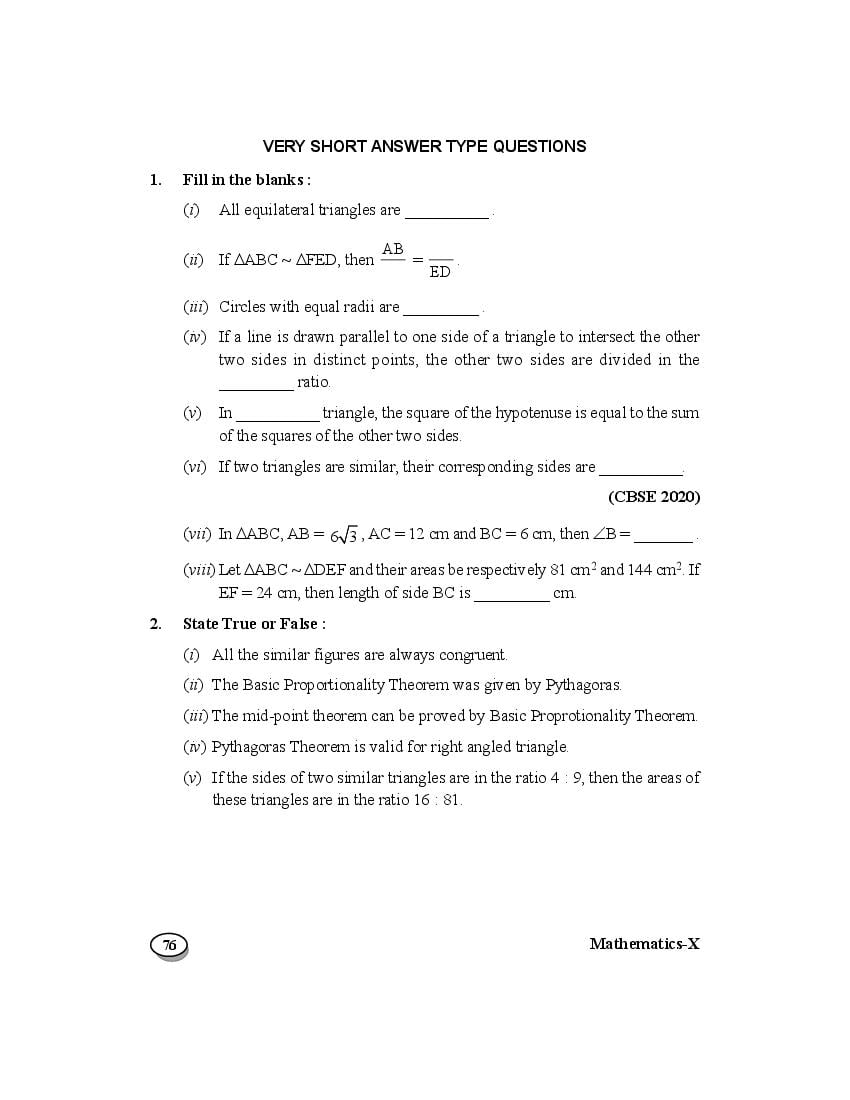
1. Fill in the blanks :
(i) All equilateral triangles are __________ .
AB
(ii) If ABC ~ FED, then = .
ED
(iii) Circles with equal radii are _________ .
(iv) If a line is drawn parallel to one side of a triangle to intersect the other
two sides in distinct points, the other two sides are divided in the
_________ ratio.
(v) In __________ triangle, the square of the hypotenuse is equal to the sum
of the squares of the other two sides.
(vi) If two triangles are similar, their corresponding sides are __________.
(CBSE 2020)
(vii) In ABC, AB = 6 3 , AC = 12 cm and BC = 6 cm, then B = _______ .
(viii) Let ABC ~ DEF and their areas be respectively 81 cm2 and 144 cm2. If
EF = 24 cm, then length of side BC is _________ cm.
2. State True or False :
(i) All the similar figures are always congruent.
(ii) The Basic Proportionality Theorem was given by Pythagoras.
(iii) The mid-point theorem can be proved by Basic Proprotionality Theorem.
(iv) Pythagoras Theorem is valid for right angled triangle.
(v) If the sides of two similar triangles are in the ratio 4 : 9, then the areas of
these triangles are in the ratio 16 : 81.
76 Mathematics-X
Page 2
Column I Column II
(a) If corresponding angles are equal in two (i) SAS similarity criterion
triangles, then the two triangles are similar.
(b) If sides of one triangle are proportional to (ii) ASA similarity criterion
the sides of the other triangle, then the two
triangles are similar.
(c) If one angle of a triangle is equal to one (iii) AAA similarity criterion
angle of the other triangle and the sides
including these angles are proportional,
then the two triangles are similar. (iv) SSS similarity criterion
PX PY 1
4. In the following figure, XY || QR and = = , then
XQ YR 2
P
X Y
Q R
1
(a) XY = QR (b) XY =
QR
3
1
(c) XY2 = QR2 (d) XY = QR
2
5. In the following figure, QA AB and PB AB, then AQ is
P
10 units O 9 units
A
B
6 units
Q
(a) 15 units (b) 8 units
(c) 5 units (d) 9 units
Mathematics-X 77
Page 3
(a) ratio of their corresponding sides.
(b) ratio of their corresponding altitudes.
(c) ratio of the square of their corresponding sides.
(d) ratio of their perimeter.
7. The areas of two similar triangles are 144 cm2 and 81 cm2. If one median of the
first triangle is 16 cm, length of corresponding median of the second triangle is
(a) 9 cm (b) 27 cm
(c) 12 cm (d) 16 cm
8. In a right triangle ABC, in which C = 90° amd CD AB. If BC = a, CA = b,
AB = c and CD = p, then A
1 1 1 1 1 1
(a) 2
2 2 (b) 2
2 2
p a b p a b c
D
1 1 1 1 1 1 b
2 2 2 2 p
(c) 2 (d) 2
p a b p a b
C a B
AB 1
9. If ABC ~ DEF, ar(DEF) = 100 cm2 and = , then ar(ABC) is
DE 2
(a) 50 cm2 (b) 25 cm 2
(c) 4 cm2 (d) 200 cm2
10. If the three sides of a triangle are a, 3a and 2a , then the measure of hte
angle opposite to longest side is
(a) 45° (b) 30°
(c) 60° (d) 90°
11. A vertical pole of length 3 m casts a shadow of 7 m and a tower casts a shadow
of 28 m at a time. The height of tower is
(a) 10 m (b) 12 m
(c) 14 m (d) 16 m
12. The length of the diagonals of a rhombus are 16 cm and 12 cm. Then, the
length of the side of the rhombus is (NCERT Exempler)
(a) 9 cm (b) 10 cm
(c) 8 cm (d) 20 cm
78 Mathematics-X
Page 4
is not true? (NCERT Exempler)
(a) BC.EF = AC.FD (b) AB.EF = AC.DE
(c) BC.DE = AB.EF (d) BC.DE = AB.FD
14. Write the statement of pythagoras theorem.
15. Write the statement of Basic Proportionality Theorem.
16. Is the triangle with sides 12 cm, 16 cm and 18 cm a right triangle?
Area ( ABC) 9
17. If ABC ~ QRP, = , AB = 18 cm, BC = 15 cm, then find
Area ( PQR) 4
the length of PR. (CBSE 2018)
18. In the given Fig., M = N = 46°, Express x in terms of a, b and c.
L
P
a
x
46° 46°
M b c K
19. In the given Fig. AHK ~ ABC. If AK = 10 cm, BC = 3.5 cm and HK = 7 cm,
find AC. (CBSE 2010)
H
A
C K
B
20. It is given that DEF ~ RPQ. Is it true to say that D = R and F = P?
21. If the corresponding Medians of two similar triangles are in the ratio 5 : 7.
Then find the ratio of their sides.
22. An aeroplane leaves an airport and flies due west at a speed of 2100 km/hr. At
the same time, another aeroplane leaves the same place at airport and flies due
Mathematics-X 79
Page 5
hour?
23. The areas of two similar triangles ABC and DEF are 225 cm2 and 81 cm2
respectively. If the longest side of the larger triangle ABC be 30 cm, find the
longest side of the smaller triangle DEF.
24. In the given figure, if ABC ~ PQR, find the value of x?
A
R x Q
6 cm 5 cm 3.75 cm 4.5 cm
B C
4 cm
P
PX PY 1
25. In the given figure, XY || QR and = = , find XY : QR.
XQ YR 2
P
X Y
Q R
26. In the given figure, find the value of x which will make DE || AB ?
(NCERT Exempler)
A B
3x + 19 3x + 4
E D
x+3 x
C
27. If ABC ~ DEF, BC = 3EF and ar (ABC) = 117cm2 find area (DEF).
80 Mathematics-X
Page 6
then find the value of C.
29. If the ratio of the corresponding sides of two similar triangles is 2 : 3, then find
the ratio of their corresponding attitudes.
BC 1 ar( PRQ)
30. It is given that ABC ~ PQR with = , then find the value of .
QR 3 ar( ACB)
SHORT ANSWER TYPE QUESTIONS-I
31. In the given Fig. PQ = 24 cm, QR = 26 cm, PAR = 90°, PA = 6 cm and AR =
8 cm, find QPR.
Q P
A
R
BE BC
32. In the given Fig., DE || AC and DC || AP Prove that = (CBSE 2020)
EC CP
33. In ABC, AD BC such that AD2 = BD × CD. Prove that ABC is right
angled triangle.
34. In the given Fig., D and E are points on sides AB and CA of ABC such that
B = AED. Show that ABC ~ AED.
A
D
E
B C
Mathematics-X 81
Page 7
3x – 1 and OB = 2x + 1, OC = 5x – 3 and OD = 6x – 5, find the value of x.
D C
6x – 3
5 5x –
1 O 2x +
3x – 1
A B
36. In the given Fig. PQR is a triangle, right angled at Q. If XY || QR, PQ = 6 cm,
PY = 4 cm and PX : XQ = 1 : 2. Calculate the lengths of PR and QR.
P
X Y
Q R
37. In the given figure, AB || DE. Find the length of CD.
B
6 cm
5 cm
A
C
E
3 cm
D
38. In the given figure, ABCD is a parallelogram. AE divides the line segment BD
in the ratio 1 : 2. If BE = 1.5 cm find BC.
D C
O E
A B
82 Mathematics-X
Page 8
(i) DOC, (ii) DCO, (iii) OAB, (iv) OBA.
D C
70°
O 115°
A B
40. Perimeter of two equilateral triangles ABC and PQR are 144 m and 96 m,
Find ar (ABC) : ar (PQR).
SHORT ANSWER TYPE QUESTIONS-II
QR QT
41. In the given figure, = and 1 = 2 then prove that PQS ~ TQR.
QS PR
(NCERT)
T
P
1 2
Q
S R
42. In equilateral ABC, AD BC. Prove that 3BC2 = 4AD2.
BC 2 BD
43. In ABC, ACB = 90° and CD AB. Prove that = . (HOTS)
AC 2 AD
44. In the adjoining figure ABC and DBC are on the same base BC. AD and BC
area ( ABC) AO
intersect at O. Prove that = . (CBSE 2020)
area ( DBC) DO
A C
O
B D
Mathematics-X 83
Page 9
AB AD
PQR, Prove that = .
PQ PS
46. In the given figure, DE || AC. Which of the following is correct?
ab B
ay
x or x
ay ab a
E D
x
b
C y A
47. Prove that the sum of the squares of the sides of a rhombus is equal to the sum
of the squares of its diagonals.
(NCERT, CBSE 2019, 2020)
48. A street light bulb is fixed on a pole 6 m above the level of the street. If a
woman of height 1.5 m casts a shadow of 3 m, find how far she is away from
the base of the pole.
(NCERT Exempler)
49. Two poles of height a metrs and b metres are p metres apart. Prove that the
height of the point of intersection of the lines joining the top of each pole to the
ab
foot of the opposite pole is given by metres.
ab
50. In the given figure AB || PQ || CD, AB = x, CD = y and PQ = z. Prove that
1 1 1
.
x y z
A
C
x P
y
z
B D
Q
84 Mathematics-X
Page 10
51. In the given figure D = E and = . Prove that BAC is an isoscles
DB EC
triangle. (CBSE 2020)
52. In the figure, a point O inside ABC is joined to its vertices. From a point D on
AO, DE is drawn parallel to AB and from a point E on BO, EF is drawn parallel
to BC. Prove that DF || AC.
A
D
O
E F
B C
53. Two triangles BAC and BDC, right angled at A and D respectively are drawn
on the same base BC and on the same side of BC. If AC and DB intersect at P.
PRove that AP × PC = DP × PB. (CBSE 2019)
54. Hypotenuse of a right triangle is 25 cm and out of the remaining two sides, one
is larger than the other by 5 cm, find the length of the other two sides.
(NCERT Exempler)
Mathematics-X 85
Page 11
55. In the given figure DE || AC and = . Prove that DC || AP..
EC CP
A
D
B E C P
56. In a quadrilateral ABCD, B = 90°, AD2 = AB2 + BC2 + CD2. Prove that
ACD = 90°.
57. In the given figure, DE || BC, DE = 3 cm, BC = 9 cm and ar (ADE) = 30 cm2.
Find ar (BCED).
A
D E
3cm
B 9 cm C
86 Mathematics-X
Page 12
58. In an equilateral ABC, D is a point on side BC such that BD = BC. Prove
3
that 9A D 2 = 7AB2. (NCERT, CBSE 2018, 2020)
59. In PQR, PD QR such that D lies on QR. If PQ = a, PR = b, QD = c and DR =
d and a, b, c, d are positive units. Prove that (a + b) (a – b) = (c + d) (c – d).
(NCERT Exempler)
60. Prove that the ratio of the areas of two similar triangles is equal to the ratio of
the squars of their corresponding sides. (CBSE 2010, 2018, 2019)
61. In the given figure, the line segment XY is Parallel to AC of ABC and it
AX 2 1
divides the triangle into two parts of equal areas. Prove that = .
AB 2
A
X
B Y C
62. Through the vertex D of a parallelogram ABCD, a line is drawn to intersect the
DA FB FC
sides BA and BC produced at E and F respectively. Prove that = = .
AE BE CD
63. Prove that if in a triangle, the square on one side is equal to the sum of the
squares on the other two sides, then the angle opposite to the first side is a right
angle.
(CBSE 2019, 2020)
64. Prove that in a right angle triangle, the square of the hypotenuse is equal the
sum of the squares of other two sides. (CBSE 2018, 2019, 2020)
Mathematics-X 87
Page 13
sides in distinct points, then prove that the other two sides are divided in the
same ratio.
(CBSE 2019, 2020)
66. In an Obtuse ABC (B is obtuse), AD is perpendicular to CB produced.
Then prove that A C2 = AB2 + BC2 + 2BC × BD.
67. In figure BN and CM are medians of a ABC right angled at A. Prove that
4(BN2 + CM2) = 5 BC2 (CBSE (C) 2020)
C
N
A B
M
68. Sides AB and AC and median AD of ABC are respectively proportional to
sides PQ and PR and median PM of PQR. Show that ABC ~ PQR.
(CBSE 2020)
69. In figure if ABC ~ DEF and their sides of lengths (in cm) are marked along
them, then find the lengths of sides of each triangle. (CBSE 2020)
A D
2x – 1 3x 18 6x
B C E F
2x + 2 3x + 9
70. The Perimeters of two similar triangles are 30 cm and 20 cm repsectively. If
one side of the first triangle is 9 cm long. Find the length of the corresponding
side of the second triangle. (CBSE 2020)
71. In figure PQR is right-angled at P.M is a point on QR such that PM is
perpendicular to QR. Show that PQ2 = QM × QR. (CBSE 2020)
88 Mathematics-X
Page 14
M
P Q
ANSWERS AND HINTS
VERY SHORT ANSWER TYPE QUESTIONS-I
AB BC
1. (i) Similar (ii) = (iii) Congruent
FE E D
(iv) Same (v) Right (vi) Proportional
(vii)90° (viii) 18 cm
2. (i) False (ii) False (iii) True
(iv) True (v) True
3. (a) (iii) AAA similarity criterion.
(b) (iv) SSS similarity criterion.
(c) (i) SAS similarity criterion.
1
4. (B) XY = QR
3
5. (A) 15 units
6. (C) Ratio of the square of their corresponding sides.
7. (C) 12 cm
1 1 1
8. (A) 2
2 2
p a b
9. (B) 25 cm2
10. (D) 90°
11. (B) 12 m
12. (B) 10 cm
Mathematics-X 89
Page 15
14. See point 3(iii) of Key Points
15. See point 3(i) of Key Points.
16. No, because (12)2 + (16)2 (18)2
17. 10 cm
18. KPN ~ KLM
x c
a bc
ac
x=
bc
AK HK 10 7
19. = = AC = 5 cm
AC BC AC 3.5
20. D = R (True)
F = P (False)
21. 5 : 7
N
2100 Km
22. W
0
E AB = (2100) 2 (2000) 2 = 2900 km
A
2000 Km
B
5
B
23. Let longest side of the DEF be x cm.
2
225 30
=
81 x
x = 18 cm
90 Mathematics-X
Page 16
24. = = x = 3cm
PQ QR 4.5 x
25. PXY ~ PQR
PX XY 1
= =
PQ QR 3
XY : QR = 1 : 3
x3 x
26. = (By B.P.T.)
3 x 19 3x 4
x=2
ar (ABC) BC 2 3EF 2 3 2
27. = = =
ar (DEF) EF EF 1
117
=9 ar(DEF) = 13 cm2
ar(DEF)
28. F = C = 56°
29. 2 : 3
30. 1/9
31. PR = (6) 2 (8) 2 = 10 cm.
As QR2 = PQ2 + PR2 , therefore QPR = 90°.
(By Converse of Pythagoras theorem)
AD EC
32. DE || AC, = ...(1) [ BPT]
DB BE
AD CP
DC || AP, = ...(2) [ BPT]
DB BC
From (1) and (2), we get
BE BC
=
EC CP
Mathematics-X 91
Page 17
A
B D C
In ADB, AD2 = AB2 – BD2 ...(2)
Adding (1) and (2), we have
2AD2 = AC2 + AB2 – BD2 – DC2
2AD2 + BD2 + DC2 = AC2 + AB2
2BD × CD + BD2 + DC2 = AC2 + AB2
(BD + DC)2 = AC2 + AB2 (Using (a + b)2 = a2 + b2 + 2ab)
BC2 = AC2 + AB2
By converse of Pythagoras Theorem, ABC is a right angled triangle.
34. B = AED (Given)
A = A (Common)
ABC ~ AED [AA similarity criterion]
DE DO DE OC
35. Draw EO || AB, = (In ADB) and = (In ACD)
EA OB EA OA
D C
6x
– 5 3
E 5x –
1 O
2x +
3x – 1
A B
3x 1 2x 1 1
= x= or 2
5x 3 6x 5 2
1
But x = is neglected because (5x – 3) get negative value.
2
So, x = 2 is the required value.
92 Mathematics-X
Page 18
36. = = YR = 8 cm
XQ YR 2 YR
PR = 8 + 4 = 12 cm
QR = (12) 2 (6) 2 = 6 3 cm
37. ABC ~ EDC (AA Similarity criterion)
6 5
=
3 CD
CD = 2.5 cm
38. BOE ~ DOA (AA Similarity criterion)
BO BE
=
DO DA
1 1.5
=
2 DA
DA = 3 cm
BC = DA = 3 cm (Opposite sides of a parallelogram)
39. (i) 65°
(ii) 45°
(iii) 45°
(iv) 70°
ar ( ABC) 144 2 9
ar ( PQR) 96
40. = =
4
ar (ABC) : ar (PQR) = 9 : 4
41. In PQR, 1 =
PR = PQ [Opposite sides of equal angles]
QR QT
= and 1 = 1 (Common)
QS PQ
PQS ~ TQR (SAS Similarity criterion)
Mathematics-X 93
Page 19
BD = DC
1
BD = BC ...(1)
2
In right angled ADB, B D C
AB2 = AD2 + BD2
2
BC
BC2 = AD2 + [ AB = BC = CA and from (1)]
2
3BC2 = 4AD2
43. ABC ~ CBD
BC2 = AB.BD ...(1)
ABC ~ ACD
AC2 = AB.AD ...(2)
Divide (1) by (2), we get
BC 2 BD
2 =
AC AD
44. Draw AX BC and DY BC
1
ar ( ABC) × BC× AX
2 AX
= 1 = ...(1)
ar ( DBC) DY
× BC× DY
2
A C
Y
O
X
B D
AXO ~ DYO [AA similarity criterion]
AX AO
= ...(2) (C.P.S.T.)
DY DO
From (1) and (2), we get
94 Mathematics-X
Page 20
=
ar ( DBC) DO
45.
1
BC
AB BC 2 BD
As ABC ~ PQR, Hence B = Q and = = 1 =
PQ QR QR QS
2
In ABD and PQS
AB BD
= and B = Q.
PQ QS
ABD ~ PQS (SAS Similarity criterion).
AB AD
Hence, = (C.P.S.T.)
PQ PS
46. BED ~ BCA
x a
=
y ab
ay
x=
ab
47.
D
C
o
A B
Mathematics-X 95
Page 21
In right angled BOC, BC2 = OB2 + OC2 ...(2)
In right angled COD, CD2 = OC2 + OD2 ...(3)
In right angled DOA, DA2 = OD2 + OA2 ...(4)
Adding (1), (2), (3) and (4), we get
AB2 + BC2 + CD2 + DA2 = 2OA2 + 2OB2 + 2OC2 + 2OD2
2 2 2 2
1 1 1 1
= 2 AC 2 BD 2 AC 2 BD
2 2 2 2
[ Diagonals of rhombus bisect each other]
= AC2 + BD2
48. ABE ~ CDE
AB BE
=
CD DE
6 3 + BD
=
1.5 3
BD = 9m
ab
49. To prove : EF =
ab
Proof : AB || EF || DC
EFC ~ ABC
EF FC A
= ...(1)
AB BC
BFE ~ BCD D
am
EF BF E
= ...(2) bm
CD BC
Adding (1) and (2), we get
B F C
EF EF FC+ BF pm
+ =
AB CD BC
96 Mathematics-X
Page 22
EF =
AB CD BC
1 1
EF = 1
a b
ab
EF =
ab
50. Same as Q. 48.
AD AE
51.
DB EC
By converse of BPT, DE || BC
D = B and E = C (Corresponding Angles)
But D = E
So, B = C
AB = AC
So, ABC is an isosceles triangle.
OD OE
52. In OAB, = .... (1) ( BPT)
DA EB
OE OF
In OBC, = .... (2) ( BPT)
EB FC
From (1) and (2), we get
OD OF
=
DA FC
By converse of BPT, DF || AC.
53. APB ~ DPC (AA Similarity criterion)
AP PB
= ( C.P.S.T.)
DP PC
AP.PC = DP.PB
Mathematics-X 97
Page 23
By Pythagoras theorem,
(x)2 + (x + 5)2 = (25)2
x = 15 or – 20
But side is always positive, So, x = 15.
Length of two sides is 15 cm and 20 cm.
55. Same as Q.31.
56. In right angled ABC, AC2 = AB2 + BC2 ...(1)
Given, AD2 = (AB2 + BC2) + CD2
AD2 = AC2 + CD2 [From (1)]
By converse of Pythagoras theorem, ACD = 90°.
57. ADE ~ ABC
ar (ADE) DE 2
ar (ABC) BC
=
2
30 3
ar(ABC) 9
=
ar(ABC) = 270 cm2
ar (BCFD) = ar (ABC) – ar (ADE)
= 270 – 30 = 240 cm2
58. Draw AE BC
ABE ACE
A
1
BE = CE BE = BC
2
In right angled AED, AE2 = AD2 – DE2 ...(1)
In right angled AEB, AE2 = AB2 – BE2 ...(2)
From (1) and (2), we have
AD2 – DE2 = AB2 – BE2
B D E C
2
1
AD2 – (BE – BD)2 = BC2 – BC
( AB = AC)
2
98 Mathematics-X
Page 24
1
2 1 2 BC
AD BC BC = BC
2 3 4
9AD2 = 7AB2
59. In right angled PDQ,
PD2 = a2 – c2 ...(1)
In right angled PDR
PD2 = b2 – d2 ...(2)
From (1) and (2), we have
a2 – c2 = b2 – d2 P
a2 – b2 = c2 – d2
(a – b) (a + b) = (c + d) (c – d)
a b
60. Theorem 6.6 of NCERT.
61. Given, ar BXY = ar AXYC
ar ( ABC) = ar BXY + ar AXYC
Q c D d R
= 2 ar BXY
ar( ABC) 2
ar( BXY) = 1
ABC ~ XBY
2 ar (ABC)
AB
= ar (BXY)
XB
AB
= 2
XB
XB 1
=
AB 2
XB 1
1 = 1
AB 2
Mathematics-X 99
Page 25
=
AB 2
AX 2 1
= F
AB 2
62. EAD ~ EBF
EA AD
= D
EB BF C
BF AD BF AD BF BC CF
= = = =
BE AE BE AE BA DC
63. Theorem 6.9 of NCERT.
E A B
64. Theorem 6.8 of NCERT.
65. Theorem 6.9 of NCERT.
66. In ADB A
AB2 = AD2 + DB2 ...(i)
In ADC
AC2 = AD2 + DC2
= AD2 + (DB + BC)2
= AD2 + DB2 + BC2 + 2BC.BD D B C
= AB2 + BC2 + 2BC.BD (Using (i))
1
67. BN is median AN = CN = AC
2
1
CM is median AN = MB = AB
2
In BAC, BC2 = AB2 + AC2 ...(1)
2
AC
In BNC, BC2 = AB2 +
2
4BN2 = 4AB2 + AC2 ...(2)
100 Mathematics-X
Page 26
4CM2 = AB2 + 4AC2 ...(3)
Adding corresponding sides of (2) and (3)
4 (BN2 + CM2) = 5AB2 + 5AC2
4 (BN2 + CM2) = 5BC2
68. In ABC and PQR
AB AC AD
= = ...(1)
PQ PR PM
Extend AD to a point E s.t. AD = DE and PM to point L s.t. PM = ML
A P
B C Q R
D M
E L
quadrilateral of ABEC and PQLR are parallelogram
( diagonals bisect each other)
AC = BE, AB = EC
PR = QL, PQ = LR } ....(2)
From (1) and (2)
AB BE 2 AD AE
= = =
PQ QL 2 PM PL
ABE ~ PQL
ABE = PQL ...(3)
Similarly, AEC ~ PLR
CAE = RPL ...(4)
CAB = RPQ (from 3 and 4)
In ABC and PQR
Mathematics-X 101
Page 27
= and CAB = RPQ
PQ PR
ABC ~ PQR
AB BC CA
69. = = ( ABC ~ DEF)
DE EF FD
2x 1 2x 2 3x
= =
18 3x 9 6x
Solving, we get x = 5
AB = 9 cm BC = 12 cm AC = 15 cm
DE = 18 cm EF = 24 cm FD = 30 cm
70. ABC ~ DEF
AB BC AC
= = =k
DE EF DF
AB = kDE, BC = kEF, AC = kDF
AB + BC + AC = k (DE + EF + DF)
30 9
= x = 6 cm
20 x
71. In PMR, PR2 = PM2 + RM2 ...(1)
In PMQ, PQ2 = PM2 + MQ2 ...(2)
In PQR, RQ2 = RP2 + PQ2 ...(3)
RM2 + MQ2 + 2RM.MQ = RP2 + PQ2 ...(4) ( RQ = RM + MQ)
Adding (1) and (2), PR2 + PQ2 = 2PM2 + RM2 + MQ2 ...(5)
From (4) and (5)
PM2 = RM.MQ
102 Mathematics-X
Page 28
Triangles
Time : 1 Hrs. M.M. : 20
SECTION - A
1. If sides of two similar triangles are in the ratio of 8:10, then areas of these
triangles are in the ratio __________ . 1
AB BC CA
2. If in two triangles ABC and PQR, = = , then 1
QR RP PQ
(A) PQR ~ CAB (B) PQR ~ ABC
(C) CBA ~ PQR (D) BCA ~ PQR
3. ABC is an isosceles right triangle, right angled at C, then AB2 = ..........
(A) AC2 (B) 2 AC2 (CBSE 2020)
(C) 4 AC 2 (D) 3 AC 2 1
4. A line DE is drawn parallel to base BC of ABC, meeting AB in D and AC at
E .
AB
If = 4 and CE = 2 cm, find the length of AE.
BD
SECTION B
5. The lengths of diagonals of a rhombus field are 32 m and 24 m. Find the length
of the side of the field. 2
6. A man goes 24 m towards West and then 10 m towards North. How far is he
from the starting point? 2
7. Using converse of Basic Proportionality Theorem, prove that the line joining
the mid-points of any two sides of a triangle is parallel to the third side. 2
SECTION C
8. E is a point on the side AD produced of a parallelogram ABCD and BE intersect
CD at F. Show that ABE ~ DCB. 3
9. In an equilateral triangle, prove that three times the square of one side is equal
to four times the square of one of its altitude. 3
SECTION D
10. State and prove Basic Proportionality Theorem. 4
Mathematics-X 103
Document Details
| Board / Org | Aglasem |
| Exam | Class 10 |
| Type | Question Bank |
| Pages | 28 |
| Updated | 22 Jul 2026 |