NIOS Class 10 April 2024 Question Paper Social Science
Finished viewing? Save it for later —
Download NIOS Class 10 April 2024 Question Paper Social Science (PDF · 20 pages)About NIOS Class 10 April 2024 Question Paper Social Science
NIOS Class 10 April 2024 Question Paper Social Science is available here for free download. Published by NIOS for National Institute of Open Schooling Class 10, this question paper can be viewed online or downloaded as a PDF (20 pages). Candidates preparing for National Institute of Open Schooling Class 10 can use NIOS Class 10 April 2024 Question Paper Social Science to understand the exam pattern, the type of questions asked, and the overall difficulty level.
Frequently Asked Questions
How can I download NIOS Class 10 April 2024 Question Paper Social Science?
Open this page and click the Download button to save NIOS Class 10 April 2024 Question Paper Social Science as a PDF. It is completely free on AglaSem Docs.
Is NIOS Class 10 April 2024 Question Paper Social Science free to download?
Yes. NIOS Class 10 April 2024 Question Paper Social Science can be viewed online and downloaded as a PDF free of cost on AglaSem Docs.
How many pages does NIOS Class 10 April 2024 Question Paper Social Science have?
NIOS Class 10 April 2024 Question Paper Social Science contains 20 pages, which you can read online or download together as a single PDF.
Where can I find more National Institute of Open Schooling Class 10 study material?
You can find more National Institute of Open Schooling Class 10 question papers, sample papers, syllabus, and answer keys on AglaSem Docs.
NIOS Class 10 April 2024 Question Paper Social Science – Text
Read the full text of this question paper below — useful to quickly search, copy and reference the content online without downloading the PDF.
📄 View text version (20 pages)
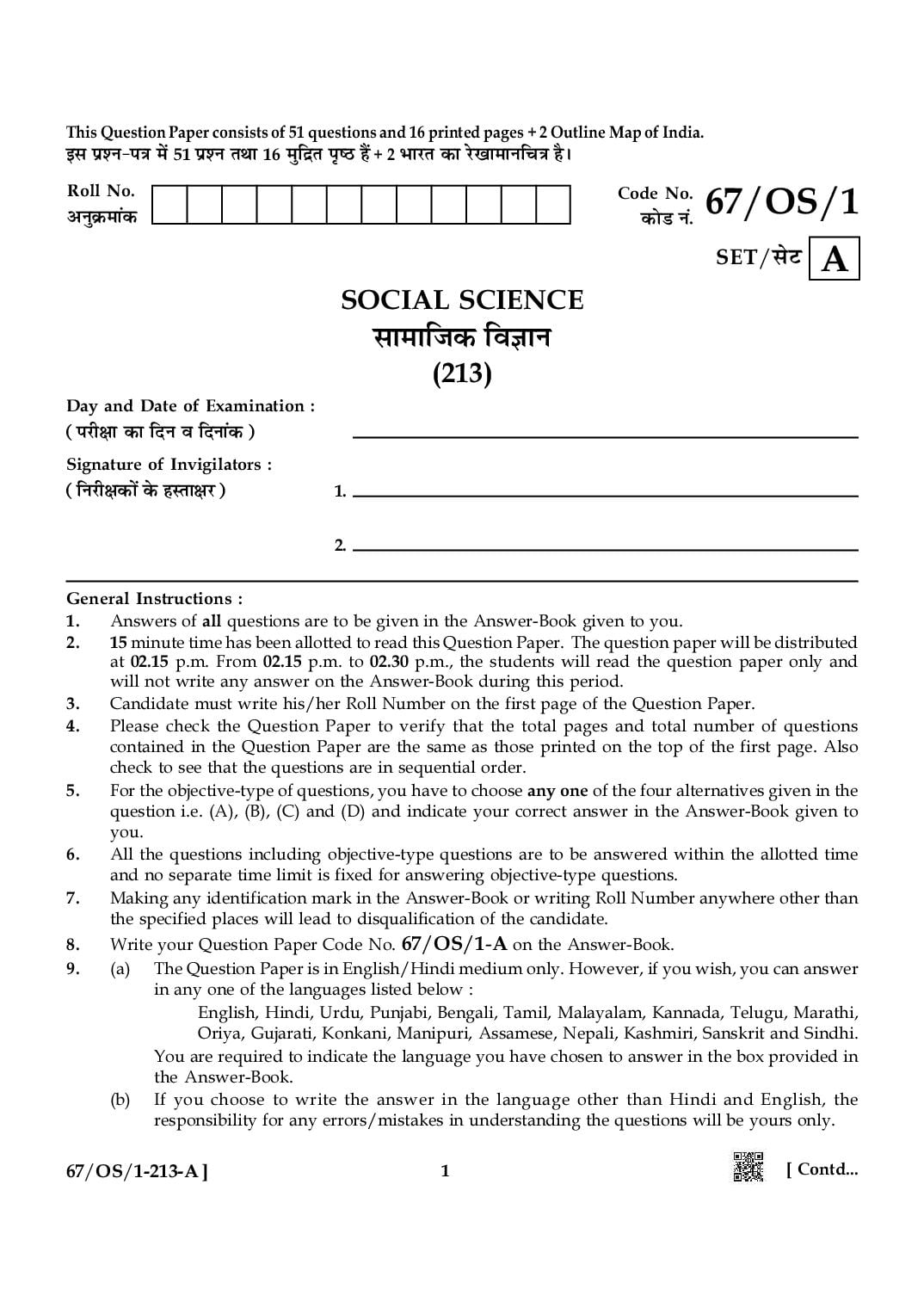
Page 1
ß‚ ¬˝‡Ÿ-¬òÊ ◊¥ 51 ¬˝‡Ÿ ÃÕÊ 16 ◊ÈÁŒ˝Ã ¬Îc∆U „Ò¥ + 2 ÷Ê⁄Uà ∑§Ê ⁄UπÊ◊ÊŸÁøòÊ „Ò–
Roll No. Code No.
•ŸÈ∑˝§◊Ê¥∑§ ∑§Ê«U Ÿ¥.
67/OS/1
SET/‚ ≈ A
SOCIAL SCIENCE
‚Ê◊ÊÁ¡∑§ ÁflôÊÊŸ
(213)
Day and Date of Examination :
(¬⁄UˡÊÊ ∑§Ê ÁŒŸ fl ÁŒŸÊ¥∑§)
Signature of Invigilators :
(ÁŸ⁄UˡÊ∑§Ê¥ ∑§ „SÃÊˇÊ⁄U) 1.
2.
General Instructions :
1. Answers of all questions are to be given in the Answer-Book given to you.
2. 15 minute time has been allotted to read this Question Paper. The question paper will be distributed
at 02.15 p.m. From 02.15 p.m. to 02.30 p.m., the students will read the question paper only and
will not write any answer on the Answer-Book during this period.
3. Candidate must write his/her Roll Number on the first page of the Question Paper.
4. Please check the Question Paper to verify that the total pages and total number of questions
contained in the Question Paper are the same as those printed on the top of the first page. Also
check to see that the questions are in sequential order.
5. For the objective-type of questions, you have to choose any one of the four alternatives given in the
question i.e. (A), (B), (C) and (D) and indicate your correct answer in the Answer-Book given to
you.
6. All the questions including objective-type questions are to be answered within the allotted time
and no separate time limit is fixed for answering objective-type questions.
7. Making any identification mark in the Answer-Book or writing Roll Number anywhere other than
the specified places will lead to disqualification of the candidate.
8. Write your Question Paper Code No. 67/OS/1-A on the Answer-Book.
9. (a) The Question Paper is in English/Hindi medium only. However, if you wish, you can answer
in any one of the languages listed below :
English, Hindi, Urdu, Punjabi, Bengali, Tamil, Malayalam, Kannada, Telugu, Marathi,
Oriya, Gujarati, Konkani, Manipuri, Assamese, Nepali, Kashmiri, Sanskrit and Sindhi.
You are required to indicate the language you have chosen to answer in the box provided in
the Answer-Book.
(b) If you choose to write the answer in the language other than Hindi and English, the
responsibility for any errors/mistakes in understanding the questions will be yours only.
67/OS/1-213-A ] 1 [ Contd...
Page 2
1. ‚÷Ë ¬˝‡ŸÊ¥ ∑§ ©ûÊ⁄U •Ê¬∑§Ê ŒË ªÿË ©ûÊ⁄U-¬ÈÁSÃ∑§Ê ◊¥ „Ë Á‹π¥–
2. ß‚ ¬˝‡Ÿ-¬òÊ ∑§Ê ¬…∏Ÿ ∑§ Á‹∞ 15 Á◊Ÿ≈U ∑§Ê ‚◊ÿ ÁŒÿÊ ªÿÊ „Ò– ¬˝‡Ÿ-¬òÊ ∑§Ê ÁflÃ⁄UáÊ ŒÊ¬„⁄U ◊¥ 02.15 ’¡ Á∑§ÿÊ ¡Ê∞ªÊ–
02.15 ’¡ ‚ 02.30 ’¡ Ã∑§ ¿UÊòÊ ∑§fl‹ ¬˝‡Ÿ-¬òÊ ∑§Ê ¬…∏¥ª •ÊÒ⁄U ß‚ •flÁœ ∑§ ŒÊÒ⁄UÊŸ fl ©ûÊ⁄U-¬ÈÁSÃ∑§Ê ¬⁄U ∑§Ê߸ ©ûÊ⁄U Ÿ„Ë¥
Á‹π¥ª–
3. ¬⁄UˡÊÊÕ˸ ¬˝‡Ÿ-¬òÊ ∑§ §¬„‹ ¬Îc∆U ¬⁄U •¬ŸÊ •ŸÈ∑˝§◊Ê¥∑§ •fl‡ÿU Á‹π¥–
4. ∑Χ¬ÿÊ ¬˝‡Ÿ-¬òÊ ∑§Ê ¡ÊÚ°ø ‹¥ Á∑§ ¬˝‡Ÿ-¬òÊ ∑§ ∑ȧ‹ ¬Îc∆UÊ¥ ÃÕÊ ¬˝‡ŸÊ¥ ∑§Ë ©ÃŸË „Ë ‚¥ÅUÿÊ „Ò Á¡ÃŸË ¬˝Õ◊ ¬Îc∆ ∑ §‚’‚ ™§¬⁄U
¿U¬Ë „Ò– ß‚ ’Êà ∑§Ë ¡ÊÚ°ø ÷Ë ∑§⁄U ‹¥ Á∑§ ¬˝‡Ÿ ∑˝ Á◊∑§ UM§¬ ◊¥ „Ò¥–
5. flSÃÈÁŸc∆U ¬˝‡ŸÊ¥ ◊¥ •Ê¬∑§Ê øÊ⁄U Áfl∑§À¬Ê¥ (A), (B), (C) ÃÕÊ (D) ◊¥ ‚ ∑§Ê߸ ∞∑§ ©ûÊ⁄U øÈŸŸÊ „Ò ÃÕÊ ŒË ªß¸ ©ûÊ⁄U-¬ÈÁSÃ∑§Ê ◊¥
‚„Ë ©ûÊ⁄U Á‹πŸÊ „Ò–
6. flSÃÈÁŸc∆U ¬˝‡ŸÊ¥ ∑§ ‚ÊÕ-‚ÊÕ ‚÷Ë ¬˝‡ŸÊ¥ ∑§ ©ûÊ⁄U ÁŸœÊ¸Á⁄Uà •flÁœ ∑§ ÷ËÃ⁄U „Ë ŒŸ „Ò¥– flSÃÈÁŸc∆U ¬˝‡ŸÊ¥ ∑§ Á‹∞ •‹ª ‚
‚◊ÿ Ÿ„Ë¥ ÁŒÿÊ ¡Ê∞ªÊ–
7. § ©ûÊ⁄U-¬ÈÁSUÃ∑§Ê ◊¥ ¬„øÊŸ-Áøq ’ŸÊŸ •ÕflÊ ÁŸÁŒ¸c≈U SÕÊŸÊ¥ ∑§§•ÁÃÁ⁄UÄà ∑§„Ë¥ ÷Ë •ŸÈ∑˝§◊Ê¥∑§ Á‹πŸ ¬⁄U ¬⁄UˡÊÊÕ˸ ∑§Ê •ÿÊÇÿ
∆U„⁄UÊÿÊ ¡ÊÿªÊ–
8. •¬ŸË ©ûÊ⁄U-¬ÈÁSUÃ∑§Ê ¬⁄U ¬˝‡Ÿ-¬òÊ ∑§Ê ∑§Ê«U Ÿ¥. 67/OS/1-A Á‹π¥–
9. (∑§) ¬˝‡Ÿ-¬òÊ ∑§fl‹ •¥ª˝¡Ë/Á„¥ŒË ◊¥ „Ò– Á»§⁄U ÷Ë, ÿÁŒ •Ê¬ øÊ„¥ ÃÊ ŸËø ŒË ªß¸ Á∑§‚Ë ∞∑§ ÷Ê·Ê ◊¥ ©ûÊ⁄ Œ ‚∑§Ã „Ò¥ —
•¥ª˝¡Ë, Á„¥ŒË, ©ŒÍ¸, ¬¥¡Ê’Ë, ’°ª‹Ê, ÃÁ◊‹, ◊‹ÿÊ‹◊, ∑§ãŸ«∏, ËȪÍ, ◊⁄UÊ∆UË, ©Á«∏ÿÊ, ªÈ¡⁄UÊÃË, ∑§Ê¥∑§áÊË,
◊ÁáʬÈ⁄UË, •‚Á◊ÿÊ, Ÿ¬Ê‹Ë, ∑§‡◊Ë⁄UË, ‚¥S∑Χç•ÊÒ⁄U Á‚¥œË–
∑Χ¬ÿÊ ©ûÊ⁄U-¬ÈÁSÃ∑§Ê ◊¥ ÁŒ∞ ª∞ ’ÊÚÄ‚ ◊¥ Á‹π¥ Á∑§ •Ê¬ Á∑§‚ ÷Ê·Ê ◊¥ ©ûÊ⁄U Á‹π ⁄U„ „Ò¥–
(π) ÿÁŒ •Ê¬ Á„¥ŒË ∞fl¥ •¥ª˝¡Ë ∑§ •ÁÃÁ⁄UÄà Á∑§‚Ë •ãÿ ÷Ê·Ê ◊¥ ©ûÊ⁄U Á‹πà „Ò¥, ÃÊ ¬˝‡ŸÊ¥ ∑§Ê ‚◊¤ÊŸ ◊¥ „ÊŸ flÊ‹Ë
òÊÈÁ≈UÿÊ¥/ª‹ÁÃÿÊ¥ ∑§Ë Á¡ê◊UŒÊ⁄Ë ∑ fl‹ •Ê¬∑§Ë „ʪ˖
67/OS/1-213-A ] 2 [ Contd...
Page 3
‚Ê◊ÊÁ¡∑§ ÁflôÊÊŸ
(213)
Time : 3 Hours ] [ Maximum Marks : 100
‚◊ÿ — 3 ÉÊá≈U ] [ ¬ÍáÊÊZ∑§ — 100
Note :
(i) This question paper consists of 51 questions in all.
(ii) All questions are compulsory.
(iii) Marks are given against each question.
(iv) Section - A consists of
(a) Q.No. 1 to 20 - Multiple Choice Type Questions (MCQs) carrying 1 mark each. Select and
write the most appropriate option out of the four options given in each of these questions.
An internal choice has been provided in some of these questions. You have to do only one of
the given choices in such questions.
(b) Q.No. 21 to 35 - Objective type questions carrying two marks each (with 2 sub parts of 1
mark each). Attempt these questions as per the instructions given for each of the questions.
Section - B consists of
(c) Q.No. 36 to 41 - Very Short Answer type questions carrying 2 marks each to be answered in
the range of 30 - 50 words. Attempt these questions as per the instructions given for each of
the questions.
(d) Q.No. 42 to 47 - Short Answer type questions carrying 3 marks each to be answered in the
range of 50 - 80 words.
(e) Q.No. 48 to 49 - Skill (Map) based questions carrying 4 marks each. (Alternative questions
are given in lieu of map based questions for visually impaired students.)
(f) Q.No. 50 to 51 - Long Answer type questions carrying 6 marks each to be answered in
80 - 120 words.
ÁŸŒ¸‡Ê —
(i) ß‚ ¬˝‡Ÿ-¬òÊ ◊¥ 51 ¬˝‡Ÿ „Ò¥–
(ii) ‚÷Ë ¬˝‡Ÿ •ÁŸflÊÿ¸ „Ò¥–
(iii) ‚÷Ë ¬˝‡ŸÊ¥ ∑§ •¥∑§ ©Ÿ∑§ ‚ÊÕ ÁŒÿ ªÿ „Ò¥–
(iv) 𥫠- • ∑§ ¬˝‡Ÿ
(a) ¬˝‡Ÿ ‚¥ÅÿÊ 1 ‚ 20 Ã∑§ - 1 •¥∑§ flÊ‹ ’„ÈÁfl∑§À¬Ëÿ ¬˝∑§Ê⁄U ∑§ ¬˝‡Ÿ „Ò¥– ÁŒÿ ªÿ øÊ⁄U Áfl∑§À¬Ê¥ ◊¥ ‚ ‚flʸÁœ∑§
©¬ÿÈÄà Áfl∑§À¬ ∑§Ê øÈŸ¥ ÃÕÊ Á‹π¥– ∑ȧ¿U ¬˝‡ŸÊ¥ ◊¥ •Ê¥ÃÁ⁄U∑§ øÿŸ ∑§Ë ‚ÈÁflœÊ ŒË ªÿË „Ò– •Ê¬∑§Ê ∞‚ ŒÊ Áfl∑§À¬Ê¥
◊¥ ‚ ∑§fl‹ ∞∑§ ¬˝‡Ÿ ∑§⁄UŸÊ „Ò–
(b) ¬˝‡Ÿ ‚¥ÅÿÊ 21 ‚ 35 Ã∑§ - 2 •¥∑§ flÊ‹ flSÃÈÁŸc∆U ¬˝∑§Ê⁄U ∑§ ¬˝‡Ÿ „Ò¥ (¬˝àÿ∑§ 1 •¥∑§ ∑§ 2 ©¬-÷ʪʥ ∑§ ‚ÊÕ)– ߟ
¬˝‡ŸÊ¥ ∑§Ê ©ûÊ⁄U ¬˝‡ŸÊ¥ ∑§ ‚ÊÕ ÁŒÿ ªÿ ÁŸŒ¸‡ÊÊ¥ ∑§ •ŸÈ‚Ê⁄U ŒËÁ¡ÿ–
𥫠- ’ ∑§ ¬˝‡Ÿ
(c) ¬˝‡Ÿ ‚¥ÅÿÊ 36 ‚ 41 Ã∑§ - 2 •¥∑§ flÊ‹ •Áà ‹ÉÊÈ-©ûÊ⁄UËÿ ¬˝∑§Ê⁄U ∑§ ¬˝àÿ∑§ ¬˝‡Ÿ ∑§Ê ©ûÊ⁄U 30 ‚ 50 ‡ÊéŒÊ¥ ◊¥
ŒËÁ¡ÿ– ߟ ¬˝‡ŸÊ¥ ∑§Ê ©ûÊ⁄U ¬˝‡ŸÊ¥ ∑§ ‚ÊÕ ÁŒÿ ªÿ ÁŸŒ¸‡ÊÊ¥ ∑§ •ŸÈ‚Ê⁄U Œ¥–
(d) ¬˝‡Ÿ ‚¥ÅÿÊ 42 ‚ 47 Ã∑§ - 3 •¥∑§ flÊ‹ ‹ÉÊÈ-©ûÊ⁄UËÿ ¬˝∑§Ê⁄U ∑§ ¬˝àÿ∑§ ¬˝‡Ÿ ∑§Ê ©ûÊ⁄U 50 ‚ 80 ‡ÊéŒÊ¥ ◊¥ Œ¥–
(e) ¬˝‡Ÿ ‚¥ÅÿÊ 48 ‚ 49 Ã∑§ - ∑§Ê҇ʋ (◊ÊŸÁøòÊ) ¬⁄U •ÊœÊÁ⁄Uà 4 •¥∑§ flÊ‹ ¬˝‡Ÿ „Ò¥– (ŒÎÁc≈U’ÊÁœÃ ¿UÊòÊÊ¥ „ÃÈ ◊ÊŸÁøòÊ
¬⁄U •ÊœÊÁ⁄Uà ¬˝‡ŸÊ¥ ∑§ SÕÊŸ ¬⁄U flÒ∑§ÁÀ¬∑§ ¬˝‡Ÿ ÁŒÿ ªÿ „Ò¥–)
(f) ¬˝‡Ÿ ‚¥ÅÿÊ 50 ‚ 51 Ã∑§ - 6 •¥∑§ flÊ‹ ŒËÉʸ-©ûÊ⁄UËÿ ¬˝∑§Ê⁄U ∑§ ¬˝àÿ∑§ ¬˝‡Ÿ ∑§Ê ©ûÊ⁄U 80 ‚ 120 ‡ÊéŒÊ¥ ◊¥ Œ¥–
67/OS/1-213-A ] 3 [ Contd...
Page 4
1. Europe witnessed profound changes in which of the following area during Renaissance ? 1
(A) Cultural sphere (B) Economic sphere
(C) Political sphere (D) Religious sphere
¬ÈŸ¡Ê¸ª⁄UáÊ ∑§Ê‹ ◊¥ ÿÍ⁄Uʬ Ÿ ÁŸêŸ ◊¥ ‚ Á∑§‚ ˇÊòÊ ◊¥ ª„Ÿ ¬Á⁄UfløŸ Œπ?
(A) ‚Ê¥S∑ΧÁÃ∑§ ˇÊòÊ (B) •ÊÁÕ¸∑§ ˇÊòÊ
(C) ⁄UÊ¡ŸËÁÃ∑§ ˇÊòÊ (D) œÊÁ◊¸∑§ ˇÊòÊ
OR / •ÕflÊ
Which one of the following period is associated with Renaissance in Europe ?
(A) Period of darkness (B) Period of scientific inquiry
(C) Period of ignorance (D) Period of irrationality
ÁŸêŸÁ‹Áπà ◊¥ ‚ ∑§ÊÒŸ-‚Ê ∑§Ê‹ ÿÍ⁄Uʬ ∑§ ¬ÈŸ¡Ê¸ª⁄UáÊ ‚ ‚¥’¥ÁœÃ „Ò?
(A) •ãœ∑§Ê⁄U ÿȪ (B) flÒôÊÊÁŸ∑§ ¡Ê°ø ∑§Ê ÿȪ
(C) •ôÊÊŸÃÊ ∑§Ê ∑§Ê‹ (D) •ÃÊÁ∑¸§∑§ÃÊ ∑§Ê ‚◊ÿ
2. Which of the following periods of British history is known as the period of Industrial 1
Revolution ?
(A) 1450 - 1550 (B) 1550 - 1650 (C) 1650 - 1750 (D) 1750 - 1850
Á’˝Á≈U‡Ê ßÁÄʂ ◊¥ ÁŸêŸÁ‹Áπà ◊¥ ‚ Á∑§‚ ∑§Ê‹ ∑§Ê •ÊÒlÊÁª∑§ ∑˝§Ê¥Áà ∑§ M§¬ ◊¥ ¡ÊŸÊ ¡ÊÃÊ „Ò?
(A) 1450 - 1550 (B)
1550 - 1650 (C) 1650 - 1750 (D) 1750 - 1850
OR / •ÕflÊ
Which one of the following systems was developed in England during Industrial
Revolution ?
(A) Factory System (B) Barter System
(C) Feudal System (D) Mansabdari System
ߥNjҥ«U ◊¥ •ÊÒlÊÁª∑§ ∑˝§Ê¥Áà ∑§ ŒÊÒ⁄UÊŸ ÁŸêŸÁ‹Áπà ◊¥ ‚ Á∑§‚ ¬˝áÊÊ‹Ë ∑§Ê Áfl∑§Ê‚ „È•Ê?
(A) ∑§Ê⁄UπÊŸÊ ¬˝áÊÊ‹Ë (B) flSÃÈ ÁflÁŸ◊ÿ ¬˝áÊÊ‹Ë
(C) ‚Ê◊¥ÃË √ÿflSÕÊ (D) ◊Ÿ‚’ŒÊ⁄UË √ÿflSÕÊ
3. Who amongst the following is the author of the book ‘Das Capital’ ? 1
(A) Otto Van Bismarck (B) Kaiser William I
(C) Karl Marx (D) Count Cavour
ÁŸêŸÁ‹Áπà ◊¥ ‚ “ŒÊ‚ ∑Ò§Á¬≈U‹” Á∑§ÃÊ’ ∑§Ê ‹π∑§ ∑§ÊÒŸ „Ò?
(A) •ÊÚ≈UÊ flŸ Á’S◊Ê∑¸§ (B) ∑§‚⁄U ÁflÁ‹ÿ◊ ¬˝Õ◊
(C) ∑§Ê‹¸ ◊ÊÄ‚¸ (D) ∑§Ê©¥≈U ∑§fl⁄U
4. Which one of the following was the first international organisation set up in 1920 ? 1
(A) The Red Cross Society (B) The Amnesty International
(C) The United Nations Organisation (D) The League of Nations
ÁŸêŸÁ‹Áπà ◊¥ ‚ ∑§ÊÒŸ-‚Ê 1920 ◊¥ SÕÊÁ¬Ã ¬„‹Ê •¥Ã⁄Uʸc≈˛UËÿ ‚¥ª∆UŸ ÕÊ?
(A) ⁄U«U ∑˝§Ê‚ ‚Ê‚Ê߸U≈UË (B) •◊ŸS≈UË ß¥≈U⁄UŸ‡ÊŸ‹
(C) ‚¥ÿÈÄà ⁄UÊc≈˛U ‚¥ÉÊ (D) ‹Ëª •ÊÚ»§ Ÿ‡Ê¥‚
67/OS/1-213-A ] 4 [ Contd...
Page 5
(A) Peshwa Baji Rau (B) Tipu Sultan
(C) Muhammad Bin Tughlaq (D) Nawab Wajid Ali Shah
•Ê¥Ç‹-◊Ò‚Í⁄U ÿÈh ◊¥ ÁŸêŸÁ‹Áπà ◊¥ ‚ Á∑§‚Ÿ ◊Ò‚Í⁄U ∑§Ê ŸÃÎàfl Á∑§ÿÊ?
(A) ¬‡ÊflÊ ’Ê¡Ë ⁄UÊÚfl (B) ≈UË¬Í ‚ÈÀÃÊŸ
(C) ◊Ê„ê◊Œ Á’Ÿ ÃȪ‹∑§ (D) ŸflÊ’ flÊÁ¡Œ •‹Ë ‡ÊÊ„
OR / •ÕflÊ
Who amongst the following British official introduced Permanent Settlement in Bengal and
Bihar in 1793 ?
(A) Wellsley (B) Cornwallis (C) Dalhousie (D) Mountbatten
1793 ◊¥ ÁŸêŸÁ‹Áπà ◊¥ ‚ Á∑§‚ •¥ª˝¡ •»§‚⁄U Ÿ ’¥ªÊ‹ •ÊÒ⁄U Á’„Ê⁄U ◊¥ SÕÊÿË ’¥ŒÊ’Sà ‹ÊªÍ Á∑§ÿÊ?
(A) flÀ‚‹Ë (B) ∑§ÊÚŸ¸flÊÁ‹‚ (C) «U‹„ÊÒ$¡Ë (D) ◊Ê©¥≈U’Ò≈UŸ
6. Which one of the following Movements started in 1920 in India ? 1
(A) Civil Disobedience Movement (B) Quit India Movement
(C) Non-Cooperation Movement (D) Civil Rights Movement
1920 ◊¥ ÷Ê⁄Uà ◊¥ ÁŸêŸÁ‹Áπà ◊¥ ‚ ∑§ÊÒŸ-‚Ê •ÊãŒÊ‹Ÿ ‡ÊÈM§ „È•Ê?
(A) ‚ÁflŸÿ •flôÊÊ •Ê¥ŒÊ‹Ÿ (B) ÷Ê⁄Uà ¿UÊ«∏Ê •Ê¥ŒÊ‹Ÿ
(C) •‚„ÿʪ •Ê¥ŒÊ‹Ÿ (D) ŸÊªÁ⁄U∑§ •Áœ∑§Ê⁄U •Ê¥ŒÊ‹Ÿ
7. Generally on which of the following height Upper air currents or Jet streams blow ? 1
(A) 6,000 meters above the sea level (B) 8,000 meters above the sea level
(C) 10,000 meters above the sea level (D) 12,000 meters above the sea level
¡≈U S≈˛UË◊ ÿÊ ™§¬⁄UË flÊÿÈ œÊ⁄UÊÿ¥ ‚Ê◊Êãÿ× ÁŸêŸ ◊¥ ‚ Á∑§‚ ™°§øÊ߸ ¬⁄U ’„ÃË „Ò¥?
(A) ‚◊ÈŒ˝ Ë ‚ 6,000 ◊Ë≈U⁄ ™§¬⁄UU (B) ‚◊ÈŒ˝ Ë ‚ 8,000 ◊Ë≈U⁄U ™§¬⁄U
(C) ‚◊ÈŒ˝ Ë ‚ 10,000 ◊Ë≈U⁄ ™§¬⁄UU (D) ‚◊ÈŒ˝ Ë ‚ 12,000 ◊Ë≈U⁄U ™§¬⁄U
67/OS/1-213-A ] 5 [ Contd...
Page 6
(A) Kanchenjanga (B) Mt. Everest (C) Nanda Devi (D) Nanga Parvat
ÁŒ∞ ª∞ ÷Ê⁄Uà ∑§ ⁄UπÊ ◊ÊŸÁøòÊ ¬⁄U ÁøÁqà ‘A’ ¬fl¸Ã Á‡Êπ⁄U ∑§Ë ¬„øÊŸ ∑§ËÁ¡∞–
(A) ∑¥§øŸ¡¥ªÊ (B) ◊Ê©¥≈U ∞fl⁄US≈U (C) ŸãŒÊ ŒflË (D) ŸÊ¥ªÊ ¬fl¸Ã
For Visually Impaired
Which one of the following mountain ranges run parallel to the Bay of Bengal ?
(A) Satpura Range (B) Aravalli Range
(C) Eastern Ghats (D) Western Ghats
ÁŸêŸÁ‹Áπà ◊¥ ‚ ∑§ÊÒŸ-‚Ë ¬fl¸Ã oÎ¥π‹Ê ’¥ªÊ‹ ∑§Ë πÊ«∏Ë ∑§ ‚◊Ê¥Ã⁄U ø‹ÃË „Ò?
(A) ‚ìÈ⁄UÊ ¬fl¸Ã oÎ¥π‹Ê (B) •⁄UÊfl‹Ë ¬fl¸Ã oÎ¥π‹Ê
(C) ¬Ífl˸ ÉÊÊ≈U (D) ¬Á‡ø◊Ë ÉÊÊ≈U
67/OS/1-213-A ] 6 [ Contd...
Page 7
(A) Mahanadi and Krishna (B) Brahmaputra and Hugli
(C) Son and Kosi (D) Narmada and Tapti
ÁŒ∞ ª∞ ⁄UπÊ ◊ÊŸÁøòÊ ◊¥ ¬Ífl˸ ÉÊÊ≈U ∑§ ¬Í⁄U’ ∑§Ë •Ê⁄U ’„Ÿ flÊ‹Ë ŒÊ ŸÁŒÿÊ¥ ∑§Ê ŸÊ◊ ¬„øÊÁŸ∞–
(A) ◊„ÊŸŒË •ÊÒ⁄U ∑ΧcáÊÊ (B) ’˝rʬÈòÊ •ÊÒ⁄U „ÍÇ‹Ë
(C) ‚ÊŸ •ÊÒ⁄U ∑§Ê‚Ë (D) Ÿ◊¸ŒÊ •ÊÒ⁄U ÃÊåÃË
For visually impaired candidates.
Which of the following is a Westward flowing river ?
(A) Mahi (B) Narmada (C) Ganga (D) Yamuna
ÁŸêŸÁ‹Áπà ◊¥ ‚ ∑§ÊÒŸ-‚Ë ŸŒË ¬Á‡ø◊ ∑§Ë •Ê⁄U ’„ÃË „Ò?
(A) ◊Ê„Ë (B) Ÿ◊¸ŒÊ (C) ª¥ªÊ (D) ÿ◊ÈŸÊ
67/OS/1-213-A ] 7 [ Contd...
Page 8
(A) Anamalai Hills (B) Mahendragiri Hills
(C) Kollimalai Hills (D) Satmala Hills
÷Ê⁄Uà ∑§ ÁŒ∞ ª∞ ⁄UπÊ ◊ÊŸÁøòÊ ◊¥ ¬˝ÊÿmˬËÿ ¬∆UÊ⁄U ∑§Ë ‘A’ ‚ ÁøÁqà ¬„Ê«∏Ë ∑§Ë ¬„øÊŸ ∑§ËÁ¡∞–
(A) •ãŸÊ◊Ê‹Ê߸ ∑§Ë ¬„ÊÁ«∏ÿÊ° (B) ◊„ãŒ˝Áª⁄UË ∑§Ë ¬„ÊÁ«∏ÿÊ°
(C) ∑§ÊÀ‹Ë◊Ê‹Ê߸ ∑§Ë ¬„ÊÁ«∏ÿÊ° (D) ‚Ã◊Ê‹Ê ∑§Ë ¬„ÊÁ«∏ÿÊ°
For Visually Impaired candidates
Which one of the following plateaus is a part of Central Highlands ?
(A) Tibet Plateau (B) Deccan Plateau
(C) Malwa Plateau (D) Satpura Plateau
ÁŸêŸÁ‹Áπà ◊¥ ‚ ∑§ÊÒŸ-‚Ê ¬∆UÊ⁄U ‚¥≈˛U‹ „Êß‹Ò¥«U‚ ∑§Ê Á„S‚Ê „Ò?
(A) ÁÃé’à ∑§Ê ¬∆UÊ⁄U (B) ŒÄ∑§Ÿ ¬∆UÊ⁄U
(C) ◊Ê‹flÊ ¬∆UÊ⁄U (D) ‚ìÈ⁄UÊ ¬∆UÊ⁄U
67/OS/1-213-A ] 8 [ Contd...
Page 9
(A) Shiwalik Range (B) Aravalli Range
(C) Gir Range (D) Satpura Range
÷Ê⁄Uà ∑§ ÁŒ∞ ª∞ ⁄UπÊ ◊ÊŸÁøòÊ ◊¥ •¥Á∑§Ã ‘M’ ¬fl¸Ã oÎ¥π‹Ê ∑§Ë ¬„øÊŸ ∑§ËÁ¡∞–
(A) Á‡ÊflÊÁ‹∑§ oÎ¥π‹Ê (B) •⁄UÊfl‹Ë oÎ¥π‹Ê
(C) Áª⁄U oÎ¥π‹Ê (D) ‚ìÈ⁄UÊ oÎ¥π‹Ê
Note : The following question is only for the visually impaired candidates in lieu of Q.11
ŸÊ≈U — ÁŸêŸÁ‹Áπà ¬˝‡Ÿ ∑§fl‹ ŒÎÁc≈U’ÊÁœÃ ¬Á⁄UˇÊÊÁÕ¸ÿÊ¥ ∑§ Á‹∞ ¬˝‡Ÿ ‚¥ÅÿÊ 11 ∑§ SÕÊŸ ¬⁄U „Ò–
Which of the following is the mountain range of Rajasthan and near about area ?
(A) Shiwalik Range (B) Aravalli Range (C) Gir Range (D) Satpura Range
ÁŸêŸÁ‹Áπà ◊¥ ‚ ∑§ÊÒŸ-‚Ë ¬fl¸Ã oÎ¥π‹Ê ⁄UÊ¡SÕÊŸ •ÊÒ⁄U ©‚∑§ ÁŸ∑§≈UflÃ˸ ˇÊòÊ ∑§Ë „Ò?
(A) Á‡ÊflÊÁ‹∑§ oÎ¥π‹Ê (B) •⁄UÊfl‹Ë oÎ¥π‹Ê (C) Áª⁄U oÎ¥π‹Ê (D) ‚ìÈ⁄UÊ oÎ¥π‹Ê
67/OS/1-213-A ] 9 [ Contd...
Page 10
(A) Claim (B) Authority (C) Property (D) Liberty
∞∑§ •Áœ∑§Ê⁄U ∑§Ê ∞∑§ √ÿÁÄà ∑§ Á‹ÿ ÄÿÊ •Õ¸ „ÊÃÊ „Ò? ÁŸêŸÁ‹Áπà ‡ÊéŒÊ¥ ◊¥ ‚ ©Áøà ‡ÊéŒ ∑§Ê øÿŸ ∑§ËÁ¡ÿ–
(A) ŒÊflÊ (B) ‚àÃÊ (C) ‚¥¬Áàà (D) SflÃ¥òÊÃÊ
OR / •ÕflÊ
What a duty means to someone ? Select the right term from below :
(A) Empowered (B) Required (C) Acquired (D) Desired
Á∑§‚Ë √ÿÁÄà ∑§ Á‹ÿ ∑§Ã¸√ÿ ∑§Ê ÄÿÊ •Õ¸ „ÊÃÊ „Ò? ÁŸêŸÁ‹Áπà ‡ÊéŒÊ¥ ◊¥ ‚ ©Áøà ‡ÊéŒ ∑§Ê øÿŸ ∑§ËÁ¡ÿ–
(A) •Áœ∑§Ê⁄U ¬ÊÿÊ „È•Ê (B) ¡Ê •Êfl‡ÿ∑§ „Ê (C) ¬ÊÿÊ „È•Ê (D) øÊ„Ê „È•Ê
13. The Fundamental Rights are : 1
(A) Justifiable (B) Justiciable (C) Liable (D) Fallible
◊Í‹÷Íà •Áœ∑§Ê⁄U „Ò —
(A) ‚◊Õ¸ŸËÿ (B) ãÿÊÿ ∑§ ÿÊÇÿ (C) ©àÃ⁄UŒÊ߸ (D) ŒÊ·‚ˇÊ◊
OR / •ÕflÊ
In which of the following years ‘The Right to Education’ was added by introducing a new
Article 21A in the Chapter of Fundamental Rights by 86th Constitutional Amendment ?
(A) 2000 (B) 2001 (C) 2002 (D) 2003
“Á‡ÊˇÊÊ ∑§Ê •Áœ∑§Ê⁄U” 86 fl¥ ‚¥flÒœÊÁŸ∑§ ‚¥‡ÊÊœŸ ∑§ mÊ⁄UÊ ◊Í‹ÊÁœ∑§Ê⁄UÊ¥ ∑§ •äÿÊÿ ◊¥ ∞∑§ ŸÿÊ •ŸÈë¿Œ 21A ∑§ M§¬ ◊¥
ÁŸêŸÁ‹Áπà ◊¥ ‚ Á∑§‚ fl·¸ ◊¥ ¡Ê«∏Ê ªÿÊ ÕÊ?
(A) 2000 (B) 2001 (C) 2002 (D) 2003
14. Appointment of Advocate General comes under which powers of a Governor of an Indian 1
State ?
(A) Executive powers (B) Legislative powers
(C) Financial powers (D) Discretionary powers
∞∑§ ÷Ê⁄UÃËÿ ⁄UÊíÿ ∑§ ⁄UÊíÿ¬Ê‹ mÊ⁄UÊ ∞«UflÊ∑§≈U ¡Ÿ⁄U‹ ∑§Ë ÁŸÿÈÁÄà ©‚∑§Ë Á∑§Ÿ ‡ÊÁÄÃÿÊ¥ ∑§ •¥Ãª¸Ã ∑§Ë ¡ÊÃË „Ò?
(A) ∑§Êÿ¸∑§Ê⁄UË ‡ÊÁÄÃÿÊ° (B) ÁflœÊ߸ ‡ÊÁÄÃÿÊ°
(C) ÁflàÃËÿ ‡ÊÁÄÃÿÊ° (D) Áflfl∑§ÊœËŸ ‡ÊÁÄÃÿÊ°
OR / •ÕflÊ
Appointment of members of State Finance Commission comes under which powers of a
Governor of an Indian State ?
(A) Legislative powers (B) Financial powers
(C) Discretionary powers (D) Executive powers
∞∑§ ÷Ê⁄UÃËÿ ⁄UÊíÿ ∑§ ⁄UÊíÿ¬Ê‹ mÊ⁄UÊ ⁄UÊíÿ ∑§ ÁflàÃËÿ •Êÿʪ ∑§ ‚ŒSÿÊ¥ ∑§Ë ÁŸÿÈÁÄà ©‚∑§Ë Á∑§Ÿ ‡ÊÁÄÃÿÊ¥ ∑§ •¥Ãª¸Ã
∑§Ë ¡ÊÃË „Ò?
(A) ÁflœÊ߸ ‡ÊÁÄÃÿÊ° (B) ÁflàÃËÿ ‡ÊÁÄÃÿÊ°
(C) Áflfl∑§ÊœËŸ ‡ÊÁÄÃÿÊ° (D) ∑§Êÿ¸∑§Ê⁄UË ‡ÊÁÄÃÿÊ°
15. Who presides over the meetings of Lok Sabha ? 1
(A) President of India (B) Speaker
(C) Deputy Chairman (D) Vice President of India
‹Ê∑§‚÷Ê ∑§Ë ’Ò∆U∑§Ê¥ ∑§Ë •äÿˇÊÃÊ ∑§ÊÒŸ ∑§⁄UÃÊ „Ò?
(A) ÷Ê⁄Uà ∑§ ⁄UÊc≈˛U¬Áà (B) S¬Ë∑§⁄U
(C) ©¬‚÷ʬÁà (D) ÷Ê⁄Uà ∑§ ©¬⁄UÊc≈˛U¬ÁÃ
67/OS/1-213-A ] 10 [ Contd...
Page 11
(A) Abraham Lincoln (B) Mahatma Gandhi
(C) Leo Tolstoy (D) Subhash Chandra Bose
““‹Ê∑§ÃãòÊ ¡ŸÃÊ ∑§Ë, ¡ŸÃÊ ∑§ Á‹ÿ, ¡ŸÃÊ ∑§Ë ‚⁄U∑§Ê⁄U „Ò–”” Á∑§‚Ÿ ∑§„Ê ÕÊ?
(A) •’˝Ê„◊ Á‹¥∑§Ÿ (B) ◊„Êà◊Ê ªÊ¥œË
(C) Á‹ÿÊ ≈UÊ‹S≈UÊÿ (D) ‚È÷Ê· ø¥Œ˝ ’Ê‚
17. Which of the following is not a must for a Democracy ? 1
(A) Participation of the people (B) Compulsory Military Service
(C) People’s Satisfaction (D) Political and Social Equality
ÁŸêŸÁ‹Áπà ◊¥ ‚ ‹Ê∑§ÃãòÊ ∑§ Á‹ÿ ÄÿÊ •Êfl‡ÿ∑§ Ÿ„Ë¥ „Ò?
(A) ¡Ÿ÷ʪˌÊ⁄UË (B) •ÁŸflÊÿ¸ ‚ÒÁŸ∑§ ‚flÊ
(C) ¡ŸÃÊ ∑§Ë ‚¥ÃÈÁc≈U (D) ⁄UÊ¡ŸËÁÃ∑§ ÃÕÊ ‚Ê◊ÊÁ¡∑§ ‚◊ÊŸÃÊ
18. Consider the following : 1
ÁŸêŸ ¬⁄U ÁfløÊ⁄U ∑§⁄¥U —
(i) Gross Domestic Product (ii) Life Expectancy
gH$b Kaob y CËnmX OrdZ àË`mem
(iii) Literacy (iv) Levels of Employment
gmjaVm amoOJma Ho$ ñVa
The indicators written above are used to measure which type of underwritten
development ?
(A) Human development (B) Socio-economic development
(C) Social development (D) Economic development
™§¬⁄U Á‹π „Èÿ ‚¥∑§Ã∑§ Á∑§‚ ÁŸêŸÁ‹Áπà Áfl∑§Ê‚ ∑§ ¬˝∑§Ê⁄U ∑§ ◊ʬŸ ◊¥ ¬˝ÿÈÄà „Êà „Ò¥?
(A) ◊ÊŸfl Áfl∑§Ê‚ (B) ‚Ê◊ÊÁ¡∑§ ÃÕÊ •ÊÁÕ¸∑§ Áfl∑§Ê‚
(C) ‚Ê◊ÊÁ¡∑§ Áfl∑§Ê‚ (D) •ÊÁÕ¸∑§ Áfl∑§Ê‚
19. Which one of the following countries was a main participant in the First and Second World 1
Wars ?
(A) Austria (B) Turkey (C) Germany (D) Denmark
ÁŸêŸÁ‹Áπà ◊¥ ‚ ∑§ÊÒŸ-‚Ê Œ‡Ê ¬˝Õ◊ •ÊÒ⁄U ÁmÁÃÿ Áfl‡flÿÈh ◊¥ ◊ÈÅÿ ¬˝ÁÃ÷ÊªË ÕÊ?
(A) •ÊÁS≈˛UÿÊ (B) ÃÈ∑§Ë¸ (C) ¡◊¸ŸË (D) «UŸ◊Ê∑¸§
67/OS/1-213-A ] 11 [ Contd...
Page 12
ÁŸêŸ ¬⁄U ÁfløÊ⁄U ∑§⁄¥U —
(i) Freedom from military dangers (ii) Freedom from hunger
g¡Ý` IVam| go ñdV§ÌVm ^yI go ñdV§ÌVm
(iii) Freedom from armed conflicts (iv) Freedom from environmental degradation
geñÌ PJ‹S>m| go ñdV§ÌVm n`m©daUr` j` go ñdV§ÌVm
Which of the above written freedoms are new understandings of ‘security’ ?
(A) (i) and (ii) (B) (i) and (iii) (C) (i) and (iv) (D) (ii) and (iv)
™§¬⁄U Á‹πË „ÈÿË ‚ SflÃ¥òÊÃÊ•Ê¥ ◊¥ ∑§ÊÒŸ-‚Ë “‚È⁄UˇÊÊ” ∑§Ë ŸÿË ‚◊¤Ê „Ò?
(A) (i) •ÊÒ⁄U (ii) (B) (i) •ÊÒ⁄U (iii) (C) (i) •ÊÒ⁄U (iv) (D) (ii) •ÊÒ⁄U (iv)
21. Fill in the blanks : 2
πÊ‹Ë SÕÊŸ ÷⁄UÊ —
The spirit of __________ also found expression in the field of art and literature. The greatest
achievements of renaissance artists were in the field of __________.
__________ ∑§Ë œÊ⁄UáÊÊ ∑§Ê ∑§‹Ê •ÊÒ⁄U ‚ÊÁ„àÿ ∑§ ˇÊòÊ ◊¥ ÷Ë •Á÷√ÿÁÄà Á◊‹Ë– ¬ÈŸ¡Ê¸ª⁄UáÊ ∑§‹Ê∑§Ê⁄UÊ¥ ∑§Ë ‚’‚
’«∏Ë ©¬‹ÁéœÿÊ° __________ ∑§ ˇÊòÊ ◊¥ ÕË–
OR / •ÕflÊ
The spirit of __________ also marks the rise of Nationalism in Europe. People now began to
free themselves of medieval __________ restrictions and bonds.
__________ ∑§Ë ÷flŸÊ ÿÍ⁄Uʬ ◊¥ ⁄UÊc≈˛UflÊŒ ∑§Ë ÷ÊflŸÊ ∑§ ©Œÿ ∑§Ê ÷Ë ¬Á⁄U‹ÁˇÊà ∑§⁄UÃË „Ò– ‹ÊªÊ¥ Ÿ •’ Sflÿ¥ ∑§Ê
◊äÿ∑§Ê‹ËŸ __________ ¬˝ÁÃ’ãœÊ¥ ÃÕÊ ’¥œŸÊ¥ ‚ ◊ÈÄà ∑§⁄UŸÊ ¬˝Ê⁄¥U÷ ∑§⁄U ÁŒÿÊ ÕÊ–
22. Answer any two questions. 2
1. Why did Europeans discover new lands during Renaissance Period ?
2. Why did Europeans want to trade with East during Industrial Revolution ?
3. Why did Europeans search direct trade routes for East during Industrial Revolution ?
Á∑§ã„Ë¥ ŒÊ ¬˝‡ŸÊ¥ ∑§ ©ûÊ⁄U ŒËÁ¡ÿ —
1. ¬ÈŸ¡Ê¸ª⁄UáÊ ∑§ ŒÊÒ⁄UÊŸ ÿÍ⁄UʬËÿ ‹ÊªÊ¥ Ÿ ŸÿË ÷ÍÁ◊ÿÊ¥ ∑§Ë πÊ¡ ÄÿÊ¥ ∑§Ë?
2. •ÊÒlÊÁª∑§ ∑˝§Ê¥Áà ∑§ ŒÊÒ⁄UÊŸ ÿÍ⁄UʬËÿ ‹Êª ¬Ífl¸ ∑§ ‚ÊÕ √ÿʬÊ⁄U ÄÿÊ¥ ∑§⁄UŸÊ øÊ„Ã Õ?
3. •ÊÒlÊÁª∑§ ∑˝§Ê¥Áà ∑§ ŒÊÒ⁄UÊŸ ÿÍ⁄UʬËÿ ‹Êª ¬Ífl¸ ∑§ Á‹ÿ ‚Ëœ √ÿʬÊÁ⁄U∑§ ⁄UÊSà ÄÿÊ¥ πÊ¡ ⁄U„ Õ?
23. Answer any two questions. 2
1. Why is the Revolution in Britain referred to as the Glorious Revolution ?
2. Why did the King James II of England have to leave his throne ?
3. Why did King James II lose support of his countrymen ?
Á∑§ã„Ë¥ ŒÊ ¬˝‡ŸÊ¥ ∑§ ©ûÊ⁄U ŒËÁ¡ÿ —
1. Á’˝≈UŸ ∑§Ë ∑˝§ÊÁãà ∑§Ê ªÊÒ⁄Ufl¬Íáʸ ∑˝§ÊÁãà ÄÿÊ¥ ∑§„Ê ¡ÊÃÊ „Ò?
2. ߥNjҥ«U ∑§ ⁄UÊ¡Ê ¡ê‚ ÁmÃËÿ ∑§Ê •¬ŸÊ Á‚¥„Ê‚Ÿ ÄÿÊ¥ ¿UÊ«∏ŸÊ ¬«∏Ê ÕÊ?
3. ⁄UÊ¡Ê ¡ê‚ ÁmÃËÿ Ÿ •¬Ÿ Œ‡ÊflÊÁ‚ÿÊ¥ ∑§Ê ‚◊Õ¸Ÿ ÄÿÊ¥ πÊ ÁŒÿÊ ÕÊ?
67/OS/1-213-A ] 12 [ Contd...
Page 13
(b) Why did Swami Dayanand Saraswati founded Arya Samaj ?
(a) ⁄UÊ¡Ê ⁄UÊ◊ ◊Ê„Ÿ ⁄UÊÿ Ÿ ‚ÃË ¬˝ÕÊ ∑§Ê Áfl⁄UÊœ ÄÿÊ¥ Á∑§ÿÊ ÕÊ?
(b) SflÊ◊Ë ŒÿÊŸ¥Œ ‚⁄USflÃË Ÿ •Êÿ¸ ‚◊Ê¡ ∑§Ë SÕʬŸÊ ÄÿÊ¥ ∑§Ë ÕË?
25. Fill in the blanks : 2
πÊ‹Ë SÕÊŸ ÷Á⁄Uÿ —
The struggle for __________ was carried by Subhash Chandra Bose from Abroad. He found
that outbreak of __________ to be a convenient opportunity to smite the blow for freedom of
India.
‚È÷Ê· øãŒ˝ ’Ê‚ mÊ⁄UÊ ÁflŒ‡Ê ‚ __________ ∑§ Á‹ÿ ‚¥ÉÊ·¸ ∑§Ê ø‹ÊÿÊ ªÿÊ– ©ã„Ê¥Ÿ __________ ∑§Ë ‡ÊÈL§•ÊÃ
∑§Ê ÷Ê⁄Uà ∑§Ë SflÃ¥òÊÃÊ ∑§ Á‹ÿ •¥ª˝¡Ê¥ ¬⁄U øÊ≈U ∑§⁄UŸ ∑§Ê ∞∑§ ‚ÈÁflœÊ¡Ÿ∑§ •fl‚⁄U ¬ÊÿÊ–
OR / •ÕflÊ
Netaji gave a famous battle cry __________; he promised independence to Indians saying,
‘tum mujhe khoon do main tumhe ajadi dunga’. In March 1944, the __________; was hoisted
at Kohima.
ŸÃÊ¡Ë Ÿ ¬˝Á‚h ÿÈhÉÊÊ· __________ ÁŒÿÊ– ©ã„Ê¥Ÿ ÷Ê⁄UÃËÿÊ¥ ‚ SflÃ¥òÊÃÊ ∑§Ê flÊŒÊ ÿ„ ∑§„à „Èÿ Á∑§ÿÊ Á∑§ ““ÃÈ◊
◊È¤Ê πÍŸ ŒÊ ◊Ò¥ ÃÈê„¥ •Ê¡ÊŒË ŒÍ°ªÊ–”” ◊Êø¸ 1944 ◊¥ ∑§ÊÁ„◊Ê ◊¥ __________ »§„⁄UÊÿÊ ªÿÊ–
26. Why did India has good trade relations with many countries across the sea ? 2
÷Ê⁄Uà ∑§ ‚◊ÈŒ˝ ¬Ê⁄U ∑§ Œ‡ÊÊ¥ ‚ •ë¿U √ÿʬÊÁ⁄U∑§ ‚¥’¥œ ÄÿÊ¥ ⁄U„ „Ò¥?
OR / •ÕflÊ
Why are the mountain passes important ?
¬„Ê«∏Ë Œ⁄¸U ÄÿÊ¥ ◊„àfl¬Íáʸ „Ò¥?
27. Why does Meghalaya receive more than 200 cm of rainfall per year ? 2
◊ÉÊÊ‹ÿ ◊¥ ¬˝ÁÃfl·¸ 200 ‚◊Ë ‚ •Áœ∑§ fl·Ê¸ ÄÿÊ¥ „ÊÃË „Ò?
OR / •ÕflÊ
Why does Rajasthan receive less than 60 cm of rainfall per year ?
⁄UÊ¡SÕÊŸ ◊¥ ¬˝ÁÃfl·¸ 60 ‚◊Ë ‚ ∑§◊ fl·Ê¸ ÄÿÊ¥ „ÊÃË „Ò?
28. Fill in the blanks : 2
Border roads are constructed along the __________ areas of the country for easy accessibility
of goods and other requirements of __________ personnel during the time of war and
emergency and for the benefit of the people living in those areas.
πÊ‹Ë SÕÊŸ ÷Á⁄Uÿ —
Œ‡Ê ∑§ __________ ˇÊòÊÊ¥ ◊¥ ‚Ë◊Ê ‚«∏∑§ ∑§Ê ÁŸ◊ʸáÊ •ÊÒ⁄U •Ê¬ÊÃ∑§Ê‹ ∑§ ‚◊ÿ __________ ∑§Ë ¡M§⁄Uà ÃÕÊ
•ãÿ ‚Ê◊ÊŸ ∑§Ê ¬Á⁄Ufl„Ÿ •Ê‚ÊŸ ∑§⁄UŸ ∑§ Á‹ÿ „ÊÃÊ „Ò– ß‚∑§ •‹ÊflÊ fl„Ê° ⁄U„Ÿ flÊ‹ ‹ÊªÊ¥ ∑§Ê ÷Ë ‹Ê÷ ¬„È°øÃÊ „Ò–
67/OS/1-213-A ] 13 [ Contd...
Page 14
⁄U‹fl ∑§ Á∑§ã„Ë¥ ŒÊ ‹Ê÷Ê¥ ∑§Ê ©À‹π ∑§ËÁ¡∞–
30. Fill in the blanks : 2
The Chief Minister advises the Governor on the appointment of the __________ of Ministers
and allocates __________ to them.
πÊ‹Ë SÕÊŸ ÷Á⁄Uÿ —
◊¥ÁòÊ __________ ∑§Ë ÁŸÿÈÁÄà ÃÕÊ ◊¥ÁòÊ ¬Á⁄U·Œ ∑§ ‚ŒSÿÊ¥ ∑§ ’Ëø __________ ∑§ •Ê’¥≈UŸ ∑§ Á‹ÿ ⁄UÊíÿ¬Ê‹
∑§Ê ‚‹Ê„ ŒÃÊ „Ò–
31. Fill in the blanks : 2
The President is indirectly elected by an __________ which consists of the elected members
of both the houses of __________ as well as State Legislative Assemblies.
πÊ‹Ë SÕÊŸ ÷Á⁄Uÿ —
⁄UÊc≈˛U¬Áà ∑§Ê øÈŸÊfl ∞∑§ __________ mÊ⁄UÊ Á∑§ÿÊ ¡ÊÃÊ „Ò Á¡‚◊¥ __________ ∑§ ŒÊŸÊ¥ ‚ŒŸÊ¥ ∑§ ÁŸflʸÁøà ‚Ê¥‚Œ
ÃÕÊ ‚÷Ë ⁄UÊíÿÊ¥ ∑§Ë ÁflœÊŸ ‚÷Ê•Ê¥ ∑§ ÁŸflʸÁøà ‚ŒSÿ „Êà „Ò¥–
32. Explain any two powers of President of India. 2
÷Ê⁄Uà ∑§ ⁄UÊc≈˛U¬Áà ∑§Ë Á∑§ã„Ë¥ ŒÊ ‡ÊÁÄÃÿÊ¥ ∑§Ë √ÿÊÅÿÊ ∑§ËÁ¡∞–
33. Fill in the blanks : 2
The __________ issues the Proclamation of Emergency only when decision of the Union
Cabinet to that effect is communicated to her/him in __________.
πÊ‹Ë SÕÊŸ ÷Á⁄Uÿ —
__________ •Ê¬ÊÃ∑§Ê‹ ∑§Ë ÉÊÊ·áÊÊ ∑§fl‹ Ã’ ∑§⁄UÃÊ „Ò ¡’ ©‚ ∑§ãŒ˝Ëÿ ◊ÁãòÊ◊á«U‹ ∑§Ê ÁŸáʸÿ __________
◊¥ ÷¡Ê ¡ÊÃÊ „Ò–
34. Answer in one or two words : 2
Name the group as per definitions given below :
(1) Organized group of the people which seeks to promote their specific motives.
(2) A group which exerts influence/pressure in strong determined way to produce
particular result.
∞∑§ ÿÊ ŒÊ ‡ÊéŒÊ¥ ◊¥ ©ûÊ⁄U ŒËÁ¡ÿ —
ŸËø ŒË ªÿË ¬Á⁄U÷Ê·Ê ∑§ •ŸÈ‚Ê⁄U ‚◊Í„ ∑§Ê ŸÊ◊ Á‹Áπÿ–
(1) ‹ÊªÊ¥ ∑§Ê ∞∑§ ‚¥ªÁ∆Uà ‚◊Í„ ¡Ê •¬Ÿ ÁflÁ‡Êc≈U Á„ÃÊ¥ ∑§Ë ¬ÍÁø ∑§⁄UŸÊ øÊ„ÃÊ „Ê–
(2) ‹ÊªÊ¥ ∑§Ê ∞∑§ ‚◊Í„ ¡Ê Á∑§‚Ë ÁflÁ‡Êc≈U ¬Á⁄UáÊÊ◊ ∑§Ë ¬˝ÊÁåà „ÃÈ ŒÎ…∏ÃÊ ‚ Œ’Êfl ’ŸÊÿ–
35. Fill in the blanks : 2
Peace and __________ are inseparable. Combined together, it is a condition where individuals,
institutions, regions, nations and the __________ move ahead without any threat.
πÊ‹Ë SÕÊŸ ÷Á⁄Uÿ —
‡ÊÊÁãà •ÊÒ⁄U __________ •Áfl÷Êíÿ „Ò¥– ‚ÊÕ-‚ÊÕ ŒπŸ ‚ ÿ„ ¬ÃÊ ø‹ÃÊ „Ò Á∑§ ÿ„ fl„ ÁSÕÁà „Ò ¡„Ê° √ÿÁÄÃ,
‚¥SÕÊÿ¥, ˇÊòÊ, ⁄UÊc≈˛U •ÊÒ⁄U __________ Á’ŸÊ πÃ⁄U ∑§ ∞∑§ ‚ÊÕ •Êª ’…∏à „Ò¥–
67/OS/1-213-A ] 14 [ Contd...
Page 15
36. Write two events which marked the beginning of the Modern Age. 2
•ÊœÈÁŸ∑§ ÿȪ ∑§Ê ¬˝Ê⁄Uê÷ Œ‡ÊʸŸ flÊ‹Ë ŒÊ ÉÊ≈UŸÊÿ¥ Á‹Áπÿ–
37. Why did British invest for improvement in transport in India ? Give two reasons. 2
÷Ê⁄Uà ◊¥ ¬Á⁄Ufl„Ÿ ∑§ ‚ÈœÊ⁄U ∑§ Á‹ÿ •¥ª˝¡Ê¥ Ÿ ÁŸfl‡Ê ÄÿÊ¥ Á∑§ÿÊ ÕÊ? ŒÊ ∑§Ê⁄UáÊ ’ÃÊßÿ–
OR / •ÕflÊ
Why did British create a class of English educated in India ? Give two reasons.
÷Ê⁄Uà ◊¥ •¥ª˝¡Ê¥ Ÿ ∞∑§ •¥ª˝¡Ë ¬…∏ Á‹π Á‡ÊÁˇÊà ‚◊Ê¡ ∑§Ê ‚ΡŸ ÄÿÊ¥ Á∑§ÿÊ ÕÊ? ŒÊ ∑§Ê⁄UáÊ ’ÃÊßÿ–
38. Describe the importance of human rights in Indian Constitution. 2
÷Ê⁄UÃËÿ ‚¥ÁflœÊŸ ◊¥ ◊ÊŸfl •Áœ∑§Ê⁄UÊ¥ ∑§ ◊„àfl ∑§Ê fláʸŸ ∑§ËÁ¡ÿ–
OR / •ÕflÊ
Describe any two Fundamental Duties.
Á∑§ã„Ë¥ ŒÊ ◊ÊÒÁ‹∑§ ∑§Ã¸√ÿÊ¥ ∑§Ê fláʸŸ ∑§ËÁ¡ÿ–
39. Explain any two qualifications of a Governor of an Indian State. 2
∞∑§ ÷Ê⁄UÃËÿ ⁄UÊíÿ ∑§ ⁄UÊíÿ¬Ê‹ ∑§Ë Á∑§ã„Ë¥ ŒÊ ÿÊÇÿÃÊ•Ê¥ ∑§Ë √ÿÊÅÿÊ ∑§ËÁ¡ÿ–
OR / •ÕflÊ
Explain any two powers of Chief Minister of a State.
⁄UÊíÿ ∑§ ◊ÈÅÿ ◊¥òÊË ∑§Ë Á∑§ã„Ë¥ ŒÊ ‡ÊÁÄÃÿÊ¥ ∑§Ë √ÿÊÅÿÊ ∑§ËÁ¡ÿ–
40. Explain the number of judges including Chief Justice in Supreme Court of India. 2
÷Ê⁄Uà ∑§ ‚flʸëø ãÿÊÿÊ‹ÿ ◊¥ ◊ÈÅÿ ãÿÊÿÊœË‡Ê ‚Á„à ãÿÊÿʜˇÊÊ¥ ∑§Ë ‚¥ÅÿÊ ∑§Ë √ÿÊÅÿÊ ∑§ËÁ¡ÿ–
41. How do Political Parties help in running democratic processes ? 2
⁄UÊ¡ŸËÁÃ∑§ Œ‹ Á∑§‚ ¬˝∑§Ê⁄U ‹Ê∑§ÃÊÁãòÊ∑§ ¬˝Á∑˝§ÿÊ•Ê¥ ∑§Ê ø‹ÊŸ ◊¥ ‚„ÊÿÃÊ ∑§⁄Uà „Ò¥?
42. Describe the condition of Italy on the eve of Renaissance in 14th century. 3
14flË¥ ‡ÊÃÊéŒË ◊¥ ¬ÈŸ¡Ê¸ª⁄UáÊ ∑§Ë ¬Ífl¸‚ãäÿÊ ¬⁄U ß≈U‹Ë ∑§Ë Œ‡ÊÊ ∑§Ê fláʸŸ ∑§ËÁ¡ÿ–
43. Describe the rise of Germany as a potent rival of England before the First World War. 3
¬˝Õ◊ Áfl‡fl ÿÈh ‚ ¬Ífl¸ ¡◊¸ŸË ∑§Ê ߥNjҥ«U ∑§ ¬˝’‹ ¬˝ÁÃmãŒË ∑§ M§¬ ◊¥ ©Œÿ ∑§Ê fláʸŸ ∑§ËÁ¡ÿ–
44. Explain the causes for early resistance movements against British rule in India before the 3
Revolt of 1857.
1857 ∑§ ÁflŒ˝Ê„ ‚ ¬Ífl¸ ÷Ê⁄Uà ◊¥ •¥ª˝¡Ê¥ ∑§ ÁflL§h ¬˝Ê⁄UÁê÷∑§ ¬˝ÁÃ⁄UÊœ •ÊãŒÊ‹ŸÊ¥ ∑§Ë √ÿÊÅÿÊ ∑§ËÁ¡ÿ–
OR / •ÕflÊ
Explain the causes for the revolt of Poligars of Madras.
◊Œ˝Ê‚ ∑§ ¬Ê‹ËªÊ⁄UÊ¥ ∑§ ÁflŒ˝Ê„ ∑§ ∑§Ê⁄UáÊÊ¥ ∑§Ë √ÿÊÅÿÊ ∑§ËÁ¡ÿ–
45. Examine the significance of Vande Matram in nationalist movement of India. 3
÷Ê⁄Uà ∑§ SflÃ¥òÊÃÊ ‚¥ª˝Ê◊ ◊¥ fl㌠◊ÊÃ⁄U◊ ∑§ ◊„àfl ∑§Ê ¬⁄UˡÊáÊ ∑§ËÁ¡ÿ–
OR / •ÕflÊ
How did the regional organizations convert into national organization during Colonial India ?
•ÊÒ¬ÁŸflÁ‡Ê∑§ ÷Ê⁄Uà ∑§ ŒÊÒ⁄UÊŸ ˇÊÁòÊÿ ‚¥ª∆UŸ ⁄UÊc≈˛UËÿ ‚¥ª∆UŸÊ¥ ◊¥ Á∑§‚ ¬˝∑§Ê⁄U ¬Á⁄UflÁøà „È∞?
46. Analyse any three aspects of village roads. 3
ª˝Ê◊ËáÊ ‚«∏∑§Ê¥ ∑§ Á∑§ã„Ë¥ ÃËŸ ¬„‹È•Ê¥ ∑§Ê Áfl‡‹·áÊ ∑§ËÁ¡∞–
47. Explain any three steps of Indian Government for the Women Empowerment. 3
÷Ê⁄UÃËÿ ‚⁄U∑§Ê⁄U mÊ⁄UÊ ŸÊ⁄UË ‚‡ÊÁÄÃ∑§⁄UáÊ ∑§ Á‹∞ ©∆UÊ∞ ª∞ Á∑§ã„Ë¥ ÃËŸ ∑§Œ◊Ê¥ ∑§Ë √ÿÊÅÿÊ ∑§ËÁ¡∞–
OR / •ÕflÊ
67/OS/1-213-A ] 15 [ Contd...
Page 16
‚Ãà Áfl∑§Ê‚ ∑§Ë •Êfl‡ÿ∑§ÃÊ ∑§Ë √ÿÊÅÿÊ ∑§ËÁ¡∞–
48. Following four places related with transportation facilities in India are marked as (A), (B), 4
(C) and (D) on the given outline map of India. Identify these places with the help of the
following information and write their correct names :
(A) An International Airport in India (B) A port
(C) A city on Golden Quadrilateral (D) A city on North South corridor
÷Ê⁄Uà ∑§ ÁŒÿ „Èÿ ◊ÊŸÁøòÊ ◊¥ (A), (B), (C) •ÊÒ⁄U (D) øÊ⁄U ¬Á⁄Ufl„Ÿ ‚ÈÁflœÊ•Ê¥ ‚ ‚¥’¥ÁœÃ øÊ⁄U SÕÊŸ ÁŒÿ ªÿ „Ò¥–
ߟ∑§Ê ÁŸêŸÁ‹Áπà ¡ÊŸ∑§Ê⁄UË ∑§ •ÊœÊ⁄U ¬⁄U ¬„øÊÁŸÿ ÃÕÊ ßŸ∑§ ‚„Ë ŸÊ◊ Á‹Áπÿ —
(A) ÷Ê⁄Uà ∑§Ê ∞∑§ •¥Ã⁄Uʸc≈˛UËÿ „flÊ߸ •«˜U«UÊ (B) ∞∑§ ’¥Œ⁄UªÊ„
(C) SflÁáʸ◊ øÃÈ÷ȸ¡ ∑§Ê ∞∑§ Ÿª⁄U (D) ©ûÊ⁄U ŒÁˇÊáÊ ªÁ‹ÿÊ⁄U ¬⁄U ∞∑§ Ÿª⁄U
Note : This question is for visually impaired candidates only, in lieu of Q. No. 48.
(A) Name one international airport in Punjab
(B) Name one port in Kerala
(C) Name Northernmost city on Golden Quadrilateral
(D) Name Southernmost city on North South corridor
ŸÊ≈U — ÿ„ ¬˝‡Ÿ ∑§fl‹ ŒÎÁc≈U’ÊÁœÃ ¬Á⁄UˇÊÊÁÕ¸ÿÊ¥ ∑§ Á‹∞ ¬˝‡Ÿ ‚¥ÅÿÊ 48 ∑§ SÕÊŸ ¬⁄U „Ò–
(A) ¬¥¡Ê’ ∑§ ∞∑§ •¥Ã⁄Uʸc≈˛UËÿ „flÊ߸ •«˜«U ∑§Ê ŸÊ◊ Á‹πÊ
(B) ∑§⁄U‹ ∑§ ∞∑§ ’¥Œ⁄UªÊ„ ∑§Ê ŸÊ◊ Á‹πÊ
(C) SflÁáʸ◊ øÃÈ÷ȸ¡ ∑§ ‚’‚ ©ûÊ⁄UË Ÿª⁄U ∑§Ê ŸÊ◊ Á‹πÊ
(D) ©ûÊ⁄U ŒÁˇÊáÊ ªÁ‹ÿÊ⁄U ¬⁄U ‚’‚ ŒÁˇÊáÊË Ÿª⁄U
49. On the given outline map of India locate and label the following : 4
(A) River Kaveri
(B) Cardamom Hills
(C) Area of Gujarat receiving less than 60 cm rainfall per annum
(D) Chhota Nagpur Plateau
÷Ê⁄Uà ∑§ ÁŒÿ ªÿ ◊ÊŸÁøòÊ ¬⁄U ÁŸêŸ ∑§Ê ¬„øÊÁŸÿ ÃÕÊ ŸÊ◊ Á‹Áπÿ —
(A) ∑§Êfl⁄UË ŸŒË
(B) ∑§Ê«Uʸ◊◊ ¬fl¸Ã üÊáÊË
(C) ªÈ¡⁄UÊà ∑§Ê ¬˝ÁÃfl·¸ 60 ‚◊Ë ‚ ∑§◊ fl·Ê¸ flÊ‹Ê ˇÊòÊ
(D) ¿UÊ≈UÊ ŸÊª¬È⁄U ¬∆UÊ⁄U
Question for visually impaired.
Write any four features of Eastern Ghats.
¬Ífl˸ Ã≈U ∑§Ë øÊ⁄U Áfl‡Ê·ÃÊÿ¥ Á‹Áπÿ–
50. Explain the powers of Supreme Court of India. 6
‚flʸëø ãÿÊÿÊ‹ÿ ∑§Ë ‡ÊÁÄÃÿÊ¥ ∑§Ë √ÿÊÅÿÊ ∑§ËÁ¡ÿ–
OR / •ÕflÊ
Explain the powers of Prime Minister of India.
÷Ê⁄Uà ∑§ ¬˝œÊŸ◊¥òÊË ∑§Ë ‡ÊÁÄÃÿÊ¥ ∑§Ë √ÿÊÅÿÊ ∑§ËÁ¡ÿ–
51. Explain the role of United Nations Organisation. 6
‚¥ÿÈÄà ⁄UÊc≈˛U ‚¥ÉÊ ∑§Ë ÷ÍÁ◊∑§Ê ∑§Ë √ÿÊÅÿÊ ∑§ËÁ¡∞–
OR / •ÕflÊ
Explain the role of Non-Alignment Movement.
ªÈ≈U ÁŸ⁄U¬ˇÊ •Ê¥ŒÊ‹Ÿ ∑§Ë ÷ÍÁ◊∑§Ê ∑§Ë √ÿÊÅÿÊ ∑§ËÁ¡∞–
-o0o-
67/OS/1-213-A ] 16 [ Contd...
Page 17
✄
•ŸÈ∑˝§◊Ê¥∑§
✄
67/OS/1-213-A ] 17 [ Contd...
Page 18
G
PA
K
AN
BL
67/OS/1-213-A ] 18 [ Contd...
Page 19
✄
•ŸÈ∑˝§◊Ê¥∑§
✄
67/OS/1-213-A ] 19 [ Contd...
Page 20
G
PA
K
AN
BL
67/OS/1-213-A ] 20 [ Contd...
Document Details
| Board / Org | NIOS |
| Exam | National Institute of Open Schooling Class 10 |
| Type | Question Paper |
| Pages | 20 |
| Language | english |
| Updated | 24 Sep 2026 |