WBCHSE Class 11 Syllabus 2024 Anthropology
Finished viewing? Save it for later —
Download WBCHSE Class 11 Syllabus 2024 Anthropology (PDF · 8 pages)About WBCHSE Class 11 Syllabus 2024 Anthropology
WBCHSE Class 11 Syllabus 2024 Anthropology is available here for free download. Published by West Bengal Board for Class 11, this syllabus can be viewed online or downloaded as a PDF (8 pages). Candidates preparing for Class 11 can use WBCHSE Class 11 Syllabus 2024 Anthropology to understand the exam pattern, the type of questions asked, and the overall difficulty level.
Frequently Asked Questions
How can I download WBCHSE Class 11 Syllabus 2024 Anthropology?
Open this page and click the Download button to save WBCHSE Class 11 Syllabus 2024 Anthropology as a PDF. It is completely free on AglaSem Docs.
Is WBCHSE Class 11 Syllabus 2024 Anthropology free to download?
Yes. WBCHSE Class 11 Syllabus 2024 Anthropology can be viewed online and downloaded as a PDF free of cost on AglaSem Docs.
How many pages does WBCHSE Class 11 Syllabus 2024 Anthropology have?
WBCHSE Class 11 Syllabus 2024 Anthropology contains 8 pages, which you can read online or download together as a single PDF.
Where can I find more Class 11 study material?
You can find more Class 11 question papers, sample papers, syllabus, and answer keys on AglaSem Docs.
WBCHSE Class 11 Syllabus 2024 Anthropology – Text
Read the full text of this syllabus below — useful to quickly search, copy and reference the content online without downloading the PDF.
📄 View text version (8 pages)
Page 1
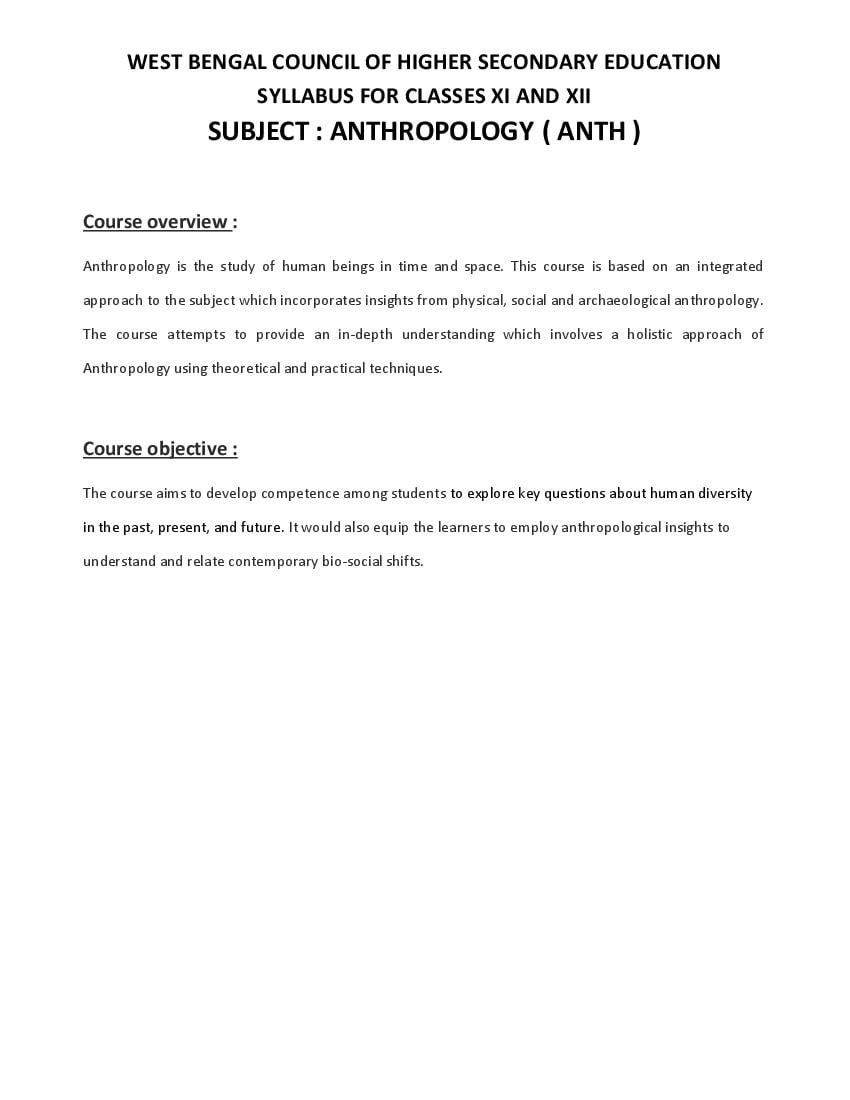
SYLLABUS FOR CLASSES XI AND XII
Course overview :
Anthropology is the study of human beings in time and space. This course is based on an integrated
approach to the subject which incorporates insights from physical, social and archaeological anthropology.
The course attempts to provide an in-depth understanding which involves a holistic approach of
Anthropology using theoretical and practical techniques.
Course objective :
The course aims to develop competence among students to explore key questions about human diversity
in the past, present, and future. It would also equip the learners to employ anthropological insights to
understand and relate contemporary bio-social shifts.
Page 2
SEMESTER – I
FULL MARKS : 35 CONTACT HOURS : 80 Hours
Subject Topics : Introducing Anthropology :
UNIT NO. TOPICS MARKS
Unit -1 1. Introduction to Anthropology
i. Definition, concept of Anthropology, history, development of
Anthropology in India [Major stages].
8 3
ii. Branches of Anthropology, relationship of Anthropology with
other disciplines [Biology, Geography, Geology, Psychology,
Sociology, Economics, Political Science and History].
Unit -2 2. Biological Anthropology
i. Concept, aim, scope and branches.
ii. How can we identify ourselves in the animal kingdom, in order
primates following the classification of Simpson.
20 9
iii. How some of our living ancestors Indian monkeys and apes
(like Macaque, Langur, Gibbon) and African ape (like
Chimpanzee) are similar and different in morphological,
skeletal and behavioural features and distribution.
Unit -3 3. Social-Cultural Anthropology
i. History, branches and scope of Social-Cultural Anthropology
ii. Why do we study society and culture?
iii. Concept of society, community, institution, association and
20 9
social groups.
iv. Concept of culture (material and non-material culture),
acculturation, social change, enculturation, diffusion and
assimilation. Cultural relativism and ethnocentrism.
Unit -4 4. Archaeological anthropology
i. Introduction to Archaeological anthropology – aim and scope
and its relation to palaeoanthropology and prehistoric
archaeology.
20 9
ii. Geological time scale, palaeo-environment [Glacial, inter-
glacial, pluvial and inter-pluvial phases]
iii. Evidences of palaeoenvironment – biotic and abiotic
components. Paleoenvironment and human interface.
Unit -5 5. Theories of organic evolution and basic genetics
i. Lamarckism, Darwinism and Neo-Darwinism and the criticisms
ii. Laws of Mendel. Concept of chromosome and allele.
12 5
Significance of crossing over and recombination. Application of
Mendel’s laws in human [PTC tasting ability, ABO blood groups
system, albinism and colour blindness].
Page 3
SEMESTER – II
FULL MARKS : 35 CONTACT HOURS : 70 Hours
UNIT NO. TOPICS MARKS
Unit -1 1. Evolutionary trends
i. Evolutionary trends of Primates, locomotory changes,
encephalization. 14 7
ii. External morphological features of humans, skeletal
morphology [only name, number and position of bones].
Unit -2 2. Human biological evolution
i. Who are humans? How and why we evolved? Role of genetics
and environment in human evolution. [Distribution and salient
features only of the following specimens]
14 7
ii. Australopithecus [afarensis and africanus variety]
iii. Homo erectus [Java man and Peking man]
iv. Homo sapiens neanderthalensis [ La-Chapelle-aux-saints]
v. Homo sapiens sapiens [Cro Magnon man].
Unit -3 3. Cultural evolution
i. Geological time scale, salient features and distribution of the
following]
ii. Why do we study prehistoric culture? How can we reconstruct
the life and livelihood of our ancestors by studying prehistoric
culture? 14 7
iii. Three age paradigm: Distribution, general characteristic
features and typical tool types and technology
iv. Palaeolithic [ Lower, Middle and Upper]
v. Mesolithic
vi. Neolithic.
Unit -4 4. Indian Tribal populations
i. Concept of tribe. Colonial construct and postcolonial construct
of tribal population.
ii. Tribal population and Particular Vulnerable Tribal Groups
14 7
(PVTGs) in India. Distribution, traditional economic pursuits
and changes in subsistence economy
iii. Constitutional provisions and safeguards for Indian Tribal
populations. Why are these safeguards required ?
Unit -5 5. Social stratification
i. Concept of social stratification.
ii. Emergence of stratified society
14 7
iii. Caste, Class and Clan [definition, features]
iv. Origin of Indian Caste system, debates and changes in the
Indian caste system.
[20 contact hours for remedial teaching, tutorials and home assignment for Semester I and II]
Page 4
SEMESTER-I & SEMESTER-II
FULL MARKS : 30 CONTACT HOURS : 20 hours (1st sem) + 10 hours (2nd sem)
COURSE CODE : PRACTICAL
Subject Topic : Practical in Biological Anthropology :
a. Identification of the following tools [handaxe, cleaver, scraper, point, harpoon, one microlith, celt] with
salient features from original/cast/photograph. Drawing and labelling of the tools, their features, cultural
age, technology and probable use need to be documented in the laboratory note book. (6 Marks)
b. Identification of the following human bones with salient features from original/cast/photograph [scapula,
humerus, ulna, radius, innominate, femur and tibia]. Drawing and labelling of these bones need to be
documented in the laboratory note book. (8 Marks)
c. Identification of the skull cap/cranium of the following fossil remains from cast/photograph based on salient
features. Drawing and labelling of these fossils need to be documented in the laboratory note book.
(6 Marks)
i. Australopithecus (africanus)
ii. Java man
iii. Neanderthal man
iv. Cro Magnon man
d. Laboratory Note Book (5 marks)
e. Viva-voce (5 Marks)
Page 5
SEMESTER – III
FULL MARKS : 35 CONTACT HOURS : 80 Hours
Subject Topics : Introducing Anthropology :
UNIT NO. TOPICS MARKS
Unit -1 Indian prehistory
Study of the following prehistoric sites of India [Location, general
features, tool typology and technology and other associated findings and
significance]
i. Sohan and Attirrampakkam 12 5
ii. Nevasa
iii. Bhimbetka
iv. Birbhanpur
v. Burzahom
Unit -2 Human Biological diversity
i. Historical concept of race and racial criteria (skin colour, head hair,
nose form, stature, ABO blood group), concept of typological
(Blumenbach and Hooton; for Indian population H.H. Risley, B.S.
Guha and S.S. Sarkar) and evolutionary models (Garn) of race. 16 8
ii. Racism, inequality; UNESCO statement on race, concept of ethnic
group and ethnicity.
Contemporary relevance of studying ethnic diversity [prehistoric
migration, ethnicity and disease]
Unit -3 Anthropology and Religion
i. Concept of religion. Religion and society.
ii. Supernatural Beliefs, Animism, Animatism, Naturism, Manaism,
Totemism, Taboo, Sacred and Profane, Myth, Cult
16 8
iii. Ancestor Worship, religion and magic, Witchcraft and Sorcery, Evil
Eye
iv. Religious beliefs and practices of tribal communities with respect to
Santal, Chenchu, Garo, Toda
Page 6
Unit -4 Overview of some applied areas of anthropology
i. Forensic anthropology: Definition, Basic Concept, evidences
generally used for personal identification (like use of ABO blood
group, skeletal remains and finger prints) and paternity diagnosis
(use of ABO blood group)
ii. Nutritional Anthropology: Concept, Ecology and food, culture and
food; effect of globalization on dietary habit, gender and food,
measures of nutritional status (BMI and waist-hip ratio) . 26 10
iii. Anthropology and Museum Studies: Notion of Museum, types of
museum, material conservation and documentation, and
cataloging, museum as education and public engagement.
iv. Anthropology and Development: Concept of development,
anthropological insights on development, relevance and
contribution of anthropology to development, outline of tribal
development in India.
Unit -5 Contribution of some Indian Anthropologists
S.C. Roy, H.D. Sankalia, Dharani Sen, Nirmal K. Bose, Ashok Ghosh, 10 4
P.K. Bhowmik, D.P. Mukherjee, Amitabha Basu, B.M. Das.
Page 7
SEMESTER – IV
FULL MARKS : 35 CONTACT HOURS : 70 Hours
UNIT NO. TOPICS MARKS
Unit -1 Subsistence economy
i. Define modes of subsistence. Concept of surplus, exchange,
reciprocity and market economy.
ii. Describe the general elements of all modes of subsistence.
iii. Distribution of Indian tribal populations on the basis of subsistence
14 7
economy.
iv. Subsistence economy of tribal populations [Garo , Toda, Santal and
Chenchu]
v. Subsistence economy of Particularly Vulnerable Tribal Groups [Toto
and Lodha].
Unit -2 Social Organisation of some Indian tribal populations
14 7
Santal, Toda, Lodha, Chenchu, Garo
Unit -3 Indian Protohistory
i. Chalcolithic period: Definition, Geographical distribution,
Characteristic features, Chalcolithic pottery, Chalcolithic settlements
[Ahar culture, Malwa culture, Pandurajar Dhibi] 14 7
ii. Indus valley civilization (IVC): Concept of civilization, geographical
distribution of IVC, town planning, art and craft, religion, trade,
possible causes of decline.
Unit -4 Human Growth and Adaptation
i. Basic concepts of growth, development and maturation; overview
of prenatal and postnatal growth, factors affecting growth
ii. Definition, concept and significance of studying human adaptation,
biological adaptation, cultural adaptation and developmental 14 7
adjustment
iii. Adaptation to cold
iv. Adaptation to hot and humid
v. Adaptation in high altitude.
Unit -5 Fieldwork in Anthropology
i. Anthropological fieldwork: Definition, concept and prospect
ii. Field work tradition in Anthropology from colonial to contemporary
period.
14 7
iii. Steps and techniques of fieldwork [site selection, rapport
establishment, ethnography (participant and non-participant
observations), interview (structured and unstructured), case study,
bias in fieldwork, culture shock.
[20 contact hours for remedial teaching, tutorials and home assignment for Semester III and IV]
Page 8
SEMESTER-III & SEMESTER-IV
FULL MARKS : 30 CONTACT HOURS : 20 hours (1st sem) + 10 hours (2nd sem)
COURSE CODE : PRACTICAL
Subject Topics : Fieldwork
A. Fieldwork in Social-cultural Anthropology 25 Marks
a. Training of students in carrying out local fieldwork. The candidates are required to collect census data
[age, sex, marital status, occupation, education] on 15 households, conduct interviews from at least
10 adult individuals about their perception and attitudes towards any one of the following social issues:
child marriage, dowry system, domestic violence, child labour.
Field report (handwritten or typed to be submitted at the time of examination), the report should
contain (i) Introduction to fieldwork, (ii) utility of fieldwork, (iii) selection of study area, (iv) description of
the study area, (v) process of rapport establishment, (vi) method of data collection, (vii) presentation of
census data in the form of tables (viii) documentation of interview excerpts (ix) Conclusion and
references. (20 marks)
b. Viva-voce (5 Marks)
B. Estimation of the nutritional status based on BMI 5 Marks
a. Students should collect data (measurements of height and weight) at least from 10 individuals and
calculate BMI and finally assess their nutritional status based on WHO (1995) standard.
b. A report should be prepared (handwritten or typed) duly signed by the teacher for examination
(3 marks)
c. Viva voce. (2 marks)
Document Details
| Board / Org | West Bengal Board |
| Exam | Class 11 |
| Type | Syllabus |
| Pages | 8 |
| Updated | 22 Jul 2026 |