WBCHSE Class 11 Syllabus 2024 Accountancy
Finished viewing? Save it for later —
Download WBCHSE Class 11 Syllabus 2024 Accountancy (PDF · 13 pages)About WBCHSE Class 11 Syllabus 2024 Accountancy
WBCHSE Class 11 Syllabus 2024 Accountancy is available here for free download. Published by West Bengal Board for Class 11, this syllabus can be viewed online or downloaded as a PDF (13 pages). Candidates preparing for Class 11 can use WBCHSE Class 11 Syllabus 2024 Accountancy to understand the exam pattern, the type of questions asked, and the overall difficulty level.
Frequently Asked Questions
How can I download WBCHSE Class 11 Syllabus 2024 Accountancy?
Open this page and click the Download button to save WBCHSE Class 11 Syllabus 2024 Accountancy as a PDF. It is completely free on AglaSem Docs.
Is WBCHSE Class 11 Syllabus 2024 Accountancy free to download?
Yes. WBCHSE Class 11 Syllabus 2024 Accountancy can be viewed online and downloaded as a PDF free of cost on AglaSem Docs.
How many pages does WBCHSE Class 11 Syllabus 2024 Accountancy have?
WBCHSE Class 11 Syllabus 2024 Accountancy contains 13 pages, which you can read online or download together as a single PDF.
Where can I find more Class 11 study material?
You can find more Class 11 question papers, sample papers, syllabus, and answer keys on AglaSem Docs.
WBCHSE Class 11 Syllabus 2024 Accountancy – Text
Read the full text of this syllabus below — useful to quickly search, copy and reference the content online without downloading the PDF.
📄 View text version (13 pages)
Page 1
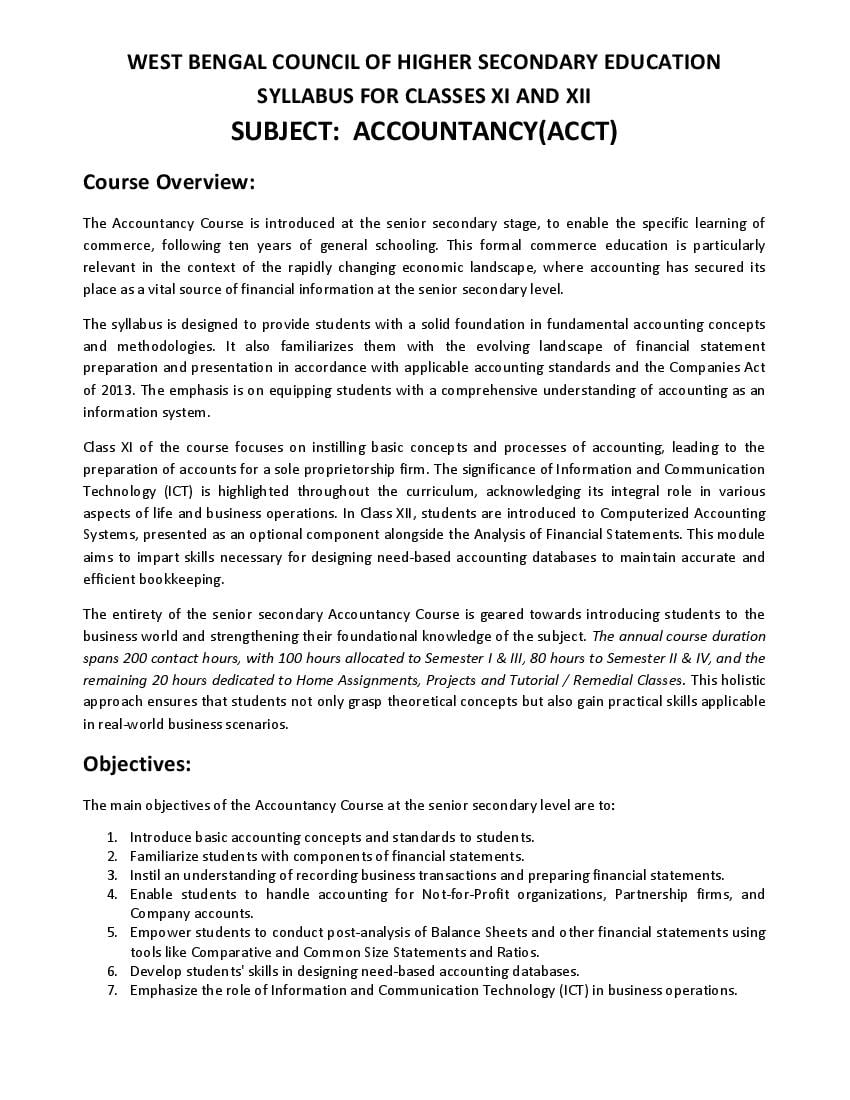
SYLLABUS FOR CLASSES XI AND XII
SUBJECT: ACCOUNTANCY(ACCT)
Course Overview:
The Accountancy Course is introduced at the senior secondary stage, to enable the specific learning of
commerce, following ten years of general schooling. This formal commerce education is particularly
relevant in the context of the rapidly changing economic landscape, where accounting has secured its
place as a vital source of financial information at the senior secondary level.
The syllabus is designed to provide students with a solid foundation in fundamental accounting concepts
and methodologies. It also familiarizes them with the evolving landscape of financial statement
preparation and presentation in accordance with applicable accounting standards and the Companies Act
of 2013. The emphasis is on equipping students with a comprehensive understanding of accounting as an
information system.
Class XI of the course focuses on instilling basic concepts and processes of accounting, leading to the
preparation of accounts for a sole proprietorship firm. The significance of Information and Communication
Technology (ICT) is highlighted throughout the curriculum, acknowledging its integral role in various
aspects of life and business operations. In Class XII, students are introduced to Computerized Accounting
Systems, presented as an optional component alongside the Analysis of Financial Statements. This module
aims to impart skills necessary for designing need-based accounting databases to maintain accurate and
efficient bookkeeping.
The entirety of the senior secondary Accountancy Course is geared towards introducing students to the
business world and strengthening their foundational knowledge of the subject. The annual course duration
spans 200 contact hours, with 100 hours allocated to Semester I & III, 80 hours to Semester II & IV, and the
remaining 20 hours dedicated to Home Assignments, Projects and Tutorial / Remedial Classes. This holistic
approach ensures that students not only grasp theoretical concepts but also gain practical skills applicable
in real-world business scenarios.
Objectives:
The main objectives of the Accountancy Course at the senior secondary level are to:
1. Introduce basic accounting concepts and standards to students.
2. Familiarize students with components of financial statements.
3. Instil an understanding of recording business transactions and preparing financial statements.
4. Enable students to handle accounting for Not-for-Profit organizations, Partnership firms, and
Company accounts.
5. Empower students to conduct post-analysis of Balance Sheets and other financial statements using
tools like Comparative and Common Size Statements and Ratios.
6. Develop students' skills in designing need-based accounting databases.
7. Emphasize the role of Information and Communication Technology (ICT) in business operations.
Page 2
SEMESTER – I
SUBJECT: ACCOUNTANCY (ACCT )
FULL MARKS: 40
UNIT TOPICS MARKS
Unit 1 Introduction & Theory Base of Accounting 12
Unit 2 Fundamental Accounting Process – I 16
Unit 3 Reserves & Provisions 6
Unit 4 Bills of Exchange (Excluding Retiring, Renewal and Accommodating Bills) 6
Total 40
Question Paper Typology
Sl. No. Typology of Questions Marks In %
1. Remembering & Understanding 12 30
2. Applying 20 50
3. Analyzing, Evaluating and Critical Understanding 8 20
Weightage to form Questions
Unit Topics Unit Question No. of Marks of Total
Marks type Questions each Marks
question
Unit 1 Introduction & Theory 12 MCQ 12 1 12
Base of Accounting
Unit 2 Fundamental Accounting 16 MCQ 16 1 16
Process – I
Unit 3 Reserves & Provisions 6 MCQ 6 1 6
Unit 4 Bills of Exchange 6 MCQ 6 1 6
(Excluding Retiring,
Renewal
&Accommodating Bills)
Total 40 40
Page 3
SEMESTER – I
SUBJECT: ACCOUNTANCY (ACCT)
FULL MARKS: 40 CONTACT HOURS: 100 Hours
COURSE CODE: THEORY
CONTACT
UNIT NO. TOPICS MARKS
HOURS
Unit 1 Introduction & Theory Base of Accounting
Accounting:
Meaning, Accounting as a source of information,
Objectives and limitations.Users of accounting
information and their needs.Sub-fields of
Accounting (Financial Accounting, Cost
Accounting and Management Accounting).
Basic Accounting Terms:
Entity, Business Transaction, Capital, Drawings,
Liabilities (Non-Current and Current), Assets
(Non-Current, Current); Expense, Revenue,
30 12
Income, Profit, Gain, Loss, Purchase, Sales,
Goods, Stock, Debtor, Creditor, Voucher,
Discount (Trade discount and Cash discount),
Contingent Assets and Contingent Liabilities,
Revenue and Capital Receipts, Revenue and
Capital Expenditure, Deferred Revenue
Expenditure.
GAAP (Generally Accepted Accounting
Principles): Concept.
Basic Accounting Concept:
Business Entity, Money Measurement, Going
Concern, Accounting Period, Cost Concept, Dual
Aspect, Revenue Recognition, Matching, Full
Disclosure, Consistency, Conservatism,
Materiality and Objectivity.
System of Accounting:
Single Entry and Double Entry.
Basis of Accounting:
Cash Basis and Accrual Basis.
Valuation Principles:
Historical Cost, Current Cost, Realizable Value
and Present Value.
Accounting Standards:
Objectives of Accounting Standards (AS) and
Indian Accounting Standards (Ind AS).
Applicability of Ind AS.
Goods and Service Tax (GST):
Characteristics and Advantages.
Page 4
UNIT NO. TOPICS MARKS
HOURS
Unit 2 Fundamental Accounting Process – I
Voucher and Transactions:
Source documents and Vouchers, Preparation of
Vouchers
Fundamental Accounting Equation:
Meaning and Analysis.
Rules of Debit and Credit
Book of Original Entry: Journal
Special Purpose Books: 40
16
Purchases Book, Sales Book, Purchases Return
Book, Sales Return Book, Journal Proper
Rectification of Errors (Before Preparation of
Trial Balance):
Classification of Errors: Errors of Omission,
Errors of Commission, Errors of Principles, and
Compensating Errors.
Detection and Rectification of Errors.
Unit 3 Reserves & Provisions
Provisions, Reserves – Meaning
Difference Between Provisions and Reserves.
Types of Reserves:
i. Revenue Reserve ii. Capital Reserve iii. General 15 6
Reserve iv. Specific Reserve v. Secret Reserve
Difference between Capital Reserve and Revenue
Reserve
Unit 4 Bills of Exchange (Excluding retiring, renewal and
accommodating Bills)
Bills of Exchange and Promissory Note:
Definition, features, parties, specimen and
distinction.
Important Terms:
Terms of Bill, Due Date, Days of Grace, Date of 15
6
Maturity, Bill at Sight, Bill after Date,
Discounting of Bill, Endorsement of Bill, Bill sent
for Collection, Dishonour of Bill and Noting of
Bill.
Accounting treatment of bills of exchange till
dishonour of bill.
Total 100 40
Page 5
SEMESTER – I
SUBJECT: ACCOUNTANCY (ACCT)
FULL MARKS: 40
Unit Topics Marks
Unit 1 Fundamental Accounting Process – II 20
Unit 2 Final Accounts of Sole Proprietor 10
Unit 3 Accounts of Non-Profit Seeking Organization 5
Unit 4 Accounts from Incomplete Records (Excluding conversion to Double Entry 5
System)
Total 40
Question Paper Typology
Sl. No Typology of Questions Marks In %
1. Remembering & Understanding 12 30
2. Applying 20 50
3. Analyzing, Evaluating and Critical Understanding 8 20
Weightage to form Questions
Unit Details Unit Question No of Marks of Total Marks
Marks type Questions each
question
Unit 1 Fundamental Accounting Descriptive 2 5
Process – II 20 SAQ Type 2 2 3 [10+6+4=20]
SAQ Type 1 2 2
Unit 2 Final Accounts of Sole Descriptive 1 5
Proprietor SAQ Type 2 1 3 [5+3+2=10]
10
SAQ Type 1 1 2
Unit 3 Accounts of Non-Profit SAQ Type 2 1 3
Seeking Organization 5 SAQ Type 1 [3+2=5]
1 2
Unit 4 Accounts from 5
Incomplete Records
(Excluding conversion to Descriptive 1 5 5
Double Entry System)
Total 40 40
Page 6
SEMESTER – II
SUBJECT: ACCOUNTANCY (ACCT)
FULL MARKS: 40 CONTACT HOURS: 80 HOURS
COURSE CODE: THEORY
CONTACT
UNIT NO. TOPICS MARKS
HOURS
Unit 1 Fundamental Accounting Process – II
Ledger:
Format, Posting from Journal and Subsidiary
Books, Balancing of Accounts.
Cash Book:
Simple Cash Book, Cash Book with Cash and
Bank Column and Petty Cash Book
Trial Balance:
Objectives, Meaning and Preparation of Trial
Balance from Balances only.
Bank Reconciliation Statement:
Need; Preparation of Bank Reconciliation
Statement(excluding amended cash book)
Rectification of Errors (After preparation of
Trial Balance but excluding after preparation
of Final Accounts): 40 20
Preparation of Suspense Account
Depreciation:
Meaning, Need for providing Depreciation,
factors to be considered while computing
Depreciation.
Methods of Depreciation:i. Straight Line
Method (SLM) ii. Written Down Value
Method (WDV)
Difference between SLM and WDV;
Method of recording Depreciation by
charging to asset account onlyincluding
purchase and sale of Depreciable Assets.
Note – Excluding change of Method of Depreciation
Page 7
UNIT NO. TOPICS MARKS
HOURS
Unit 2 Final Accounts of Sole Proprietor
Meaning, Objectives and Importance
Preparation of Manufacturing Account
Trading and Profit and Loss Account:
Concepts of Gross profit, Operating profit and
Net profit.
Balance Sheet:
Need, grouping and marshalling of assets and
20 10
liabilities.
Preparation of Trading and Profit and Loss
account and Balance Sheet of a sole
proprietorship concern with adjustments:
Closing Stock, Outstanding Expenses, Prepaid
Expenses, Accrued Income, Income Received
in Advance, Depreciation, Bad Debts,
Provision for Doubtful Debts, Provision for
Discount on Debtors,Abnormal Loss, Goods
taken for personal use/Staff Welfare and
Manager’s Commission.
Unit 3 Accounts of Non-Profit Seeking Organizations
Non-Profit Seeking organizations:
Concept
Receipts and Payments Account:
Meaning and Features.
Income and Expenditure Account: 10 5
Meaning and Features.
Preparation of Income and Expenditure
Account from the given Receipts and
Payments Account with additional
information.
Unit 4 Accounts from Incomplete Records (Excluding
conversion to Double Entry System)
Features, reasons and limitations. 10 5
Preparation of Statement of Profit / Loss and
Statement of Affairs.
Total 80 40
[Note: 20 Hours reserved for Remedial Classes, Tutorials and Home Assignments]
Page 8
COURSE CODE: PROJECT
Full Marks: 20 [Project Report: 10 Marks; Viva Voce: 10 Marks]
Students need to undertake any oneproject out of the four topics given below
at the end of Semester II of Class XI.
Topic 1 Preparation of at least 25 vouchers and recording of transactions with the help of these
vouchers, posting the Journal Entries in Ledgers and preparation of Trial Balance
therefrom.
Topic 2 Preparation of a Cash Book with cash and bank columns with at least 25 transactions
including bank transactions.
Topic 3 Preparation of Bank Reconciliation Statement with the given Cash Book and the Pass Book
with at least 25 transactions.
Topic 4 Preparation of Final Accounts of a Sole Trader from the given Journal Entries.
ACCOUNTANCY (ACCT)
Class XII
Semester -III
Full Marks: 40
Unit Topic Marks
Unit 1 Accounting for Partnership Firms – I 15
Unit 2 Accounting for Company – I 10
Unit 3 Analysis of Financial Statements 15
OR
Computerized Accounts – I
Total 40
Question Paper Typology
Sl. No. Typology of Questions Marks In %
1. Remembering & Understanding 12 30
2. Applying 20 50
3. Analyzing, Evaluating and Critical Understanding 8 20
Page 9
Unit Topics Unit Question No. of Marks of Total
Marks type Questions each Marks
question
Unit 1 Accounting for Partnership Firms – I 15 MCQ 15 1 15
Unit 2 Accounting for Company – I 10 MCQ 10 1 10
Unit 3 Analysis of Financial Statements 15 MCQ 15 1 15
OR
Computerized Accounts - I
Total 40 40
CLASS XII
SEMESTER – III
SUBJECT: ACCOUNTANCY (ACCT
FULL MARKS: 40 CONTACT HOURS: 100 HOURS
COURSE CODE: THEORY
UNIT TOPICS CONTACT MARKS
NO. HOURS
Unit 1 Accounting for Partnership Firms - I
Partnership:
Features, Partnership Deed.
Provisions of the Indian Partnership Act 1932 in the absence
of partnership deed.
Fixed v/s fluctuating capital accounts.
Preparation of Profit and Loss Appropriation account:
Division of profit among partners, guarantee of profits.
Past Adjustments:
Relating to interest on capital, interest on drawing, salary and 35 15
profit-sharing ratio.
Goodwill:
Meaning, nature, factors affecting and methods of valuation -
average profit, super profit and capitalization.
Recommendations of Accounting Standards in relation to
recognition of Goodwill.
Note: Interest on partner's loan is to be treated as a charge against
profits.
Unit 2 Accounting for Company – I
Features and types of companies.
Share and Share Capital: Nature and types.
Debentures: Meaning and types.
Issue of Debentures at par, at a premium and at a discount.
Issue of Debentures for consideration other than cash. 25 10
Issue of Debentures with terms of redemption.
Writing off Discount / loss on issue of Debentures.
Note: Discount or loss on issue of Debentures to be written off in the
year Debentures are allotted from Security Premium Reserve (if it
exists) and then from Statement of Profit and Loss as Financial Cost
(AS 16)
Page 10
NO. HOURS
Unit 3 Analysis of Financial Statements
Financial Statement Analysis:
Meaning, Significance, Objectives, Importance and
Limitations.
Accounting Ratios:
Meaning, Objectives, Advantages, Classification and
computation.
Liquidity Ratios: Current Ratio and Quick Ratio.
Solvency Ratios: Debt to Equity Ratio, Total Asset to
Debt Ratio, Proprietary Ratio and Interest Coverage
Ratio, Debt to Capital Employed Ratio.
Activity Ratios: Inventory Turnover Ratio, Trade 40 15
Receivables Turnover Ratio, Trade Payables Turnover
Ratio, Fixed Asset Turnover Ratio, Net Asset Turnover
Ratio and Working Capital Turnover Ratio.
Profitability Ratios: Gross Profit Ratio, Operating Ratio,
Operating Profit Ratio, Net Profit Ratio and Return on
Investment.
Tools for Financial Statement Analysis :Comparative
Statements, Common Size
Statements, Ratio Analysis.
OR
Computerized Accounts - I
Concept of Electronic Spreadsheet:
Concept, Data Entry, Text Management and Cell Formatting,
Data Formatting, Output Reports, Preparation of Reports
using Pivot Tables and Common Errors in Spreadsheet.
Payroll Accounting.
Data Graphs, Charts and Diagrams, Preparation of Graphs and
Charts using Excel, Advantages of using Graphs and Charts.
Total 100 40
CLASS-XII
SEMESTER – IV
SUBJECT: ACCOUNTANCY (ACCT)
Full Marks: 40
Unit Topics Marks
Unit 1 Accounting for Partnership Firms – II 25
Unit 2 Accounting for Company – II 10
Unit 3 Cash Flow Statement 5
OR
Computerized Accounts – II
Total 40
Page 11
Sl. No. Typology of Questions Marks In %
1. Remembering & Understanding 12 30
2. Applying 20 50
3. Analyzing, Evaluating and Critical Understanding 8 20
Weightage to form Questions
Unit Topics Unit Question No. of Marks of Total Marks
Marks type Questions each
question
Unit 1 Accounting for Partnership Descriptive 2 5
Firms – II 25 SAQ Type 2 3 3 [10+9+6=25]
SAQ Type 1 3 2
Unit 2 Accounting for Company – II Descriptive 1 5
10 SAQ Type 2 1 3 [5+3+2=10]
SAQ Type 1 1 2
Unit 3 Cash Flow Statement 5 Descriptive 1 5 [5]
OR
Computerized Accounts - II
Total 40 40
CLASS XII
SEMESTER –IV
SUBJECT: ACCOUNTANCY (ACCT)
Full Marks: 40 CONTACT HOURS: 80 HOURS
COURSE CODE: THEORY
UNIT TOPICS CONTACT MARKS
NO. HOURS
Unit 1 Accounting for Partnership Firms – II
Change in the Profit-Sharing Ratio among the existing
partners–
Sacrificing Ratio, Gaining Ratio, Accounting for Revaluation
of Assets and Reassessment of Liabilities and Treatment of
Reserves, Accumulated Profits and Losses.
Admission of a partner:
Effect of admission of a partner on change in the Profit- 50 25
Sharing Ratio, Treatment of Goodwill, Treatment for
Revaluation of Assets and Reassessment of Liabilities,
Treatment of Reserves, Accumulated Profits and Losses,
Adjustment of Capital Accounts and Preparation of Capital,
Current Account and Balance Sheet.
Page 12
NO. HOURS
Retirement and death of a partner:
Effect of Retirement / Death of a Partner on change in Profit
Sharing Ratio, Treatment of Goodwill, Treatment for
Revaluation of Assets and Reassessment of Liabilities,
Adjustment of Accumulated Profits, Losses and reserves,
Adjustment of Capital Accounts and Preparation of Capital,
Current Account and Balance Sheet, Preparation of Loan
Account of the Retiring Partner, Calculation of deceased
partner’s Share of Profit till the date of death, Preparation of
deceased partner’s Capital Account and his Executor’s
Account.
Dissolution of Partnership Firm:
Meaning of dissolution of partnership and partnership firm.
Types of dissolution of a firm. Settlement of Accounts –
Preparation of Realization Account, and other related
accounts: Capital Accounts of Partners and cash/bank a/c
(excluding piecemeal distribution, sale to a company and
insolvency of partner(s)).
Unit 2 Accounting for Share Capital - II
Accounting for share capital:
Issue and allotment of equity and preferences shares
including simple problems on prorata allotment.
Public subscription of shares:
Over-subscription and under-subscription of shares; Issue at
par and at premium, calls in advance and arrears (excluding 20 10
interest), issue of shares for consideration other than cash.
Forfeiture and reissue of shares:
Accounting treatment.
Disclosures:
Disclosure of Share Capital in the Balance Sheet of a
company as per Schedule III, Part I of the Companies Act,
2013.
Unit 3 Cash Flow Statement
Indirect Method of AS-3 (Revised) and without
Adjustments:
Meaning, Objectives, Benefits, Cash and Cash Equivalents,
Classification of Activities and Preparation of Cash Flow
Statement
OR
Computerized Accounts - II 10 5
Data Base Management System:
Defining Data Base Requirements, Identification of Data to
be stored in tables, Structure of Data.
Creating Data Table for Accounting, Using Queries, Forms
and Reports for generating accounting information with
the help of Microsoft Access Software.
Total 80 40
[Note: 20 Hours reserved for Remedial classes, Tutorials and Home Assignments.]
Page 13
COURSE CODE: PROJECT
Full Marks: 20 [Project Report: 10 Marks; Viva Voce: 10 Marks]
Students need to undertake any oneproject out of the four topics given below
at the end of Semester IV of Class XII.
Topic 1 Analysis of Financial Statements of a concern applying the tools of Ratio Analysis from a
given Balance Sheet.
Topic 2 Analysis of Financial Statements of two concerns applying the tools of Comparative and
Common size Statements.
Topic 3 Preparation of Cash Flow Statement from given Financial Statement of at least two
business enterprises.
Topic 4 Preparation of an imaginary Balance Sheet of any concern as per the Companies Act, 2013
along with Notes to Accounts from a given set of information.
Document Details
| Board / Org | West Bengal Board |
| Exam | Class 11 |
| Type | Syllabus |
| Pages | 13 |
| Updated | 22 Jul 2026 |