WBCHSE Class 11 Syllabus 2024 Applied Artificial Intelligence
Finished viewing? Save it for later —
Download WBCHSE Class 11 Syllabus 2024 Applied Artificial Intelligence (PDF · 13 pages)About WBCHSE Class 11 Syllabus 2024 Applied Artificial Intelligence
WBCHSE Class 11 Syllabus 2024 Applied Artificial Intelligence is available here for free download. Published by West Bengal Board for Class 11, this syllabus can be viewed online or downloaded as a PDF (13 pages). Candidates preparing for Class 11 can use WBCHSE Class 11 Syllabus 2024 Applied Artificial Intelligence to understand the exam pattern, the type of questions asked, and the overall difficulty level.
Frequently Asked Questions
How can I download WBCHSE Class 11 Syllabus 2024 Applied Artificial Intelligence?
Open this page and click the Download button to save WBCHSE Class 11 Syllabus 2024 Applied Artificial Intelligence as a PDF. It is completely free on AglaSem Docs.
Is WBCHSE Class 11 Syllabus 2024 Applied Artificial Intelligence free to download?
Yes. WBCHSE Class 11 Syllabus 2024 Applied Artificial Intelligence can be viewed online and downloaded as a PDF free of cost on AglaSem Docs.
How many pages does WBCHSE Class 11 Syllabus 2024 Applied Artificial Intelligence have?
WBCHSE Class 11 Syllabus 2024 Applied Artificial Intelligence contains 13 pages, which you can read online or download together as a single PDF.
Where can I find more Class 11 study material?
You can find more Class 11 question papers, sample papers, syllabus, and answer keys on AglaSem Docs.
WBCHSE Class 11 Syllabus 2024 Applied Artificial Intelligence – Text
Read the full text of this syllabus below — useful to quickly search, copy and reference the content online without downloading the PDF.
📄 View text version (13 pages)
Page 1
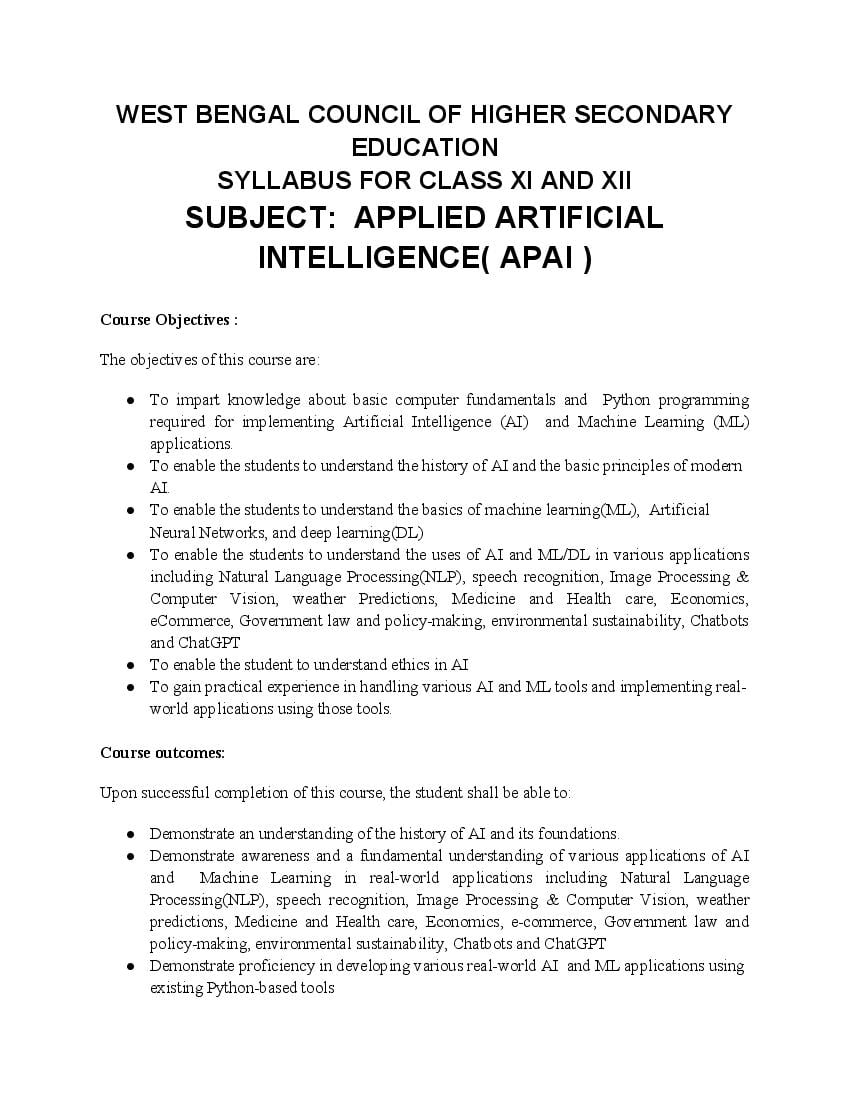
EDUCATION
SYLLABUS FOR CLASS XI AND XII
SUBJECT: APPLIED ARTIFICIAL
INTELLIGENCE( APAI )
Course Objectives :
The objectives of this course are:
● To impart knowledge about basic computer fundamentals and Python programming
required for implementing Artificial Intelligence (AI) and Machine Learning (ML)
applications.
● To enable the students to understand the history of AI and the basic principles of modern
AI.
● To enable the students to understand the basics of machine learning(ML), Artificial
Neural Networks, and deep learning(DL)
● To enable the students to understand the uses of AI and ML/DL in various applications
including Natural Language Processing(NLP), speech recognition, Image Processing &
Computer Vision, weather Predictions, Medicine and Health care, Economics,
eCommerce, Government law and policy-making, environmental sustainability, Chatbots
and ChatGPT
● To enable the student to understand ethics in AI
● To gain practical experience in handling various AI and ML tools and implementing real-
world applications using those tools.
Course outcomes:
Upon successful completion of this course, the student shall be able to:
● Demonstrate an understanding of the history of AI and its foundations.
● Demonstrate awareness and a fundamental understanding of various applications of AI
and Machine Learning in real-world applications including Natural Language
Processing(NLP), speech recognition, Image Processing & Computer Vision, weather
predictions, Medicine and Health care, Economics, e-commerce, Government law and
policy-making, environmental sustainability, Chatbots and ChatGPT
● Demonstrate proficiency in developing various real-world AI and ML applications using
existing Python-based tools
Page 2
limitations, and its impact on society.
Class XI, SEMESTER-I
Theory
Full Marks: 35 Contact Hours : 60 Hours
Sub Topic
Hours
Unit Sub Topic Marks
Classification of computers: Micro, mini, mainframe and
supercomputers
Computer architecture: (Block diagram-based): important units like
CPU, Memory, Input and output units of a computer, interaction of
computer units via system bus. Data flow between C PU, Memory,
1a and I/O devices. Different parts of the CPU and their functions (in 5 10
brief). Types of memory (examples). Cache memory. Information
Unit -1 transfer from Memory to Processor (a block diagram with a brief
Computer description). Mention of different types of I/O devices with
Fundamental examples, Processor to I/O Devices communication (a block diagram
(15) with brief description).
Number systems and Logic gates: How a computer manipulates
or stores numbers. Decimal number system, conversion of decimal
to binary, octal, and Hexadecimal number system. Logic gates -
1b. basic logic gates: AND gate, OR gate, NOT gate, and XOR gate. 5 8
Laws of Boolean algebra. An example of a small logic circuit
containing AND gates, OR gates, and/or NOT gates.
Page 3
WAN, Internet (brief introduction with suitable figures). Very short
1c. introduction (with diagrams/figures) to network devices- Network 5 6
Interface Card, Hub, Repeater, Switch, Bridge, Router, Gateway.
Software: Difference between software and hardware, Classification
of Software with examples. Basic Concepts of Operating Systems
2a. (OS)- functions of OS, Types of OS, Windows operating system- 5 8
desktop, icons, menu, taskbar. File System- creating files/folders,
deleting files/folders, copying files/folders from one drive to another.
Basics of Computer Programming (three levels: high-level language,
assembly language, machine language, definition, and block
Unit -2
diagrams), Overview of Compiler and Interpreter (definition and
Software &
mention name of major compiled (e.g., C, C++) and interpreted
Languages
languages (e.g., Python)),
(10)
Overview of procedural and object-oriented programming (key
2b features and just the basic differences, mention names of some 5 10
popular procedural (e.g., BASIC, FORTRAN, C) and object-
oriented programming languages (e.g., C++, Java, Python)).Concept
of Algorithm and Flowchart.
Basic programming concepts, What is programming language?
Classification of programming languages with examples. What is a
computer program?
Features of Python programming language, Applications of Python,
Installing Jupyter using Anaconda, Steps to open Python Shell in
interactive mode, Steps to create Python file. Variables, data types,
operators, different types of expressions, input and output built-in
Unit -3 functions, Python comment, Lists -accessing list element, updating
Python
3 list, deleting list, List vs tuple. Control structures- conditional 10 18
Programming statements with small examples, While loop, For loop. Arrays-
(10)
searching in an array (a simple example). Defining user-defined
functions(with simple examples). Some important Python libraries-
Numpy, OpenCV, Matplotlib, NLTK, Pandas((very short description
for each library).
NB : Additional 10 hours for Remedial and/or Tutorial classes
Page 4
Theory
Full Marks: 35 Contact Hours : 60 Hours
Sub Topic
Hours
Unit Sub Topic Marks
History of AI, What is natural intelligence? What is Artificial
4a Intelligence(AI)? Strong AI vs. weak AI. 3 6
● AI agent, An architecture of an AI agent( a block diagram
and short description of each component).
● Relationships between AI, Machine Learning(ML), and
Unit -4 Deep Learning(DL).
Foundation ● What is Machine Learning? Difference between traditional
of AI programming and Machine Learning. Different types of
(10) 4b Machine Learning. Advantages of ML over DL. 7 18
● Basic steps of ML system design- problem understanding,
data acquisition, Features, Data representation, modeling
using approaches like rule-based, supervised learning,
unsupervised learning, and Reinforcement Learning(short
description of each modeling approach with simple
examples).
● Supervised learning - a block diagram with a short
Unit -5 description,
Concept of ● regression and classification with simple examples.
Supervised 5 ● Common supervised classifiers- K-Nearest Neighbour search 10 12
Learning algorithm (in detail),
(10) ● Decision tree classifier (basic idea only, no induction
algorithm),
Page 5
Concept of
Unsupervise 6 5 8
d Learning K-means clustering algorithm. Illustration with an example.
(5)
● Neural Network- biological motivation, comparison between
Artificial Neuron and Human Neuron.
● Artificial Neuron as a processing unit. Perceptron learning
Unit -7 rule for updating weights of an artificial neuron. Limitation
Preliminary of a perceptron in solving XOR problem,
Concept of ● Multilayer feedforward neural network (only a diagram
Artificial 7 showing interconnections among neurons at multiple layers). 10 16
Neural ● High-level description of Forward pass and backward pass of
Network the backpropagation (BP) algorithm used for training.
(10) ● Multilayer feedforward neural network (No mathematical
derivation).
● How is deep learning (DL) related to Artificial Neural
Networks? Difference between shallow and deep learning.
NB : Additional 10 hours for Remedial and/or Tutorial classes
Page 6
Full Marks : 30 [ Project Marks : 10+Viva : 05+Practical: 15 ]
Sub Topic for practical
Sl Topic Marks Hours
No (60)
1. Computer Fundamentals [ No marks ]
● Visit to Computer Lab and familiarization with computers and
peripherals and different
networking devices (e.g., modem, switch, router).
1 ● Opening of the CPU box/cabinet and identification of different 0 10
parts (e.g., Motherboard,
CPU/Processor, RAM, Hard Disk, power supply).
2. Introduction to Python Programming [15 Marks ]
● Introduction to installing and running simple python codes and
simple access to user inputs from console examples.
● Write Python programs
i) To convert the temperature from centigrade to Fahrenheit and
vice versa.
ii) To calculate the simple and compound interest.
2a 3 14
iii) To calculate the area of a triangle when three sides are given
iv) Calculate the DA, MA, and HRA from a given salary.
iv) To solve the quadratic equation
v) To check if a given year is a leap year or not.
vi) To find the largest among three numbers using the fourth
variable & without using the fourth variable.
Page 7
simple logical and arithmetic operations.
2) Write Python programs for
i) Converting a 3-digit number into words (eg: input -123, output-
One hundred twenty-three)
ii) printing patterns,
2b iii) Conversion of binary to decimal and vice versa, 7 24
iv) computing GCD of two numbers,
v) Finding prime numbers in a given interval
vi) Generating Fibonacci sequence,
vii) Computing factorial of a number.
viii) To find the sum of the digits of an integer.
Write programs
i) to Find the max, min, average, sum, and length of a list
ii) to Use of basic string methods like upper(), lower(), count(),
2c 5 12
find(), join(), replace(), split() Etc.
iii) Linear search
iv) Bubble sort in an array
Page 8
Theory
Full Marks: 35 Contact Hours : 60 Hours
Sub Topic
Unit Sub Topic Marks Hours
● Structured data
1a ● unstructured (Audio, video, and text) data 2 7
Unit-1 ● semi-structured data
Different
Types of ● Natural Language Processing
Data & ● speech recognition
Various ● Computer vision
Application ● weather Predictions
● Self-driving cars
Areas of AI 1b 3 8
● Autonomous systems
(5) ● robotics
(A brief description of each area, focusing on the question:
what is it?)
Page 9
● Applications of NLP
● Major Natural Language Processing applications-
Chatbots,
● Autocomplete in Search Engines
● Voice Assistants (Siri, Alexa, or Google Assistant),
● Machine translation
● Grammar Checkers, Email Classification and Filtering,
Unit -2
● Sentiment analysis, Fake news detection, hate speech
AI in
detection.
Natural
2 (Brief explanation of each NLP topic using suitable 10 15
Language
examples. Roles of AI and ML in the respective application
Processing
(brief explanation in storytelling fashion with a suitable
(10)
diagram only . Sophisticated math must be avoided).
● Use cases: Sentiment analysis, common features
extraction using NLTK toolkit (Bag-of-words model,
TF-IDF features, n-gram features), classification tools -
KNN model, Decision Tree, ANN (in Scikit learn)
training sentiment analysis model and testing the
learned model (Use block diagram and ML tools, no
mathematical description or derivation ).
What is a speech signal? Applications of Speech recognition.
How does it differ from text.? Common audio
Unit -3. format(.wav,.mp3), description of basic speech
AI in Speech features(Frequency, Amplitude, pitch, zero crossing rate,
3 energy, and autocorrelation, MFCC), feature extraction using 7 10
Recognition
(7) Python toolbox (no mathematics, only concepts), speech
recognition using ANN(in Scikit learn). Roles of AI and ML in
speech recognition.
Page 10
Computer Vision. Common image and video formats (very
brief description .jpeg, .tiff, .bmp,.mp4,.avi), Color Model:
RGB, image representation in computer, image
Unit -4. binarization(Threshold Based) , image features-pixel features,
AI in Image Gray Scale Values as Features, Mean pixel values of channels,
Processing Edge features(Prewitt kernel, Sobel kernel,), Texture Feature,
& Computer 4 Use case: image classification using the Animal dataset(three 8 10
Vision classes- dogs, cats, and pandas) , image representation with
examples, description of the Animal dataset, Using ML tools
(8) like k-NN or others for classification (A brief description of the
steps: Data collection, Data representation, Split the Dataset
into train and test sets, Train the Classifier, Evaluation using
Scikit learn tools).
Unit -5.
AI for
Weather Problem definition, Features, Time series data (stock market
Predictions time series analysis ), ARIMA Model (briefly) Data 5 10
representation, Prediction using linear regression (using
(5) regression tools, no mathematical derivation).
NB: Additional 10 hours for Remedial and/or Tutorial classes
Page 11
Theory
Full Marks: 35 Contact Hours : 60 Hours
Sub Topic
Unit Sub Topic Marks Hours
How is AI Changing Medical Science (brief notes). AI for medical
disease detection using- Diabetes detection using Machine Learning
Unit -6. Algorithm (KNN, ANN), AI for medical diagnostic-disease detection
AI for using computer vision (Example-based), AI for Medical
Medicine and Prognosis(example-based). AI for health surveillance (sensor-based
6 7 10
Health care examples with flow diagram). Will Clinicians be replaced by AI?
Limitations and Challenges in the Application of Artificially
(7) Intelligent Systems in Medical Science (Discussion on each topic
should be brief and be example-based).
AI for Economics:
How can AI reshape the future of economics? AI-powered economic
7a forecasting, Stock market prediction, Regression-based Forecasting 3 7
of economic indicators such as GDP and inflation, a brief description
Unit -7. of each use case, and block diagram architecture of the AI model
AI for used for forecasting. Challenges and limitations of using AI for
Business economic forecasting
(6) AI for eCommerce:
How is AI changing eCommerce? Recommendation System Steps
(Collecting user data, Analyzing data, Filtering, Generating
7b 3 7
recommendations). Recommendation using user-based k-nearest
neighbors, Online shopping, virtual assistants, chatbots, and vo ice
assistants (Brief introduction to each use case).
Page 12
AI for
Government ● Introduction, AI tool-based analysis of the reactions of the
Law and common people when a new policy is to be introduced.
8 3 7
Policy-making ● Automatic legal advisers, AI-based methods for legal
document retrieval and processing for supporting
(3) argumentation (example-based).
Unit -9.
AI in What is meant by environmental sustainability? GreenHouse Effect
Environment 9 Carbon Footprint. Renewable energy forecasting using machine 5 9
Sustainability learning (Regression Based ). How can AI help in environment
sustainability (brief description with suitable examples).
(5)
Unit -10.
Chatbots, How does a chatbot work? A block-level diagram for a chatbot.
Large What is a language model? How does the traditional language model
Language 10 differ from a Large Language Model? What is chatGPT? How is it 7 10
Models, and related to deep learning? How does it function? Impact of chatGPT
ChatGPT on various sectors like education, health, etc. What is Prompt
Engineering? What is its importance?
(7)
● Positive aspects of AI, negative aspects of AI.
● Short notes on various risks of the misuse of AI- Lethal
Unit -11 autonomous weapons, surveillance, and persuasion, biased
Benefits, Risks decision-making, impact on employment, safety- critical
and Ethics of applications, and cyber security (example-based discussion).
AI 11 ● AI ethics - Commonly cited principles to be followed while 7 10
creating or using AI technology, the ethical side of lethal
(7) autonomous weapons, Surveillance, security, privacy, fairness
and bias, trust and transparency, and robot rights (each topic
should be discussed in brief with suitable examples).
NB: Additional 10 hours for Remedial and/or Tutorial classes
Page 13
Full Marks : 30 [ Project Marks : 10+Viva : 05+Practical: 15 ]
Sub Topic for practical
Sl Topic MARKS Hours(60)
No Suggested Experiments (at least 3 Experiments must be Completed) (15)
1. Develop a machine learning-based sentiment analysis model (Python-based Scikit Learn
tools)
2. a) Write a Python Program to read a .wav audio file and visualize the signal
b) Develop spoken numeral recognition using MFCC features and KNN (Python-based Scikit
Learn tools) .
3. a) Write a Python Program to read an image and display the image.
b) Develop an image classification system using ANN on Animal dataset (Python-based Scikit
Learn tools)
4. Develop a simple weather prediction system using a regression tool (Python-based Scikit
Learn tools).
5. Develop a Diabetes prediction system using ANN (Python-based Scikit Learn tools)
6. Develop a chatbot using existing tools
7. Use chatGPT for various tasks: Writing Essay, Letters, Poem, Coding Assistant, Compose
song lyrics, Generate Movie Scripts,
Suggested Reading:
1 Fundamentals of computers, E Balagurusamy, McGraw Hill,2009
2 Artificial Intelligence: A modern approach, Stuart Russell, Peter Norvig, Pearson
Edition
3 Principles of Artificial Intelligence, Nills J. Nilsson, Springer Berlin, Heidelberg
4 Machine Learning by Peter Flach, Cambridge University Press
5 Machine Learning, Tom Mitchell, McGraw Hill, 1997
6 Introduction to Machine Learning with Python by Andreas C Muller, Sarah Guido,
Publisher(s): O’Reilly Media
Document Details
| Board / Org | West Bengal Board |
| Exam | Class 11 |
| Type | Syllabus |
| Pages | 13 |
| Updated | 22 Jul 2026 |