CTET 2013 (Jul) Question Paper 1
Finished viewing? Save it for later —
Download CTET 2013 (Jul) Question Paper 1 (PDF · 56 pages)About CTET 2013 (Jul) Question Paper 1
CTET 2013 (Jul) Question Paper 1 is available here for free download. Published by CBSE for CTET, this question paper can be viewed online or downloaded as a PDF (56 pages). Candidates preparing for CTET can use CTET 2013 (Jul) Question Paper 1 to understand the exam pattern, the type of questions asked, and the overall difficulty level.
Frequently Asked Questions
How can I download CTET 2013 (Jul) Question Paper 1?
Open this page and click the Download button to save CTET 2013 (Jul) Question Paper 1 as a PDF. It is completely free on AglaSem Docs.
Is CTET 2013 (Jul) Question Paper 1 free to download?
Yes. CTET 2013 (Jul) Question Paper 1 can be viewed online and downloaded as a PDF free of cost on AglaSem Docs.
How many pages does CTET 2013 (Jul) Question Paper 1 have?
CTET 2013 (Jul) Question Paper 1 contains 56 pages, which you can read online or download together as a single PDF.
Where can I find more CTET study material?
You can find more CTET question papers, sample papers, syllabus, and answer keys on AglaSem Docs.
CTET 2013 (Jul) Question Paper 1 – Text
Read the full text of this question paper below — useful to quickly search, copy and reference the content online without downloading the PDF.
📄 View text version (56 pages)
Page 1
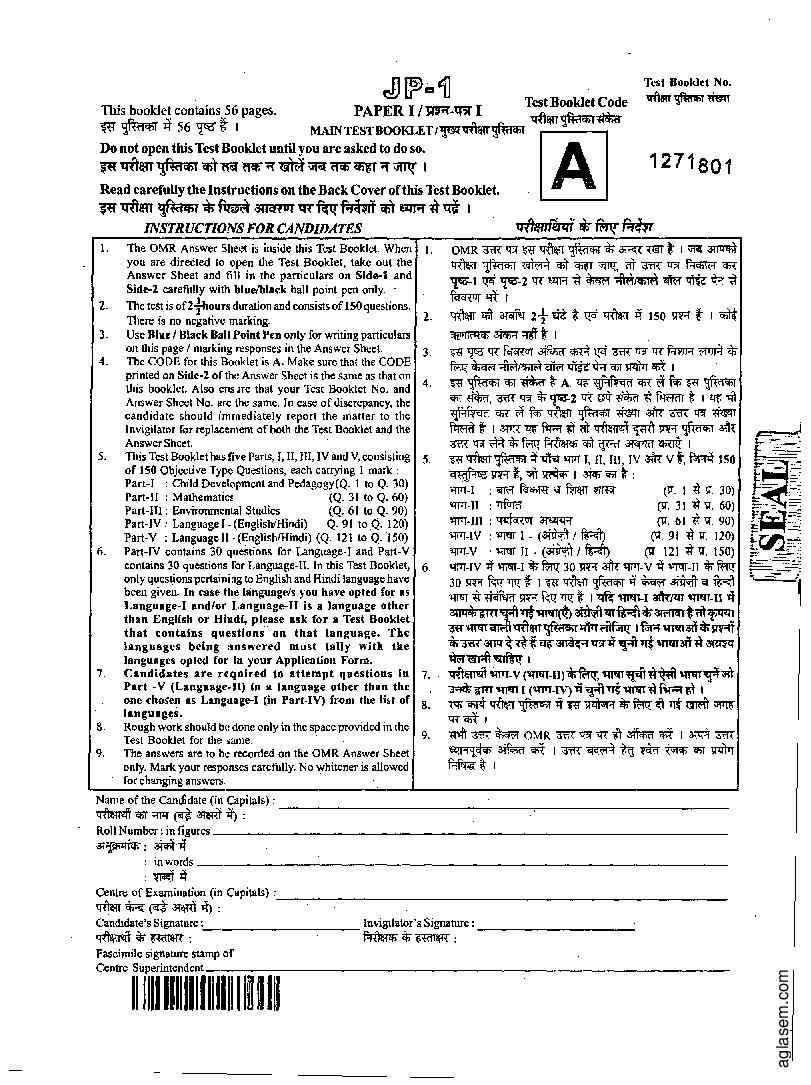
JJ~a1]
Test Booklet No.
llil!IIT~~
This booklet contains 56 pages. PAPER I /~-WI T.:;:;ooklet;::e
"'~ h '!"' ~ I MAINTESfDOOKLET/'l"'•'JII-1
Do not open this Test Booklet until you are asked to do so.
~ 'lfiii.IU ~ CfiT Oof nCfi "I'~ \if<~' nCfi ~"I'~ I 1271801
Read carefully the Instructions on the Back Cover of this Test Booklet.
~ 1fiiiiU ~ <frttw~ 31mVT 'QTrorr.mrr
C6T tzlR ~ -qf 1
INSTRUCTIONS FOR CANDIDATES
I. The OMR Answer Sheet is inside this Test Booklet. When 1. OMR ~ 'l'f ~.~<);~<1m t I~~
you are directed to open the Test Booklet, take out the tri'tw ~ ~ <!iT ~ -;;nl(, m'3'ffi' 'l;f f.:!<fiwr ~
Answer Sheet and fill in the particulars on Side-1 and
Side-2 carefully with blue/black ball point pen only. ·
"rr-t ~ "l''-2 'Cf< err::r -.l ~ ~ iiTi'f ~IF -.l
fucRur 'Gt I
2. The test is of21Jtours duration and consists of 150 questions.
There is no negative marking. 2. • <ffi ~ 2ftitt~ • .q' 150 ~ f I CfiTt
3. Use Blue I Black Ball Point Pen only for writing particulars ~ 3:fci;;f -:m t I
on this page I marking responses in the Answer Sheet. 3. ~ "!113" 'Cf< fucRur ~ "'iB ~ ~ 'l;f 'Cf< f.mr:r 'i'J1'J1-2t <);
4. The CODE for this Booklet is A. Make sure that the CODE
printed on Side-2 of the Answer Sheet is the same as that on
~ ~ -;fu;t~ -aJi;r riitz' .r..-
<ffi wiTrr q;t I
this booklet. Also ensme that your Test Booklet No. and 4
·
~ ~ <m ~ t A. <W ~~of fil> ~ ~
Answer Sheet No. are the same. In case of discrepancy, the <m &, ~ 'l;f <~; "l''-2 'It wr m -.l fllffiir t , v. '11
candidate should immediately report the matter to the ~ ~ of fil> • ~ ~ .;fir ~ 'l;f <il9!!1'
lnvigilator for replacement of both the Test Booklet and the m
fl«offi t 1 wr< w f':A- ~ ~ ~ ~ ~ 31tr
Answer Sheet. ~ 'l'f 'i'f.t <); ~ ~ CfiT ¥'f awRf ~ I
5. This Test Booklet has five Parts, I, II, III, IV and V, consisting 5. ~-~.q'~1Wfl, II, III, IV ->fRy f.~ ISO
of 150 Objective Type Questions, each carrying I mark : ~~t,-:m~t ~<mt:
Part-! : Child Development and Pedagogy(Q. I to Q. 30)
'IWT-1 : <!R'i ~ q fum ~ (11'. 1 <l 1<. 30)
Part- II : Mathematics. (Q. 31 to Q. 60)
Part-III: Environmental Studies (Q. 61 to Q. 90) 'IWT-ll ; 1'lfUrn (11'. 31 <l 1<. 60)
Part- IV : Language 1- (Englishil:lindi) Q. 91 to Q. 120) 'IWT-III : ~ ~ (11'. 61 <f 1<. 90)
Part-Y : Language [J. (Engiish!Hindi) (Q. 121 to Q. !50) 'IWT-IV : 'I1W I - (~I fRl) (11'. 91 -.l 1<. 120)
6. Part-IV contains 30 questions for Language-! and Part-Y 'IWT-V : 'I1W II- (~I fRl) (lr. 121 -.l 1<. ISO)
contains 30 questions for Language-11. In this Test Booklet, 6. 'IWT-JV .q' '11W-I <); ~ 30 ~ 31tr 'IWT-V fl '11W-II <); ~
only questions pertaining to English and Hindi language have 3o~~~t~~-~.q:~~"~
been given. In case the languagets' you have opted for as
'I1W -.l Wifu'ff ~ ~ ~ ~ I ~ ~-1 afu'!lU ~-IIlf
Language-! and/or Language-11 is a language other
than English or Hindi, please ask for a Test Booklet .;nq<~;&RT~Ttf~~~"?U~*'amrot'ffi~
that contains questions.. on that language. The ~'lfi'II'T~'Qi\111T~1l\1T~ tf.iR ~m*'m
languages being :answered must tally with the '!!>'3'ffi' atltf~~t~ ri<r-r trlilf ~ 11f ~ ~ orcmr
languages opted for in your Application Form. ~w;ft~l
7. Candidates are required to attempt questions in 7. 'Qi\ew.ft m.t.v ('lfi'II'T-11)~, ~~-.l~ ~'q'l;;rf
Part -V (Language-11) in a language other than the ~&RT~I(\WT-IV)lf~Ttf~~f'A~ l
one chosen as Language-! (in Part-IV) fr.om the list of 8. \'ii~•~*~~<~;~~'ltm~
I languages. 'Cffq;tl .
8. Rough work should b<l done only in the space provided in the
Test Booklet for the >arne. 9. 'fl'lft ~ ~-OMR '3m' 'l'f 'Cf< tft aWm q;t I ~ ~
9. The answers are to be recorded on the OMR Answer Sheet ~ 3#m q;t , '3'ffi' ~ tq m ~ <m m
only. Mark your responses carefully. No whitener is allowed ~~I
for changing answers. __
Name of the Candidate (in C a p i t a l s ) : - - - - - - - - - - - - - - - - - - , , - - - - - - - - - - - - -
~<ffi"'lff1 ~ aMf'G'):
Roll Number: in figures
31'l'64i<il : 3lCilt .q:
: inwords
:~'G'
Centre of Examination (in Capitals) = - - - - - - - - , . - - - - - - - - - - - - - - - - - - - - - -
-~~aMf'G'); .
Candidate's Signature: - - - - - - - - Invigilator's Signature:--~-------
~<i;mrw: ~<!;~:
Fascimile signature stamp of
flul1~illim 11111111~ IIIII
Centre
Page 2
PART- I /'qfl'f -1
. CHILD DEVELOPMENT AND PEDAGOGY /~fCICfii~ crfulffil'Jw.il'
' • t t
Directio11s: Answer the following questions by Rffl: ~ 3fom ~ ~ RAfffl&rt JrRT
selecting the most appropriate option. ~ '3'ffr<fff.mr I .
1. The following threE~ aspects of 1. ~ atffiRifi'l of.a
~ f"''+=1f("'f&l1
intelligence are dealt by Sternberg's 'IWT CiiT ~ ~ ftrffir ftr.ain '# mnf'Q1'1'
1riarchic theory excel!! fcficrr~t I
(I) componential (1) ~
(2) social ( 2) ~·lll"'l f"' Cfi
(3) experiential (3) ~
(4) contextual (4) ~
2. Howard Gardner's theory of multiple 2. ~ ~ ~ of.a ~ ftr.ain - -
intelligences emphasizes ~on:r~t I
(I) general intelligf:nce
(2) common abilities required in ( 1) WfF!I' off.a
school (2) feW IWI ~ ~ m <ilr<rm3lT
(3) the unique abilities of each (3) ~~ qft ~ <W<rm.aU
individual (4) ~~~~
· (4) conditioning skills in students
3. The sounds t/1, ph, ch are 3. ef, 'In, 'i;r ~t
(1) ~orphemes (1) ~
(2) Graphemes (2) ~
(3) Lexemes (3) ~
(4) Phonemes (4) ~
4. In order to avoid gender stereotyping 4. ~~~'!C'i\&iitoal11 ~~~iffir~
in class, a teacher should ~q:;f
(1) try to put both boys and girls in (1) ~~ 'CfiT ~ '&if
non-traditional roles. 31-~~3lT~~· I
(2) appreciate students' good work by (2) ·~ ~·, ·~ ~· ~
saying 'good girl' or 'good boy'. ~ ~ ~ cnrct qft mw-rr
(3) disco.urage girl:> from taking part m~l
in wrestling. (3) cpffi ~ 1WT ffi ~ ~ <.'1$f¢4\ q;f
(4) encourage boys to take risk and be f.:t N'{'ll Mo 'CfiBT I
bold. (4) ~ q;f ~ 60R ~ f.Mq,
~ ~ ~ lilNJ IMI"l 'CfiBT I
5. Schools should cater to Individual 5. fcr'€11('141 'CfiT ~ iffir ~4fcfi"'C6 f1AnTm
differences to q:;f~~~?
(1) narro.w the gap between individual ( 1) . cl<lfiffitfi ~ ~ l'l~~nsrrt CfiT <P11
students. 'CfiR~~I
(2) even out abilities and performance (2) ~ ~ ~ ~ <W<rm.aU q;f
of students. m 'CflVt ~ ft;ro: 1
(3) understand why students are able (3) <w ~ ~ ft;ro: fc!;' 'f<ll ~
or unable to learn. ~~~<rr~t1
rn qft
(4) make individual students feel <4> &<lfCffiCfi ~ CfiT ~
exclusive. ~'RR~~~
Page 3
6. ·What kind of support can a school
provide to address the individual
6. ~~ *~<~fcfi'1'*' r~m <nt -m:nr~
~ cf> ft;rtr '(lCfl f<w IM<l ~ m <fiT
differences in students ? ~~C6'rcff~t?
(1) Follow a child-centered (1) Gffi'f-~ 41C}_<l'ql!J <liT ~ CWIT
curriculum and provide multiple 3m- ~ q:;l ~ <t ~
learning opportunities to students ;wmr ~ qm;:rr I
(2) Apply every possible measure to (2) ~ -q ~qfcffiq> flrrrrraff q:;l
remove the individual differences
~ ~ <t ~ ~ "fi'qq '31Wf
in students
CWIT I
(3) Refer slow learners to special
schools
(3) m-m 1Jfu ~ ~ ~ ~ q:;l
fcMq f<HlliM4'i -q' $;;IT I
(4) Follow same level of curriculum
(4) ~ ~ <t~ m mr cit
for all students
4k~_<l-q -qj <liT 3f.fl1'R CWIT I
7. Continuous and Comprehensive 7. ~ afu- ~ •g"<liq)"' - - - - 'QT ~
Evaluation empha!dzes ~tl
(1) continuous testing on a Cl) ~q:;t W'-if~ilct ~ct~O!lfllCI)
comprehensive scale to ensure
learning. ~1Rf.ltm"~
(2) how learning can be observed, . (2) ~ q:;l ~ m 61ClMlf'hH, ftcoJi
recorded and improved upon.
afu- -woo~~ 1R
(3) fine-tuning of tests with the
teaching. (3) ~ ct Wi m.m <liT m•*',fll
(4) redundancy of the Board
examination.
8. School Based Assessment . 8. fcWIM<l :amufun~
(1) Dilutes the accountability of
(I) fum- -.ITt cit "1 Cl I"'~ t:l q:;q q:;r ~T
Boards of Education. %-I
(2) ~ ~ ~ cit mf1<f ll
(2) ·Hinders achieving Universal
National Standards. orrm ~ q:;{(1T %- 1
(3) ~ Cl/(ilq{O/ -q' ~ ~ -q'
(3) Helps all students learn more
through diagnosis. ~ ~cit~ q:;{(1T %- I
(4) Makes stude:nts and teachers non- (4) ~ afu- ~ q:;l ~ 31ir
serious and easual. MI4 <Cll ~ ORTt1T %- I
9. ·~ cit mqrn• ciT am- ~
9. "Readiness for learning" refers to Cfmfttl --
( 1) general ability level of students
(1) ~ q;r ~ <W<:rctT mr
(2) present cognitive level of students
in the learning continuum (2) ~ <t fllt1<"'4Cf> # ~ CfiT
(3) satisfying nature of the act of
~ <t 'Cf>r<hlft ~ q:;l ~ ~
learning (3)
(4) Thorndike's Law of Readiness (4) '414:si~Cf> <liT~ <liT f.!w:r
Page 4
10. A teacher has some physically 10. ~ fufam ctT cnm it ~ :m{lfhn
challenged children in her class. fc1Cf>Hi 1@ crn;l- ~ f I f"''Aft"tfuti1 it~
Which of the following would be ~ft;rtr~~~~-rnr?
appropriate for her to say ? {1) ~-¢ qwf ~ i1Fr .q ~ <t
(1) Wheel-chaired bound children ~ -3llH '!14614% m ~~~
may take help of their peers in -R~tl
going to hall.
·(2) . •111f1P:<t> ~ ~ ~ ~ cnm
(2) Physically inconvenienced .q if"<.!# ~Cf>f(>'G<t> ~ C1'iT ~
children may do an alternative fl
activity in the: classroom.
(3) ~<ffi;t~.q~<t~3l1'1
(3) Mohan why don't you use your .aw.ft ~ 'H lf@<il '<tiT m <!<IT ~
crutches to go to the playground. ~?
(4) Polio afflicted children will now (4) 41fC141u«J ~ 3lOf ~ TTRT mwr
present a song. ~I
11. Learning disabilities may occur due to 11. <t a~RtRCf\1 fP~ortft1fu!l1 ~ il>
all of the following exce1_1t Cf>m1T aTIW!ll" ~~~~ t I
{1) Cerebral dysfunction (1) ~ f-&WlCf!tH
(2) Emotional disturbance {2) ti~• IIM<ti fub1
(3) · Behavioural disturbance {3) O!ICI$F(llt'1 fub'f
(4) Cultural factors (4) <Hif't'fliif> ~
12. ~ ft<il<l:tfl fcltlli'1«1
12. An inClusive school.
(1) ~ qft ~3TI qft 1WW f~
(1) Is committed to· improve the
foRT w:fT <t ~-~ q;f
learning outcomes of all students
~<t~~m-m~~
irrespective of their capabilities
(2) ~ <t lWT 3trr 'ROT ~ a:ftr
(2) Differentiate between students ~ ~ ~ m111 ~ <t ~ Cf;tf
and sets less challenging tj~Ml'f"l ~ ~ Rmfur 'ROT
achievement targets for specially ~I
abled children
(3) ~ ~ ~ <W<r ~ <t
(3) Committed particularly to ~-~ct>T ~ <t ~
improve the learning outcomes of ~~~~mm~l
specially abled students (4) ~ qft f-1<il"'"IMI il> ~ ~
~ qft 3JicP(I4if>cti3TI q;f ~
(4) · Decides learning heeds of students
'ROT~ I
according to their disability
Page 5
13. Gifted students 13. ·~~~
{I) Need support not ordinarily (l) ~ ~ qft 311C:Fi4Cfl\'11 mill ~ -m
provided by the school <illil~\'1: f<lEll<'141 lrnT ~ ~
(2) Can manage their studies without ~;;WI
a teacher (2) ~ t- foRT am 3Tl:Z!'R "Cfl't
aqqf.flll\'1 "Cflr "ffil t I
(3) Can be good models for other
students (3) aR~t"~~~"R"
~tl
(4) Cannot be learning disabled
(4) ~-~~m~~
14. Giftedness is due to 14. _ _ t"<f;R11T~~t I
(1) Genetic makeup (1) ail'jCif~ICfl r'tRT
(2) Environmental motivation (2) Cll\'11q{O(lq ~
(3) Combination of(l) and (2) (3) (l) afu" (2) <.fir~
(4) Psychosocial factors (4) 11-lT-filii lf"1<6 C!iRC6T
15. Which of the following is appropriate 15. ~ .q ~ afu" wR t- ~ 3lf~
for environment c:onducive to thinking ~ CIIHI<HUI t"~ f-'l""fR:iRsH "&l"t~
and learning in children ?
~t?
(1) Passive list(:ning for long periods
of time (1) ~ ~ wr:r t- ~ Rm ~ -#
(2) Home assignments given ~
frequently (2) f.mrPJ~C6l<f ~ ~
· (3) Individual tasks done by the. (3) ~ ~ lrnT Ollf<fl"jl 1\'1 C6l<f C6V1T
learners
(4) allowing students to take some (4) ~ "Cfl't ¥ 'W ~ t.rr fcf; ~
decisions about what to learn and ~~afu-~~~1
how to learn
16. Learning Disability in motor skills is 16. Tffuq:;- ~ .q 3lf'Q11Jf f-'l<t1•th'll - -
call~d C6t'W11ffi t I
(l) Dyspraxia (1) f-s'Hlfcm41
(2) Dyscalculia (2) f-s~wrf<n41
(3) Dyslexia (3) f-s+<'lf#141
. (4) f-s:0>f~41
(4) Dysphasia
17. 3lf'Q11Jf f-14i•<li'11 - -
17. Learning Disability
(1) ~~31cW!IT~ I
( 1) is a stable state
(2) ~m- 31cW!IT ~ I
(2) is a variable state
(3) need not impair functioning (3) ~ ~ fcfic:wb:r.sfu Cfft ~ <R 1
(4) does not improve with appropriate (4) ~ H<m t- -w.r wnr ~ m
input mill I
Page 6
18. The following are the steps in the
process of problem solving except M~t~~"'fctf~cf;~f
(I) Identification of a problem (1) ~cttW€1R
(2) Breaking down the problem into (2) ~ Cj;f -rnt ~ -q: ~
smaller parts
(3) ~~em~
(3) Explore possible strategies
(4) llfturrriT qff 3lmT ~
(4) Anticipate outcomes
19. ~~(Cfil)
19. A teacher should
(I) ~ mr ctt 7lt ~ cot l%"
(I) treat errors committed by students
~ ~ *"~ -q: *rr ~ afu"
as blunders and take serious note
of each error
~ We
~I
*"
~ *fir R"u:fuft -e;;ft
(2) measure success as the number of (2) ~ fcmRt ow~ q;R ~ ~
times students avoid making
mistakes ~I
-
~ ~~ *" *" ~ -q: *rr
l1l1l"
(3) not correct students while they're (3) ~ ~ fcrtmT em ~ q;R -em
trying to communicate ideas ~ q;n~- ~ m~~m q;r-rr
~I
(4) focus more on lecturing and
(4) 041 @41"1 '!R 31fuq;- 'I:ZIR t.rr ~ afu"
provide
knowledge
a foundation for~
m;r
~I
*"
~ 3l1'lm" ~ ~
W. Seema is desperate to score A+ grade 20. • lfflm tl A+ m- ~ ~ cf; ~
in an examination. As she enters the atffi ~t 1\ifif ~lfflm 'i1cR tl ~
examination hall and the examination mm
"ffiT t neTr lfflm '!fiN t, ~ ~@Tcfi"
begins, she be,:omes extremely
nervous. Her feet ~~o cold, her heart
m
orcrn -;;ffift t I ~ ·qrcnit ~ ~ f,
starts pounding and she is unable to
~ ~ ctr ~ ~ ~ "\il"lffi t m
~~~~~"3W~~-qrffi I
answer properly. The primary reason
for this is that ~~CfimJT~~t
(1) she may not be very confident (I) "WK w 3l1AT m ~ -.m- -q: OJSO
about her preparation 3lll"'fct><Cll«l -=m ~ 1
(2) she may be thinking excessively
about the . result of this
(2) "WK w ~ ~ 1:!ftunll *" *" ont -q:
OJSO 31fuq;- ~ ~ I
examination
(3) f.rOOcl;- ~ "'T ~ '!R t w
(3) invigilator teacher on duty may be
~q;m~~~~afu"
her class teacher and she is of
very strict nature W ~ # OJSO CfiCTr ~ I
(4) she may not be able to deal with (4) "WKW ~ fi~•III"!Cfi anWr CfiT
sudden emotional outburst WHTm<ii\~ I
Page 7
21. Which ofthe following cognitive verbs 21. R¥01ff;!fu:l11 'It ~-m fiili"''IC+!Cfi ~ ~
are used to analyse the information Tif ~ cl> fctqtil<I!OI ~ fffir ~ 'It Fl'1f
given? ~t?
( 1) IdentifY
(1) W't!Ff~
(2) Differentiate (2) atrr~
(3) Classify (3) ~~
(4) Describe (4) qu\;r~
22. Rajesh is a voracious reader. Apart 22. · -mm m ~ l:(lOcf> t 1 ~ m 'CfiRt
from studying his course · books, h~ ttl ~ ~ cl> a~fr~Rcm ~: ~Cfii{Ot"l
often goes to library and reads books ";ifl'ffi t afu- f'Ff SICfi~Un· 1R" ~ ~
on diverse topics. Rajesh does his t I ~tf~. -mffl~-~"#
project even in the lunch break. He ~ 4R<ilJ1'11 ~ 'Cfi«<T t I m -.:ritamn
~ fffir w:t ~ ~ m ~ 3MiU
does not need prompting by his
teachers or parents to study for tests
an~ im1 "Cfi'lft ~ ~ ttl ~
and seems to truly enjoy learning. He
~ t 31tt~~ll ~ q;r awiG"fflrr
can be best described as a(n) _ __
~311r!Tt 1m __ ~~'lt~ucn
(1) fact-c{:ntred learner ~~~~~m~t 1
(2) teacher motivated learner (1) ~-amnfui ~
(2) ~-~~
(3) assessment-centered learner
(3) ~-~~
(4) intrinsically motivated learner
(4) ~~~·~~
23. Children in pre-primary get 23. ~~~~"Q"f~ltl"•m
satisfaction rrQ.m being allowed to ttl ~ ~~ "J1llf "ffi ~ ~ m"J1Tit t, 1
discover. They become distressed, ~a;tf.!i'ilffil~l'1 ~-;;m:rrtm~~
when they are discouraged. They do m~t~~~ ttl~
so due to their motivation to arl'~~~~tl
(1) redw;e their ignorance (1) 31tRT.q;fq;q~
(2) affiliate with the class cz,) ~~~~rn
(3) create disorder in the class (3) ~ .q ~""'Cl~l ~ .q
(4) exercise their power (4) ~~q;r~~
Page 8
24. Understanding Human Growth and 24. -qr.rcr~~~<it~~q;l
Development enables a teacher to _ _ <);<rlnf GRTffi t I
(1) · gain control of learners' emotions (1) ~~~~~~"!R"
while teaching.
~~~
(2) be clear about teaching diverse
(2) ~ ~ ~ ~ ~ om- .q
learners.
~
(3) tell students how they can
(3) ~ q;t w Offi'Ft fcl;- cf 3N-t
improve their lives.
~1l~wm-<Rm~
(4) practice her ·teaching m an
unbiased way. (4) Ruru ~ ~ 311ft ~-3Mffi
25. Which one ofthe foUowing is true ? 25. Pi""1IT=if&n"ll~qfR-m~t?
(1) Development and learning are
(1) ~ ~ ~ m-<Hi*¥fo<t•
unaffected by socio-cultural
~~~Wit~ I
contexts.
(2) ·Students learn only in a certain (2) ~~~om~~~ 1
way. \ (3) ~ ~ ~ 'HII"11f->1Cfi ~ ~
(3) Play is significant for cognition Wnnn$o%" I
and social competence.
(4) ~ sm w.:r ~ <8~Hiii"ICfi
(4) Questioning by teacher constrains
~1l~%"1
cognitive development.
26. Which one of thll following is true 26. ~<);~ll ::tll'j/'t&t<Mt afu"Cllni<HUI
about the role of heredity and <it ~ <); Grit .q r~ . . . f<:1f&n .q ~ qfR_
environment in the development of a m~t?
child?
(1) 'H"iCI<HCI>l ~ ftrtci; (genes) "CfiT
(I) The relative contributions of peers ~ ~ <il•lliiiCfi ~ m-m 1
and genes are not additive.
(2) 3ilf'if!<ICfictl ~ CllctiCI{UI ~ ~
(2) Heredity and environment do not
operate together.
qfl:illf(i'tct ~ m- I
(3) ~ ~ CllctiCI{UI ~ ~ %"
(3) Propensity IS related to
~ CIFRifqCfi fcf<:f;m ~ Wrrt
environment while actual
::ttlf'if!<ICfictl ~ %" I
development requires heredity.
(4) 611f'if:(ICfictl ~ CllctiCI<(UI <;f.:IT ~
(4) Both heredity and environment
~ ~fqq:;m # 50%-50%·~
contribute 50% each m the
development of a child. · tft I
Page 9
I
27. Socialization is
(1) Rapport
taught
between teacher and
(1) ~ ~ :ql3nr<nr ~ oiR:r m
(2) Process of modernization of (2) m ~ aw{-1Chli.fi<ul Cfft ~
society
(3) m~11RW~~~
(3) Adaptation of social norms
(4) fll'"llf"l'f> 11RW -q ~
(4) Change in social norms
28. A PT teacher wants her students to 28. ~ m.il. ~ ~ ~ <fi ~ it
improve fielding in the game of m mmr~ <fi alsf-Ta{11T c:nT WI'HI
cricket. Which one of the following ~ t . 1 f.p:;:r it ~-m ~ -«
strategies will best help his students fuanf~ CfiT 3JtRT ~ Jl11<f Cfir-'r it
achieve that goal ? W'Q<fi '!"ll\1~<6 t?
(1) Tell students how important it is c1) ~ "'fiT <:w omRT &tr-wur w
for them to learn to field. ~ ~ ~ f<R:r m '"lt\fCl'{ul
(2) Explain the logic behind good %-I
fielding and rate of success. (2) ~ &tr-wur-*<" ~ Cfft Gr ~
(3) Demonstrate fielding while -QW- ~ ncf; "'fiT ~ q;r-rr I
students observe. ( 3) &tr-wur "'fiT ~ q;r-rr am- mwrr
(4) Give students a lot of practice in .:llcktl'f>"' ~ I
fielding. (4) ~ "'f)) &tr-wur "'fiT 31fuq;-
-3-l'Rim~ I
29. A teacher wishes to help her students 29. ~ ~ arCR fuallf~ ~ ~~it
to appreciate multiple views of a ll"« "<6FIT ~ t ~ <l ~ fu.1fu ~
situation. She provides her students aRcn <tfle<b)Oi) ~ ~ '<6'f "fi"Ct I Cfl\'
multiple opportunities to debate on
this situation in different groups.
fcff1Fl" ~ it ~ ~ ~ CI'TG·~
According to Vygotsky's perspective,
Cfir-'r cfi .aRcn' ~ ~ <6"mft t I
her students will various· cU$•ilrt<t>1 cfi ~ cfi ~ ~
views and develop multiple fmmfl fcif1Fl" 't foe <b) 0n CfiT
perspectives of the situation on their ~ attr m rrflcf; -« "3'(01" fu.1fu <fi aR<n
own. . ~ fCI<bfWt ~ I
(1) internalize (1) ~
(2) constmct (2) Rtrtur
· (3) operationalize (3) 'iifMI'f>{OI
(4) rationalize (4) ncf>Wm- '
30. Sita has learned to eat rice and dal 30. ~~m -«
~ attr "'ilTc'fM "&AT •
with her hand. When she is given dal ~ t .I \ii'Oi ~ ~ am-
"'ilTc'fM fcr<r ~ t
and rice, she mixes rice and dal and nT Cfl\' ~-"'ilTc'fM f"1MI<6~ ~ ~ t I
starts ·eating. She has eating ~ ~ c:nT Cfir-'r <fi fffir m ~ it
rice and dal into her schema for doing ~ aTtr "'ilTc'fM ~ CfiT '(f)'f ~
things. t"l
(1) Accommodated (1) lil'"ll~'tf"ln
(2) Assimilated (2) <ll'j<tifl1i1
(3) Appropriated (3) lill{ilcti11
(4) Initiated (4) ~
Page 10
PART- II I 'qf1l_ II
MATHEMATICS I •1f01<'1
31. Perimeter of a square is 24 em and 31. %«~ wT q;r ~ 24 ~. afu- ftfim
length of a rectangle is 8 em. If the ~ Cfft ~ 8 ~. t I <mf wT afu-
perimeters of the square and the
~~~~~.m~q;r
rectangle are equal, then the area (in
~(wl~.~t
square em) of the rectangle is
(1) 16
(1) 16
(2) 24
(2) 24
(3) 32
(3) 32
(4) 64
(4) 64
32. The difference of the place value and 32. ~ 12345 .q 3 ~~-qr-fi'fm ~
the face value of the number 3 in -qr-fliaiffi"t
12345 is
(1) 0
(1) 0
(2) 295 (2) 295
(3) 297 .(3) 297
(4) 305 (4) 305
33. Which one of the following is not 33. f.:l+::r 1i "« ~ m ~::ill t ?
correct?
(1) 56.7 f<tw1ll'll'i 5670WT
(1) 56.7 kilogram= 5670 grams
(2) ~tj;:p)>6 ~~t
(2) A ·cube has six faces.
(3) One millimetre= 0.1 em (3) ~ f'"lf~P=tic:< 0.1~.
(4) 0.10 is same as 0.1 (4) 0.10 311t 0.1 WIRt
SPACE FOR ROUGH WORK /~<iil<f cl;-~~
Page 11
34. The speed of a boat in a river is 20 kni 34. ~ 1{ ~ -;:nq c6T -:c:m;r 20 ~ Jffif tkT t
per hour ai1d the speed of another afu"~ ~ -;:nq c6T -:c:m;r 23 ~ Jffif "dGT
boat is 23 km per hour. They travel in t ~<hton -;:nq ~ -tt ~ 1l ~ ~-«
the same direction from the same · ~~ 1R" 'T.fffift f I ~ "ffi::f tit ~
place at the same time. The distance
m~c6T~t
.between the boats after three and half
hours is
(1) 10M.
(1) 10 km
(2) 1o.sM.
. (2) 10.5 km
(3) 11M.
(3) 11 km
(4) 11.5 M.
(4) 11.5km
35. When 90707 is divided by 9, the 35. ~ 90707 qiT9-« \{111" ~1R"~t
remainder is
(1) 3
(1) 3
(2) 5
(2) 5
(3) 6
(3) 6
(4) 7 (4) 7
SPACE FOR ROUGH WORK I ~'-6T<f ~fut:r\illW
Page 12
36. When a fresh fish is dried it becomes 36. ~i'I'T'ill ~ q;l p 'tR"~ ~ 1/3
1/3 of its weight. Sunita buys 1500 kg ~ ";iffiiT t I wflor 1500 fcnffi i'I'T'iiT ~
fresh fish for f 25 per kg and sell
f 25 Jffif fcnffi ;f;- 'qJq ~ ~ ~. ~
them, when dried, for f 80 per kg.
How much does sbe earn ? WM ~. f 80 Jffif fcnffi cf> 'qJq 'tR" ~ <tit
t l~'lfcm"'Cfg"~t
(1) f2,500
. (1) t 2,500
(2) t 2,700 (2) t 2,700
(3) ~ 3,000 (3) t 3,000
(4) ~ 3,500
(4) n,5oo
37. Look at the following pattern : 37. ~~q;l~:
(9-1)+8= 1 (9 -1) + 8 = 1
(98-2)+8=12 (98- 2) + 8 = 12
(987 - 3) + 8 = 123 (987- 3) + 8 = 123
(9876 - 4) + 8 = 1234
(9876- 4) + 8 = 1234
~~;f;-~
According to this pattern
(987654- 6) + 8 =
(987654- 6) + 8 =
(1) 12345 (1) 12345
(2) 123456 (2) 123456
(3) 123465 (3) 123465
(4) 123467
(4) 123467
SPACE FOR ~OUGH WORK I ~'C61<f cfi"'ft;nr~
Page 13
38. 750 ml juice is. fiUed in one bottle and 38. ~~'If 750 ft:«;ft ~ ~ \jf(ffi t am-
six such bottles are packed in one tm 6 ~q;l~~lf ~~\jf(ffi
carton. The number of cartons needed t I 450 ~ ~ ~ futr ~161!/<l<f> 'filW
for 450 litres of juice is ct~mmt
(1) 75 (1) 75
(2) 80 . '
(2) sif;
(3) 90 (3) 90
(4) 100 (4) 100
-,
'
39. Internal length, breadth and depth of 39. ~ (311<li'11Cf>H) orcm qft ~ mnl.
a (rectangular) box are 4 em, 3 em ~ afif~J6lm: 4 ~-. 3 Wft. nm
and 2 em re·spectively. How many_
2 -@ft. f I 8664 calhfkn.:ro:tlq;l~~
such boxes are needed to pack 8664
centimetre cubes ?
(1) 351 (1) 351
(2) 361 (2) 361
(3) 391
(3) 391
(4) . 722
(4) 722
_SPACE FORROUGH WORK/~~cf;~~
Page 14
•1cl; fii11j(i<4 f'R ~ I" ifim IV cl;
1
40. "Write the equivalent fraction of 3 ." 40.
The above question asked to students tmnrem ~ ~ 11trr ~"f!Cim cit
of Class IV refers to annt~n ctmn f I
(1) lower-level demand task as it
(1) ~ ~ ~-q;r;f, ~ ~
requires procedural skills only.
<);cffi ~Sf>4UI"f>Hl ~ cit ·
(2) lower-level demand task as it is
3'11<:!~4"fldi ~ ~
based on memc>rization only.
(2) ~ ~ ~-q;r;f, ~ w <);cffi
(3) higher-level dl!mand task as it is
~qr~~
based on procedure with
(3) ~ ~ ~-q;r;f,' ~ ~
connection.
~c);~~qr~t
(4) · higher-level demand task as it is
(4) ~~~-q;r;f. ~~c);
based on procedure without
f.Rr~qr~~
connection.
41. Students often make a mistake in 41. Jmf: mawdf <alilt"'a ~an cit 'iFR' ll
comparing the decimal numbers. For ~ Cfi'«l" f I 3~ ~~~ UI cl; ~ 0.50, 0.5 ~
example 0.50 is larger than 0.5. The wm t llfl' ~ q;r flai~ifi ~ <m"OT
most probable reason for this error is
~~t
(1) lack of practice of these t).rpes of
questions in the class. (1) ~"' ~ Wffi" c);~ c);~
<tiT 3N1a" I
(2) lack of concrete experience of
representation of decimal number (2) ~ ~ qr G~i"R"'C! ~c); f.Rc:;qur
on number line. c);~ ~<tiT 3N1a" I
(3) careless attempt by the students. (3) ~ rnr ("114l:<~ltll Ol«'AT 1
(4) misconception regarding the
(4) ~ G~l4("1<rll ~cit fll~"fl!11 ~
significanc<: · of zero in ordering
·~~fi"fl<?IHII
decimal.
SPACE FOR ROUGH WORK/l'qi~cf;~~
Page 15
42. A teacher prompts the students to 42. ~ fm1<n tmmwn ~ ·~ ~ .q:
prepare Mathematical journal with TTfirrrr q;r ~ 'j3'l en w ~ ~ m1!f ., FU rffi <~
the theme "Application of ~~~~~~~tiT
Mathematics in Daily life". This t 1wTTffifcri'~t
activity is (1) ~ <ift ~ fi<t>&<J"11arr <ift
(1) to test tl)e students understanding of mq:;r;:rr 1
Mathematical concepts. (2) 3N-l m 3fu- ~ -<t>T -mw ~ cl;-
(2) to provide opportunity to students ~~-<t>T~~
Cf){RT I
share their ideas and knowledge.
(3) lJfUm qft ~ -q ~ qft ~
(3) to help smdents to sense of
q:;r;:rr I
Mathematics.
(4) ~ fi<t>&<J"11arr 3fu- ~
(4) to help students to connect 3lill"MI -q m ~ 3fu- 3N-l
Mathematical concepts and its m ~ fcrqffi -<t>T mw ~ -q
applications and to share their -~ qft ~ q:;r;:rr I
knowledge and ideas.
43. According to Van Hiele level of 43. ct.; m ~ J<lrfi:IJI<~ ~ ~ ~ ~
geometric thought, the five )evels are - ~~~f-~. fCI!IH~Ui,
visualization, analysis,
deduction, formal deduction arid
informal n
~ 4l 4iltR <6 f.:frrq;:f, ail 4ilt <6 f.¥rq;:f afu-
~ (rigour) I 'C6'afT ill ~ ~ ~ ~ .
rigour. Some polygons are given to a
child of Class III for sorting. ~~~~~~~·
l 6~~oool
He classified tbe polygons on the basis
cg 1prrm ctt ~an cl;- amm-tff~
of the number of sides. This child is at ~~crnrrt I W~WfmR~
---'':.....·.;.:..· level of Van-Hiele \i<ltf>iJ\<4 ~~ ~tfft I
Geometrical tbought
(1) ~
(1) Visualization
(2) fcP/H"'OI
(2) ','Analysis
(3) lnf<;>rmal deduction (3) · 314l4'<HRCfl ~
~.., i .
(4) Formal deduction (4) 6ih<liR<t>~
SPACE FOR ROUGH WORK~~~ c);~~
Page 16
44. A child displays difficulty in 44: ~ ~ ~arr. ~arr afu" ~
differentiating between numbers, ~ t-~ ~. M~rnm anfu-1l atn-
operations and symbols, two clock
~ ll <6fd011~ ~ q;rffi t I~
hands, different coins etc. This implies
that the specific barrier affecting his. f01~n1ei tfln-;;IT ~~~~
learning is <fiT lN1fan <nn"tt t, cit
(1) poor verbal, visual, auditory and
working memory.
(2) poor visual processing ability i.e.
visual discrimination, spatial (2) ~ ~-Wf;l1UT <!Tn:im, ~ -
organization and visual ~~.. ~~-mr
coordination.
(3) poor language processing ability.
(3) ~ 'llTm mf;l10T <!Tn:im, ~
i.e. expression, vocabulary and
~. ~-~ 3W ~ mf;l10T
auditory processing.
(4) ·poor motor skills, reading and
writing skills.
45. NCF 2005 emphasises on Constructivist 45. ~ QIQ_<I'€1<1\ ct>1 '(<'Q~@i 2005 atfwrq c);
Approach of learning as it focuses on 'l'il"ii<Ml ~ ~ -.wr ~ t, ~ Cf5
{1) memorization of definitions and ~~tl
formulae. (1) ~:m-mr~cot<nG~
(2) sub!llission of regular homework. (2) ~ lJ't'-~ ;:;p:fT -~
(3) active participation of Ieamer (3) ~#~~~~
through engaging activities. q;y ~ ..wne:1fh11
(4) effective lecture and instructions (4) ~ 00 >MTCft O<ll(0..041'1 3W
by teacher. ~
SPACE FOR ROUGH WORK I rq;'C6'1<f cf;~~
Page 17
46. Following are array diagram using 46. f"'i01ffwif&l1 ~ CfiT ~ ~ §tr 15 .m
bindis to represent 15. ~m<mhi<ilfut11 (array) ~f
0 0 0 ~0,__,..0....,0~0.....,0:-1 0
000 00000 0
000 00000 0 0
0 000 00000
000 00000 0 00000 0
000 0
000 0 000 0
000 0 0
0 000
0 0
0
loooooooooooooool 00 loooooooooooooool 80
0
0 0
0 0
0 0
0 0
The way of representing 15 or any .
other number in the above manner 1s amcrr 3R' ~ ~ .m Jre:fun m
can be used to teach concept of cl; ~ ~ .m __ 'lfft tfi!fii'Q""'
'Q'JR <);~ $:M¥U('1 %orr \ill~ t I
(I) area and commutative,property
(2) commutative property of (1) ~*~wrfu
multiplication, identification of
prime and composite numbers,
(2) ~em ~ wrfu, ~ am-
area ofrec:tangle ~ mw em ~. 3W«f q;r
·~
(3) representation of a number as
product of two numbers,
commutative property of
(3) ey ~~ ~ ~ ~ ~ .q ~
multiplication, multiplicative ~ CliT ~ q;r;f, ~em~
identity, identification of prime · wrfu, ~ ~. ~ afu"
and composite numbers, area of ~~em~. 41311(<0(<6 ~
rectangle using units quantity
q;r ~ q;cl ~ 3W«f q;r ~
(4) representation of a number as
product of two numbers, (4) ey ~~ ~ ~ ~ ~ * ~
commutative
multiplic:ation,
property of
multiplication
~ q;r ~.~em~ wrm.
~~.~am-~
identity, identification of prime
and composite numbers. ~~em~
SPACE FOR ROUGH WORK/~~cl;'fi;nr~
Page 18
47. Which of the following questions is 47. f.:t101f€tf&fl if"« <nt.:r-m ~ atn crn:rr w-f
open-ended ? t?
{I) Write the numbers 25, 7I, I9, 9, {I) '25, 7I, I9, 9, 8, I7, 85 ~
8, I7, 85 in ascending order. am)it~if~ I
(2) Which is more ? (2) ~m~t?
I 7 I 7
-or- -err-
3 5 3 5
(3) Write any four number greater (3) 2. nt ~ cmt '<m" ~ fffi3T 1
than 2.7.
2
(4) 7~7~~t?
(4)
Wh . . 2
at ts 7 more than 7 ?
48. The most appropriate tool to expose . 48. q;m II cf; fulmf~ <fiT ~ all'f>Rt41,
the students of class II to plane ~ ~ afu- fcf;;ml "« ~ qm;t <fiT
figures, its vertices and edges is
•I ,
{I) Geo-Board
(2) Nets of 3D solids
(3) Cubes (3) ~
(4) Black-board surface
SP.ACE FOR ROUGH WORK ~~~tfi-~~
Page 19
49. Following is a problem from text book 49. f.1'"1R:If<S~i1 ~ v <it ~-~.q ~ ~
of class V: m;m;rt:
"There are 4 poles ofmeasure 105 em, «-qif 4 Gist t fiR<I;r 11'fll ji;111T.· 105 'fWI.,
115 em, 150 em and 235 em
215 'fWI., 150 'fWt. rreTT 235 'fWt. t I~
respectively. If they have to be cut into
pieces of equal length, what is the
Trt~ ~.q,~ .q: <1iTc:'fT t niJTr"lR; .
gcnt<lft 31('~ ~'if<lT -mJ ?"
maximum length of each piece ?"
This question is asked to
(1) test knowledge of factors and (I) ~ 3fu- ~ $'~ cn~bRwr
multiples
(2) tt"'-Hiltt'h mn ~ $'~ <1>1 ~
(2) check the skill of finding HCF
(3) enhance problem solving skills
C3) mw 1ft fi Cf)C'<l '11 an "CflT m "Cfl«l ~
~~~q;)~
using learnt concepts
' (4) tt"'-H'Iltt'h (fllf tt<"lmQ"l w ~
(4) give practice of word problems
based on HCF and LCM ~-~an "CflT 3Mffi ~
50. Following is a problem from text book so. . f.:t'"1ft'1f&i'1 ~ m <it ~-~ .q ~
of class III : ~m:R<nt:
"Which mathematical operation will be ··~ ~ q;7 'ffl' m .q, ffflr
used to solve the following problem .? q:ff;:r_ fit 1(/Vf(flq 'fifincrr q;r ]1?#r f<l;w
A milkman sold I410 litres of milk in
~?
10 days. How many litres of milk did he
r['1> ~ 10 ~ .q: 1410 r:ftcr fl1 knr
sell in a day ?"
Which competence of Bloom's
t I CW r['l>~ rf film:t r:ftcrfll knr #'?"
~m;m;r oq ~ cf; ~:HHii"''Cfi iltr Cfft
cognitive domain is referred in the
above question ? ~~<it am-~t?
· (l) Knowledge (1) ~
(2) · Comprehension (2) ~
(3) Analysis (3) fc:l~(it~OI
(4) Synthesis (4) fi~(it<jOI
SPACE FOR ROUGH WORK t~Cfi'T<f cf;~~
Page 20
51. Rashid is studying in class V. He can 51. rlfuG~ V 'It 'Ql'ffi' t I ~fuf~ lfcfiR"~
classify various types of triangles in ~ q;f f~ ~ .q ~ ~Wfi'ffi
different categories but has difficulty
in understanding the abstract proof t~ ~ 1t iR q;foif q;p:rrrr 1so mm
for the sum of three angles in a t- ~ ~ Wfl17T q;f ~ .q -m Cfifcs"11~
triangle to be always 180. According mffi t I ~ ~ :H~Hii'iCfi fu';atf ~
to Piaget Cognitive Theory Rashid is ·
at ~rrfuG-~wt 1
(1) Concrete operational stage (1) ~ 'liflfl"'li"'!Cfi ~
(2) Formal operational stage (2) 3/l4"<l1Rcti 'liflfl"'l("'""lcti ~
(3) Sensorimotor stage (3) 'li~e.'1•1fi1Cfi ~
( 4) Pre-operational stage (4) ~-'liflfl"'l("'""lcti ~
52. According to NCF 2005 52. ~ Qld<lil<ll qft <(C\Q~@ 2005 ~ =
A ' -•_;""
"Developing children's abilities for '''TlfUrrr Cfft fm1r "" 1J?.W ~ ~ <1fT
mathematization is the main goal of •lf0Tri1Ch (0/ Cfft Q11rr7T31f "" fiFI;-nr 'f&r-11'
mathematics education. The narrow
aim of school mathematics is io develop
f I P{!ffl 'T1fUrrr 'liT ifffirrr Mll?1 f -
'useful' capabilities." ' ~ Q11rr7T31f 'liT fiFI;-nr I "
\
Here mathematization refers to '<l'iT '<lfOIJiCfi~OI' ~ 'Cift ~3fi
develop child's abilities cnr fci'Cfi'm ~ 'Cift am-~~ t 1
( 1) In performing all number (1) ~ 3'!lt ~ f"lctilii'l~ ~wiT
operations efficiently including of
~~31Tct~~cn1
finding square root and cube root.
(2) To formulate Theorems of (2) ~ ~ ~ ""'llf'"lffi"' m 'CfiT
Geometry and their proofs f.r'!C\qur 3'!lt ~ ~ 'CfiB cn1
independently.
(3) ~-'WRZ!T31'f q;)- ~ 'HlilCfi(OI #
(3) To translate word problems into
linear equations. ~CI?Rcn1
(4) To develop the child's resources (4) ~311· q;)- ~ ~ R1'.Cfi1i 'CfiT
to think and reason
mathematically, to pursue ¢li~ilw1 ~ 3'!lt ~ 'CfiT ~
assumptions to their logical CI?R c), ~ TTfO'rffi<r ~ ~ fmR 3'!lt
conclusion and to handle
~ct~ct~'CfiT~~
abstraction.
Page 21
53; The highlights of a good textbook are 53. ~ ~ 41a,<~y;'klcn <tT fCI~I''iGrll~ t:
that
at". ~~~~ci;fffir~
A. They contain numerous mhfl<mft" 1
exercises to give rigorous
practice. Of. ~c); 11lUitf ~mil fi<ti&<H 1m
Cfil~~";i{l~t I
B. All concepts can be introduced
thro~gh situations.
~- ~ &T ~ TTlf ~ tt mf1rn
c. Only solved examples are fcn"tr TTlf t I
included.
G". ~mitcr~~~ICI~<Icni· I
D. They must" be thick and heavy.
(1) at"~<r
(1) AandB
(2) CandD (2) (1~(\
(3) AandC (3) 31~(1
(4) BandD
(4) Of~<\
54. NCF 2005 emphasises that 54. rTlil<r Qld<lil<ll ciT <{<\Q~&I 2005
A ' ----
wawrtftt 1
(1) Succeeding m Mathematics
should be mandatory for every (1) l1fUrfT -q ~ ~ ~ ~ ~
child. ~tl
(2) Students should be tested first for (2) ~ q:,1 ~-~ <irr<:mr ~
their logico-mathematical ability. ~~~WwiA"t~
· (3) Maths curriculum shall be (3) ~ ~aii ~ ~ l1'fUR'T_
separate for low achievers. 414_4'<141 alwr tMt
(4) Maths shall be taught to selective
students.
SPACE FOR ROUGH WORK I -rq;q;ycf c);~\ifTT6
Page 22
55. The difference between the sinilllest 55. · 5, 10 afu" 35 <fi mR{ mt 't11si•JUI'tj afu"
common multiple and biggest
common factor of5, 10 and 35 is
(1) 30
(1) 30
(2) 35
(2) . 35
(3) 65
(3) 65
(4) . 75
(4) 75
56. The number of factors of 105 is 56. ~ 105 <fi 1JU Hci'!l Cfft ~ f
(1) 3 (1) 3
(2) 4 (2) 4
(3) 6 (3) 6
(4) 8 (4) 8
57. If the time li~w is 2.17 P.M., what will 57. ~~ 31if 2.17 P.M. t, nT 31ir~cftct>
be. the time 11 hours and 59 minutes 11. tit afu- 59 f1:RG <l; ~ ~ ~
from now? ~?
(1) 1 L57 A.M. (1) 11.57 A.M.
(2) 9 : 59 A.M. (2) 9 : 59 A.M.
(3) · 2.16A.M. (3) 2.16 A.M.
(4) 2.17A.M. (4) 2.17 A.M.
SI'ACE FOR ROUGH WORK /~ctiT<htd~~~ .
Page 23
equals t
(1) 144 (1) 144
(2) 1221 (2) .1221
(3) 12321 (3) 12321
(4) 111111 (4) 11111-1
60. The sum of five hundred nine and 60. ~~;:ft afu"tfr.;~ ~~~t
three thousand twenty eight is
(1) 3537
(1) 3537
(2) 3087
(2) 3087
(3) 837
(3) 837
(4) 387 (4) 387
Page 24
PART- Ill/'tWT-' Ill .
ENVIRONMENTAL STUDIES I Q<OiieH cit ~ .
61. The name of the scientist· who first 61. ~ •hnP!Cfl CfiT ~ ';:f1lf t f-;:m-;t <('lclSII!l q
peeped into a mosquito stomach and lfTm' ~ 1k' ~ ~ "ffiCti'-~ ~ 31tr ~
proved that mosquitoes spread ~~~q(;)fhul=!~n~~tffm
malaria and for his research was l'« ~ ~ ~ R<('ltaH 190i *
awarded Nobel Prize in medicine in filfcfiH'II ~l$f1f~ $~H fcrl:n'Tl<IT I
December 1902 is
(I) ~~
(1) Charles Darwin
(2) ww~
(2) Gregor Mendel
(3) George Mistral (3) "**~
(4) Ronald Ross (4) ~mr
62. Rajat said to his friend, "I cannot play 62. ~ ;f 3TQ;f fir.nh;-gr, "'il-:;ift ~ 'Wfiffi
because I am down with fever. I pass ~ ~ ~ t I 'il tqtcfl, ~.
through a cycle of shivering, fever and
~afu-affi1f~aTR~"<ijl;~
headache and finally sweating. .After
my blood test doctor prescribed me a "FfffiT t I r<ffi ~ ~ ~ ~ ~ ;f
bitter medicine.'' Rajat . might be ~ ~ 'CfliCit ~ ;tt I" ~ ~ Wr ~
suffering from titmf mwmrr t?
(1) Typhoid ( 1) fW:rr<ft ~
(2) Diarrhoea (2) 3lfimTr
(3) . Cholera (3) ~
(4) Malaria (4) ~
63. Who was AI-Biruni ? 63. 3Wi'-~ '!liR ~ ?
(1) OW ~ 'f(j"WIItft ~ ~ ~
(1) A Qutabshahi Sultan who ruled
our country for about 40 years. ~ ~
~I
* ~ 40 'Cl'rt ~
{2) A trader from Afghanistan who
(2) OW 31 Cfi 1 11 f01 «'111 Cffi' ~ &fT!1'R1 ~T ;;IT
came to study the dryfruit markets
~~*.qqr~~Cffi' ~
of our country.
't!iR aw:IT ~ I
(3) A traveller from Uzbekistan who (3) ow a~fcfi'R111 q;r <mil' ~. ~ ~
wrote· a book which is helpful to
~M";;IT~~~~~
know the past of our country.
ont*~*~tl
(4) A traveller who travelled from (4) ew~<mft'~~'l1m'f~mctt
Kashmir to Kanyakumari to study ~ Cffi' ~ 't!iR ~~ ~
the culture of Indian people. ~ Cfl~l'f"ll'l.i <1Cfl' ctt ~ Cifr I
Page 25
64. The animals that flre awake at night 64. mrll~~~~~'lfit
can see .objects
(1) ~trf'lf~Wiifft I
(1) in all colours
(2) c);crc;r q;rffi 3lk ~ tl' ~ t I
(2) only in black and white colours
(3) in green colour only (3) c);crc;r rt trf ll ~ N tI
(4) in red colour only C4> cf;crc;r~trrll~mt 1
65. Select the correct statements about 65. -ro'~ <fi ~ <fi iflt 'If m:t ~ '!fit
elephant herd : ~:
A. An elephant herd has· mainly
females and baby elephants
A. -ro'~ t- '$" 'If cficn;t m-~ •
14-15 Cifli<fi~~.:<h'\~f I
upto 14-15 years old.
B. An elephant herd comprises B. -ro'~ <fi ~ 'ijs 'If W ~ "t\
members of a particular family. 'Qfum-<fi~ ~ f I
C. The oldest female is the leader
of the herd. c. '$" ctt mm w mw~t -tt ~ ~
D. An elephant herd may
Cfft*'rrMt I
accommodate any· number of D. ~ ~ 'If ~f~f~<4l afif ~ Cfft
female elephant and the young ~fctm;:fl~~~t I
ones.
(I) AandB (1) A 021T B
(2) A andC (2) A 021T C
(3) Band D (3) B 021T D
(4) C and D (4) C021TD
66. Inside the petals, in the middle of a 66. <ieji<4'i <fi ~ ~ cf; itT:!' 'If ¥tJ ~
flower we find a thin powdery 'Q1nf ~ ~fuJTt ~ t ~~
structure, called f
(1) Anther ( 1) 4<1' 1"1\ll<l
(2) Pollen (2) ~
(3) Radicle (3) ~
(4) ~
(4) Stigma
67. If you go to Ahmedabad (Gujarat) by 67. ~ 3TN twmft 1m o18'W&U« ('J'riW'1)
train, then at Ahmedabad railway ~m~~~~atfi14in(m
station you will find that most of the ~~~~-~~~~?
vendors are sellb1g
(1) Dhokla with chutney and lemon (1) ~. ~. ;ffor~"€1Tcwr
rice (2) uM-~~~
(2) Chholay-bhature and lassi
(3) ~-~~em-~
(3) Idli-chutney and Vada-chutney
(4) Puri-shaak and thanda doodh (4) 'ttft-mrr~~~
Page 26
68. The birds move their neck very often 68. ~ ~ ~ arso anQ<fi ft;m{ t
because ~<mVTt~
{1) they can fly. (1) ~~~I
(2) the birds eyf:s are fixed.
(2) ~ em • em ~ <{11 ~
(3) the birds have small eyes. ~I
(4) their ears are covered with (3) ~em•mtt~~ 1
feathers.
· (4) ~cmtksihhcl>~~ 1
69. After diagnosis a doctor says to a 69. f.1GR c);- ~ ~ ~ nrft ~ <w
patient that there is less haemoglobin
Cfi"g'ffi t ~ ~ ~ 1l "~lqhflfo'H" <tf
in his blood. Which of the following
should he eat to make up the
Cf>lft t ;:IT ~ nrft cnT 3mfR qft Cf>lft cnT
deficiency of iron ? ~ q;Rcf>ft;rtr~-~~ mmr 1
(1) Rice, sugar, amla ( 1) ~. -:df.:IT, 31icwrr
(2) Green leafy vegetables, wheat, (2) ro~~.~mm.
orange
(3) w.~~
(3)_ Jaggery, lemon, pea
(4) ~. ro~~. w
(4) Amla, green leafy vegetables,•
jaggery
70. National Curriculum Framework, 70. ~ 41<!_<1'4<11 <tf '!<\4~&1 200S Rll!l~ifi
2005 strongly · recommends that ~ 'QT 4<11<4~01 ~ m~RUT 'f6T ~
teaching of EVS at primary stage ~W~Tmmr
should primarily aim at
'
~ em ~ ~ifiM41m em
.
{t)
( 1) developing understanding of basic ~ ~ CfiT fucfim I
concepts of the subject.
(2) ~ c); ~ fu;:iffi ~ ~
(2) memorizing basic principles of the CWlT I
subject.
(3) ~ ~ ~ ~ fCiiQI<"'<I c);
(3) linking c:Iassroom learning to life
~c); ~ter-n~~ 1
outside t'~e school.
(4) ~ ~ ~ ~ ~ qft ¥~1<"11'11
(4) acquiring skiJls to carry out·
a#imCW'!T I
·experiments independently.
Page 27
71. Which one of the following is not 71. f.:t"'1fi;tfuit1 ll '« ~-m S111Qfi1Cfi «R' tR'
.consistent with the requirements of qq\<HUI ~ <tf Qjoq~q\ <tf
"
EVS curriculum at primary stage ? <Jf ICI11'1Cfit11 eli~~ t 1
{1) It should equip the learners with ( 1) ~ "1fiTi1 ~ ~ ll 1ICM ~ fffi;
knowledge and skills to enter the ~q:;f~~~~~
world of work. Clir-IT. I
(2) · It should inculcate in learners a (2) ~ ~ # 4"11<'1(01 ~ ~- q:;f
concern for environment. ~Clir-IT· I
· {3) It should engage learners m (3) ~ ~ q:;f ~ ~ ~
acquiring methods and processes ~.m"i.fil~~-q~
leading to generation of new ~·"""~~q:;f~~
knowledge. #am~~ 1
(4) It should suit cognitive level of (4) ~ ~ ~ 4Hf~Cfi «it ~
the learners.
~~··I
72. Higher priority and space has been 72. lf'.~.f,am-.i\. qft ~-~ ll Q'i\Ci(Uj
given in NCERT textbooks on EVS to ~ 'CfiT ~ SI11Qfi:ri.fit11 atR' ~ ~
~t
(1) explain basic concepts of the
(I) ~ ~ ~ tii.fi("<<'ilaU ~
subject.
~~<li~l
(2) provide opportunities to learners
· for contemplation and wondering.
(2) fim;f ~ ~ ~ ~ q:;f
arcrnr~m~~ i
*"
(3) provide exact definitions of (3) <1Cfl41Cfl'l 'tl""lc!C'tl ~ ~ ~
technical terms. · ~m<li~1
(4) include large number of practice (4) aW:tq;- ~ # 3Mm ~ q:;f ~
questions. ~~~I
73. Which one of the following is .!!!!! an 73- qq\cnur ~ <tt ~-~ 1l
objective of including poems and ~an~ Cfi~tf.:tll'i 'i.fiT ~ -m 'fiT
stories in EVS textbooks ? f.:t"'1f<;tf&t11l"« ~-m ~ ~ t?
(1) To develop interest in the subject. o) ~ -q m "CflT fcrcfim Clir-IT 1
(2) To have a change in routine and . (2) ~ ~ ~ ~-crtq # ~
monotonous content. Clir-IT I
(3) To provide fun and enjoyment for (3) ~ q:;f ~ -~ lf-i!T ~
learners. "Cfl\RT I
(4) To promote imaginative and (4) ~ -q Cfl("<<'11>til~<11 ~
creative ability in the learners. ~"1'111'4Cfl ~ "CfiT ~ ~ I
Page 28
74. · Good EVS ~;urriculum should be 'true 74. 'Q4TCI~OI ~<f>l ~ ~ QI4_4T.l4l CfiT
to the child, true to life and true to the ~ "' Jffit ~. 'itCR "' Jffit ~ ~
subject.' Which of the following ~ <f> lffir ~ ~ mfttr I' 414_4'<14\
characteristics of a curriculum does ·<tt r~'"'tf(ilr&n Pcnthil11m 4 ~ ~ m
not meet the above requirements ? ~ 311CI~4Cfil11 CfiT 't{n :ffi <fm'il ?
(1) It promotes the value of freedom
(1) ~~~~tt'Tffi'ffic);~
CiiT.~~t I
from fear and prejudice.
(2) ~ ~ q;f ~ flli11f"1Cfi ~c);~
(2) It requires the Ieamer to view the -q~c);~~~~
subject as a social enterprise. tl
(3) It emphasises more on processes (3) ~ ~-~-~ 11{ ~
of teaching and learning. om~t 1.
(4) It emphasizes more on terms and (4) ~ ·~1a::1Cii1 ~ ~'* 11{ ~
definitions. om~t1
75. Nalini wants to introduce the topic on 75. -;:ffi;r-:ft cnm m cf> fmm'~ 'CfiT •;;rr;:rcrr_
'Animals - our friends' to Class III · ~ m' JrCf)'fOl ~ ~ 'Cfi'fRl ~
students. In order to ·introduce the t 1 JrCf)'fOl 'CfiT ~ an~ ~ ~ ~
topic more interestingly, the best
teaching strategy would be to ·
~ cnR "'fffir f~'"'tft'lf&l1 ~ <tR-
m~"Wrif~~mtft 1
*
(1) use a chart showing pictures of (1) ~~c);~q;f~~
different animals. ~· ~ 'Cf)T m <!WIT 1
(2) draw pictures of different animals (2) . ~~c);~q;f ~41114{,2 11{
on the blackboard. ORRT I
(3) show a video film on animals and (3) ~ ~ 34lllPii11
(9"22T 1R
their usefulness. .mmfuT ~~<!WIT I
(4) ask the students to see pictures of (4) .~ Cf>T ~-~ -q ~ c);
animals given in the textbook. ~~fq;ITCf>T~c);~~ I
76. Class V NCERT EVS textbooks · · 76. cnm v <tt ~.m.tmr.it. <tt Q4tCI<OI
include a section 'what we have
learnt' in the end of every chapter. It
.~ <f>l ~-~ ~
'll~mCfiT~~TTtiTt- ''glf~
* tffir"'
atn
is suggested that answer to questions . ~?' ~~~TTtiTtf<f;~m*
included in this section should not be ·
~ JfAT "'~ q;r ~ ~ T'I'M'O "'~
assessed in terms of. right or wrong. · ·
This shift has been done because
* ~ -::m ~ ~ I ~ QRCirl"'1
(1) children cannot · write correct · · ~~TTtiTt~
answers at this stage. (1) ~ «'R' 11{ ~ ~ 6W ~ fffi9
~I
(2) it enhances convenience to
(2) ~~-q~ctft~~T
teachers in assessment.
tl
(3) it helps the teacher to know how
(3) ~ ~ -q ~<it wrmr Cfi«!T tr
children are learning. ~~~•wt1
(4) it reduces subjectivity m (4) ~ ~ -q fqqqf-'1<>3i'il q;f q;q
assessment. Cfi«!T lr I
Page 29
77. Experimenting, Exploring, Investigating 77. JOI<il•i~ill'kil, ~. ~-~ afu'~
Jmd Questioning constitute esslmtial ~ qq\c:n 01 ~ell~ anQTTlf ell
·elements· of activE~ learning of EVS. A
~~'!iil'~ctmftl~
teacher arranges the following activities
ma;cn ''{ifAT ~ ~ '{ifAT ~ em
related to the concept of 'Food we should
eat'. '!'iCfl('Q"11 ell ifltl{ ~ell~ f.:t'"1f<:tfuii1
~~em ~<fi'rnt •
(1) Draws the diagrams of all such
foods on the blackboard. (I) >t41'1q{c: 'tR ~ 'lfCflR' t" w:ft ~
~t"~q.m:rrt I
(2) Gives examples of different foods
each in essential components of (2) ~~~t-~tnt
food.
~l{ ~ ~ GfffiiiT t I
(3) Asks students to collect related
information from. all possible
(3) ' ~ ~ ~ t fq; w:ft W1ifcm
sources. -m ~ ~ "11'1Cfli'O ~ <R 1
(4) Shows a video on the topic. '
Which one of the above four activities ~ "iff'f ~~ .q ~ ~-lfl ~
satisfy the condition for active ari'U1'11f 'Cfll ~~ t?
learning?
78. While teaching the topic on 'Air is 78- ~ IV ell -mam~ 'Cfll •-gqr ~ ~ t>
everywhere' to Class IV students, ~ ·~ ~ ~ Pi'"1Rrif&l'1
Gitika. plans to perform the following 1'lfufuf~ 'Cfll ~em-~ ar.rn=ft t ,
activities :
(1) Take the students to a field trip.·
(2) Explain the · concept . through (2) ~ a~•wn ~ fii'fi<"HI <!iT
specific examples. 'O!!T&IT I
(3) Use multimedia capsule to explain (3) fii'fi('<l"'ll '<tiT ~ t- ~
the concept. 'lt'i1•ilf.s41 ~ q;r m 1
(4) Ask probing questions related to
(4) ~~~~~~
the topic.
~ JHI'1lfctl'1 ~~ .q ~ ~-m
Which one of the above proposed
~ 'Cfll JNTCft 'ffilcf; ~ ~ ell ~
activities is not relevant for teaching
of the topic effectively ? ~:m!t?
Page 30
79. The section on 'Do this and find out' 79. Q<I,CI'!OI ~ ctfl ~-~ 1l fcn''iA
i.ncluded in different topics in EVS
textbooks aim at
~ .q ~'cis ·m- w <fiT mfJ«;r
fcn<ITTTli'Tt~~ t
( 1) providinli direct hands-on
expenences.
(2) improving performance m (2) ·ll~C!if~ I
examination.
(3) ~;!11f"1Cfi Jtliii:JqMl C!>1 ~
(3) learning definitions of scientific ~.
terms.
(4) tl\ll~C!ifcxrn;~ I
(4) keeping the students engaged at
home.
80. Q<i\CI'!OI ~ 1l ~ ~ ~ 'Cfi1<f ~
80. A good assignment in EVS. should
primarily aim at ~~~~
(1) revise the lesson for effective (1) ~ ~*'~11T0Cf>1~ I
learning.
(2) ~ CfiT ~ ~ <!lf"1~ild
(2) ensure better utilization oftime.
~I
(3) keep the students engaged and
disciplined.
(4) provide extended learning
opportunities.
81. As an EV.S teacher, the major 81. q~\CI'!OI ~ *"
fmrcn ~ "(<\tf 1l
objective of or1~anizing a field trip to a
zoo should be
*"
fil~<llfH · 'j,lqVT ~ ~ q;r-f ~
~~~~
(1) to provide fun and enjoyment to
students.
(2) to have a change in monotony of (2) ~ ~ ~ C!>1 QCfi{@l q;f
routine teaching schedule. ~I
(3) to provide active learning
experience to students.
(4) to satisfy parents on quality of (4) rom C!>1 ~ *' ont 1l ~
education. <!iT~~ I
Page 31
82. Which one of the following is not an 82. 'Hi"lif"'ifl fcmRcfi~lf Q<ll<I~Oi ~
objective of study of EVS in relation ~ "<fiT f~141fl1f&l1 ll ~ ~-m ~
to Social Sciences ? :lEt?
· (1) It should enable children to (1) w~<PT~~~
question the existing ideas and 3MT'HT 1R ~ ~ <i; <!Tni ORRT
practices. .I
(2) It should enable children to grow
up as responsible member of
(2)
.I
w~ <PT ~ <ii ~ f-!Jlil<m
~ <i; ~ -q ~ <i; <iTni GF!Rf
.,
society.
(3) It should enable children to (3) w ~ coT ~-3MT'HT ll
respect differences of · cultural fuW.rnT q;r ~ ~ <!Tni ORRT
practices.
(4) It should enable children to learn (4) W ~coT~ ~I~IClMl ttft ~
correct definition of key terms. ~ <uc:~ <W<r GA"RT . . I
. 83. Kavita. wants to emphasise more on 83. <tiftffiT q<ji<I~Oj ~ qft <ii81f lf ~.
social issues like poverty, illiteracy ~ afu- CflT-a!MI"''I11 M 'HI"liRilifl
and class inequalities in an EVS class. ~ ~ ~ t-u ~ t I PI141R:if&l1 ll
Which one of the following learning
~ ~-m arl'Wllr-~ l'fl' ~ <tt
experiences will be more effective to
•llanQ<fl"lNT<ft ~ ?
achieve this objllctive ?
(1) ~ ~ 1R fcMq 641l:941-ti q;r
(1) Organising special lectures on
~q;r;:rr I
related issues.
(2) Asking the students to prepare (2) ~coT~ ~l"llf"'lifl ~·-qr
charts on related social issues. '<nt~~<i;~~ I
(3) Asking the students to undertake {3) ~ coT ~ "1Hifll~?i ~
group projects to coiiect and ~ ~ ~ fcH'HtlOI ~ <i; ~
analyse related information. ~l"lft~C!i 4R4l"1'11 ~<i;~~r 1
{4) Asking the students to write (4) ~ coT ~ 1f# 1R ~
slogans on related issues. ~<i;-~~1
84. Formative Assessment in EVS at 84. Jntlf~C!i ~ ~ q«<ic:n 01 ~ ll
primary stage does not include hl"'liil4i ~ ltiT vnfiwr :!!!
( l) identification of learning gaps of ~I
students.
(l) ~<ii~-~qft~
(2) identification of deficiencies in
teaching. (2) . ftmur -q ~ ctt ~
(3) enhancement of students' '
(3) ~<ii~<PTGliR
learning.
(4) grading and ranking of students. (4) ~ctt~ ~ffi;Tr
Page 32
85. Given below . are some human 85. ;futm~~ m.(jjCf)("jjQ ror~t =
activities :.
A. mq;rai'€1+1 ~
A. Digging of mines.
· B. Constructing dams.
c. omm-1hN-:f ~fffir ,:!fu<lhrri ~
C. Collection of leaves and herbs to
sell them in the market. ~~q;r.rr
D. Weaving baskets from bamboo.
E. Making leaf plates out of fallen
leaves.
~~~m,qjCf)("jjQ 'Cflt.:f~t~~~
The activities responsible for the
disappearance of forests is/are lTJ?:r.nM ~ fffir f~>R<m t ?
(1) only A (1) ~A
(2) A and B both (2) A n£ITB~
(3) A,BandC (3) A, B n£IT C ·
(4) · B,C,DandE (4) B, C, Dn£ITE
86. . Select correct statements al1out 86. ~~alt.q-m'T~~:
Bronze:
A. rtfm ~. ~ 1'00 ~ qft ~
A, Bronze is an element like iron,
~-mqt I
silver and gold.
B. Bronze is made on melting B. ~ 'C6l i'lt.n 1'00 fl;; ~ NEH''IICfi~
copper and tin. ~~~tl
C. Bronze is very strong and is c. rtfm~~~t·~
used in ·making cannons and
nN 1'00 ~ (¥) lR'If 'iil'ffiT f I
statues.
D. ~~~ ~RJ~f.:t<lq lf;~qft
D. The utensils made of Bronze are
lighter and stronger than that of WRT.q~attratf~~ ~
aluminium. tl
(1) Band C (1) B n£ITC
(2) . C and D (2) C~D
(3) D and A (3) Dn£IT A
(4) A n£IT C
(4) AandC
Page 33
87. A person living in Gandhidham · 87. lli!ftqrq ('j'I1W'1) ~ ~ 'CffiYIT <filt ~
(Gujarat) wants to visit first Bhopal
~ ~ ~ ~ aftf ~ ku•UG
(Madhya Pradesh) and then
Hyderabad (Andhra Pradesh). The (amt ~ \ii'RT ~ t I '3Wl; ~
dirj;lctions of his journey will be (<mil) ctt mmr~ m ?
(1) First towards East and then
(1) ~~Rm-ll ~m~Rm
towards South -q
(2) First towards West and then
·(2) ~~Rm-ll~m~
towards South
Rmll
(3) First towards South and then
(3) ~ ~ Rm -q ~ Nit ~
towards West
Rmll
(4) First towards South and then
towards East
(4) ~~Rm-ll ~m~rn
-q
88. On a city map it was mentioned 88. ~~~¥1Hf-<~iilw~fi;rorrm•~
"Scale 1 em = 110 metres". If the 1 ~;;:!14\e~ = 110 ~· I~ ¥1HR:4:il W
distance between two localities on the ~~~eli~<tl~ 15 ~::ll>fte~
map is 15 em, then the actual distance t, "ffi "R cWIT ~eli~ qft CII'Rifctlfi"
between the two localities is ~t
(1) 1165 centimetres (1) 1165 fl•ihfic<
(2) 1100 metres (2) 1100~
(3) 1500 metres (3) 1500~
(4) 1.65 kilometres (4) 1.65 fct>Ml11'l2<
89. Mount Everest is a part of 89. ~~~'IWTt
( 1) India (2) Tibet (1) ~em (2) fuo;;m- em
(3) Nepal (4) Myanmar (3) ~em (4) ~em
90. Study the following duties/ 90. ;:fftl ~ Tf{f ~/3'i'1~«1f<IR.i'i ~ ~
responsibilities : ~:
A. Help others in carrying their A. ~~~mtrRmll~
bags. Cf>RT I
· B. Let the group follow you and · B. 'IJt ~eli awl~.~ ,fut.
keep at the front. -dht~ I .
C. Ask those to stay back who c. -m 'iiFr ~ ~ ~ m eli ff;nr
cannot climb properly. 'lfi"AT I
D. Look after those who are ··not lf1V.ft eli ~ ~ w "3W.fiT !.ZfR
D.
well and arrange food for the ~ ~ ~ ffitr ~-'t(t;l ~
group. ,.,\ill¥1 Cf>RT "I
E. Find a good place to stop and
rest.
E. m • arm;r ~ eli ffitr 3tT.dt
~{Frr I
Which of the above are the
responsibilities of a group leader in
>11aoefo1<dl•1 ll ~ m- <tt fJt¥il« 1fhri ct;T
mountaineering ? ~*~~~:
(1) A, Band C
(1) A, B (leiT C
(2) B, C and D (2) B, C (leiT D
(3) C, D and E (3) C, D (leiT E
(4) A,DandE (4) A, D (leiT E
Page 34
Candidates .shou14 answer questions
from the following :Part only if they
have opted for ENGLISH as
LANGUAGE- I.
~ f"""kif~f~ft cqyTT ~ ~ ~ dfH
~q{Yt ~. ~ ~ d~~~ ~~~~ - I q;r
fgct>~ ai!l~1 ~ m- 1
Page 35
PART-IV
LANGUAGE-I
ENGLISH
Directions : Read the given passage and
91. A poem reflects the culture ofthe
answer the questions that follow
(Q: Nos. 91 to 99) by selecting the most (1) period it belongs to
appropriate option : (2) historical past
Why do poets use poems to tell about (3) imaginary life
social injustices ? Tht: answer is simple.
(4) present only
This way a poet can catch and hold the
reader's attention, his/her emotions.
Usually poets in their works present 92. Here, the expression 'pulling strings'
facts in order to capture attention of means
many people. These are not new facts (1) challenging beliefs
that are presented to an audience. Poems
(2) · promoting popular notions
are always aimed at reaching feelings of
(3) secretly controlling thoughts
people and, thus, pulling strings.
Literature of every state shows all the · (4) exerting strength
complexity of every epoch. When the
situation is the same at several countries,
93. A word in the passage which means a
it has a worldwide significance. Before
quality of being intricate is
talking about poetry, we should answer
(1) general
the question : What is poetry ? Poetry is
a special way of describing situations, (2) · photograph
things, ideas, feelings. ·Poets present (3) complexity
their ideas in short phrases.
(4) evaluation
·A poem can be .compared to a
photograph as it reflects real .life, real
situations and feelings, In a poem a poet 94. Romantic . Movement is a literary
captures the exact moment and period when the poetry mostly
represents it the way he/she has seen it. (1) is religious and philosophical
When you read a poem you see the
(2) dealt with the supernatural and
poet's subjective evaluation of facts,
violence
situations and the ~och in general.
Poets of the Romanti<: Movement wrote (3) focused on self-reliance and
their poems to share their feelings. They independence
wrote to help peopl€: understand their
(4) emphasised on emotion and
time from the poet's point of view.
"imagination
Page 36
95. The structure of poetry is usually Directions : Read the given poem and answer
characterized by the questions that follow (Q. Nos.
100 to 105) by selecting the most
(1) sequences of two or more words appropriate option.
without an 'action word'
(2) long winded sentences Between the Miles
Because existence can become severe
(3) lengthy descriptive stanzas
in one d_ay,
(4) short, factual stanzas
just sense me and I'll be there.
In the mind's eye,
96. An example of 'subjective evaluation' I'm not so far away.
is If you hold o~t your hand,
.,
in the-whispers,
(1) Everybody likes dishes prepared
I'll become the zephyr ...
with potatoes.
and besiege you.
(2) The potato is a staple in some If your eye's upon the stars,
countries. in the crystalline darkness,
(3) There are over 25 types of I'll become the moon.
potatoes around the world. And the light shall guide you.
(4) The potato has a large percentage If you rest upon the ground,
of starch content. in the warmth,
I'll become the grass.
And embrace you.·:,.
97. The meaning of the word 'epoch' is a If you tum outside,
·'
(1) lengthy, complex poem in the wetness,
(2) type of literary work in England I'll become the rain.
An upon your forehead, kiss you.
(3) distinctive point of time
If you free the air,
(4) being great and impressive in the light of day,
I'll become the sun.
· 98. The purpose of poetry is to _ _ __ And smile for you.
the reader.
Between the miles- ·
( 1) distract
if you need me.
(2) appeal to If you need a friend.
(3) disturb Let me be the friend, I want to be. ·
(4) confuse Heather Stoop
99. The themes of poems are usually 100. 'The' zephyr' is a
about
(1) fine quality of cloth
. (1) everyday happenings
(2) scent or odour
(2) heroism and death
(3) strong stream of air
(3) romance
(4) important life events (4) gentle, mild breeze
Page 37
101. An example of a metaphor is 107. A 'mental block' associated with
(1) 'I'll become the grass.' English language learning is
(2) 'Between the miles' (1) interest in Sports and Arts.
(3) 'I want to be.' (2) disinterest in studies in generaL
(4) 'If you rest upon the ground' (3) lack of opportunities to use
English.
(4) dyslexia-a disability.
102: A synonym of the word 'besiege' is
(1) surround
· 108. A company labels its frozen snacks
(2) attack
75% fat free rather than co11taills 25%
(3) befriend
fat so that people will view them more
(4) trap
positively. This is an example of a
(1) prototype
103. The theme of the poem is about (2) phoneme
(1) separation (3) subjecrive utility
(2) relationship (4) semantic slanting
(3) travel
(4) nature 109. When children first start to speak in
sentences, their speech may be
104. The 'crystalline darkness' suggests described as
that surrounding is (1) babbling
(2) exceptionally soft
(1) black and sombre
(3) telegraphic
(2) in the moonlight
(4) multi-lingual
(3) .lit up by the stars only
(4). pitch dark and quiet ·
110. Which observation supports Noam
Chomsky's ideas about language
105. In the poem, the poet suggests that acquisition ?
friendship is unaffected by (1) Children's language development
( 1) individual independence follows a similar pattern across
· (2) changing feelings cultures.
(3) time and distance (2) The stages of language
(4) differences in attitude development occur at about the
same ages in most children.
Directions : Answer the following. questions by (3) Children acquire language quickly
selecting the most appropriate and effortlessly.
option: (4) All of these
106. A learner's competence in English will
111. What is the system of rules that
improve when she/he receives
governs how words can be
or· learning experience that is
meaningfully arranged to form
appropriate.
phrases and sentences ?
(1) an equal level {1) Language
(2) a slightly higher level
(2) Syntax
(3) a range of levels (3) Morpheme·
(4) a slightly easier, lower level (4) Phoneme
Page 38
112. A twelve-year-old child enjoys using 117. Remediation, when students find
puns. This enjoyment indicates that difficulty in the use of different
she has 'modals' would be for them to
( 1) be given ample practice in using
(1) semantic slanting
modals in a set of sentences.
(2) deductive reasoning (2) frame sentences on their own and
(3) mental blocks teacher corrects them.
(3) learn about the structures outside
(4) metalinguistic awareness
the classroom through suitable
activities.
113. Did you really the money (4) practice by collaboratively
yesterday? completing tasks where structures
(1) knead are used integratively, in a variety of
real life situations.
(2) kneed
(3) need 118. What is wrong with the following
(4) needed multiple choice question ?
Tick the most appropriate :
The Metro theatre is located _ __
114. You don't smoke, ? [tag LodhiRoad.
question) (a) over (b) at
(1) have you (c) beside (d) behind
· (2) are you (1) All answers are wrong
(2) Two are wrong
(3) do you (3) The statement IS not correctly
(4) don't you framed
(4) 'Over' is the correct answer
115. A 'critical period' during language
learning is
(1) the period during which language 119. Receptive Language skills are
can be acquired with greater ease (1) using grammatical structures
than any other time. accurately.
(2) the length of time before a (2) writing in a range of styles.
comprehensive assessment . takes (3) listening and reading for
place in class. .
information.
(3) best preparatory period for any
language project. (4) being able to self-correct while
(4) special time set aside for students using language.
to intensively practice language
use. 120. The 'Natural Order' in the process of
learning English suggests that,
116. The two skills required to take notes children
effectively are (1) are slow at learning to speak when
(1) using symbols and abbreviations riot in school.
instead of words. (2) learn to read and write
(2) re-writing a text, using your own
simultaneously.
'YOrds.
(3) writing legibly with correct (3) are able to speak first and then
punctuation. listen.
(4) writing fluently, using (4) acquire some language structures
conjunctions. earlier than others.
Page 39
Candidates should answer questions
. from the following Part only if they
have . opted ·. for HINDI as
LANGUAGE-I.
Wwff f~~f(;ff~sHi mrr c); ~ c); dfH
ct>ct<1 .Cflfr ~ ~ d~l~ · \:II till - I CfiT
fqCf)(A/ ~ ~Tf11" m- 1
..
·l
Page 40
mtr-IV
~-1
~
~: -;fffl ~ ~ ~ ~ 1WiR m.~ 92. lffi'n'-fi«rr q;y ~ cn1 mtt mm ~ -.rrt .q
~ q;r T.f1R ~: ~~~t?
m # Ylo~ll<:11alt, ~ ~ fum q:ft c1> •~ em~ fulWir ~ ~
~ ~ q:ft ~ <6tft ~ t I rn?: ~ im' ~~I
~c6tm-om-~~q:,1~~t 1 (2) •orurmmwr~OR"~ 1
'GT-Grt ~ ~ ~ c6t '1ft~#~ an (3) ~ ~ ~ q;r f.:p:riur fcf;<rr ~
~I
~ Cf>f 311W '1ft ~-Pit ll OFIT S3lf t I
(4) ~q;f~~~~ I
~~~'ff{q:ft~~~'lftt
fcf;' ~'1ft m-om-~~ -.m- #, ~ q:,1
93. ~·~~Mffml'T~t?
wrnm~ont# ~m'lfit~~ ( 1) ~ ~ :1 OR" -qr;f ~<IT\ "W.I;c: ~
3Fm lffii'T-ftmr ~ . ~ ~ q;r m
~ q;tf ~ '1ft 1IT'({f ~ ~ I lffii'T-ftmr (2) 'Eit omR q:ft fum ~ cmvft mc'1T ~
ct;~
~ ~ -qffi fc!im 1-fT~ ~c6t ~~
·ful:srr<rr ;;n(11' t fq;- m-om- ~ q;r ~ ~ (3) lffiiT-furr iffiT ~ q;r ~-~ ~
~~~
t? ~-qffi fc!im 'lft~c6t~'lft~
(4) ~~rnfum~~~~
fu1:srr<rr ;;n(11' fq;- ~ ~ ~ ~ q:ft
m
~. ~ q:,1 "'Rr ~ ? 1lfu_1:Wft m q;r
~ ~ t ? ~ '1ft ~ ~ Offfiffi' I l:lftuTJl1
94. ~ct;~mm~~~~
mq; t fq;- ;:;frcR ~ m ~ -qffi it 'Eit ~ h
~ ~ f I 'Eit omR q:ft 1("J1<:1l ~ ~
(1) ~~ont#
OCl> q;tf ~ t ~ ~·~ ~ t I (2) ~q:ftftlm~ont#
m ~~wrrc:rrm~~~~
(3) lffiiT-furr ~ fum-«K q;f
wrrr~tc:rr~~ ~<RWf I
(4) ~q:ft~~q:ft;;wft.
91. ~ ct; ~ ~ 'fmtuT Jl1'l<'l' ~
~t? 95. 'lffi'n'-fl«w ~:~t
( 1) ~ q;f fcl;it '1ft W:fiR"qft fum ~ Cf>f
(1) ~~-'fl1
. (2) ~lffiiT-furr~q;r
(3) rn?:-rn?: ~ q;f ~ ~fcii'El,.,.,R'1,..,<4l ll 'll<ffi (2) f.R$!>~-'fl1
~q;r
(3) ~~-'fl1
(4) ~-1!NT~q;r
(4)' ~-~~-'fl1
Page 41
96. •1ft• ~t 100. cnFcr ci; 3FJmf ~ 'qJ1<f 61 'fr.l' ~ ffl nT
(1) fs'll<llfct'?l"'OI ~ffl?
(2) ~- (1) \R fi:wr -;;mf I
(3) f.:rmr (2) w~;f\T}~mm 1
(4) WIT (3) ~ m m\R ~ mrn "3l'R'1 tft 1
(4) \R m "lfcfffi ~ ~ ~ 1
97. ·~~~~qft ~mt ~<rg"'lft t
fcJ> ... , CfTCf<J cii h:s~ if<f>rl am CfiT tt+ll'11 eft .
101. ~ ciicmuT~-m~~~~-q
~t
~sarrt?
(1) ClF~<lfctCfi
. (1) «R
(2) Cl Fk1 fctCfio I
(2) ~
(3) ~-
(4) . ~ (3) ~
(4) ~
98. ~<ii~-~Cf)(~<m1JT~t?
film orR q;r 3llt ";f ;;n;RT 102. ~~~-m 'CRjUT' CfiT tt+lHiefi t?
(1) l{fffi-
(2)
(3)
~ q;r 3llt ";f ~
tf{ omR qft ~ "Cfir-IT
(1)
(2)
•
l1itq
(3) ~
(4) ~~ontll-;r~
(4) ~
99. ~~-q ~ ~ CfiT anm-<AT sarr t 1
(1) ~~~q;T~-q~q;r
.103. 'W ~-~hr-:r-hwrr~-~t
(2) ~~~q;"t~~q;r
(1) ~W11Cf.~
(3) ~~~q;T~-q~~
q;r (2) ~.~w:r-r
(4) ~ q;"t ~ ";f ~ q;r
(3) W11Cf, ~. w:r-f
(4) ~.~.w:r-r
f.mT: ;fiT} ey TJt~ q;"t ~~ ~ ~
q;r T.I<Ff ~ :
104. q;fcr-;f~~Cfil'~~t?
~fc!;W~~. (1) ~~~q;r
<1f!:."f<W:r_a:jq;~t I (2) ~q;r
~ lff Cf<IT tft -;r m (3) ~q;r
~f.F;f«R~t? (4) «F!T"Cf>T
Page 42
105. fclfU-3tcn"«~ t 109. ~ ·~aftfzy eli~~ft;nranq~
ffil\"<it 'C6liFft q;r ~ ~ ?
(l) ~-a:iq;-
. c1) ~~w~~~
(2) ,~,ft;m~
(2) ~GTtf~m: I
(3) 'l1JT<r q;r ft;m '[3lT .
(3) f;mct~, ~ ~~;ffi~qu'r:
(4) ~m ctt M fil:.'lli'4i6 m1
(4) ;;TI~mc:rm 1
~:~~~~
110. l'll~f.:j<f> ~ 'Ql" oqm_~ <fft l'll~fi'li6i11
t 7 lfft oqm afif fclEJI\'1(1 lt ~ ~ qn;ft
106. f"'' ~~
(1) ~ 3fu-~<toom ~
~ q;r fcrcmr C!iVlT I
(l) ~~r-nffitt 1
(2) Ol't-'tl'f cffi FH li'4Ciii'11 3fu" l{jf~ Cf>~ I q;'t
(2) ~m~t1
~C!iVlT I
(3) ~3lWTmfflt I (3) Ol't-'tl'f ctt ~-Wffif q;r fcrcmr
C!iVlT I
(4) ~ ~~ lJ!!«ft t I
.(4) m~~<ffiW!ill~
C!iVlT I
107. m~l'iq; ~ 'Ql" m1 •oqm_fiwrr eli fffir ..
~ ari'UCfi'll\'t<l'{u\ t
111. ~q;rlf~N
(1) ~-~
(1) ~~tlRT~I
(2) a"'"H~<l4 i1on"11Cfil <p;f
(2) ~aTI~tlRT~I
(3) O!lli6<fbli6 f.:l<mT q;r ~
' (3) ~-lJ,Ot~~m~ 1
(4) ~~tlRT-1
108. m1-wm eli~~ 'C6l ~ eli·~
112. oqmeli<flt'lt <tA'-m ~ '3fun t?
~UCfi~~m~t
( 1) 'l'flqf ~ H4 4 01<>.\i O!fCR'i!IT t I
(1) fu&lurcffi~q;r~~
(2) 'l'flqf O!fiCfi<1lT q;r ~ ~ tI
(2) ~Wl'~wrr~
(3) 'l'flqf 3fu- <i1Mt ~ <fi'l1T ,ft cntt ,ft m
d"-'tl'R'Hl4 ~ ~
(3)
~~I
(4) OIIR~q;r~~
(4) 'l'fiqf~:~mffit I
Page 43
113. JIII'.IMCfi ~ # 'm -q;f• (~ ~ 117. ~.q ~ afu-'C!I"'QCf)" ~ 'Cf)T ~ t
'Cf)T~~~ (1) mm ~~ "Cf)T 3lJCRR m
(1) lt'P~ ~~it~~ "Cfi\-IT I (2) '111m~~~ fi;jfuffi ~ ~ wr)rr
qft ~ "Cf)T 3lJCRR
(2) fclfi:Fr ~ it 'llim-wrlrr ~ arcrnT
(3) ~~ qft ~ "Cf)T 3lJCRR
~"Cfi\-IT I
(4) cffi;ft" qft • ~foRT WmR qft ~
(3) ~coT 31;piiffll'1 ~ I "Cf)T 3lJCRR
(4) ~q;f~Jmmr I
l18. ~-'Cfim .q fclf1R ~-Jjj'Cj!f mwrr 'Cf)T
~'Cf)T~~t
114. ~M~#r.mffi~t I~
{l) ~m ~ ~ qft 611Cll(<l<f){11m "Cf)T
~f<rnw~~mnr1 'lll'Fr~ I
(1) ~ (2) ~-fuw;f qft ~ q;f ~
<ART I
(2) fcrnJlR
(3) fcrolw:f-~ ~ Rm "Cf)T -qm;r
(3) fll~"''<ilt
"Cfi\-IT I
(4) 'llim-1'14'1•11(111~1
(4) ~~q;f~it~1
115. 'Cfim .q ~ ~ ~ ~ crMT miUt
~ qm{ ~ I ~ ~-fmr<n ~ ~ 1f 119. ~-~cnl~
3{TQ'<m~?
(1) ~~~~fc!>crawr~~ (1) mwr~.~-~
;:r'Cf>tl (2) ~~~-I
(2) ~ p lR" ~ 'lll'Fr ~
~I (3) ~ q;fo;r ~ ~ 'l'ffi ~
T-1# ~ q;f ofm OfR WmR ~ ~ -I
(3)
cWl I (4) ~C!ftwcr~C!ftmm~
(4) ~ "Cf)T -m1 ~ ~ Sit·~ q;f
ffi'ffift-~ ~- I
~ 1m" ~ ~ "Cf)T 31ctffiCfi"'' ~
afur ~ "Cf)T arcrnT ~ .I
uo. <UII'.Ifi:ICfi~W'~-~ ~~t
116. or=n ctt ~ ~ 'Cf)T ~ ~ ~ (1) '111m "Cf)T ~ fum;rr
'Cf)T-- ~'ffit'Cf>T t
(1) ~~'3'&~1 (2) 3T-il'R1fr<l ~ ~
. (2) fclfi:Fr ~it~ (3) '111m "Cf)T wr)rr fum;rr
(3) ~Sltcof~~.~~
(4) ""I"'~~~ IR Cf) (fe2:f ~ "Cfi\-IT
(4) waG~
Page 44
Candidates should answer questions
from the following. Part only if they
· have opted · for ENGLISH as
I LANGUAGE- II.
~ f~ktf(1f~d ~ ct- w.=[ ct- dfH
&>ctM 'frlTI ~ ~ d;JQ1~ 1=11~1 - II CfiT
m
fct Cf50"1 ai!) \!fl ~ I
Page 45
PART-V
LANGUAGE-TI
ENGLISH
Directions : Read the given passage and 3. Although scales typically cover reptiles,
answer the questions that follow the pterosaurs probably had hairy coats.
(Q. Nos. 121 to 129) by selecting the The recent discovery of a pterosaur
most appropriate option. specimen covered in long, dense and
relatively thick hair-like fossil material,
1. The fossil remains of the first flying was the first clear evidence that this
reasoning was correct. Efforts to explain
vertebrates, the pterosaurs, have
how the pterosaurs became air-borne
intrigued paleontologists for more than
have led to suggestions that they
two centuries. How such large creatures, launched themselves by jumping . from
which had wingspans from 8 to 12 cliffs, by dropping from trees, or even by
metres, solved the problems of powered rising in~o light winds from the crests of
waves.
flight, and exactly what these creatures
were-reptiles or birds - are among the
121. The skeleton of a pterosaur can be
questions scientists have puzzled over.
distinguished from a birds by the
( 1) size if its wing span.
2. Perhaps the least controversial assertion
(2) presence of hollow bones. ·
about the pterosaurs is that they were
(3) hook-like projections at the hind
reptiles. Their skulls, pelvises and hind feet.
feet are reptilian. The anatomy of their (4) the anatomy of its wing span.
wings suggests that they did not evolve.
into the class of birds. In pterosaurs, a 122. Which is the characteristic of
greatly elongated foUJth finger of each pterosaur?
(1) They hung upside down like bats
forelimb supported a wmg like
before flight
membrane. In birds the second finger is
(2) Flew to capture prey
the principle strut of the wing. If the ·
(3) Unable to fold their wing fully at
pterosaur walked or remained stationary, rest
the fourth finger and with it the wing, (4) Lived mostly in the forest
could. only tum upward in an extended
inverted V -shape alongside of the
123. The elongated finger in the _ _ __
animal's body. Both the pterosaurs and supported the outstretched wings.
the birds have hollow bones, a feature
( 1) pterosaurs
that represents a saving in weight. In the
(2) birds
birds, however, these bones are
(3) both
reinforced more massively by internal
struts. (4) neither
Page 46
124. The · body of the pterosaurs was Directions : Read the given passage and
covered in answer the . questions that follow
(I) feathers (Q. Nos. 130 to 135) by selecting the
(2) scales most appropriate option :
(3) fur 1. A man found a cocoon of a butterfly.
(4) smooth skin One day a small opening appeared. He
sat and watched the butterfly for several
125. The pterosaurs flew by hours as it struggled to force its body
(I) jumping off a mountain ledge through that little hole. Then it seemed
(2) pushed by wind before take off
to stop making any progress. It appeared
(3) jumping upwards with force
as if it had gotten as far as it could, and it
(4) moment.um gained by running
could go no further: So the man decided
126. A synonym for 'compressed', from the to help the butterfly. He took al pair of
passage is scissors and snipped off the remaining
(I) launch bit of the cocoon. 'fh.e butterfly then
(2) dense
emerged easily. But it had a swollen
(3) light
body and small, shriveled wings. The
(4) s~rut
man continued to watch the' butterfly
127. The opposite of 'contrqversial' Is because he expected that, . at any
(I) questionable moment, the wings would enlarge and
(2) uncertain expand to be able to support the body,
(3) debatable which would contract in time.
(4) undisputed ,2. Neither happened! In fact, the butterfly
spent the rest of its life crawling around
128. It can be understood from the passage with a swollen body and shriveled
that scientists believe that the
wings. It never was able to fly. What the
( 1) large wings help pterosaurs to. fly
man, in his kindness and haste, did not
great distances.
understand was that the restricting
(2) hollow bones showed they
cocoon and the struggle required for the
evolved from bats.
butterfly to get through the tiny opening
(3) fossil remains explain how they
flew. were God's way of forcing fluid from
(4) pterosaurs walked on all fours. the body of the butterfly into its wings so
that it would be ready for flight once it
achieved its freedom from the cocoon.
129. Fossils often left scientists in doubt
whether the pterosaur
130. The man's first instinct was
( 1) ever existed at all
(1) leave the cocoon alone
(2) how many lived at that pefiod (2) help the butterfly
(3) their size and weight (3) leave the butterfly alone
(4) their shape and gender (4) keep watching
Page 47
131. The natural process would have the Directions : Answer the questions that follow
wings of the ·butterfly by selecting the most appropriate
option:
(1) unfold and s,tretch out
., 136. The 'bottom up model' of curriculum
(2) fold up and remain snug is one where
· (3) half open and snug against the (1) learning IS based on a set of
body software to make curriculum more
Ieamer friendly.
(4) unfold.and remain stiff
(2) the curriculum that allows
freedom for student mobility with
132. A word that means 'to make or increased choice of curricular
become withered' is activity and encourages learning
1.
by doing.
(1) · moistened
(3) the learning process 1s geared
(2) folded
towards career orientation.
(3) wasted
(4) a need-based distance education
(4) shrivelled with indirect influence on
students.
133. The writer's message in his/her essay
is about 137. The Humanistic Approach is
specifically tuned to the
(1) not to have any problems
(1) mastery of academic disciplines
(2) need for struggles in life with all their characteristic features .
. (3) escape pain at any cost (2) application of learnt structure,
(4) needless struggles in life content, concepts and principals to
new situations.
(3) processes that enable students to
134. The essay is _ _ _ _ in form. discover structures for themselves.
(l) factual (4) process where sequence is taught
along with how to present the
(2) descriptive related .contents .
. (3) discursive
(4) argumentative 138. A 'special needs language classroom'
is ide~lly
135. A man noticed that the---'------ (1) exclusively furnished.
( 1) butterfly was hidden (2) located separately.
(2) cocoon was growing
(3) integrates all types of learners.
(3) cocoon was moving (4) · has extra teachers to help regular
(4) .butterfly was e'merging . teachers.
Page 48
139. One of the challenges of 'Behaviour 142. Curriculum development follows the
Management' in a senior class is following sequence :
(1) students' readiness to use the (1) Formulation of objectives,
smart board. assessment of needs, selection of
(2) student's lack of self study skills. texts/learning experiences,
evaluation
(3) teachers' preference to conduct
group rather than individual work. (2) Selection of texts/learning
experiences, assessment of needs,
(4) teachers' lack of self confidence.
formulation of objectives,
evaluation
140. To inculcate a 'Never Give Up .
(3) Assessment of needs, formulatjon
Attitude', a suitable activity is the one
of objectives, selection of
when students texts/learning expenences,
( 1) sang two popular songs and evaluation
exhibited some of their art and
(4) Formulation of objectives,
craft works during the parent- assessment of needs, evaluation,
teacher meet. selection of texts/learning
(2) ·made modifications to their paper experiences
planes and tested them. again,
experimented with the best way to
get them to go the distance and 143. The learning experiences that offer a
vicarious experience to learners are
shared their finding.
(3) in groups created graphs about the (1) ·real objects and specimens
difficult situations that students (2) abstract words, case study
have had to face in life.
(3) display boards, film clips
(4) managed to get the Principal's
permission to go out and play (4) · field trips, observations
during the English period.
144. In Computer Aided Instruction [CAl),
141. Assessing reading at Class VII, can be the 'simulation mode' is where learners
done most effectively through a
( 1) experience real life systems and
(1) spoken qUiz based on the phenomena.
meanings of words and
(2) receive bits of information
expressions.
followed by questions with
(2) written test based the characters immediate feedback.
and events in the story/text.
(3) a senes of exercises with '
(3) an oral interview to find out how
repetition practice.
much they have read.
(4) writing a 50 word book/text (4) get problems which are solved by
a process of trial and error.
_review as a small project.
Page 49
145. ~ 'listening stimulus' 149.. Language acquisition
(1) presents input to separate groups
of students who gather again to (1) is the memorization and use of
share what they listened.
necessary vocabulary
(2) presents an information ' gap
activity such as giving directions.
(2) involves a systematic approach to
(3) is listening to a good commentary
to review it. the analysis and comprehension of
(4) enables students to discuss a set of grammar as well as to the
criteria which they prioritize to
memorization of vocabulary.
complete and present a task.
(3) refers to the process of learning a
146. The 'interactional routine' during
speaking assessment includes a native or a second language
(I) negotiating meanings, taking turns because of the innate capacity of
and allowing others to take turns.
the human brain.
(2) describing one's school or its
environs informally.
(4) is a technique intended to simulate
(3) 'telephone' conversation with
another. the environment in which children
(4) comparing two or more learn their native language.
objects/places/events for the
assessor.
147. Retrieval skills in writing are 150. Noah Chomsky's reference to "deep
(I) note making and note taking
(2) diagramming and summarising structures" means a
(3) abilities to do extensive reference
work (1) hidden set of grammatical rules
(4) orgamzmg information ·while learnt through intensive study.
reading/listening
(2) transformational grammar that -has
148. 'Awareness raising' grammar· games led in tum to increased interest in
encourage students to comparative linguistics.
(1) think consciously about the
structures they have learnt. (3) a trend that English is the most
(2) collaborate in completing a given
common-auxiliary language in the
activity.
(3) engage and feel about human world.
relationships while the teacher
controls the structures. · (4) universal wammar underlying all
(4) use learnt structures to languages and corresponding to an
communicate with one another
innate capacity of the human
about a given theme.
brain.
Page 50
Candidates should answer questions
.from the following Part only if they
have opted · for HINDI as
LANGlJAGE- II.
~ f~J04"1f{1f@d <qJTT ~· ~ c);- 3fH
~q(1 'ffm ~ ~ a~1~ \i'~' - 11 Cf)T
fqCf)(Yq ~ Tf1T m- 1
Page 51
qpy_y
<qf1'.ff - II
~
f.mT : ~ Rtt ~ -rrnm q;f ~ ~ ~ 122. ~~fcr~rnhf~lfi'f~ t1
~ q;r "'€I<R ~:
(1) ~>lit~~ I
~~-tt~fum~~
~WR:"sl~ I ~;nllll\~~ (2) ~ Ci>f wWr ~ IIMf'"l<t> mr
(lCf)" it~~ I
afu- ~ 'i''i'<lit1l C!?l· ow fur ~ ~
m~t I ~llo-f~OW~-rr:IT~~ (3) ~ q;r m OJSO mfim ~ 1
~~~~cf;~~"#
(4) ar-<f ~1ft~ <j<T ~ t I
-~ ~ I W"f <f>1 mRT ~ tl 2Ai<ICf>(
fmr-lT f"l<t>~ffi ~. "f'ffi "3mt 1ft "Cf)l1 mRT
f"l<t>~<:,J ~ I ~-~ 'l1I1S1T <f>1 mit~ 123. ~-;f~qft WRTf<nmf qft t?
~ 'il'ffi aTir tl tft ~ t I "ffr 4 3Noft (1) ~"#
~ cf; ~ fum cf; 'lmT{ cf; <nt -q . oqt\I(<:,JqRJ tl
(2)
~tm~f<r<rn-ti~~~~ 1
tlr qft 'qt\i(i;.Jql~l -q of<\ ~ qft ow <w t (3) ~"#
~~~ I~(!Cf)"it~~ (4) 'i{w:"#
q;r ~ t: ~"t-tl awl~~~
~ 3l!OT. · t 1 ~ q;r "{!;;; m
124. ~ fmrr cf; -;;rq tR" ~ ~ S3TT \ill
. IH<lf"i<t> fum (ICf)" ~ t : ¢ ~ >f, 'W
~cnl .ariW:r t?
~~qftfumcf;~~t 11Rt
<w ~ Fm -<t>Tt ~ 'l1I1S1T ~ q;r 31CR1{ (1) ~qifmr-ftq;r~"#~
~ P=wrr, ~ ~ qiT ~ fcmR;r ~ q;f
(2) ~-<t>~Wit q;r ~f"l<ilf"li1 ~ ~
fum cf; ~ ~ cf; "IRlrr -q oru:rr it
~
~ ~ I ~ q:;1:fi ~ fiil<t>ffH'l ~
~ OFRT t afu" OOf 1ft ~· ~4'{ci<t> ~ t (3) ~cf;~fumt.=rr
~~~ll\~-~~cf; c4) "ffiriT q;f fum q;r ~ mq; ;:r m
~mfiwrrn 1
121. F~-~-q·~ 'llmll~mffi .. 125. ·fcrem" l'JGG -q ·~. ~ ~ tR" \illl'JGG
~"? ~.~t
(1) m- 'l1I1S1T -q (1) fiiloqlfl:<t>
(2) llRCf)" 'l1I1S1T -q (2) ~-q1fl:<t>
(3) ~ 'l1I1S1T -q (3) ~oqRJCf>
(4) ~-q (4) ~-q1R<t>
Page 52
. 126. ·~ llOGf 129. ~cf;~5lf~'Siffi~~
(1) ~ t?
(2) f~<llfct~lQUI
(1) -;;;T~t I
(3) """"l'*'li~Cfl@
(4) fu;<rr (2) -;;;1 ~ Cflt ~t I
(3) -;;;l;ffir~~t I
127. '"ER"cit T.I~IH~'lcm'lll~~cit ~~
~ ~ t I' G{1'Cflf 1t ~mif<t>i't am t (4) -;;;1 ~ciT~ mq;«f 1
(1) fu;<rr~
(2) f"'''t~<ICII~Cfl ~
(3) ~f"'''t~<ICII~Cfl ~ 130. ~ cf; ~ 5lf ~ OfTJf lR" m:rr_
(4) ~ ~rcf.:rri:l' ~~t?
(1} ~ ll'RC!T c);- ;:rp:r ~
128. ~ 31lf ~ q;f '!''!'(ifri'i cit ~ fm" .
(2) ~ m c);-;:rp:r ~
'30R~~tf.F;~ 31lf~
(3) ~crt~m ciT ~c);-;:rp:r~
(1) ~~i'Wff~~t I
(2) 3Jqjg;:ft<j ~;q ~ ~ ~ t I (4) '!!Tit ~ ;:rp:r ~
(3) ~c);-mm~~t 1
(4) C~ifffinc;q~~~t 1 131. ·~ ~ ~ 1t !!5 tt m t ..... '
'C(lCfqlt ~&if<t>i1l10G~ ~cit am-~
'Cf>«{Tf?
~ : ~ f<N ~ rr~ "Cfll ~ ~ -mT
~Cj;f'q<R~: (1) "1::>011<:'14'1 ciT (1{4>
<1"1-i~lfctCfl <miT ciT TWfi 'If ~ "''T 'i:ft
(2) ~~wm~~cil(1{4>
<W, 3l1R ~~ciT~ 'If lll1
~ .qr "ffr \l ~.. ~ ~ ~ ~
~~ awffi~wfft ~~~
~\lrnt l+lRCf~lf~~
c);- C6TruT f;r;t ~t ;f\T.rr w ~ t, ~ ~
~\llll1orqmm~ ~~-~~
132. ~ l10G 'It~~ 'Q;;:rq CfUT c);-~ lR"
~ ;:rp:r ~ lll1 ~ ~ q;«f t, ~
~l:_)q;J~~\ifl'~f?
~ m 'If ~it 3lffi t, ~ mamo:
~·ffihnit ~it z;itrrr ~11m~ t I m (1) ~
'If, ~ -qrn off.&: m, ~ 6fu- ~ (2) ~
t lllnt ~ ~ ~ awm .~ m, 1:jfq
(3) ~
~ 6fu- 3lf01f.ft c);- 381 ~ ~ ~
~qft"¢~\l'i:ft~~t I ·(4) ~
Page 53
133. ·~ w.;pl cnt.l-m ~ t? 137. ~'!'1/IHHill·~t
(1) ~ (1) "ffi'WHTOGT cf> m 'f>1 ¥WffiT
(2) <r (2) (fur TJfu ~ ~ q,1 ¥WffiT
(3) ~ (3) ~ ~ ~ CfiT m <nR cn1
(4) ft<r
(4) ~m cn1 3{]qiJIUC6-~'"I'q'tlif<C6
"ij'ij'f.alf -q ~ f:fl $l C6 offi;:R 'f>1 '1J'( I<'1 (11
134. ·~ 'ifi'!ltnhilcl,' ~1l&<rrt
(1) ~ . 138. ~cf>~t
(2) ~ ( 1) WRf, ~. 1WIT, ft;mRr
(2) ~. 1WIT, ft;mRr, wm:=rr
(4) ~ (3) 1WIT, ft;mRr, WAf, wm:=rr
(4) ft;mRr, ~. 1WIT, ~
135. ~cf>am:m-w~~~tr.n
139. ~fcliiliW"l 3fR~~
(I) ~Cfif~<T'@1R~~t I
(1) Cf>lt·~ 'q!qf~~~ I
(2) ~ CfiT am~ ~ crt-~
(2) wft~w~~ 1
'f>1 "&It coT~ t I
~~~~~~
am * l:JTff ~
(3)
~ ~ ~i1
(3)
~tl
(4) wr-=IT ~-"'t11('1" qif 'q!qf * ~~
~rn~~
(4) ~~ ~~~cf;-fcf;;nt
~tl
140. ~ ntl\"cf>~ .q ~ ~ ~-fcrcm:i
~~~?
f.:$T:~~~P.: (1) ~ ~ ~ lWIT-ftrffi ~ 'q!qf
136. ~<nl~-~llmRtttl\f<l'{uhmt CfifwWr~~ I
(2) ~~~~cf;-wft~
~c);-~ f.:rtR 3ffi:fil;<rr ~ ~ I
(3) ~ ~ ~ ~ "C6m ~
'q!qf-ll"ll'I~IIHI CfiT f.:rtR wWr ~
tl
(4) ~m~'q!qfCfifwWr~
Page 54
141. wr.rr~ll~~ 145. wm ~ ~ Cflfcs•ug 'CflT ~ qmrr
~ I~ ~!ffi:rn"t I
(1) ~·cit Ofl(f wR # ~, $t ~ (1) f,gfl;llf<h"'l
llfof¢"11
(2) f.s'k'ifCffi"'l
(2) w-:rr q;f '6q 1'1 'iel Cfl wR cit &fl1ffi q;r (3) f,g~(1'1'ffl"'l
~ (4) f.s'!>!llf'"l"'l
(3) ¥1ifo'{c1Cfl trRI.
146. ~-~ <nT m ~ ~-~ cit
(4) wt~~cit~ •:rwqf11 ~cnlom::IT~~
(1) ~'11Jl'!T Cf;f ~t I
(2) fr-l'Ell("l"' Cf;f ~ tI
142. fcn~n:r<nR"'Cf>T~ :11t~fqq; ~<nl ~
(3) ~ ~ ~ 1:R" ~ m<'T WIX'!T ·~ I
~'Cf>T ~~-q~~m:llf~? (4) ~ 'I1Jl'IT-wWr cn&lT # 'I1Jl'IT- cllli Ict <oI
(1) ~q;f~ I Cf;f f.:rlltur CRffi ~ I
(2) <rre:cit7ft~~ I 147. ~-a:r;;R. ~-3lfQTTq -q ~ ainTt
(3) Mc;:¥"1"Cf;f~~ I (1) ~-~ cf; ~ q;r 3l'R1R1
~q;r I
(4) Wc)#~mn:fm~~ 1
(2) ~q;r I
(3) 'I1Jl'IT cfi f.:r<ll::IT q;f ~ ~ Cf;f I
(4) 'I1Jl'IT ~ cfi 3l'R1R1 Cf;f I
143. ~ -q 1:lo-l-~ 'CflT fcrcnm ~ cf; fffir
~t
148. ~ ~ <nalT -q ~ cnl ~ cf;
(1) cn&lT B ~ CfRR ~ Cf;f 3l'R1R1 I wm<nT
<m1. ~ ll&f·~ Wurr I (1) ~~·I
t.n'.
(2)
(2) lilffM'i ~ ~. I
(3) cffi;:ft ~ Cf;f 3l'R1R1 I
{3) ~ mflm OR I
(4) ~~Cf;f~-3Mffi I (4) icffir mffllt\'1 ~ Cj;BT • I
149. JW!If'"lCfl~lff~-~'Cf>T~t
(1) ~citfuman~'~Mm~
(2) Wfrcf;~~~~·~
( 1) ~ W-~ Tffufcifu liBr ~ I (3) ¥Wf ~or-fAT
(4) ¥Wf Cf<ffiT or-fAT
(2) ~ cit ~ 1fqfu q;f ~
CRffi ~ I 150. ~~afu.m-~~~~t
(3) "Cfll01:f-01fi@1T Cf;f ~ lWT ~ I (1) ~q;f~cf;furo;
(4) ~-3l'R1ffi Cf;f ~ fit\fi"l'{Oj ~· (2) ~~~cf;~
(3) ;;ftcR_~ q;f ~ ~ cf; fum:
~I
(4) <l~
Page 55
SPACE FOR ROUGH WORK
'ftn~~~~
Page 56
READ CAREFULLY THE FOLLOWING
INSTRUCTIONS;
I. Out of the four alternatives for each question, only I. ~~~W!u:~TTlt'<l'K~it ~ ~"31'R"~ft;ro:
one circle for the correct answer is to be darkened OMR "31'R" '!f;f ~ ~2 1R" ~ '!%" C[ff q;l ~ 1J_ft i'fW
·completely with Blue/Black Ball Point Pen on Side-2
;fu;f~ ofu;r ~~ ~ o/ 11%"01T{ "3W ~ <iR=l
of the OMR Answer Sheet. The answer once marked
is not liable to be changed. ~<!IH~~~;;rr~i I
2 The candidates should ensure that the Answer Sheet 2 ~ '!J>R~i!i1 'fitflf>~ "3W'!f;f q;ll:!Tm ":1" ~~ ~
is not folded. Do not make any stray marks on the
'Q\ Cfilt 3R' f.mR ":1" ~ I ~ 31lRT 611!*'11i<6
Answer Sheet. Do not write your Roll No. anywhere
else except in the specified space in the Answer Sheet. "3W'!f;f it Rmmf ~ ~ ~ 3FPr ":1" ~ I
3. Handle the Test Booklet and Answer Sheet with care, 3. m ~ ~ "3W 'Q;f "<6T 'UlH'{cl<6 wWT 'fit, ~
as under no circumstances (except for discrepancy fcl>m ,:ft qf{f~f('l it ~. ~ ~ "31'1"{ 'Q;f ~
in Test Booklet Code or Number lind Answer Sheet
Code or Number), another set will be provided .. ·<rr~itf':Rm'fft~q;l~ ~·
~~~'Rflit;;m:rft I
4. The candidates will write the cortect Test Booklet
Code and Number as given in the Test Booklet I 4. ·~ ~-~'!f;fitro;TJlt•~•q
Answer Sheet in the Attendance Sheet. ~q;l~~~~~-'!f;fit~ I
5. Candidates are not allowed to carry any textual
material, printed or written, bits of papers, pager, 5. ..mwrr liTU m ~~it~ em~ fucuq fcl>m
· mobile phone, electronic device or any other material . m<fft~wrnt, ~<TTt\fi4fMf<lli1, ~~~,
except the Admit Card inside the examination hall/ ~. ~~. ~Ji~f<1<6 ~<rrfcom JFTm
room
'f>1 "f!TI1!ft q;l B ;m;f <TT ~ <iR=l 'f>1 ~ ~ t I
6. Each candidate must show on demand his I her
Admission Card to the Invigilator. 6. ~ "'R 'Q\ ~~. ~q;l 31lRT ~-em
7. No candidate, without special permission of th~ ~I
Superintendent or Invigilator, should leave his I her
seat.
.7. ~<rr~'fft~ ~~f.Frr<filt~
8. ~~":fmtl
The candidates should not leave the Examination Hall
without handing over their Answer Sheet to the 8. ~ ~q;l3l'FIT ~'Q;f ~ f.Frr ~ ~-'!f;f
lnvigilator on duty and sign the Attendance Sheet
twice. Cases where a candidate has not signed the
'Q\~~~f.Frr~·~~~ I
Attendance Sheet a second time will be deemed not ~ fcl>m ~ ~ ~ OIT{ mRm-'!f;f 'Q\ ~ ~
to have handed over the Answer Sheet and dealt ~m~11RT~flf>~m'Q;f~~t 3ll<
with as an unfair means case. The candidates are · ~ ~ ~ q;r l11l1ffi 11RT ~ 1'lfilaneii rn
also required to put their left hand THUMB
impression in the space provided in the Attendance ~w:r ~ aP&q;r
T.mr-r~-lf5r .q furlTif~
:
Sheet. 'IR'~~ I
9. Use of Electronic I Manual Calculator is prohibited. 9. ~M~1R<61 iH<'iill~(i 4R<6(1<6 q;r ~ ~ t I
10. The candidates are governed by all Rules and
Regulations of the Board with regard to their conduct 10. •-~it ~~Wro:..mwrrmt~~m.=rr~
in the Examination Hall. All cases ofunfair means will ~ liTUf.r:rilffit I ~ <mR'f~~ ~q;r
be dealt with as per Rules and Regulations of the ~mt~m.=rr~~~~m-rn 1
Board
11. No part of the Test Booklet and Answer Sheet shall 11. fci>mtm'm it • ~ 3li<~'Q;fq;f m11fiT 3Will.
be detached under any circumstances. ":f:q;tl
12. On completion of the test, the candidate must hand 12. -qillltl mq;;f ~ W, -qilaneif ~I ~ ~ ~ ~
over the Answer Sheet to the Invigilator in the
~ mf ~--r.m~ ?.fiT arcQlf llfq ~ 1 m~
Room I Hall. The candidates are allowed to take
away this Test Booklet with them. artFt wrW p1 Tift~~ <fit R' ~ Wfi1T f I
A
Document Details
| Board / Org | CBSE |
| Exam | CTET |
| Type | Question Paper |
| Pages | 56 |
| Updated | 30 Apr 2026 |