AIIMS M.Sc Nursing 2025 Question Paper
Finished viewing? Save it for later —
Download AIIMS M.Sc Nursing 2025 Question Paper (PDF · 19 pages)About AIIMS M.Sc Nursing 2025 Question Paper
AIIMS M.Sc Nursing 2025 Question Paper is available here for free download. Published by AIIMS for AIIMS M.Sc, this question paper can be viewed online or downloaded as a PDF (19 pages). Candidates preparing for AIIMS M.Sc can use AIIMS M.Sc Nursing 2025 Question Paper to understand the exam pattern, the type of questions asked, and the overall difficulty level.
Frequently Asked Questions
How can I download AIIMS M.Sc Nursing 2025 Question Paper?
Open this page and click the Download button to save AIIMS M.Sc Nursing 2025 Question Paper as a PDF. It is completely free on AglaSem Docs.
Is AIIMS M.Sc Nursing 2025 Question Paper free to download?
Yes. AIIMS M.Sc Nursing 2025 Question Paper can be viewed online and downloaded as a PDF free of cost on AglaSem Docs.
How many pages does AIIMS M.Sc Nursing 2025 Question Paper have?
AIIMS M.Sc Nursing 2025 Question Paper contains 19 pages, which you can read online or download together as a single PDF.
Where can I find more AIIMS M.Sc study material?
You can find more AIIMS M.Sc question papers, sample papers, syllabus, and answer keys on AglaSem Docs.
AIIMS M.Sc Nursing 2025 Question Paper – Text
Read the full text of this question paper below — useful to quickly search, copy and reference the content online without downloading the PDF.
📄 View text version (19 pages)
Page 1
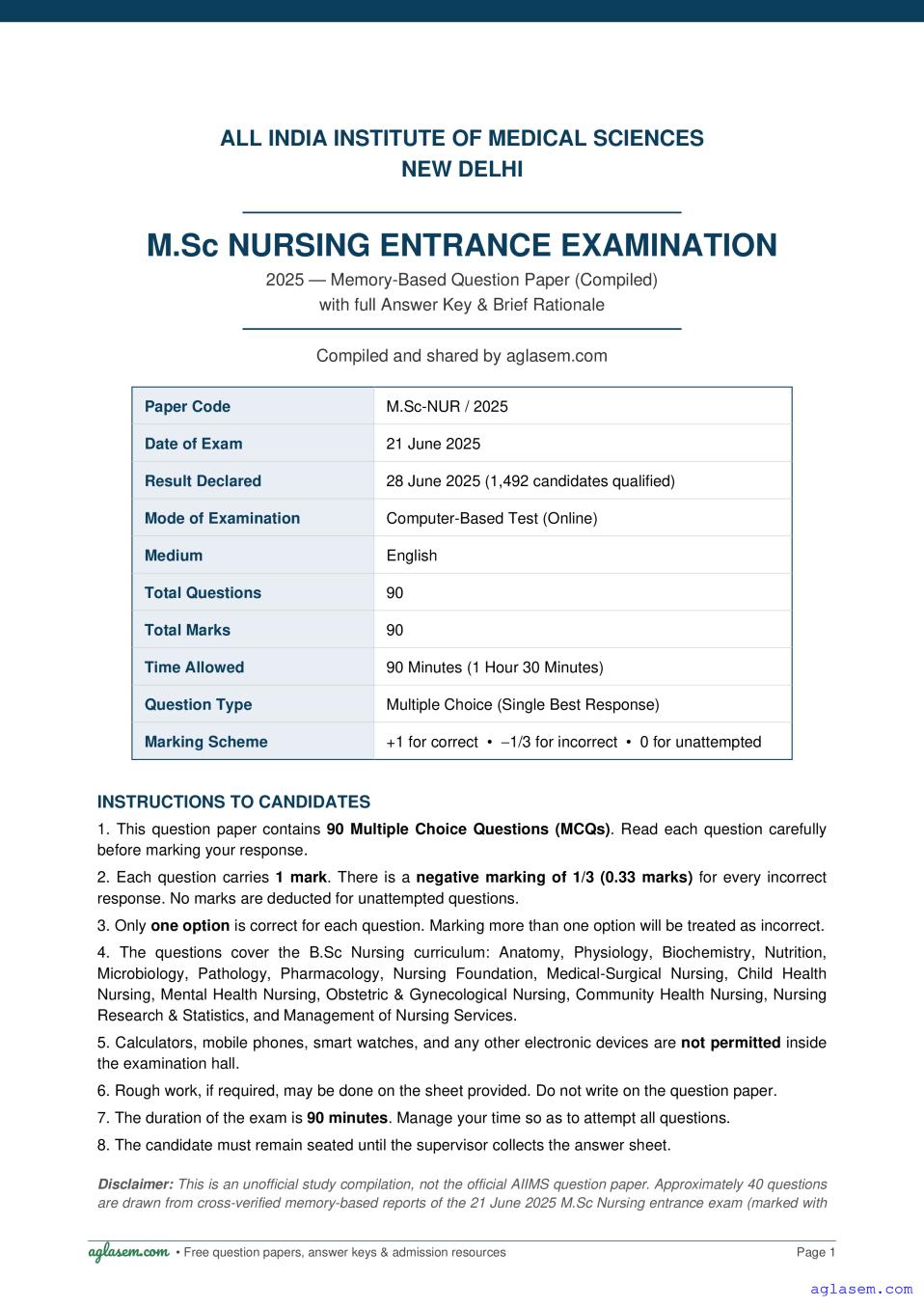
NEW DELHI
M.Sc NURSING ENTRANCE EXAMINATION
2025 — Memory-Based Question Paper (Compiled)
with full Answer Key & Brief Rationale
Compiled and shared by
Paper Code M.Sc-NUR / 2025
Date of Exam 21 June 2025
Result Declared 28 June 2025 (1,492 candidates qualified)
Mode of Examination Computer-Based Test (Online)
Medium English
Total Questions 90
Total Marks 90
Time Allowed 90 Minutes (1 Hour 30 Minutes)
Question Type Multiple Choice (Single Best Response)
Marking Scheme +1 for correct • −1/3 for incorrect • 0 for unattempted
INSTRUCTIONS TO CANDIDATES
1. This question paper contains 90 Multiple Choice Questions (MCQs). Read each question carefully
before marking your response.
2. Each question carries 1 mark. There is a negative marking of 1/3 (0.33 marks) for every incorrect
response. No marks are deducted for unattempted questions.
3. Only one option is correct for each question. Marking more than one option will be treated as incorrect.
4. The questions cover the B.Sc Nursing curriculum: Anatomy, Physiology, Biochemistry, Nutrition,
Microbiology, Pathology, Pharmacology, Nursing Foundation, Medical-Surgical Nursing, Child Health
Nursing, Mental Health Nursing, Obstetric & Gynecological Nursing, Community Health Nursing, Nursing
Research & Statistics, and Management of Nursing Services.
5. Calculators, mobile phones, smart watches, and any other electronic devices are not permitted inside
the examination hall.
6. Rough work, if required, may be done on the sheet provided. Do not write on the question paper.
7. The duration of the exam is 90 minutes. Manage your time so as to attempt all questions.
8. The candidate must remain seated until the supervisor collects the answer sheet.
Disclaimer: This is an unofficial study compilation, not the official AIIMS question paper. Approximately 40 questions
are drawn from cross-verified memory-based reports of the 21 June 2025 M.Sc Nursing entrance exam (marked with
• Free question papers, answer keys & admission resources Page 1
Page 2
†). The remaining questions are high-yield, syllabus-aligned items reconstructed from the AIIMS M.Sc Nursing paper
trend and standard nursing references.
• Free question papers, answer keys & admission resources Page 2
Page 3
SECTION I — MEDICAL-SURGICAL NURSING (Questions 1–25)
Q1. † Beck's Triad — hypotension, muffled heart sounds, and jugular venous distension — is diagnostic
of:
(A) Acute myocardial infarction
(B) Cardiac tamponade
(C) Pulmonary embolism
(D) Tension pneumothorax
Q2. † The most common early sign of renal cell carcinoma is:
(A) Flank mass
(B) Unexplained weight loss
(C) Painless hematuria
(D) Fever of unknown origin
Q3. † The electrolyte imbalance commonly seen in multiple myeloma is:
(A) Hypocalcemia
(B) Hypercalcemia
(C) Hyperkalemia
(D) Hyponatremia
Q4. † The late sign of compartment syndrome among the 6 P's is:
(A) Pain out of proportion
(B) Paresthesia
(C) Pallor
(D) Pulselessness
Q5. † A patient presents with acute kidney injury, microangiopathic hemolytic anemia, and
thrombocytopenia following a diarrhoeal illness. The most likely diagnosis is:
(A) Disseminated intravascular coagulation (DIC)
(B) Hemolytic Uremic Syndrome (HUS)
(C) Thrombotic thrombocytopenic purpura (TTP)
(D) Idiopathic thrombocytopenic purpura
Q6. † The initial pharmacological management of stable (hemodynamically tolerated) ventricular
tachycardia in an adult is:
(A) Immediate defibrillation
(B) Synchronized cardioversion
(C) Amiodarone IV infusion
(D) Cardiopulmonary resuscitation
Q7. † A patient is brought to the ER from a house fire. Pulse oximetry shows SpO■ 100% but ABG shows
PaO■ 65 mmHg and severe metabolic acidosis. The likely diagnosis is:
(A) Severe asthma
(B) Carbon monoxide poisoning
(C) Pulmonary embolism
(D) Acute COPD exacerbation
Q8. † The characteristic ECG change of hypokalemia is:
(A) Tall peaked T waves
(B) Presence of U waves
(C) ST-segment elevation
(D) Shortened QT interval
• Free question papers, answer keys & admission resources Page 3
Page 4
Q9. † The classical finding of intussusception in an infant is:
(A) Bilious vomiting
(B) Currant-jelly stools
(C) Hematochezia with normal stool
(D) Steatorrhea
Q10. † Symptoms of osteoarthritis classically include:
(A) Rheumatoid nodules and morning stiffness > 1 hour
(B) Joint pain, stiffness < 30 min, and decreased range of motion
(C) Symmetrical small-joint involvement only
(D) Heliotrope rash with proximal muscle weakness
Q11. † A laboratory finding suggestive of chronic lymphocytic leukemia (CLL) is:
(A) Marked neutrophilia
(B) Thrombocytopenia with elevated lymphocyte count
(C) Reed-Sternberg cells
(D) Bence-Jones proteinuria
Q12. The drug of choice for status epilepticus (IV first-line) is:
(A) IV Phenytoin
(B) IV Lorazepam
(C) IV Carbamazepine
(D) IV Mannitol
Q13. Cushing's triad in raised intracranial pressure consists of:
(A) Tachycardia, hypotension, tachypnoea
(B) Bradycardia, hypertension with widened pulse pressure, irregular respirations
(C) Bradycardia, hypotension, Cheyne-Stokes breathing
(D) Tachycardia, hypertension, Kussmaul breathing
Q14. Earliest ECG change of hyperkalemia is:
(A) Tall, peaked T waves
(B) ST-segment depression
(C) Prominent U waves
(D) Widened QRS complex
Q15. The most common cause of acute pancreatitis in India is:
(A) Alcohol
(B) Gallstones
(C) Hypertriglyceridemia
(D) Drug-induced
Q16. The time window for IV alteplase (tPA) in acute ischemic stroke is up to:
(A) 3 hours
(B) 4.5 hours
(C) 6 hours
(D) 12 hours
Q17. Pulsus paradoxus — fall in systolic BP > 10 mmHg during inspiration — is most characteristic of:
(A) Aortic stenosis
(B) Cardiac tamponade
(C) Mitral regurgitation
(D) Hypertrophic cardiomyopathy
• Free question papers, answer keys & admission resources Page 4
Page 5
Q18. Battle's sign — bruising over the mastoid process — indicates:
(A) Le Fort II maxillary fracture
(B) Basilar skull fracture
(C) Cervical spine injury
(D) Mandibular fracture
Q19. Normal range of Central Venous Pressure (CVP) measured at the right atrium is:
(A) 0–2 mmHg
(B) 2–6 mmHg
(C) 8–12 mmHg
(D) 12–18 mmHg
Q20. Insulin used by IV infusion for management of diabetic ketoacidosis (DKA) is:
(A) NPH insulin
(B) Regular (soluble) insulin
(C) Glargine
(D) Lispro
Q21. Which of the following is NOT a feature of nephrotic syndrome?
(A) Proteinuria > 3.5 g/day
(B) Hypoalbuminemia
(C) Generalized edema
(D) Gross hematuria
Q22. Trousseau's sign (carpal spasm on inflating BP cuff above systolic for 3 min) indicates:
(A) Hyperkalemia
(B) Hypocalcemia
(C) Hypomagnesemia only
(D) Hyponatremia
Q23. The drug of choice for acute anaphylaxis (IM, anterolateral thigh) is:
(A) IM Hydrocortisone 100 mg
(B) IM Adrenaline 0.3–0.5 mg of 1:1000
(C) IV Diphenhydramine
(D) IV Salbutamol
Q24. Cullen's sign (periumbilical bluish discoloration) is seen in:
(A) Acute appendicitis
(B) Acute hemorrhagic pancreatitis
(C) Ruptured spleen
(D) Perforated peptic ulcer
Q25. Confirmatory diagnostic test for HIV after a positive ELISA is:
(A) PCR for HIV RNA
(B) Western blot
(C) Repeat ELISA
(D) p24 antigen test
SECTION II — OBSTETRIC & GYNAECOLOGICAL NURSING (Questions 26–37)
• Free question papers, answer keys & admission resources Page 5
Page 6
Q26. † The correct sequence of cardinal movements (mechanism) of labour for a vertex presentation
is:
(A) Engagement → Descent → Flexion → Internal rotation → Extension → Restitution → External
rotation
(B) Flexion → Engagement → Descent → External rotation → Internal rotation → Restitution
(C) Descent → Flexion → Internal rotation → Engagement → Restitution → Extension
(D) Engagement → Internal rotation → Descent → Flexion → Restitution → External rotation
Q27. † Simultaneous prolapse of a fetal extremity alongside the presenting part is called:
(A) Breech presentation
(B) Transverse lie
(C) Compound presentation
(D) Face presentation
Q28. † Chadwick's sign in early pregnancy refers to:
(A) Softening of the cervix
(B) Bluish discoloration of the vagina and cervix
(C) Enlargement of the lower uterine segment
(D) Lateral palpation of fetal small parts
Q29. † A primigravida at 31 weeks has BP 160/100 mmHg, 3+ proteinuria, blurred vision, and headache.
The most likely diagnosis is:
(A) Gestational hypertension
(B) Mild pre-eclampsia
(C) Pre-eclampsia with severe features
(D) Chronic hypertension
Q30. † A pregnant woman at 34 weeks presents with sudden severe abdominal pain, a tense, woody-hard
uterus and dark vaginal bleeding. The most likely diagnosis is:
(A) Placenta previa
(B) Abruptio placentae
(C) Ruptured ectopic pregnancy
(D) Uterine rupture
Q31. † The gold-standard drug for prevention and control of eclamptic seizures is:
(A) IV Diazepam
(B) IV Magnesium sulphate
(C) IV Phenytoin
(D) IV Lorazepam
Q32. † The Bishop score is used to assess:
(A) Severity of pre-eclampsia
(B) Cervical favourability for induction of labour
(C) Fetal well-being
(D) Degree of postpartum involution
Q33. † The suboccipitobregmatic diameter of the fetal skull (in a well-flexed vertex presentation)
measures:
(A) 8.5 cm
(B) 9.5 cm
(C) 11.5 cm
(D) 13.5 cm
• Free question papers, answer keys & admission resources Page 6
Page 7
Q34. † The Spinnbarkeit phenomenon (stretchable, clear, egg-white cervical mucus) is observed during
the:
(A) Menstrual phase
(B) Ovulatory phase
(C) Luteal phase
(D) Premenstrual phase
Q35. † The safest mood stabilizer for use during pregnancy is:
(A) Sodium valproate
(B) Lamotrigine
(C) Lithium
(D) Carbamazepine
Q36. Calculation of expected date of delivery (Naegele's rule) from the first day of LMP:
(A) Add 9 months and 7 days
(B) Subtract 3 months and add 7 days
(C) Add 7 months and 9 days
(D) Add 10 months exactly
Q37. Couvelaire uterus (uteroplacental apoplexy) is a complication of:
(A) Placenta previa
(B) Abruptio placentae
(C) Uterine rupture
(D) Vasa previa
SECTION III — CHILD HEALTH NURSING (Questions 38–47)
Q38. † Which neonatal reflex involves symmetrical abduction followed by adduction of the limbs in
response to a sudden loud sound or a feeling of falling?
(A) Rooting reflex
(B) Palmar grasp reflex
(C) Moro reflex
(D) Babinski reflex
Q39. † The normal respiratory rate of a healthy term newborn at rest is:
(A) 10–20 breaths/minute
(B) 20–30 breaths/minute
(C) 30–60 breaths/minute
(D) 60–80 breaths/minute
Q40. † The most important 'red flag' for delayed social development at 12 months of age is:
(A) Not walking independently
(B) Absence of social smile
(C) Not feeding self with a spoon
(D) Inability to scribble
Q41. † Failure to pass meconium within the first 24–48 hours of life is most suggestive of:
(A) Hirschsprung's disease
(B) Pyloric stenosis
(C) Intussusception
(D) Gastroesophageal reflux
• Free question papers, answer keys & admission resources Page 7
Page 8
Q42. † A 4-week-old infant presents with non-bilious projectile vomiting, dehydration, and a palpable 'olive'
in the epigastrium. The likely diagnosis is:
(A) Duodenal atresia
(B) Pyloric stenosis
(C) GERD
(D) Intussusception
Q43. † The recommended route and site for the MMR vaccine in a child is:
(A) IM in deltoid
(B) Subcutaneous in upper arm
(C) Intradermal in forearm
(D) Oral
Q44. † The most common site for intraosseous (IO) access in a pediatric emergency is the:
(A) Sternum
(B) Proximal tibia
(C) Distal radius
(D) Iliac crest
Q45. † Phototherapy for neonatal hyperbilirubinemia works by converting bilirubin into:
(A) Biliverdin
(B) Lumirubin (water-soluble isomer)
(C) Urobilinogen
(D) Stercobilin
Q46. APGAR score is assessed at:
(A) At birth and 5 minutes
(B) 1 and 5 minutes after birth
(C) 5 and 10 minutes
(D) Every 5 minutes for first hour
Q47. WHO low-osmolarity ORS contains sodium in the concentration of:
(A) 45 mmol/L
(B) 75 mmol/L
(C) 90 mmol/L
(D) 120 mmol/L
SECTION IV — COMMUNITY HEALTH NURSING (Questions 48–58)
Q48. † The goal of the 'LaQshya' initiative launched by the Ministry of Health is to improve:
(A) Adolescent nutrition
(B) Quality of care in labour rooms and maternity operation theatres
(C) Universal immunization coverage
(D) Mental health services at PHC level
Q49. Janani Suraksha Yojana (JSY) primarily aims at:
(A) Free generic medicines for the poor
(B) Promotion of institutional delivery
(C) Adolescent reproductive health
(D) Universal immunization
• Free question papers, answer keys & admission resources Page 8
Page 9
Q50. Mission Indradhanush was launched to:
(A) Eradicate malaria
(B) Achieve full immunization of children and pregnant women
(C) Reduce iron-deficiency anaemia
(D) Promote menstrual hygiene
Q51. The pentavalent vaccine under the Universal Immunization Programme protects against:
(A) DPT + Hep B + Hib
(B) DPT + Polio + Hep B
(C) DPT + Hep B + Measles
(D) DPT + Hib + Rotavirus
Q52. The cold-chain temperature for storage of most routine vaccines at the PHC level is:
(A) −20°C to 0°C
(B) 0°C to 2°C
(C) +2°C to +8°C
(D) +8°C to +15°C
Q53. Ayushman Bharat — PMJAY provides health-insurance cover up to:
(A) ■1 lakh per family per year
(B) ■3 lakh per family per year
(C) ■5 lakh per family per year
(D) ■10 lakh per individual
Q54. Universal salt iodization in India requires iodine content (at consumer level) of not less than:
(A) 5 ppm
(B) 15 ppm
(C) 30 ppm
(D) 50 ppm
Q55. India was declared polio-free by the WHO in:
(A) 2011
(B) 2012
(C) 2014
(D) 2016
Q56. The most common cause of maternal mortality in India is:
(A) Hemorrhage
(B) Sepsis
(C) Hypertensive disorders of pregnancy
(D) Unsafe abortion
Q57. ASHA in the National Health Mission stands for:
(A) Auxiliary Staff for Health Action
(B) Accredited Social Health Activist
(C) Approved Self-Help Aide
(D) Allied Social Health Assistant
Q58. The SDG 3.1 target for Maternal Mortality Ratio by 2030 is:
(A) < 30 per lakh live births
(B) < 50 per lakh live births
(C) < 70 per lakh live births
(D) < 100 per lakh live births
SECTION V — MENTAL HEALTH NURSING (Questions 59–65)
• Free question papers, answer keys & admission resources Page 9
Page 10
Q59. † Which of the following is a negative symptom of schizophrenia?
(A) Auditory hallucination
(B) Delusion of persecution
(C) Social withdrawal
(D) Thought broadcasting
Q60. † A 7-year-old child became withdrawn and refuses to play one month after the death of his mother.
According to Kübler-Ross, he is in the stage of:
(A) Denial
(B) Anger
(C) Depression
(D) Acceptance
Q61. † The principal defence mechanism involved in obsessive-compulsive disorder is:
(A) Projection
(B) Undoing
(C) Reaction formation
(D) Displacement
Q62. † The first stage in the Kübler-Ross model of grief (DABDA) is:
(A) Anger
(B) Denial
(C) Bargaining
(D) Depression
Q63. † The nursing theory that focuses on the concept of 'Self-Care Deficit' is proposed by:
(A) Florence Nightingale
(B) Virginia Henderson
(C) Dorothea Orem
(D) Hildegard Peplau
Q64. The most appropriate treatment for severe depression with psychotic features or active suicidal intent
is:
(A) SSRIs alone
(B) Cognitive Behavioural Therapy
(C) Electroconvulsive therapy (ECT)
(D) Psychoanalysis
Q65. An early sign of lithium toxicity is:
(A) Hypertension
(B) Coarse tremors and ataxia
(C) Hair loss
(D) Polyuria
SECTION VI — NURSING FOUNDATION, BMW & PROCEDURES (Questions 66–72)
Q66. † In Biomedical Waste (BMW) Management Rules, 2016, broken or discarded glassware (vials,
ampoules) is segregated in:
(A) Yellow bin
(B) Red bin
(C) Blue bin / puncture-proof container
(D) White (translucent) container
• Free question papers, answer keys & admission resources Page 10
Page 11
Q67. † The standard concentration of insulin commercially available in a vial in India is:
(A) 40 units/mL
(B) 100 units/mL
(C) 200 units/mL
(D) 500 units/mL
Q68. † The antidote for heparin overdose is:
(A) Vitamin K
(B) Protamine sulphate
(C) Fresh frozen plasma
(D) Tranexamic acid
Q69. † A Glasgow Coma Scale (GCS) score indicating deep coma is:
(A) 6
(B) 5
(C) 3
(D) 1
Q70. The 5 'Rights' of medication administration include all of the following EXCEPT:
(A) Right patient
(B) Right drug
(C) Right route
(D) Right cost
Q71. Which of the following is the FIRST step in the nursing process?
(A) Diagnosis
(B) Planning
(C) Assessment
(D) Evaluation
Q72. The correct hand-washing duration recommended by WHO is at least:
(A) 10–15 seconds
(B) 20–30 seconds for hand rub; 40–60 seconds for hand wash
(C) 5 minutes scrub
(D) 1 minute regardless of method
SECTION VII — ANATOMY & PHYSIOLOGY (Questions 73–78)
Q73. The cardiac pacemaker is the:
(A) AV node
(B) Bundle of His
(C) SA node
(D) Purkinje fibres
Q74. Antidiuretic hormone (ADH) is synthesized in the:
(A) Anterior pituitary
(B) Posterior pituitary
(C) Supraoptic nuclei of hypothalamus
(D) Adrenal cortex
Q75. Normal pH of arterial blood is:
(A) 7.25–7.35
(B) 7.30–7.40
(C) 7.35–7.45
(D) 7.40–7.50
• Free question papers, answer keys & admission resources Page 11
Page 12
Q76. Cranial nerve responsible for muscles of facial expression is:
(A) V (Trigeminal)
(B) VII (Facial)
(C) IX (Glossopharyngeal)
(D) XII (Hypoglossal)
Q77. Glucose is reabsorbed in the nephron mainly at the:
(A) Proximal convoluted tubule
(B) Loop of Henle
(C) Distal convoluted tubule
(D) Collecting duct
Q78. The largest gland in the human body is the:
(A) Pancreas
(B) Thyroid
(C) Liver
(D) Adrenal
SECTION VIII — MICROBIOLOGY, PATHOLOGY & PHARMACOLOGY (Questions
79–84)
Q79. Mycobacterium tuberculosis is best demonstrated by which staining method?
(A) Gram stain
(B) Ziehl–Neelsen (acid-fast) stain
(C) Giemsa stain
(D) India ink preparation
Q80. The most common hospital-acquired infection worldwide is:
(A) Surgical site infection
(B) Catheter-associated urinary tract infection (CAUTI)
(C) Ventilator-associated pneumonia
(D) Central line-associated bloodstream infection
Q81. Antidote for paracetamol (acetaminophen) overdose is:
(A) Naloxone
(B) Flumazenil
(C) N-acetylcysteine
(D) Atropine
Q82. Antidote for opioid overdose is:
(A) Flumazenil
(B) Naloxone
(C) Atropine
(D) Physostigmine
Q83. First-line antibiotic for methicillin-resistant Staphylococcus aureus (MRSA) bacteremia is:
(A) Cefazolin
(B) Vancomycin
(C) Ceftriaxone
(D) Penicillin G
• Free question papers, answer keys & admission resources Page 12
Page 13
Q84. Standard concentration of bleach (sodium hypochlorite) for disinfection of blood spills is:
(A) 0.1%
(B) 0.5%
(C) 1%
(D) 10%
SECTION IX — NURSING RESEARCH & STATISTICS (Questions 85–87)
Q85. A p-value of 0.04 in a hypothesis test (α = 0.05) implies:
(A) The null hypothesis is true
(B) The result is statistically significant — reject the null hypothesis
(C) Clinical importance is established
(D) Type II error has occurred
Q86. A Type I error is defined as:
(A) Accepting a false null hypothesis
(B) Rejecting a true null hypothesis
(C) Failure to compute the p-value
(D) Bias in sampling
Q87. Cronbach's alpha is used to measure:
(A) Validity
(B) Internal consistency (reliability)
(C) Sensitivity
(D) Specificity
SECTION X — NURSING MANAGEMENT & EDUCATION (Questions 88–90)
Q88. Bloom's taxonomy of learning includes which three domains?
(A) Cognitive, Affective, Psychomotor
(B) Cognitive, Behavioural, Social
(C) Affective, Behavioural, Emotional
(D) Cognitive, Affective, Spiritual
Q89. At the base of Maslow's hierarchy of needs are:
(A) Safety needs
(B) Love and belongingness
(C) Physiological needs
(D) Self-actualization
Q90. The most appropriate leadership style during a code blue / cardiac arrest is:
(A) Laissez-faire
(B) Democratic
(C) Autocratic (directive)
(D) Transformational
† Questions marked with this symbol are directly drawn from cross-verified memory-based reports of the 21 June
2025 AIIMS M.Sc Nursing entrance exam. Compiled by .
• Free question papers, answer keys & admission resources Page 13
Page 14
ANSWER KEY WITH BRIEF RATIONALE
Use this key only after attempting the paper under timed conditions. Score yourself: (Correct × 1) − (Incorrect × 1/3).
AIIMS M.Sc Nursing cut-offs typically lie in the range of 45–55 marks for the General category (based on 2023–2025
trends). More previous-year papers at .
1. B 2. C 3. B 4. D 5. B
6. C 7. B 8. B 9. B 10. B
11. B 12. B 13. B 14. A 15. B
16. B 17. B 18. B 19. B 20. B
21. D 22. B 23. B 24. B 25. B
26. A 27. C 28. B 29. C 30. B
31. B 32. B 33. B 34. B 35. B
36. A 37. B 38. C 39. C 40. B
41. A 42. B 43. B 44. B 45. B
46. B 47. B 48. B 49. B 50. B
51. A 52. C 53. C 54. B 55. C
56. A 57. B 58. C 59. C 60. C
61. B 62. B 63. C 64. C 65. B
66. C 67. B 68. B 69. C 70. D
71. C 72. B 73. C 74. C 75. C
76. B 77. A 78. C 79. B 80. B
81. C 82. B 83. B 84. C 85. B
86. B 87. B 88. A 89. C 90. C
DETAILED RATIONALES
Q1. † Answer: (B) Cardiac tamponade
Triad indicates impaired cardiac filling due to pericardial fluid accumulation; emergency pericardiocentesis is the
definitive intervention.
Q2. † Answer: (C) Painless hematuria
Classical triad: hematuria + flank pain + palpable mass appears late; painless hematuria is the earliest and most
common presentation.
Q3. † Answer: (B) Hypercalcemia
Osteoclast activation by myeloma cells causes lytic bone lesions and hypercalcemia — part of the CRAB criteria
(Calcium↑, Renal failure, Anemia, Bone lesions).
Q4. † Answer: (D) Pulselessness
The 6 P's: Pain, Pallor, Paresthesia, Paralysis, Poikilothermia, Pulselessness. Pulselessness is a late, ominous sign
— fasciotomy must be done before this stage.
Q5. † Answer: (B) Hemolytic Uremic Syndrome (HUS)
• Free question papers, answer keys & admission resources Page 14
Page 15
Classic triad of HUS — MAHA + thrombocytopenia + AKI — typically follows EHEC O157:H7 in children. Treatment
is mainly supportive; avoid antibiotics and antimotility agents.
Q6. † Answer: (C) Amiodarone IV infusion
Stable VT with pulse → IV amiodarone (or procainamide). Synchronized cardioversion is reserved for unstable VT
with a pulse; defibrillation for pulseless VT/VF.
Q7. † Answer: (B) Carbon monoxide poisoning
Pulse oximetry cannot distinguish carboxyhaemoglobin from oxyhaemoglobin — falsely shows normal SpO■.
Diagnosis needs co-oximetry. Treatment: 100% O■; hyperbaric O■ for severe cases.
Q8. † Answer: (B) Presence of U waves
Hypokalemia: U wave appearance, flat T, ST depression, prolonged QT. Hyperkalemia: peaked T waves, widened
QRS.
Q9. † Answer: (B) Currant-jelly stools
Sausage-shaped abdominal mass + currant-jelly (blood-mucus) stool + colicky pain triad. Treatment: air or contrast
enema reduction; surgery if failed.
Q10. † Answer: (B) Joint pain, stiffness < 30 min, and decreased range of motion
OA: pain worsens with activity, brief morning stiffness (<30 min), Heberden & Bouchard nodes. RA: prolonged
stiffness, symmetric small joints, rheumatoid nodules.
Q11. † Answer: (B) Thrombocytopenia with elevated lymphocyte count
CLL: persistent lymphocytosis (>5000/µL), smudge cells on peripheral smear, thrombocytopenia in advanced
stages.
Q12. Answer: (B) IV Lorazepam
IV Lorazepam 0.1 mg/kg is the recommended first-line benzodiazepine; if seizures persist after 5 min, second-line
agents (levetiracetam/phenytoin/valproate) are added.
Q13. Answer: (B) Bradycardia, hypertension with widened pulse pressure, irregular respirations
Late and ominous sign reflecting brainstem compression; warrants emergency neurosurgical intervention.
Q14. Answer: (A) Tall, peaked T waves
Sequence: peaked T → flattened P → prolonged PR → wide QRS → sine wave. Immediate IV calcium gluconate
stabilizes the myocardium.
Q15. Answer: (B) Gallstones
Gallstones account for ~40–50% of cases; alcohol is the second commonest. Severity is assessed using Ranson's
criteria or APACHE II.
Q16. Answer: (B) 4.5 hours
Standard IV thrombolysis window from symptom onset; mechanical thrombectomy extends to 6–24 hours in
selected large-vessel occlusions.
Q17. Answer: (B) Cardiac tamponade
Also seen in severe asthma, COPD, and constrictive pericarditis. Forms part of the triad alongside Beck's signs.
Q18. Answer: (B) Basilar skull fracture
Other signs of basal skull fracture: raccoon eyes, CSF rhino/otorrhoea, hemotympanum. Avoid nasogastric tube
insertion in such patients.
Q19. Answer: (B) 2–6 mmHg
Elevated in volume overload, right heart failure, cardiac tamponade; low in hypovolemia and distributive shock.
Q20. Answer: (B) Regular (soluble) insulin
Only regular insulin is approved for IV use. Typical infusion 0.1 unit/kg/hr after initial 1 L normal saline bolus.
Q21. Answer: (D) Gross hematuria
Hematuria is characteristic of nephritic — not nephrotic — syndrome. Nephrotic also features hyperlipidemia.
Q22. Answer: (B) Hypocalcemia
• Free question papers, answer keys & admission resources Page 15
Page 16
Both Trousseau's and Chvostek's signs reflect neuromuscular irritability from hypocalcemia (also seen in
alkalosis-induced ionized Ca²■ fall).
Q23. Answer: (B) IM Adrenaline 0.3–0.5 mg of 1:1000
Adrenaline IM is the first-line drug; may be repeated every 5–15 minutes. Antihistamines and steroids are adjuncts.
Q24. Answer: (B) Acute hemorrhagic pancreatitis
Indicates retroperitoneal hemorrhage; Grey-Turner sign (flank discoloration) has equivalent significance.
Q25. Answer: (B) Western blot
Sequence per NACO algorithm: 3 ELISAs/rapid tests (Strategy III); Western blot is the classical confirmatory
immunoassay.
Q26. † Answer: (A) Engagement → Descent → Flexion → Internal rotation → Extension → Restitution →
External rotation
Standard sequence: Engagement, Descent, Flexion, Internal rotation, Extension (delivery of head), Restitution,
External rotation, Expulsion.
Q27. † Answer: (C) Compound presentation
Compound presentation — commonest is a hand prolapsing alongside the vertex. Often self-corrects; expectant
management unless cord prolapse occurs.
Q28. † Answer: (B) Bluish discoloration of the vagina and cervix
Due to increased pelvic vascular congestion; seen as early as 6–8 weeks. Goodell's = softening of cervix; Hegar's =
softening of the isthmus.
Q29. † Answer: (C) Pre-eclampsia with severe features
BP ≥ 160/110 with neurological symptoms (headache, visual disturbance) defines severe pre-eclampsia.
Magnesium sulphate prophylaxis + delivery planning indicated.
Q30. † Answer: (B) Abruptio placentae
Painful bleeding with a board-like uterus is characteristic of abruption. Placenta previa is painless bleeding.
Q31. † Answer: (B) IV Magnesium sulphate
MgSO■ (Pritchard or Zuspan regimen) is superior to both diazepam and phenytoin. Monitor for toxicity — loss of
patellar reflex, RR < 12, urine output < 30 mL/hr.
Q32. † Answer: (B) Cervical favourability for induction of labour
Components: dilation, effacement, station, consistency, position. A score ≥ 8 indicates a favourable cervix.
Q33. † Answer: (B) 9.5 cm
9.5 cm — the smallest AP diameter, presenting in a fully flexed vertex. Mento-vertical (14 cm) is the largest, in brow
presentation.
Q34. † Answer: (B) Ovulatory phase
Estrogen-induced cervical mucus changes around ovulation; stretches 8–10 cm without breaking. Used in fertility
awareness.
Q35. † Answer: (B) Lamotrigine
Valproate (neural-tube defects), Carbamazepine (NTD), Lithium (Ebstein anomaly) are teratogenic. Lamotrigine has
the most favourable safety profile.
Q36. Answer: (A) Add 9 months and 7 days
Equivalent to subtracting 3 months and adding 7 days + 1 year (assumes a 28-day cycle).
Q37. Answer: (B) Abruptio placentae
Concealed abruption forces blood into the myometrium, producing a bluish, oedematous, atonic uterus.
Q38. † Answer: (C) Moro reflex
Moro reflex appears at birth and disappears by 4–6 months. Absent/asymmetrical Moro suggests CNS injury or
brachial plexus palsy.
Q39. † Answer: (C) 30–60 breaths/minute
Tachypnoea is defined as > 60/min — a red flag for sepsis or respiratory distress (TTN, RDS, pneumonia).
• Free question papers, answer keys & admission resources Page 16
Page 17
Q40. † Answer: (B) Absence of social smile
Social smile normally appears by 2 months; absence at 12 months is a major red flag for autism-spectrum
disorders.
Q41. † Answer: (A) Hirschsprung's disease
Hirschsprung's = aganglionosis of distal colon. Diagnosis: rectal biopsy. Look for explosive stool on PR
examination.
Q42. † Answer: (B) Pyloric stenosis
Hypertrophic pyloric stenosis — non-bilious, projectile vomiting at 3–6 weeks; hypochloraemic, hypokalaemic
metabolic alkalosis. Treatment: Ramstedt pyloromyotomy.
Q43. † Answer: (B) Subcutaneous in upper arm
MMR is a live attenuated vaccine, 0.5 mL subcutaneously over upper arm. Under UIP, given at 9–12 months (MR-1)
and 16–24 months (MR-2).
Q44. † Answer: (B) Proximal tibia
Anteromedial flat surface of the proximal tibia, 1–2 cm below tibial tuberosity. Used when IV access cannot be
obtained within 90 seconds in arrest/shock.
Q45. † Answer: (B) Lumirubin (water-soluble isomer)
Blue light (460–490 nm) causes photo-isomerization of unconjugated bilirubin to lumirubin, which is water-soluble
and excreted in bile/urine without conjugation.
Q46. Answer: (B) 1 and 5 minutes after birth
If 5-min score < 7, scoring is continued every 5 min up to 20 min.
Q47. Answer: (B) 75 mmol/L
Total osmolarity 245 mOsm/L: Na 75, Cl 65, K 20, citrate 10, glucose 75 mmol/L.
Q48. † Answer: (B) Quality of care in labour rooms and maternity operation theatres
LaQshya (Labour Room Quality Improvement Initiative) — launched 2017 — aims to reduce preventable maternal
and newborn deaths and improve birthing experience.
Q49. Answer: (B) Promotion of institutional delivery
A safe motherhood intervention under NHM providing conditional cash assistance to reduce MMR and NMR via
institutional delivery.
Q50. Answer: (B) Achieve full immunization of children and pregnant women
Launched December 2014; aims to fully immunize against vaccine-preventable diseases. Intensified Mission
Indradhanush (IMI) and IMI 5.0 are subsequent expansions.
Q51. Answer: (A) DPT + Hep B + Hib
Diphtheria, Pertussis, Tetanus, Hepatitis B, and H. influenzae type b — given at 6, 10, 14 weeks.
Q52. Answer: (C) +2°C to +8°C
OPV is stored at −20°C at higher levels; most UIP vaccines at +2 to +8°C. DPT, Hep B, TT must NOT be frozen.
Q53. Answer: (C) ■5 lakh per family per year
World's largest government-funded health assurance scheme; targets ~12 crore vulnerable families.
Q54. Answer: (B) 15 ppm
Salt must contain ≥ 30 ppm at production and ≥ 15 ppm at consumer level (parts per million).
Q55. Answer: (C) 2014
Last reported case 13 January 2011 (Howrah, WB); WHO South-East Asia Region certified polio-free on 27 March
2014.
Q56. Answer: (A) Hemorrhage
Hemorrhage (mostly postpartum) accounts for the largest share of direct maternal deaths, followed by sepsis and
hypertensive disorders.
Q57. Answer: (B) Accredited Social Health Activist
• Free question papers, answer keys & admission resources Page 17
Page 18
A trained female community health volunteer; one per ~1000 population in rural areas. First port of call for health
needs.
Q58. Answer: (C) < 70 per lakh live births
SDG 3.1 — reduce global MMR to less than 70 per 1,00,000 live births by 2030.
Q59. † Answer: (C) Social withdrawal
Negative symptoms (5 A's): Affective flattening, Alogia, Avolition, Anhedonia, Asociality. Positive symptoms:
hallucinations, delusions, thought disorders.
Q60. † Answer: (C) Depression
DABDA: Denial → Anger → Bargaining → Depression → Acceptance. Withdrawal and sadness mark the
depression stage.
Q61. † Answer: (B) Undoing
Undoing — performing a compulsive act to neutralize an unacceptable thought (e.g., handwashing to undo
'contamination'). Isolation and reaction formation are also seen.
Q62. † Answer: (B) Denial
Denial protects against the initial shock — "This can't be happening." It is a healthy initial response if not prolonged.
Q63. † Answer: (C) Dorothea Orem
Orem's three nested theories: Self-Care, Self-Care Deficit, and Nursing Systems. Nursing is required when an
individual cannot meet his own therapeutic self-care demand.
Q64. Answer: (C) Electroconvulsive therapy (ECT)
ECT produces the most rapid and robust antidepressant effect in severe, psychotic, or treatment-refractory
depression with high suicide risk.
Q65. Answer: (B) Coarse tremors and ataxia
Therapeutic range 0.6–1.2 mEq/L; toxicity > 1.5: coarse tremor, ataxia, dysarthria, blurred vision, then
seizures/coma.
Q66. † Answer: (C) Blue bin / puncture-proof container
Blue: broken glass, metallic implants. Yellow: human/animal anatomical, soiled, pharmaceutical. Red: contaminated
recyclable plastics. White: sharps.
Q67. † Answer: (B) 100 units/mL
U-100 is the global standard. U-40 was previously used and required a different syringe; mismatching syringes is a
major medication error.
Q68. † Answer: (B) Protamine sulphate
1 mg protamine neutralizes ~100 IU of heparin. Vitamin K reverses warfarin.
Q69. † Answer: (C) 3
Minimum possible total = 3 (E1+V1+M1). Maximum = 15. GCS ≤ 8 generally indicates the need for definitive airway
protection.
Q70. Answer: (D) Right cost
5 R's: Right Patient, Right Drug, Right Dose, Right Route, Right Time. Modern expansions add Right
Documentation, Right Reason, Right Response.
Q71. Answer: (C) Assessment
Five steps: Assessment → Diagnosis → Planning → Implementation → Evaluation (ADPIE).
Q72. Answer: (B) 20–30 seconds for hand rub; 40–60 seconds for hand wash
WHO 'My 5 Moments for Hand Hygiene' campaign: alcohol rub 20–30 s; soap-water 40–60 s with 7-step technique.
Q73. Answer: (C) SA node
SA node intrinsic rate ~60–100/min; AV node ~40–60; ventricular escape ~20–40.
Q74. Answer: (C) Supraoptic nuclei of hypothalamus
ADH and oxytocin are synthesized in the supraoptic and paraventricular hypothalamic nuclei, stored and released
by the posterior pituitary.
• Free question papers, answer keys & admission resources Page 18
Page 19
Q75. Answer: (C) 7.35–7.45
Acidemia: pH < 7.35; alkalemia: pH > 7.45. Life-threatening < 6.8 or > 7.8.
Q76. Answer: (B) VII (Facial)
CN VII also supplies anterior 2/3 taste, lacrimal/submandibular/sublingual secretion, and the stapedius muscle.
Q77. Answer: (A) Proximal convoluted tubule
Nearly 100% of filtered glucose is reabsorbed in the PCT via SGLT2 (and SGLT1) — the target of -gliflozin drugs.
Q78. Answer: (C) Liver
Liver weighs ~1.4–1.6 kg in adults; also the largest internal organ.
Q79. Answer: (B) Ziehl–Neelsen (acid-fast) stain
ZN stain shows acid-fast bacilli as bright red rods against a blue background; auramine-O is a fluorescent
alternative.
Q80. Answer: (B) Catheter-associated urinary tract infection (CAUTI)
UTIs account for ~30% of nosocomial infections; majority associated with indwelling catheters.
Q81. Answer: (C) N-acetylcysteine
NAC replenishes glutathione, neutralizing the toxic metabolite NAPQI; most effective within 8–10 hours of ingestion.
Q82. Answer: (B) Naloxone
Pure opioid antagonist at µ receptor; IV/IM/IN routes; titrate to respiratory rate, not full consciousness.
Q83. Answer: (B) Vancomycin
IV vancomycin remains the standard; daptomycin or linezolid are alternatives.
Q84. Answer: (C) 1%
1% sodium hypochlorite (10,000 ppm) for blood/body-fluid spills; 0.5% for routine surface disinfection.
Q85. Answer: (B) The result is statistically significant — reject the null hypothesis
p < α: reject H■. Statistical significance does not equal clinical significance; sample size influences both.
Q86. Answer: (B) Rejecting a true null hypothesis
α = probability of Type I error (false positive). Type II error (β) = accepting a false null hypothesis (false negative).
Q87. Answer: (B) Internal consistency (reliability)
α ≥ 0.7 is generally acceptable for internal consistency of a multi-item scale.
Q88. Answer: (A) Cognitive, Affective, Psychomotor
Cognitive (thinking — Knowledge → Evaluation), Affective (feeling), and Psychomotor (doing). Revised version
replaces nouns with verbs.
Q89. Answer: (C) Physiological needs
Order (bottom→top): Physiological → Safety → Love/Belonging → Esteem → Self-actualization.
Q90. Answer: (C) Autocratic (directive)
Autocratic, directive style ensures rapid, unambiguous decisions during a life-threatening emergency. Democratic
style suits routine policy decisions.
How to use this paper: Attempt under exam conditions (90 minutes, no books). Calculate your raw score
using the AIIMS marking scheme. Topics where you missed marks → revise from the appropriate B.Sc
nursing textbook (Lewis/Brunner for MSN, Dutta/D.C. Dutta for Obstetrics, K. Park for Community Health,
Marlow for Pediatrics, Townsend for Mental Health, Polit & Beck for Research). For more previous-year
papers, answer keys and admission resources, visit .
End of Paper. Best wishes for AIIMS M.Sc Nursing 2026.
• Free question papers, answer keys & admission resources Page 19
Document Details
| Board / Org | AIIMS |
| Exam | AIIMS M.Sc |
| Type | Question Paper |
| Pages | 19 |
| Updated | 24 Sep 2026 |