AIIMS M.Sc Nursing 2024 Question Paper
Finished viewing? Save it for later —
Download AIIMS M.Sc Nursing 2024 Question Paper (PDF · 18 pages)About AIIMS M.Sc Nursing 2024 Question Paper
AIIMS M.Sc Nursing 2024 Question Paper is available here for free download. Published by AIIMS for AIIMS M.Sc, this question paper can be viewed online or downloaded as a PDF (18 pages). Candidates preparing for AIIMS M.Sc can use AIIMS M.Sc Nursing 2024 Question Paper to understand the exam pattern, the type of questions asked, and the overall difficulty level.
Frequently Asked Questions
How can I download AIIMS M.Sc Nursing 2024 Question Paper?
Open this page and click the Download button to save AIIMS M.Sc Nursing 2024 Question Paper as a PDF. It is completely free on AglaSem Docs.
Is AIIMS M.Sc Nursing 2024 Question Paper free to download?
Yes. AIIMS M.Sc Nursing 2024 Question Paper can be viewed online and downloaded as a PDF free of cost on AglaSem Docs.
How many pages does AIIMS M.Sc Nursing 2024 Question Paper have?
AIIMS M.Sc Nursing 2024 Question Paper contains 18 pages, which you can read online or download together as a single PDF.
Where can I find more AIIMS M.Sc study material?
You can find more AIIMS M.Sc question papers, sample papers, syllabus, and answer keys on AglaSem Docs.
AIIMS M.Sc Nursing 2024 Question Paper – Text
Read the full text of this question paper below — useful to quickly search, copy and reference the content online without downloading the PDF.
📄 View text version (18 pages)
Page 1
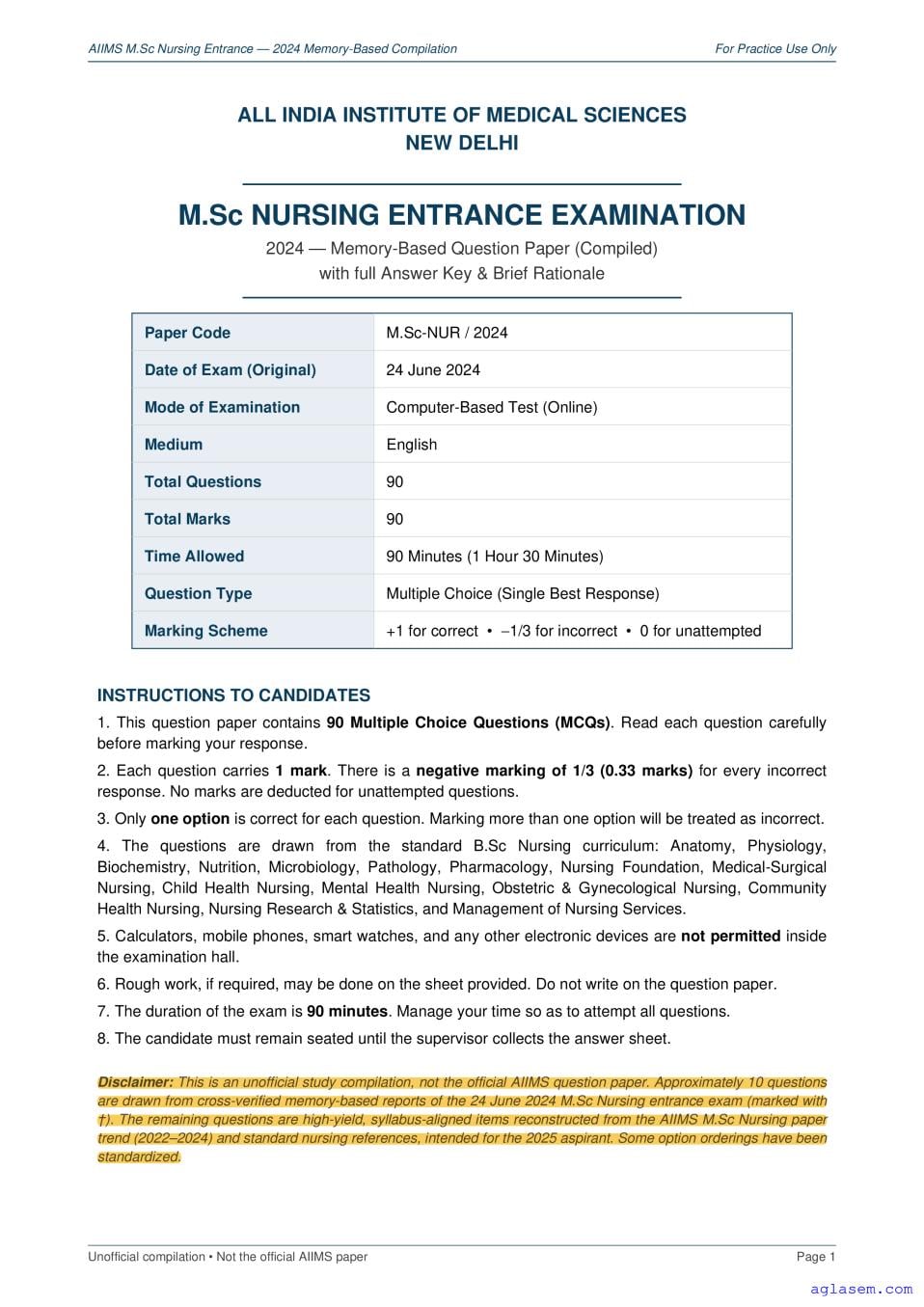
ALL INDIA INSTITUTE OF MEDICAL SCIENCES
NEW DELHI
M.Sc NURSING ENTRANCE EXAMINATION
2024 — Memory-Based Question Paper (Compiled)
with full Answer Key & Brief Rationale
Paper Code M.Sc-NUR / 2024
Date of Exam (Original) 24 June 2024
Mode of Examination Computer-Based Test (Online)
Medium English
Total Questions 90
Total Marks 90
Time Allowed 90 Minutes (1 Hour 30 Minutes)
Question Type Multiple Choice (Single Best Response)
Marking Scheme +1 for correct • −1/3 for incorrect • 0 for unattempted
INSTRUCTIONS TO CANDIDATES
1. This question paper contains 90 Multiple Choice Questions (MCQs). Read each question carefully
before marking your response.
2. Each question carries 1 mark. There is a negative marking of 1/3 (0.33 marks) for every incorrect
response. No marks are deducted for unattempted questions.
3. Only one option is correct for each question. Marking more than one option will be treated as incorrect.
4. The questions are drawn from the standard B.Sc Nursing curriculum: Anatomy, Physiology,
Biochemistry, Nutrition, Microbiology, Pathology, Pharmacology, Nursing Foundation, Medical-Surgical
Nursing, Child Health Nursing, Mental Health Nursing, Obstetric & Gynecological Nursing, Community
Health Nursing, Nursing Research & Statistics, and Management of Nursing Services.
5. Calculators, mobile phones, smart watches, and any other electronic devices are not permitted inside
the examination hall.
6. Rough work, if required, may be done on the sheet provided. Do not write on the question paper.
7. The duration of the exam is 90 minutes. Manage your time so as to attempt all questions.
8. The candidate must remain seated until the supervisor collects the answer sheet.
Disclaimer: This is an unofficial study compilation, not the official AIIMS question paper. Approximately 10 questions
are drawn from cross-verified memory-based reports of the 24 June 2024 M.Sc Nursing entrance exam (marked with
†). The remaining questions are high-yield, syllabus-aligned items reconstructed from the AIIMS M.Sc Nursing paper
trend (2022–2024) and standard nursing references, intended for the 2025 aspirant. Some option orderings have been
standardized.
Unofficial compilation • Not the official AIIMS paper Page 1
Page 2
SECTION I — MEDICAL-SURGICAL NURSING (Questions 1–25)
Q1. † The Government of India launched the “Nikshay” portal for tracking and monitoring patients with:
(A) Tuberculosis
(B) Leprosy
(C) Blindness
(D) Pneumonia
Q2. † Clay-coloured stool seen in jaundice is most characteristic of:
(A) Hemolytic jaundice
(B) Hepatocellular jaundice
(C) Obstructive (post-hepatic) jaundice
(D) Amoebic hepatitis
Q3. † Dose of chemotherapeutic drugs is most commonly calculated on the basis of:
(A) Body Surface Area (BSA)
(B) Body weight (kg)
(C) Height
(D) Body Mass Index (BMI)
Q4. † Helicobacter pylori infection is most strongly associated with which of the following malignancies?
(A) Adenocarcinoma of esophagus
(B) Squamous cell carcinoma of lung
(C) MALT lymphoma of the stomach
(D) Hepatocellular carcinoma
Q5. † Kussmaul respiration — deep, sighing, rapid breathing — is classically observed in:
(A) Metabolic acidosis
(B) Respiratory acidosis
(C) Metabolic alkalosis
(D) Respiratory alkalosis
Q6. † The most common site of oral cancer in India is:
(A) Lips
(B) Floor of the mouth
(C) Lateral border of the tongue
(D) Hard palate
Q7. † Active infection by which of the following organisms is best detected by a blood smear taken at
night?
(A) Wuchereria bancrofti
(B) Plasmodium vivax
(C) Varicella zoster virus
(D) Hepatitis B virus
Q8. † Which teaching method is most effective for behavioural modification in a group of substance
abusers?
(A) Symposium
(B) Group discussion
(C) Role play
(D) Didactic lecture
Q9. † Kielland's forceps are primarily used for:
(A) Delivery of head at the outlet
(B) Rotation of the head in deep transverse arrest
(C) Delivery of the head in caesarean section
(D) Delivery of after-coming head in breech
Unofficial compilation • Not the official AIIMS paper Page 2
Page 3
Q10. † The best anthropometric measure for the assessment of chronic malnutrition (stunting) in
children is:
(A) Weight-for-age
(B) Height-for-age
(C) Weight-for-height
(D) Mid-upper arm circumference (MUAC)
Q11. Cushing's triad in raised intracranial pressure consists of:
(A) Tachycardia, hypotension, tachypnoea
(B) Bradycardia, hypertension with widened pulse pressure, irregular respirations
(C) Bradycardia, hypotension, Cheyne–Stokes breathing
(D) Tachycardia, hypertension, Kussmaul breathing
Q12. The drug of choice for status epilepticus in adults (first-line, IV) is:
(A) IV Phenytoin
(B) IV Lorazepam
(C) IV Carbamazepine
(D) IV Mannitol
Q13. Cullen's sign (periumbilical bluish discoloration) is seen in:
(A) Acute appendicitis
(B) Acute hemorrhagic pancreatitis
(C) Ruptured spleen
(D) Perforated peptic ulcer
Q14. The Glasgow Coma Scale assesses three components. What is its lowest possible score?
(A) 0
(B) 1
(C) 3
(D) 5
Q15. Earliest ECG change of hyperkalemia is:
(A) Tall, peaked T waves
(B) ST-segment depression
(C) U wave appearance
(D) Wide QRS complex
Q16. Immediate emergency drug to stabilize the myocardium in severe hyperkalemia is:
(A) IV Insulin with Dextrose
(B) IV Calcium gluconate
(C) Nebulized Salbutamol
(D) IV Sodium bicarbonate
Q17. Pulsus paradoxus — fall in systolic BP > 10 mmHg during inspiration — is classically seen in:
(A) Aortic stenosis
(B) Cardiac tamponade
(C) Mitral regurgitation
(D) Hypertrophic cardiomyopathy
Q18. The time window for administering IV thrombolysis (alteplase) in acute ischemic stroke is up to:
(A) 3 hours
(B) 4.5 hours
(C) 6 hours
(D) 12 hours
Unofficial compilation • Not the official AIIMS paper Page 3
Page 4
Q19. Inferior wall myocardial infarction is most commonly caused by occlusion of the:
(A) Left anterior descending (LAD) artery
(B) Left circumflex artery
(C) Right coronary artery (RCA)
(D) Left main coronary artery
Q20. Battle's sign (bruising over the mastoid process) indicates:
(A) Le Fort II maxillary fracture
(B) Basilar skull fracture
(C) Cervical spine injury
(D) Mandibular fracture
Q21. Normal range of Central Venous Pressure (CVP) is:
(A) 0–2 mmHg
(B) 2–6 mmHg
(C) 8–12 mmHg
(D) 12–18 mmHg
Q22. The insulin of choice for managing diabetic ketoacidosis (DKA) via IV infusion is:
(A) NPH insulin
(B) Regular (soluble) insulin
(C) Glargine
(D) Lispro
Q23. Which of the following is NOT a feature of nephrotic syndrome?
(A) Massive proteinuria (>3.5 g/day)
(B) Hypoalbuminemia
(C) Generalized oedema
(D) Gross hematuria
Q24. Which of the following tumour markers is most specific for hepatocellular carcinoma?
(A) CEA
(B) CA 19-9
(C) Alpha-fetoprotein (AFP)
(D) CA 125
Q25. Trousseau's sign (carpal spasm on inflating BP cuff above systolic for 3 min) indicates:
(A) Hyperkalemia
(B) Hypocalcemia
(C) Hypomagnesemia only
(D) Hyponatremia
SECTION II — OBSTETRIC & GYNAECOLOGICAL NURSING (Questions 26–37)
Q26. The most common cause of postpartum hemorrhage (PPH) is:
(A) Retained placenta
(B) Genital tract trauma
(C) Uterine atony
(D) Coagulopathy
Q27. The drug of choice for the prevention and control of eclamptic seizures is:
(A) IV Diazepam
(B) IV Magnesium sulphate
(C) IV Phenytoin
(D) IV Lorazepam
Unofficial compilation • Not the official AIIMS paper Page 4
Page 5
Q28. Calculation of expected date of delivery (Naegele's rule) from the first day of the LMP:
(A) Add 9 months and 7 days
(B) Subtract 3 months and add 7 days
(C) Add 7 months and 9 days
(D) Add 10 months exactly
Q29. Bishop's score is used to assess:
(A) Severity of pre-eclampsia
(B) Cervical favourability for induction of labour
(C) Fetal well-being
(D) Degree of uterine prolapse
Q30. The presenting diameter in a fully extended (face) presentation with mento-anterior position is:
(A) Suboccipito-bregmatic (9.5 cm)
(B) Submento-bregmatic (9.5 cm)
(C) Occipito-frontal (11.5 cm)
(D) Mento-vertical (14 cm)
Q31. McRoberts manoeuvre (sharp flexion of maternal thighs onto abdomen) is the first-line manoeuvre
for:
(A) Shoulder dystocia
(B) Cord prolapse
(C) Retained placenta
(D) Uterine inversion
Q32. Couvelaire uterus (uteroplacental apoplexy) is a complication of:
(A) Placenta previa
(B) Abruptio placentae
(C) Rupture of uterus
(D) Vasa previa
Q33. WHO recommends exclusive breastfeeding for:
(A) 3 months
(B) 4 months
(C) 6 months
(D) 12 months
Q34. Mifepristone is a/an:
(A) Selective estrogen receptor modulator
(B) Progesterone receptor antagonist
(C) GnRH analogue
(D) Aromatase inhibitor
Q35. The foetal pole on transvaginal USG is first visualized at approximately:
(A) 4 weeks
(B) 5–6 weeks
(C) 9 weeks
(D) 12 weeks
Q36. Which contraceptive is contraindicated in a lactating mother in the first 6 weeks postpartum?
(A) Progesterone-only pill
(B) Combined oral contraceptive pill
(C) Cu-T (IUCD)
(D) Lactational amenorrhoea method
Unofficial compilation • Not the official AIIMS paper Page 5
Page 6
Q37. The most reliable sign of placental separation in the third stage of labour is:
(A) Lengthening of cord
(B) Sudden gush of blood
(C) Rising of uterine fundus and becoming globular
(D) All of the above
SECTION III — CHILD HEALTH NURSING (Questions 38–47)
Q38. APGAR score is assessed at:
(A) At birth and 5 minutes
(B) 1 and 5 minutes after birth
(C) 5 and 10 minutes
(D) Every 5 minutes for first hour
Q39. WHO low-osmolarity ORS contains sodium in the concentration of:
(A) 45 mmol/L
(B) 75 mmol/L
(C) 90 mmol/L
(D) 120 mmol/L
Q40. BCG vaccine is given by which route?
(A) Subcutaneous
(B) Intramuscular
(C) Intradermal
(D) Oral
Q41. The most common malignancy in children is:
(A) Wilms tumour
(B) Neuroblastoma
(C) Acute lymphoblastic leukemia (ALL)
(D) Retinoblastoma
Q42. The anterior fontanelle normally closes by:
(A) 3 months
(B) 6 months
(C) 12 months
(D) 18 months
Q43. The pentavalent vaccine under UIP protects against:
(A) DPT + Hep B + Hib
(B) DPT + Polio + Hep B
(C) DPT + Hep B + Measles
(D) DPT + Hib + Rotavirus
Q44. Which is NOT a component of Tetralogy of Fallot?
(A) Pulmonary stenosis
(B) Right ventricular hypertrophy
(C) Atrial septal defect
(D) Overriding aorta
Q45. Most common type of cerebral palsy is:
(A) Spastic
(B) Athetoid (dyskinetic)
(C) Ataxic
(D) Mixed
Unofficial compilation • Not the official AIIMS paper Page 6
Page 7
Q46. The first dose of Vitamin A prophylaxis under the National Programme is given at:
(A) 6 months
(B) 9 months along with measles vaccine
(C) 12 months
(D) 18 months
Q47. Erikson's stage for the toddler (1–3 years) is:
(A) Trust vs Mistrust
(B) Autonomy vs Shame & Doubt
(C) Initiative vs Guilt
(D) Industry vs Inferiority
SECTION IV — COMMUNITY HEALTH NURSING (Questions 48–58)
Q48. Janani Suraksha Yojana (JSY) primarily aims at:
(A) Free generic medicines for the poor
(B) Promotion of institutional delivery
(C) Adolescent reproductive health
(D) Universal immunization
Q49. Mission Indradhanush was launched to:
(A) Eradicate malaria
(B) Achieve full immunization coverage of children and pregnant women
(C) Reduce iron-deficiency anaemia
(D) Promote menstrual hygiene
Q50. The Expanded Programme on Immunization (EPI) was launched in India in:
(A) 1974
(B) 1978
(C) 1985
(D) 1992
Q51. Ayushman Bharat — PMJAY provides health-insurance cover up to:
(A) ■1 lakh per family per year
(B) ■3 lakh per family per year
(C) ■5 lakh per family per year
(D) ■10 lakh per individual
Q52. The cold chain temperature for storage of most routine vaccines at the PHC level is:
(A) −20°C to 0°C
(B) 0°C to 2°C
(C) +2°C to +8°C
(D) +8°C to +15°C
Q53. Universal salt iodization in India requires iodine content (at consumer level) of not less than:
(A) 5 ppm
(B) 15 ppm
(C) 30 ppm
(D) 50 ppm
Q54. India was declared polio-free by the WHO in:
(A) 2011
(B) 2012
(C) 2014
(D) 2016
Unofficial compilation • Not the official AIIMS paper Page 7
Page 8
Q55. The most common cause of maternal mortality in India is:
(A) Hemorrhage
(B) Sepsis
(C) Hypertensive disorders of pregnancy
(D) Unsafe abortion
Q56. ASHA in the National Health Mission stands for:
(A) Auxiliary Staff for Health Action
(B) Accredited Social Health Activist
(C) Approved Self-Help Aide
(D) Allied Social Health Assistant
Q57. The disease for which India still uses oral polio vaccine in pulse rounds is caused by a virus of the
family:
(A) Orthomyxoviridae
(B) Picornaviridae (Enterovirus)
(C) Paramyxoviridae
(D) Rhabdoviridae
Q58. The Sustainable Development Goal (SDG) target for Maternal Mortality Ratio by 2030 is:
(A) < 30 per lakh live births
(B) < 50 per lakh live births
(C) < 70 per lakh live births
(D) < 100 per lakh live births
SECTION V — MENTAL HEALTH NURSING (Questions 59–65)
Q59. The most effective treatment for severe depression with psychotic features or suicidal risk is:
(A) SSRIs alone
(B) Cognitive Behavioural Therapy
(C) Electroconvulsive therapy (ECT)
(D) Psychoanalysis
Q60. Which of the following is NOT a feature of schizophrenia?
(A) Auditory hallucinations
(B) Delusions of reference
(C) Flight of ideas
(D) Thought withdrawal
Q61. Beck's cognitive triad in depression includes negative views of the:
(A) Past, present, and future
(B) Self, world, and future
(C) Family, friends, and self
(D) Body, mind, and emotions
Q62. An early sign of lithium toxicity is:
(A) Hypertension
(B) Coarse tremors and ataxia
(C) Hair loss
(D) Polyuria
Q63. Attribution of one's own unacceptable feelings or impulses to another person is the defence
mechanism of:
(A) Projection
(B) Displacement
(C) Rationalization
(D) Reaction formation
Unofficial compilation • Not the official AIIMS paper Page 8
Page 9
Q64. First-line pharmacological agent for obsessive-compulsive disorder (OCD) is:
(A) Tricyclic antidepressants
(B) Selective serotonin reuptake inhibitors (SSRIs)
(C) Benzodiazepines
(D) Mood stabilizers
Q65. Wernicke's encephalopathy in chronic alcoholics is due to deficiency of:
(A) Thiamine (B1)
(B) Niacin (B3)
(C) Pyridoxine (B6)
(D) Cobalamin (B12)
SECTION VI — ANATOMY & PHYSIOLOGY (Questions 66–72)
Q66. Total number of bones in the adult human vertebral column (functional) is:
(A) 26
(B) 30
(C) 33
(D) 36
Q67. The pacemaker of the heart is the:
(A) AV node
(B) Bundle of His
(C) SA node
(D) Purkinje fibers
Q68. Antidiuretic hormone (ADH) is synthesized in the:
(A) Anterior pituitary
(B) Posterior pituitary
(C) Supraoptic nuclei of the hypothalamus
(D) Adrenal cortex
Q69. Normal pH of arterial blood is:
(A) 7.25–7.35
(B) 7.30–7.40
(C) 7.35–7.45
(D) 7.40–7.50
Q70. The cranial nerve responsible for muscles of facial expression is:
(A) V (Trigeminal)
(B) VII (Facial)
(C) IX (Glossopharyngeal)
(D) XII (Hypoglossal)
Q71. Which of the following is the largest gland in the human body?
(A) Pancreas
(B) Thyroid
(C) Liver
(D) Adrenal
Q72. Glucose is reabsorbed in the nephron mainly at the:
(A) Proximal convoluted tubule
(B) Loop of Henle
(C) Distal convoluted tubule
(D) Collecting duct
Unofficial compilation • Not the official AIIMS paper Page 9
Page 10
SECTION VII — MICROBIOLOGY, PATHOLOGY & INFECTION CONTROL
(Questions 73–77)
Q73. Mycobacterium tuberculosis is best demonstrated by which staining method?
(A) Gram stain
(B) Ziehl–Neelsen (acid-fast) stain
(C) Giemsa stain
(D) India ink preparation
Q74. The most common hospital-acquired infection worldwide is:
(A) Surgical site infection
(B) Catheter-associated urinary tract infection (CAUTI)
(C) Ventilator-associated pneumonia
(D) Central line-associated bloodstream infection
Q75. Universal Precautions in infection control were first recommended by:
(A) WHO
(B) CDC (USA)
(C) ICMR
(D) IMA
Q76. Confirmatory test for HIV after a positive ELISA is:
(A) PCR for HIV RNA
(B) Western blot
(C) Repeat ELISA
(D) p24 antigen test
Q77. Standard concentration of bleach (sodium hypochlorite) for disinfection of blood spills is:
(A) 0.1%
(B) 0.5%
(C) 1%
(D) 10%
SECTION VIII — PHARMACOLOGY (Questions 78–82)
Q78. Antidote for paracetamol (acetaminophen) overdose is:
(A) Naloxone
(B) Flumazenil
(C) N-acetylcysteine
(D) Atropine
Q79. Antidote for opioid overdose is:
(A) Flumazenil
(B) Naloxone
(C) Atropine
(D) Physostigmine
Q80. Warfarin overdose with active bleeding is reversed with:
(A) Protamine sulfate
(B) Vitamin K with FFP/PCC
(C) Tranexamic acid
(D) Desmopressin
Unofficial compilation • Not the official AIIMS paper Page 10
Page 11
Q81. First-line drug for methicillin-resistant Staphylococcus aureus (MRSA) bacteremia is:
(A) Cefazolin
(B) Vancomycin
(C) Ceftriaxone
(D) Penicillin G
Q82. The maximum recommended single dose of IV adrenaline (epinephrine) in adult anaphylaxis (IM
route) is:
(A) 0.1 mg
(B) 0.3 mg
(C) 0.5 mg
(D) 1 mg
SECTION IX — NURSING RESEARCH & STATISTICS (Questions 83–87)
Q83. The best measure of central tendency for skewed quantitative data is:
(A) Mean
(B) Median
(C) Mode
(D) Standard deviation
Q84. A p-value of 0.04 in a hypothesis test (α = 0.05) implies:
(A) The null hypothesis is true
(B) The result is statistically significant — reject the null hypothesis
(C) Clinical importance is established
(D) Type II error has occurred
Q85. A Type I error is defined as:
(A) Accepting a false null hypothesis
(B) Rejecting a true null hypothesis
(C) Failure to compute the p-value
(D) Bias in sampling
Q86. A study in which every 10th patient on a list is selected is using:
(A) Simple random sampling
(B) Stratified random sampling
(C) Systematic sampling
(D) Cluster sampling
Q87. Cronbach's alpha in research is used to measure:
(A) Validity
(B) Internal consistency (reliability)
(C) Sensitivity
(D) Specificity
SECTION X — NURSING MANAGEMENT & EDUCATION (Questions 88–90)
Q88. Bloom's taxonomy of learning includes which three domains?
(A) Cognitive, Affective, Psychomotor
(B) Cognitive, Behavioural, Social
(C) Affective, Behavioural, Emotional
(D) Cognitive, Affective, Spiritual
Unofficial compilation • Not the official AIIMS paper Page 11
Page 12
Q89. At the base of Maslow's hierarchy of needs are:
(A) Safety needs
(B) Love and belongingness
(C) Physiological needs
(D) Self-actualization
Q90. The most appropriate leadership style during a code blue/cardiac arrest is:
(A) Laissez-faire
(B) Democratic
(C) Autocratic (directive)
(D) Transformational
† Questions marked with this symbol are directly drawn from cross-verified memory-based reports of the 24 June
2024 AIIMS M.Sc Nursing entrance exam.
Unofficial compilation • Not the official AIIMS paper Page 12
Page 13
ANSWER KEY WITH BRIEF RATIONALE
Use this key only after attempting the paper under timed conditions. Score yourself: (Correct × 1) − (Incorrect × 1/3).
AIIMS M.Sc Nursing cut-offs typically lie in the range of 45–55 marks for the General category (based on 2023–2024
trends).
1. A 2. C 3. A 4. C 5. A
6. C 7. A 8. C 9. B 10. B
11. B 12. B 13. B 14. C 15. A
16. B 17. B 18. B 19. C 20. B
21. B 22. B 23. D 24. C 25. B
26. C 27. B 28. A 29. B 30. B
31. A 32. B 33. C 34. B 35. B
36. B 37. D 38. B 39. B 40. C
41. C 42. D 43. A 44. C 45. A
46. B 47. B 48. B 49. B 50. B
51. C 52. C 53. B 54. C 55. A
56. B 57. B 58. C 59. C 60. C
61. B 62. B 63. A 64. B 65. A
66. A 67. C 68. C 69. C 70. B
71. C 72. A 73. B 74. B 75. B
76. B 77. C 78. C 79. B 80. B
81. B 82. C 83. B 84. B 85. B
86. C 87. B 88. A 89. C 90. C
DETAILED RATIONALES
Q1. † Answer: (A) Tuberculosis
Nikshay is the web-based notification and case-management system of the National Tuberculosis Elimination
Programme (NTEP).
Q2. † Answer: (C) Obstructive (post-hepatic) jaundice
Obstruction of bile flow prevents conjugated bilirubin/bile pigments from reaching the gut, producing pale,
putty/clay-coloured stools.
Q3. † Answer: (A) Body Surface Area (BSA)
BSA (m²) correlates better with cardiac output, GFR, and blood volume than weight alone and is the standard for
cytotoxic drug dosing.
Q4. † Answer: (C) MALT lymphoma of the stomach
H. pylori is a Class I carcinogen (IARC) and the principal cause of gastric MALT (mucosa-associated lymphoid
tissue) lymphoma; eradication often induces regression.
Q5. † Answer: (A) Metabolic acidosis
It represents respiratory compensation: hyperventilation blows off CO■ to correct the low pH (e.g., diabetic
ketoacidosis).
Unofficial compilation • Not the official AIIMS paper Page 13
Page 14
Q6. † Answer: (C) Lateral border of the tongue
The lateral border (especially the middle third) of the tongue is the commonest intraoral site, strongly linked to
tobacco/areca-nut chewing.
Q7. † Answer: (A) Wuchereria bancrofti
Microfilariae of W. bancrofti exhibit nocturnal periodicity in peripheral blood; sample is best drawn between 10 PM
and 2 AM.
Q8. † Answer: (C) Role play
Role play allows experiential learning, empathy, and rehearsal of refusal/coping skills — proven most effective for
attitude change.
Q9. † Answer: (B) Rotation of the head in deep transverse arrest
Kielland's forceps have a sliding lock and minimal pelvic curve, designed specifically for rotation in deep transverse /
occipito-posterior arrest.
Q10. † Answer: (B) Height-for-age
Height-for-age (stunting) reflects long-term cumulative undernutrition; weight-for-height reflects acute wasting;
MUAC screens for SAM.
Q11. Answer: (B) Bradycardia, hypertension with widened pulse pressure, irregular respirations
A late, ominous sign of cerebral herniation; reflects brainstem compression.
Q12. Answer: (B) IV Lorazepam
IV Lorazepam (0.1 mg/kg) is the recommended first-line benzodiazepine; longer half-life and lower respiratory
depression than diazepam.
Q13. Answer: (B) Acute hemorrhagic pancreatitis
Indicates retroperitoneal haemorrhage; Grey-Turner sign (flank discoloration) has the same significance.
Q14. Answer: (C) 3
Eye (1–4) + Verbal (1–5) + Motor (1–6); minimum 3 (deep coma), maximum 15 (fully alert).
Q15. Answer: (A) Tall, peaked T waves
Sequence: peaked T → flattened P → prolonged PR → widened QRS → sine wave.
Q16. Answer: (B) IV Calcium gluconate
Calcium does not lower K■ but antagonizes its membrane effect; onset within minutes. Insulin-dextrose and others
shift/remove K■.
Q17. Answer: (B) Cardiac tamponade
Also seen in severe asthma, COPD, and constrictive pericarditis.
Q18. Answer: (B) 4.5 hours
Standard window from symptom onset; mechanical thrombectomy extends to 6–24 hours in selected cases.
Q19. Answer: (C) Right coronary artery (RCA)
RCA supplies the inferior wall in ~80% of individuals (right-dominant circulation); also supplies SA/AV nodes —
hence bradyarrhythmias.
Q20. Answer: (B) Basilar skull fracture
Other signs of basilar skull fracture: raccoon eyes, CSF rhino/otorrhoea, hemotympanum.
Q21. Answer: (B) 2–6 mmHg
Measured at the right atrium; elevated in fluid overload, right heart failure, tamponade.
Q22. Answer: (B) Regular (soluble) insulin
Only regular insulin is approved for IV use; typical infusion 0.1 unit/kg/hr after initial fluids.
Q23. Answer: (D) Gross hematuria
Hematuria is characteristic of nephritic — not nephrotic — syndrome. Nephrotic typically has hyperlipidemia.
Q24. Answer: (C) Alpha-fetoprotein (AFP)
AFP is elevated in >70% of HCC; CEA — colorectal; CA 19-9 — pancreatic; CA 125 — ovarian.
Q25. Answer: (B) Hypocalcemia
Unofficial compilation • Not the official AIIMS paper Page 14
Page 15
Both Trousseau's and Chvostek's signs are due to neuromuscular irritability of hypocalcemia.
Q26. Answer: (C) Uterine atony
Uterine atony accounts for 70–80% of primary PPH. The “4 Ts”: Tone, Trauma, Tissue, Thrombin.
Q27. Answer: (B) IV Magnesium sulphate
MgSO■ (Pritchard or Zuspan regimen) is superior to diazepam/phenytoin for both prophylaxis and treatment of
eclampsia.
Q28. Answer: (A) Add 9 months and 7 days
Equivalent to subtracting 3 months and adding 7 days + 1 year (for a 28-day cycle).
Q29. Answer: (B) Cervical favourability for induction of labour
Components: dilation, effacement, station, consistency, position. Score ≥ 8 = favourable cervix.
Q30. Answer: (B) Submento-bregmatic (9.5 cm)
Submento-bregmatic = 9.5 cm. Mento-vertical (14 cm) — brow presentation — is the largest and undeliverable
vaginally.
Q31. Answer: (A) Shoulder dystocia
Rotates the symphysis cephalad and flattens lumbar lordosis, freeing the impacted anterior shoulder.
Q32. Answer: (B) Abruptio placentae
Concealed abruption forces blood into the myometrium, producing a bluish, oedematous, atonic uterus.
Q33. Answer: (C) 6 months
Followed by appropriate complementary feeding with continued breastfeeding up to 2 years and beyond.
Q34. Answer: (B) Progesterone receptor antagonist
Used with misoprostol for medical termination of early pregnancy (up to 7–9 weeks).
Q35. Answer: (B) 5–6 weeks
Gestational sac at 4.5 weeks, yolk sac at 5 weeks, foetal pole and cardiac activity at 5.5–6 weeks.
Q36. Answer: (B) Combined oral contraceptive pill
Estrogen in COCs reduces milk volume and quality; POPs and IUCDs are safe.
Q37. Answer: (D) All of the above
Schroeder's, Kustner's and cord-lengthening signs together confirm separation. Brandt-Andrews manoeuvre then
delivers it.
Q38. Answer: (B) 1 and 5 minutes after birth
If 5-min score < 7, additional scoring is done every 5 min up to 20 min.
Q39. Answer: (B) 75 mmol/L
Total osmolarity 245 mOsm/L: Na 75, Cl 65, K 20, citrate 10, glucose 75 mmol/L.
Q40. Answer: (C) Intradermal
0.1 mL (0.05 mL in < 1 month) intradermally over left deltoid; produces a wheal that ulcerates and heals as a scar in
6–12 weeks.
Q41. Answer: (C) Acute lymphoblastic leukemia (ALL)
ALL accounts for ~25% of all childhood cancers; peak age 2–5 years.
Q42. Answer: (D) 18 months
Closes by 12–18 months. Posterior fontanelle closes by 2 months.
Q43. Answer: (A) DPT + Hep B + Hib
Diphtheria, Pertussis, Tetanus, Hepatitis B, and Haemophilus influenzae type b — given at 6, 10, 14 weeks.
Q44. Answer: (C) Atrial septal defect
ToF = VSD (not ASD) + Pulmonary stenosis + RVH + Overriding aorta. ASD is part of pentalogy of Fallot.
Q45. Answer: (A) Spastic
Spastic CP accounts for ~70–80% of cases; commonest subtype is spastic diplegia in preterm infants.
Q46. Answer: (B) 9 months along with measles vaccine
Unofficial compilation • Not the official AIIMS paper Page 15
Page 16
1 lakh IU at 9 months; then 2 lakh IU every 6 months up to 5 years (total 9 doses).
Q47. Answer: (B) Autonomy vs Shame & Doubt
Erikson's psychosocial stages: Infant — Trust vs Mistrust; Toddler — Autonomy; Preschool — Initiative; School-age
— Industry.
Q48. Answer: (B) Promotion of institutional delivery
A safe motherhood intervention under NHM providing conditional cash assistance for institutional delivery to reduce
MMR and NMR.
Q49. Answer: (B) Achieve full immunization coverage of children and pregnant women
Launched in December 2014; aims at full immunization against vaccine-preventable diseases. Intensified Mission
Indradhanush (IMI) followed.
Q50. Answer: (B) 1978
Globally launched by WHO in 1974; India adopted it in 1978. Renamed Universal Immunization Programme (UIP) in
1985.
Q51. Answer: (C) ■5 lakh per family per year
World's largest government-funded health assurance scheme; targets ~12 crore poor and vulnerable families.
Q52. Answer: (C) +2°C to +8°C
OPV is stored at −20°C at higher levels; most other UIP vaccines at +2 to +8°C. DPT, Hep B, TT must NOT be
frozen.
Q53. Answer: (B) 15 ppm
Salt must contain ≥ 30 ppm at production and ≥ 15 ppm at consumer level (parts per million).
Q54. Answer: (C) 2014
The last reported case was on 13 January 2011 (Howrah, WB); WHO South-East Asia Region was certified
polio-free on 27 March 2014.
Q55. Answer: (A) Hemorrhage
Hemorrhage (mostly postpartum) accounts for the largest share of direct maternal deaths, followed by sepsis and
hypertensive disorders.
Q56. Answer: (B) Accredited Social Health Activist
A trained female community health volunteer, one per ~1000 population; the first port of call for health needs.
Q57. Answer: (B) Picornaviridae (Enterovirus)
Poliovirus is an Enterovirus, family Picornaviridae; three serotypes (1, 2, 3) — type 2 and 3 declared eradicated
globally.
Q58. Answer: (C) < 70 per lakh live births
SDG 3.1 — reduce global MMR to less than 70 per 1,00,000 live births by 2030.
Q59. Answer: (C) Electroconvulsive therapy (ECT)
ECT has the most rapid and robust antidepressant effect in severe, psychotic, or refractory depression with suicidal
intent.
Q60. Answer: (C) Flight of ideas
Flight of ideas is characteristic of mania; thought disorders in schizophrenia include thought insertion, withdrawal,
and broadcasting.
Q61. Answer: (B) Self, world, and future
Aaron Beck's foundation for cognitive therapy: a pessimistic view of self (worthlessness), world (defeated), and
future (hopeless).
Q62. Answer: (B) Coarse tremors and ataxia
Therapeutic range 0.6–1.2 mEq/L; toxicity > 1.5: coarse tremor, ataxia, dysarthria, blurred vision, then
seizures/coma.
Q63. Answer: (A) Projection
Classic example: an angry person accusing others of being hostile toward him.
Q64. Answer: (B) Selective serotonin reuptake inhibitors (SSRIs)
Unofficial compilation • Not the official AIIMS paper Page 16
Page 17
SSRIs (fluoxetine, sertraline, fluvoxamine) at higher doses than for depression; combined with
exposure-and-response prevention (ERP).
Q65. Answer: (A) Thiamine (B1)
Classical triad: ophthalmoplegia, ataxia, confusion. Treated with IV thiamine before glucose to prevent Korsakoff
psychosis.
Q66. Answer: (A) 26
7 cervical + 12 thoracic + 5 lumbar + 1 (5 fused) sacrum + 1 (4 fused) coccyx = 26 functional bones.
Q67. Answer: (C) SA node
SA node intrinsic rate ~60–100/min; AV node ~40–60; ventricular escape ~20–40.
Q68. Answer: (C) Supraoptic nuclei of the hypothalamus
ADH and oxytocin are synthesized in hypothalamic nuclei (supraoptic and paraventricular) and stored/released by
the posterior pituitary.
Q69. Answer: (C) 7.35–7.45
Acidemia: pH < 7.35; alkalemia: pH > 7.45. Life-threatening below 6.8 or above 7.8.
Q70. Answer: (B) VII (Facial)
CN VII supplies facial muscles, anterior 2/3 taste, lacrimal/submandibular/sublingual secretion, stapedius.
Q71. Answer: (C) Liver
Liver weighs ~1.4–1.6 kg in adults; also the largest internal organ.
Q72. Answer: (A) Proximal convoluted tubule
Nearly 100% of filtered glucose is reabsorbed in the PCT via SGLT2 (and SGLT1) — the target of -gliflozin drugs.
Q73. Answer: (B) Ziehl–Neelsen (acid-fast) stain
ZN stain shows acid-fast bacilli as bright red rods against a blue background; auramine-O is a fluorescent
alternative.
Q74. Answer: (B) Catheter-associated urinary tract infection (CAUTI)
Urinary tract infections account for ~30% of nosocomial infections; majority associated with indwelling catheters.
Q75. Answer: (B) CDC (USA)
First formulated by the CDC in 1985–87 in response to HIV; later expanded to Standard Precautions.
Q76. Answer: (B) Western blot
Sequence per NACO algorithm: ELISA/Rapid ×3 (Strategy III); Western blot is the classical confirmatory
immunoassay.
Q77. Answer: (C) 1%
1% sodium hypochlorite (10,000 ppm) for blood/body-fluid spills; 0.5% for routine surfaces.
Q78. Answer: (C) N-acetylcysteine
NAC replenishes glutathione, conjugating the toxic metabolite NAPQI; most effective within 8–10 hours of ingestion.
Q79. Answer: (B) Naloxone
Pure opioid antagonist at µ receptor; IV/IM/IN routes; titrate to respiratory rate, not full consciousness.
Q80. Answer: (B) Vitamin K with FFP/PCC
Vitamin K replenishes clotting factor synthesis; FFP or 4-factor PCC for immediate reversal.
Q81. Answer: (B) Vancomycin
IV vancomycin remains the standard; daptomycin or linezolid are alternatives.
Q82. Answer: (C) 0.5 mg
0.3–0.5 mg of 1:1000 adrenaline IM in the mid-anterolateral thigh; may be repeated every 5–15 minutes.
Q83. Answer: (B) Median
Median is unaffected by extreme values; mean is pulled toward the tail of skewed distributions.
Q84. Answer: (B) The result is statistically significant — reject the null hypothesis
p < α: reject H■. Statistical significance ≠ clinical significance; sample size matters.
Unofficial compilation • Not the official AIIMS paper Page 17
Page 18
Q85. Answer: (B) Rejecting a true null hypothesis
α = probability of Type I error (false positive). Type II (β) = accepting a false null (false negative).
Q86. Answer: (C) Systematic sampling
Systematic = fixed sampling interval k = N/n after a random start.
Q87. Answer: (B) Internal consistency (reliability)
α ≥ 0.7 is generally acceptable for internal consistency of a multi-item scale.
Q88. Answer: (A) Cognitive, Affective, Psychomotor
Cognitive (thinking — Knowledge → Evaluation), Affective (feeling), and Psychomotor (doing). Revised version
replaces nouns with verbs.
Q89. Answer: (C) Physiological needs
Order (bottom→top): Physiological → Safety → Love/Belonging → Esteem → Self-actualization (and
Self-transcendence in later versions).
Q90. Answer: (C) Autocratic (directive)
An autocratic, directive style ensures rapid, unambiguous decisions during a life-threatening emergency.
How to use this paper: Attempt under exam conditions (90 minutes, no books). Calculate your raw score
with the AIIMS marking scheme. Topics where you missed marks → revise from the appropriate B.Sc
nursing textbook (Lewis/Brunner for MSN, Dutta/D.C. Dutta for Obstetrics, K. Park for Community Health,
Marlow for Pediatrics, Townsend for Mental Health, Polit & Beck for Research). Solve previous years'
AIIMS papers (2022, 2023) in addition to this set.
End of Paper. Best wishes for AIIMS M.Sc Nursing 2025.
Unofficial compilation • Not the official AIIMS paper Page 18
Document Details
| Board / Org | AIIMS |
| Exam | AIIMS M.Sc |
| Type | Question Paper |
| Pages | 18 |
| Updated | 24 Sep 2026 |