Finished viewing? Save it for later —
Download NCERT Book Class 11 English (Hornbill) Writing Skills Ch 2 Summarising (PDF · 4 pages)About NCERT Book Class 11 English (Hornbill) Writing Skills Ch 2 Summarising
NCERT Book Class 11 English (Hornbill) Writing Skills Ch 2 Summarising is available here for free download. Published by NCERT for Class 11, this books can be viewed online or downloaded as a PDF (4 pages). Candidates preparing for Class 11 can use NCERT Book Class 11 English (Hornbill) Writing Skills Ch 2 Summarising to understand the exam pattern, the type of questions asked, and the overall difficulty level.
Frequently Asked Questions
How can I download NCERT Book Class 11 English (Hornbill) Writing Skills Ch 2 Summarising?
Open this page and click the Download button to save NCERT Book Class 11 English (Hornbill) Writing Skills Ch 2 Summarising as a PDF. It is completely free on AglaSem Docs.
Is NCERT Book Class 11 English (Hornbill) Writing Skills Ch 2 Summarising free to download?
Yes. NCERT Book Class 11 English (Hornbill) Writing Skills Ch 2 Summarising can be viewed online and downloaded as a PDF free of cost on AglaSem Docs.
How many pages does NCERT Book Class 11 English (Hornbill) Writing Skills Ch 2 Summarising have?
NCERT Book Class 11 English (Hornbill) Writing Skills Ch 2 Summarising contains 4 pages, which you can read online or download together as a single PDF.
Where can I find more Class 11 study material?
You can find more Class 11 question papers, sample papers, syllabus, and answer keys on AglaSem Docs.
NCERT Book Class 11 English (Hornbill) Writing Skills Ch 2 Summarising – Text
Read the full text of this books below — useful to quickly search, copy and reference the content online without downloading the PDF.
📄 View text version (1 page)
Page 1
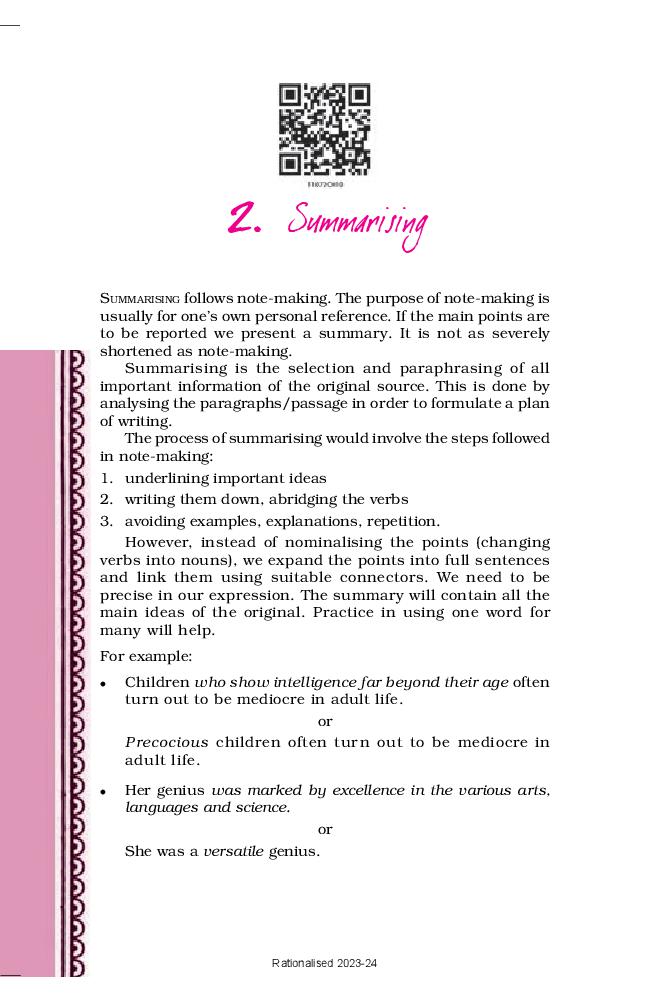
Summari ing follows note-making. The purpose of note-making is usually
for one’s own personal reference. If the main points are to be reported
we present a summary. It is not as severely shortened as note-making.
Summarising is the selection and paraphrasing of all important
information of the original source. This is done by analysing the
paragraphs/passage in order to formulate a plan of writing.
The process of summarising would involve the steps followed in
note-making:
1. underlining important ideas
2. writing them down, abridging the verbs
3. avoiding examples, explanations, repetition.
However, instead of nominalising the points (changing verbs into
nouns), we expand the points into full sentences and link them using
suitable connectors. We need to be precise in our expression. The
summary will contain all the main ideas of the original. Practice in
using one word for many will help.
For example:
Children who show intelligence far beyond their age often turn out
to be mediocre in adult life.
or
Precocious children often turn out to be mediocre in adult life.
Her genius was marked by excellence in the various arts, languages
and science.
or
She was a versatile genius.
Now read the following text underlining important words as you go
along.
Soybeans belong to the legume family. The beans are the seeds
of the leguminous soybean plant. They can be grown on a variety
of soils and in a wide range of climates. Soybeans are versatile
s
Showing the first page only. Download the PDF above for the complete document.
Document Details
| Board / Org | NCERT |
| Exam | Class 11 |
| Type | Books |
| Pages | 4 |
| Updated | 29 Aug 2026 |