CSIR UGC NET syllabus for Mathematical Sciences
Finished viewing? Save it for later —
Download CSIR UGC NET syllabus for Mathematical Sciences (PDF · 4 pages)About CSIR UGC NET syllabus for Mathematical Sciences
CSIR UGC NET syllabus for Mathematical Sciences is available here for free download. Published by NTA for CSIR National Eligibility Test, this syllabus can be viewed online or downloaded as a PDF (4 pages). Candidates preparing for CSIR National Eligibility Test can use CSIR UGC NET syllabus for Mathematical Sciences to understand the exam pattern, the type of questions asked, and the overall difficulty level.
Frequently Asked Questions
How can I download CSIR UGC NET syllabus for Mathematical Sciences?
Open this page and click the Download button to save CSIR UGC NET syllabus for Mathematical Sciences as a PDF. It is completely free on AglaSem Docs.
Is CSIR UGC NET syllabus for Mathematical Sciences free to download?
Yes. CSIR UGC NET syllabus for Mathematical Sciences can be viewed online and downloaded as a PDF free of cost on AglaSem Docs.
How many pages does CSIR UGC NET syllabus for Mathematical Sciences have?
CSIR UGC NET syllabus for Mathematical Sciences contains 4 pages, which you can read online or download together as a single PDF.
Where can I find more CSIR National Eligibility Test study material?
You can find more CSIR National Eligibility Test question papers, sample papers, syllabus, and answer keys on AglaSem Docs.
CSIR UGC NET syllabus for Mathematical Sciences – Text
Read the full text of this syllabus below — useful to quickly search, copy and reference the content online without downloading the PDF.
📄 View text version (4 pages)
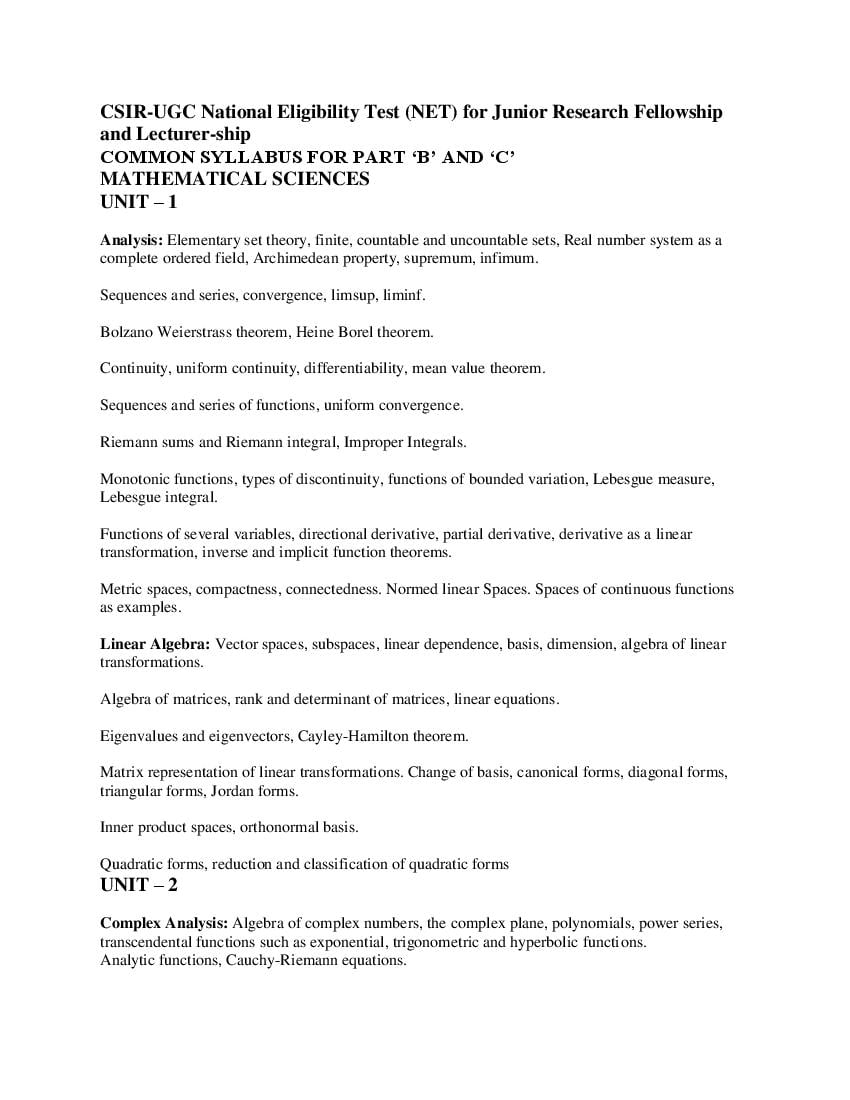
Page 1
and Lecturer-ship
COMMON SYLLABUS FOR PART ‘B’ AND ‘C’
MATHEMATICAL SCIENCES
UNIT – 1
Analysis: Elementary set theory, finite, countable and uncountable sets, Real number system as a
complete ordered field, Archimedean property, supremum, infimum.
Sequences and series, convergence, limsup, liminf.
Bolzano Weierstrass theorem, Heine Borel theorem.
Continuity, uniform continuity, differentiability, mean value theorem.
Sequences and series of functions, uniform convergence.
Riemann sums and Riemann integral, Improper Integrals.
Monotonic functions, types of discontinuity, functions of bounded variation, Lebesgue measure,
Lebesgue integral.
Functions of several variables, directional derivative, partial derivative, derivative as a linear
transformation, inverse and implicit function theorems.
Metric spaces, compactness, connectedness. Normed linear Spaces. Spaces of continuous functions
as examples.
Linear Algebra: Vector spaces, subspaces, linear dependence, basis, dimension, algebra of linear
transformations.
Algebra of matrices, rank and determinant of matrices, linear equations.
Eigenvalues and eigenvectors, Cayley-Hamilton theorem.
Matrix representation of linear transformations. Change of basis, canonical forms, diagonal forms,
triangular forms, Jordan forms.
Inner product spaces, orthonormal basis.
Quadratic forms, reduction and classification of quadratic forms
UNIT – 2
Complex Analysis: Algebra of complex numbers, the complex plane, polynomials, power series,
transcendental functions such as exponential, trigonometric and hyperbolic functions.
Analytic functions, Cauchy-Riemann equations.
Page 2
modulus principle, Schwarz lemma, Open mapping theorem.
Taylor series, Laurent series, calculus of residues.
Conformal mappings, Mobius transformations.
Algebra: Permutations, combinations, pigeon-hole principle, inclusion-exclusion principle,
derangements.
Fundamental theorem of arithmetic, divisibility in Z, congruences, Chinese Remainder Theorem,
Euler’s Ø- function, primitive roots.
Groups, subgroups, normal subgroups, quotient groups, homomorphisms, cyclic groups, permutation
groups, Cayley’s theorem, class equations, Sylow theorems.
Rings, ideals, prime and maximal ideals, quotient rings, unique factorization domain, principal ideal
domain, Euclidean domain.
Polynomial rings and irreducibility criteria.
Fields, finite fields, field extensions, Galois Theory.
Topology: basis, dense sets, subspace and product topology, separation axioms, connectedness and
compactness.
UNIT – 3
Ordinary Differential Equations (ODEs):
Existence and uniqueness of solutions of initial value problems for first order ordinary differential
equations, singular solutions of first order ODEs, system of first order ODEs.
General theory of homogenous and non-homogeneous linear ODEs, variation of parameters,
Sturm-Liouville boundary value problem, Green’s function.
Partial Differential Equations (PDEs):
Lagrange and Charpit methods for solving first order PDEs, Cauchy problem for first order PDEs.
Classification of second order PDEs, General solution of higher order PDEs with constant
coefficients, Method of separation of variables for Laplace, Heat and Wave equations.
Numerical Analysis :
Numerical solutions of algebraic equations, Method of iteration and Newton-Raphson method, Rate
of convergence, Solution of systems of linear algebraic equations using Gauss elimination and
Gauss-Seidel methods, Finite differences, Lagrange, Hermite and spline interpolation, Numerical
differentiation and integration, Numerical solutions of ODEs using Picard, Euler, modified Euler and
Page 3
Calculus of Variations:
Variation of a functional, Euler-Lagrange equation, Necessary and sufficient conditions for extrema.
Variational methods for boundary value problems in ordinary and partial differential equations.
Linear Integral Equations:
Linear integral equation of the first and second kind of Fredholm and Volterra type, Solutions with
separable kernels. Characteristic numbers and eigenfunctions, resolvent kernel.
Classical Mechanics:
Generalized coordinates, Lagrange’s equations, Hamilton’s canonical equations, Hamilton’s
principle and principle of least action, Two-dimensional motion of rigid bodies, Euler’s dynamical
equations for the motion of a rigid body about an axis, theory of small oscillations.
UNIT – 4
Descriptive statistics, exploratory data analysis
Sample space, discrete probability, independent events, Bayes theorem. Random variables and
distribution functions (univariate and multivariate); expectation and moments. Independent random
variables, marginal and conditional distributions. Characteristic functions. Probability inequalities
(Tchebyshef, Markov, Jensen). Modes of convergence, weak and strong laws of large numbers, Central
Limit theorems (i.i.d. case).
Markov chains with finite and countable state space, classification of states, limiting behaviour of n-step
transition probabilities, stationary distribution, Poisson and birth-and-death processes.
Standard discrete and continuous univariate distributions. sampling distributions, standard errors and
asymptotic distributions, distribution of order statistics and range.
Methods of estimation, properties of estimators, confidence intervals. Tests of hypotheses: most powerful
and uniformly most powerful tests, likelihood ratio tests. Analysis of discrete data and chi-square test of
goodness of fit. Large sample tests.
Simple nonparametric tests for one and two sample problems, rank correlation and test for independence.
Elementary Bayesian inference.
Gauss-Markov models, estimability of parameters, best linear unbiased estimators, confidence intervals,
tests for linear hypotheses. Analysis of variance and covariance. Fixed, random and mixed effects models.
Simple and multiple linear regression. Elementary regression diagnostics. Logistic regression.
Multivariate normal distribution, Wishart distribution and their properties. Distribution of quadratic
forms. Inference for parameters, partial and multiple correlation coefficients and related tests. Data
reduction techniques: Principle component analysis, Discriminant analysis, Cluster analysis, Canonical
correlation.
Page 4
sampling. Ratio and regression methods.
Completely randomized designs, randomized block designs and Latin-square designs. Connectedness and
orthogonality of block designs, BIBD. 2K factorial experiments: confounding and construction.
Hazard function and failure rates, censoring and life testing, series and parallel systems.
Linear programming problem, simplex methods, duality. Elementary queuing and inventory models.
Steady-state solutions of Markovian queuing models: M/M/1, M/M/1 with limited waiting space, M/M/C,
M/M/C with limited waiting space, M/G/1.
All students are expected to answer questions from Unit I. Students in mathematics
are expected to answer additional question from Unit II and III. Students with in
statistics are expected to answer additional question from Unit IV.
csirhdg.res.in
Document Details
| Board / Org | NTA |
| Exam | CSIR National Eligibility Test |
| Type | Syllabus |
| Pages | 4 |
| Updated | 01 Aug 2026 |