CSIR UGC NET syllabus for Life Sciences
Finished viewing? Save it for later —
Download CSIR UGC NET syllabus for Life Sciences (PDF · 16 pages)About CSIR UGC NET syllabus for Life Sciences
CSIR UGC NET syllabus for Life Sciences is available here for free download. Published by NTA for CSIR National Eligibility Test, this syllabus can be viewed online or downloaded as a PDF (16 pages). Candidates preparing for CSIR National Eligibility Test can use CSIR UGC NET syllabus for Life Sciences to understand the exam pattern, the type of questions asked, and the overall difficulty level.
Frequently Asked Questions
How can I download CSIR UGC NET syllabus for Life Sciences?
Open this page and click the Download button to save CSIR UGC NET syllabus for Life Sciences as a PDF. It is completely free on AglaSem Docs.
Is CSIR UGC NET syllabus for Life Sciences free to download?
Yes. CSIR UGC NET syllabus for Life Sciences can be viewed online and downloaded as a PDF free of cost on AglaSem Docs.
How many pages does CSIR UGC NET syllabus for Life Sciences have?
CSIR UGC NET syllabus for Life Sciences contains 16 pages, which you can read online or download together as a single PDF.
Where can I find more CSIR National Eligibility Test study material?
You can find more CSIR National Eligibility Test question papers, sample papers, syllabus, and answer keys on AglaSem Docs.
CSIR UGC NET syllabus for Life Sciences – Text
Read the full text of this syllabus below — useful to quickly search, copy and reference the content online without downloading the PDF.
📄 View text version (16 pages)
Page 1
and Lecturer-ship
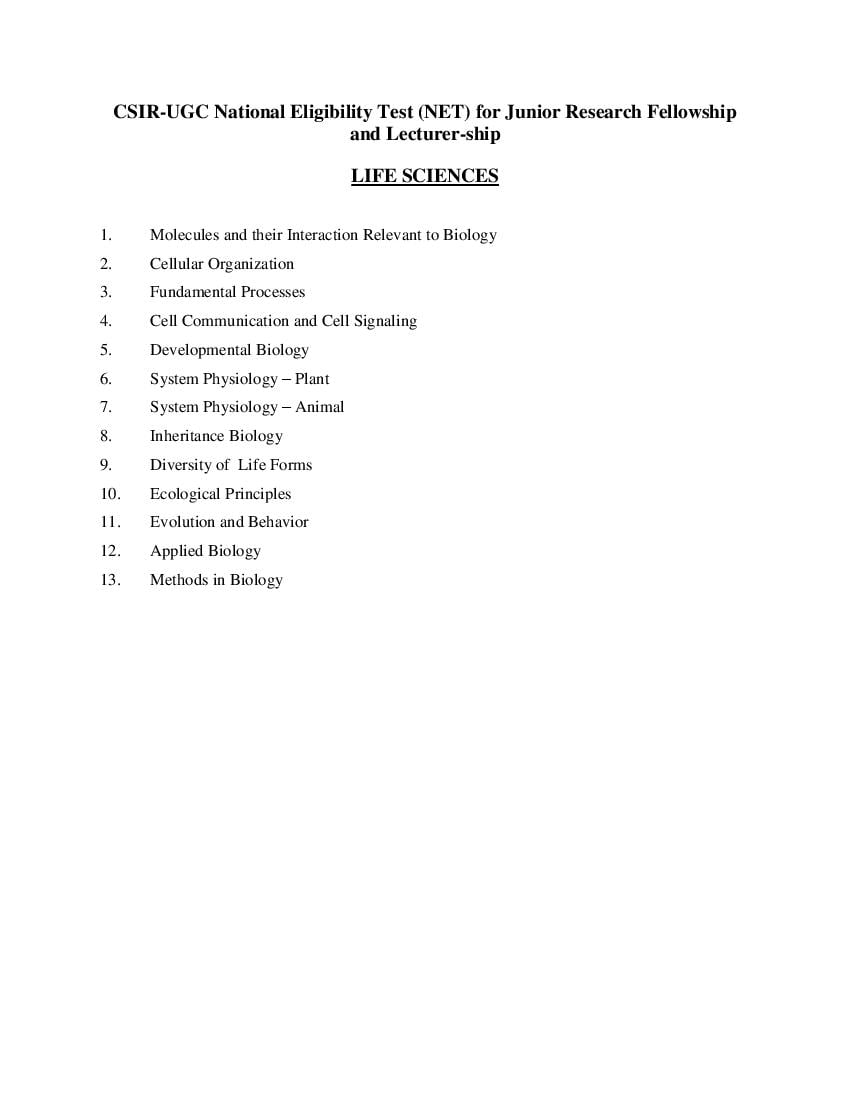
LIFE SCIENCES AND BIO-TECHNOLGY (LS&BT) SYLLABUS
1. Structure and Function of Biomolecules
2. Cellular Organization
3. Fundamental Processes
4. Cell Communication and Cell Signaling
5. Developmental Biology
6. System Physiology – Plant
7. System Physiology – Animal
8. Inheritance Biology
9. Evolution and Diversity of Life Forms
10. Ecology and Behavioural Biology
11. Bioinformatics and Computational Biology
12. Biochemical Engineering and Industrial Biotechnology
13. Advances in Biotechnology
14. Methods in Biology
1
Page 2
A. Structure of atoms, molecules and chemical bonds.
B. Composition, structure and function of biomolecules (carbohydrates, lipids, proteins,
nucleic acids and vitamins).
C. Stabilizing interactions (van der Waals, electrostatic, hydrogen bonding, hydrophobic
interaction, etc.).
D. Principles of biophysical chemistry (pH, buffer, reaction kinetics, thermodynamics,
colligative properties).
E. Bioenergetics, glycolysis, oxidative phosphorylation, coupled reactions, group
transfer, biological energy transducers.
F. Principles of catalysis, enzymes and enzyme kinetics, enzyme regulation,
mechanism of enzyme catalysis, isozymes
G. Conformation of proteins (Ramachandran plot, secondary structure, domains, motif
and folds).
H. Conformation of nucleic acids (Structural characteristics of A, B and Z DNA; RNA
conformation).
I. Stability of proteins and nucleic acids.
J. Metabolism of carbohydrates, lipids, amino acids, nucleotides and vitamins.
2
Page 3
A. Cell wall and cell membrane: structure and function
Cell wall, physical structure of model membranes in prokaryotes and eukaryotes, lipid
bilayer, membrane proteins, diffusion, osmosis, ion channels, active transport, membrane
pumps, mechanism of sorting and regulation of intracellular transport, electrical properties of
membranes.
B. Structural organization and function of intracellular organelles
Nucleus and its organization and dynamics, mitochondria, Golgi bodies, lysosomes,
endoplasmic reticulum, peroxisomes, plastids, vacuoles, chloroplast, structure & function of
cytoskeleton and its role in motility.
C. Organization of genes and chromosomes
Operon, unique and repetitive DNA, interrupted genes, gene families, structure of chromatin
and chromosomes, heterochromatin, euchromatin, transposons.
D. Cell division and cell cycle
Mitosis and meiosis, their regulation, steps in cell cycle, regulation and control of cell cycle,
apoptosis, necrosis and autophagy.
E. Microbial Physiology
Growth kinetics, strategies of cell division, stress response, antimicrobial resistance (AMR).
3
Page 4
A. DNA replication, repair and recombination
Unit of replication, enzymes involved, replication origin and replication fork, fidelity of
replication, extrachromosomal replicons, DNA damage and repair mechanisms, homologous
and site-specific recombination.
B. RNA synthesis, processing and regulation
Mechanism and regulation of transcription, transcriptional inhibitors, transcription factors and
machinery, transcription activators and repressors, RNA polymerases, capping, RNA
processing, RNA editing, splicing, and polyadenylation, structure and function of different
types of RNA, RNA transport, ribozyme, riboswitches, non-coding RNA.
C. Protein synthesis, processing and degradation
Ribosome, mechanism of translation and its regulation, translational inhibitors, post-
translational modification of proteins, protein trafficking and transport, protein degradation.
D. Control of gene expression at transcription and translation level
Regulation of gene expression in phages, viruses, prokaryotes and eukaryotes, role of
chromatin in gene expression and gene silencing, epigenetic regulation.
4
Page 5
A. Cell signaling
Hormones and their receptors, cell surface receptors, signaling through G-protein coupled
receptors, signal transduction pathways, second messengers, regulation of signaling
pathways, bacterial and plant two-component systems, light-signaling in plants, bacterial
chemotaxis and quorum sensing.
B. Cellular communication
General principles of cell communication, cell adhesion and roles of different adhesion
molecules, gap junctions, extracellular matrix, integrins, neurotransmission and its
regulation, regulation of haematopoiesis.
C. Innate and adaptive immune system
Cells and molecules involved in innate and adaptive immunity, antigens, antigenicity and
immunogenicity, B and T cell epitopes, structure and function of antibody molecules,
generation of antibody diversity, monoclonal antibodies, antibody engineering, antigen-
antibody interactions, MHC molecules, antigen processing and presentation, activation
and differentiation of B and T cells, B and T cell receptors, humoral and cell- mediated
immune responses, primary and secondary immune modulation, the complement system,
Toll-like receptors, cell-mediated effector functions, inflammation, hypersensitivity and
autoimmunity, immune response during bacterial, parasitic and viral infections, congenital
and acquired immunodeficiencies, vaccines.
D. Host pathogen interaction
Recognition and entry processes of different pathogens like bacteria, viruses into
animal and plant host cells, alteration of host cell behaviour by pathogens, virus-induced cell
transformation, pathogen-induced diseases in animals and plants, cell-cell fusion in both
normal and abnormal cells.
E. Cancer
Genetic rearrangements in progenitor cells, oncogenes, tumor suppressor genes, cancer
and the cell cycle, virus-induced cancer, metastasis, interaction of cancer cells with normal
cells, therapeutic interventions of uncontrolled cell growth.
5
Page 6
A. Basic concepts of development
Potency, commitment, specification, induction, competence, determination and
differentiation, morphogenetic gradients, cell fate and cell lineages, stem cells, genomic
equivalence and the cytoplasmic determinants, imprinting, mutants and transgenics in
analysis of development.
B. Gametogenesis, fertilization and early development
Production of gametes, cell surface molecules in sperm-egg recognition in animals, zygote
formation, cleavage, blastula formation, embryonic fields, gastrulation and formation of germ
layers in animals.
Male gametophyte development, embryo sac development and double fertilization in plants,
embryogenesis, establishment of symmetry in plants, seed formation, embryo and
endosperm developmental dynamics and germination.
C. Morphogenesis and organogenesis in animals
Cell aggregation and differentiation in Dictyostelium, axes and pattern formation in
Drosophila, amphibia and chick; organogenesis - vulva formation in Caenorhabditis elegans,
eye lens induction, limb development and regeneration in vertebrates, differentiation of
neurons, post embryonic development - larval formation, metamorphosis; environmental
regulation of normal development; sex determination.
D. Morphogenesis and organogenesis in plants
Organization of shoot and root apical meristem, shoot and root development, leaf
development and phyllotaxy, transition to flowering, floral meristems, organogenesis and
floral development.
E. Programmed cell death, aging and senescence in animals and plants
6
Page 7
A. Photosynthesis
Light harvesting complexes, mechanisms of electron transport, photoprotective mechanisms,
CO2 fixation - C3, C4 and CAM pathways.
B. Respiration and photorespiration
Citric acid cycle, plant mitochondrial electron transport and ATP synthesis, alternate oxidase,
photorespiratory pathway.
C. Nitrogen metabolism
Nitrate and ammonium assimilation; amino acid biosynthesis, biological nitrogen fixation.
D. Plant hormones
Biosynthesis, storage, breakdown and transport, physiological effects and mechanisms of
action.
E. Sensory photobiology
Light perception, structure, function and mechanisms of action of phytochromes,
cryptochromes and phototropins, stomatal movement, photoperiodism and biological clock.
F. Solute transport and photoassimilate translocation
Uptake, transport and translocation of water, ions, solutes and macromolecules from soil,
through cells, across membranes, through xylem and phloem, transpiration, mechanisms of
loading and unloading of photoassimilates.
G. Secondary metabolites
Biosynthesis of terpenes, phenolics, alkaloids, phenylpropanoids, nitrogenous compounds
and their roles, metabolic engineering in plants.
H. Stress physiology
Physiological and molecular responses of plants to biotic and abiotic stresses, innate
immunity.
7
Page 8
A. Blood and circulation
Blood corpuscles, haemopoiesis and formed elements, plasma function, blood volume,
blood volume regulation, blood groups, haemoglobin, immunity, haemostasis.
B. Cardiovascular system
Comparative anatomy of heart structure, myogenic heart, specialized tissue, ECG – its
principle and significance, cardiac cycle, heart as a pump, blood pressure, neural and
chemical regulation of cardiovascular system.
C. Respiratory system
Comparison of respiration in different species, anatomical considerations, transport of gases,
exchange of gases, waste elimination, neural and chemical regulation of respiration.
D. Nervous system
Neurons, action potential, gross neuroanatomy of the brain and spinal cord, central and
peripheral nervous system, neural control of muscle tone and posture.
E. Sense organs: Vision, hearing and tactile responses.
F. Excretory system
Comparative physiology of excretion, kidney, urine formation, urine concentration, waste
elimination, micturition, regulation of water balance, blood volume, blood pressure,
electrolyte balance, acid-base balance.
G. Thermoregulation: Comfort zone, body temperature – physical, chemical, neural
regulation, acclimatization.
H. Stress and adaptation
I. Digestive system: Digestion, absorption, energy balance, BMR.
J. Endocrinology and reproduction: Endocrine glands, basic mechanism of hormone
action, hormones and diseases; reproductive processes, gametogenesis, ovulation,
neuroendocrine regulation.
K. Concept of metaorganisms/holobionts: Gut microbiome in physiology; study of gut
microbiome; germ-free animals; gut-brain axis, dysbiosis, and disease
L. Interorgan communication and energy homeostasis; metabolic health and
disorders
8
Page 9
A. Chromosomal and extrachromosomal inheritance
Principles of Mendelian inheritance, codominance, incomplete dominance, penetrance and
expressivity, gene interactions, pleiotropy, genomic imprinting, linkage and cross-over, sex-
linked inheritance, inheritance of mitochondrial and chloroplast genes, maternal inheritance.
B. Genes and mutations
Allele, multiple alleles, pseudoallele, complementation tests; Mutation types, causes and
detection; mutant types – lethal, conditional, biochemical, loss of function, gain of function,
dominant-negative; germinal verses somatic mutations.
C. Genetic analysis
Linkage maps, mapping with molecular markers in plants, animals and bacteria, tetrad
analysis, gene transfer in bacteria: transformation, conjugation, transduction, sex-duction,
fine structure analysis of gene, development of mapping population in plants.
D. Human genetics
Pedigree analysis, LOD score for linkage testing, karyotypes, genetic disorders.
E. Quantitative genetics
Population genetics and Hardy-Weinberg equilibrium, polygenic inheritance, heritability and
its measurements, molecular mapping.
F. Structural and numerical alterations of chromosomes
Recombination, deletion, duplication, inversion, translocation, ploidy and their genetic
implications.
9
Page 10
A. Evolution of Life and Life Forms
Origin of life and early evolution; Evolution of cellular structures, functions and
multicellularity; Mechanisms of evolution - Natural selection, genetic drift, gene flow, and
mutation; Mechanisms of speciation; Extinction events and their role in shaping biodiversity;
Adaptive radiation and convergent evolution; Coevolution and evolutionary arms races;
Human evolution.
B. Principles & Methods of Taxonomy
Concepts of species and hierarchical taxa, biological nomenclature, classical & quantitative
methods of taxonomy of plants, animals and microorganisms.
C. Microbial Life
Bacteria and Archaea: diversity and ecological roles; Viruses: structure, replication, and
impact on life; Economically and pathologically important microbes.
D. Protists
Algae; Protozoa; Slime molds and water molds; Ecological roles of protists.
E. Fungi
Diversity of fungal groups: chytrids, zygomycetes, glomeromycetes, ascomycetes, and
basidiomycetes; Important fungal pathogens of plants and humans.
F. Plant Life
Evolution and diversity of land plants: bryophytes, ferns, gymnosperms, and angiosperms;
Plant morphology, anatomy, and reproduction.
G. Animal Life
Evolutionary relationships and key characteristics of Invertebrates and Vertebrates.
10
Page 11
A. Introduction to Ecology
Levels of organization- individual, population, community, ecosystem, biosphere; Abiotic and
biotic ecological factors, Ecological adaptations.
B. Population Ecology
Population growth models- Exponential growth, logistic growth, density-dependent and
density-independent factors, life tables, survivorship curves; Population dynamics- Age
structure, sex ratio, life history strategies (r-selected vs. K-selected); Metapopulations-
Habitat fragmentation, connectivity, and extinction risk.
C. Community Ecology
Community structure - Food webs, trophic levels, keystone species; Species interactions -
Competition, predation, mutualism, parasitism; Succession- Primary and secondary
succession, community stability.
D. Ecosystem Ecology
Energy flow in ecosystems- Primary production, trophic levels, energy pyramids;
Biogeochemical cycles- Carbon, nitrogen, phosphorus, water cycles; Ecosystem services
and human impacts.
E. Human Impacts on Ecosystems
Anthropogenic pressures: Land use and land-cover change; Climate change, pollution,
invasive species.
F. Biodiversity and Conservation
Biodiversity and its importance; Threats to biodiversity; IUCN categories of threat;
Conservation genetics; Population viability analysis (PVA); Ex-situ and in-situ conservation
strategies; Community-based conservation and the role of indigenous knowledge;
International and national conservation policies and legislation.
G. Act and policies
Biodiversity Act 2002; Agricultural biodiversity; International Treaty on Plant Genetic
Resources for Food and Agriculture (PGRFA); Conservation strategies for seed gene bank;
Climate change and conservation of plant genetic resources; Strategies on PPVFR and
Biodiversity Acts.
H. Behavioural Ecology
Introduction to animal behaviour- Proximate and ultimate causes of behaviour; Foraging
behaviour; Communication; Conflict and aggression; Migration, dispersal, and navigation;
Social behaviour; Sexual selection and mating systems; Parental care.
11
Page 12
A. Major Bioinformatic Resources
Sequence databases, gene expression databases, 3D structure database, pattern sequence
databases.
B. Basic Concepts of Sequence Analysis
Database searches, BLAST and FASTA, sequence identity and similarity, definitions of
homologues, orthologues, paralogues, repeat finding, scoring matrix, pairwise sequence
alignments, multiple sequence alignments (MSA), application in taxonomy and phylogeny,
comparative genomics.
C. Gene annotation
Prediction of gene function using homology, context, structures, networks; Genetic variation-
polymorphism, deleterious mutations; Phylogenetics.
D. Molecular Modelling and Dynamics
3-D structure visualization and simulation, Basic concepts in molecular modeling, Molecular
Mechanics, Force fields etc.
E. Classification and comparison of protein 3D structures
Anatomy of proteins – Hierarchical organization of protein structure, Secondary and tertiary
structure prediction, homology/comparative modeling, fold recognition, threading
approaches, and ab initio structure prediction methods, AI-based methods of structure
prediction (eg. AlphaFold).
F. Drug design
Chemical databases like NCI /PUBCHEM, Fundamentals of Receptor-ligand interactions,
Structure-based drug design, Ligand based drug design: Structure-Activity Relationship,
QSARs and pharmacophores, in silico predictions of drug activity and ADMET.
G. Systems Biology
Data science applications in biology, health and drug discovery, mathematical modelling of
metabolic pathways and disease, digital health, personalized medicine.
12
Page 13
A. Introductory Mathematics
Calculus review, Ordinary differential equations, Second and higher order differential
equations, Linear algebra, Numerical methods.
B. Engineering Principles
Material and energy balance, Steady state energy and material balance, Properties of
substances, Introduction to transport phenomena, momentum transfer, heat and mass
transfer, Introduction to mass transfer equipment.
C. Thermodynamics in Biological Systems
First and second law of thermodynamics, Biological systems as open non-equilibrium
systems, Failure of classical thermodynamics in describing biological processes, Concepts
of thermodynamics flux and force, Concept of entropy production, Constitutive equations,
Thermodynamics of coupled biochemical reactions, Thermodynamic analysis of oxidative
phosphorylation, Glycolytic oscillations; biological clocks.
D. Bioprocess Engineering and Technology
Principles of microbial growth and factors affecting growth, Growth kinetics and substrate
utilization in batch, fed-batch and continuous systems, Introduction to bioreactors: batch and
fed-batch, plug flow, continuous, enzyme reactors, Sterilization, Mass and energy balance in
microbial process-effects of dissolved oxygen, Mass transfer of oxygen, aeration and
agitation, fluid rheology, Fermentation technology for antibiotics, organic acids, alcohol,
bioplastics, vitamins, enzymes; biotransformation of steroids, Process flow sheet and
process economics.
E. Enzymes and microbial technology
Enzymes in organic solvents and ionic liquids, biocatalysts, enzyme engineering, random
and rational approach to protein engineering, Biocatalysis, techniques of immobilization of
enzymes and whole cells: design, operation and kinetics of immobilized enzyme reactors,
diffusional resistance and Thiele modulus.
F. Downstream processing in biotechnology
Biomass removal and disruption, Precipitation by salts, solvents, Membrane based
purification, Adsorption and chromatography, Extraction (solvent, aqueous two-phase, super
critical), Drying.
G. Bioprocess Plant Design
General design information, Process flow sheet, Scale-up and scale-down issues, Scale up
of downstream processes. Selection and specifications of bioprocess equipment.
H. Metabolic Engineering and Synthetic Biology
13
Page 14
A. Recombinant DNA technology
Molecular cloning, expression of recombinant proteins, In vitro mutagenesis and deletion
techniques, gene knock out in bacterial and eukaryotic organisms, genome editing
techniques. Protein sequencing methods, DNA sequencing methods, strategies for genome
sequencing and gene expression analysis.
B. Medical Biotechnology
Application of immunological principles (autoimmunity, transplantation, tumor immunology,
stem cell therapy, cell-based vaccines), vaccines (Live, killed, attenuated, subunit, and
recombinant nucleic acid vaccines) and diagnostics, adjuvants, cell therapy, stem cell
therapy, immunotherapy, r-DNA based therapy, antibody engineering, phage display
libraries, tissue engineering.
Stem cell technology: induced pluripotent stem cells, guided/directed differentiation methods;
application in drug screening and disease biology; Organoid: Stem-cell based, self-
organizing 3D models for disease and developmental biology.
Neurobiology: Electrophysiological studies of the brain, behavioural tests.
Medical devices and implants, Biosensors
C. Animal Biotechnology
Transgenic animals, animal breeding, conservation of germplasm, genetic health monitoring,
molecular medicine and surgery, concept of molecular diagnosis of pathogens, cell cloning
and selection, cell and tissue culture methods in biotechnological applications.
D. Agriculture Biotechnology
Transgenic plants, molecular approaches to diagnosis and strain identification; genomics
and its application to agriculture, development of ESTs, molecular markers for plant
genotyping and germplasm analysis, marker assisted breeding for various traits, foreground
and background selection, gene introgression and pyramiding, non-gel based techniques for
plant genotyping, impact of GE crops on biodiversity; tissue and cell culture methods in
plants, plantibodies.
E. Marine Biotechnology
Important marine organisms, their biology and behaviour, marine resources assessment,
Population study and marine environment protection, role of microbes in marine
environment, microbial metabolites, seafood microbiology, marine pharmacology, fouling
and corrosion, biofilms; oceanography
F. Environmental Biotechnology
Wastewater treatment systems, Pollution control, Environment friendly technologies:
Biosurfactants, biofertilizers, biopesticides, microbially enhanced oil recovery, integrated
waste management, biogas & biofuel from waste, bioremediation, phytoremediation.
14
Page 15
A. Molecular Biology Techniques
Isolation, separation and analysis of biological macromolecules (DNA, RNA, proteins,
carbohydrates and lipids), chromatography, electrophoresis and centrifugation.
B. Biophysical Methods
Spectroscopy (UV/visible, fluorescence, circular dichroism, NMR and ESR), molecular
structure determination using X-ray diffraction, cryo-electron microscopy and NMR,
Molecular analysis using light scattering, different types of mass spectrometry methods and
surface plasma resonance.
C. Genomics, Transcriptomics, Proteomics and Metabolomics
Structure and organization of prokaryotic and eukaryotic genomes, Comparative genomics,
Global gene expression analysis, Comparative transcriptomics, Differential gene expression;
protein interaction analysis and mapping, targeted and untargeted metabolic profiling, DNA
finger printing and its applications, DNA bar coding, Single-cell sequencing, single-cell
omics.
D. Radiolabeling techniques
Detection and measurement of different types of radioisotopes normally used in biology,
incorporation of radioisotopes in biological tissues and cells, molecular imaging of
radioactive material, safety guidelines.
E. Histochemical and Immunotechniques
Antibody generation, Detection of molecules using ELISA, RIA, western blot,
immunoprecipitation, flow cytometry and immunofluorescence microscopy, detection of
molecules in living cells, in situ localization by techniques such as FISH and GISH.
F. Microscopic techniques
Visualization of cells and subcellular components by light microscopy and advanced
microscopic techniques, resolving power of microscopes, microscopy of living cells,
scanning and transmission microscopes, sample preparation techniques for microscopy.
G. Electrophysiological methods
Single neuron recording, patch-clamp recording, ECG, Brain activity recording, lesion and
stimulation of brain, pharmacological testing, PET, MRI, fMRI, CAT.
H. Methods in field biology
Methods of estimating population density of animals and plants, ranging patterns through
direct, indirect and remote observations, sampling methods in the study of behaviour, habitat
characterization: ground and remote sensing methods.
I. Statistical Methods
15
Page 16
Measures of central tendency and dispersal; probability distributions (Binomial, Poisson and
normal); Sampling distribution; Difference between parametric and non-parametric statistics;
Confidence Interval; Errors; Levels of significance; Regression and Correlation; t-test;
Analysis of variance; X2 test; basic introduction to multivariate statistics, etc.
J. IPR, Biosafety and Bioethics
Intellectual property rights, types of IP, Patent databases; Biological safety measures,
biosafety levels, regulatory guidelines, animal ethics, research ethics, publication ethics,
plagiarism, use of AI in research and publication.
16
Document Details
| Board / Org | NTA |
| Exam | CSIR National Eligibility Test |
| Type | Syllabus |
| Pages | 16 |
| Updated | 01 Aug 2026 |