ACET Jun 2023 Solution
Finished viewing? Save it for later —
Download ACET Jun 2023 Solution (PDF · 10 pages)About ACET Jun 2023 Solution
ACET Jun 2023 Solution is available here for free download. Published by Actuaries India for ACET, this answer key can be viewed online or downloaded as a PDF (10 pages). Candidates preparing for ACET can use ACET Jun 2023 Solution to understand the exam pattern, the type of questions asked, and the overall difficulty level.
Frequently Asked Questions
How can I download ACET Jun 2023 Solution?
Open this page and click the Download button to save ACET Jun 2023 Solution as a PDF. It is completely free on AglaSem Docs.
Is ACET Jun 2023 Solution free to download?
Yes. ACET Jun 2023 Solution can be viewed online and downloaded as a PDF free of cost on AglaSem Docs.
How many pages does ACET Jun 2023 Solution have?
ACET Jun 2023 Solution contains 10 pages, which you can read online or download together as a single PDF.
Where can I find more ACET study material?
You can find more ACET question papers, sample papers, syllabus, and answer keys on AglaSem Docs.
ACET Jun 2023 Solution – Text
Read the full text of this answer key below — useful to quickly search, copy and reference the content online without downloading the PDF.
📄 View text version (10 pages)
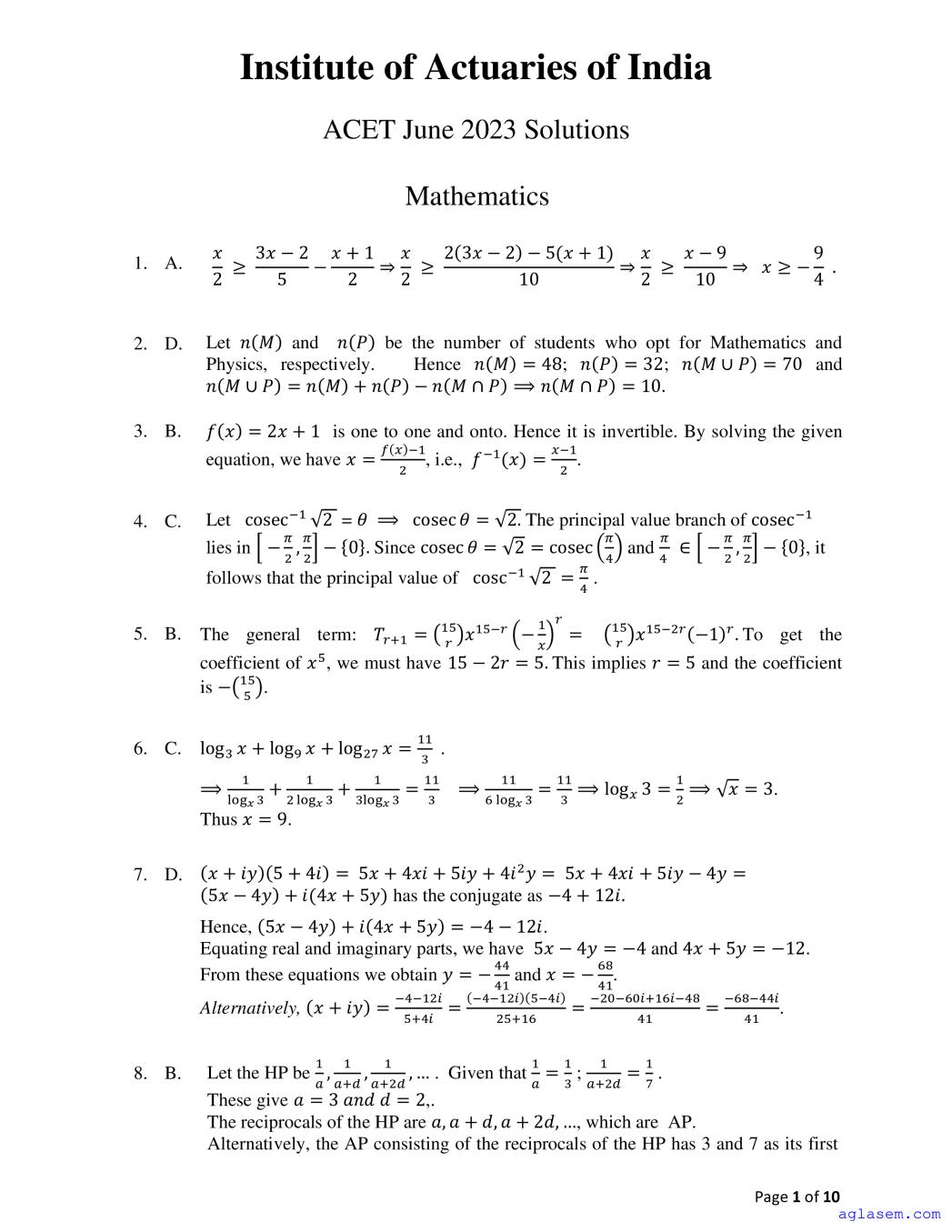
Page 1
ACET June 2023 Solutions
Mathematics
𝑥 3𝑥 − 2 𝑥 + 1 𝑥 2(3𝑥 − 2) − 5(𝑥 + 1) 𝑥 𝑥−9 9
1. A. ≥ − ⇒ ≥ ⇒ ≥ ⇒ 𝑥≥− .
2 5 2 2 10 2 10 4
2. D. Let 𝑛(𝑀) and 𝑛(𝑃) be the number of students who opt for Mathematics and
Physics, respectively. Hence 𝑛(𝑀) = 48; 𝑛(𝑃) = 32; 𝑛(𝑀 ∪ 𝑃) = 70 and
𝑛(𝑀 ∪ 𝑃) = 𝑛(𝑀) + 𝑛(𝑃) − 𝑛(𝑀 ∩ 𝑃) ⟹ 𝑛(𝑀 ∩ 𝑃) = 10.
3. B. 𝑓(𝑥) = 2𝑥 + 1 is one to one and onto. Hence it is invertible. By solving the given
𝑓(𝑥)−1 𝑥−1
equation, we have 𝑥 = 2 , i.e., 𝑓 −1 (𝑥) = 2 .
4. C. Let cosec −1 √2 = 𝜃 ⟹ cosec 𝜃 = √2. The principal value branch of cosec −1
𝜋 𝜋 𝜋 𝜋 𝜋 𝜋
lies in [ − 2 , 2 ] − {0}. Since cosec 𝜃 = √2 = cosec ( 4 ) and 4 ∈ [ − 2 , 2 ] − {0}, it
𝜋
follows that the principal value of cosc −1 √2 = 4 .
1 𝑟
5. B. The general term: 𝑇𝑟+1 = (15
𝑟
)𝑥15−𝑟 (− 𝑥) = (15
𝑟
)𝑥15−2𝑟 (−1)𝑟 . To get the
coefficient of 𝑥 5 , we must have 15 − 2𝑟 = 5. This implies 𝑟 = 5 and the coefficient
is −(15
5
).
11
6. C. log 3 𝑥 + log 9 𝑥 + log 27 𝑥 = 3 .
1 1 1 11 11 11 1
⟹ log 3 + 2 log 3 + 3log 3 = 3 ⟹ 6 log 3 = 3 ⟹ log 𝑥 3 = 2 ⟹ √𝑥 = 3.
𝑥 𝑥 𝑥 𝑥
Thus 𝑥 = 9.
7. D. (𝑥 + 𝑖𝑦)(5 + 4𝑖) = 5𝑥 + 4𝑥𝑖 + 5𝑖𝑦 + 4𝑖 2 𝑦 = 5𝑥 + 4𝑥𝑖 + 5𝑖𝑦 − 4𝑦 =
(5𝑥 − 4𝑦) + 𝑖(4𝑥 + 5𝑦) has the conjugate as −4 + 12𝑖.
Hence, (5𝑥 − 4𝑦) + 𝑖(4𝑥 + 5𝑦) = −4 − 12𝑖.
Equating real and imaginary parts, we have 5𝑥 − 4𝑦 = −4 and 4𝑥 + 5𝑦 = −12.
44 68
From these equations we obtain 𝑦 = − 41 and 𝑥 = − 41.
−4−12𝑖 (−4−12𝑖)(5−4𝑖) −20−60𝑖+16𝑖−48 −68−44𝑖
Alternatively, (𝑥 + 𝑖𝑦) = = = = .
5+4𝑖 25+16 41 41
1 1 1 1 1 1 1
8. B. Let the HP be 𝑎 , 𝑎+𝑑 , 𝑎+2𝑑 , … . Given that 𝑎 = 3 ; 𝑎+2𝑑 = 7 .
These give 𝑎 = 3 𝑎𝑛𝑑 𝑑 = 2,.
The reciprocals of the HP are 𝑎, 𝑎 + 𝑑, 𝑎 + 2𝑑, …, which are AP.
Alternatively, the AP consisting of the reciprocals of the HP has 3 and 7 as its first
Page 1 of 10
Page 2
15
The sum to 15 terms of 3,5,7,…is 𝑠15 = 2 [2 × 3 + (15 − 1)2] = 255.
9. A. 𝑥 2 − 𝑥 + 3𝜇 = 0 and 4𝑥 2 − 5𝑥 + 𝜇 = 0 , (𝜇 ≠ 0) have a common root 𝛼.
Hence, 𝛼 2 − 𝛼 + 3𝜇 = 0 and 4𝛼 2 − 5𝛼 + 𝜇 = 0.
By eliminating 𝜇 from the two equations, we have 3(4𝛼 2 − 5𝛼 + 𝜇) −
(𝛼 2 − 𝛼 + 3𝜇) = 0, i.e., (11𝛼 − 14)𝛼 = 0. The solution 𝛼 = 0 implies 𝜇 = 0,
14
which is not allowed. Therefore, 𝛼 = 11.
𝑥−1.0 1.1−1.0 𝑥−1.0 0.1
10. C. By interpolation, Φ(𝑥)−0.8413 =0.8643−0.8413 ⟹ Φ(𝑥)−0.8413 = 0.023.
𝑥−1.0
⟹ Φ(𝑥) = 0.8413 + × 0.023
0.1
1.05−1.0
⟹ Φ(1.05) = 0.8413 + 0.1 × 0.023 = 0.8413 + 0.5 × 0.023 = 0.8413 +
0.0115 = 0.8528.
Alternatively,
1.05−1.0 0.8643+0.8413
Φ(𝑥) = 0.8413 + 1.1−1.0 × (0.8643 − 0.8413) = = 0.8528.
2
1 ℎ
11. D. The Trapezoidal rule is ∫0 𝑓(𝑥)𝑑𝑥 = 2 [(𝑦0 + 𝑦5 ) + 2(𝑦1 + 𝑦2 + 𝑦3 + 𝑦4 )] =
0.25
[(0 + 2.7828) + 2(0.3210 + 0.8244 + 1.5878)]] = 1.03115.
2
12. A. Let 𝑦 = 𝑥 − 5. This implies as 𝑥 → 5, 𝑦 → 0.
𝑒 𝑥 − 𝑒5 𝑒 𝑦+5 − 𝑒 5 𝑒 5 (𝑒 𝑦 − 1)
lim = lim = lim
𝑥⟶5 𝑥 − 5 𝑦⟶5 𝑦 𝑦⟶5 𝑦
𝑦
𝑒 − 1
= 𝑒 5 lim = 𝑒 5 × 1 = 𝑒 5 (using l′Hopital Rule).
𝑦⟶0 𝑦
3 1
13. B. Given 𝑦 = 𝑒 𝑥 −2 log𝑒 𝑥 ,
𝑑𝑦 3 1 1 3 1 1
= 𝑒 𝑥 −2 log𝑒 𝑥 (3𝑥 2 − ) = 𝑒 𝑥 𝑒 −2 log𝑒 𝑥 (3𝑥 2 − )
𝑑𝑥 2𝑥 2𝑥
3 1 1 3 1 1
= 𝑒𝑥 1 (3𝑥 2 − ) = 𝑒 𝑥 (3𝑥 2 − ).
2𝑥 √𝑥 2𝑥
𝑒 2 log𝑒 𝑥
14. C. Given 𝑓(𝑥) = 𝑥 3 𝑒 −2𝑥 ,
3
𝑓 ′ (𝑥) = 3𝑥 2 𝑒 −2𝑥 + 𝑥 3 𝑒 −2𝑥 (−2) = 𝑒 −2𝑥 𝑥 2 (3 − 2𝑥) > 0 if 𝑥 < 2 .
3
The function is strictly increasing in 𝑥 in the interval (−∞, 2 ).
5 5
15. A. ∫4 5𝑥 𝑑𝑥 = ∫4 𝑒 𝑥 log𝑒 5 𝑑𝑥 Put 𝑢 = 𝑥 log 𝑒 5. Then
5 5 log𝑒 5
𝑥
1 1 2500
∫ 5 𝑑𝑥 = ∫ 𝑒 𝑢 𝑑𝑢 = [ 𝑒 5 log𝑒 5 − 𝑒 4 log𝑒 5 ] = .
4 log 𝑒 5 4 log𝑒 5 log 𝑒 5 log 𝑒 5
Page 2 of 10
Page 3
𝑥3 2
16. D. ∫(3𝑥 2 − 4 tan 𝑥 + 3√𝑥) 𝑑𝑥 = 3 3 + 4 log(cos 𝑥) + 3𝑥 2 × 3 + 𝐶 = 𝑥 3 +
4 log(cos 𝑥) + 2𝑥 √𝑥 + 𝐶.
17. B. sin 𝜃 cos 𝜃 sin 𝜃 cos 𝜃
| | = sin2 𝜃 + cos 2 𝜃 = 1. 𝐴𝑑𝑗 [ ]=
− cos 𝜃 sin 𝜃 − cos 𝜃 sin 𝜃
sin 𝜃 − cos 𝜃
[ ].
cos 𝜃 sin 𝜃
sin 𝜃 − cos 𝜃
Hence inverse is [ ].
cos 𝜃 sin 𝜃
18. C. Given that |𝑎⃗ ° 𝑏⃗⃗| = |𝑎⃗ × 𝑏⃗⃗| ⇒ |𝑎⃗ || 𝑏⃗⃗|⌈cos 𝜃⌉ = |𝑎⃗ || 𝑏⃗⃗|⌈sin 𝜃⌉ ⇒ tan 𝜃 = 1.
𝜋
Hence 𝜃 = 4 .
19. A. Given |⃗⃗⃗𝑎⃗|=1, |𝑏⃗⃗| = 2 and |𝑐⃗| = 3 and 𝑎⃗ + 𝑏⃗⃗ +⃗⃗⃗𝑐 = 0,
2 2
Now, | 𝑎⃗ + 𝑏⃗⃗ + ⃗⃗⃗𝑐 | = | 𝑎⃗ |2 + | 𝑏⃗⃗ | + | ⃗⃗⃗𝑐 |2 +2 ( 𝑎⃗ ° 𝑏⃗⃗ + 𝑏⃗⃗ ° 𝑐⃗ + 𝑐⃗ °𝑎⃗).
Hence, 0 = 1 + 4 + 9 + 2(𝑎⃗ ° 𝑏⃗⃗ + 𝑏⃗⃗ ° 𝑐⃗ + 𝑐⃗ °𝑎⃗) and 𝑎⃗ ° 𝑏⃗⃗ + 𝑏⃗⃗ ° 𝑐⃗ + 𝑐⃗ °𝑎⃗ = −7.
2 2 4 6 8
20. D. 𝑀 = [3]; 𝑀𝑇 = [2 3 4]. 𝑀𝑀𝑇 = [3] [2 3 4] = [6 9 12].
4 4 8 12 16
𝑇
The rank of 𝑀𝑀 is 1 since all minors of order above 2 are not zero.
Page 3 of 10
Page 4
21. B. If all the weights are multiplied by a constant, then the A.M. does not change. So
the A.M. remains same, that is, 16.
1+3+4+4+5+7 24 2+2+2+3+3+4+𝑝
22. C. 𝑀= = 6 = 4. = 𝑀 − 1 = 3 ⇒ 𝑝 = 5.
6 7
Then median of the numbers 2, 2, 2, 3, 3, 4, 5 is 3.
𝑝 and 𝑞 are 5 and 3.
7+7+8+𝑋+10+12+𝑌
23. A. Mean = = 11 ⇒ 𝑋 + 𝑌 = 33.
7
𝐶𝑜𝑣(𝑋,𝑌)
𝐶𝑜𝑟𝑟(𝑋, 𝑌) = . 𝐶𝑜𝑣(𝑋, 𝑌) = 𝐶𝑜𝑣(𝑋, 33 − 𝑋) = −𝑉𝑎𝑟(𝑋).
√𝑉𝑎𝑟(𝑋)𝑉𝑎𝑟(𝑌)
𝑉𝑎𝑟(𝑋)
𝑉𝑎𝑟(𝑋) = 𝑉𝑎𝑟(𝑌). So 𝐶𝑜𝑟𝑟(𝑋, 𝑌) = − = −1.
𝑉𝑎𝑟(𝑋)
24. D. Marks Frequency Cumulative
frequency
20 8 8
40 12 20
50 18 38
60 6 44
70 12 56
75 9 65
90 5 70
Median = (35th obs. + 36th obs.)/2 = (50+50)/2 = 50.
Mode = 50.
) ̅̅ ) ̅̅
25. C. 𝑃(𝐸̅ |𝐹̅ )𝑃(𝐹̅ |𝐸̅ ) = 𝑃(𝐸̅𝐹 × 𝑃(𝐸̅𝐹 .
𝑃(𝐹) 𝑃(𝐸 )
2 3 1
𝑃(𝐸̅ 𝐹̅ ) = 1 − 𝑃(𝐸 ∪ 𝐹) = 1 − [𝑃(𝐸) + 𝑃(𝐹) − 𝑃(𝐸 ∩ 𝐹)] = 1 − (5 + 10 − 5) =
1
.
2
2 1 3 7 21 1 50 25
(𝑃(𝐸̅ 𝐹̅ )) = 4 . 𝑃(𝐸̅ )𝑃(𝐹̅ ) = 5 × 10 = 50. 𝑃(𝐸̅ |𝐹̅ )𝑃(𝐹̅ |𝐸̅ ) = 4 × 21 = 42.
26. D. 𝑃(𝐸) = 𝑝, 𝑃(𝐹) = 2𝑝.
5 5
𝑃(exactly one of 𝐸 and 𝐹 occurs) = 9 ⇒ 𝑃(𝐸 𝐹̅ ) + 𝑃(𝐸̅ 𝐹) = 9
5 5
⇒ 𝑃(𝐸)𝑃(𝐹̅ ) + 𝑃(𝐸̅ )𝑃(𝐹) = 9 ⇒ 𝑝(1 − 2𝑝) + (1 − 𝑝)2𝑝 = 9
5 1
⇒ 36𝑝2 − 27𝑝 + 5 = 0 ⇒ 𝑝 = 12 , 3
27. B. The probability density function can be expressed as
1 −
1
(𝑥−10)2
𝑓(𝑥) = 𝑒 2.22
2√2 𝜋
So 𝑋 ∼ 𝑁(10, 22 ). Mean = 10. For normal distribution, mean = median = mode.
Page 4 of 10
Page 5
𝑥
1
28. A. 𝑓(𝑥) = 2 𝑥𝑒 −𝜆 . Mode is that value of 𝑥, for which 𝑓(𝑥) is maximum.
𝜆
𝑥 𝑥
1 𝑥
𝑓 ′ (𝑥) = 𝜆2 (𝑒 −𝜆 − 𝜆 𝑒 −𝜆 ) = 0 ⇒ 𝑥 = 𝜆. It can be checked that 𝑓 ′′ (𝜆) < 0. So 𝜆 is
the mode of the distribution.
Hence 𝜆 = 2.
𝑥2
∞1 ∞
29. D. Required probability = 𝑃(𝑋 > 6) = ∫6 𝑥𝑒 −16 𝑑𝑥 = ∫36⁄16 𝑒 −𝑦 𝑑𝑦 = 𝑒 −2.25.
8
30. C. Let 𝑋 be the number of chocolate chips in a cookie. 𝑋 ∼ 𝑃𝑜𝑖𝑠𝑠𝑜𝑛 (𝜇)
𝑃(𝑋 ≥ 1) = 1 − 𝑒 −4.2 ⇒ 1 − 𝑃(𝑋 = 0) = 1 − 𝑒 −4.2 ⇒ 𝑃(𝑋 = 0) = 𝑒 −4.2.
𝑒 −𝜇 = 𝑒 −4.2 ⇒ 𝜇 = 4.2. Therefore, 𝑃(𝑋 = 1) = 4.2𝑒 −4.2 .
1 1 1 𝑝 1 𝑝 10 𝑝
31. B. 𝐸(𝑋) = 1 × 4 + 2 × 4 + 3 (4 + 4) + 4 (4 − 4) = 4 − 4.
10 𝑝
𝐸(𝑋) = 2.4 ⇒ 4 − 4 = 2.4 ⇒ 𝑝 = 0.4.
𝑥2 𝑏 𝑥2
1 1 1
32. A. 𝜙(𝑥) = 𝑒− 2 . 𝐸(𝑋) = ∫ 𝑥 𝑒 − 2 𝑑𝑥
√2 𝜋 Φ(𝑏) − Φ(𝑎) 𝑎 √2 𝜋
1 1 𝑎2 𝑏2 𝜙(𝑎) − 𝜙(𝑏)
= ( ) [ 𝑒− 2 − 𝑒− 2 ] = .
Φ(𝑏) − Φ(𝑎) √2 𝜋 Φ(𝑏) − Φ(𝑎)
8!
33. B. The number of arrangements of the letters of the word ‘ANACONDA’ is .
3! 2!
5!
Now, other than 3 A’s, there 5 letters which can be arranged in ways. In each
2!
arrangement of these five letters there are 6 places, 4 between the 5 letters and one
on extreme left and other on extreme right. No two A’s will occur together, if A’s
are arranged in these 6 places. This can be done in (63) ways.
5! 5! 6!
The number of ways in which no two A’s are together = 2! × (63) = 2! × 3!3!
5! 6!
×( ) 5! 6! 3!×2! 5
2! 3!3!
Required probability = 8! = 2! × 3!×3! × = 14.
8!
3!2!
34. A. 𝐸 = 𝐴 hits the target, 𝐹 = 𝐵 hits the target and 𝐺 = 𝐶 hits the target
5 4 3
𝑃(𝐸) = , 𝑃(𝐹) = and 𝑃(𝐺) = .
6 5 4
P(exactly two of 𝐴, 𝐵 and 𝐶 will hit the target)
= 𝑃(𝐸 ∩ 𝐹 ∩ 𝐺̅ ) + 𝑃(𝐸̅ ∩ 𝐹 ∩ 𝐺) + 𝑃(𝐸 ∩ 𝐹̅ ∩ 𝐺)
= 𝑃(𝐸)𝑃(𝐹)𝑃(𝐺̅ ) + 𝑃(𝐸̅ )𝑃(𝐹)𝑃(𝐺) + 𝑃(𝐸)𝑃(𝐹̅ )𝑃(𝐺)
5 4 3 5 4 3 5 4 3
= × × (1 − ) + (1 − ) × × + × (1 − ) ×
6 5 4 6 5 4 6 5 4
1 1 1 47
= + + = .
6 10 8 120
35. D. Let 𝐴 be the event that an insured vehicle meets with an accident. Then
Page 5 of 10
Page 6
1000 1 2000 2 3000 3
Given that 𝑃(𝑆) = 6000 = 6 , 𝑃(𝐶) = 6000 = 6 , 𝑃(𝑇) = 6000 = 6.
𝑃(𝐴|𝑆) = 0.02, 𝑃(𝐴|𝐶) = 0.03, 𝑃(𝐴|𝑇) = 0.04.
1 2 3 1
𝑃(𝐴)= 0.02 × 6 + 0.03 × 6 + 0.04 × 6 = 30.
𝑃(𝐴|𝑇)𝑃(𝑇) 3
𝑃(𝑇|𝐴) = , 𝑃(𝐴|𝑇) × 𝑃(𝑇) = 0.04 × = 0.02, 𝑃(𝑇|𝐴) = 0.02 × 30 =
𝑃(𝐴) 6
0.6.
3
36. A. 𝑃(𝑋 = 3|𝑋 ≥ 3) = 𝑃(𝑋=3,𝑋≥3) = 𝑃(𝑋=3). 𝑃(𝑋 = 3) = 1 (3) .
𝑃(𝑋≥3) 𝑃(𝑋≥3) 4 4
1 3 9 27
𝑃(𝑋 ≥ 3) = 1 − 𝑃(𝑋 = 0) − 𝑃(𝑋 = 1) − 𝑃(𝑋 = 2) = 1 − 4 − 16 − 64 = 64.
1 3 3 64 1
𝑃(𝑋 = 3|𝑋 ≥ 3) = ( ) × = .
4 4 27 4
5 5 4
37. C. 𝑃(𝑋 ≥ 1) = ⇒ 1 − 𝑃(𝑋 = 0) = ⇒ 𝑃(𝑋 = 0) = .
9 9 9
4 2
𝑃(𝑋 = 0) = 𝑞 2 ⇒ 𝑞 2 = 9 ⇒ 𝑞 = 3.
2 4 16 65
𝑃(𝑌 ≥ 1) = 1 − 𝑃(𝑌 = 0) = 1 − (3) = 1 − 81 = 81.
38. B. 𝐶𝑜𝑣(𝑋, 𝑋 4 ) = 𝐸(𝑋 5 ) − 𝐸(𝑋)𝐸(𝑋 4 ).
1 𝑥 1 𝑥5
𝐸(𝑋) = ∫−1 2 𝑑𝑥 = 0 , 𝐸(𝑋 5 ) = ∫−1 2 𝑑𝑥 = 0. 𝐶𝑜𝑣(𝑋, 𝑋 4 ) = 0.
𝐶𝑜𝑣(𝑋, 𝑋 4 ) 0
𝐶𝑜𝑟𝑟(𝑋, 𝑋 4 ) = = = 0.
√𝑉𝑎𝑟(𝑋)𝑉𝑎𝑟(𝑋 4 ) √𝑉𝑎𝑟(𝑋)𝑉𝑎𝑟(𝑋 4 )
𝐶𝑜𝑣(𝑥,𝑢)
39. B. Regression coefficient of 𝑥 on 𝑢 is 𝑏𝑥𝑢 = 𝑉𝑎𝑟(𝑢) = 2.4.
Hence 𝐶𝑜𝑣(𝑥, 𝑢) = 2.4 𝑉𝑎𝑟(𝑢).
𝐶𝑜𝑣(𝑦,𝑣) 𝐶𝑜𝑣(−2𝑥,6+3𝑢)
Regression coefficient of 𝑦 on 𝑣 is 𝑏𝑦𝑣 = 𝑉𝑎𝑟(𝑣) = =
𝑉𝑎𝑟(𝑣)
𝐶𝑜𝑣(𝑥,𝑢) 𝑉𝑎𝑟(𝑢)
−6 𝑉𝑎𝑟(𝑣) = −6 × 2.4 32×𝑉𝑎𝑟(𝑢) = −1.6.
40. C. 𝐸(𝑍) = 1 × 𝑃(𝑋1 + 𝑋2 ≤ 1) + 0 × 𝑃(𝑋1 + 𝑋2 > 1) = 𝑃(𝑋1 + 𝑋2 ≤ 1).
1 1 1 1
∫ ∫ 𝑓(𝑥1 , 𝑥2 )𝑑𝑥2 𝑑𝑥1 = 1 ⇒ ∫ ∫ 𝑘(𝑥1 + 𝑥2 )𝑑𝑥2 𝑑𝑥1 = 1.
0 0 0 0
1 1 1 1
1 1
⇒ 𝑘 ∫ ∫ 𝑥1 𝑑𝑥2 𝑑𝑥1 + 𝑘 ∫ ∫ 𝑥2 𝑑𝑥2 𝑑𝑥1 = 1 ⇒ 𝑘 ( + ) = 1 ⇒ 𝑘 = 1.
0 0 0 0 2 2
𝑃(𝑋1 + 𝑋2 ≤ 1)
1 1−𝑥1
= ∫ ∫ (𝑥1 + 𝑥2 )𝑑𝑥2 𝑑𝑥1
0 0
1 (1 − 𝑥1 )2 1
1 1 1
= ∫ [𝑥1 (1 − 𝑥1 ) + ] 𝑑𝑥1 = ∫ ( − 𝑥12 ) 𝑑𝑥1 = .
0 2 0 2 2 3
Page 6 of 10
Page 7
41. D. In order that percentage of male students is less than twice that of female students,
percentage of female students must be more than 33%. It is evident from the bar chart
that this happened in the last 3 years.
42. B. Number of male students admitted in
2017: 520 × 0.75 = 390.
2018: 550 × 0.72 = 396 (highest).
2019: 500 × 0.70 = 350.
2020: 580 × 0.65 = 377.
43. C. Number of female students admitted in
2014: 140.
2015: 144.
2017: 130 (minimum).
2019: 150.
2020: 203.
2021: 228.
2022: 248 (maximum).
44. D. Calculate percentage male students/percentage female students.
2013: 2.33.
2014: 2.57 (> 2.5).
2015: 2.33.
2017: 3 (> 2.5).
2018: 2.57 (> 2.5).
2019: 2.33.
45. A. Share of Brand I in Market C is smaller than its share in Market A. It is also smaller
than the share of Brand IV in Market A and the share of Brand II in Market B.
46. C. 20 1
For Brand IV, business in Market A / business in Market B = 15 × 2 < 1.
15 1
For Brand I, business in Market C / business in Market A = 25 × 2 < 1.
20 2
For Brand II, business in Market B / business in Market A = 35 × 1 > 1.
15 1
For Brand III, business in Market C / business in Market A = 20 × 2 < 1.
47. D. 4
The share of Market B in the combined market is 2+4+1 = 57.1%.
48. C. The shares of various combinations of brands and markets in the combined market are
summarized below.
All three
Market A Market B Market C markets
0.25 × 2 0.3 × 4 0.15
Brand I = 7.1% = 17.1% = 2.1% 26.3%
7 7 7
0.35 × 2 0.2 × 4 0.25
Brand II = 10.0% = 11.4% = 3.6% 25.0%
7 7 7
Page 7 of 10
Page 8
Brand III = 5.7% = 20.0% = 2.1% 27.8%
7 7 7
0.2 × 2 0.15 × 4 0.45
Brand IV = 5.7% = 8.6% = 6.4% 20.7%
7 7 7
All three
brands 29% 57% 14% 100%
49. D. In all the countries, girls perform better in reading than boys.
50. C. The number of countries where proficiency in reading for both boys and girls is at
least 75 is 14.
51. A. It is evident from the table that boys are better in mathematics with proficiency level
greater than 75 for both boys and girls in the countries UK, Belgium, New Zealand
and Australia.
Page 8 of 10
Page 9
52. B.
53. B.
54. A.
55. B.
56. C.
57. A.
58. B.
59. C.
60. D.
61. B.
62. C.
Page 9 of 10
Page 10
63. A.
64. D. At 12: 00 noon, both the hands of the clock are together. Relative speed between
360−30
the two hands is 60 = 5.5 degrees per minute. So time taken by the hands to
form the angle of 275 degrees is 275/5.5 = 50 minutes.
65. A. Each day of the week is repeated after 7 days. So 49 days before any Sunday is
another Sunday. Additional 3 days back would make it a Thursday.
66. C. HCF of 45, 75 and 90 is 15.
67. A. Option A is the only one where the successive items do not include the preceding
ones. It only describes a food chain.
68. B. X and P are brothers and Z and S are their children. S and M are the only nephews
of P, and D has no kids. Therefore, P must be a parent of Z and Y, the remaining
two grandsons of C. So Z and S are cousins.
69. D. If all Turns are Good and some Turns are Cans then some Cans are Good.
70. B. C is standing exactly between G and D, and A is standing to the immediate left of
D. Therefore, irrespective of the positions of the others, A, D, C and G must be
standing consecutively from left to right. Hence C is standing to the immediate left
of G.
The remaining statements imply that the order of standing is B,F,A,D,C,G and E.
********************
Page 10 of 10
Document Details
| Board / Org | Actuaries India |
| Exam | ACET |
| Type | Answer Key |
| Pages | 10 |
| Updated | 24 Sep 2026 |