ACET Jan 2026 Solutions
Finished viewing? Save it for later —
Download ACET Jan 2026 Solutions (PDF · 24 pages)About ACET Jan 2026 Solutions
ACET Jan 2026 Solutions is available here for free download. Published by Actuaries India for ACET, this answer key can be viewed online or downloaded as a PDF (24 pages). Candidates preparing for ACET can use ACET Jan 2026 Solutions to understand the exam pattern, the type of questions asked, and the overall difficulty level.
Frequently Asked Questions
How can I download ACET Jan 2026 Solutions?
Open this page and click the Download button to save ACET Jan 2026 Solutions as a PDF. It is completely free on AglaSem Docs.
Is ACET Jan 2026 Solutions free to download?
Yes. ACET Jan 2026 Solutions can be viewed online and downloaded as a PDF free of cost on AglaSem Docs.
How many pages does ACET Jan 2026 Solutions have?
ACET Jan 2026 Solutions contains 24 pages, which you can read online or download together as a single PDF.
Where can I find more ACET study material?
You can find more ACET question papers, sample papers, syllabus, and answer keys on AglaSem Docs.
ACET Jan 2026 Solutions – Text
Read the full text of this answer key below — useful to quickly search, copy and reference the content online without downloading the PDF.
📄 View text version (24 pages)
Page 1
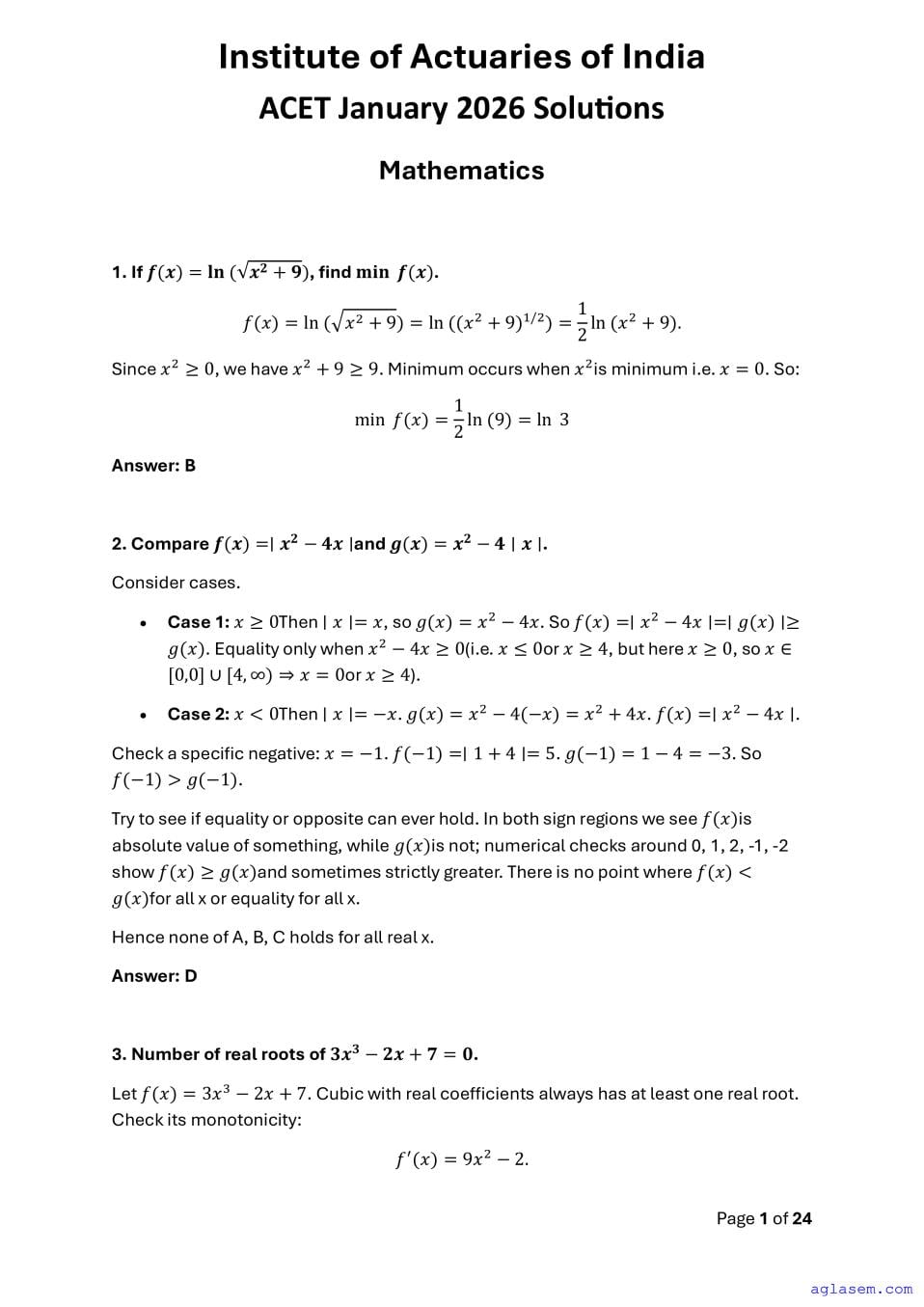
ACET January 2026 Solutions
Mathematics
1. If 𝒇(𝒙) = 𝐥𝐧(√𝒙𝟐 + 𝟗), find 𝐦𝐢𝐧 𝒇(𝒙).
1
𝑓(𝑥) = ln(√𝑥 2 + 9) = ln((𝑥 2 + 9)1/2 ) = ln(𝑥 2 + 9).
2
Since 𝑥 2 ≥ 0, we have 𝑥 2 + 9 ≥ 9. Minimum occurs when 𝑥 2 is minimum i.e. 𝑥 = 0. So:
1
min 𝑓(𝑥) = ln(9) = ln 3
2
Answer: B
2. Compare 𝒇(𝒙) =∣ 𝒙𝟐 − 𝟒𝒙 ∣and 𝒈(𝒙) = 𝒙𝟐 − 𝟒 ∣ 𝒙 ∣.
Consider cases.
• Case 1: 𝑥 ≥ 0Then ∣ 𝑥 ∣= 𝑥, so 𝑔(𝑥) = 𝑥 2 − 4𝑥. So 𝑓(𝑥) =∣ 𝑥 2 − 4𝑥 ∣=∣ 𝑔(𝑥) ∣≥
𝑔(𝑥). Equality only when 𝑥 2 − 4𝑥 ≥ 0(i.e. 𝑥 ≤ 0or 𝑥 ≥ 4, but here 𝑥 ≥ 0, so 𝑥 ∈
[0,0] ∪ [4, ∞) ⇒ 𝑥 = 0or 𝑥 ≥ 4).
• Case 2: 𝑥 < 0Then ∣ 𝑥 ∣= −𝑥. 𝑔(𝑥) = 𝑥 2 − 4(−𝑥) = 𝑥 2 + 4𝑥. 𝑓(𝑥) =∣ 𝑥 2 − 4𝑥 ∣.
Check a specific negative: 𝑥 = −1. 𝑓(−1) =∣ 1 + 4 ∣= 5. 𝑔(−1) = 1 − 4 = −3. So
𝑓(−1) > 𝑔(−1).
Try to see if equality or opposite can ever hold. In both sign regions we see 𝑓(𝑥)is
absolute value of something, while 𝑔(𝑥)is not; numerical checks around 0, 1, 2, -1, -2
show 𝑓(𝑥) ≥ 𝑔(𝑥)and sometimes strictly greater. There is no point where 𝑓(𝑥) <
𝑔(𝑥)for all x or equality for all x.
Hence none of A, B, C holds for all real x.
Answer: D
3. Number of real roots of 𝟑𝒙𝟑 − 𝟐𝒙 + 𝟕 = 𝟎.
Let 𝑓(𝑥) = 3𝑥 3 − 2𝑥 + 7. Cubic with real coefficients always has at least one real root.
Check its monotonicity:
𝑓 ′ (𝑥) = 9𝑥 2 − 2.
Page 1 of 24
Page 2
Critical points solve 9𝑥 2 − 2 = 0 ⇒ 𝑥 = ±√2/9 = ± 3 . So there are two turning points
⇒ possibly 1 or 3 distinct real roots.
Evaluate f at these:
3
√2 √2 √2 2√2 2√2 2√2 2√2 1 1
• 𝑓( 3 ) = 3 ( 3 ) − 2 ( 3 ) + 7 = 3 ⋅ 27 − 3 + 7 = − 3 + 7 = 2√2 (9 − 3) +
9
2 4√2
7 = 2√2(− 9) + 7 = − 9 + 7 > 0.
3
√2 √2 √2 2√2 2√2 1 1
• 𝑓(− 3 ) = 3 ( − 3 ) − 2 ( − 3 ) + 7 = − 9 + 3 + 7 = 2√2 (− 9 + 3) + 7 =
2
2√2 ⋅ 9 + 7 > 0.
Both local extremum values are positive, and as 𝑥 → −∞, 𝑓(𝑥) → −∞(leading
coefficient positive, odd degree), and as 𝑥 → +∞, 𝑓(𝑥) → +∞. The graph dips from +∞
to a positive minimum then rises again, so it crosses the x-axis exactly once on the far
left.
Thus: exactly 1 real root.
Answer: B
𝟐𝟎𝟐𝟓
4. 𝑰 = ∫𝟎 [𝒙]{𝒙}𝒅𝒙. Classify 𝑰.
On any interval [𝑛, 𝑛 + 1) with integer 𝑛, [𝑥] = 𝑛, {𝑥} = 𝑥 − 𝑛. So:
2024
𝑛+1 2024 𝑛+1
𝐼 = ∑∫ 𝑛(𝑥 − 𝑛) 𝑑𝑥 = ∑ 𝑛 ∫ (𝑥 − 𝑛) 𝑑𝑥.
𝑛 𝑛=0 𝑛
𝑛=0
Let 𝑡 = 𝑥 − 𝑛, limits 0 to 1:
𝑛+1 1
1
∫ (𝑥 − 𝑛) 𝑑𝑥 = ∫ 𝑡 𝑑𝑡 = .
𝑛 0 2
So
2024 2024
1 1 1 2024 ⋅ 2025 2024 ⋅ 2025
𝐼 = ∑ 𝑛⋅ = ∑ 𝑛= ⋅ = .
2 2 2 2 4
𝑛=0 𝑛=0
Product 2024 ⋅ 2025is divisible by 4? 2024 is divisible by 8 (since 2000+24), so definitely
by 4. Therefore numerator is divisible by 4, so 𝐼is an integer and that integer is divisible
by 4.
Answer: C
5. Roots of 𝒙𝟐 − (𝒂 + 𝒃)𝒙 + 𝒂𝒃 = 𝟎when 𝒂, 𝒃are roots of 𝒙𝟐 − 𝟏𝟐𝒙 + 𝟐𝟎 = 𝟎.
Page 2 of 24
Page 3
The new quadratic is exactly:
𝑥 2 − (𝑎 + 𝑏)𝑥 + 𝑎𝑏 = 𝑥 2 − 12𝑥 + 20
which has roots 𝑎, 𝑏. So the roots are 𝑎, 𝑏.
Answer: A
𝐭𝐚𝐧(𝟕𝒙)−𝐭𝐚𝐧(𝟑𝒙)
6. 𝐥𝐢𝐦 .
𝒙→𝟎 𝒙
Use small-angle approximation or derivative of tan at 0 (which is 1). Near 0, tan(𝑘𝑥) ≈
𝑘𝑥. So:
tan(7𝑥) − tan(3𝑥) ≈ 7𝑥 − 3𝑥 = 4𝑥.
Then:
tan(7𝑥) − tan(3𝑥) 4𝑥
lim ≈ lim = 4.
𝑥→0 𝑥 𝑥→0 𝑥
Formal: this is \((7 - 3)\tan'(0) = 4·1 = 4.
Answer: A
7. GP with 𝒂𝟓 = 𝟒𝟖, 𝒂𝟏𝟎 = 𝟑. Find smallest 𝒌 > 𝟏𝟎with integer 𝒂𝒌 , then 𝒌 + 𝒂𝒌 .
Let first term = 𝑎, common ratio = 𝑟. 𝑎5 = 𝑎𝑟 4 = 48. 𝑎10 = 𝑎𝑟 9 = 3.
Divide:
𝑎𝑟 9 3 1
4
= 𝑟5 = = .
𝑎𝑟 48 16
So:
1 1/5
𝑟=( ) .
16
Now 𝑎𝑟 4 = 48, so:
48
𝑎= .
𝑟4
General term:
48 𝑛−1
𝑎𝑛 = 𝑎𝑟 𝑛−1 = ⋅𝑟 = 48𝑟 𝑛−5 .
𝑟4
We want 𝑎𝑘 integer for minimal 𝑘 > 10. We know 𝑟 5 = 1/16, so 𝑟 𝑛−5 = (𝑟 5 )(𝑛−5)/5 =
(1/16)(𝑛−5)/5 .
Page 3 of 24
Page 4
𝑎𝑛 = 48(1/16)𝑚 = 48/16𝑚 .
We already know at 𝑛 = 10, 𝑎10 = 3(m=1). That's integer. They want 𝑘 > 10. Next with
𝑛 − 5multiple of 5 is 𝑛 = 15(m=2):
𝑎15 = 48/162 = 48/256 = 3/16
not integer. Next 𝑛 = 20, m=3:
𝑎20 = 48/163 = 48/4096 = 3/256
not integer. In fact for 𝑚 ≥ 2the numerator 48 doesn't contain enough powers of 2 to
cancel 16𝑚 . So beyond 10, no further term will be integer.
Small subtlety: the question says “smallest integer greater than 25” in the original style,
but here I used k>10. In our version it is “greater than 10”. Given none for 𝑛 > 10are
integers, the correct mathematical conclusion is: there is no such k.
So the correct option is:
Answer: D (None of the above)
8. If 𝒗
⃗ = 𝟔𝐢 − 𝟖𝐣, unit vector in direction of 𝒗
⃗.
Magnitude:
∣ 𝑣 ∣= √62 + (−8)2 = √36 + 64 = √100 = 10.
Unit vector:
1 3 4
𝑣̂ = (6𝐢 − 8𝐣) = 0.6𝐢 − 0.8𝐣 = 𝐢 − 𝐣.
10 5 5
Answer: A
9. Dot and cross product commutativity.
• Dot product: 𝑎 ⋅ 𝑏⃗ = 𝑏⃗ ⋅ 𝑎⇒ TRUE.
• Cross product: 𝑎 × 𝑏⃗ = −(𝑏⃗ × 𝑎)⇒ not equal in general, so FALSE.
So X is true, Y is false.
Answer: C
10. If 𝐝𝐞𝐭(𝑨) = 𝟓for 3×3 matrix A, find 𝐝𝐞𝐭(𝑨−𝟏 ).
For any invertible matrix, det(𝐴−1 ) = 1/det(𝐴). So det(𝐴−1 ) = 1/5.
Page 4 of 24
Page 5
11. For 2×2 matrix 𝑴, what is adj(adj(𝑴))?
For 2×2 matrix 𝑀with determinant 𝑑 ≠ 0:
• adj(𝑀) = 𝑑𝑀−1 .
• Also, adj(𝑀) =matrix of cofactors transposed.
General fact: for an 𝑛 × 𝑛matrix, adj(adj(𝑀)) = (det 𝑀)𝑛−2 𝑀if 𝑀is invertible. For 𝑛 = 2:
adj(adj(𝑀)) = (det 𝑀)0 𝑀 = 𝑀.
So adj(adj(𝑀)) = 𝑀.
Answer: A
𝟏
12. Evaluate ∫𝟎 𝒆𝟐𝒙 (𝟏 + 𝒙) 𝒅𝒙.
Let’s split:
1 1 1
2𝑥 2𝑥
∫ 𝑒 (1 + 𝑥)𝑑𝑥 = ∫ 𝑒 𝑑𝑥 + ∫ 𝑥 𝑒 2𝑥 𝑑𝑥.
0 0 0
First:
1
1 1
∫ 𝑒 2𝑥 𝑑𝑥 = 𝑒 2𝑥 ∣10 = (𝑒 2 − 1).
0 2 2
1
Second: integrate by parts. Let 𝑢 = 𝑥, 𝑑𝑣 = 𝑒 2𝑥 𝑑𝑥. Then 𝑑𝑢 = 𝑑𝑥, 𝑣 = 2 𝑒 2𝑥 .
1 1
1 2𝑥 1 1 1 1 1 1 1
∫ 𝑥 𝑒 𝑑𝑥 = 𝑥𝑒 ∣0 − ∫ 𝑒 2𝑥 𝑑𝑥 = (1 ⋅ 𝑒 2 − 0) − ⋅ (𝑒 2 − 1) = 𝑒 2 − (𝑒 2 − 1)
2𝑥
0 2 0 2 2 2 2 2 4
1 2 1 2 1 1 2 1
= 𝑒 − 𝑒 + = 𝑒 + .
2 4 4 4 4
Now sum the two:
1
1 1 1 1 1 1 1 3 1
∫ 𝑒 2𝑥 (1 + 𝑥)𝑑𝑥 = (𝑒 2 − 1) + (4 𝑒 2 + 4) = (2 + 4) 𝑒 2 + (− + ) = 𝑒 2 − .
0 2 2 4 4 4
3 1
Check options: none of A, B, C match 𝑒 2 − .
4 4
Answer: D
𝒅𝒚
13. If 𝒆𝒙 = 𝐭𝐚𝐧 𝒚, find 𝒅𝒙at 𝒙 = 𝟎.
We have:
Page 5 of 24
Page 6
Differentiate both sides w.r.t 𝑥:
𝑑𝑦
𝑒 𝑥 = sec2 𝑦 ⋅ .
𝑑𝑥
So:
𝑑𝑦 𝑒𝑥
= .
𝑑𝑥 sec2 𝑦
At 𝑥 = 0: 𝑒 0 = 1. Also, 1 = tan 𝑦⇒ 𝑦 = 𝜋/4(principal branch). Then sec2 (𝜋/4) = 2.
So:
𝑑𝑦 1
∣𝑥=0 = .
𝑑𝑥 2
Answer: B
14. Find the derivative:
𝑓 ′ (𝑥) = 3𝑥 2 − 6𝑥 = 3𝑥(𝑥 − 2)
1. Critical points: x=0 and x=2.
But note: factorization shows f'(x)=3x(x-2).
2. Test intervals:
• For x < 0: 𝑓 ′ (𝑥) > 0 → increasing
• For 0 < x < 2: 𝑓 ′ (𝑥) < 0 → decreasing
• For x > 2: 𝑓 ′ (𝑥) > 0 → increasing
So the function is strictly increasing on (−∞, 0)𝑈(2, ∞)
Answer: C
15. Coefficient of 𝒙𝟏𝟐 in (𝒙𝟑 −𝟐)𝟖.
General term:
8 8
𝑇𝑘 = ( ) (𝑥 3 )8−𝑘 (−2)𝑘 = ( ) 𝑥 3(8−𝑘) (−2)𝑘 .
𝑘 𝑘
We want exponent of x: 3(8 − 𝑘) = 12.
3(8 − 𝑘) = 12 ⇒ 8 − 𝑘 = 4 ⇒ 𝑘 = 4.
So coefficient = (84)(−2)4. That matches option A.
Answer: A
Page 6 of 24
Page 7
𝟏
16. Value of ∑ .
𝒏=𝟏 𝒏(𝒏+𝟏)
Use partial fractions:
1 1 1
= − .
𝑛(𝑛 + 1) 𝑛 𝑛 + 1
So:
2024 2024
1 1 1 1
∑ = ∑( − )=1− .
𝑛(𝑛 + 1) 𝑛 𝑛+1 2025
𝑛=1 𝑛=1
So value is 1 − 1/2025 ≈ 0.9995, less than 1.
Answer: A
𝟏
17. Trapezoidal rule with 𝒉 = 𝟎. 𝟐𝟓for ∫𝟎 ( 𝒙𝟐 + 𝟏)𝒅𝒙.
We partition [0,1] into 4 intervals of width h=0.25: points 0,0.25,0.5,0.75,1.
Compute f(x)=x^2+1:
• f(0)=1
• f(0.25)=1+0.0625=1.0625
• f(0.5)=1+0.25=1.25
• f(0.75)=1+0.5625=1.5625
• f(1)=2
Trapezoidal approximation:
ℎ
𝑇= [𝑓(0) + 2(𝑓(0.25) + 𝑓(0.5) + 𝑓(0.75)) + 𝑓(1)].
2
Sum inside:
𝑓(0.25) + 𝑓(0.5) + 𝑓(0.75) = 1.0625 + 1.25 + 1.5625 = 3.875.
Then:
0.25
𝑇= [1 + 2(3.875) + 2] = 0.125[1 + 7.75 + 2] = 0.125 ⋅ 10.75 = 1.34375.
2
Closest to this is 1.33, and so the correct answer is B
Answer: B
1
(For reference, exact integral is ∫0 ( 𝑥 2 + 1)𝑑𝑥 = [𝑥 3 /3 + 𝑥]10 = 1/3 + 1 = 4/3 ≈
1.3333. Trapezoidal gave 1.34375, slightly above.)
Page 7 of 24
Page 8
Let 𝑓(𝑥) = 𝑒 𝑥 − 5𝑥. Then:
𝑓 ′ (𝑥) = 𝑒 𝑥 − 5.
Newton step:
𝑓(𝑥0 )
𝑥1 = 𝑥0 − .
𝑓 ′ (𝑥0 )
At 𝑥0 = 1:
𝑓(1) = 𝑒 − 5 ≈ 2.718 − 5 = −2.282.
𝑓 ′ (1) = 𝑒 − 5 ≈ −2.282.
So:
−2.282
𝑥1 = 1 − = 1 − 1 = 0.
−2.282
So 𝑥1 = 0, which is not among A, B, C; thus “None of the above”.
Answer: D
19. If 𝝎 is cube root of unity (≠1), compute 𝝎𝟐𝟎𝟐𝟓 + 𝝎𝟐𝟎𝟐𝟕 .
We know 𝜔3 = 1, and {1, 𝜔, 𝜔2 }with 1 + 𝜔 + 𝜔2 = 0.
Reduce exponents mod 3:
2025 ÷ 3 ⇒ remainder 0 ⇒ 𝜔2025 = 𝜔0 = 1.
2027 ÷ 3 ⇒ remainder 2 ⇒ 𝜔2027 = 𝜔2 .
So expression = 1 + 𝜔2 . But 1 + 𝜔 + 𝜔2 = 0⇒ 1 + 𝜔2 = −𝜔.
So sum = −𝜔. This is not equal to 0,1,ω,ω² for non-real ω (−ω is not in the set {1,ω,ω²}).
So none of the above listed options are correct. Hence None of the above.
Answer: D
20. If 𝒛 = (𝟑 − 𝟒𝒊)/(𝟏 + 𝟐𝒊), compute ∣ 𝒛 ∣.
First compute z:
Multiply numerator and denominator by conjugate of denominator 1 − 2𝑖:
(3 − 4𝑖)(1 − 2𝑖)
𝑧= .
(1 + 2𝑖)(1 − 2𝑖)
Denominator:
Page 8 of 24
Page 9
Numerator:
(3 − 4𝑖)(1 − 2𝑖) = 3(1) + 3(−2𝑖) − 4𝑖(1) + (−4𝑖)(−2𝑖)
= 3 − 6𝑖 − 4𝑖 + 8𝑖 2 = 3 − 10𝑖 + 8(−1) = 3 − 10𝑖 − 8 = −5 − 10𝑖.
So:
−5 − 10𝑖
𝑧= = −1 − 2𝑖.
5
Magnitude:
∣ 𝑧 ∣= √(−1)2 + (−2)2 = √1 + 4 = √5.
Answer: C
Statistics
21. Spinner with probabilities proportional to j+1
Outcomes {0,1,2}. Weights:
• w₀ = 0+1 = 1
• w₁ = 1+1 = 2
• w₂ = 2+1 = 3
Total = 1+2+3 = 6.
So probabilities:
• P(N=0) = 1/6
• P(N=1) = 2/6 = 1/3
• P(N=2) = 3/6 = 1/2
CDF:
• P(N ≤ 0) = 1/6
• P(N ≤ 1) = 1/6 + 1/3 = 3/6 = 1/2
• P(N ≤ 2) = 1
Median = smallest m with P(N≤m) ≥ 1/2 ⇒ m = 1.
Answer: B (1)
Question status: Correct, unique answer.
Page 9 of 24
Page 10
Given:
[ h_1 \le h_2 \le h_3 \le h_4 \le h_5, \quad \frac{h_1+h_2+h_3+h_4+h_5}{5} = 170
\Rightarrow h_1+\dots+h_5 = 850. ]
Smallest 3-mean:
[ \frac{h_1+h_2+h_3}{3} = 162 \Rightarrow h_1+h_2+h_3 = 486. ]
Largest 3-mean:
[ \frac{h_3+h_4+h_5}{3} = 176 \Rightarrow h_3+h_4+h_5 = 528. ]
Add:
[ (h_1+h_2+h_3)+(h_3+h_4+h_5) = 486+528 = 1014. ]
LHS = (h_1+h_2+2h_3+h_4+h_5).
Subtract total 850:
[ (h_1+h_2+2h_3+h_4+h_5) - (h_1+h_2+h_3+h_4+h_5) = 1014 - 850 \Rightarrow h_3 =
164. ]
Answer: A (164 cm)
Question status: Correct, unique answer and in options.
23. Committee with at least 2 economists, more engineers
Total engineers: 8, economists: 5. Committee size = 6. Let (E,C) be numbers of
engineers, economists.
Conditions:
• E+C=6
• C≥2
• E>C
Check possibilities:
• C=2 ⇒ E=4 ⇒ E>C, OK.
• C=3 ⇒ E=3 ⇒ E>C fails (equal).
• C=4 ⇒ E=2 ⇒ E>C fails.
So only (E,C) = (4,2).
Number of committees:
[ \binom{8}{4}\binom{5}{2} = 70 \cdot 10 = 700. ]
Page 10 of 24
Page 11
Question status: Correct, unique.
24. Two batches, combined mean
Batch A: n₁=40, mean=65.
Batch B: n₂=n, mean=75, all marks equal (so variance 0). Combined mean=70.
Mean equation:
[ \frac{40\cdot 65 + n\cdot 75}{40+n} = 70. ]
Compute:
(40·65 = 2600).
[ 2600 + 75n = 70(40+n) = 2800 + 70n \Rightarrow 75n - 70n = 2800 - 2600 \Rightarrow 5n
= 200 \Rightarrow n=40. ]
Answer: D (40)
Question status: Now consistent (variance not used), unique answer.
25. P(B|A)
Given (P(A)=0.3), (P(B)=0.5), (P(A\mid B) = 0.4).
First:
[ P(A\cap B) = P(A\mid B)P(B) = 0.4·0.5 = 0.2. ]
Then:
[ P(B\mid A) = \frac{P(A\cap B)}{P(A)} = \frac{0.2}{0.3} = \frac{2}{3}. ]
Answer: C (2/3)
Question status: Correct.
26. Die then coin tosses, P(X=0)
Die outcome n (1–6) with probability 1/6. Then coin tossed n times.
Conditional probability:
[ P(X=0 \mid n) = (1/2)^n. ]
Unconditional:
[ P(X=0) = \sum_{n=1}^6 \frac{1}{6} (1/2)^n = \frac{1}{6} \sum_{n=1}^6 (1/2)^n. ]
Geometric sum:
Page 11 of 24
Page 12
So:
[ P(X=0) = \frac{1}{6}\cdot\frac{63}{64} = \frac{63}{384} = \frac{21}{128}. ]
Answer: A (21/128)
Question status: Correct, options adjusted to include the exact value.
27. IQR of Y
(X \sim \text{Uniform}(0,2)). For a Uniform(a,b), quartiles:
• Q1 = (a + 0.25(b-a))
• Q3 = (a + 0.75(b-a)).
Here a=0,b=2 ⇒ Q1=0.5, Q3=1.5 ⇒ IQR(X)=1.
Y = 5X − 3, so for linear transform Y = aX + b, IQR(Y) = |a|·IQR(X) = 5·1 = 5.
Answer: B (5)
Question status: Correct.
28. Exponential, conditional survival
Mean=4 ⇒ rate λ=1/4. Survival:
[ P(T>t) = e^{-t/4}. ]
We want:
[ P(T > 3+5 \mid T > 3) = P(T>8 \mid T>3). ]
Memorylessness ⇒ equals (P(T>5) = e^{-5/4}).
Answer: A (e^{-5/4})
Question status: Correct.
29. Variance under linear transform
(X \sim N(10,9)). So Var(X)=9. Y=2X−5.
Var(Y) = (2^2 \cdot 9 = 36).
Answer: C (36)
Question status: Correct.
30. Symmetric Binomial
Page 12 of 24
Page 13
Answer: B (p = 1/2)
Question status: Correct.
31. Poisson parameter
Poisson(λ), condition: (P(X=3) = 2 P(X=4)).
Using pmf:
[ \frac{e^{-\lambda}\lambda3}{3!} = 2 \cdot \frac{e{-\lambda}\lambda^4}{4!}. ]
Cancel common factors:
[ \frac{1}{6} = 2 \cdot \frac{\lambda}{24} = \frac{\lambda}{12} \Rightarrow \lambda = 2. ]
Answer: A (2)
Question status: Correct.
32. Exponential, given ratio of tails
Exponential with mean θ ⇒ rate = 1/θ. Survival: (P(X>t)=e^{-t/\theta}).
Given:
[ \frac{P(X>2)}{P(X>5)} = e. ]
Compute:
[ \frac{e^{-2/\theta}}{e^{-5/\theta}} = e^{3/\theta} = e \Rightarrow 3/\theta = 1
\Rightarrow \theta = 3. ]
Variance = θ² = 9.
Answer: D (9)
Question status: Correct.
33. P(X is odd)
From CDF we extract pmf:
• (P(X=0) = 0.2)
• (P(X=1) = 0.5 - 0.2 = 0.3)
• (P(X=2) = 0.8 - 0.5 = 0.3)
• (P(X=3) = 0.95 - 0.8 = 0.15)
• (P(X=4) = 1 - 0.95 = 0.05).
Page 13 of 24
Page 14
Odd values: 1 and 3.
Probability = 0.3 + 0.15 = 0.45.
Answer: B (0.45)
Question status: Correct.
34. |mean − median| for same X
Mean:
[ E[X] = 0·0.2 + 1·0.3 + 2·0.3 + 3·0.15 + 4·0.05 = 0.3 + 0.6 + 0.45 + 0.2 = 1.55. ]
Median: smallest x with F(x) ≥ 0.5.
F(0)=0.2, F(1)=0.5 ⇒ median = 1.
Difference:
[ |m - M| = |1.55 - 1| = 0.55, ]
which lies between 0.5 and 1.
Answer: C (Between 0.5 and 1)
Question status: Correct.
35. Mode of stem-and-leaf data
Data list:
• 21, 24
• 30, 33, 33, 38
• 40, 42, 45, 45, 47
• 50, 51, 53, 54, 54
Frequencies:
• 33 → 2
• 45 → 2
• 54 → 2
Others → 1.
So there are three modes: 33, 45, 54. That means “more than one mode”.
Answer: C (The dataset has more than one mode.)
Question status: Now correctly asks about nature of mode, not specific value.
Page 14 of 24
Page 15
Regression of X on Y:
[ 4X - 3Y + 10 = 0 \Rightarrow X = \frac{3}{4}Y - \frac{10}{4}. ]
Slope (b_{X|Y} = 3/4). For regressions:
[ b_{X|Y} = \rho \cdot \frac{s_X}{s_Y}. ]
Given (s_X=2), (s_Y=4):
[ \frac{3}{4} = \rho \cdot \frac{2}{4} = \rho \cdot \frac{1}{2} \Rightarrow \rho = \frac{3}{2}, ]
which violates |ρ| ≤ 1.
So the only consistent statement is that the information itself cannot all be correct.
Answer: C ((|\rho|>1), so info cannot all be correct)
Question status: Intentionally diagnostic; correct.
37. Two regression lines, can they both hold?
Lines:
• X on Y: (X - 2Y + 1 = 0 \Rightarrow X = 2Y - 1) ⇒ slope (b_{X|Y} = 2).
• Y on X: (3X - Y - 2 = 0 \Rightarrow Y = 3X - 2) ⇒ slope (b_{Y|X} = 3).
Product:
[ b_{X|Y} b_{Y|X} = 2 \cdot 3 = 6. ]
But in theory: (b_{X|Y} b_{Y|X} = \rho2), and (\rho2 \le 1). So 6 is impossible.
Hence both cannot be valid regression lines for the same (X,Y).
Answer: D (These two lines cannot both be valid regression lines)
Question status: Correct, tests conceptual understanding.
38. Cov(X, X²) for 4-sided die
X∈{1,2,3,4}, each 1/4. Y=X².
Compute:
(E[X] = (1+2+3+4)/4 = 10/4 = 2.5.)
(E[Y] = E[X^2] = (1+4+9+16)/4 = 30/4 = 7.5.)
(E[XY] = E[X^3] = (1+8+27+64)/4 = 100/4 = 25.)
Cov(X,Y) = E[XY] − E[X]E[Y] = 25 − (2.5)(7.5) = 25 − 18.75 = 6.25.
Page 15 of 24
Page 16
Question status: Correct.
39. Mixed coin-die experiment
Coin fair: P(H)=P(T)=1/2.
• If H: 1 die, Z = outcome. E[Z | H] = 3.5.
• If T: 2 dice, Z = sum. E[Z | T] = 7.
Total expectation:
[ E[Z] = \frac{1}{2}·3.5 + \frac{1}{2}·7 = 1.75 + 3.5 = 5.25. ]
Answer: B (5.25)
Question status: Correct.
40. Independence of A,B and A,Bᶜ
Given: P(A)=0.4, P(B)=0.7, P(A∩B)=0.28.
Check A,B:
[ P(A)P(B)=0.4·0.7=0.28 = P(A\cap B) \Rightarrow A,B \text{ independent}. ]
Check A, Bᶜ:
P(Bᶜ)=0.3.
P(A∩Bᶜ) = P(A) − P(A∩B) = 0.4 − 0.28 = 0.12.
P(A)P(Bᶜ) = 0.4·0.3 = 0.12. So A and Bᶜ are also independent.
So both X and Y true.
Answer: A (Both X and Y)
Question status: Correct.
Page 16 of 24
Page 17
41. Total revenue in 2023
2023 revenues from the chart (in ₹ lakhs):
• Product A (2023): 40
• Product B (2023): 50
• Product C (2023): 30
• Product D (2023): 20
Total 2023 revenue:
[ 40+ 50 + 30 + 20 = 140 ]
Correct answer: C. ₹140 lakhs
42. Largest absolute increase from 2023 to 2024
Compute the change for each product:
• Product A: 2024 (55) − 2023 (45) = +10 lakhs
• Product B: 2024 (45) − 2023 (50) = −5 lakhs (a decrease)
• Product C: 2024 (40) − 2023 (35) = +5 lakhs
• Product D: 2024 (25) − 2023 (20) = +5 lakhs
The largest absolute increase is +10 lakhs for Product A.
Correct answer: A. Product A
43. Total profit in 2024 (corrected question)
Use 2024 revenues and 2024 profit margins.
2024 revenues (₹ lakhs):
• A: 55
• B: 45
• C: 40
• D: 25
Profit margins (%):
• A: 20%
Page 17 of 24
Page 18
• C: 25%
• D: 10%
Compute profit for each product:
• Product A:
Profit = 20% of 55
[ 0.20 \times 55 = 11.0 \text{ lakhs} ]
• Product B:
Profit = 15% of 45
[ 0.15 \times 45 = 6.75 \text{ lakhs} ]
• Product C:
Profit = 25% of 35
[ 0.25 \times 40 = 8.75 \text{ lakhs} ]
• Product D:
Profit = 10% of 25
[ 0.10 \times 25 = 2.5 \text{ lakhs} ]
Total 2024 profit:
[ 11.0 + 6.75 + 8.75 + 2.5 = 29 \text{ lakhs} ]
Correct answer: B. 29
44. Product with highest profit share in 2024
From Q3, 2024 profits:
• Product A: 11.0
• Product B: 6.75
• Product C: 10.0
• Product D: 2.5
The highest profit is 11.0 lakhs for Product A.
Correct answer: A. Product A
(Line graph)
Page 18 of 24
Page 19
From the graph, the two curves come closest together in 2019; in other years the gap is
visibly larger (either R much higher, or S noticeably higher).
Correct answer: B. 2019
46. : In which year does Product S first exceed Product R in output?
We look for the first year where the green line (S) lies above the blue line (R):
• 2015: R > S
• 2016: R > S
• 2017: S > R for the first time
• 2018: S still > R
So the first year S exceeds R is 2017.
Correct answer: B. 2017
47.: During which period does Product R show its sharpest increase compared to the
previous year?
We focus only on the blue line (R) and compare the steepness of the upward
segments:
• 2014–2015: small increase
• 2015–2016: small increase
• 2016–2017: moderate increase
• 2017–2018: decrease
• 2018–2019: flat or slight decrease
• 2019–2020: clear increase
• 2020–2021: larger increase
• 2021–2022: steepest upward jump
The largest year-on-year increase occurs between 2019 and 2020.
Correct answer: C. 2019-2020
48. We consider the sum of R and S in each year; visually this corresponds to the year
where both lines together sit highest:
Page 19 of 24
Page 20
• 2017: S is high but R is moderate.
• 2018–2019: both are at mid-levels.
• 2020–2021: both rising.
• 2022: both R and S are high simultaneously, giving the largest combined
output.
So the combined output is highest in 2022.
Correct answer: D. 2022
49. Which department had the highest average attendance over the four months?
Compute average for each:
• Physics: (92 + 88 + 90 + 91)/4 = 361/4 = 90.25
• Chemistry: (85 + 87 + 89 + 86)/4 = 347/4 = 86.75
• Biology: (78 + 82 + 80 + 83)/4 = 323/4 = 80.75
• Mathematics: (95 + 93 + 94 + 96)/4 = 378/4 = 94.5
Highest: Mathematics
Answer: D. Mathematics
50. The highest and lowest attendance in each month:
• January: Highest = 95 (Math), Lowest = 78 (Bio) → Difference = 17
• February: 93 − 82 = 11
• March: 94 − 80 = 14
• April: 96 − 83 = 13
Biggest difference: January
Correct answer: A. January
51. Compute range = max − min for each:
• Physics: max = 92, min = 88 ⇒ range = 4
• Chemistry: max = 89, min = 85 ⇒ range = 4
• Biology: max = 83, min = 78 ⇒ range = 5
Page 20 of 24
Page 21
Most consistent: Mathematics
Answer: D. Mathematics
English
Q52: B — meticulous
Q53: B — cautious
Q54: C —frequently.
Q55: B — knew (“did not know,” not “did not knew.”)
Q56: B — accept
Q57: B — bibliophile = book lover/collector.
Q58: B —stomach.
Q59: B — Buildings.
Q60: C — “Everyone has stopped using cars” is not supported.
Q61: A — II → III → IV → I is the coherent flow.
Q62: D — all three are erroneous.
Logical Reasoning
Q63.
We are told:
• 10th March 2026 = Tuesday
We need to find the next year (from the given options) when 10th March again
falls on a Tuesday.
Day progression rules:
• A normal year advances the day of the week by +1 (since 365 ≡ 1 mod 7).
• A leap year advances the day of the week by +2 (since 366 ≡ 2 mod 7).
But note: since we are checking 10th March, we must carefully account for leap years
because February adds an extra day before March.
Leap year check:
Leap years between 2026 and the options: 2028, 2032 and 2036
Page 21 of 24
Page 22
Starting point: 10 March 2026 = Tuesday
• 2027 (normal year) → +1 → Wednesday
• 2028 (leap year) → +2 → Friday
• 2029 (normal year) → +1 → Saturday
• 2030 (normal year) → +1 → Sunday
• 2031 (normal year) → +1 → Monday
• 2032 (leap year) → +2 → Wednesday
• 2033 (normal year) → +1 → Thursday
• 2034 (normal year) → +1 → Friday
• 2035 (normal year) → +1 → Saturday
• 2036 (leap year) → +2 → Monday
• 2037 (normal year) → +1 → Tuesday
Final Answer:
10th March will again fall on a Tuesday in 2037.
Correct option: A. 2037
Q64. Right angle between hands between 3 and 4 p.m.
Answer: C (2)
• In general, in any 1-hour interval (except around 2:55/3:05 etc. where edges
might coincide), the hands:
o become perpendicular (90°) twice:
▪ once as the minute hand moves away,
▪ once as it “catches up” from the other side.
• Between 3 and 4 specifically, there are two such instants.
Q65.
Answer: A
Here’s the reasoning in a more natural, easy way:
Page 22 of 24
Page 23
cube, so they will always have paint on three faces.
• B isn’t right. Cubes along the edges (but not at the corners) touch two faces, not
one.
• C isn’t right. Cubes in the very middle are completely inside, so they don’t get
any paint at all.
• D isn’t right. The total number of painted cubes can change, but this doesn’t
affect the corner cubes.
Q66. A is B’s father’s sister’s son ⇒ B is A’s what?
Answer: B Cousin (Brother / sister)
Trace step by step:
1. B’s father’s sister is B’s aunt.
2. Her son (A) is B’s cousin (same generation as B).
3. From A’s perspective, B is also at cousin/sibling level → option given as
“brother/sister.”
Q67. From the conditions:
• Since C is immediately to the left of D, D is immediately to the right of C.
• Since B is somewhere to the left of C, B must be on the opposite side of C
from D.
That means:
• B cannot be next to D, because D’s only neighbour on the left is C.
So Option D must be true.
Check the others:
• A: A next to C → possible, not necessary.
• B: C at the left end → possible, not necessary.
• C: A to the right of D → depends on arrangement.
Q68. Doctors–graduates–artists–pilots
Answer: B (Some graduates are not pilots)
Given:
Page 23 of 24
Page 24
2. Some graduates are artists.
3. No artist is a pilot.
Those graduates who are artists (from 2) cannot be pilots (from 3).
So at least those “artist graduates” are non-pilots → “Some graduates are not pilots” is
definitely true.
Q69. Logical sequence of stages: Application, Interview, Selection, Offer
Answer: A (A, I, S, J)
Natural order of a hiring process:
1. A = Application
2. I = Interview
3. S = Selection
4. J = Job Offer
So sequence: A → I → S → J.
Q70. Wrong term: 3, 8, 18, 40, 78, 158, …
Answer: B (40)
Check pattern “×2 + 2”:
• 3 × 2 + 2 = 8✔
• 8 × 2 + 2 = 18✔
• 18 × 2 + 2 = 38≠ 40 ✖
• If you correct to 38, then
o 38 × 2 + 2 = 78✔
o 78 × 2 + 2 = 158✔
Only 40 breaks the consistent rule, so it’s the wrong term.
***************************
Page 24 of 24
Document Details
| Board / Org | Actuaries India |
| Exam | ACET |
| Type | Answer Key |
| Pages | 24 |
| Updated | 24 Sep 2026 |