ACET Mar 2025 Solution
Finished viewing? Save it for later —
Download ACET Mar 2025 Solution (PDF · 7 pages)About ACET Mar 2025 Solution
ACET Mar 2025 Solution is available here for free download. Published by Actuaries India for ACET, this answer key can be viewed online or downloaded as a PDF (7 pages). Candidates preparing for ACET can use ACET Mar 2025 Solution to understand the exam pattern, the type of questions asked, and the overall difficulty level.
Frequently Asked Questions
How can I download ACET Mar 2025 Solution?
Open this page and click the Download button to save ACET Mar 2025 Solution as a PDF. It is completely free on AglaSem Docs.
Is ACET Mar 2025 Solution free to download?
Yes. ACET Mar 2025 Solution can be viewed online and downloaded as a PDF free of cost on AglaSem Docs.
How many pages does ACET Mar 2025 Solution have?
ACET Mar 2025 Solution contains 7 pages, which you can read online or download together as a single PDF.
Where can I find more ACET study material?
You can find more ACET question papers, sample papers, syllabus, and answer keys on AglaSem Docs.
ACET Mar 2025 Solution – Text
Read the full text of this answer key below — useful to quickly search, copy and reference the content online without downloading the PDF.
📄 View text version (7 pages)
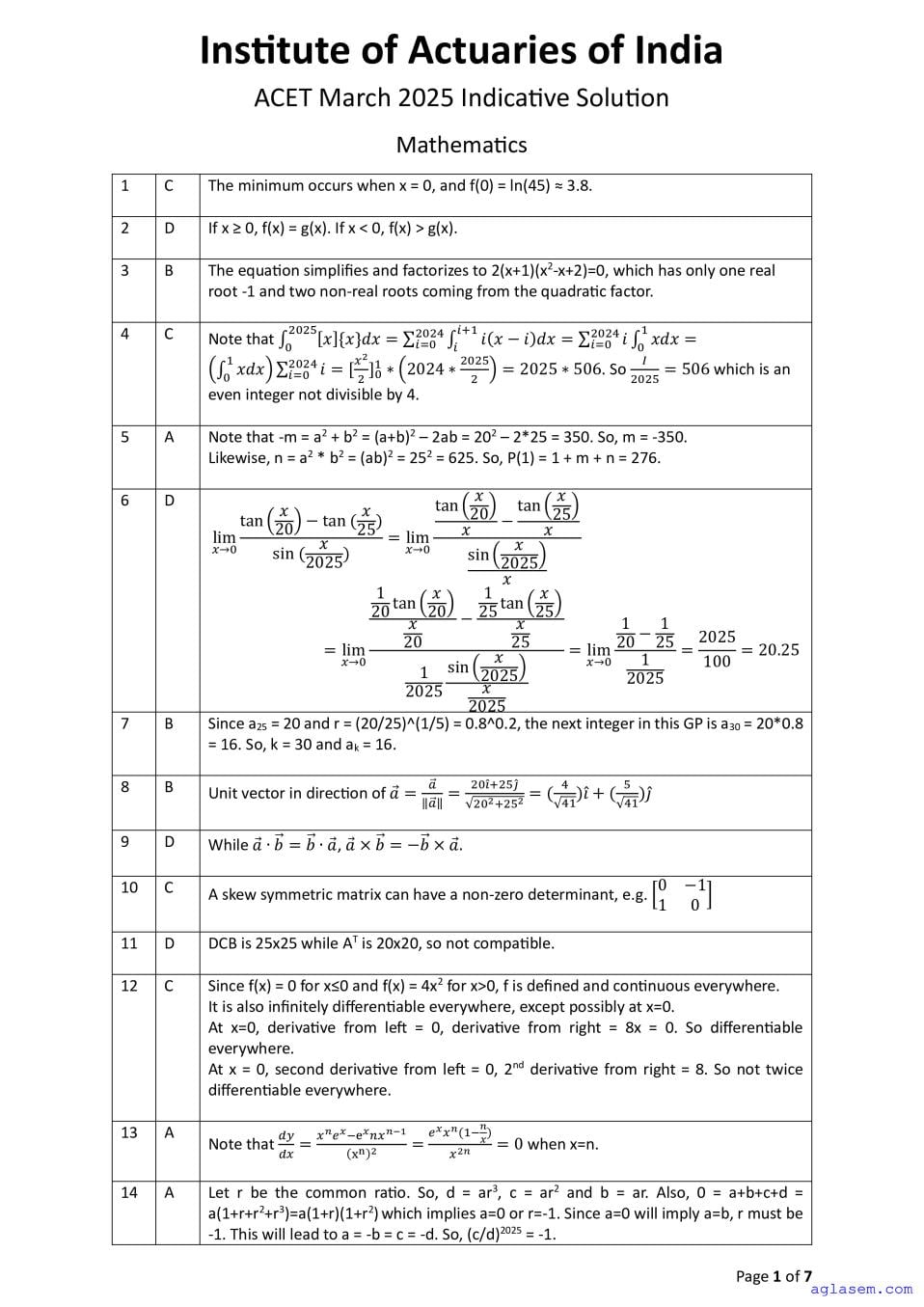
Page 1
ACET March 2025 Indicative Solution
Mathematics
1 C The minimum occurs when x = 0, and f(0) = ln(45) ≈ 3.8.
2 D If x ≥ 0, f(x) = g(x). If x < 0, f(x) > g(x).
3 B The equation simplifies and factorizes to 2(x+1)(x2-x+2)=0, which has only one real
root -1 and two non-real roots coming from the quadratic factor.
4 C 2025 𝑖+1 1
Note that ∫0 [𝑥]{𝑥}𝑑𝑥 = ∑2024
𝑖=0 ∫𝑖 𝑖(𝑥 − 𝑖)𝑑𝑥 = ∑2024
𝑖=0 𝑖 ∫0 𝑥𝑑𝑥 =
1 𝑥2 2025 𝐼
(∫0 𝑥𝑑𝑥 ) ∑2024 1
𝑖=0 𝑖 = [ 2 ]0 ∗ (2024 ∗ 2
) = 2025 ∗ 506. So 2025 = 506 which is an
even integer not divisible by 4.
5 A Note that -m = a2 + b2 = (a+b)2 – 2ab = 202 – 2*25 = 350. So, m = -350.
Likewise, n = a2 * b2 = (ab)2 = 252 = 625. So, P(1) = 1 + m + n = 276.
6 D 𝑥 𝑥
𝑥 𝑥 tan (20) tan ( )
tan (20) − tan( ) − 25
lim 25 = lim 𝑥 𝑥
𝑥→0 𝑥 𝑥→0 𝑥
sin( ) sin ( )
2025 2025
𝑥
1 𝑥 1 𝑥
20 tan ( )
20 − 25 tan ( )
25
𝑥 𝑥 1 1
20 20 − 2025
= lim 25 = lim 25 = = 20.25
𝑥→0 𝑥 𝑥→0 1 100
1 sin ( )
2025 2025
2025 𝑥
2025
7 B Since a25 = 20 and r = (20/25)^(1/5) = 0.8^0.2, the next integer in this GP is a30 = 20*0.8
= 16. So, k = 30 and ak = 16.
8 B 𝑎⃗⃗ 20𝑖̂+25𝑗̂ 4 5
Unit vector in direction of 𝑎⃗ = ‖𝑎⃗⃗‖ = = ( 41)𝑖̂ + ( 41)𝑗̂
√202 +252 √ √
9 D While 𝑎⃗ ∙ 𝑏⃗⃗ = 𝑏⃗⃗ ∙ 𝑎⃗, 𝑎⃗ × 𝑏⃗⃗ = −𝑏⃗⃗ × 𝑎⃗.
10 C 0 −1
A skew symmetric matrix can have a non-zero determinant, e.g. [ ]
1 0
11 D DCB is 25x25 while AT is 20x20, so not compatible.
12 C Since f(x) = 0 for x≤0 and f(x) = 4x2 for x>0, f is defined and continuous everywhere.
It is also infinitely differentiable everywhere, except possibly at x=0.
At x=0, derivative from left = 0, derivative from right = 8x = 0. So differentiable
everywhere.
At x = 0, second derivative from left = 0, 2nd derivative from right = 8. So not twice
differentiable everywhere.
𝑥 𝑛 𝑛
13 A 𝑑𝑦 𝑥 𝑛 𝑒 𝑥 −e𝑥 𝑛𝑥 𝑛−1 𝑒 𝑥 (1− )
Note that 𝑑𝑥 = (xn )2
= 𝑥 2𝑛 𝑥 = 0 when x=n.
14 A Let r be the common ratio. So, d = ar3, c = ar2 and b = ar. Also, 0 = a+b+c+d =
a(1+r+r2+r3)=a(1+r)(1+r2) which implies a=0 or r=-1. Since a=0 will imply a=b, r must be
-1. This will lead to a = -b = c = -d. So, (c/d)2025 = -1.
Page 1 of 7
Page 2
𝑐26 𝑥 26 + ⋯ + 𝑐45 𝑥 45. So, the total terms is 21+21 = 42.
16 B 𝑛−1 𝑛 1 1 1 1
We simplify: ∑∞ ∞ ∞
𝑛=1 𝑛! = ∑𝑛=2(𝑛! − 𝑛!) = ∑𝑛=2((𝑛−1)! − 𝑛!) = 1! = 1.
17 C Trapezoidal rule: 1/4*(f(0)+2f(0.5)+f(1)) = 20. So, f(0)+f(1) + 2f(0.5) = 80.
Simpson’s 1/3rd rule: 1/6*(f(0)+4f(0.5)+f(1)) = 25. So, f(0)+f(1) + 4f(0.5) = 150.
So, 2f(0.5) = 70 or f(0.5) = 35.
18 D Using x=0,1,2, we figure that f(x) is approximated as 2x2+2x-5. This means f(6) should
have been 79, rather than 77.
19 A The product of a complex number and its conjugate equals the square of its modulus,
which must be a nonnegative real number.
20 C The given expression is a factor of α7-1, so α7=1. Thus, α 2025 = α 7*289 α 2 = 1* α 2 = α 2.
Page 2 of 7
Page 3
21 B Since 03+13+…93 = 2025, Pr(N=j) = j3/2025 for j in {0,1,…,9}.
Mode M = value of j with maximum probability = 9.
Pr(N≥9) = Pr(N=9) = 729/2025 < 0.5. Pr(N≥8) = Pr(N=8)+Pr(N=9) = (512+729)/2025 >
0.5. So median m = 8.
22 D Let original number be n and the height of new students be h. So, (170*n + h*5)/(n+5)
= 172. This simplifies to: 2n + 860 = 5h. So, n depends on h (which is not given) so there
is insufficient information. If h=180, n=20. If h=182, n=25 and so on.
23 A For the first teacher, the four grades can be chosen in 6C4 = 15 ways. For each grade,
there are 2 choices for section. So total choices = 15*24 = 240.
For the second teacher, exactly two of the grades MUST be common with first teacher
(possible choices = 4C2 = 6, no further choice of section available) and for the other two
grades, there are two choices for section. So total choices = 6*22 = 24.
For the third teacher, no choices remain. So overall total choices N = 240*24 = 5760.
So, largest integer not exceeding N/100 (i.e. 57.6) = 57 is an odd composite number.
24 C The overall median could be anything between 20 and 25, but cannot lie outside this
range. The overall proportion of students with less than 20 marks < 0.5. The overall
proportion of students with more than 25 marks < 0.5. So median cannot lie outside
the range [20,25].
25 B P(M|S)=P(M∩S)/P(S); P(S|M)=P(M∩S)/P(M). So P(M|S)/P(S|M) = P(M)/P(S) = p/q.
Then p/q = 20%/25% = 0.8.
26 A The number of ways of arranging 7 objects is 7! = 5040. However, there are two
identical objects (As), so we divide by 2 to get 2520 distinct ways.
27 C For a fair die, Q1 = 2 and Q3 = 5. So IQR = 5 – 2 = 3. Range = 6 – 1 = 5. Ratio = 3/5 = 0.6.
28 A By memorylessness property of exponential distribution, Pr(X>4|X>2) = Pr(X>2),
which equals e-2/2 = 1/e = 0.368.
29 D Var(aX+b) = a2*Var(X) = a2σ2.
30 C Binomial distribution is symmetric iff p = ½.
31 B We compute probability mass functions as:
x 1 2 3 4 5 6
P(x) 1/36 3/36 5/36 7/36 9/36 11/36
E(X) = (1*1+2*3+3*5+…+6*11)/36 = 161/36. Median = 5.
So difference = 5 – 161/36 = 19/36 which lies in (0.5,1).
32 A Modal score = one with highest frequency = 67 (occurs thrice), is unique.
33 D Regression line 1: y = (-3/2)x + 13. So regression coefficient 1 = -3/2.
Regression line 2: x = (-1/6)y +31/6. So regression coefficient 2 = -1/6.
So, size of correlation coefficient = sqrt(regression coefficient 1 * regression coefficient
2) = sqrt(-1/6*-3/2) = ½. Since regression coefficients are negative, so is the correlation
coefficient. So, correlation coefficient = -0.5.
34 A E(X) = (1+2+…+6)/6 = 7/2. Likewise, E(X2) = (12+22+…+62)/6 = 91/6. Similarly, E(X3) =
(13+23+…+63)/6 = 147/2. So, Cov(X,X2) = E(X*X2)-E(X)E(X2) = 147/2 – 637/12 = 245/12.
Page 3 of 7
Page 4
with the x-axis with base = 5 and height = 2.5k. Since the integral / area under the PDF
curve over the range must be 1, we get area of triangle = ½*5*2.5k = 1. So k = 0.16.
36 B Let’s tabulate the various cases of n as follows:
N 1 2 3 4 5 0
Pr(n heads) 5/32 5/16 5/16 5/32 1/32 1/32
Expected sum
3.5 14 31.5 56 87.5 0
of die rolls
Expected sum of die rolls = 5/32*3.5 + … + 1/32*87.5 = 26.25.
37 C Mean(Y) = s/2; Var(Y) = s2/12. Equating the two and solving for positive s gives s=6.
38 A If A and B are independent, so are A and Bc, Ac and Bc. For example, X can be proved as:
P(A∩Bc)=P(A) – P(A∩B) = P(A)-P(A)P(B) = P(A)(1-P(B)) = P(A)P(Bc).
39 C Equating the PMF for Poisson distribution at x=a and x=a+1 and simplifying, we get: m
= a+1.
40 B There must be one end point on line m, which can be chosen in 20 ways. The other end
point must be on line n and can be chosen in 25 ways. So, total ways = 20*25 = 500.
Page 4 of 7
Page 5
41 B Since the time period is uniform for all outlets, highest CAGR is equivalent to highest
growth (2025 sales divided by 2021 sales). This is highest for V (221%).
42 A Year 2021 2022 2023 2024 2025
Median sales 180.5 233.5 201 237 275
The steepest growth is from 2021 to 2022, to the tune of 233.5/180.5 - 1 = 29.4%.
43 A The outlet with the highest sales during observation period is Y (sales = 1371).
Y had its lowest sales (of 178) in 2021.
44 D X’s market share in 2022 was 7%, which was the lowest.
45 C Deliveries: Peak = ~100, Off-peak = ~50, Ratio = 2:1 (approx.)
46 B Success-rate: Peak = ~60%, Off-peak = ~90%, Ratio = 2:3 (approx.)
47 C Late deliveries: Peak = ~40%, Off-peak = ~10%, Overall = (40%*2+10%*1)/3 = 30%
(approx.)
48 A The given information can be analysed to produce the following table:
49 C Alpha Beta Gamma Delta
50 B Sales 50 100 30 120
51 D
Expenses 30 90 24 116
Profit 20 10 6 4
Margin 40% 10% 20% 3.33%
From these, the answers follow:
48. 50+100+30+120 = 300
49. 116 – 90 = 26
50. Median of {20,10,6,4} = (10+6)/2 = 8
51. Ratio of max to min = 40%/3.33% = 12
Page 5 of 7
Page 6
52 D
53 C ‘A’ one-eyed person
54 B
55 A
56 B It should be “whether” instead of “weather”.
57 A
58 D ‘Canter’ means ‘run’; others mean ‘shout’.
59 C
60 C “As the world improves, our threshold for complaining drops.” But that does not mean
that humans always complain about increasingly petty problems over time. In fact, if
an existential crisis were to emerge (of which the 9/11 terrorism incident was an
example), people get serious and stop complaining about petty problems.
61 B
62 C Please give me a blank sheet of paper.
Please tell me how I can improve my English.
Page 6 of 7
Page 7
63 C Republic Day (RD) and Independence Day (ID) are on Sunday and Friday in 2025. So
their days in a non-leap year will never be same / consecutive – so they cannot both
fall on a weekend in a non-leap year. It remains to check leap years. From a leap year
to next, they will move by 5 days.
Year 2028 2032 2036 2040 2044 2048
26-Jan Wed Mon Sat Thu Tue Sun
15-Aug Tue Sun Fri Wed Mon Sat
64 A This happens at integer number of hours, which are 24 in a 24-hour period.
65 B Number of unit cubes with exactly three sides pink will be 8, independent of n.
66 D One’s father = sun’s son, one’s mother = moon’s sister
67 A The ordering should be man – woman – man – woman – man.
Since the man in the middle has both women adjacent, only Mr. Z can be there.
The remaining positions / individuals are not uniquely determined as there are two
possibilities: (Mr. X, Mrs. Y, Mr. Z, Mrs. X, Mr. Y) OR (Mr. Y, Mrs. X, Mr. Z, Mrs. Y, Mr. X).
68 D Y follows as runners are subset of athletes which is disjoint from mathematicians.
X need not be true as some (non-athlete) scientist can be a mathematician.
69 C Symptom is seen, followed by diagnosis, leading to treatment being prescribed and
eventually disease being cured.
70 B n-th term is sum of factorials of first n positive integers. 5th term should have been
33+120 = 153 (not 163).
*****************************************
Page 7 of 7
Document Details
| Board / Org | Actuaries India |
| Exam | ACET |
| Type | Answer Key |
| Pages | 7 |
| Updated | 24 Sep 2026 |