NBSE Class 12 Question Paper 2022 Biology
Finished viewing? Save it for later —
Download NBSE Class 12 Question Paper 2022 Biology (PDF · 4 pages)About NBSE Class 12 Question Paper 2022 Biology
NBSE Class 12 Question Paper 2022 Biology is available here for free download. Published by Nagaland Board for Class 12, this question paper can be viewed online or downloaded as a PDF (4 pages). Candidates preparing for Class 12 can use NBSE Class 12 Question Paper 2022 Biology to understand the exam pattern, the type of questions asked, and the overall difficulty level.
Frequently Asked Questions
How can I download NBSE Class 12 Question Paper 2022 Biology?
Open this page and click the Download button to save NBSE Class 12 Question Paper 2022 Biology as a PDF. It is completely free on AglaSem Docs.
Is NBSE Class 12 Question Paper 2022 Biology free to download?
Yes. NBSE Class 12 Question Paper 2022 Biology can be viewed online and downloaded as a PDF free of cost on AglaSem Docs.
How many pages does NBSE Class 12 Question Paper 2022 Biology have?
NBSE Class 12 Question Paper 2022 Biology contains 4 pages, which you can read online or download together as a single PDF.
Where can I find more Class 12 study material?
You can find more Class 12 question papers, sample papers, syllabus, and answer keys on AglaSem Docs.
NBSE Class 12 Question Paper 2022 Biology – Text
Read the full text of this question paper below — useful to quickly search, copy and reference the content online without downloading the PDF.
📄 View text version (4 pages)
Page 1
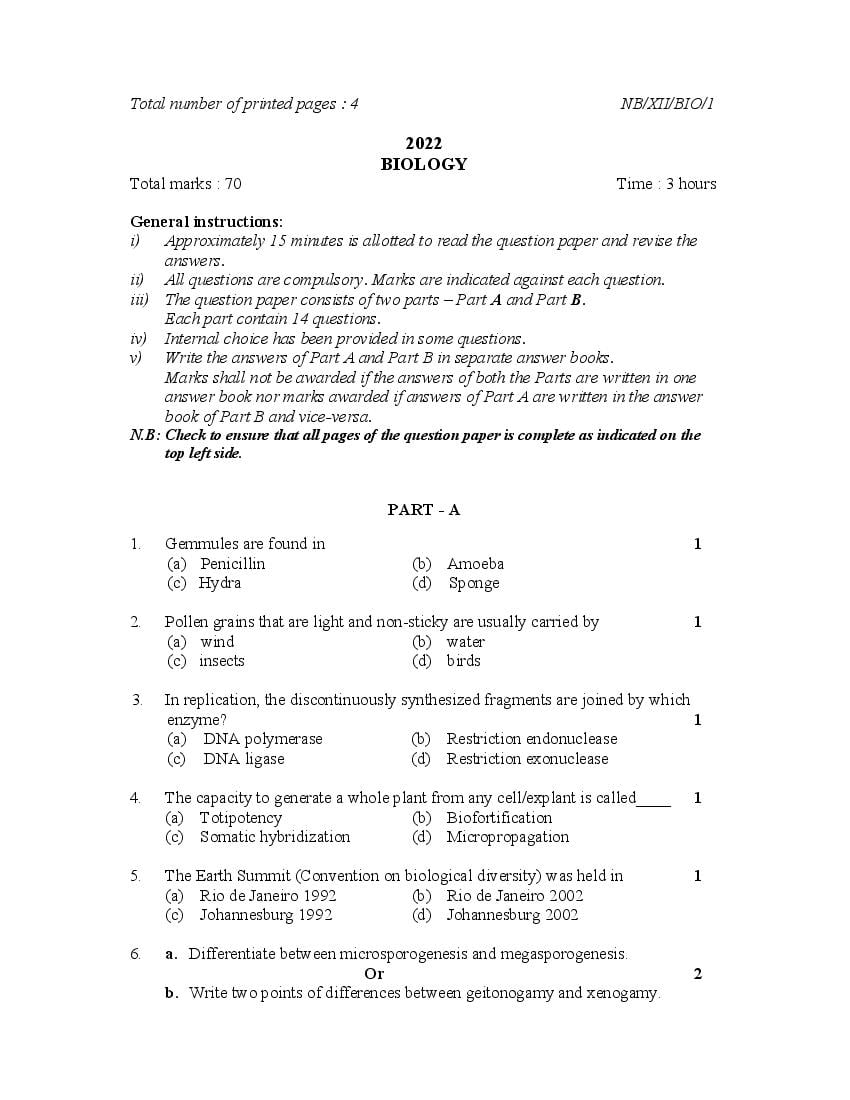
2022
BIOLOGY
Total marks : 70 Time : 3 hours
General instructions:
i) Approximately 15 minutes is allotted to read the question paper and revise the
answers.
ii) All questions are compulsory. Marks are indicated against each question.
iii) The question paper consists of two parts – Part A and Part B.
Each part contain 14 questions.
iv) Internal choice has been provided in some questions.
v) Write the answers of Part A and Part B in separate answer books.
Marks shall not be awarded if the answers of both the Parts are written in one
answer book nor marks awarded if answers of Part A are written in the answer
book of Part B and vice-versa.
N.B: Check to ensure that all pages of the question paper is complete as indicated on the
top left side.
PART - A
1. Gemmules are found in 1
(a) Penicillin (b) Amoeba
(c) Hydra (d) Sponge
2. Pollen grains that are light and non-sticky are usually carried by 1
(a) wind (b) water
(c) insects (d) birds
3. In replication, the discontinuously synthesized fragments are joined by which
enzyme? 1
(a) DNA polymerase (b) Restriction endonuclease
(c) DNA ligase (d) Restriction exonuclease
4. The capacity to generate a whole plant from any cell/explant is called____ 1
(a) Totipotency (b) Biofortification
(c) Somatic hybridization (d) Micropropagation
5. The Earth Summit (Convention on biological diversity) was held in 1
(a) Rio de Janeiro 1992 (b) Rio de Janeiro 2002
(c) Johannesburg 1992 (d) Johannesburg 2002
6. a. Differentiate between microsporogenesis and megasporogenesis.
Or 2
b. Write two points of differences between geitonogamy and xenogamy.
Page 2
7. a. What is ecosystem? Name the components of the ecosystem.
Or 2
b. What is green house effect? Suggest two measures to control global warming.
8. a. What are sacred groves? What is their role in biodiversity conservation?
b. What is meant by co-extinction? Give one example.
9. a. Draw a neat labelled diagram of a complete flower.
b. Draw a neat labelled diagram of a mature embryo sac.
10. a. Write three features of genetic code.
Or 3
b. Write any three silent features of Human Genome Project.
11. a. What is plant breeding? Name two hybrid varieties of a crop.
b. What is micropropagation? Give two benefits of micropropagation.
12. a. What is an operon? Describe the working of Lac Operon.
b. Explain transcription unit with schematic representation.
13. a. What are cloning vectors? Explain the features of cloning vectors.
b. Describe briefly the steps involved in the process of recombinant DNA
technology.
14. a. Describe the three types of ecological pyramids. Give two limitations of
ecological pyramids.
b. What is biomagnification? Explain the biomagnification of DDT in an
aquatic food chain.
PART - B
1. After ovulation, the ruptured Graafian follicle changes into 1
(a) Corpus striatum (b) Corpus luteum
(c) Corpus albicans (d) None of these
2. HIV is not transmitted by 1
(a) Blood transfusion (b) Sharing of injection
(c) Hugging (d) Infected mother to child
Page 3
3. Forelimb of frog and forelimb of human is an example of 1
(a) Homologous organs (b) Analogous organs
(c) Vestigial organs (d) Rudimentary organs
4. Gobar gas contains mainly 1
(a) CH₄ and CO₂ (b) CH₄ and O₂
(c) CH₄ and H₂ (d) CH₄ and H₂O
5. Which mammal excretes concentrated urine to conserve water? 1
(a) Kangaroo rat (b) Camel
(c) Squirrel (d) Polar bear
6. a. Explain the inheritance of haemophilia in the offsprings, if a normal female
marries a haemophilic male.
b. What are the similarities found between man and great apes on the basis of
molecular studies?
7. a. Draw a well labelled diagram of an antibody molecule.
Or 2
b. What is biological nitrogen fixation? Which organism fixes atmospheric
nitrogen in the root of legumes?
8. a. What is biopiracy? How are industrialised nations exploiting the
bioresources?
Or 2
b. What is biotechnology? Give two applications of biotechnology.
9. a. Briefly describe sex determination in honey bee.
b. Write three embryological evidences that support evolution.
10. a. What are ‘cry’ proteins? Name an organism that produce it. How has man
exploited this protein to his benefit?
Or 3
b. Why do lepidopterans die when they feed on Bt-cotton plant?
11. a. What adaptation help parasites to sustain?
b. With the help of a suitable diagram, describe the logistic population growth
curve.
Page 4
12. a. Explain the process of fertilization with diagram.
b. What is ART? Suggest some methods to assist infertile couples to have
children.
13. a. Explain in detail, incomplete dominance and multiple alleles with examples.
b. Describe Oparin-Haldane theory on origin of life.
14. a. What is innate immunity? Explain the four types of barriers of innate
immunity.
Or 5
b. What are antibiotics? Who discovered penicillin? Name the source from
where antibiotic penicillin has been derived. Write two properties of
antibiotics.
*******************