AP Inter 1st Year Syllabus 2023 Chemistry
Finished viewing? Save it for later —
Download AP Inter 1st Year Syllabus 2023 Chemistry (PDF · 9 pages)About AP Inter 1st Year Syllabus 2023 Chemistry
AP Inter 1st Year Syllabus 2023 Chemistry is available here for free download. Published by Andhra Pradesh Board for Class 11, this syllabus can be viewed online or downloaded as a PDF (9 pages). Candidates preparing for Class 11 can use AP Inter 1st Year Syllabus 2023 Chemistry to understand the exam pattern, the type of questions asked, and the overall difficulty level.
Frequently Asked Questions
How can I download AP Inter 1st Year Syllabus 2023 Chemistry?
Open this page and click the Download button to save AP Inter 1st Year Syllabus 2023 Chemistry as a PDF. It is completely free on AglaSem Docs.
Is AP Inter 1st Year Syllabus 2023 Chemistry free to download?
Yes. AP Inter 1st Year Syllabus 2023 Chemistry can be viewed online and downloaded as a PDF free of cost on AglaSem Docs.
How many pages does AP Inter 1st Year Syllabus 2023 Chemistry have?
AP Inter 1st Year Syllabus 2023 Chemistry contains 9 pages, which you can read online or download together as a single PDF.
Where can I find more Class 11 study material?
You can find more Class 11 question papers, sample papers, syllabus, and answer keys on AglaSem Docs.
AP Inter 1st Year Syllabus 2023 Chemistry – Text
Read the full text of this syllabus below — useful to quickly search, copy and reference the content online without downloading the PDF.
📄 View text version (9 pages)
Page 1
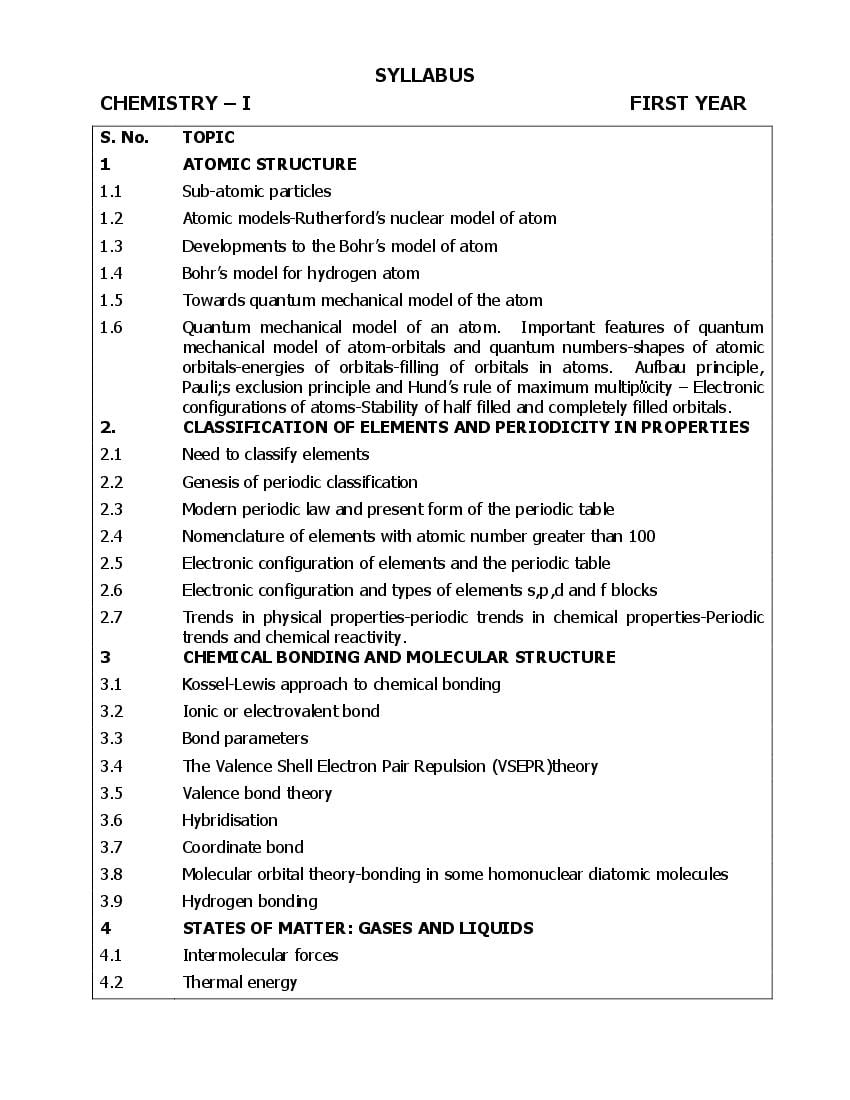
CHEMISTRY – I FIRST YEAR
S. No. TOPIC
1 ATOMIC STRUCTURE
1.1 Sub-atomic particles
1.2 Atomic models-Rutherford’s nuclear model of atom
1.3 Developments to the Bohr’s model of atom
1.4 Bohr’s model for hydrogen atom
1.5 Towards quantum mechanical model of the atom
1.6 Quantum mechanical model of an atom. Important features of quantum
mechanical model of atom-orbitals and quantum numbers-shapes of atomic
orbitals-energies of orbitals-filling of orbitals in atoms. Aufbau principle,
Pauli;s exclusion principle and Hund’s rule of maximum multiplicity – Electronic
configurations of atoms-Stability of half filled and completely filled orbitals.
2. CLASSIFICATION OF ELEMENTS AND PERIODICITY IN PROPERTIES
2.1 Need to classify elements
2.2 Genesis of periodic classification
2.3 Modern periodic law and present form of the periodic table
2.4 Nomenclature of elements with atomic number greater than 100
2.5 Electronic configuration of elements and the periodic table
2.6 Electronic configuration and types of elements s,p,d and f blocks
2.7 Trends in physical properties-periodic trends in chemical properties-Periodic
trends and chemical reactivity.
3 CHEMICAL BONDING AND MOLECULAR STRUCTURE
3.1 Kossel-Lewis approach to chemical bonding
3.2 Ionic or electrovalent bond
3.3 Bond parameters
3.4 The Valence Shell Electron Pair Repulsion (VSEPR)theory
3.5 Valence bond theory
3.6 Hybridisation
3.7 Coordinate bond
3.8 Molecular orbital theory-bonding in some homonuclear diatomic molecules
3.9 Hydrogen bonding
4 STATES OF MATTER: GASES AND LIQUIDS
4.1 Intermolecular forces
4.2 Thermal energy
Page 2
4.4 The gaseous state
4.5 The gas laws
4.6 Ideal gas equation
4.7 Graham’s law of diffusion – Dalton’s law of partial pressures
4.8 Kinetic molecular theory of gases
4.9 Kinetc gas equaon of an ideal gas (no derivation) – Deduction of gas laws
from kinetic gas equation
4.10 Distribution of molecular speeds – rms, average and most probable speeds –
kinetic energy of gas molecules
4.11 Behaviour of real gases – deviation from ideal gas behavior – compressibility
factor Vs pressure diagrams of real gases
4.12 Liquefaction of gases
4.13 Liquid state – properties of liquids in terms of inter molecular interactions –
vapour pressure, viscosity and surface tension (Qualitative idea only, no
mathematical derivation)
5 STOICHIOMETRY
5.1 Some basic concepts
5.2 Laws of chemical combinations, Gay Lussac’s law of Gaseous volumes,
Dalton’s atomic theory, Avogadro law
5.3 Atomic and molecular masses – mole concept and molar mass concept of
equivalent weight
5.4 Percentage composition of compounds and calculations of empirical and
molecular formulae of compounds
5.5 Stoichiometry and stoichiometric calculations
5.6 Methods of expressing concentrations of solutions
5.7 Redox reactions
5.8 Oxidation number concept
5.9 Types of redox reactions
5.10 Balancing of redox reactions – oxidation number method – half reaction (ion-
electron)method.
5.11 Redox reactions in titrimetry
6 THERMODYNAMICS
6.1 Thermodynamic terms
6.2 Applications –work-enthalpy-extensive and intensive properties-heat capacity
6.3 Measurement of “U and H”: Calorimetry
6.4 Enthalpy change, ‘rH’ of reactions
6.5 Enthalpies for different types of reactions
6.6 Spontaneity
Page 3
6.8 Absolute entropy and the third law of thermodynamics
7 CHEMICAL EQUILIBRIUM AND ACIDS-BASES
7.1 Equilibrium in physical process
7.2 Equilibrium in chemical process – dynamic equilibrium
7.3 Law of chemical equilibrium – law of mass action and equilibrium constant
7.4 Homogeneous equilibria, equilibrium constant in gaseous systems, relationship
between Kp and Kc
7.5 Heterogeneous equilibria
7.6 Applications of equilibrium constant
7.7 Relationship between equilibrium constant ‘K’, reaction Quotient ‘Q’ and Gibbs
energy ‘G’
7.8 Factors affecting equilibria – Le-chatelier’s principle application to industrial
synthesis of ammonia and sulphur trioxide
7.9 Ionic equilibrium in solutions
7.10 Acids, bases and salts – Arrhenius, Bronsted-Lowry and Lewis concepts of
acids and bases
7.11 Ionisation of acids and bases
7.12 Buffer solutions
7.13 Solubility equilibria of sparingly soluble salts
Solubility product constant-common ion effect on solubility of Ionic salts
8 HYDROGEN AND ITS COMPOUNDS
8.1 Position of hydrogen in the periodic table
8.2 Dihydrogen - Occurance and isotopes
8.3 Preparation of dihydrogen
8.4 Properties of dihydrogen
8.5 Hydrides: Ionic, covalent, and non-stiochiometric hydrides
8.6 Water: Physical properties; structure of water, ice chemical properties of
water; hard and soft water temporary and permanent hardness of water.
8.7 Hydrogen peroxide: Preparation; physical properties; structure and chemical
properties; storage and uses
8.8 Heavy water
8.9 Hydrogen as a fuel
9 S- BLOCK ELEMENTS (ALKALI AND ALKALINE EARTH METALS)
GROUP 1 ELEMENTS:
9.1 Alkali metals; Electronic configurations; atomic and ionic radii; ionization
enthalpy; hydration enthalpy; physical properties; chemical properties; uses
9.2 General characteristics of the compounds of the alkali metals: oxides; halides;
salts of oxy acids
9.3 Anamalous properties of lithium:
Page 4
sodium hydroxide; sodium hydrogen carbonate
9.5 Biological importance of sodium and potassium
Group 2 Elements:
9.6 Alkaline earth elements; Electronic configuration; ionization enthalpy;
hydration enthalpy; physical properties; chemical properties; uses
9.7 General characteristics of compounds of the alkaline earth metals, oxides,
hydroxides, halides, salts of oxyacids (carbonates, sulphates and nitrates)
9.8 Anomalous behavior of beryllium; its diagonal relationship with aluminium
9.9 Some important compounds of calcium
9.10 Biological importance of calcium and magnesium
10 p-BLOCK ELEMENTS GROUP 13 (BORON FAMILY)
10.1 General introduction – Electronic configuration, atomic radii, ionization
enthalpy, electro negativity; physical & chemical properties
10.2 Important trends and anomalous properties of boron
10.3 Some important compounds of boron – borax, ortho boric acid, diborane
10.4 Uses of boron, aluminium and their compounds
11 p-BLOCK ELEMENTS GROUP 14 (CARBON FAMILY)
11.1 General introduction – Electronic configuration, atomic radii, ionization
enthalpy, electro negativity; physical & chemical properties
11.2 Important trends and anomalous properties of carbon
11.3 Allotropes of carbon
11.4 Uses of carbon
11.5 Some important compounds of carbon and silicon-carbonmonoxide, carbon
dioxide, silica, silicones, silicates and zeolites
12 ENVIRONMENTAL CHEMISTRY
12.1 Definition of terms: Air, Water and Soil pollutions
12.2 Environmental pollution
12.3 Atmospheric pollution
12.4 Acid rain: Particulate pollutants
12.5 Stratospheric pollution
12.6 Water pollution
12.7 Soil Pollution: Pesticides, industrial wastes
12.8 Strategies to control environmental pollution
12.9 Green chemistry
13 ORGANIC CHEMISTRY-SOME BASIC PRINCIPLES AND TECHNIQUES
AND HYDROCARBONS
13.1 General introduction
Page 5
13.3 Structural representations of organic compounds
13.4 Classification of organic compounds
13.5 Nomenclature of organic compounds
13.6 Isomerism
13.7 Fundamental concepts in organic reaction mechanisms
13.8 Methods of purification of organic compounds
13.9 Qualitative elemental analysis of organic compounds
13.10 Quantitative elemental analysis of organic compounds
HYDROCARBONS
13.11 Classification of hydrocarbons
13.12 Alkanes – Nomenclature, isomerism (structural and conformations of ethane
only) preparation of alkanes – properties of alkanes
13.13 Alkenes – Nomenclature, structure of ethane, isomerism (structural and
geometrical) – methods of preparation of alkenes – properties of alkenes
13.14 Alkynes – Nomenclature and isomerism, structure of acetylene methods of
preparation of acetylene – physical properties and chemical reactions of
alkynes
13.15 Aromatic Hydrocarbons: Nomenclature and isomerism
Structure of benzene, resonance and aromaticity-preparation of benzene
physical and chemical properties of benzene-directive influence of functional
groups in mono substituted benzene, Carcinogenicity and toxicity
Page 6
CHEMISTRY – I s¡kÕj·Tq XÊg+ ` 1 FIRST YEAR
S. No. TOPIC
1. |üs¡e÷DT ìsêàD+
1.1 ñ|ü|üs¡e÷DT ø£D≤\T
1.2 |üs¡e÷DT qeT÷Hê\T
1.3 uÀsY |üs¡e÷DT qeT÷Hê Á|ü‹bÕ<äq≈£î <ë]rdæq |ü]D≤e÷\T
1.4 uÀsY ôV’≤Á&√»Hé |üs¡e÷DT qeT÷Hê
1.5 |üs¡e÷DT ñ|üø£D≤\ ø±´+≥yéT j·÷+Á‹ø£ uÛ≤eq\T
1.6 ø±´+≥yéT j·÷+Á‹ø£ |üs¡e÷DT qeT÷Hê
2. eT÷\ø±\ eØZø£s¡D ` Äes¡Ôq <Ûäsêà\
2.1 eTq+ eT÷\ø±\qT m+<äT≈£î eØZø£]+#ê*
2.2 eT÷\ø±\ Äes¡Ôq |ü{Ϻø£ Ä$sꓤe+
2.3 Ä<ÛäTìø£ Äes¡Ôq ìj·TeT+, Á|üdüTÔ‘· Äes¡Ôq |ü{Ϻø£
2.4 |üs¡e÷DT dü+K´ 100 ø£+fÒ m≈£îÿe >∑\ eT÷\ø±\ HêeTs¡D+
2.5 eT÷\ø±\ m\Áø±ºHé $Hê´dü+, Äes¡Ôq |ü{Ϻø£
2.6 m\Áø±ºHé $Hê´kÕ\T, eT÷\ø±\ s¡ø±\T ` s, p, d, f- u≤¢≈£î\T
2.7 eT÷\ø£ <Ûäsêà\˝À Äes¡Ôq Áø£eT+
3. s¡kÕj·Tq ã+<Ûä+ ` nDTìsêàD+
3.1 ø=ôd‡˝Ÿ ` \÷sT÷ s¡kÕj·Tq ã+<Ûë\ $es¡D
3.2 nj·÷ìø£ ˝Ò<ë m\Áø√ºy˚˝…+{Ÿ ã+<Ûä+
3.3 ã+<Ûä |üsê$T‘·T\T
3.4 y˚\Hé‡ ø£s¡Œs¡ m\Áø±ºHé »+≥\ $ø£s¡¸D dæ<ë∆+‘·+
3.5 dü+jÓ÷»ø£‘· ã+<Ûä+ dæ<ë∆+‘·+
3.6 dü+ø£s¡ø£s¡D+
3.7 düeTq«j·T düeTjÓ÷»˙j·T ã+<Ûä+
3.8 nDT Ä]“{≤˝Ÿ dæ<ë∆+‘·+
3.9 ôV’≤Á&√»Hé ã+<Ûä+
4. |ü<ës¡ú+ dæú‘·T\T : yêj·TTe⁄\T, Á<äyê\T
4.1 n+‘·s¡ nDT ã˝≤\T
4.2 ñwüíX¯øÏÔ
4.3 n+‘·s¡ nDTu˝≤\T ` ñwüíX¯øÏÔ
4.4 yêj·TTdæú‹
4.5 yêj·TT ìj·Te÷\T
Page 7
4.7 Á>±Vü≤+ yêj·TT yê´düq ìj·TeT+
4.8 yêj·TTe⁄\ nDT#·\q dæ<ë∆+‘·+
4.9 Ä<äs¡Ùyêj·TTe⁄ #·\ <ë«j·T düMTø£s¡D+
4.10 nDTy˚>±\ |ü+|æD°
4.11 ì»yêj·TTe⁄\ Á|ües¡Ôq`Ä<äs¡Ù yêj·TT Á|ües¡Ôq qT+&ç $#·\q+
4.12 yêj·TTe⁄\ Á<äMø£s¡D
4.13 Á<äedæú‹
5. kÕúsTT øÏjÓ÷yÓTÁ{°
5.1 s¡kÕj·TqXÊg+˝À ø=ìï eTÚ*ø£ uÛ≤eq\T
5.2 s¡kÕj·Tìø£ dü+jÓ÷>∑ ìj·Te÷\T
5.3 |üs¡e÷DT, nDT Á<äe´sêX¯ó\T
5.4 dü+|òüT≥q XÊ‘·+
5.5 kÕúsTTøÏjÓ÷yÓTÁ{°`kÕúsTTøÏjÓ÷yÓTÁ{Ïø˘ >∑Dq\T
5.6 Á<ëeD≤\ >±&ÛÉ‘·\qT ‘Ó*ù| |ü<ä∆‘·T\T
5.7 Äø°‡ø£s¡D ` ø£åj·Tø£s¡D #·s¡´\T
5.8 Äø°‡ø£s¡D ` dü+K´uÛ≤eq
5.9 Äø°‡ø£s¡D ` ø£åj·Tø£s¡D #·s¡´\T ` yê{Ï s¡ø±\T
5.10 Äø°´ø£s¡D ` ø£åj·Tø£s¡D #·s¡´\qT ‘·T\´+ #˚j·T&É+
5.11 n+X¯e÷|üq |ü<ä∆‹˝À Äø°‡ø£s¡D ` ø£åj·Tø£s¡D
6. ñwüí>∑‹ø£ XÊg+
6.1 ñwüí>∑‹ø£ XÊg+˝À yê&˚ |ü<ë\T
6.2 nqTes¡ÔHê\T
6.3 ∆U, ∆H \qT ¬ø˝À]yÓTÁ{°˝À ø=*#˚ $<Ûëq+
6.4 #·s¡´ m+<∏ë©Œ ` #·s¡´ m+<∏ë©Œ e÷s¡TŒ ∆, ”H”
6.5 y˚s¡T y˚s¡T #·s¡´\T≈£î m+<∏ë©Œ e÷s¡TŒ\T
6.6 dü«#·Ã¤+<ä‘· (nj·Trïø£è‘·+)
6.7 –uŸ‡X¯øÏÔ e÷s¡TŒ, düeT‘êdæú‹
6.8 |üs¡eT m+Á{À|æ, ñwüí>∑‹ø£XÊg+ eT÷&√ ìj·TeT+
7. s¡kÕj·Tìø£ düeT‘êdæú‹, Äe÷¢\T ` øå±sê\T
7.1 uÛÖ‹ø£ Á|üÁøÏj·T\˝Àì düeT‘êdæú‹
7.2 s¡kÕj·Tq Á|üÁøÏj·T\˝À düeT‘êdæú‹ ` >∑‹ø£ düeT‘êdæú‹
7.3 s¡kÕj·Tq düeT‘êdæú‹ ìj·TeT+ ` düeT‘êdæú‹ dæúsê+ø£+
7.4 düC≤‹ düeT‘êdæú‘·T\T
7.5 $C≤‹ düeT‘êdæú‹ #·s¡´\T
Page 8
7.7 düeT‘êdæú‹ dæúsê+ø£ ‘K’
#·s¡´ uÛ≤>∑|òü\ dæúsê+ø£+, ‘Q’ –uŸ‡X¯øÏÔ ‘G’ M{Ï eT<Ûä´ dü+ã+<Ûä+
7.8 düeT‘êdæú‹ì Á|üuÛ≤$‘·+ #˚ùd n+XÊ\T
7.9 Á<ëeD≤\˝À nj·÷ìø£ düeT‘êdæú‹
7.10 Äe÷¢\T, øå±sê\T, \eD≤\T
7.11 Äe÷¢\, øå±sê\ nj·T˙ø£s¡D+
7.12 ã|òüsY Á<ëeD≤\T
7.13 n\Œ Á<ëeD°j·T \eD≤\˝À Á<ëeD°j·T‘· düeT‘êdæú‹
8. ôV’≤Á&√»Hé ` <ëì düy˚Tàfi¯Hê\T
8.1 Äes¡Ôq |ü{Ϻø£˝À ôV’≤Á&√»Hé kÕúq+
8.2 &Ó’ôV’≤Á&√»Hé H2
8.3 &Ó’ôV’≤Á&√»Hé H2 ì ‘·j·÷s¡T#˚j·T&É+
8.4 &Ó’ôV’≤Á&√»Hé <Ûäsêà\T
8.5 ôV’≤Á&Ó’&é\T
8.6 ˙s¡T
8.7 ôV’≤Á&√»Hé ô|sê¬ø’‡&é (H2O2)
8.8 uÛ≤s¡»\+ D2O
8.9 Ç+<Ûäq+>± ôV’≤Á&√»Hé
9. S ` u≤¢≈£î eT÷\ø±\T
9.1 Á>∑÷|ü⁄ ` 1 eT÷\ø±\T : øå±s¡˝ÀVü‰\T
9.2 øå±s¡˝ÀVü‰\ düy˚Tàfi¯Hê\ kÕe÷q´ \ø£åD≤\T
9.3 Á>∑÷|ü⁄˝À Ç‘·s¡ eT÷\ø±\‘√ b˛*ùdÔ *~∏j·T+ nkÕ<Ûës¡D <Ûäsêà\T
9.4 k˛&çj·T+ jÓTTø£ÿ ø=ìï eTTK´yÓTÆq düy˚Tàfi¯Hê\T
9.5 k˛&çj·T+, bı{≤wæj·T+\ JeXÊg dü+ã+<ÛäyÓTÆq ÁbÕeTTK´‘·
9.6 Á>∑÷|ü⁄ ` 2 eT÷\ø±\T : øå±s¡eTè‹Ôø£ ˝ÀVü‰\T
9.7 øå±s¡eTè‹Ôø£ ˝ÀVü‰\ düy˚Tàfi¯Hê\ kÕ<Ûës¡D <Ûäsêà\T
9.8 u…Ø*j·T+ ndü+>∑‘· Á|ües¡Ôq
9.9 ø=ìï eTTK´yÓTÆq ø±*¸j·T+ düy˚Tàfi¯Hê\T
9.10 JeXÊg+˝À yÓT^ïwæj·T+, ø±*¸j·T+\ ÁbÕeTTK´+
10. P - u≤¢≈£î eT÷\ø±\T ` 13e Á>∑÷|t
10.1 13e Á>∑÷|ü⁄ eT÷\ø±\T : uÀsêHé ≈£î≥T+ã+
10.2 uÀsêHé eTTK´ Á|üeè‘·TÔ\T ` ndü+>∑‘· \ø£åD≤\T
10.3 ø=ìï eTTK´yÓTÆq uÀsêHé düy˚Tàfi¯Hê\T
Page 9
11. P ` u≤¢≈£î eT÷\ø±\T ` 14e Á>∑÷|ü⁄
11.1 14e Á>∑÷|ü⁄ eT÷\ø±\T : ø±s¡“Hé ≈£î≥T+ã+
11.2 ø±s¡“Hé <Ûäsêà\ düs¡[, ndü+>∑‹ Á|ües¡Ôq
11.3 ø±s¡“Hé s¡÷bÕ+‘·sê\T
11.4 ø±s¡“Hé, dæ*ø±Hé\ ø=ìï eTTK´ düy˚Tàfi¯Hê\T
12. |üsê´es¡D s¡kÕj·TqXÊg+
12.1 |ü<ë\ ìs¡«#·Hê\T : >±*, ˙s¡T, uÛÑ÷$T (H˚\) ø±\TcÕ´\T
12.2 |üsê´es¡D ø±\Twü´+
12.3 yê‘êes¡D ø±\Twü´+
12.4 ÄeT¢es¡¸+
12.5 ÁkÕº{Àes¡D ø±\Twü´+
12.6 ˙{Ï ø±\Twü´+
12.7 H˚\ (uÛÑ÷) ø±\Twü´+
12.8 |üsê´es¡D ø±\TcÕ´ìï ìj·T+Á‘·D+ #˚j·T&ÜìøÏ bÕ{Ï+#˚ Á|üD≤[ø£\T
12.9 Vü≤]‘· s¡kÕj·TqXÊg+
13. ø£s¡“q s¡kÕj·TqXÊg+ ` kÕe÷q´ dü÷Á‘ê\T, $<ÛëHê\T
13.1 ñb˛<ëÈ‘·+
13.2 ø±s¡“Hé #·‘·Ts¡ dü+jÓ÷»ø£‘·
13.3 ø£s¡“q düy˚Tàfi¯Hê\ ìsêàD≤‘·àø£ bòÕs¡Tà˝≤\T
13.4 ø£s¡“q düy˚Tàfi¯Hê\ eØZø£s¡D
13.5 ø£s¡“q düy˚Tàfi¯Hê\ HêeTø£s¡D+
13.6 kÕ<äèX¯´+
13.7 ø£s¡“q s¡kÕj·Tq #·sê´$<Ûëq+˝À eTÚ*ø£ uÛ≤eq\T
13.8 ø£s¡“q s¡kÕj·Tq X¯ó~∆ #˚ùd $<ÛëHê\T
13.9 ø£s¡“q düy˚Tàfi¯Hê\˝Àì eT÷\ø±\ >∑TD≤‘·àø£ $X‚¢wüD
13.10 ø£s¡“q düy˚Tàfi¯q+˝Àì eT÷\ø±\ |ü]e÷D≤‘·àø£ $X‚¢wüD
ôV’≤Á&√ø±s¡“Hé\T
13.11 eØZø£s¡D+
13.12 Ä˝ÒÿHé\T
13.13 Ä©ÿHé\T
13.14 Ä˝…’ÿHé\T
13.15 ms√e÷{Ïø˘ ôV’≤Á&√ø±s¡“Hé\T
Document Details
| Board / Org | Andhra Pradesh Board |
| Exam | Class 11 |
| Type | Syllabus |
| Pages | 9 |
| Updated | 30 Apr 2026 |