AP Inter 1st Year Syllabus 2023 History
Finished viewing? Save it for later —
Download AP Inter 1st Year Syllabus 2023 History (PDF · 5 pages)About AP Inter 1st Year Syllabus 2023 History
AP Inter 1st Year Syllabus 2023 History is available here for free download. Published by Andhra Pradesh Board for Class 11, this syllabus can be viewed online or downloaded as a PDF (5 pages). Candidates preparing for Class 11 can use AP Inter 1st Year Syllabus 2023 History to understand the exam pattern, the type of questions asked, and the overall difficulty level.
Frequently Asked Questions
How can I download AP Inter 1st Year Syllabus 2023 History?
Open this page and click the Download button to save AP Inter 1st Year Syllabus 2023 History as a PDF. It is completely free on AglaSem Docs.
Is AP Inter 1st Year Syllabus 2023 History free to download?
Yes. AP Inter 1st Year Syllabus 2023 History can be viewed online and downloaded as a PDF free of cost on AglaSem Docs.
How many pages does AP Inter 1st Year Syllabus 2023 History have?
AP Inter 1st Year Syllabus 2023 History contains 5 pages, which you can read online or download together as a single PDF.
Where can I find more Class 11 study material?
You can find more Class 11 question papers, sample papers, syllabus, and answer keys on AglaSem Docs.
AP Inter 1st Year Syllabus 2023 History – Text
Read the full text of this syllabus below — useful to quickly search, copy and reference the content online without downloading the PDF.
📄 View text version (5 pages)
Page 1
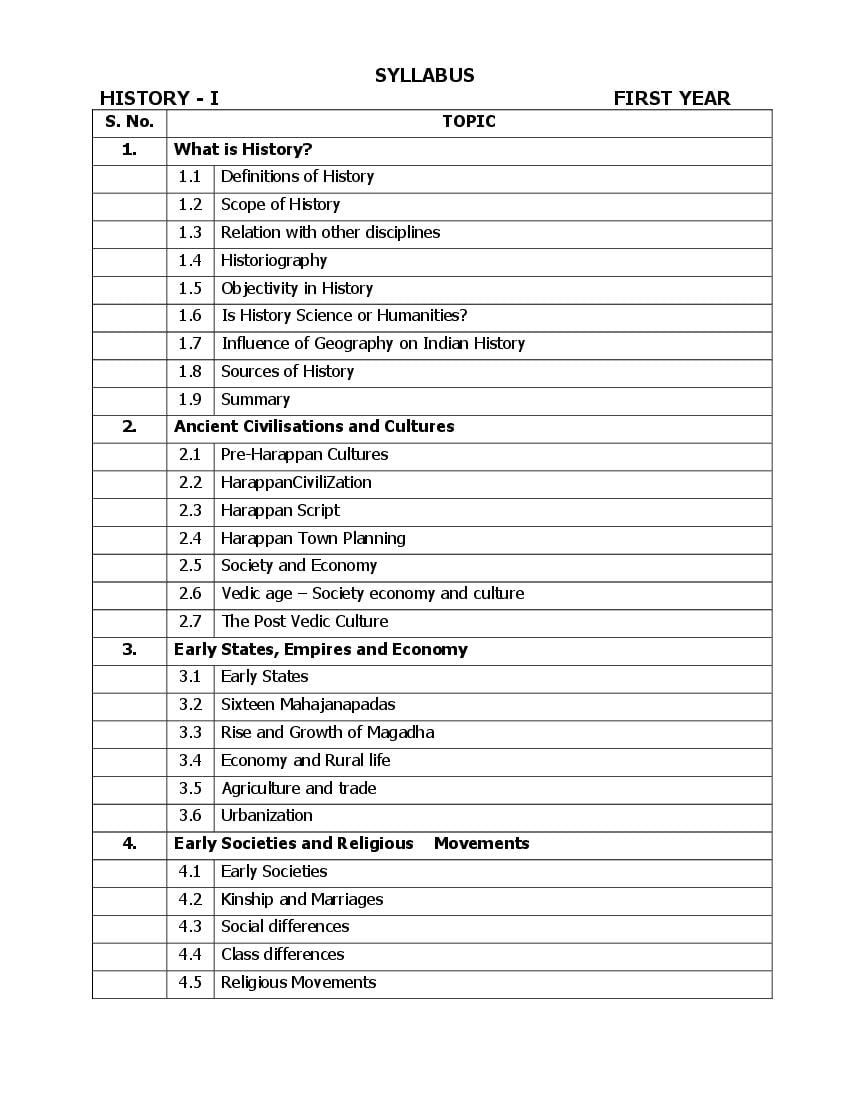
HISTORY - I FIRST YEAR
S. No. TOPIC
1. What is History?
1.1 Definitions of History
1.2 Scope of History
1.3 Relation with other disciplines
1.4 Historiography
1.5 Objectivity in History
1.6 Is History Science or Humanities?
1.7 Influence of Geography on Indian History
1.8 Sources of History
1.9 Summary
2. Ancient Civilisations and Cultures
2.1 Pre-Harappan Cultures
2.2 HarappanCiviliZation
2.3 Harappan Script
2.4 Harappan Town Planning
2.5 Society and Economy
2.6 Vedic age – Society economy and culture
2.7 The Post Vedic Culture
3. Early States, Empires and Economy
3.1 Early States
3.2 Sixteen Mahajanapadas
3.3 Rise and Growth of Magadha
3.4 Economy and Rural life
3.5 Agriculture and trade
3.6 Urbanization
4. Early Societies and Religious Movements
4.1 Early Societies
4.2 Kinship and Marriages
4.3 Social differences
4.4 Class differences
4.5 Religious Movements
Page 2
4.7 LokaYatas
4.8 Jainism
4.9 Buddhism
5. Polity, Economy, Society and Culture from 3rd Century BC to
7thCentrury AD
5.1 Sources
5.2 Polity
5.3 Administration
5.4 Economy
5.5 Society
5.6 Culture
5.7 Science
6. Deccan and South Indian up to 10th Century AD
6.1 Sources
6.2 Sangam Age
6.3 Briefy survey of Political history of Deccan and South India
6.4 Society, Economy, Religion, Art and Archietecture
7. Age of Delhi Sultannate (1206-1526 AD)
7.1 Source Materail
7.2 Arab Invasion on Sind
7.3 Turkish Invasion
7.4 Muhammad Ghazni
7.5 Muhammad Ghori
7.6 Delhi Sultanate – Dynasties
7.7 Important Sulthans and their Achievements
7.8 Polity during Sultanate age
7.9 Society, Economy and Culture
8. Age of Mughals
8.1 Sources
8.2 Conditions of India on the Eve of Babur’s Invasion
8.3 Sher shah
8.4 Imperial Mughals
8.5 Disintegration of Mughal empire
Page 3
8.7 Akbar’s Religious Policy
8.8 Art and Architecture under Mughals
8.9 Rise of Maratas
9. Bhakti and Sufi Traditions 8th AD-16th Century
9.1 Meaning of Bhakti
9.2 Salient features of the Bhakti Saints
9.3 Prominent Bhakti saints and their Preachings
9.4 Bhakti Movement in Maharastra
9.5 Sufism- meaning, origin and main features
9.6 Prominent Sufi orders and Sufi Saints
9.7 Impact of Bhakti and Sufi movements on society
10. Deccan and South India from 10th century to 19th Century AD
10.1 Sources
10.2 The Kakatiyas
10.3 The Vijayanagara Rules
10.4 The Bahamanis of Gulbarga
10.5 The QutubShahis of Golkonda
10.6 The Asafjahis of Hyderabad (1724-1948)
11. Indian Under the Colonial Rule
11.1 Advent of European Companies in India and conflict
11.2 Expansion of East India Company’s authority
11.3 Governor Generals and their Policies
11.4 1857 Revolt
12. Indian National Movement
12.1 Background to Indian National Movement
12.2 Foundation of Indian National Congress
12.3 Phases of Indian National Movement
12.4 Vandemataram Movement
12.5 The role of Revolution – Early Phase
12.6 Home Rule Movement
12.7 Gandhiji – Early struggles
12.8 Non Cooperation Movement
12.9 Second Phase of Revolutionary Movement
Page 4
12.11 Quit Indian Movement
12.12 Constitutional Reforms
12.13 Role of Women in National Movement
12.14 Towards Freedom
12.15 Indian Constitution
Page 5
HISTORY - I #·]Á‘· - I FIRST YEAR
S. No. TOPIC
1. #·]Á‘· n+fÒ @$T{Ï ?
2.
ÁbÕNq Hê>∑]ø£‘·, dü+düÿ è‘·T\T
3. ‘=* sêC≤´\T, kÕÁe÷C≤´\T, Ä]úø£ |ü]dæú‹
4. ‘=* düe÷C≤\T ` eT‘√<ä´e÷\T
5. Áø°.X¯. 3e X¯‘êã›+ qT+∫ Áø°.X¯. 7e X¯‘êã›+ es¡≈£î sê»ø°j·T Ä]úø£, kÕe÷õø£
|ü]dæú‘·T\T, dü+düÿè‹
6.
<äø£ÿHé, <äøÏåD uÛ≤s¡‘·<˚X¯+ Áø°.X¯. 10e X¯‘êã›+ es¡≈£î
7. &Ûç©¢ düT˝≤ÔqT\ j·TT>∑+ Áø°.X¯. 1206 ` 1526
8. yÓTT>∑\T\ j·TT>∑+
9. uÛÑøÏÔ, dü÷|ò” dü+Á|ü<ëj·÷\T Áø°.X¯. 8 ` 16 X¯‘êu≤›\T
10. Áø°.X¯. 10e X¯‘êã›+ qT+∫ 19e X¯‘êã›+ es¡≈£î <äø£ÿHé, <äøÏåD uÛ≤s¡‘·<˚X¯ #·]Á‘·
>
11. e\dübÕ\q˝À uÛ≤s¡‘·<˚X¯+
12. uÛ≤s¡‘· C≤rjÓ÷<ä´eT+
Document Details
| Board / Org | Andhra Pradesh Board |
| Exam | Class 11 |
| Type | Syllabus |
| Pages | 5 |
| Updated | 30 Apr 2026 |