NCERT Book Class 11 Physics Chapter 12 Kinetic Theory
Finished viewing? Save it for later —
Download NCERT Book Class 11 Physics Chapter 12 Kinetic Theory (PDF · 15 pages)About NCERT Book Class 11 Physics Chapter 12 Kinetic Theory
NCERT Book Class 11 Physics Chapter 12 Kinetic Theory is available here for free download. Published by NCERT for Class 11, this books can be viewed online or downloaded as a PDF (15 pages). Candidates preparing for Class 11 can use NCERT Book Class 11 Physics Chapter 12 Kinetic Theory to understand the exam pattern, the type of questions asked, and the overall difficulty level.
Frequently Asked Questions
How can I download NCERT Book Class 11 Physics Chapter 12 Kinetic Theory?
Open this page and click the Download button to save NCERT Book Class 11 Physics Chapter 12 Kinetic Theory as a PDF. It is completely free on AglaSem Docs.
Is NCERT Book Class 11 Physics Chapter 12 Kinetic Theory free to download?
Yes. NCERT Book Class 11 Physics Chapter 12 Kinetic Theory can be viewed online and downloaded as a PDF free of cost on AglaSem Docs.
How many pages does NCERT Book Class 11 Physics Chapter 12 Kinetic Theory have?
NCERT Book Class 11 Physics Chapter 12 Kinetic Theory contains 15 pages, which you can read online or download together as a single PDF.
Where can I find more Class 11 study material?
You can find more Class 11 question papers, sample papers, syllabus, and answer keys on AglaSem Docs.
NCERT Book Class 11 Physics Chapter 12 Kinetic Theory – Text
Read the full text of this books below — useful to quickly search, copy and reference the content online without downloading the PDF.
📄 View text version (1 page)
Page 1
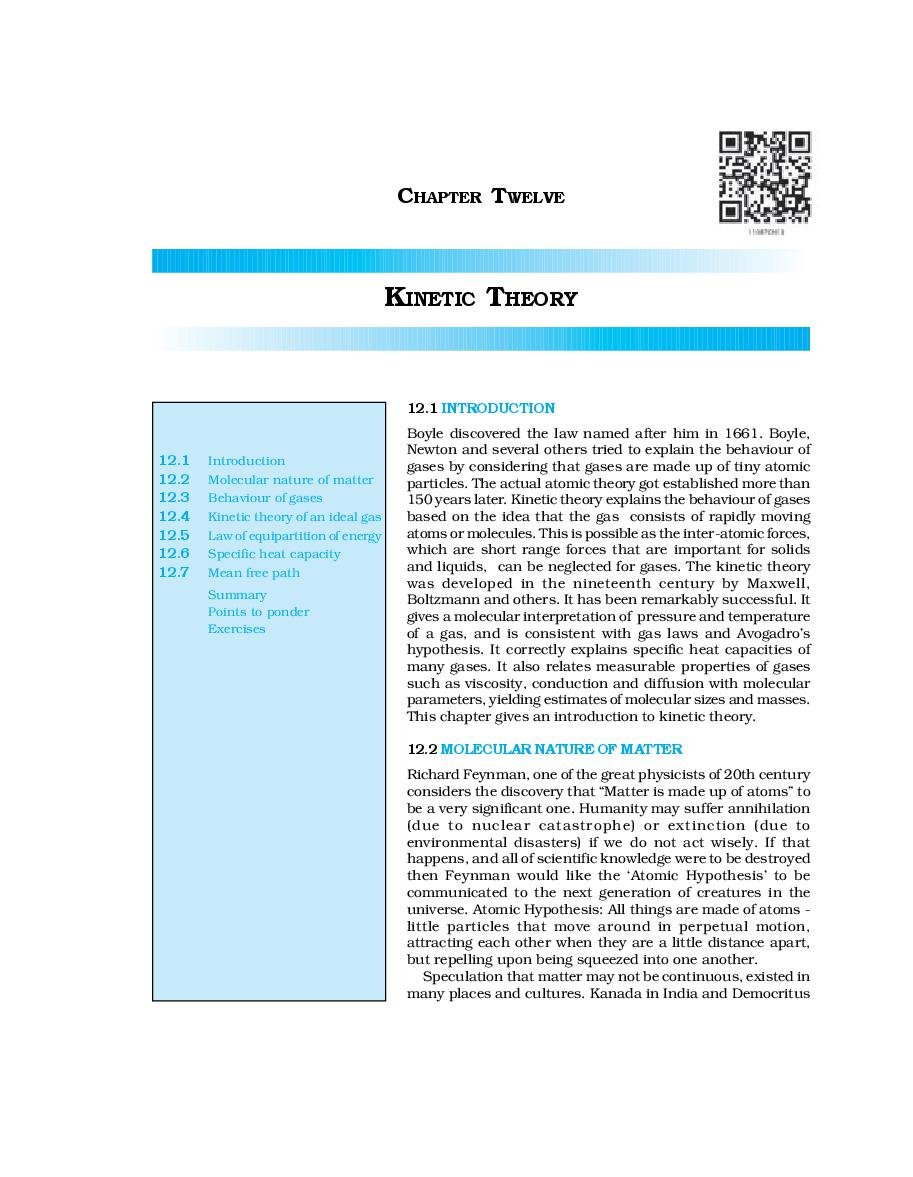
KINETIC THEORY
12.1 INTRODUCTION
Boyle discovered the law named after him in 1661. Boyle,
Newton and several others tried to explain the behaviour of
12.1 Introduction gases by considering that gases are made up of tiny atomic
12.2 Molecular nature of matter particles. The actual atomic theory got established more than
12.3 Behaviour of gases 150 years later. Kinetic theory explains the behaviour of gases
12.4 Kinetic theory of an ideal gas based on the idea that the gas consists of rapidly moving
12.5 Law of equipartition of energy atoms or molecules. This is possible as the inter-atomic forces,
12.6 Specific heat capacity which are short range forces that are important for solids
12.7 Mean free path and liquids, can be neglected for gases. The kinetic theory
was developed in the nineteenth century by Maxwell,
Summary Boltzmann and others. It has been remarkably successful. It
Points to ponder gives a molecular interpretation of pressure and temperature
Exercises of a gas, and is consistent with gas laws and Avogadro’s
hypothesis. It correctly explains specific heat capacities of
many gases. It also relates measurable properties of gases
such as viscosity, conduction and diffusion with molecular
parameters, yielding estimates of molecular sizes and masses.
This chapter gives an introduction to kinetic theory.
12.2 MOLECULAR NATURE OF MATTER
Richard Feynman, one of the great physicists of 20th century
considers the discovery that “Matter is made up of atoms” to
be a very significant one. Humanity may suffer annihilation
(due to nuclear catastrophe) or extinction (due to
environmental disasters) if we do not act wisely. If that
happens, and all of scientific knowledge were to be destroyed
then Feynman would like the ‘Atomic Hypothesis’ to be
communicated to the next generation of creatures in the
universe. Atomic Hypothesis: All things are made of atoms -
little particles that move around in perpetual motion,
attracting each other when they are a little distance apart,
but repelling upon being squeezed into one another.
Speculation that matter may not be continuous, existed in
many places and cultures. Kanada in India and Democritus
Showing the first page only. Download the PDF above for the complete document.
Document Details
| Board / Org | NCERT |
| Exam | Class 11 |
| Type | Books |
| Pages | 15 |
| Updated | 29 Aug 2026 |