NCERT Book Class 11 Physics Chapter 10 Thermal Properties of Matter
Finished viewing? Save it for later —
Download NCERT Book Class 11 Physics Chapter 10 Thermal Properties of Matter (PDF · 24 pages)About NCERT Book Class 11 Physics Chapter 10 Thermal Properties of Matter
NCERT Book Class 11 Physics Chapter 10 Thermal Properties of Matter is available here for free download. Published by NCERT for Class 11, this books can be viewed online or downloaded as a PDF (24 pages). Candidates preparing for Class 11 can use NCERT Book Class 11 Physics Chapter 10 Thermal Properties of Matter to understand the exam pattern, the type of questions asked, and the overall difficulty level.
Frequently Asked Questions
How can I download NCERT Book Class 11 Physics Chapter 10 Thermal Properties of Matter?
Open this page and click the Download button to save NCERT Book Class 11 Physics Chapter 10 Thermal Properties of Matter as a PDF. It is completely free on AglaSem Docs.
Is NCERT Book Class 11 Physics Chapter 10 Thermal Properties of Matter free to download?
Yes. NCERT Book Class 11 Physics Chapter 10 Thermal Properties of Matter can be viewed online and downloaded as a PDF free of cost on AglaSem Docs.
How many pages does NCERT Book Class 11 Physics Chapter 10 Thermal Properties of Matter have?
NCERT Book Class 11 Physics Chapter 10 Thermal Properties of Matter contains 24 pages, which you can read online or download together as a single PDF.
Where can I find more Class 11 study material?
You can find more Class 11 question papers, sample papers, syllabus, and answer keys on AglaSem Docs.
NCERT Book Class 11 Physics Chapter 10 Thermal Properties of Matter – Text
Read the full text of this books below — useful to quickly search, copy and reference the content online without downloading the PDF.
📄 View text version (1 page)
Page 1
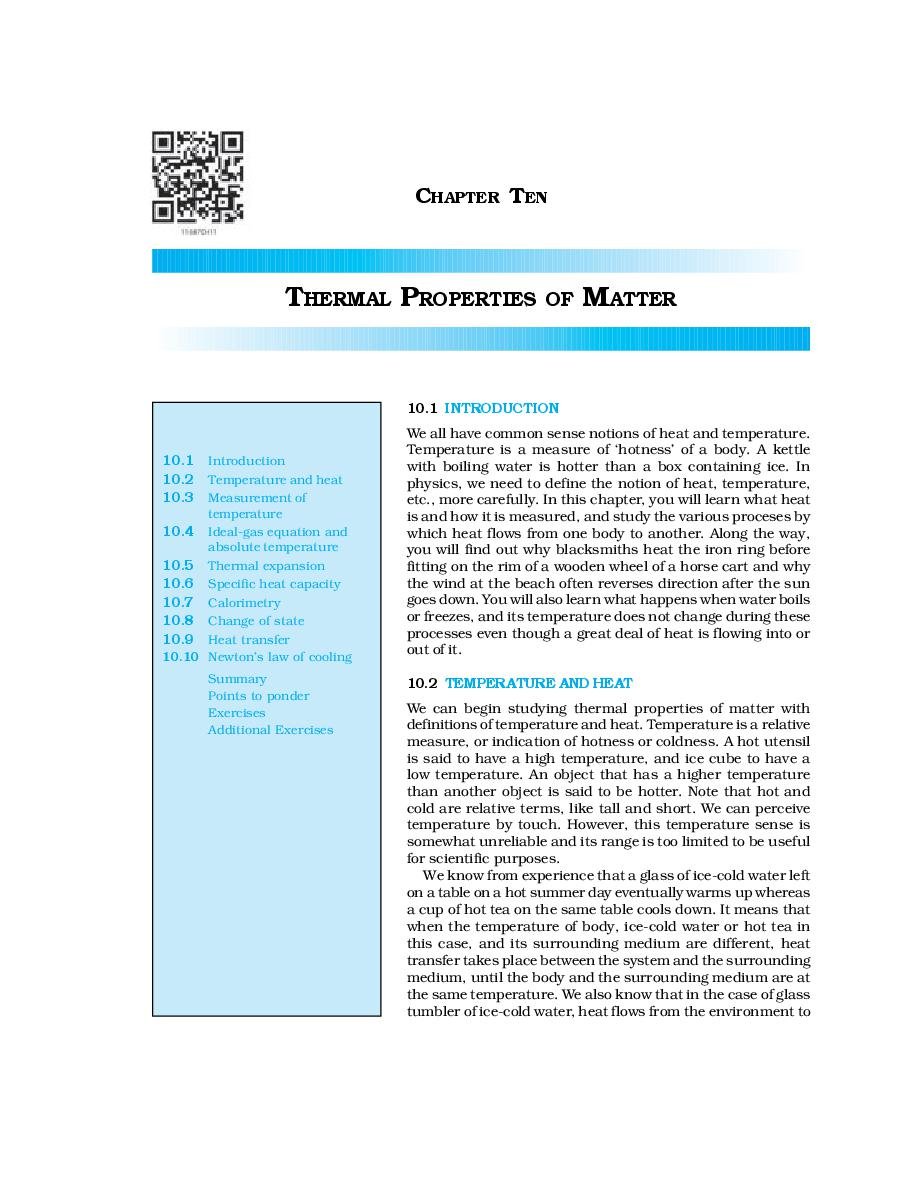
THERMAL PROPERTIES OF MATTER
10.1 INTRODUCTION
We all have common sense notions of heat and temperature.
Temperature is a measure of ‘hotness’ of a body. A kettle
10.1 Introduction with boiling water is hotter than a box containing ice. In
10.2 Temperature and heat physics, we need to define the notion of heat, temperature,
10.3 Measurement of etc., more carefully. In this chapter, you will learn what heat
temperature is and how it is measured, and study the various proceses by
10.4 Ideal-gas equation and which heat flows from one body to another. Along the way,
absolute temperature you will find out why blacksmiths heat the iron ring before
10.5 Thermal expansion fitting on the rim of a wooden wheel of a horse cart and why
10.6 Specific heat capacity the wind at the beach often reverses direction after the sun
10.7 Calorimetry goes down. You will also learn what happens when water boils
10.8 Change of state or freezes, and its temperature does not change during these
10.9 Heat transfer
processes even though a great deal of heat is flowing into or
out of it.
10.10 Newton’s law of cooling
Summary 10.2 TEMPERATURE AND HEAT
Points to ponder
Exercises We can begin studying thermal properties of matter with
Additional Exercises definitions of temperature and heat. Temperature is a relative
measure, or indication of hotness or coldness. A hot utensil
is said to have a high temperature, and ice cube to have a
low temperature. An object that has a higher temperature
than another object is said to be hotter. Note that hot and
cold are relative terms, like tall and short. We can perceive
temperature by touch. However, this temperature sense is
somewhat unreliable and its range is too limited to be useful
for scientific purposes.
We know from experience that a glass of ice-cold water left
on a table on a hot summer day eventually warms up whereas
a cup of hot tea on the same table cools down. It means that
when the temperature of body, ice-cold water or hot tea in
this case, and its surrounding medium are different, heat
transfer takes place between the system and the surrounding
medium, until the body and the surrounding medium are at
the same temperature. We also know that in the case of glass
tumbler of ice-cold water, heat flows from the environment to
Showing the first page only. Download the PDF above for the complete document.
Document Details
| Board / Org | NCERT |
| Exam | Class 11 |
| Type | Books |
| Pages | 24 |
| Updated | 29 Aug 2026 |