AP 10th Class Marking Scheme 2019 Mathematics - Paper 2 (English Medium)
Finished viewing? Save it for later —
Download AP 10th Class Marking Scheme 2019 Mathematics - Paper 2 (English Medium) (PDF · 14 pages)About AP 10th Class Marking Scheme 2019 Mathematics - Paper 2 (English Medium)
AP 10th Class Marking Scheme 2019 Mathematics - Paper 2 (English Medium) is available here for free download. Published by Andhra Pradesh Board for Class 10, this solution can be viewed online or downloaded as a PDF (14 pages). Candidates preparing for Class 10 can use AP 10th Class Marking Scheme 2019 Mathematics - Paper 2 (English Medium) to understand the exam pattern, the type of questions asked, and the overall difficulty level.
Frequently Asked Questions
How can I download AP 10th Class Marking Scheme 2019 Mathematics - Paper 2 (English Medium)?
Open this page and click the Download button to save AP 10th Class Marking Scheme 2019 Mathematics - Paper 2 (English Medium) as a PDF. It is completely free on AglaSem Docs.
Is AP 10th Class Marking Scheme 2019 Mathematics - Paper 2 (English Medium) free to download?
Yes. AP 10th Class Marking Scheme 2019 Mathematics - Paper 2 (English Medium) can be viewed online and downloaded as a PDF free of cost on AglaSem Docs.
How many pages does AP 10th Class Marking Scheme 2019 Mathematics - Paper 2 (English Medium) have?
AP 10th Class Marking Scheme 2019 Mathematics - Paper 2 (English Medium) contains 14 pages, which you can read online or download together as a single PDF.
Where can I find more Class 10 study material?
You can find more Class 10 question papers, sample papers, syllabus, and answer keys on AglaSem Docs.
AP 10th Class Marking Scheme 2019 Mathematics - Paper 2 (English Medium) – Text
Read the full text of this solution below — useful to quickly search, copy and reference the content online without downloading the PDF.
📄 View text version (14 pages)
Page 1
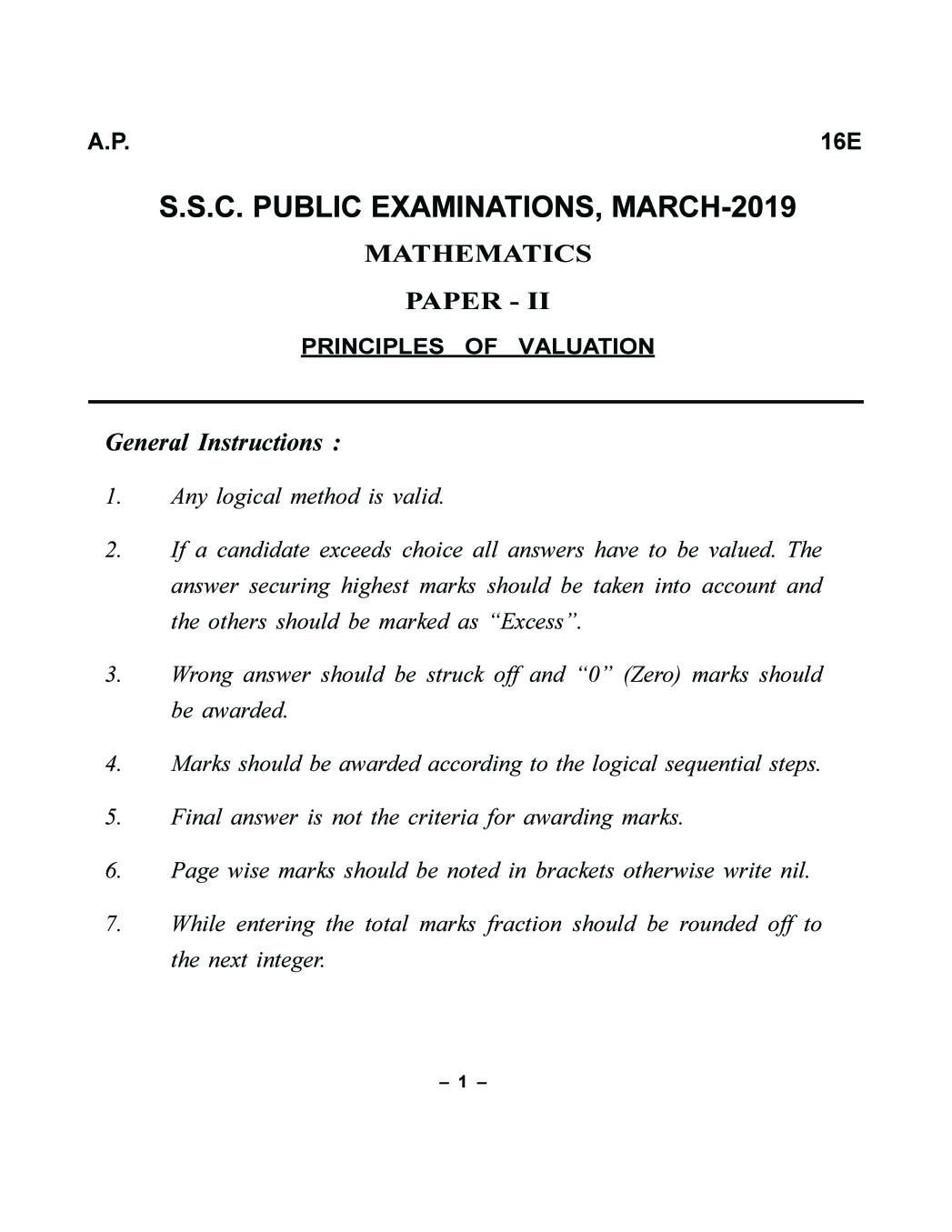
S.S.C. PUBLIC EXAMINATIONS, MARCH-2019
MATHEMATICS
PAPER - II
PRINCIPLES OF VALUATION
General Instructions :
1. Any logical method is valid.
2. If a candidate exceeds choice all answers have to be valued. The
answer securing highest marks should be taken into account and
the others should be marked as Excess.
3. Wrong answer should be struck off and 0 (Zero) marks should
be awarded.
4. Marks should be awarded according to the logical sequential steps.
5. Final answer is not the criteria for awarding marks.
6. Page wise marks should be noted in brackets otherwise write nil.
7. While entering the total marks fraction should be rounded off to
the next integer.
1
Page 2
SECTION - I
A
AL AM
1. = ⎫
LB MC ⎪
⎪ L > M
1
⎬ /2 M
2 5 ⎪ B > C
= ⎪⎭
3 MC
⎫
15 ⎪
MC = = 7.5 cm ⎪
2 ⎬ 1/ M
⎪ 2
AC = AM + MC = 5 + 7.5 = 12.5 cm ⎪⎭
1M
2. sin 15° . sec 75°
1
= sin 15° . sec (90 15)° /2 M
= sin 15° . cosec 15° ⎫
⎪
1 ⎪⎪ 1/ M
= sin 15° . ⎬ 2
sin15°
⎪
⎪
=1 ⎪⎭
1M
2
Page 3
3. Total Number of balls = 3+4=7 ⎫
⎪
Total Number of possible outcomes = 7 ⎪
⎪ 1/ M
⎬ 2
Favourable outcomes that the ball ⎪
⎪
be a red ball = 4 ⎪
⎭
Probability for the ball drawn ⎫
⎪ 1
⎬ /2 M
4 ⎪
to be the red = ⎭
7
1M
Σfi di
4. x=a+
Σf i
fi = Frequency of the class 1/ M
2
di = deviation = xi a 1/ M
2
1M
3
Page 4
SECTION - II
5. Distance between two points = 1/ M
(x1 − x 2 )2 + (y1 − y 2 )2 2
Distance between (x, 1), (1, 5) = 5 ⎫
⎪ 1
⎬ /2 M
2 2
⎡⎣ x − (−1)⎤⎦ + (1 − 5 ) = 5 ⎪
⎭
(x + 1)2 + (−4 )2 = 5 ⎫
⎪
x2 + 1 + 2x + 16 = 25 ⎪⎪ 1
⎬ /2 M
x2 + 2x 8 = 0 ⎪
⎪
⎪
(x + 4) (x 2) = 0 ⎭
x = 4 or x = 2 1/ M
2
2M
6. Radius of the circle (r) = 5 cm
Distance between the centre and
the external point (d) = 13 cm
1
Length of the tangent = d2 − r 2 /2 M
= 1/ M
132 − 52 2
= 169 − 25 ⎫
⎪
= ⎪ 1M
144 ⎬
⎪
= 12 cm ⎪⎭
2M
4
Page 5
7. In right angled triangle ∆ABC C ⎫
⎪
7 AB ⎪
cos A = = x 25 ⎪
25 AC 1
⎬ /2 M
2 2 2 ⎪
x +7 = 25
⎪
x2 = 252 72 = 576 )
A ⎪
x = 24 B 7 ⎭
24 1/ M
sin A = 2
25
25 1
cosec A = /2 M
24
1 1
Observed that cosec A = /2 M
sin A
2M
C
⎫
8. Distance between the observer and ⎪
⎪
the foot of the Tower = 24 m Temple ⎪ 1
Tower (h) ⎬ /2 M
Height of the temple Tower = hm ⎪
) 30° ⎪
θ = 30° A 24 m B ⎪
⎭
BC 1
From ∆ABC, tan 30° = /2 M
AB
1 h 1
3
= /2 M
24
3h = 24 ⎫
⎪
24 ⎪⎪
h = = 8 3m ⎬
3 ⎪ 1
⎪
/2 M
Height of the Tower = 8 3m ⎪⎭
2M
5
Page 6
9. Class frequency mid value ⎫
⎪
interval of the class ⎪
⎪
8-11 4 9.5 ⎪
⎪
⎪
12-15 4 13.5 ⎪
⎪
16-19 5 17.5 ⎪ 2M
⎬
⎪
20-23 13 21.5 ⎪
⎪
⎪
24-27 20 25.5 ⎪
⎪
28-31 14 29.5 ⎪
⎪
32-35 8 33.5 ⎪⎭
2M
SECTION - III
10 a) (sinA + cosecA)2 + (cosA + secA)2
= sin2A + 2 sin A cosecA + cosec2 A + cos2A + 2cosA secA + sec2A 1M
= (sin2A + cos2A) + 2(1) + cosec2A + 2(1) + sec2A 1M
= 1 + 2 + 1 + cot2A + 2 + 1 + tan2A 1M
= 7 + cot2A + tan2A 1M
4M
6
Page 7
(OR)
10 b) CD ⊥ AB and CD = p C
1 ⎫ b a
Area of ∆ABC = ⋅ AB ⋅ CD
⎪ p 1/ M
2
⎬ 2
1 ⎪ A B
= cp (1) ⎭ D
2 → c ←⎯
⎯⎯ ⎯
1
Area of ∆ABC = ⋅ BC ⋅ AC ⎫
2 ⎪ 1
/2 M
⎬
1
= ab (2) ⎪⎭
2
From (1) and (2) equations ⎫
⎪
1 1 ⎪
cp = ab ⎬
2 2 ⎪
⎪⎭
1M
cp = ab
ab
c = p
In ∆ABC right angle is at C.
AB2 = BC2 + AC2 ⎫
c2 = a2 + b2 ⎪
2
⎪
⎛ ab ⎞ ⎪
1M
⎜ ⎟
⎝ p ⎠ = a2 + b2 ⎬
⎪
a 2 b2 ⎪
= a2 + b2 ⎪
p2 ⎭
1 a 2 + b2
= ⎫
P2 a 2 b2 ⎪
⎪
⎪ 1M
1 a2 b2 ⎬
2 = +
p a b 2 2
a b 2 2 ⎪
1 1 1 ⎪
= + ⎪
p2 b 2
a2 ⎭
4M
7
Page 8
11a) Class frequency cumulative
Interval frequency
CI f cf ⎫
⎪
⎪
11-15 3 3 ⎪
⎪
16-20 5 8 ⎪
⎪⎪
21-25 9 17 cf ⎬ 1M
⎪
⎪
l 26-30 12 f 29 ⎪
⎪
31-35 7 36 ⎪
⎪
⎪⎭
36-40 4 40
n 40 ⎫
n = 40, = = 20 ⎪
2 2 ⎬ 1M
l = 25.5, f = 12, cf = 17, h = 5 ⎪⎭
⎛n ⎞
⎜ 2 − cf ⎟
Median = l + ⎜ f ⎟× h 1
/2 M
⎜ ⎟
⎝ ⎠
⎛ 20 − 17 ⎞ 1
= 25.5 + ⎜ 12 ⎟ × 5 /2 M
⎝ ⎠
⎛ 3 ⎞ ⎫
= 25.5 + ⎜ 12 × 5 ⎟ ⎪
⎝ ⎠ ⎪⎪ 1
⎬
/2 M
5
= 25.50 + ⎪
4 ⎪
= 25.50 + 1.25 ⎪⎭
1
= 26.75 /2 M
(OR) 4M
8
Page 9
11 b) Let (4, 6) divides the line segment joining points A(6, 10) and B(3, 8)
in the ratio m1 : m2
⎛ m1x 2 + m 2 x1 m1y2 + m 2 y1 ⎞
(x, y) = ⎜ , ⎟ 1M
⎝ m 1 + m 2 m1 + m 2 ⎠
⎛ 3m1 − 6m 2 −8m1 + 10m 2 ⎞
(4, 6) = ⎜ , ⎟ 1M
⎝ m1 + m 2 m1 + m 2 ⎠
3m1 − 6m 2 −8m1 + 10m 2 1
4 = m1 + m 2 and 6 = m1 + m 2 /2 M
3m1 − 6m 2
4 = ⎫
m1 + m 2 ⎪ 1/ M
⎬ 2
4m1 4m2 = 3m1 6m2 ⎪
⎭
4m1 3m1 = 6m2 + 4m2 ⎫
⎪
7m1 = 2m2 ⎪
⎪
⎪ 1M
⎬
m1 −2 2 ⎪
= = ⎪
m 2 −7 7
⎪
⎪
∴ m1 : m2 = 2:7 ⎭
∴ The point (4, 6) divides the line segment joining the points
A(6, 10) and B(3, 8) in the ratio 2 : 7
4M
9
Page 10
12 a) Possible outcomes when two dice are thrown simultaneously
⎛ (1,1), (1, 2 ), (1,3), (1, 4 ), (1, 5 ), (1, 6 ) ⎞
⎜ ⎟
⎜ (2,1), (2, 2 ), (2,3), (2, 4 ), (2, 5 ), (2, 6 )⎟
⎜ (3,1), (3, 2 ), (3,3), (3, 4 ), (3,5 ), (3, 6 ) ⎟
⎜ ⎟
S = ⎜ (4,1), (4, 2 ), (4,3), (4, 4 ), (4, 5 ), (4, 6 )⎟
⎜ (5,1), (5, 2 ), (5, 3), (5, 4 ), (5,5 ), (5, 6 ) ⎟⎟
⎜
⎜ (6,1), (6, 2 ), (6, 3), (6, 4 ), (6,5 ), (6, 6 )⎟⎠
⎝
Total number of possible outcomes = 6 × 6 = 36 1/ M
2
Favourable outcomes for the sum is 10 = (4, 6), (5, 5), (6, 4)
a) Number of favourable outcomes for sum 10 = 3 ⎫
⎪
Number of favourable outcomes to E ⎪⎪
P(E) = Total number of possible outcomes ⎬
⎪ 1
/2 M
3 1 ⎪
P(sum 10) = = ⎪⎭
36 12
1
b) Number of favourable outcomes of sum ≤ 12 = 36 /2 M
36 1
P(sum ≤ 12) = =1 /2 M
36
c) Favourable outcomes for the sum is prime = (1, 1), (1, 2), (1, 4), (1, 6), (2, 1), (2, 3),
(2, 5), (3, 2), (3, 4), (4, 1), (4, 3), (5, 2), (5, 6), (6, 1), (6, 5)
1
Number of favourable outcomes for the sum is prime = 15 /2 M
15 5 1/ M
P(sum prime) = = 2
36 12
d) Favourable outcomes for the sum is a multiple of 3 = (1, 2), (1, 5), (2, 1), (2, 4),
(3, 3), (3, 6), (4, 2), (4, 5), (5, 1), (5, 4), (6, 3), (6, 6)
Number of favourable outcomes for the sum is a multiple of 3 = 12 1/ M
2
12 1 1/ M
P(sum is multiple of 3) = =
2
36 3
Note : No need to mention all the possible outcomes and favourable outcomes, it is
enough to mention the number.
4M
10
Page 11
(OR) A
12 b) Let the Height of the tree before ⎫
⎪
fall be AB = (x + y) m ⎪
⎪
BD = 6 m ⎪
⎪
ym
⎪
Tree is broken at C. ⎪
⎬
Its top A touches the ground at D ⎪ 1
/2 M
C
⎪
AC = CD = y m. ⎪ 1/ M
⎪ 2
Angle of elevation ∠BDC = 30° ⎪ y
⎪ m
xm
⎪
BC = x m. ⎭
In right triangle ∆CBD ⎫
⎪
BC ⎪ 30° )
tan 30° = ⎪
B 6m D
BD
⎪
1 x ⎪
= ⎬ 1M
3 6 ⎪
⎪
3x = 6 ⎪
6 ⎪
x = m = 2 3 m ⎪⎭
3
BD ⎫
cos 30° = ⎪
CD
⎪
6 ⎪
3 ⎪
= ⎪
2 y ⎬ 1M
⎪
3y = 12 ⎪
⎪
12 ⎪
y = =4 3 m. ⎪⎭
3
Height of the tree before falling down ⎫
= ⎪ 1M
2 3+4 3 ⎬
⎪
= 6 3 m. ⎭
4M
11
Page 12
13 a)
P
P'
6 cm
65° R'
Q R
5.5 cm
S1
S2
S3 X
For the construction of figure award marks as follows :
1. To construct ∆PQR with measurements QR = 5.5 cm, ⎫
⎪ 1M
⎬
∠Q = 65°, PQ = 6 cm. ⎪
⎭
1
2. To draw a ray with an acute angle ∠RQX at Q. /2 M
JJJG 1
3. To locate S1, S2, S3 on QX such that QS1 = S1S2 = S2S3 /2 M
1
4. To join S3R /2 M
1
5. To draw S2R' parallel to S3R and P'R' parallel to PR /2 M
∆PQR ~ ∆P'QR'
6. For writing construction procedure. 1M
4M
12
Page 13
(OR)
13 b)
I. Award marks for construction as follows :
i) To draw a circle with radius 4 cm with centre O 1M
1
ii) To plot a point P such that OP = 6 cm. /2 M
iii) To Bisect OP at M and draw circle with radius OM or MP 1M
1
iv) To draw tangents from intersecting points of two circles. /2 M
II. For writing construction procedure 1M
4M
13
Page 14
PART - B 20 × 1/2 M = 10 M
SECTION - IV
14. A 24. C
15. B 25. B
16. B 26. C
17. C 27. B
18. D 28. B
19. B 29. A
20. B 30. C
21. A 31. B
22. C 32. C
23. B 33. C
14
Document Details
| Board / Org | Andhra Pradesh Board |
| Exam | Class 10 |
| Type | Solution |
| Pages | 14 |
| Updated | 09 Jun 2026 |