AP 10th Class Marking Scheme 2019 Social Studies - Paper 2 (English Medium)
Finished viewing? Save it for later —
Download AP 10th Class Marking Scheme 2019 Social Studies - Paper 2 (English Medium) (PDF · 14 pages)About AP 10th Class Marking Scheme 2019 Social Studies - Paper 2 (English Medium)
AP 10th Class Marking Scheme 2019 Social Studies - Paper 2 (English Medium) is available here for free download. Published by Andhra Pradesh Board for Class 10, this solution can be viewed online or downloaded as a PDF (14 pages). Candidates preparing for Class 10 can use AP 10th Class Marking Scheme 2019 Social Studies - Paper 2 (English Medium) to understand the exam pattern, the type of questions asked, and the overall difficulty level.
Frequently Asked Questions
How can I download AP 10th Class Marking Scheme 2019 Social Studies - Paper 2 (English Medium)?
Open this page and click the Download button to save AP 10th Class Marking Scheme 2019 Social Studies - Paper 2 (English Medium) as a PDF. It is completely free on AglaSem Docs.
Is AP 10th Class Marking Scheme 2019 Social Studies - Paper 2 (English Medium) free to download?
Yes. AP 10th Class Marking Scheme 2019 Social Studies - Paper 2 (English Medium) can be viewed online and downloaded as a PDF free of cost on AglaSem Docs.
How many pages does AP 10th Class Marking Scheme 2019 Social Studies - Paper 2 (English Medium) have?
AP 10th Class Marking Scheme 2019 Social Studies - Paper 2 (English Medium) contains 14 pages, which you can read online or download together as a single PDF.
Where can I find more Class 10 study material?
You can find more Class 10 question papers, sample papers, syllabus, and answer keys on AglaSem Docs.
AP 10th Class Marking Scheme 2019 Social Studies - Paper 2 (English Medium) – Text
Read the full text of this solution below — useful to quickly search, copy and reference the content online without downloading the PDF.
📄 View text version (14 pages)
Page 1
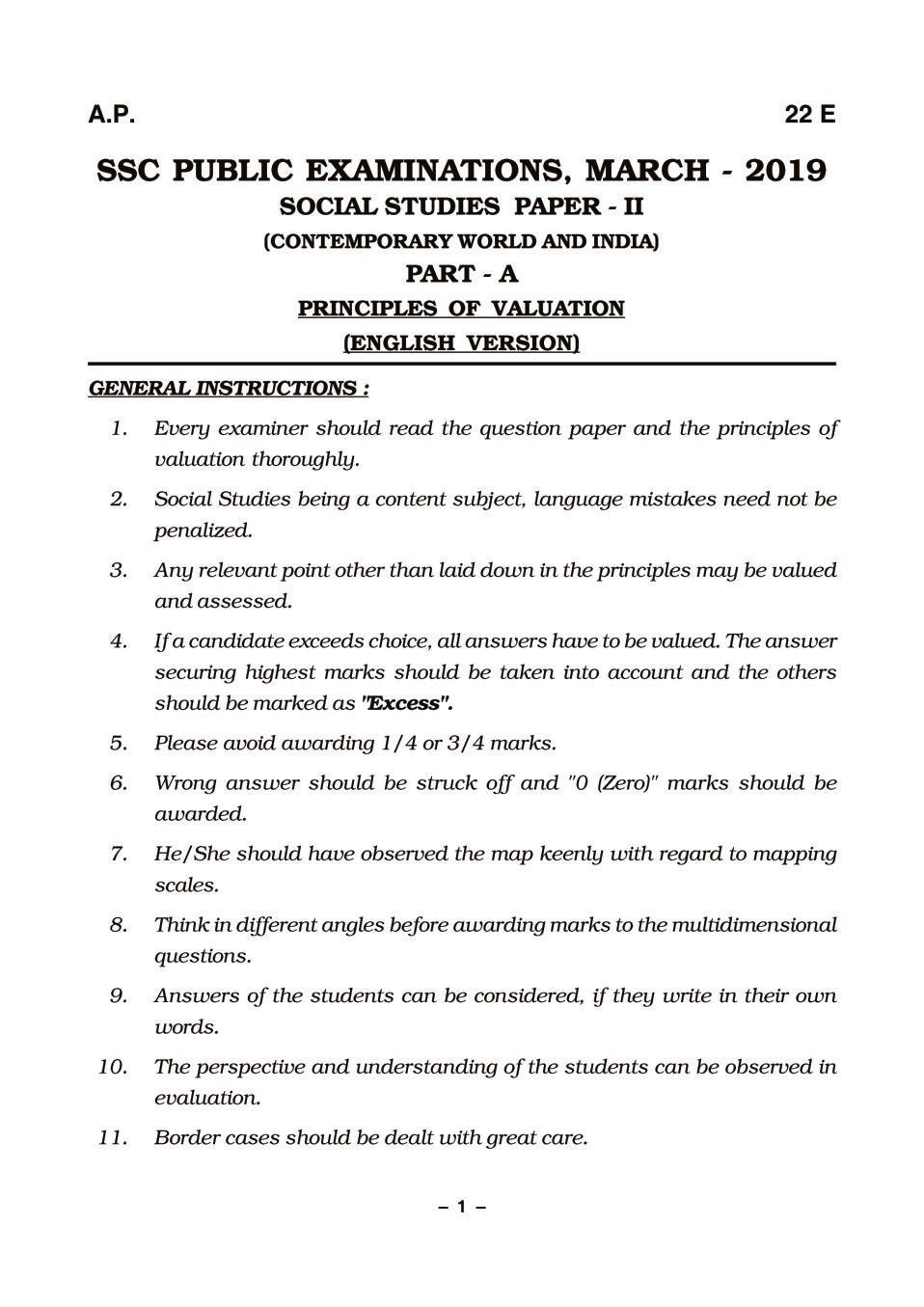
SSC PUBLIC EXAMINATIONS, MARCH - 2019
SOCIAL STUDIES PAPER - II
(CONTEMPORARY WORLD AND INDIA)
PART - A
PRINCIPLES OF VALUATION
(ENGLISH VERSION)
GENERAL INSTRUCTIONS :
1. Every examiner should read the question paper and the principles of
valuation thoroughly.
2. Social Studies being a content subject, language mistakes need not be
penalized.
3. Any relevant point other than laid down in the principles may be valued
and assessed.
4. If a candidate exceeds choice, all answers have to be valued. The answer
securing highest marks should be taken into account and the others
should be marked as "Excess".
5. Please avoid awarding 1/4 or 3/4 marks.
6. Wrong answer should be struck off and "0 (Zero)" marks should be
awarded.
7. He/She should have observed the map keenly with regard to mapping
scales.
8. Think in different angles before awarding marks to the multidimensional
questions.
9. Answers of the students can be considered, if they write in their own
words.
10. The perspective and understanding of the students can be observed in
evaluation.
11. Border cases should be dealt with great care.
– 1 –
Page 2
PART-A
SECTION I
NOTE :
(i) Answer all the following questions.
(ii) Each question carries ONE mark. 4×1=4M
1. The Great Depression :
The Great Depression was the worldwide economic decline which
occurred in 1929. 1M
2. The US intervention in the Vietnam War :
The US intervened in the Vietnam war because it worried about
communists gaining power in Vietnam. 1M
3. Coalition Government :
It is a government that formed by a number of political parties
together when no single party get clear majority. 1M
– 2 –
Page 3
4. Effect of Oil extraction on agriculture in Nigeria :
1) Soils got contaminated.
2) Crops were destroyed.
3) Ground water got contaminated.
4) Aqua culture was destroyed
Note : 1) Any one point. 1M
2) Any other relevant and correct point should also be
SECTION - II
NOTE :
(i) Answer all the following questions.
(ii) Each question carries TWO marks. 5 × 2 = 10 M
5. Welfare measures in India :
1) Public Distribution System
2) Mid Day Meal Scheme in Government Schools.
– 3 –
Page 4
3) Housing schemes. Eg : PAY etc.
4) MNREGA
5) Old age pensions.
6) Health schemes. Eg : Ayushman Bharat, NTR Vydyaseva etc.
Note : 1) Any four schemes. 4×½=2M
2) Any other relevant and correct scheme should also be
6. 1) The country that colonised Nigeria :
Britain 1M
2) South-eastern Nigeria was dominated by :
Igbo 1M
2M
– 4 –
Page 5
7. Bar-Graph
Constitutional Amendments
2M
Years
8. Suggestions to protect the world peace :
1) All the countries should maintain friendly relations with each
other.
2) Every country should respect the sovereignty and dignity of
other countries.
3) Instead of opting wars, countries have to solve the problems
through peaceful discussions.
Note : 1) Any two suggestions. 2×1=2M
2) Any other relevant and correct suggestion also to be
– 5 –
Page 6
9. Consequences of economic liberalisation in India :
1) Foreign goods entered the Indian markets.
2) Many factories closed down due to influx of cheap foreign goods.
3) Indian Industrialists were forced to compete with global
manufacturers.
4) Foreign companies came and setup industries in India.
5) Many subsidies were cutdown.
6) Privatisation expanded.
Note : 1) Any four points. 4 × 1/2 = 2 M
2) Any other relevant and correct point should also be
SECTION - III
NOTE : (i) Answer all the following questions.
(ii) Each question carries FOUR marks.
10. A) Nation States and Nationalism :
1) The idealogy of nationalism was a positive impulse. This
idealogy was the foundation of modern nation states and
the force behind the unification of Germany and Italy.
– 6 –
Page 7
2) But this idealogy could also be used to create pride in oneself
and hatred against neighbours.
th
3) This hatred was slowly building up in the 19 century among
the European States.
4) Fascism in Italy and Nazism in Germany were the other forms
of aggressive Nationalism in destructive mode. People of these
nations were mobilised against other nations of Europe.
Note : 1) Each point carries 1 mark. 4×1=4M
2) Any other relevant and correct point should also be
(OR)
– 7 –
Page 8
10. B) Basic Principles of the Indian Constitution :
Any constitution reflects the ideas and ideals of the people of
that nation. Eventhough it has permanent value, it reflects the
conditions of the period in which it is framed. Our Indian
constitution is also framed in the same way with the following
basic principles.
1) Sovereignty
2) Fundamental rights
3) Directive principles
4) Parliamentary system of government
5) Secularism
6) Socialism
7) Federalism
8) Independent Judiciary
4M
Note : Any other related and correct answer should also be
– 8 –
Page 9
11. A) America was very cruel in the Vietnam War :
1) The US was brutal in fighting with Vietnam.
2) The usage of Agent orange, the most dreadful chemical
weapon was an apt example for its brutality.
3) Agent orange was a deadly poision that kills plants.
4) Some 11 million gallons of this chemical was sprayed from
planes by the US forces.
5) Their plan was to destroy forests and fields so that they
would easily kill the Vietnamese.
6) It has been affecting the people there till today.
7) It has been causing cancer and brain damage in children.
8) The tonnage of bombs used in Vietnam exceeded that were
used throughout the Second World War.
Note : 1) Any four points. 4×1=4M
2) Any other relevant and correct comment should also be
(OR)
– 9 –
Page 10
11. B) R.T.I. Act :
1) Yes, I agree with the given statement.
2) R TI Act would help in improving and monitering the work of
the governments.
3) Transparency in administration increases.
4) This can help to prevent corruption.
5) This makes governments accountable to common, individual
citizens also.
Note : 1) Any four points. 4×1=4M
2) Any other relevant and correct point should also be
– 10 –
Page 11
12. A)
a) The country ruled by Manchu dynasty :
China 1M
b) Founder of Modern China :
Sun Yat-sen 1M
c) Environment and Human Rights activist in Nigeria :
Ken-Saro Wiwa 1M
d) Pan Africanism :
Pan Africanism is an idea which promotes the unity of all
African people irrespective of country or tribe. 1M
4M
(OR)
– 11 –
Page 12
12. B)
1) The year in which Military expenditure
was high :
1914 1M
a Reason :
The beginning of World War I. 1M
2) Impact of armaments race on the progress of a country :
There will be adverse effect on the development of the country.
The execution of Welfare Schemes would be difficult. 2M
Note : Any other suitable and relevant points should also be
4M
– 12 –
Page 13
13. A & B
– 13 –
Page 14
PART - B
SECTION - IV
Choose the correct Answers.
Each question carries 1/2 Mark. 20 × ½ = 10 M
Q.No. Answer Q.No. Answer
14. B 24. C
15. A 25. B
16. B 26. D
17. C 27. A
18. B 28. A
19. B 29. C
20. C 30. C
21. D 31. D
22. A 32. D
23. D 33. A
– 14 –
Document Details
| Board / Org | Andhra Pradesh Board |
| Exam | Class 10 |
| Type | Solution |
| Pages | 14 |
| Updated | 09 Jun 2026 |