AP 10th Class Marking Scheme 2019 Social Studies - Paper 1 (English Medium)
Finished viewing? Save it for later —
Download AP 10th Class Marking Scheme 2019 Social Studies - Paper 1 (English Medium) (PDF · 14 pages)About AP 10th Class Marking Scheme 2019 Social Studies - Paper 1 (English Medium)
AP 10th Class Marking Scheme 2019 Social Studies - Paper 1 (English Medium) is available here for free download. Published by Andhra Pradesh Board for Class 10, this solution can be viewed online or downloaded as a PDF (14 pages). Candidates preparing for Class 10 can use AP 10th Class Marking Scheme 2019 Social Studies - Paper 1 (English Medium) to understand the exam pattern, the type of questions asked, and the overall difficulty level.
Frequently Asked Questions
How can I download AP 10th Class Marking Scheme 2019 Social Studies - Paper 1 (English Medium)?
Open this page and click the Download button to save AP 10th Class Marking Scheme 2019 Social Studies - Paper 1 (English Medium) as a PDF. It is completely free on AglaSem Docs.
Is AP 10th Class Marking Scheme 2019 Social Studies - Paper 1 (English Medium) free to download?
Yes. AP 10th Class Marking Scheme 2019 Social Studies - Paper 1 (English Medium) can be viewed online and downloaded as a PDF free of cost on AglaSem Docs.
How many pages does AP 10th Class Marking Scheme 2019 Social Studies - Paper 1 (English Medium) have?
AP 10th Class Marking Scheme 2019 Social Studies - Paper 1 (English Medium) contains 14 pages, which you can read online or download together as a single PDF.
Where can I find more Class 10 study material?
You can find more Class 10 question papers, sample papers, syllabus, and answer keys on AglaSem Docs.
AP 10th Class Marking Scheme 2019 Social Studies - Paper 1 (English Medium) – Text
Read the full text of this solution below — useful to quickly search, copy and reference the content online without downloading the PDF.
📄 View text version (14 pages)
Page 1
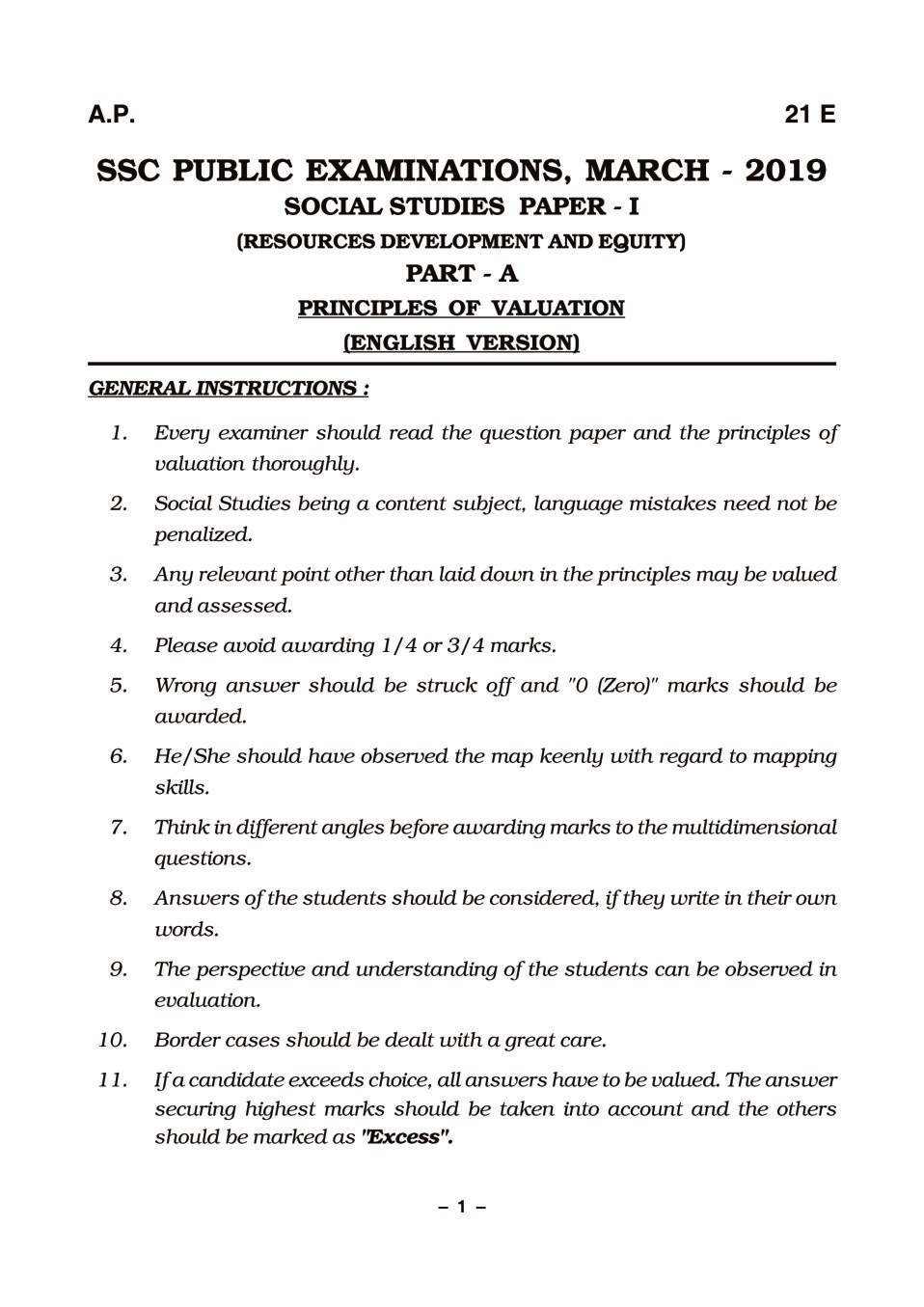
SSC PUBLIC EXAMINATIONS, MARCH - 2019
SOCIAL STUDIES PAPER - I
(RESOURCES DEVELOPMENT AND EQUITY)
PART - A
PRINCIPLES OF VALUATION
(ENGLISH VERSION)
GENERAL INSTRUCTIONS :
1. Every examiner should read the question paper and the principles of
valuation thoroughly.
2. Social Studies being a content subject, language mistakes need not be
penalized.
3. Any relevant point other than laid down in the principles may be valued
and assessed.
4. Please avoid awarding 1/4 or 3/4 marks.
5. Wrong answer should be struck off and "0 (Zero)" marks should be
awarded.
6. He/She should have observed the map keenly with regard to mapping
skills.
7. Think in different angles before awarding marks to the multidimensional
questions.
8. Answers of the students should be considered, if they write in their own
words.
9. The perspective and understanding of the students can be observed in
evaluation.
10. Border cases should be dealt with a great care.
11. If a candidate exceeds choice, all answers have to be valued. The answer
securing highest marks should be taken into account and the others
should be marked as "Excess".
– 1 –
Page 2
PART-A
SECTION I
NOTE :
(i) Write answers to the FOUR questions.
(ii) Each question carries ONE mark. 4×1=4M
1. Slogans on environmental protection.
1) Save the environment - save the world.
2) Better environment - better tomorrow.
Note : 1) 1/2 mark for each slogan. 2 × 1/2 = 1 M
2) Any other relevant slogan can also be considered.
2. W.T.O :
World Trade Organisation. 1M
– 2 –
Page 3
3. Example for conflicting things in the context of
development :
To get more electricity, industrialists may want more dams. But
the tribals may oppose this as their lands may submerge. 1M
Note: Any other relevant and correct example should also be
considered.
4. Arab Spring :
Uprooting of dictators in West Asian and North African countries
like Tunisia and Egypt was called Arab Spring. 1M
SECTION - II
NOTE :
FIVE questions.
(i) Write answers to the
(ii) Each question carries TWO marks. 5 × 2 = 10 M
5. Difference between environment's 'Source Function' and 'Sink
Function'.
Environment's Source Function :
The potential of the environment to provide the natrual
resources. 1M
Environment's Sink Function :
The potential of the environment to absorb and render harmless
waste and pollution. 1M
2M
Note : Any other relevant and correct difference should also be
considered.
– 3 –
Page 4
6. There was no drinking water shortage in Hiware Bazar. Reasons
for this :
1) Ban on felling trees.
2) Ban on free grazing.
3) Ban on bore wells for irrigation.
4) Ban on water -intensive crops.
Note : 1) 1/2 mark for each reason. 4 × 1/2 = 2 M
2) Any other relevant and correct reason should also be
considered.
7. Observations :
1) Given graph explains about the social background of short term
migrants in India in 2007-08.
2) In short term migrants, SCs are 19%.
3) In short term migrants, STs are 23%.
4) In short term migrants, OBCs are 40%.
5) Most of the short term migrants belong to OBC.
Note : 1) Any four observations. 4 × 1/2 = 2 M
2) Any other relevant and correct observation should
also be considered.
– 4 –
Page 5
8. a) The distance between the eastern and western most points
in India : 2933 km 1M
b) Countries that share their boundaries with India :
1) Pakistan
2) China
3) Nepal
4) Bhutan
5) Myanmar
6) Bangladesh
7) Sri Lanka
8) Maldives
Note : 1) Any two countries. 2 × 1/2 = 1 M
2) Any other countries that share boundaries with India
should also be considered, even if they are not shown
in the given map.
– 5 –
Page 6
9. The effect of rapid extraction of natural resources on future
development prospects.
1) Rapid extraction of natural resources is like cutting the branch
which we are sitting on.
2) It would adversely affect the future development prospects.
3) If the non-renewable resources are used up once, then there
would be no life for future generations.
4) Development at the cost of depletion of natural resources is
infact the disguised destruction.
Note : 1) Any two points. 2×1=2M
2) Any other relevant and correct point should also be
considered.
– 6 –
Page 7
SECTION - III
NOTE : (i) Answer all the following questions. 4 × 4 = 16 M
(ii) Each question carries FOUR marks.
(iii) Each question has internal choice.
10. A) The differences between the Eastern Ghats and the Western
Ghats.
Eastern Ghats Western Ghats
1) Parallel to the east coast. 1) Parallel to the west coast.
2) Discontinuous ranges. 2) Continuous ranges.
3) Lower in elevation. 3) Higher in elevation.
4) Away from the sea coast. 4) Nearer to the sea coast.
5) Source of small and 5) Source of big rivers.
medium rivers.
6) Older than Western Ghats. 6) Younger than Eastern Ghats.
7) Highest peak is Aroya 7) Highest Peak is
Konda Anaimudi.
8) Does not cause much 8) Cause heavy rainfall.
rainfall.
Note : 1) Any four differences. 4×1=4M
2) Any other relevant and correct difference should also
be considered.
– 7 –
Page 8
(OR)
10. B) Public Distribution System - Food Security :
A. 1) Ration shops are the important means for the people to access
food grains in India.
2) All the poor people get food grains at low prices through ration
shops.
3) Even among the poor, the very poor have different entitlements.
Eg : The Anthyodaya Cardholders are entitled to get 35 kgs of
food grains per month per family.
4) 75% of people in rural areas and 50% of people in urban areas
have the right to buy food grains from public distribution system.
Thus PDS plays a key role in assuring food security for the
people.
Note : 1) Any four points. 4×1=4M
2) Any other relevant and correct point should also be
considered.
– 8 –
Page 9
11. A) Effect of globalisation - Comment :
1) The impact of globalisation in India is not uniform.
2) Some large Indian companies have grown as Multi National
Companies.
3) On the other hand, most of the small producers are not happy
with the globalisation.
4) Many of their factories closed down due to influx of cheap foreign
goods.
5) If the globalisation is not fair, economic inequalities will increase
in the society.
6) Now, the important question before us is 'how to make
globalisation more fair' ?
Note : 1) Each point carries 1 Mark. 4×1=4M
2) Any other suitable and relevant comment should also
be considered.
– 9 –
Page 10
11. B) Organised sector is better than unorganised sector-
opinion :
1) Yes, I think the organised sector is better than the unorganised
sector.
2) In organised sector, the terms of employment are regular and
people have assured work.
3) Government rules and regulations are followed.
4) Workers in this sector enjoy security of employment.
5) They work only for a fixed number of hours.
6) They get benefits like paid leave, payment during holidays,
provident fund etc...
Note : 1) Each point carries 1 Mark. 4×1=4M
2) Any other relevant and correct opinion should be
considered.
– 10 –
Page 11
12. A)
1) Srilanka 1M
2) Per capita income ⎫
⎪
⎪
⎪
⎪
Life expectancy at birth ⎪
⎪⎪
⎬ 1M
⎪
Average years of schooling ⎪
⎪
⎪
⎪
Expected years of schooling. ⎪
⎪⎭
3) Nepal 1M
4) a) Health facilities should be improved. ⎫
⎪
⎪
b) Quality education should be
⎪⎪
⎬
2 × 1/2 = 1 M
⎪
⎪
⎪
provided. ⎪⎭
Note : Any other suitable suggestion should also be
considered.
Total 4M
– 11 –
Page 12
12. B)
3M
Observation:
1) Least sex ratio was recorded in 1991.
2) Highest sex ratio was recorded in 1951.
3) As per 2011 census, sex ratio in India is 943.
Any one observation 1M
4M
Note : Any other relevant and correct observation should also be
considered.
– 12 –
Page 13
13. A & B
– 13 –
Page 14
PART - B
SECTION - IV
I. Choose the correct Answers 20 × ½ = 10 M
14. A 24. B
15. A 25. B
16. B 26. A
17. A 27. D
18. B 28. B
19. A 29. B
20. A 30. C
21. A 31. B
22. C 32. C
23. C 33. D
– 14 –
Document Details
| Board / Org | Andhra Pradesh Board |
| Exam | Class 10 |
| Type | Solution |
| Pages | 14 |
| Updated | 09 Jun 2026 |