NCERT Book Class 11 Physics Chapter 3 Motion in a Plane
Finished viewing? Save it for later —
Download NCERT Book Class 11 Physics Chapter 3 Motion in a Plane (PDF · 22 pages)About NCERT Book Class 11 Physics Chapter 3 Motion in a Plane
NCERT Book Class 11 Physics Chapter 3 Motion in a Plane is available here for free download. Published by NCERT for Class 11, this books can be viewed online or downloaded as a PDF (22 pages). Candidates preparing for Class 11 can use NCERT Book Class 11 Physics Chapter 3 Motion in a Plane to understand the exam pattern, the type of questions asked, and the overall difficulty level.
Frequently Asked Questions
How can I download NCERT Book Class 11 Physics Chapter 3 Motion in a Plane?
Open this page and click the Download button to save NCERT Book Class 11 Physics Chapter 3 Motion in a Plane as a PDF. It is completely free on AglaSem Docs.
Is NCERT Book Class 11 Physics Chapter 3 Motion in a Plane free to download?
Yes. NCERT Book Class 11 Physics Chapter 3 Motion in a Plane can be viewed online and downloaded as a PDF free of cost on AglaSem Docs.
How many pages does NCERT Book Class 11 Physics Chapter 3 Motion in a Plane have?
NCERT Book Class 11 Physics Chapter 3 Motion in a Plane contains 22 pages, which you can read online or download together as a single PDF.
Where can I find more Class 11 study material?
You can find more Class 11 question papers, sample papers, syllabus, and answer keys on AglaSem Docs.
NCERT Book Class 11 Physics Chapter 3 Motion in a Plane – Text
Read the full text of this books below — useful to quickly search, copy and reference the content online without downloading the PDF.
📄 View text version (1 page)
Page 1
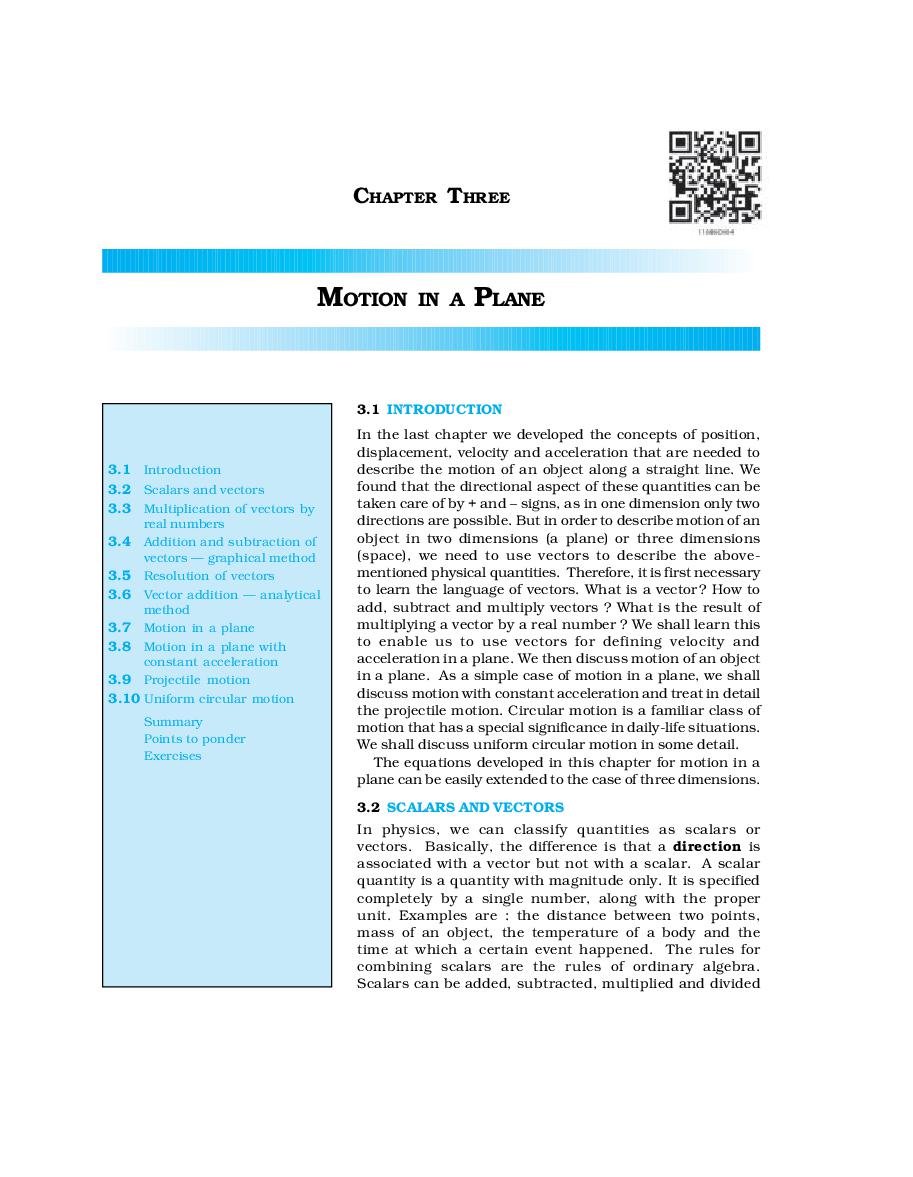
MOTION IN A PLANE
3.1 INTRODUCTION
In the last chapter we developed the concepts of position,
displacement, velocity and acceleration that are needed to
3.1 Introduction describe the motion of an object along a straight line. We
3.2 Scalars and vectors found that the directional aspect of these quantities can be
3.3 Multiplication of vectors by taken care of by + and – signs, as in one dimension only two
real numbers directions are possible. But in order to describe motion of an
3.4 Addition and subtraction of object in two dimensions (a plane) or three dimensions
vectors — graphical method (space), we need to use vectors to describe the above-
3.5 Resolution of vectors mentioned physical quantities. Therefore, it is first necessary
3.6 Vector addition — analytical to learn the language of vectors. What is a vector ? How to
method add, subtract and multiply vectors ? What is the result of
3.7 Motion in a plane multiplying a vector by a real number ? We shall learn this
3.8 Motion in a plane with to enable us to use vectors for defining velocity and
constant acceleration acceleration in a plane. We then discuss motion of an object
3.9 Projectile motion in a plane. As a simple case of motion in a plane, we shall
3.10 Uniform circular motion discuss motion with constant acceleration and treat in detail
the projectile motion. Circular motion is a familiar class of
Summary motion that has a special significance in daily-life situations.
Points to ponder We shall discuss uniform circular motion in some detail.
Exercises
The equations developed in this chapter for motion in a
plane can be easily extended to the case of three dimensions.
3.2 SCALARS AND VECTORS
In physics, we can classify quantities as scalars or
vectors. Basically, the difference is that a direction is
associated with a vector but not with a scalar. A scalar
quantity is a quantity with magnitude only. It is specified
completely by a single number, along with the proper
unit. Examples are : the distance between two points,
mass of an object, the temperature of a body and the
time at which a certain event happened. The rules for
combining scalars are the rules of ordinary algebra.
Scalars can be added, subtracted, multiplied and divided
Showing the first page only. Download the PDF above for the complete document.
Document Details
| Board / Org | NCERT |
| Exam | Class 11 |
| Type | Books |
| Pages | 22 |
| Updated | 29 Aug 2026 |